“Swaledale in the Yorkshire Dales National Park is statistically the worst location in England with three Hen Harriers confirmed to have been illegally killed and 14 more satellite-tagged birds suspiciously disappearing between 2016-2023“
and
“The most significant declines in Hen Harrier breeding in England in 2024 were observed in the North Pennines and the Yorkshire Dales, with decreases of 67% and 73% respectively, compared to 2023. Both regions are intensively managed for grouse shooting and have been linked to several confirmed and suspected Hen Harrier persecution incidents in recent years“.
Indeed, the forthcoming trial of a gamekeeper alleged to have been involved in the conspiracy to shoot and kill an untagged Hen Harrier relates to an incident filmed on a grouse moor in the Yorkshire Dales last October (as featured on Channel 4 News, here).
And yet another satellite-tagged Hen Harrier ‘disappeared’ in suspicious circumstances on a grouse moor in the Yorkshire Dales National Park earlier this year (here).
The Yorkshire Dales National Park was also where satellite-tagged Hen Harrier ‘Free’ was found dead. His post-mortem concluded that his ‘leg had been torn off while he was alive, and that the cause of death was the head being twisted and pulled off while the body was held tightly’ (see here).
Hen Harrier ‘Free’ during post-mortem examination. Photo via Natural England.
With all this recent history in mind, I’ve been following the progress of the development of the Yorkshire Dales National Park Authority’s latest five-year Management Plan (2025-2030), due to be published shortly.
As part of the Management Plan process, the Management Plan Partnership undertook a six-week public consultation process in January 2024 to find out what issues were important to residents and visitors.
A total of 1,106 responses were received, of which 50% were from people indicating they live and/or work in the National Park; 16% were from younger people (18-34); and 4% were from people identifying as being from non-white ethnic groups.
The online questionnaire identified 18 issues from which people were asked to rank their top six.
The top two priorities selected by respondents were:
Help nature to recover by creating, restoring and connecting important habitats;
Protect rare and threatened species, including ending illegal persecution of birds of prey.
That’s quite a significant result! And this isn’t the first time that the public has identified illegal raptor persecution as a major concern in this National Park (see here).
A second Management Plan consultation ran in January 2025 based on 40 proposed draft objectives, which included:
C6. Support implementation of the national Wildlife Crime Strategy to end the illegal killing and disturbance of birds of prey and other wildlife by 2028.
This proposed draft objective for tackling the illegal killing of birds of prey in the Yorkshire Dales National Park is quite different from the objective listed in the previous Management Plan (2019-2024) which was this:
C5. Work with moorland managers and other key stakeholders to devise and implement a local approach to end illegal persecution of raptors, including independent and scientifically robust monitoring, and co-ordinated hen harrier nest and winter roost site protection.
The latest draft objective for tackling illegal raptor persecution seems to have shifted significantly, away from the so-called ‘Bird of Prey Partnership’ approach, established in 2020 with representatives from the grouse-shooting industry, the raptor conservation community, RSPB, Natural England, Police, the Yorkshire Dales National Park Authority and the Nidderdale AONB (now renamed Nidderdale National Landscape) Authority.
That ‘partnership’, just like the similar one set up in the Peak District National Park and on which the Yorkshire Dales/Nidderdale Partnership was based, has failed miserably (e.g. see here) and has seen two of the ‘partners’ walk away (RSPB here, Northern England Raptor Forum here), both citing familiar complaints about the behaviour of the grouse moor lobby group, The Moorland Association.
The latest draft objective in the 2025-2030 Management Plan doesn’t mention the ‘partnership’ at all and instead focuses on ‘supporting the implementation of the [Police] National Wildlife Crime Strategy‘, which includes the national wildlife crime priorities of which raptor persecution is a key focus.
Does that mean a formal end to the Yorkshire Dales/Nidderdale Bird of Prey Partnership?
A short article appeared on the BBC News website on 5 August 2025 as follows:
The disappearance of two tracked pine martens is being treated as suspicious, police said.
Cumbria Police and South Cumbria Pine Marten Recovery Project are appealing for information to help trace the rare animals that were released near Grizedale Forest earlier this year.
It is believed one of the mammals has two dependent kits.
Tracking them is part of a University of Cumbria-led scheme to reintroduce the species to south Cumbria and the loss “could compromise their recovery”, Cumbria Police said.
Pine martens are protected under the Wildlife and Countryside Act 1981 and it is an offence to intentionally or recklessly kill, injure or take them.
It is also an offence to damage their habitat.
Anyone with information has been urged to contact the force.
The South Cumbria Pine Marten Recovery Project is a dynamic regional partnership led by the University of Cumbria and includes the Upper Duddon Landscape Recovery Project led by the University of Leeds, Natural England, Cumbria Wildlife Trust, Lake District National Park Authority, Forestry England and the Graythwaite Estate.
The Project is translocating Pine Martens from Scotland to south Cumbria as part of a coordinated national recovery scheme for this species.
Released Pine Martens are fitted with VHF-radio collars for tracking, and the team also uses camera traps, den boxes and scat analysis for monitoring.
Stand by to read the usual excuses for these suspicious disappearances, from the usual suspects – windfarms, faulty tags, it’s all a set up by anti-game-shooting extremists, the Pine Martens never existed in the first place, tag data serve no other purpose than to entrap gamekeepers etc etc.
Journalist, broadcaster and Sunday Times columnist Rod Liddle will be hosting a 20 minute piece on grouse shooting during his Saturday morning show on Times Radio, from 12.05hrs.
Rod Liddle is no stranger to this topic – having previously written, “Every way you look at this industry…its existence is an absurdity” (see here).
About his forthcoming show this Saturday, he writes:
“This Saturday at 1205 on my Times Radio programme I’m devoting 20 mins to reclaiming the grouse moors, with contributions from rewilders and conservationists and a confrontation with the Moorland Association. Lots of opportunity to comment“.
His Saturday morning show airs from 10am – 1pm and can be listened to on DAB radio (channel 11A) or the Times Radio App, or through a smart speaker, or online (where catch-up is available).
UPDATE 12 August 2025: The grouse shooting industry’s grotesque distortion of reality laid bare on Rod Liddle’s radio show (here)
An article criticising moorland mismanagement, including grouse moor management, has been published by Yorkshire Bylines.
It’s been authored by David Robson, a retired biology teacher and a member of Wharfedale Naturalists, who says the title was influenced by ‘two essential reads’ – Inglorious by Mark Avery and The Lie of the Land by Guy Shrubsole.
To read the article in full, visit the Yorkshire Bylines website here.
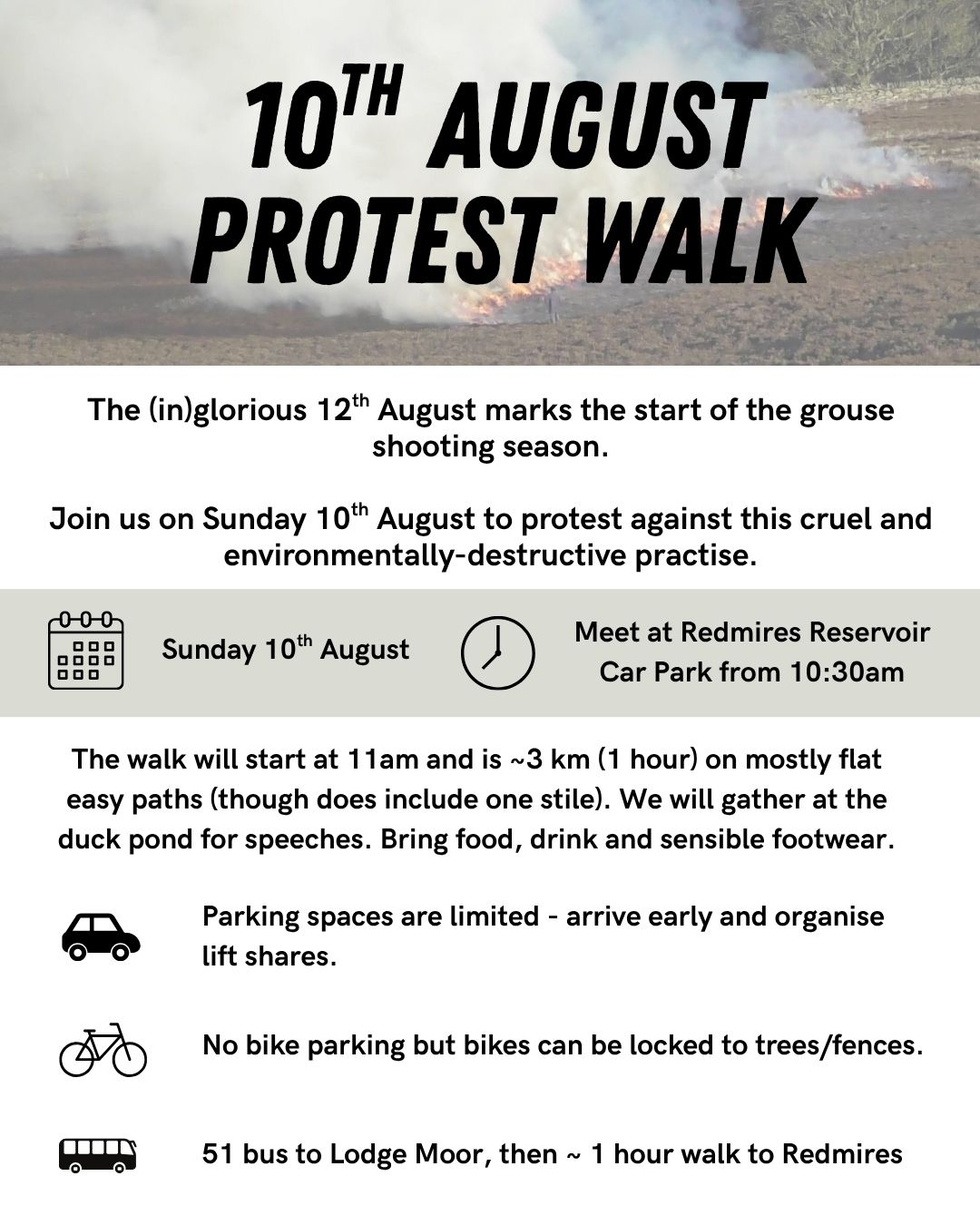
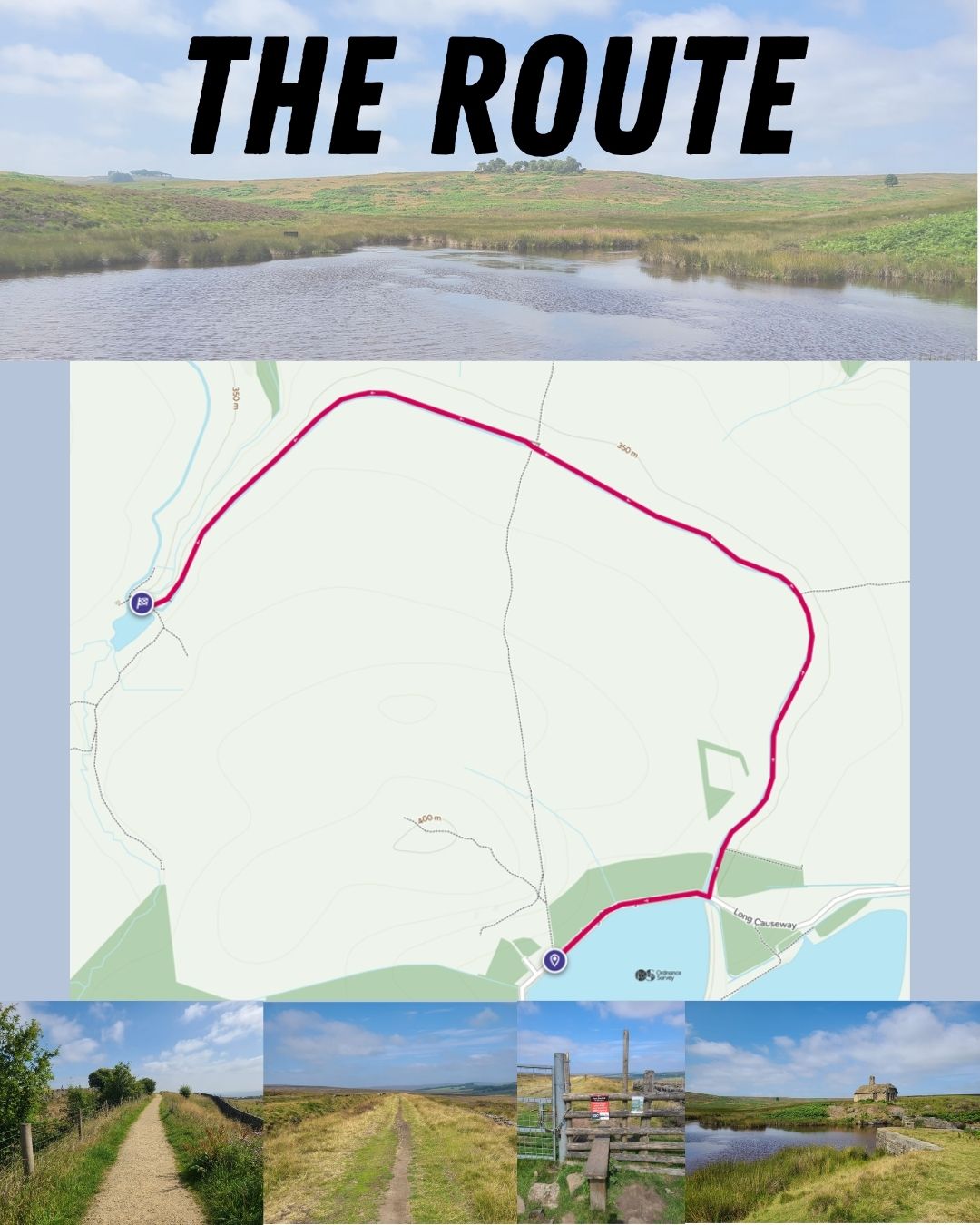
There’ll be an anti- grouse shooting protest walk taking place in the Peak District National Park this coming Sunday (10 August 2025), timed to coincide with the start of the grouse-shooting season on the Inglorious 12th.
Organised by the new campaign group Reclaim Our Moors (see here for earlier blog on them), the one-hour walk, followed by speeches, will take place on Moscar Estate, meeting at 10.30am, and is open to anyone who wants to join in.
Here are the details from Reclaim Our Moors:
If you want to contact the group directly, contact details can be found here.
Shooting estates in England are failing to declare millions of Pheasants that are being bred, reared and released in to the countryside.
That’s the finding of new research published yesterday by environmental campaigner and best-selling author Guy Shrubsole (see here for his excellent blog).
According to official statistics that Guy obtained via FoI from the Animal Plant & Health Agency (APHA), only 25.9 million Pheasants are accounted for on the latest ‘Poultry Register’. We know (from the shooting industry itself) that approximately 50 million Pheasants are released annually, which means approximately 20 million Pheasants are currently unaccounted for.
Guy didn’t ask for the equivalent data on Red-legged Partridges or Mallards.
It’s a legal requirement for anyone who keeps 50 or more birds, including Pheasants and Red-legged Partridges, to register with APHA.
Registration is mandatory because it helps APHA to manage the spread of diseases such as Avian Influenza. For example, during disease outbreaks APHA can quickly contact registered keepers to provide information and guidance on biosecurity updates. By knowing where birds are kept, APHA can also implement targeted surveillance and control measures to prevent the spread of diseases, especially Highly Pathogenic Avian Influenza (HPAI).
Pheasant feeder (with spilled food = massive biosecurity hazard) at a Pheasant release pen in Worcestershire. Photo by Ruth Tingay
Failure to register with APHA is an offence, but it’s been going on for years. In a Natural England and BASC-commissioned report published in 2020, registration compliance (for Pheasant keepers) was estimated to be less than 25%.
This low level of compliance on registering Pheasants will come as no surprise to anyone who pays attention to the behaviour of the UK gamebird shooting industry. It’s not an industry celebrated for adherence to the law on many issues, including the illegal killing of birds of prey, the illegal setting and use of traps, the illegal possession, storage and use of pesticides and poisons, the illegal burning of deep peat moorland, the illegal use of toxic lead ammunition to kill waterfowl etc etc.
Given the current high risk of Avian Flu in England (another case was reported yesterday nr Yeovil, Somerset (ref AIV 2025/54), and BASC’s idiotic legal challenge against the Government’s restrictions on gamebird releases on or close to Special Protection Areas, restrictions that were imposed specifically to help prevent the spread of HPAI to these important conservation sites (see here for yesterday’s blog on this), this level of non-compliance, with millions of unregistered ‘Ghost Pheasants’ roaming the countryside, could lead to a catastrophic HPAI epidemic as we head into the shooting season.
Four more outbreaks of Highly Pathogenic Avian Influenza (HPAI, also known colloquially as Bird Flu) have been confirmed across the UK in recent days, including on a pheasant shoot in Exmoor National Park.
And yet in a staggering display of arrogance and selfishness, the British Association for Shooting & Conservation (BASC) has now launched yet another legal challenge against the Government’s restrictions on gamebird releases; restrictions that have been put in place precisely to protect wild birds of high conservation value from the risk of being exposed to highly contagious HPAI.
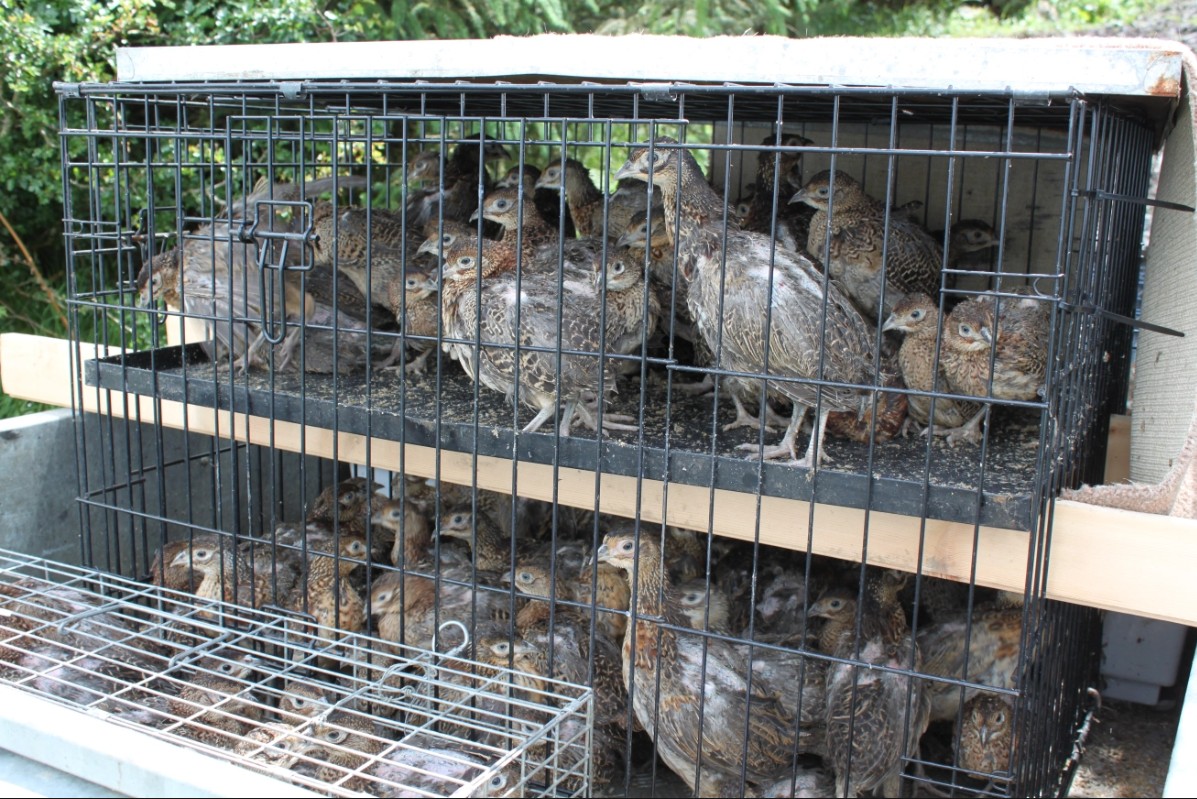
Captive-bred non-native Pheasant poults, in pretty poor condition, being transported for release in the UK countryside. Photo by Ruth Tingay
You may remember earlier this month I blogged about how Defra had sensibly withdrawn General Licence 45 in March this year – this is the licence under which restricted numbers of gamebirds (Pheasants and Red-legged Partridges) can be released on or within 500m of Special Protection Areas – which was withdrawn due to Defra’s legitimate concerns about the spread of HPAI.
Instead of being able to use GL45 this year, Natural England said that gamebird shoots could apply for individual licences to release gamebirds on or close to SPAs, but that only some licences would be permitted and only with a delayed release date for the poults, whereas licences for many other SPAs would be unlikely to be issued at all (see earlier blog here).
BASC reacted with predictable fury and self-righteousness and said it had started legal proceedings against Defra’s decision to withdraw GL45, claiming that Defra had “not provided the formal reason behind it or published a detailed decision-making document“.
However, after some investigative work by Wild Justice’s legal team at Leigh Day, it turns out that BASC has apparently dropped that legal challenge, presumably because it didn’t have a hope in hell of going anywhere given the current high risk of HPAI.
At the time of that legal challenge, there were at least five outbreaks of Highly Pathogenic Avian Influenza in West Yorkshire, County Durham, North Yorkshire, Wrexham, and Pembrokeshire.
Since then, four more outbreaks of HPAI have been confirmed in July 2025, resulting in the mass culling of captive poultry and in one case, 2,500 Pheasant poults on a Pheasant shoot near Winsford in Exmoor National Park, with subsequent 3km Protection Zones and 10km Surveillance Zones being put in place which prevents, amongst other things, the release of gamebirds for shooting. The locations of the latest outbreaks are:
25 July 2025 – near Tow Law, Bishop Auckland, County Durham (ref: AIV2025/50).
28 July 2025 – near Winsford, Somerset (Exmoor National Park) (ref: AV2025/51). Centred on grid ref: SS9162536026.
30 July 2025 – near Bampton, Devon (ref: AIV2025/52). Centred on grid ref: SS9793221915.
30 July 2025 – Snetterton, near Breckland, Norfolk (ref: AIV2025/53). Centred on grid ref: TM0069490799.
Against this backdrop of disease outbreaks, it’s really hard to comprehend BASC’s decision to start legal proceedings for a second challenge against gamebird restrictions, but that is exactly what it’s done.
This time the challenge is against Natural England and here is BASC’s reasoning, published on its website yesterday:
BASC hasn’t published the contents of its Pre-Action Protocol (PAP) letter to Natural England so it’s difficult to evaluate the strength/weakness of its legal arguments at this stage. Although any focus on the ridiculous ever-changing status of ‘wild/captive’ Pheasants (see the conundrum of Schrodinger’s Pheasant) is welcome as far as I’m concerned, and especially the interpretation of ‘released’, because even if it’s judged that gamebirds aren’t considered ‘released’ until they’re formally set free from the release pens, they still pose a considerable risk to spreading HPAI when vast release pens aren’t covered off to prevent wild birds flying in and out of them (nor Pheasants for that matter).
A large pheasant release pen on the left of the picture, with a low boundary fence providing full access for wild birds and/or Pheasants to enter and leave the pen at will. Photo: Ruth Tingay
Whatever the technical legal arguments though, it seems that the ‘rights’ of BASC members to release millions of non-native gamebirds for so-called ‘sport’ shooting is of more importance to BASC than reducing the risk of spreading a highly contagious disease and protecting the health of wild birds of high conservation value. It doesn’t look good, does it?
Wild Justice has today written to BASC and BASC’s lawyers to state its intention to apply to be an ‘interested party’ in this case if it proceeds to an application for judicial review. General Licences 43 and 45 were introduced by Defra as a direct consequence of a legal challenge by Wild Justice between 2019 and 2021 to regulate the previously uncontrolled annual release of approximately 60 million non-native gamebirds (Pheasants and Red-legged Partridges) into the countryside, so any potential new legal challenge against those General Licences is of significant interest to Wild Justice. Sign up for Wild Justice’s free newsletter to keep updated.
UPDATE 1 August 2025: Shooting estates failing to declare millions of Pheasants – could spell disaster in Avian Influenza epidemic (here).
BRITAIN’S RAREST BREEDING BIRD RAISED FOUR YOUNGSTERS AT SECRET LOCATION
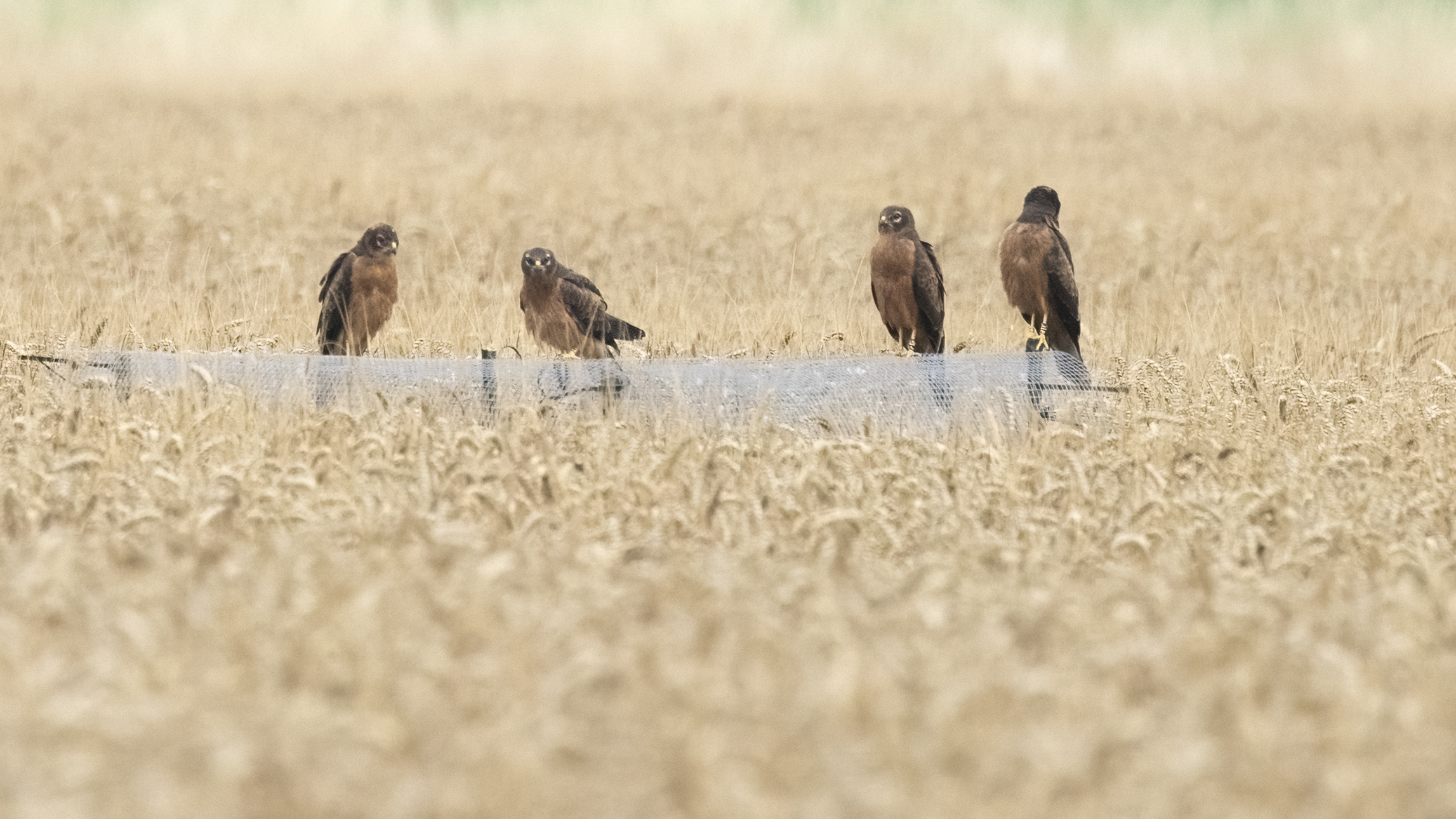
A pair of Montagu’s Harriers, Britain’s rarest breeding bird, have successfully raised four youngsters at a secret location in England
The pair of birds which arrived in May have been closely monitored by the RSPB who, working closely with a farmer, installed a protection fence around the nest in early July
This week the four chicks have made their first flights, delighting all involved
Montagu’s Harrier juveniles, 25 July 2025. Photo by RSPB
The Montagu’s Harrier is Britain’s rarest breeding bird species and hasn’t successfully nested in the UK since 2019. After a high of nine successful nests in 2011, its population has sadly dwindled – with it being officially placed on the Red List in 2021. But this year a pair arrived in the UK and have gone on to delight conservationists by raising four healthy youngsters.
Montagu’s Harriers winter in Africa and return to Europe to nest, often in agricultural fields, in particular winter sown cereals in the UK, and can return to the same nesting areas each year. Their previous strongholds in Spain and France are diminishing due to intensification of agriculture and earlier harvest dates, as well as wetter summers. Many nests across Europe are protected from predators by the installation of small metal fences by conservationists, volunteers and farmers.
The birds were first seen at the now secret location in May, raising hopes they would breed. Their nest was located in June by the licensed use of a drone and then closely monitored by a volunteer birdwatcher and the RSPB. Photographs indicated that both adult birds were ringed, remarkably the male being a chick from a UK nest in 2015 and the female from a nest in France in 2023.
Male Montagu’s Harrier. Photo by RSPB
As soon as their behaviour indicated that youngsters had hatched, the RSPB entered the field under licence and installed a small protective fence to safeguard the nest from ground predators. The chicks were then ringed in mid-July and last week made their first flights, delighting all involved.
Mark Thomas, Montagu’s Harrier species lead at RSPB, said:“We are overjoyed that a pair have returned, they managed to find each other and through the close protection of a dedicated farmer and the RSPB have managed to raise four youngsters. What’s even more remarkable is that we have been able to work out that the male was colour-ringed by the RSPB as a chick in a UK nest in 2015 and that his partner is wearing a ring indicating she is from France. This Anglo-French alliance could just be the springboard needed to save this species in Britain.”
The farmer, who cannot be named in order to protect the location, said: “It’s fantastic to have these amazing birds on the farm and a just reward for the extensive conservation work we have been undertaking for decades.”
It is now hoped the birds will all migrate safely, and the adults will return in 2026.
ENDS
Channel 4 News has also covered this story with an article and a video, here.
What excellent news this is – kudos to the farmer and the RSPB for protecting the nest. Let’s hope the adults and four juveniles manage to get out of England successfully, unlike some of their predecessors (e.g. see here, here and here).
I’m sure many of you remember the young, satellite-tagged Golden Eagle called ‘Merrick’.
She was part of the South Scotland Golden Eagle Project, a lottery-funded conservation initiative which translocated young Golden Eagles from various sites across north Scotland to boost the tiny remnants of the Golden Eagle breeding population in south Scotland that had previously been decimated by illegal persecution and become isolated by geographic barriers.
Camera trap photo of golden eagle Merrick in 2022, from South Scotland Golden Eagle Project
Merrick hit the headlines in autumn 2023 when her satellite tag suddenly and inexplicitly stopped transmitting on 12 October 2023 at a location in the area to the west of Fountainhall, between Heriot and Stow, close to the boundary of the Raeshaw Estate in the Scottish Borders.
Police Scotland issued an appeal for information in November 2023 in which they stated they believed Merrick ‘had come to harm’ but no further details were provided at that time.
We didn’t hear anything more for another six months but then in May 2024 the South Scotland Golden Eagle Project issued a press release that revealed evidence from the crime scene that led Police Scotland to believe that Merrick had been ‘shot and killed’, whilst she was sleeping in a tree, and that someone had then ‘removed her body and destroyed her satellite tag’ (see here).
The criminal who shot Merrick as she slept has not been arrested or charged. It’s the same old story – insufficient evidence to identify an individual and so whoever killed this eagle escapes without consequence, just like every single other eagle-killer in Scotland. Not one of them has ever been convicted.
New legislation was supposed to address this failure with the introduction of the Wildlife Management and Muirburn (Scotland) Act, whereby a grouse-shooting licence could be revoked in circumstances where, on the balance of probability, a crime was considered to have taken place where land was being managed for grouse shooting, but at the time of Merrick’s shooting this legislation wasn’t yet in place and can’t be applied retrospectively.
That just leaves a General Licence restriction as the only potential ‘sanction’ in this case, not that I’d describe a GL restriction as an effective sanction, for reasons that have been explored previously on this blog (e.g. here and here). Nevertheless, it’s still something.
As we head towards the two-year anniversary of Merrick being shot and killed, I wanted to know whether NatureScot had considered a General Licence restriction in this case, either on the land where Merrick was believed to have been shot or on land nearby. It was rumoured that this was under consideration over a year ago in June/July 2024 but I hadn’t seen any restriction notice so in June this year, I submitted an FoI to NatureScot to find out what the status was.
NatureScot replied to me on 21 July 2025 with this:
‘We have received an information package from Police Scotland to this case, and it is currently under consideration‘.
Tellingly, NatureScot didn’t elaborate on how long this decision had been under consideration so I’ve since submitted a further FoI request to find out on what date NatureScot received the ‘evidence package’ from Police Scotland which would allow NatureScot to begin its deliberations.
I await the response with interest.
UPDATE 11 August 2025: 16 months (& waiting) for NatureScot to make decision on General Licence restriction relating to ‘shooting and killing’ of sleeping Golden Eagle called Merrick (here).
The following is a guest blog by someone who wishes to remain anonymous, although I know their identity.
DID SCOTTISH FORESTRY KNOW STOBO HOPE WAS ‘NAPALMED’ WITH HERBICIDE LONG BEFORE ‘NEW INFORMATION CAME TO LIGHT’?
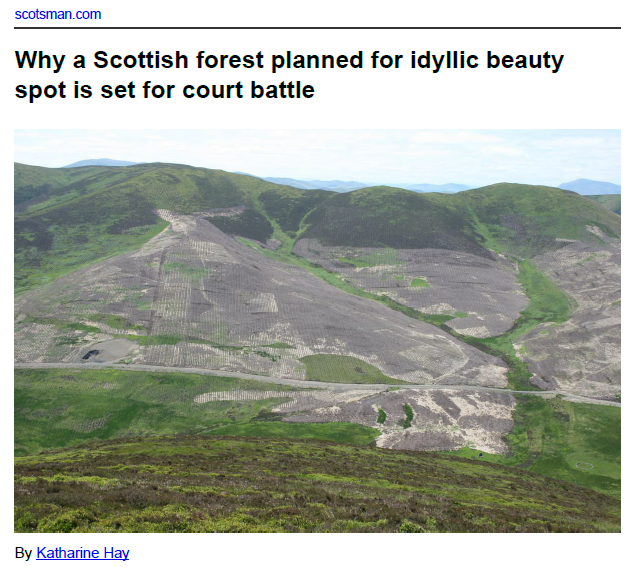
Herbicide damage at Stobo Hope, July 2024. A short video of Stobo Hope may be seen here (credit – Ted Leeming).
Readers may be familiar with Stobo Hope, a haunt of golden eagles and other raptors, with a notable black grouse lek. A Sitka spruce plantation with a £2 million taxpayer funded grant was approved by regulator Scottish Forestry. Wild Justice and Raptor Persecution UK readers greatly helped a community crowdfunder (see here) to fund a successful judicial review to challenge approval of this forestry scheme without an Environmental Impact Assessment (EIA) (see here).
Forestry work started in February 2024, the petition for judicial review was lodged in April 2024, and in September 2024, Scottish Forestry conceded the judicial review, with the £2 million grant cancelled all work since halted by court order. However, this was not before more than 750,000 conifers had been planted, and vast areas sprayed with herbicide, killing semi-natural grasslands and heather moorland. Drone footage (credit – Ted Leeming) from July 2024 (see here) shows the extent of a damaged, but otherwise beautiful landscape. An excellent blog by Parkswatch (see here) casts doubt on Scottish Forestry’s tree carbon sequestration calculations for Stobo, which seem to be tilted in favour of the landowner, the Forestry Carbon Sequestration Fund, based in the tax haven of Guernsey (see here) and managed by True North Real Asset Partners (see here).
Parkswatch has just published another excellent blog on Stobo, questioning the environmental credentials of Sitka spruce plantations across Scotland – see here).
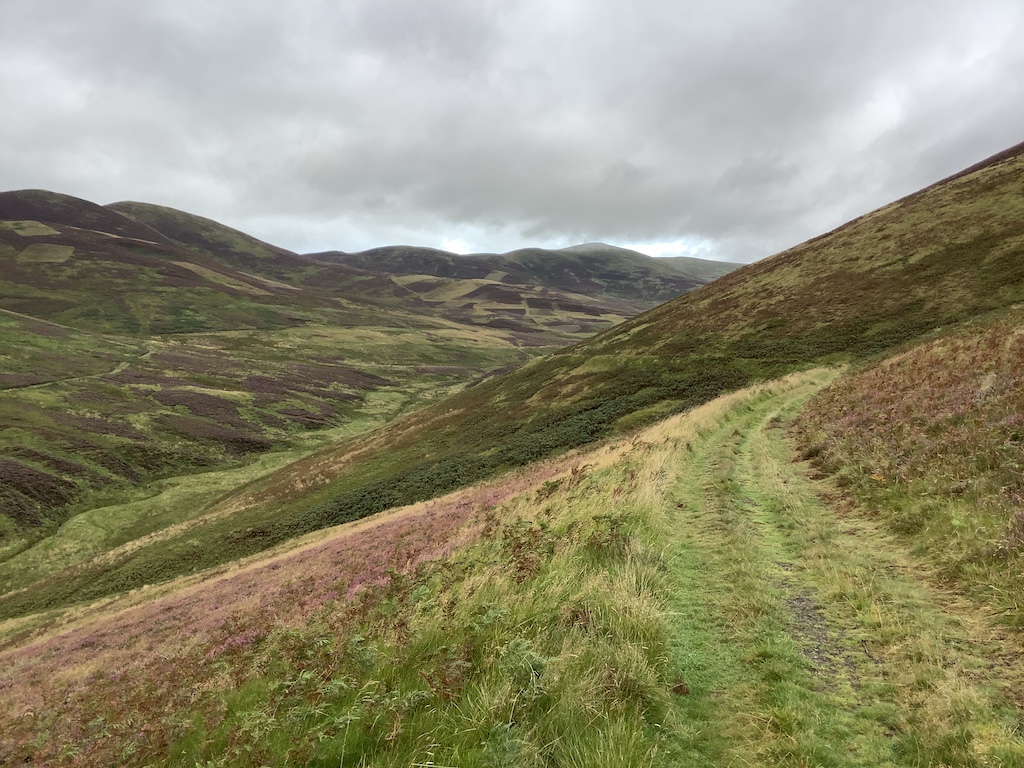
The John Buchan Way from Peebles to Broughton; lengths of this walk could become forestry tracks.
Why did Scottish Forestry concede the judicial review?
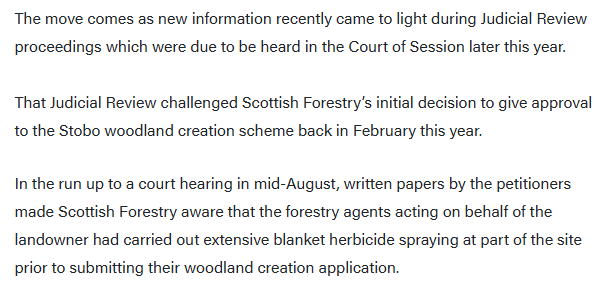
The petitioners for judicial review, the Stobo Residents Action Group, had argued that Scottish Forestry had not addressed NatureScot’s concerns about the forestry scheme’s impact on the designated National Scenic Area. On 10 September 2024, Scottish Forestry issued a news release (see here) stating work at Stobo was halted ‘as new information came to light during judicial review proceedings’. It stated ‘in the run up to the court hearing in mid-August [2024], written papers by the petitioners made Scottish Forestry aware that forestry agents acting on behalf of the landowner had carried out extensive blanket spraying’:
Extract from 10 September 2024 news release.
Scottish Forestry stated ‘a material piece of information was not disclosed by the applicant’ in reference to the herbicide spraying.
Further extract from 10 September 2024 news release.
Scottish Forestry responded to a press enquiry on 11 September 2024, which had asked why the herbicide damage was not noticed sooner (it had occurred in August 2023, five months before the forestry grant contract was signed), stating ‘our staff visited the site in early summer and even then there were no clear signs of the extent of the herbicide spraying’. The response also states ‘it was only when the petitioners presented their papers in [mid-] August [2024] we were made aware of the herbicide spraying’.
Extract from 11 September 2024 statement.
A hearing for judicial review in the Court of Session had been scheduled for autumn 2024, and the petitioners now had sufficient funds to go to court. It appears Scottish Forestry were increasingly concerned about their reputation if it was determined they had acted unlawfully in determining no Environmental Impact Assessment (EIA) was required.
The ‘non-disclosure’ of blanket use of herbicide by the forestry agents, then called Pryor and Rickett Silviculture (see here) – now called Euroforest Silviculture – seems to have resulted in the contract and £2 million grant being cancelled, the same legal remedies sought by the petitioners for the now conceded judicial review.
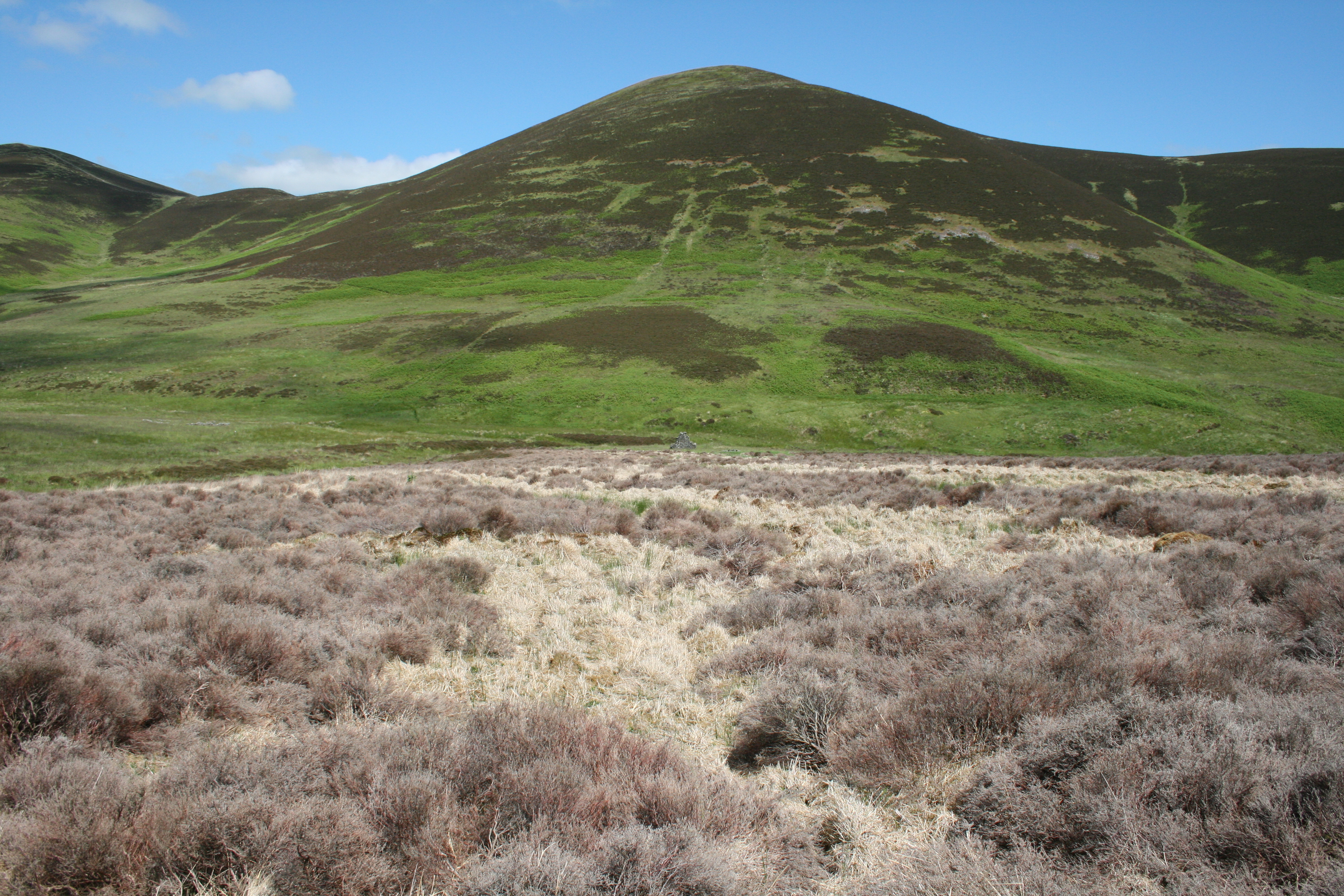
Stobo Hopehead, with Hammer Head, before herbicide application.
Do Scottish Forestry ever consider environmental impacts?
There seems to be scepticism that Scottish Forestry consider environmental impacts of proposed forestry schemes. Readers may recall Pryor and Rickett Silviculture were advised by the Game and Wildlife Trust (GWCT) to carry out predator control to supposedly help black grouse at Stobo (see here), despite NatureScot’s GWCT-commissioned research demonstrating large areas of contiguous moorland are required for black grouse (this moorland would disappear from places such as Stobo if the tree planting was permitted). Pryor and Rickett Silviculture subsequently applied to NatureScot for a licence to hunt foxes with nineteen dogs (see here), but NatureScot rejected this application, echoing the RSPB’s prediction of black grouse extinction. Scottish Forestry claimed in January 2024 that the proposed Stobo forestry scheme would not have a significant negative impact on black grouse, biodiversity, landscape, or any other environmental features, ruling out an EIA.
It is understood that the Stobo woodland creation scheme is undergoing an EIA, with Scottish Forestry expected to reach a decision on whether to allow this scheme to go ahead.
Intervention by the Scottish information Commissioner
The Scottish Information Commissioner found Scottish Forestry had failed to comply with the Environmental Information (Scotland) Regulations 2004, resulting in previously withheld information about Stobo now being released, some of which is provided in this blog.
As a reminder to readers, Scottish Forestry stated: ‘it was only when the petitioners presented their papers in [mid-] August [2024] we were made aware of the herbicide spraying’.
Communications after mid-August 2024; after this time Scottish Forestry were ‘made aware’ of blanket herbicide spraying
An email dated 21 August 2024 from Scottish Forestry’s Director of Operational Delivery, Brendan Callaghan, states:
‘it transpires that the forestry agents sprayed a very large area with herbicide before they screened the project. We weren’t aware they had done this’……’There has also been a delay in showing up as dead, but now it certainly does and looks dreadful. This wasn’t visible when [redacted] and I visited in May/June’.
‘[redacted] and I are going tonight to check they haven’t enhanced the photos. This could easily reach the media’.
Email from Scottish Forestry staff member, 21 August 2024.
An email dated 23 August from the Director of Operational Delivery states it ‘now looks like someone has napalmed the site’:
Email from Scottish Forestry staff member, 23 August 2024.
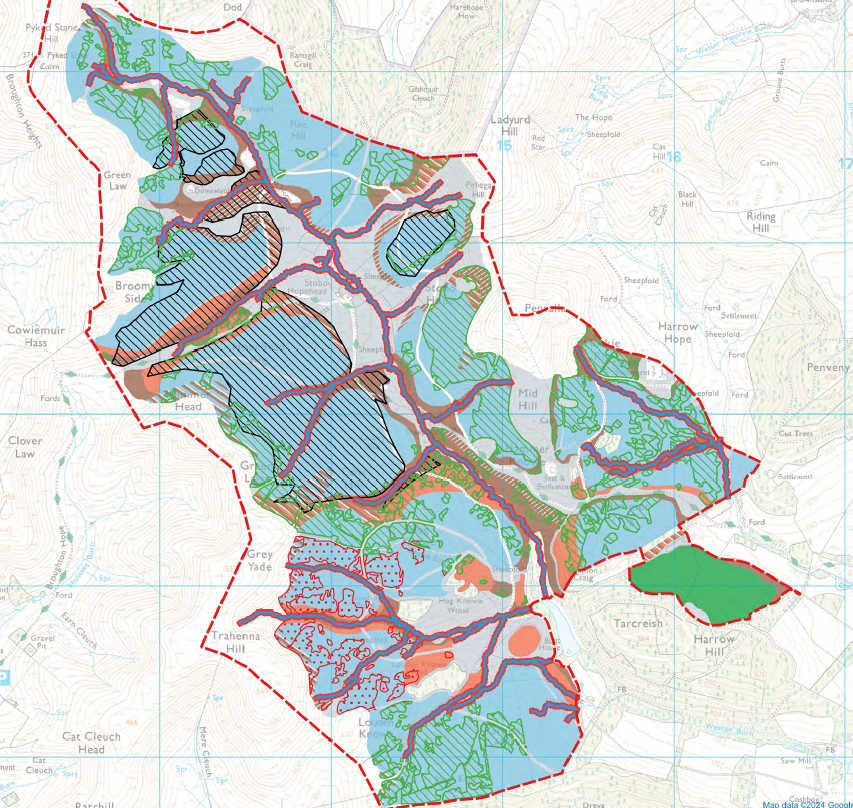
A ‘Heather Control Map’ by Euroforest Silviculture shows the area sprayed with herbicide in August 2023 (diagonal black lines), and the area to be sprayed with herbicide in 2024 (diagonal green lines).
Heather control plan superimposed on planting plan for Stobo. Blue indicates Sitka spruce, green Douglas fir and orange commercial Scots pine. Native broadleaves are indicated by brown, while light grey indicates open areas. Commercial conifers make up 82% of the planted area.
Communications before mid-August 2024; the time before which Scottish Forestry were ‘made aware’ of blanket herbicide spraying
It appears the Director of Operational Delivery discussed Stobo in an email on 1 July 2024, after a media enquiry by the Scotsman about herbicide use at Stobo:
‘We think this concern refers to an area of heather which has been over sprayed with herbicide and completely killed. I noticed when I walked over the site, but not sure of the exact size of the area, certainly a few hectares, but not that extensive. The area is adjacent to the John Buchan Way’.
Email to Scottish Forestry staff, 1 July 2024.
An email dated 3 July 2024 to the Director of Operational Delivery and copied to others, including Scottish Forestry’s Chief Executive Officer (CEO) Paul Lowe, states ‘The Stobo campaigners have posted the following video’:
Email to Scottish Forestry staff, 3 July 2024.
The email link is to a video on You Tube, showing the herbicide damage at Stobo (see here).
Scottish Forestry keep a record of media coverage of forestry matters, with documents dated 3 and 14 July 2024 containing articles from the Scotsman (see here) and Times (see here) respectively, showing pictures of herbicide destruction, such as this:
Scotsman picture, published 2 July 2024.
On 10 July 2024, an email was sent to staff including the Director of Operational Delivery and CEO, stating ‘For info – Raptor Persecution pushing the fundraiser’, providing a link to a Raptor Persecution UK article:
Email with Raptor Persecution link, dated 10 July 2024.
This blog article ‘Your help needed – ‘Save Stobo Hope from commercial forestry project’ (see here), had quoted from the crowdfunder webpage, mentioning the herbicide impact as having:
‘wiped out important plant communities including heather, blaeberry and many species of wildflowers, grasses, ferns, lichens and mosses. This will also have had a devastating effect on faunal populations, destroying the habitat, cover and food supply for mammals, birds, reptiles and invertebrates including the red-listed black grouse‘
This article contained an identical picture published by the Scotsman on 4 July 2024, and further pictures of the damage from herbicide, including this picture taken in June 2024 along the John Buchan Way:
Herbicide application along the John Buchan Way, June 2024.
When did Scottish Forestry become aware of the August 2023 herbicide application?
Let us recall Scottish Forestry stating in September 2024 that they had visited the site in early summer and ‘even then there were no clear signs of the extent of the herbicide spraying’. They also stated ‘it was only when the petitioners presented their papers in [mid-] August [2024] we were made aware of the herbicide spraying’.
This claim seems to be rather unconvincing. Alternatively, it could be that senior Scottish Forestry staff were only aware of the media articles, but didn’t read them. Perhaps these staff saw the links to the video of the herbicide destruction and to Raptor Persecution UK, but did not visit these sites. It may even be Scottish Forestry staff visited Stobo when it was dark, or there was a thick fog, not unknown in the Scottish Borders.















 Raptor Persecution UK