Following the announcement from Defra in July 2025 that the Government aimed to introduce legislation by the summer of 2026 to ban the sale and use of toxic lead ammunition for ‘live quarry shooting’ over a three-year transition period (see here), the start date for the ban has now been confirmed as 1st April 2029.
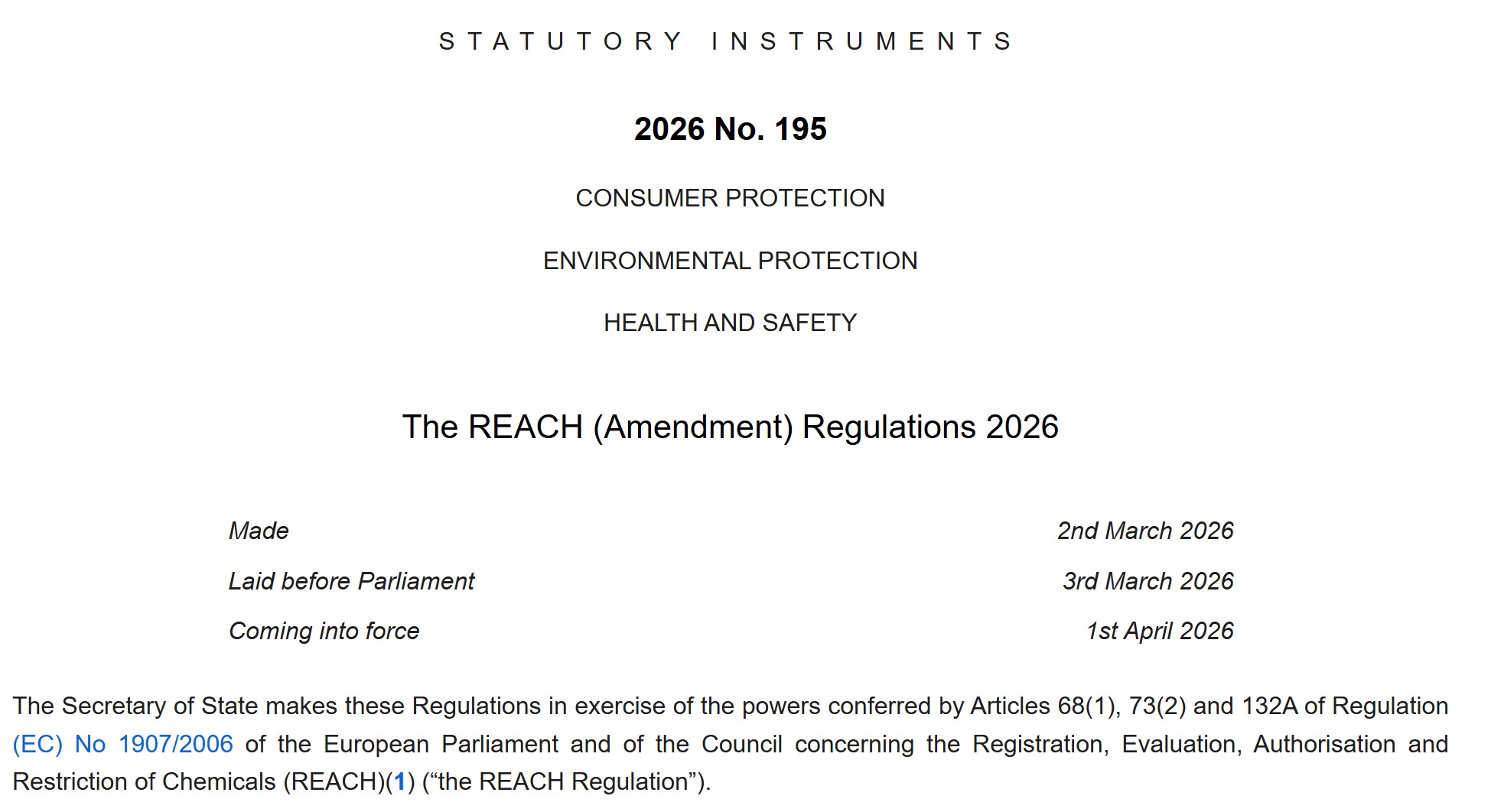
A new Statutory Instrument was laid before Parliament on 3rd March 2026 and will come in to force on 1st April 2026. This is The REACH (Amendment) Regulations 2026, which determine the start date for the ban which will apply in England, Wales and Scotland.
The REACH Regulation (Registration, Evaluation, Authorisation and Restriction of Chemicals) aims to ensure a high level of protection for human health and the environment against the harmful effects of chemical substances.
The SI details those who will be exempt from the ban (e.g. elite athletes, military, police, Border Force). The ban covers shotgun cartridges (all calibres) and rifle ammunition for live quarry shooting in calibres of 6.17 mm (.243 and above).
Importantly, the ban includes not just the sale of toxic lead ammunition, but also the use of it. That means that once the ban is in force, it will be a criminal offence to use toxic lead ammunition, regardless of whether it was bought prior to the ban.
Let’s hope that all those gamebird shooters who are currently bragging on social media about how they’ve already begun to stockpile their toxic lead ammunition (with a clear intention to use it once the ban commences) get the message.
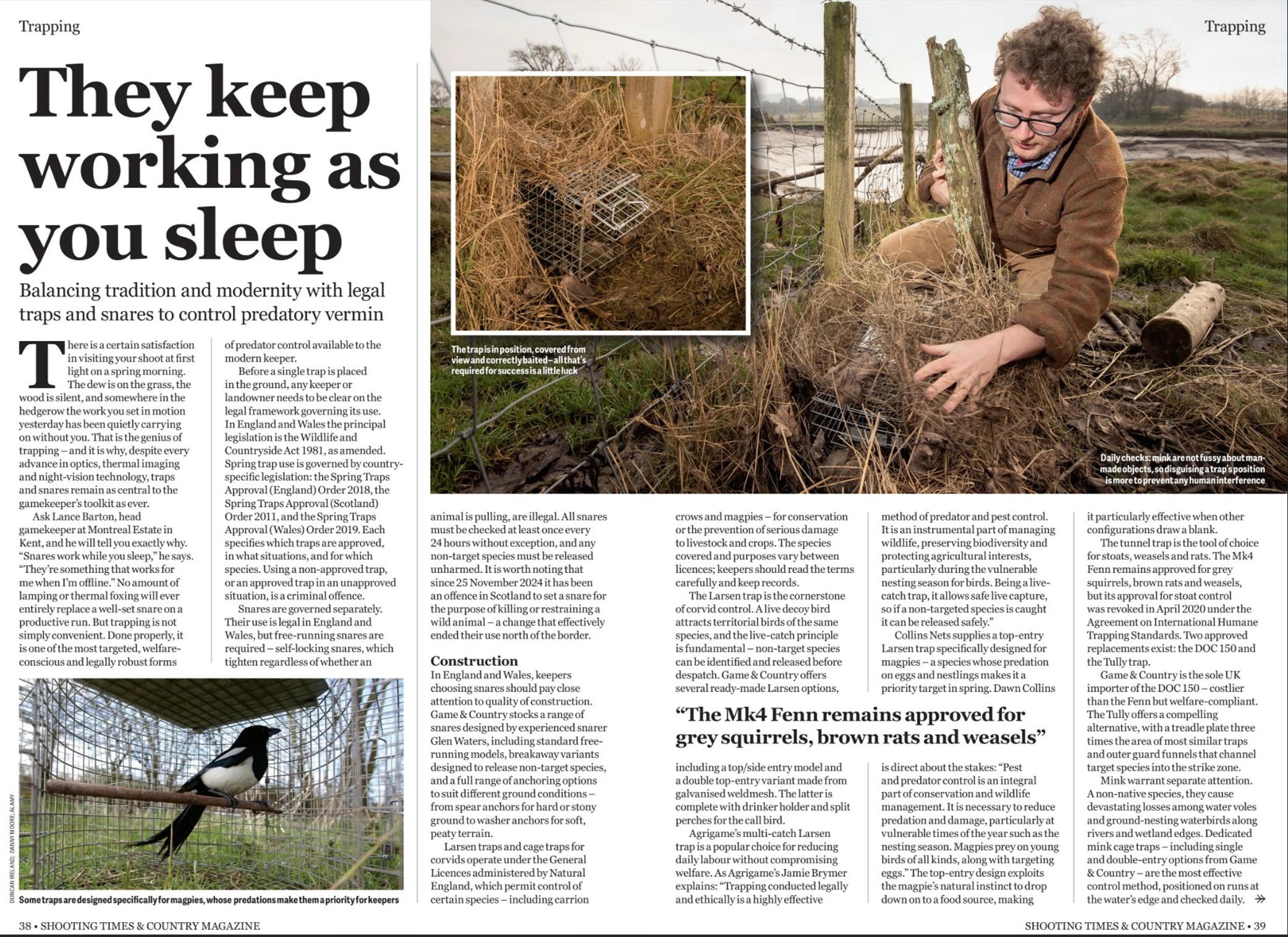
In this week’s edition of Shooting Times, ‘the official weekly journal of BASC’, there’s a three-page article all about trapping, apparently ‘balancing tradition and modernity with legal traps and snares to control predatory vermin‘.
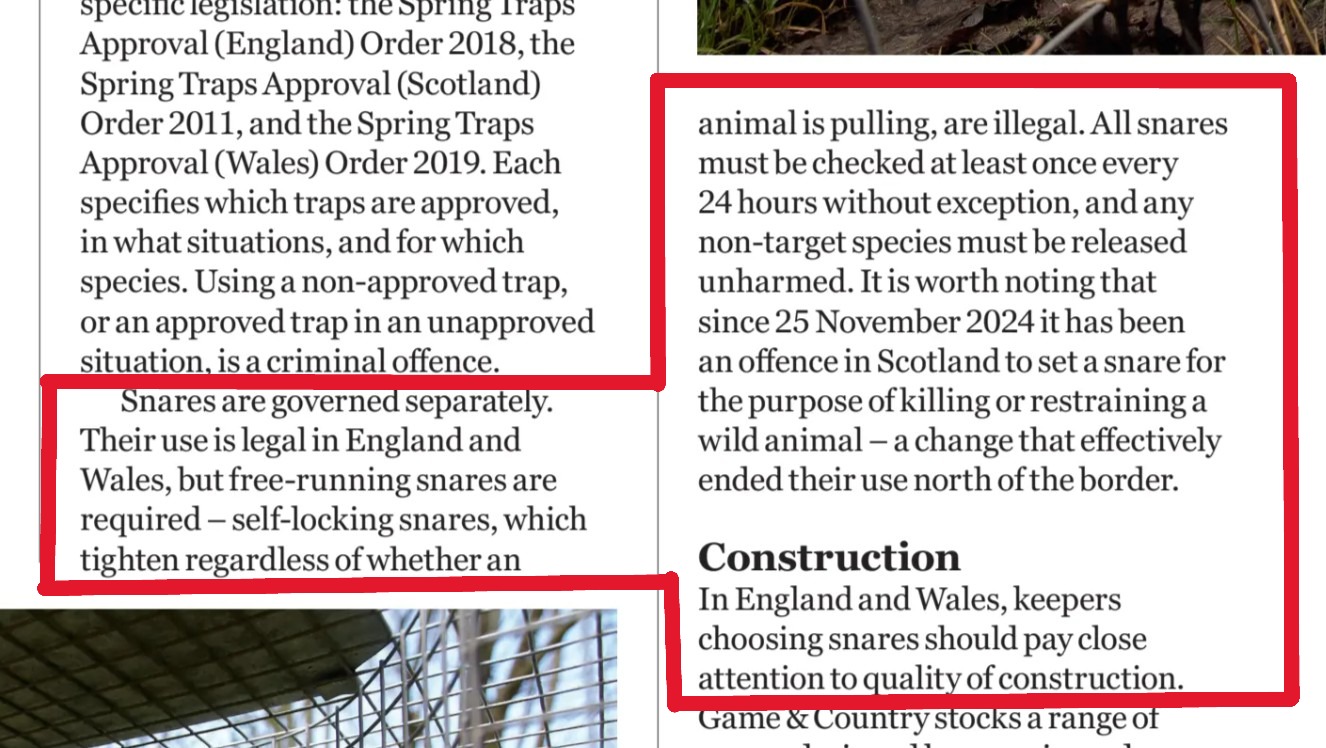
The article isn’t attributed to a specific author, but was presumably approved by a sub-editor and/or the managing editor, who somehow missed this embarrassing blunder:
For the avoidance of doubt, snaring was banned in Wales in 2023 and was the first country in the UK to do so. Scotland then followed in 2024, under the Wildlife Management and Muirburn (Scotland) Act.
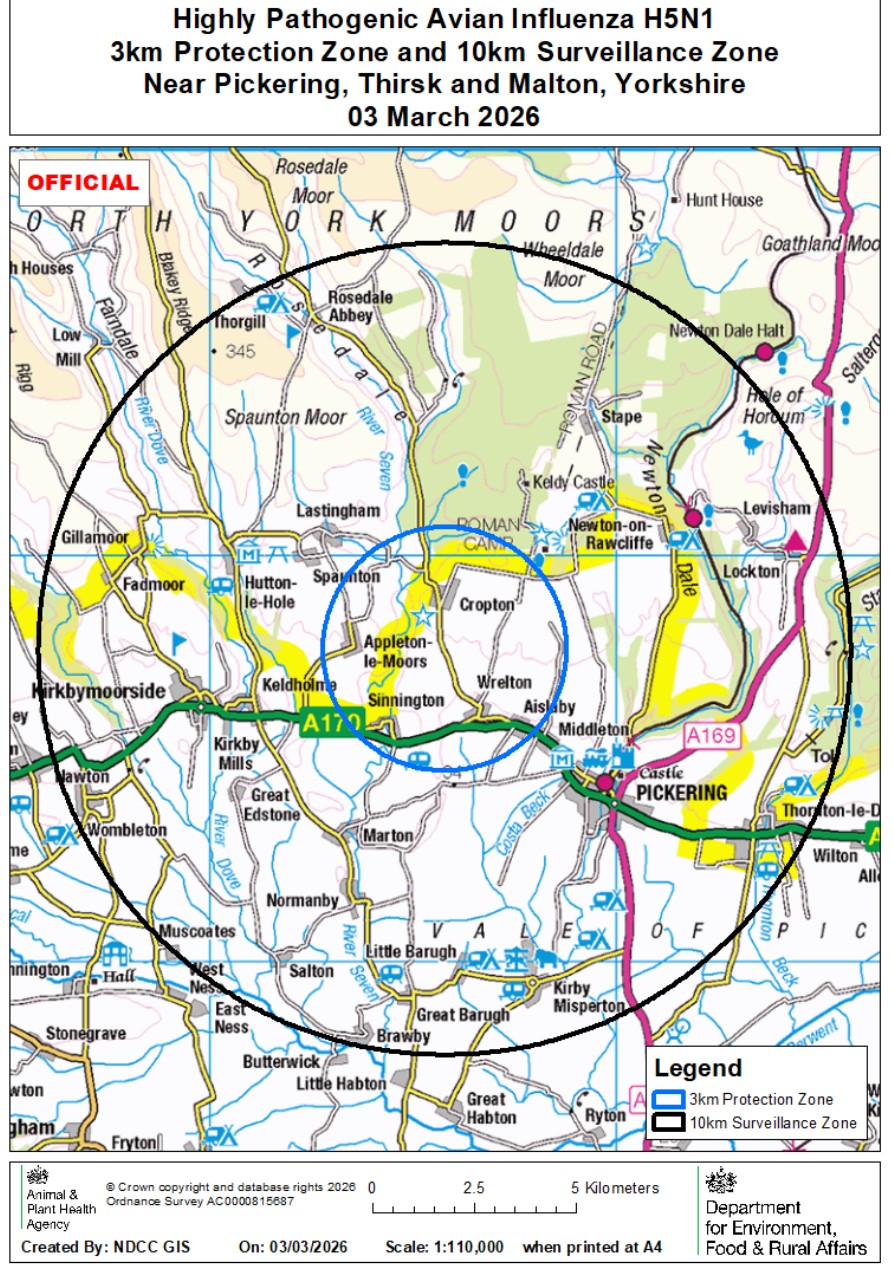
An outbreak of Highly Pathogenic Avian Influenza (Bird Flu) was confirmed yesterday at a large gamebird rearing farm in North Yorkshire.
A 3km Protection Zone and a 10km Surveillance Zone have been declared around Westfield Farms, near Cropton and all gamebirds on the premises will be humanely killed.
Westfield Farms Ltd, whose latest accounts show a value of over £5.3 Million, produces Pheasants, Red-legged Partridges, Grey Partridges and Mallards for the gamebird shooting industry.
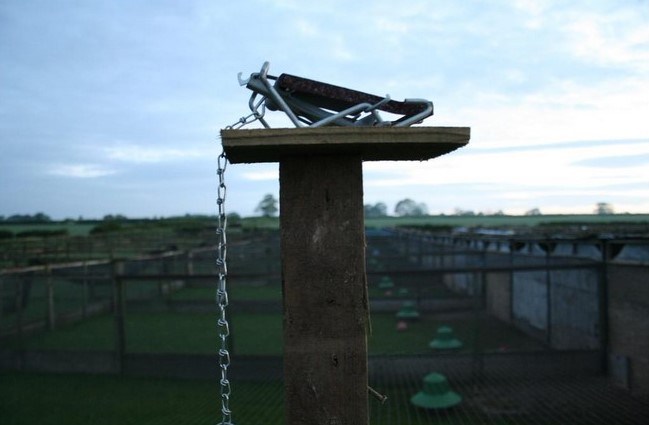
Some of you may recognise the name Westfield Farms. In 2015, Director Michael Wood successfully overturned a conviction for permitting the use of a pole trap at this gamebird rearing facility.
North Yorkshire Police, assisted by the RSPB, had seized a total of five pole traps that had been placed around the rearing pens, and two employees received police cautions (they weren’t prosecuted).
However, Mr Wood’s conviction was later overturned on appeal because the prosecution couldn’t demonstrate that Mr Wood had seen the pole trap that he was filmed driving past in his vehicle (see here).
One of the five illegal pole traps seized from Westfield Farms in 2014 (photo by RPSB)
This is the 95th confirmed outbreak of Avian Influenza in the UK since October 2025 (the outbreak season is recorded from 1st October to 30 September each year).
This surpasses the 82 recorded outbreaks during the entire 2024/2025 outbreak season.
Defra will need to decide imminently whether it will issue General Licence 45 for this year’s shooting season. This is the General Licence that permits the release of gamebirds on or within 500m of a Special Protection Area (SPA), which was introduced after a legal challenge by Wild Justice about damage to protected sites by gamebirds.
Last year, Defra withdrew GL45 due to the high risk of spreading Highly Pathogenic Avian Influenza. Given the high number of reported HPAI outbreaks since Oct 2025 (95 at the time of writing), I anticipate Defra will not issue GL45 this year.
If that happens, then it will fall to Natural England to make decisions about issuing individual licences to permit the release of gamebirds on/close to SPAs.
Last year, Natural England took a sensible and precautionary approach and refused licences at many sites (see here), although as we’ve seen, some shoot operators might think the law doesn’t apply to them and the consequences are so minimal it’s probably worth them taking the risk.
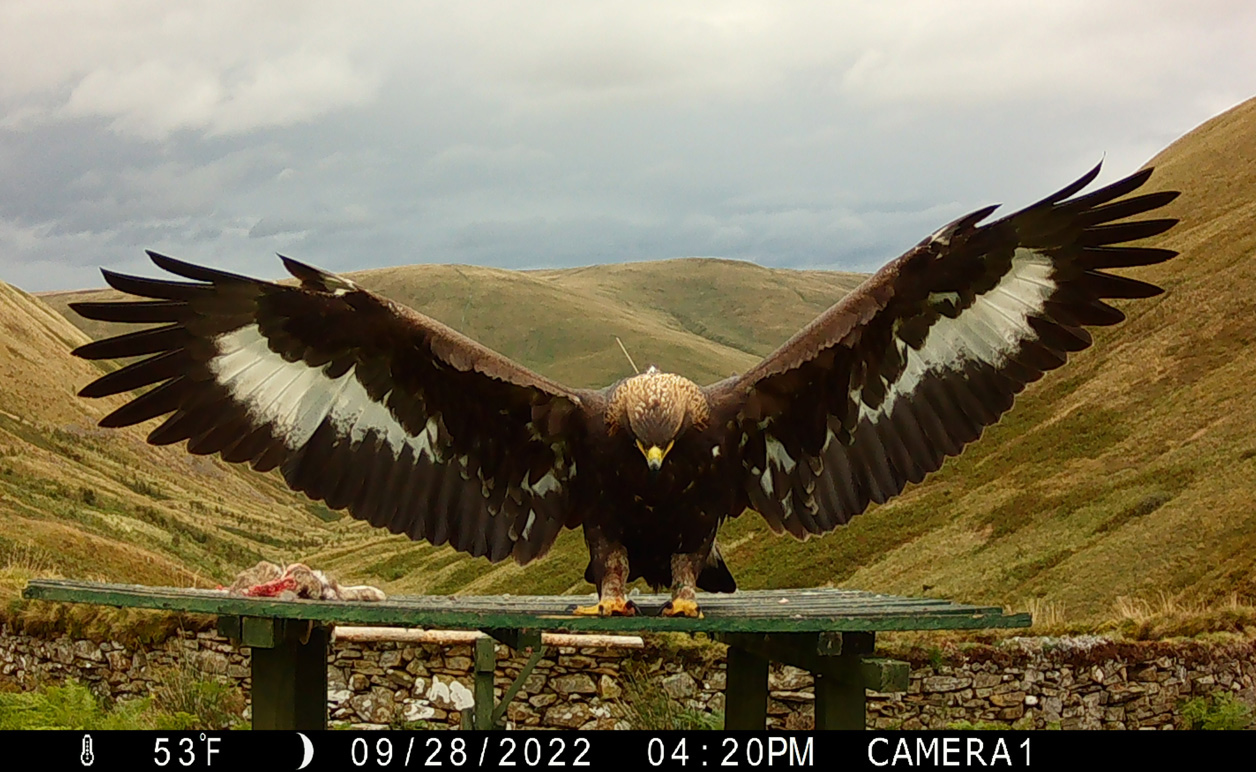
On 10 February 2026, NatureScot imposed a three-year General Licence restriction on Raeshaw Estate in the Scottish Borders (and on neighbouring Watherston Wood, which is understood to be under separate management to Raeshaw), in relation to the shooting/killing of Golden Eagle ‘Merrick’ in October 2023.
Camera trap photo of golden eagle Merrick, from South Scotland Golden Eagle Project
Following the announcement, a representative of Raeshaw Estate, believed to be under the management of a company owned by ‘grouse moor guru’ Mark Osborne, claimed the restriction was “wholly unjustified” and said the estate intended to appeal the decision (see here).
According to NatureScot’s Framework for implementing General Licence restrictions,
‘Where a decision is made to impose a restriction, the Affected Parties will be entitled to appeal the decision within 14 days of the date of the decision. An appeal must be made in writing to the Head of Licensing and must set out the grounds upon which it is proposed that the appeal be allowed.
‘An appeal shall have the effect of suspending the restriction from the date the appeal is received by the Head of Licensing until the date of the Decision on Appeal’.
As the restriction notification has now been removed from NatureScot’s website, I assume that Raeshaw Estate has lodged a written appeal and did so within the 14 day time limit.
This means that Raeshaw Estate can, until further notice, go back to using General Licences 1, 2 & 3 to lawfully kill hundreds if not thousands of certain bird species (e.g. crows) on the estate without having to report its activities to anybody.
NatureScot’s Framework states that the Head of Licensing will seek to make a decision on the appeal within four weeks. Let’s hope it doesn’t drag on any longer than that.
It is also apparent that the representatives of Watherston Wood have also lodged an appeal, although as far as I’m aware, the killing of so-called ‘pest’ bird species doesn’t take place in the wood anyway so perhaps the appeal has been made as a matter of principle rather than an attempt to reinstate the use of General Licences 1, 2 and 3.
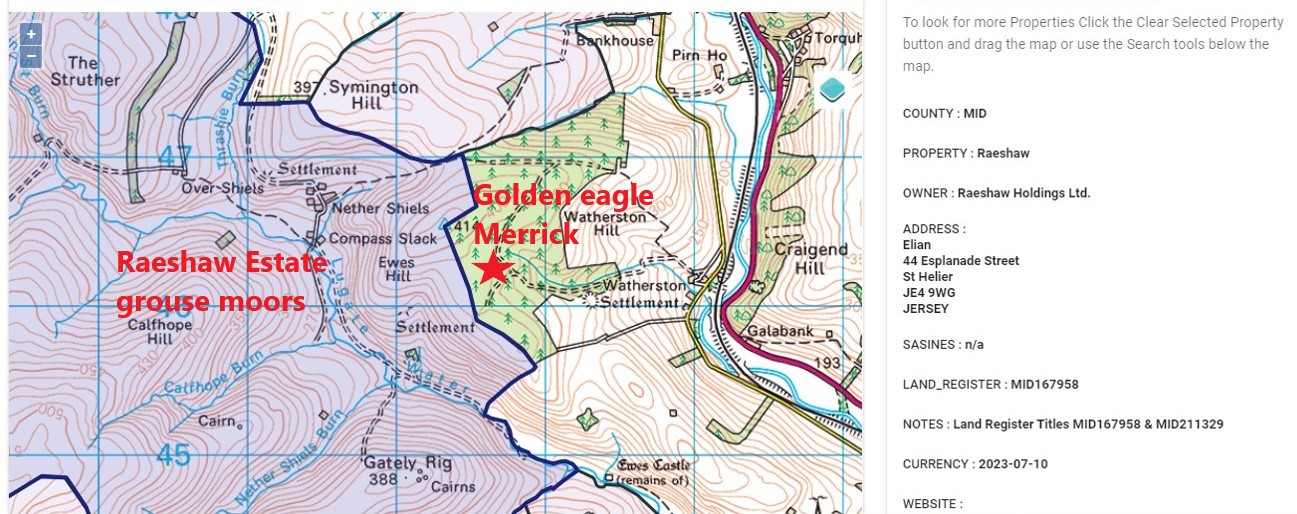
Screen grab from Who Owns Scotland website, annotated by RPUK, showing the proximity of Merrick’s last known location and the Raeshaw Estate (shaded in blue)
General Licence restrictions, which are based on a civil burden of proof if there is insufficient evidence for a criminal prosecution, were introduced by then Environment Minister Paul Wheelhouse in 2014 as a way of tackling the continuing persecution of birds of prey on gamebird shooting estates across Scotland.
These restrictions don’t stop the sanctioned estates from shooting gamebirds, nor do they limit their gamebird management activities other than requiring the estate to complete a bit of paperwork, but they were specifically designed to act as a ‘reputational driver’. I think it’s fair to say that Wheelhouse’s intentions were good but ultimately have proved ineffective.
This is an unprecedented second General Licence restriction imposed on Raeshaw Estate.
Raeshaw Estate was one of the first estates to receive a General Licence restriction in 2015, based on ‘clear police evidence’ that wildlife crimes had been committed there although there was insufficient evidence to prosecute any individual (see here). Representatives of Raeshaw Estate applied for a judicial review of NatureScot’s decision but the Court of Session upheld NatureScot’s procedures and ruled them lawful (here).
Whilst under that first General Licence restriction, Raeshaw Estate applied for, and was granted, a number of ‘individual licences’ so the gamekeepers could continue to kill certain species as part of the estate’s grouse moor management plan (quite a lot of birds were lawfully killed – see here).
However, in 2017 the individual licence was revoked by NatureScot due to non-compliance issues and more suspected wildlife crime offences (see here).
I await NatureScot’s decision on Raeshaw Estate’s latest appeal with interest.

 Raptor Persecution UK