
Earlier this month, the Scottish Government announced its commitment to closing the loophole on the grouse moor licences that were sabotaged last year by the powerful grouse shooting lobby.
If you recall, grouse moor licensing was introduced as part of the Wildlife Management & Muirburn (Scotland) Act 2024, as a result of the continued illegal killing of birds of prey on grouse moors and the associated difficulties of identifying an individual suspect and prosecuting them.
The idea was that a licence to shoot Red Grouse could be amended / withdrawn / revoked by NatureScot if evidence showed that illegal raptor persecution had taken place (importantly, based on the civil burden of proof, i.e. balance of probability, rather than the criminal burden of proof, i.e. beyond reasonable doubt). It was expected that the licence would cover an estate’s entire landholding, not just the areas where Red Grouse are shot, because raptor persecution crimes often take place beyond the boundary of the moor (e.g. in woodland).
However, in November last year, the licences were significantly weakened after legal threats from the grouse shooting industry. Instead of now covering an entire estate, it was announced that the licence holder could decide on the extent of the area the licence covered, specifically the area where Red Grouse are ‘taken or killed’.
Effectively, this could mean simply drawing an arbitrary line around their grouse butts, denoting the reach of a shotgun pellet, and argue that THAT is the area where they take/kill grouse and thus that should be the extent of the licensable area:

There has been a year of prolonged campaigning to get this loophole closed, mostly behind-the-scenes and led by Green MSP Mark Ruskell and RSPB Scotland – they deserve our gratitude because without their efforts, this loophole would have been left wide open.
When Minister Fairlie announced his intention to close the loophole, by introducing a proposed amendment to the Natural Environmental (Scotland) Bill which is currently making its way through Parliament, the precise details of his amendment were not known so although his announcement was welcomed, there was still some skepticism about whether the amendment would be fit for purpose.
The proposed amendment has now been published and Minister Fairlie has written a detailed explanation.
First, here’s the proposed amendment, which was lodged on 7 November 2025:
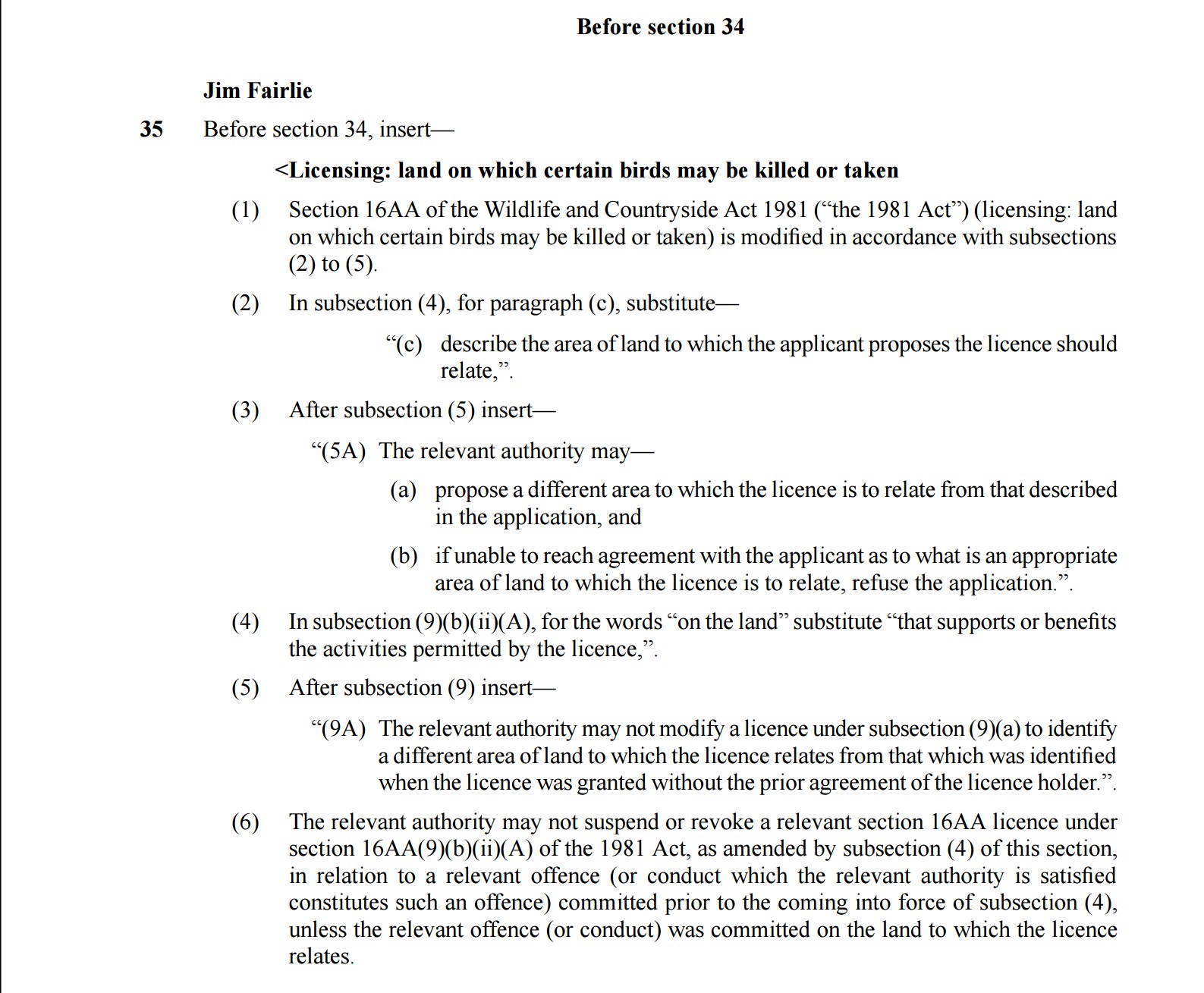
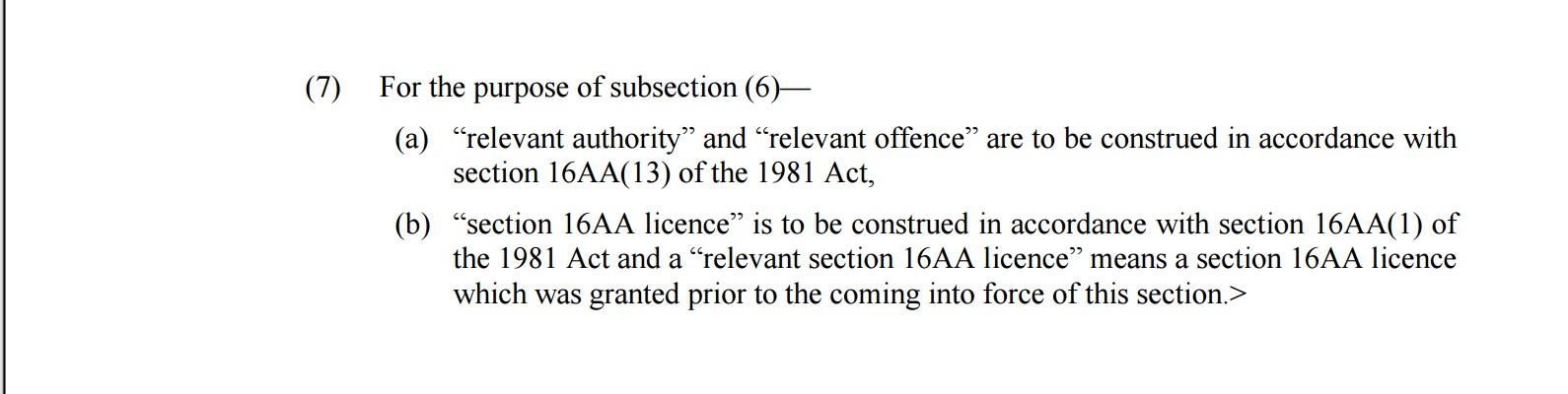
On first appearances, this looks to be pretty robust. Although it still offers room for ‘negotiation’ between the licensing authority (NatureScot) and the licence applicant about the extent of the licensable area, it is clear that if agreement is not reached, then NatureScot has the authority to refuse the licence application altogether.
That’s good, assuming that NatureScot will stand up to the powerful land-owning lobby. That’s by no means assured though, so we might expect that NatureScot’s decision-making process is laid out in writing so it is transparent for all those interested and fair to all licence applicants, in the same way that NatureScot has published the decision-making process it uses when assessing whether to impose a General Licence restriction on estates where there is evidence to support a suspicion of wildlife crime taking place.
Minister Fairlie’s amendment also removes the controversial issue of a reduced licensed area, rather than the licence applying to an estate’s entire landholding, as believed to be intended by Parliament when the Wildlife Management & Muirburn Act was passed. So instead of limiting the licensable area to only being applicable “on the land” [where Red Grouse are taken or killed], the amendment suggests that the licence could be withdrawn/revoked if a relevant offence takes place anywhere on the landholding “that supports or benefits the activities permitted by the licence“, i.e. grouse shooting.
It looks like this amendment will also bring back all the relevant offences that could result in a licence suspension/revocation, which were removed when NatureScot made changes to the licence in November last year (see here). This means that offences under the Protection of Badgers Act 1992, Wild Mammals (Protection) Act 1996, Conservation (Natural Habitats etc) Regulations 1994, Animal Health & Welfare (Scotland) Act 2006, Hunting with Dogs (Scotland) Act 2023), would all come back in to play. Excellent.
After notifying the Scottish Parliament’s Rural Affairs & Islands Committee (the committee scrutinising the Natural Environment Bill) of his intention to bring an amendment to close the grouse shoot licence loophole, Minister Fairlie was asked by the Committee Convenor to explain his rationale for his proposed amendment.
Minister Fairlie’s explanation is clear and well worth a read:
Amendments to the Natural Environment Bill stage 2 will be debated in Parliament next Wednesday (19 November 2025).
 Raptor Persecution UK
So, plenty of scope for the licence applicant and Natutrescot to get back to where we were before the amendment.
My own feeling is that the estates are more than capable of ensuring that only their views will be applicable.
“Amendments to the Natural Environment Bill stage 2 will be debated in Parliament next Wednesday (19 November 2025).”
That does not give MSPs much (enough) time to properly scrutinise these amendments – considering what happened to the Wildlife Management & Muirburn Bill.
If I were an MSP I would want/need these amendments flattened out into the existing legislation so I could see (and access) the meaning of each clause within its full context.
At the very least, I would then want these amendments (and their context) run past an experienced and supportive lawyer, and then to be able to interrogate them about meaning, context, and potential loopholes.
On the surface this takes legislative power away from the Scottish Parliament to explicitly define the spatial extent of any licence in simple, legal, terms, and hands it to NatureScot for ‘negotiation’ with the applicant. Are they really confident that NatureScot has the required backbone/expertise in all circumstances?
Once bitten, and all that…?
Would anyone regard that as a potential loophole?
This Jim Fairlie claim, in his letter, does not make sense to me:
“For existing licence holders there should be no material impact unless a relevant offence is suspected to have been committed after the new provisions come into force, and then the new grounds for suspension and revocation will apply to them.”
Is he claiming that existing licence conditions (duration – five years) can be changed retrospectively?
I think that will be challenged in court, and I think I know what the outcome will be:-(
Or is he dealing in wishful thinking?
And are MSPs still happy to hand out five-year licences right from the start? Really?
Where’s a lawyer when you need one?
“For existing licence holders there should be no material impact unless a relevant offence is suspected to have been committed after the new provisions come into force, and then the new grounds for suspension and revocation will apply to them.”
Is he claiming that existing licence conditions (duration – five years) can be changed retrospectively?”
—
What is being said is that, at the moment, a licence can only be suspended if the licence holder/land manager has “committed a relevant offence on the land“
However, once the new provision comes into force, the licence can be suspended where the offence “supports or benefits the activities permitted by the licence”.
Unless I am mistaken, it is not a question of licence conditions being changed retrospectively but that licences shall be subject to the new legislation once it takes effect.
One notable issue is that the proposed subsection 9A expressly states that the ability for NatureScot to modify a licence at any time as per ss9 will not apply to amending the area of land to which an existing licence applies (without the agreement of the licence holder). Therefore I would expect that a few licence applications will be made prior to this provision coming into force (if it indeed ever does) to ‘lock-in’ a narrower area to which the licence applies – albeit that the new subsection 9(b)(ii)(A) will still apply (once it takes effect) which reduces the extent of the ‘loop hole’.
Thanks for the reply…
“What is being said is that, at the moment, a licence can only be suspended if the licence holder/land manager has “committed a relevant offence on the land“
However, once the new provision comes into force, the licence can be suspended where the offence “supports or benefits the activities permitted by the licence”.”
Understood.
“Unless I am mistaken, it is not a question of licence conditions being changed retrospectively but that licences shall be subject to the new legislation once it takes effect.”
Exactly. It is new primary legislation which explicitly changes the area of land to which future licence conditions will apply (compared with the existing legislation).
But, we know that some licences have already been issued – under the existing legislation – for the next five years:-( There is nothing in the amendment which states that existing licences will now be declared null-and-void, and that applicants will therefore have to re-negotiate with NatureScot about their extent! Or, that NatureScot is now given special powers to unilaterally change the spatial extent of existing licences.
“One notable issue is that the proposed subsection 9A expressly states that the ability for NatureScot to modify a licence at any time as per ss9 will not apply to amending the area of land to which an existing licence applies (without the agreement of the licence holder)”
Exactly.
So why has Jim Fairlie written “For existing licence holders there should be no material impact unless a relevant offence is suspected to have been committed after the new provisions come into force, and then the new grounds for suspension and revocation will apply to them.”
At best that is ambiguous. At worse it is (deliberately?) misleading.
Say, an existing licence holder is suspected of committing a relevant offence after the proposed amendment has been passed into law and the new grounds for suspension and revocation apply. Jim Fairlie has explicitly written that ‘the new grounds for suspension and revocation will apply to them (ie the existing licence holders, referenced in his first clause!).
That is not true: it will not. The ‘new grounds for suspension and revocation’ will NOT apply to existing licence holders! Only to those who apply for new licences after the proposed amendment has come into law.
It seems to me that Fairlie is trying to imply that the amended legislation will be retrospective, when it is not (and would almost certainly be considered illegal if it were).
Why did he write that?
Presumably if NatureScot publishes its licensing conditions and then either fails to action them or does so only partly then a judicial review would force them to do so – otherwise I can see them keeping quiet and/or fudging issues like they’ve done with the General Licences