
The Herald has given more front page coverage in its series about Scottish land reform, this time focusing on recent legislation that was supposed to protect wildlife but instead is effectively ‘enabling’ wildlife crime.
The article includes quotes from three organisations from REVIVE, the coalition for grouse moor reform: Raptor Persecution UK, OneKind, and League Against Cruel Sports Scotland.
Here’s the article in full:

Scotland’s landmark wildlife laws are being “systematically weakened” by loopholes, delays and poor enforcement, campaigners have warned.
A year after the Scottish Government introduced grouse moor licensing to tackle raptor persecution, environmental groups say the scheme has already been undermined.
They argue the same pattern is emerging across other wildlife protection measures, with legislation that looks strong on paper but delivers little change on the ground.
The Wildlife Management and Muirburn (Scotland) Act 2024 was designed to allow NatureScot, the government’s statutory nature agency, to suspend or withdraw a licence to shoot grouse if there was evidence that birds of prey such as golden eagles, hen harriers and red kites were being killed.
However, within months of the law being passed, NatureScot altered the scope of the licences so they applied only to areas where grouse were “taken and killed”, rather than to entire estates.
Conservationists say that effectively excludes the remote areas where raptor persecution is most likely to occur, such as crags or woodlands, rendering the measure “fatally flawed”.
Dr Ruth Tingay, of the Revive Coalition and author of the Raptor Persecution UK blog, said: “Grouse moor licensing was overwhelmingly passed by the Scottish Government as part of the Wildlife Management and Muirburn Act 2024 precisely because the landowning sector had literally been getting away with wildlife crime for decades.
“Using its significant influence, that same lobby has effectively nullified the effect of the licences, allowing raptor persecution and other wildlife offences to continue with impunity. Surely, if landowners are committed to their claimed ‘zero tolerance policy’ towards raptor persecution, they will welcome the amendment to close the loophole. Why would they not?”
Freedom of Information requests revealed the changes were made after pressure from landowner interests and without consultation with other stakeholders.
Green MSP Mark Ruskell has lodged an amendment to the Land Reform Bill, due to be debated later this month, to close what he called a “gaping loophole” in the system.
The same 2024 Act introduced a requirement for those using traps to capture wild birds or mammals to hold a licence and complete approved training. Ministers said it was intended both to prevent illegal use of traps against raptors and to improve animal welfare “even when those traps are used lawfully”.
However, the licensing scheme has yet to come into force. Officials have said it is unlikely to begin until autumn 2026, and campaigners say key details—including licence conditions and application processes—remain unknown.
Jason Rose, chief executive of the animal welfare charity OneKind, said: “The Wildlife Management and Muirburn (Scotland) Act brought in bans on the use of snares and glue traps, a monumental action to end some of the worst suffering of wild animals in Scotland. But the Scottish Government must not grow complacent.
“Trap licensing and a code of practice, introduced by the Act, were supposed to address that, and we were assured those measures would drive up standards. Yet, a year and a half later, the trap licensing is not in force and its details are unknown, while the code of practice points to existing best practice guidance, which has no mention yet of such ‘predator control’.
“This is not good enough. People expect laws to do what they say on the tin and Scotland’s animals deserve better.”
He said the lack of oversight meant “thousands of animals” continued to suffer unnecessarily in traps, often in the name of protecting grouse populations for sport shooting.
Campaigners also claim the same weaknesses are allowing illegal fox hunting to continue despite the introduction of the Hunting with Dogs (Scotland) Act 2023, which ministers said would finally end the practice.
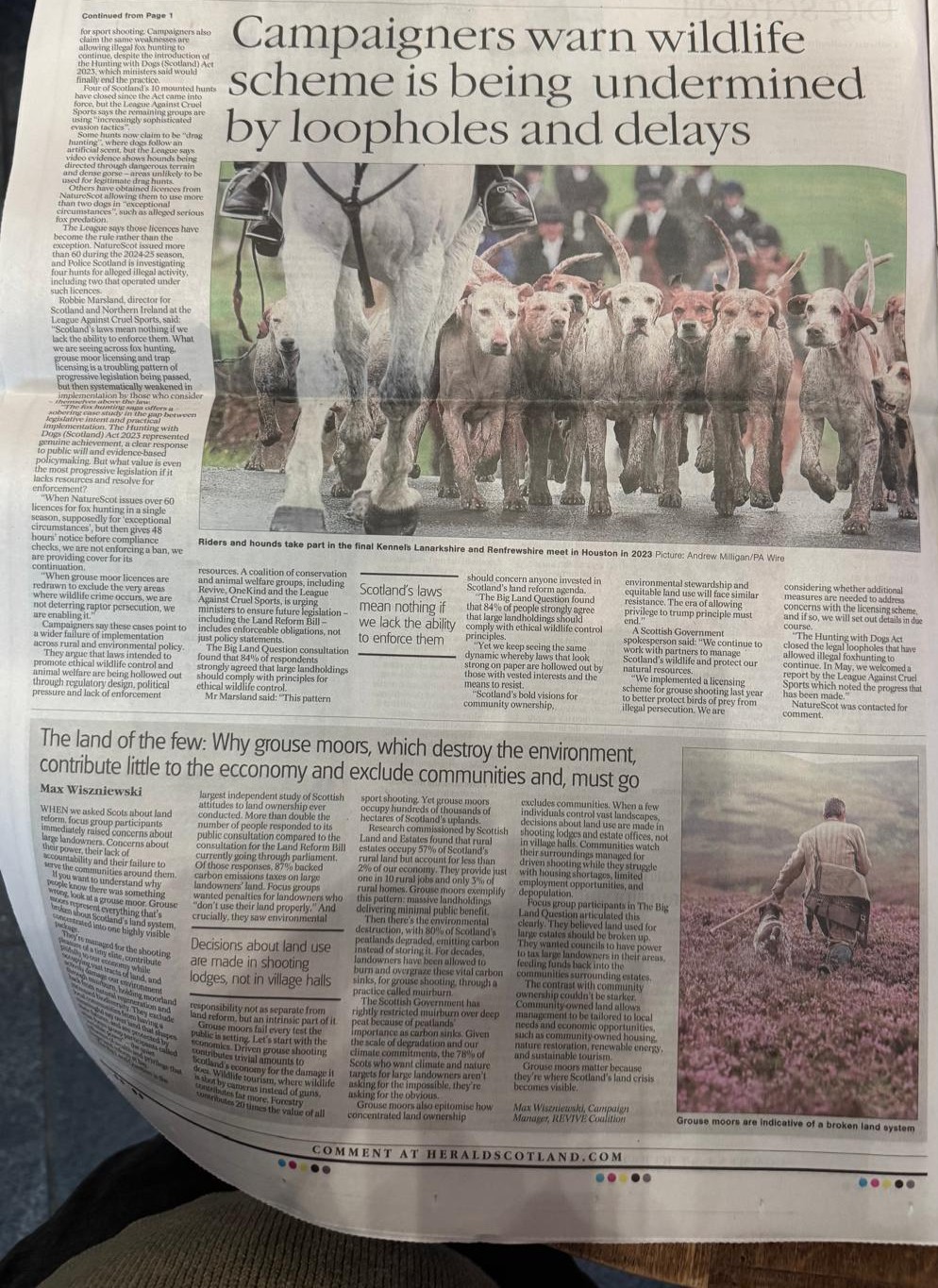
Four of Scotland’s ten mounted hunts have closed since the Act came into force, but the League Against Cruel Sports says the remaining groups are using “increasingly sophisticated evasion tactics”.
Some hunts now claim to be “drag hunting”, where dogs follow an artificial scent, but the League says video evidence shows hounds being directed through dangerous terrain and dense gorse—areas unlikely to be used for legitimate drag hunts.
Others have obtained licences from NatureScot allowing them to use more than two dogs in “exceptional circumstances”, such as alleged serious fox predation.
The League says those licences have become the rule rather than the exception. NatureScot issued more than 60 during the 2024–25 season, and Police Scotland is investigating four hunts for alleged illegal activity, including two that operated under such licences.
Robbie Marsland, director for Scotland and Northern Ireland at the League Against Cruel Sports, said: “Scotland’s laws mean nothing if we lack the ability to enforce them. What we are seeing across fox hunting, grouse moor licensing and trap licensing is a troubling pattern of progressive legislation being passed, but then systematically weakened in implementation by those who consider themselves above the law.
“The fox hunting saga offers a sobering case study in the gap between legislative intent and practical implementation. The Hunting with Dogs (Scotland) Act 2023 represented genuine achievement, a clear response to public will and evidence-based policymaking. But what value is even the most progressive legislation if it lacks resources and resolve for enforcement?
“When NatureScot issues over 60 licences for fox hunting in a single season, supposedly for ‘exceptional circumstances’, but then gives 48 hours’ notice before compliance checks, we are not enforcing a ban, we are providing cover for its continuation.
“When grouse moor licences are redrawn to exclude the very areas where wildlife crime occurs, we are not deterring raptor persecution, we are enabling it.”
Campaigners say these cases point to a wider failure of implementation across rural and environmental policy. They argue that laws intended to promote ethical wildlife control and animal welfare are being hollowed out through regulatory design, political pressure and lack of enforcement resources.
A coalition of conservation and animal welfare groups, including Revive, OneKind and the League Against Cruel Sports, is urging ministers to ensure future legislation—including the Land Reform Bill—includes enforceable obligations, not just policy statements.
The Big Land Question consultation found that 84% of respondents strongly agreed that large landholdings should comply with principles for ethical wildlife control.
Mr Marsland said: “This pattern should concern anyone invested in Scotland’s land reform agenda. The Big Land Question found that 84% of people strongly agree that large landholdings should comply with ethical wildlife control principles. Yet we keep seeing the same dynamic whereby laws that look strong on paper are hollowed out by those with vested interests and the means to resist.
“Scotland’s bold visions for community ownership, environmental stewardship and equitable land use will face similar resistance. The era of allowing privilege to trump principle must end.”
A Scottish Government spokesperson said: “We continue to work with partners to manage Scotland’s wildlife and protect our natural resources.
“We implemented a licensing scheme for grouse shooting last year to better protect birds of prey from illegal persecution. We are considering whether additional measures are needed to address concerns with the licensing scheme, and if so, we will set out details in due course.
“The Hunting with Dogs Act closed the legal loopholes that have allowed illegal foxhunting to continue. In May, we welcomed a report by the League Against Cruel Sports which noted the progress that has been made.”
ENDS
That response from the Scottish Government is pretty thin. The Government has supposedly been considering whether additional measures are needed to close the loophole in the grouse shooting licences for almost a year after it was first sabotaged by the grouse shooting industry but so far, it’s done nothing.
And I have no idea what ‘progress’ the Government thinks has been made on closing the loopholes in the Hunting with Dogs Act. The League Against Cruel Sports’ report, referred to by the Govt spokesperson, reveals nothing of the sort:
 Raptor Persecution UK
It seems that the legislation that has been put in place to protect wildlife etc has been sabotaged by vested interests and set up to fail. We need to put pressure on those in the Scottish Government to ensure the legislation is rigorously enforced and not undermined.
“We implemented a licensing scheme for grouse shooting last year to better protect birds of prey from illegal persecution. We are considering whether additional measures are needed to address concerns with the licensing scheme, and if so, we will set out details in due course“
“We are considering ” and “in due course “, have you ever seen 2 better examples of procrastination than these?
I would have thought that our socialist Scottish Government would be delighted to have a reason to bring the above-the-law landowners to heel, but this doesn’t seem to be the case, I wonder why?
One would always like to think that perhaps the people we elected to act on our behalf may actually do that and not, instead, collude with the powers that be and their vested interests
SusanH: Socialist? Very few socialists left in the Party: they have been systematically extracted since 1997, even faster since Starmer took over. It is why they are letting these landowners, shooting estates and hunts continue to break the law with impunity or passing laws so full of loopholes they are worthless.
There is so much (too much) to deal with here. But, in general, one might conclude that Scottish legislators are hopeless at drafting Bills:-( But, sadly, possibly not alone, when it comes to protecting wildlife in the UK?
“However, within months of the law being passed, NatureScot altered the scope of the licences so they applied only to areas where grouse were “taken and killed”, rather than to entire estates.”
Having looked at the wording of the legislation which was ‘passed’ by MSPs (when this storm first blew up) I’d say that wasn’t true:-( The wording explicitly allowed the applicant alone to define the scope of the licence. And that was what MSPs voted for:-(
I wrote to everybody (political parties, the professional body which drafts Scottish legislation, NatureScot, charitable conservation bodies) to try and find out why the applicant alone was explicitly allowed to define the scope of the licence in the legislation. I even offered my own suggestion for the legislation which (I think) would have prevented/restricted any mucking about: explicitly limiting such licences to just the one per entire estate/business for the (five year) duration!
Only the charitable conservation bodies responded: a wall of silence from everybody else:-(
Somewhere in that maelstrom of angst over this particular ‘faulty’ wildlife legislation I was told/learned (then) that – so far – all licence applications to NatureScot had been for entire estates.
If that remains true, it all looks a mess to me (rather than a conspiracy) because we have yet to see the obvious gaping loophole being exploited. But it is still a loophole which needs ‘fixing’, one way or another.
But all the delays were and are unconscionable. For example, snares could have been banned from the day the Act received Royal Ascent:-( It just needed to say so in the legislation!
“Somewhere in that maelstrom of angst over this particular ‘faulty’ wildlife legislation I was told/learned (then) that – so far – all licence applications to NatureScot had been for entire estates”.
I know that’s not the case – not prepared to publish details yet because of ongoing research but believe me, the loophole has very definitely been exploited!
“I know that’s not the case… the loophole has very definitely been exploited!”
Thanks, that’s very important. Maybe the information I received (I’m fairly sure it was from a conservation charity because no one else replied to me. I could check if anyone is desperate) was true at the time – quite shortly after all the fuss was first kicked up.
I fear there is worse to come, because even if the ‘faulty’ legislation is fixed, the ‘fix’ cannot easily (if at all) be made retrospective (as far as I know:-( Which means living with the consequences of this monumental ‘cock-up’ – or whatever anyone wants to call it: ‘dereliction of duty / betrayal?’ – for at least the five years of the life of any such license already granted:-(
I am yet to be persuaded that MSPs didn’t righteously vote this through in blind ignorance of what the legislation actually said, instead of what they thought it said:-(
Which makes a mockery of the line-by-line scrutiny MSPs are paid for and supposed to give to such legislation:-(
Appalling, doesn’t even come close…:-( It brings Parliamentary democracy into disrepute, and all that entails for society:-(
All said in a nutshell Keith the jobs well n truly fucked by MSPs and parliament they make a laughing stock of democracy what democracy. Country is a joke filled with jokers .