
The following is a guest blog by someone who wishes to remain anonymous, although I know their identity.
DID SCOTTISH FORESTRY KNOW STOBO HOPE WAS ‘NAPALMED’ WITH HERBICIDE LONG BEFORE ‘NEW INFORMATION CAME TO LIGHT’?

Readers may be familiar with Stobo Hope, a haunt of golden eagles and other raptors, with a notable black grouse lek. A Sitka spruce plantation with a £2 million taxpayer funded grant was approved by regulator Scottish Forestry. Wild Justice and Raptor Persecution UK readers greatly helped a community crowdfunder (see here) to fund a successful judicial review to challenge approval of this forestry scheme without an Environmental Impact Assessment (EIA) (see here).
Forestry work started in February 2024, the petition for judicial review was lodged in April 2024, and in September 2024, Scottish Forestry conceded the judicial review, with the £2 million grant cancelled all work since halted by court order. However, this was not before more than 750,000 conifers had been planted, and vast areas sprayed with herbicide, killing semi-natural grasslands and heather moorland. Drone footage (credit – Ted Leeming) from July 2024 (see here) shows the extent of a damaged, but otherwise beautiful landscape. An excellent blog by Parkswatch (see here) casts doubt on Scottish Forestry’s tree carbon sequestration calculations for Stobo, which seem to be tilted in favour of the landowner, the Forestry Carbon Sequestration Fund, based in the tax haven of Guernsey (see here) and managed by True North Real Asset Partners (see here).
Parkswatch has just published another excellent blog on Stobo, questioning the environmental credentials of Sitka spruce plantations across Scotland – see here).
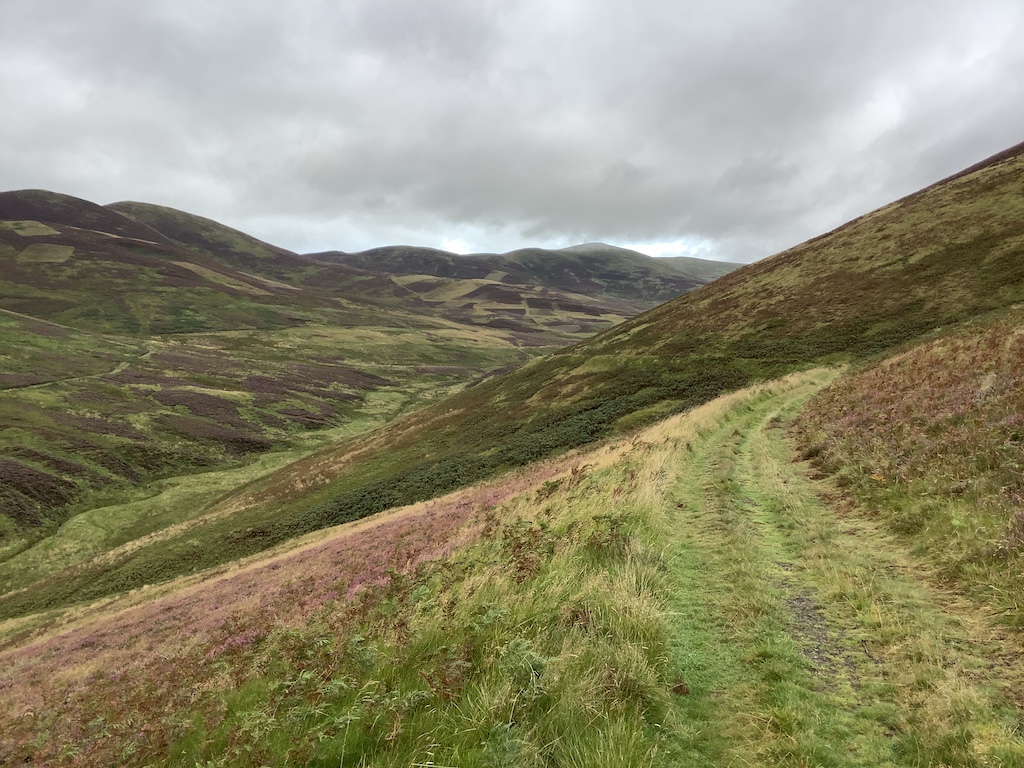
Why did Scottish Forestry concede the judicial review?
The petitioners for judicial review, the Stobo Residents Action Group, had argued that Scottish Forestry had not addressed NatureScot’s concerns about the forestry scheme’s impact on the designated National Scenic Area. On 10 September 2024, Scottish Forestry issued a news release (see here) stating work at Stobo was halted ‘as new information came to light during judicial review proceedings’. It stated ‘in the run up to the court hearing in mid-August [2024], written papers by the petitioners made Scottish Forestry aware that forestry agents acting on behalf of the landowner had carried out extensive blanket spraying’:
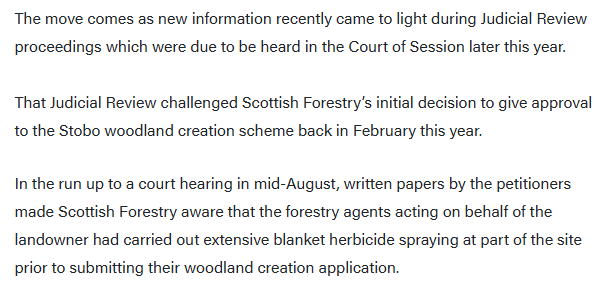
Scottish Forestry stated ‘a material piece of information was not disclosed by the applicant’ in reference to the herbicide spraying.

Scottish Forestry responded to a press enquiry on 11 September 2024, which had asked why the herbicide damage was not noticed sooner (it had occurred in August 2023, five months before the forestry grant contract was signed), stating ‘our staff visited the site in early summer and even then there were no clear signs of the extent of the herbicide spraying’. The response also states ‘it was only when the petitioners presented their papers in [mid-] August [2024] we were made aware of the herbicide spraying’.

A hearing for judicial review in the Court of Session had been scheduled for autumn 2024, and the petitioners now had sufficient funds to go to court. It appears Scottish Forestry were increasingly concerned about their reputation if it was determined they had acted unlawfully in determining no Environmental Impact Assessment (EIA) was required.
The ‘non-disclosure’ of blanket use of herbicide by the forestry agents, then called Pryor and Rickett Silviculture (see here) – now called Euroforest Silviculture – seems to have resulted in the contract and £2 million grant being cancelled, the same legal remedies sought by the petitioners for the now conceded judicial review.

Do Scottish Forestry ever consider environmental impacts?
There seems to be scepticism that Scottish Forestry consider environmental impacts of proposed forestry schemes. Readers may recall Pryor and Rickett Silviculture were advised by the Game and Wildlife Trust (GWCT) to carry out predator control to supposedly help black grouse at Stobo (see here), despite NatureScot’s GWCT-commissioned research demonstrating large areas of contiguous moorland are required for black grouse (this moorland would disappear from places such as Stobo if the tree planting was permitted). Pryor and Rickett Silviculture subsequently applied to NatureScot for a licence to hunt foxes with nineteen dogs (see here), but NatureScot rejected this application, echoing the RSPB’s prediction of black grouse extinction. Scottish Forestry claimed in January 2024 that the proposed Stobo forestry scheme would not have a significant negative impact on black grouse, biodiversity, landscape, or any other environmental features, ruling out an EIA.
It is understood that the Stobo woodland creation scheme is undergoing an EIA, with Scottish Forestry expected to reach a decision on whether to allow this scheme to go ahead.
Intervention by the Scottish information Commissioner
The Scottish Information Commissioner found Scottish Forestry had failed to comply with the Environmental Information (Scotland) Regulations 2004, resulting in previously withheld information about Stobo now being released, some of which is provided in this blog.
As a reminder to readers, Scottish Forestry stated: ‘it was only when the petitioners presented their papers in [mid-] August [2024] we were made aware of the herbicide spraying’.
Communications after mid-August 2024; after this time Scottish Forestry were ‘made aware’ of blanket herbicide spraying
An email dated 21 August 2024 from Scottish Forestry’s Director of Operational Delivery, Brendan Callaghan, states:
‘it transpires that the forestry agents sprayed a very large area with herbicide before they screened the project. We weren’t aware they had done this’……’There has also been a delay in showing up as dead, but now it certainly does and looks dreadful. This wasn’t visible when [redacted] and I visited in May/June’.
‘[redacted] and I are going tonight to check they haven’t enhanced the photos. This could easily reach the media’.

An email dated 23 August from the Director of Operational Delivery states it ‘now looks like someone has napalmed the site’:

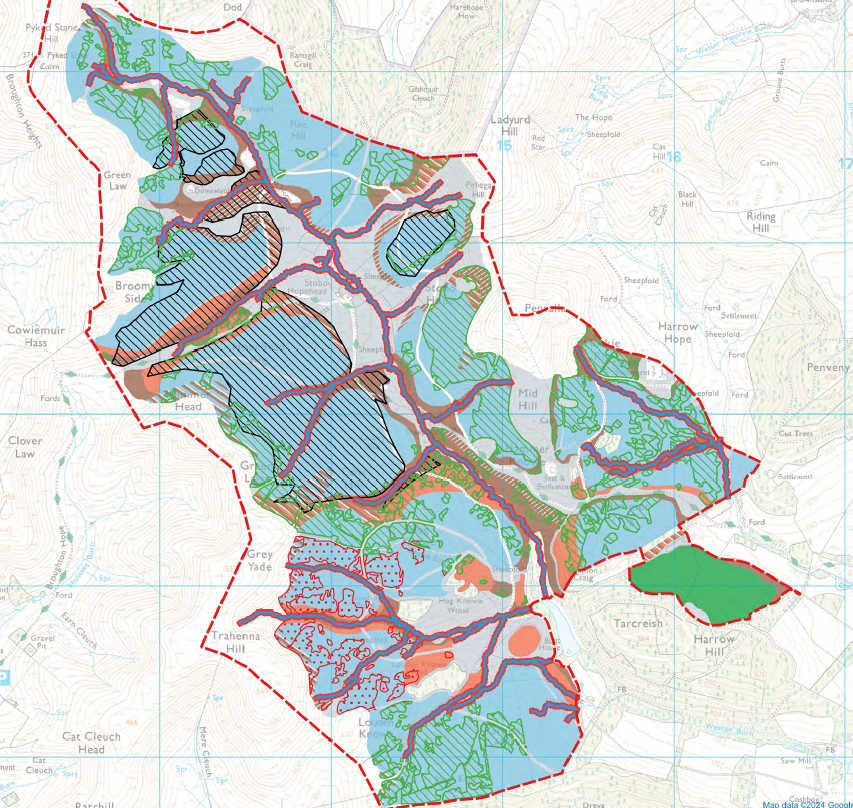
A ‘Heather Control Map’ by Euroforest Silviculture shows the area sprayed with herbicide in August 2023 (diagonal black lines), and the area to be sprayed with herbicide in 2024 (diagonal green lines).
Communications before mid-August 2024; the time before which Scottish Forestry were ‘made aware’ of blanket herbicide spraying
It appears the Director of Operational Delivery discussed Stobo in an email on 1 July 2024, after a media enquiry by the Scotsman about herbicide use at Stobo:
‘We think this concern refers to an area of heather which has been over sprayed with herbicide and completely killed. I noticed when I walked over the site, but not sure of the exact size of the area, certainly a few hectares, but not that extensive. The area is adjacent to the John Buchan Way’.

An email dated 3 July 2024 to the Director of Operational Delivery and copied to others, including Scottish Forestry’s Chief Executive Officer (CEO) Paul Lowe, states ‘The Stobo campaigners have posted the following video’:

The email link is to a video on You Tube, showing the herbicide damage at Stobo (see here).
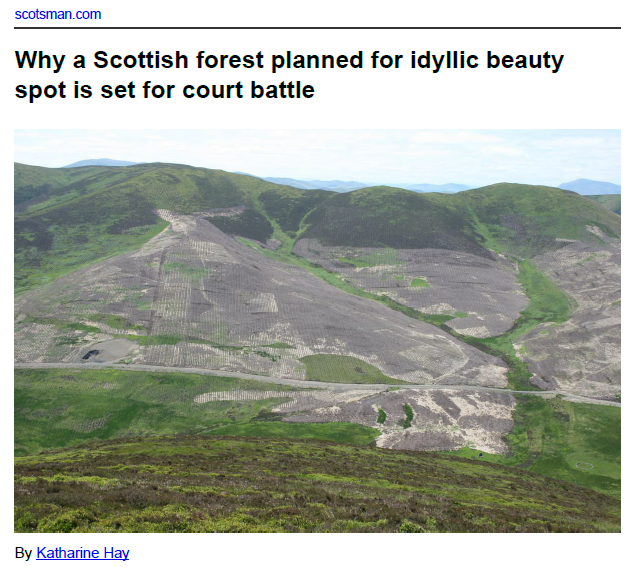
Scottish Forestry keep a record of media coverage of forestry matters, with documents dated 3 and 14 July 2024 containing articles from the Scotsman (see here) and Times (see here) respectively, showing pictures of herbicide destruction, such as this:
On 10 July 2024, an email was sent to staff including the Director of Operational Delivery and CEO, stating ‘For info – Raptor Persecution pushing the fundraiser’, providing a link to a Raptor Persecution UK article:

This blog article ‘Your help needed – ‘Save Stobo Hope from commercial forestry project’ (see here), had quoted from the crowdfunder webpage, mentioning the herbicide impact as having:
‘wiped out important plant communities including heather, blaeberry and many species of wildflowers, grasses, ferns, lichens and mosses. This will also have had a devastating effect on faunal populations, destroying the habitat, cover and food supply for mammals, birds, reptiles and invertebrates including the red-listed black grouse‘
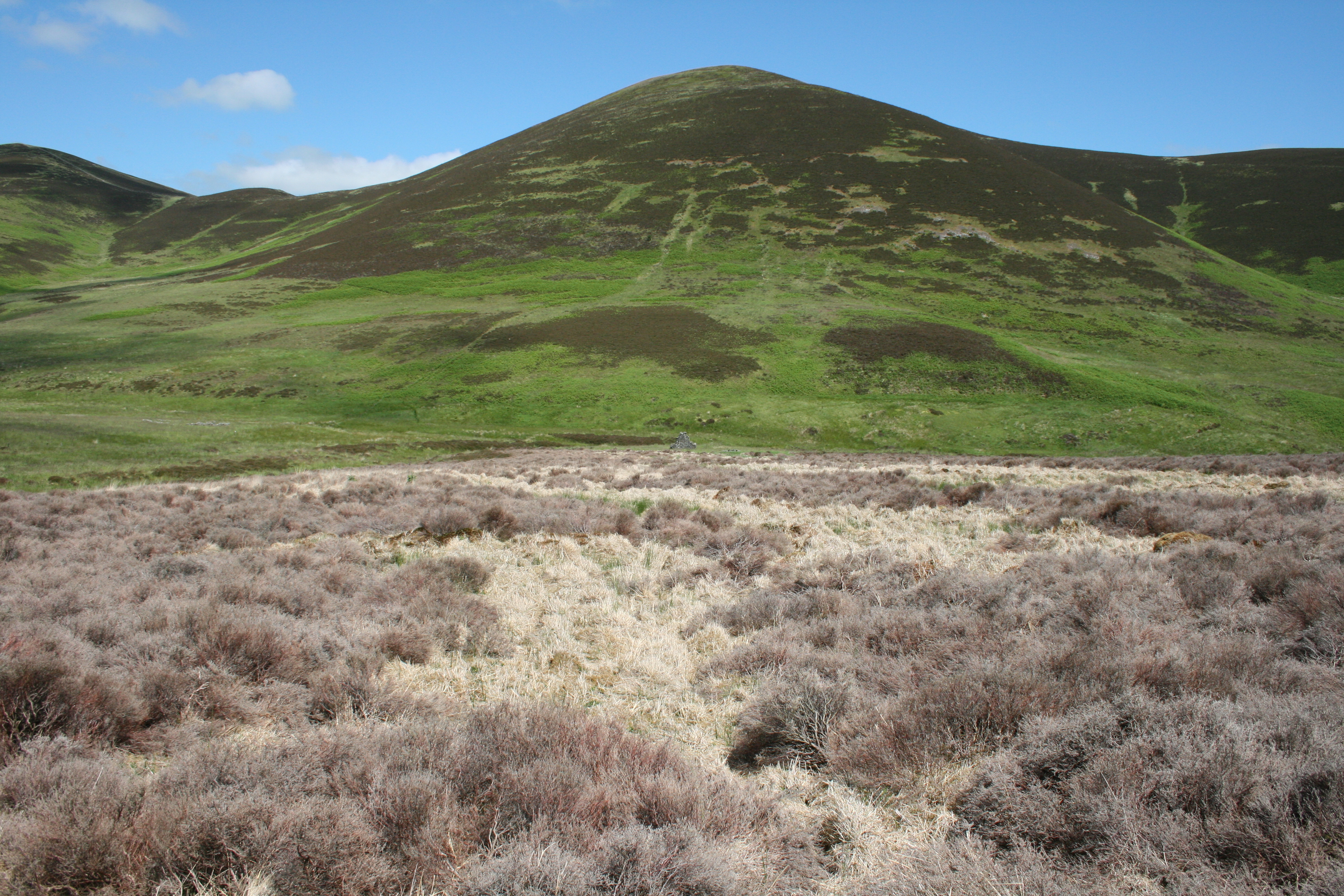
This article contained an identical picture published by the Scotsman on 4 July 2024, and further pictures of the damage from herbicide, including this picture taken in June 2024 along the John Buchan Way:
When did Scottish Forestry become aware of the August 2023 herbicide application?
Let us recall Scottish Forestry stating in September 2024 that they had visited the site in early summer and ‘even then there were no clear signs of the extent of the herbicide spraying’. They also stated ‘it was only when the petitioners presented their papers in [mid-] August [2024] we were made aware of the herbicide spraying’.
This claim seems to be rather unconvincing. Alternatively, it could be that senior Scottish Forestry staff were only aware of the media articles, but didn’t read them. Perhaps these staff saw the links to the video of the herbicide destruction and to Raptor Persecution UK, but did not visit these sites. It may even be Scottish Forestry staff visited Stobo when it was dark, or there was a thick fog, not unknown in the Scottish Borders.
ENDS
 Raptor Persecution UK
Is this kind of herbicide application routine in Scotland prior to planting Sitka etc. ? I Live adjacent to these kind of plantations and am aware the landowner already uses herbicide instead of cutting back grass and foliage along tracks, presumably because it is the cheap option, without regard for the effects on plants, wildlife or ultimately the humans who live near or walk along these tracks.
“Did Scottish Forestry know Stobo Hope was ‘napalmed’ with herbicide long before ‘new information came to light’?”
It looks like it to me.
“our staff visited the site in early summer and even then there were no clear signs of the extent of the herbicide spraying“
I don’t believe them.
liar liar pants on fire springs to mind.
sounds like Scottish Forestry are another regulator whose function is mainly an economic development agency. (Yes NatureScot , I mean like you)
Could we conclude that this is a case of Misconduct in Public Office by Scottish Forestry? This is a criminal offence. It would be interesting to know who visited the site and what documents exist in relation to this.
Interesting article. It was clear at the time Scottish Forestry revoked consent to avoid judicial review. A potential Scottish Forestry cover up needs to be investigated to ensure public confidence in the regulator and The Scottish Government, as this article cites evidence that not is all as they say. Tree planting in Scotland and the UK is important for our climate and biodiversity crisis – but it needs to be done right. Scottish Forestry are letting the Scottish people down.