
The debate on banning driven grouse shooting took place at Westminster Hall on Monday 30 June 2025, as a result of Wild Justice’s petition passing 100,000 signatures.
Wild Justice shared its views on the debate in its newsletter this morning, as follows:
On Monday afternoon, and in a 34-degree heatwave, Wild Justice headed to the Houses of Parliament to watch our petition be debated by backbenchers in Westminster Hall. This is the third time in nine years that a petition on this subject has met the criteria for a debate (100,000 signatures) but the first time under a Labour government. A massive thank you to everyone who helped it past the threshold (again).
Following Labour’s woeful response to our petition when it reached 10,000 signatures – in which they stated, ‘The Government has no plans to ban driven grouse shooting’ (see our blog here) – we didn’t have high hopes for a particularly reasoned or informed debate.
Only two Labour MPs turned up to contribute on Monday – the brilliant Olivia Blake MP (Sheffield Hallam), and Sam Rushworth MP (Bishop Auckland). [Ed: actually there was a third Labour MP, Joe Morris from the Hexham constituency, who didn’t make a speech but did make one intervention to ask about introducing vicarious liability for landowners as in Scotland].
As usual, Olivia – whose constituency yielded the highest number of signatures on our petition, and whose residents have to live alongside the polluting smoke and flooding caused by driven grouse moors – was brilliant. As the standalone backer of our petition in the debate, she clearly and firmly articulated her support, highlighting the subjects of air pollution, environmental degradation and criminal activity.
An amusingly dry comment was her suggestion to those employed, often on very low wages, by the industry charging up to £7,000 for a day’s grouse shooting; “If I were a beater, I might be unionising to take more of that profit home to my family.”
Mr Rushworth’s arguments were less coherent, stating firmly his dedication to animal welfare and his stance against fox hunting, whilst also defending an industry known for its illegal persecution of birds of prey and its legal, yet unethical, killing of wildlife such as the routine killing of foxes, referred to by the industry as ‘vermin’.
Why did so few Labour MPs – and not a single Green MP – turn up to the debate? Is this subject deemed by them to be in the ‘too difficult’ category? Are Labour perhaps wary of upsetting other ‘countryside’ groups after the reprisals over their unpopular ‘family farm tax’ proposals? Or do they simply not care about the widespread criminality and environmental damage associated with driven grouse shooting?
We know lots of you contacted your MPs over the last few weeks and asked them to attend the debate on Monday – so they can’t argue that they were unaware of the issues or of the debate. It would be interesting to hear how they account for their absence if any of you decide to challenge them on it.
Ban Driven Grouse Shooting – a game of BINGO
Although there was an almost empty house to defend our petition, we did enjoy a full house of grouse shooting BINGO. When challenged on its bad practices and poor track record, the driven grouse shooting industry has a few well-rehearsed and worn-out lines it peddles on repeat. Watching the debate on Monday we enjoyed crossing off the usual list of cliches, tropes and outright lies.

Some of our highlights included:
Claims that the driven grouse shooting industry has a ‘zero tolerance for raptor persecution’. Last week the RSPB published new figures which showed 102 Hen Harriers have been confirmed or are suspected to have been illegally killed between 2020 – 2024, mostly from areas managed for driven grouse shooting in northern England.
By the way, Greg Smith MP gets the star bonus prize for the most absurd statement which made us laugh out loud during the debate: ‘Gamekeepers are not the enemy of the hen harrier; they are its strongest ally in the uplands’. Mr Smith (a self-declared member of the Countryside Alliance & BASC) can look forward to a fruitful career on the panto circuit when his parliamentary career is over.
‘The UK has 75% of the world’s heather moorland, which is ‘rarer than rainforest’’. Upland heather moorland is an artificial, man-made habitat created by management techniques including burning vegetation on vast areas of peatland, causing air pollution and increasing carbon emissions. The ‘75%’ myth is also totally inaccurate and was debunked six years ago in this excellent blog by Professor Steve Carver of Leeds University.
‘Managed grouse moorland also provides a defence against tick-borne diseases’. This desperate claim came from Shadow Defra Minister Robbie Moore MP, and its irony wasn’t lost on us. A recent scientific study suggests that ticks found in woodlands where lots of Pheasants are released are two and a half times more likely to carry Lyme disease bacteria than ticks found in woodlands where no Pheasants are released (see here). Perhaps the ‘guardians of the countryside’ should consider stopping the annual release of 50 million non-native Pheasants if they’re so concerned about the prevalence of tick-borne diseases.
Daniel Zeichner, Defra Minister for Food Security and Rural Affairs, rounded off the ‘debate’ by providing the Government’s position on our petition. He repeated Labour’s earlier stance about having no plans to ban driven grouse shooting but this time adding, “we keep options under close review”. Not close enough, obviously.
He did acknowledge the cast-iron link between driven grouse shooting and the illegal persecution of birds of prey but then feebly muttered, “There are strong penalties in place for offences committed against birds of prey and other wildlife, and anyone found guilty of such offences should feel the full force of the law. Penalties can include an unlimited fine and/or a six-month custodial sentence” (emphasis is ours).
These statements are routinely trotted out by Defra in an attempt to gaslight the public into thinking there’s no need to worry about illegal raptor persecution because measures are in place to tackle it. The very reason that raptor persecution continues on driven grouse moors is because the criminals there know that (a) there is only a miniscule chance of being caught, and (b) even if they are caught, the punishment is of little consequence. The one, and only, custodial sentence ever given to a gamekeeper for committing raptor persecution offences was a case in Scotland in 2014, when a gamekeeper was filmed by the RSPB trapping a Goshawk and clubbing it to death with a stick, amongst other offences. He was given a four-month custodial sentence. Every other gamekeeper convicted since then has received either a small fine (probably covered by his employer) and/or a short community service order.
There’s no effective deterrent and Labour’s trite regurgitation of the words ‘should’ and ‘can’ demonstrates its appalling unwillingness to stop this brazen criminality. That is unforgiveable.
There was one spark of credibility in the Minister’s closing speech, and that was his referral to the Government’s recent public consultation on proposals to extend the Heather and Grass etc. Burning (England) Regulations 2021, including a change to the definition of deep peat from 40cm depth to 30cm depth, which would effectively ban the burning of heather on many driven grouse moors across northern England. It was evident from the speeches made by the Conservatives in the debate that this issue is of HUGE concern to them and their grouse-shooting mates. We look forward to hearing the Government’s announcement on those proposals in the near future.
John Lamont MP (Berwickshire, Roxburgh and Selkirk) first introduced and then concluded the debate, saying in reference to the petition’s 104,000 signatories, “I suspect those people will be a little surprised by the lack of balance in this debate.”
Was Wild Justice surprised at this lack of balance? No, not at all. But motivated? Absolutely. We will of course not be giving up when it comes to the fight to end this environmentally damaging and unjust so-called ‘sport’, mired in wildlife crime and savage animal cruelty.
Onwards and upwards!
ENDS
I must confess that I pretty much zoned out during the ‘debate’, such was the predictability of the propaganda/speeches from the pro-grouse shooting MPs. I was mostly interested in what DEFRA Minister Daniel Zeichner would have to say at the end of the debate. Whilst waiting for him to speak, though, my ears did prick up at the specific mention of some infamous grouse moor areas.
We had Kevin Hollinrake MP (Conservative, Thirsk & Malton) say this:
“I have beautiful moorland, including in Hawnby, Bransdale, Farndale, Snilesworth and Bilsdale—I am very proud of those areas and have visited a number of times“.
All of these locations have featured on this blog over the years: Hawnby, Bransdale, Farndale, Snilesworth and Bilsdale.
The grouse moors of the North York Moors National Park have long been identified as a raptor persecution hotspot, and North Yorkshire as a whole is repeatedly recognised as the worst county in the UK for reported raptor persecution crimes. Not much to be proud of there, Mr Hollinrake.
Sam Rushworth MP (Labour, Bishop Auckland), whose constituency includes some notorious grouse moors in the North Pennines, which is another well-known raptor persecution hotspot, spoke about attending a recent ‘Lets Learn Moor’ event with primary-age schoolchildren. He also mentioned being “disgusted by the criminality that sometimes occurs on the moorland“. I wonder if he realises that these events, funded by BASC, are facilitated by the Regional Moorland Groups, many of whose members have been under police investigation into suspected and confirmed raptor persecution crimes? Awkward. [Ed: Update 3 July 2025 – Pro-grouse shooting Labour MP Sam Rushworth received £10,000 donation from local grouse moor gamekeeper group – here].
And then there was Jim Shannon MP (DUP, Strangford, NI), a fully-signed up member of the Countryside Alliance, BASC and the Ulster Farmers Union, who treated us to this:
“I want to mention the Glenwherry shoot, which is the only grouse shoot in Northern Ireland. It is sponsored by BASC and the landowner. It is a success, but why is that? To start with, Glenwherry had no more than about 10 grouse, but it built that up. As others have said, the magpies, the crows, the greybacks, the foxes and the rats —all the predators—were controlled. It was gamekeepered, and the heath and moorland was burnt in a controlled burning, so that it could regenerate and produce the heather for the young birds and the grouse. Today, that is a successful grouse shoot. Why is it successful? Because grouse shooters know how to do it. They know how to deliver a successful grouse shoot. The lapwings and curlews also gathered momentum as a result. They have a place to breed every year because of the efforts of the gamekeeper and the landowner—the efforts of those who put money into the grouse shooting to make it a success“.
Would that be the same Glenwherry grouse moor shoot where two illegally poisoned White-tailed Eagles were found dead, side by side, in May 2023? Strange that Mr Shannon forgot to mention them.
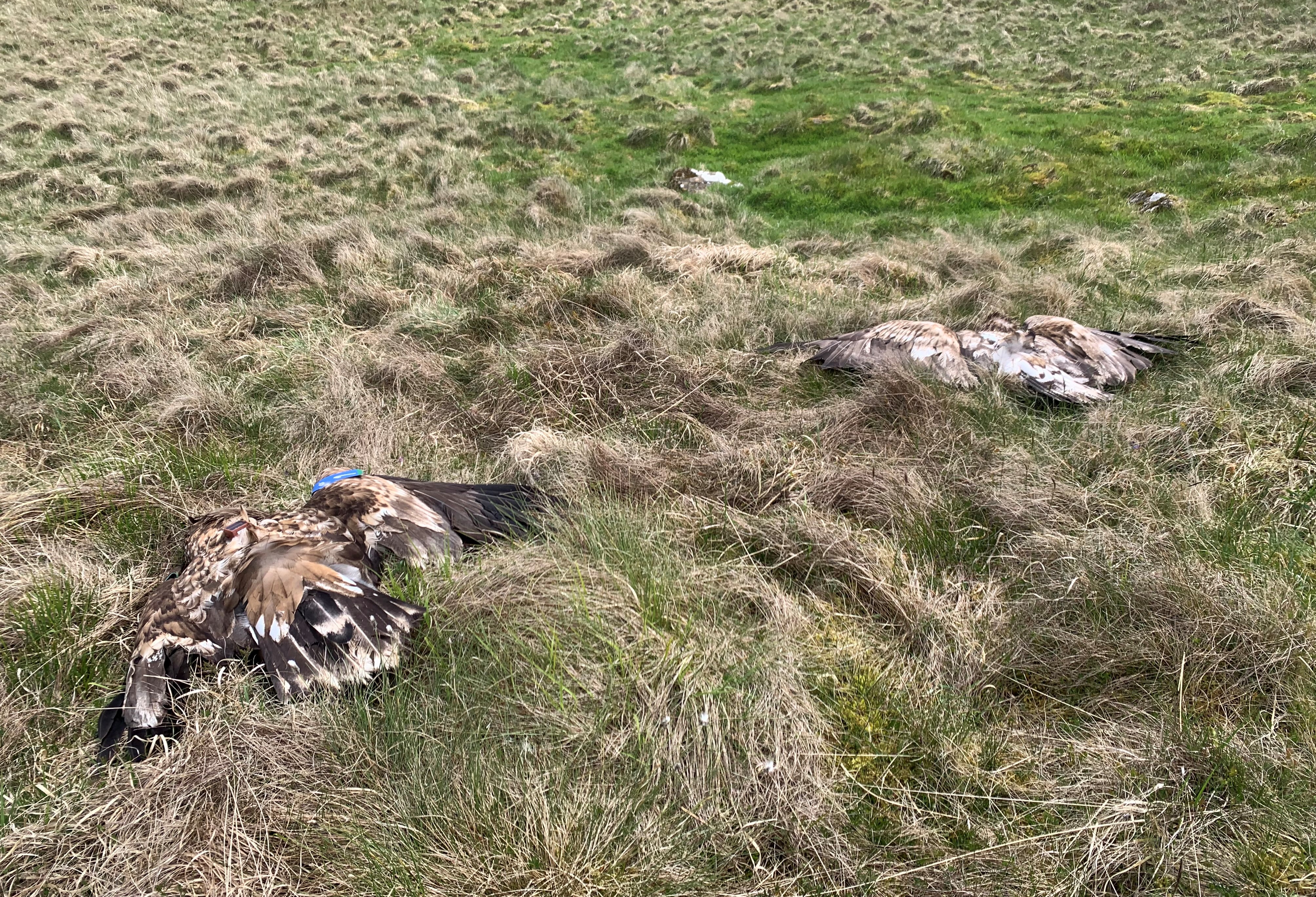
Hen Harriers were mentioned throughout the debate but it was Minister Zeichner’s reference to the Hen Harrier Taskforce, “…which is using technology such as drones and strategic partnerships to detect, deter and disrupt offenders and is targeting hotspot areas and suspected hen harrier persecution” that caught my attention.
Zeichner claimed that, “Early signs suggest that it is having a positive impact“.
Really? That’s not my understanding. The HH Taskforce has been withholding details of multiple suspected and confirmed Hen Harrier persecution incidents over the last year. There are probably legitimate reasons to withhold information about the most recent cases as the police investigations are active but some of the other cases date back many months, some of them from over a year ago. It is simply not credible to argue that making an announcement about those cases will affect an investigation at this stage. I suspect there are other, political reasons for withholding those cases from the public and I’ll set out my reasoning in future blogs – there’s too much to include here.
For those who want to watch the recording of the Ban Driven Grouse Shooting debate you can find it here.
For those who want to read/download the debate transcript, it’s here:
UPDATE 3 July 2025: Pro-grouse shooting Labour MP Sam Rushworth received £10,000 donation from local grouse moor gamekeeper group (here).
UPDATE 5 July 2025: RSPB response to Westminster Hall debate on banning driven grouse shooting (here)
 Raptor Persecution UK
I was also at the debate, and while I agree with everything Ruth has said I do also have a couple of more positive thoughts. First, this time it was a fairly civilized debate, vastly better than the previous one which the massed Tory MPs used to demonstrate their naked contempt for the petitioners and their entitled misyogeny towards the (Labour) female MPs present. The MPs’ behaviour last time was shameful, this time it was more that I disagreed with them. It’s a very low bar indeed but the ministerial statement at the end was also vastly more substantive than Therese Coffey’s mumbled disinterested dismissal.
The other issue I took away was about how to manage fire risk, something we’re concerned with here on the Quantocks (but N.B. we have no grouse or deep peat!) . The arguments against driven grouse shooting are mostly well rehearsed, but I think we probably need to put some more thought into the fuel load issue. It is a legitimate concern that I don’t think the anti argument has convincingly addressed yet. If we were talking in the pub not watching in Parliament it was the one thing the pro lobby said that I might have struggled to adequately counter.
Actually there is one more positive – I thought the debate left the door at least slightly ajar for looking again at additional measures to counter raptor persection, definitely not where the previous debate ended.
“I think we probably need to put some more thought into the fuel load issue. It is a legitimate concern that I don’t think the anti argument has convincingly addressed yet.”
In the ‘debate’, Tory Greg Smith (Mid Buckingham) said “Moreover, grouse moor management is vital in the fight against wildfires. Controlled cool burns remove the tinder-dry heather that fuels devastating wildfires… Managed moors act as fire breaks. Unmanaged ones become kindling.”
Kevin Hollinrake (Thirsk and Malton, Tory) added “Natural England is considering a consultation on reducing that figure to 30 cm. That would mean that the vast majority of the fuel load on the North York moors would not be able to be controlled by burning.”
Heather is key to feeding Red Grouse but it cannot thrive in waterlogged ground: it is a specialist drought-tolerant plant.
Hence, grouse moor management consists of systematically draining the moors to prevent all-year-round waterlogging of the heather.
At the Tarras Vally Nature Reserve, for example, one of the first tasks was to block the artificial drains and ditches of this ex-grouse moor, in order to restore its peat.
Who would expect a permanently wet, natural, peat moorland to form as high a ‘fuel-load’ as that of a deliberately drained moorland?
And what happened to our natural peat moorlands before grouse moor management was invented? Were they regularly destroyed by wildfires? If so, how did the peat manage to form and survive for millennia, becoming ever deeper?
So how did these much-maligned unmanaged moorlands manage to survive before human intervention? Magic?
On the other hand, there is plenty of evidence that drained peat shrinks.
There is also plenty of evidence that modern, grouse-moor managed so-called cool burns (yet, somehow, heather always ignites at the same temperature) lead to not only accelerated peat erosion (and consequent water supply pollution) but also to increasing run-off causing flash floods.
And then there is the wholesale destruction of higher wildlife and the beneficial microflora and fauna in the peat caused by these artificial burns, the adverse health effects on people from increased air pollution and the general increase in greenhouse gas emissions.
I wonder, does this fake obsession with ‘fuel-load’ from the shooting industry and certain Tory MPs extend to woodland, say? What would that mean for society?
Although it is not the same, since we banned the annual burning of agricultural straw has there been any increase in the number of farmland wildfires? My experience is that farmland wild fires have noticeably decreased following the ban on burning straw – for obvious reasons – because they were linked with an increased risk of the artificial fires spreading out of control.
Of course, the alternative proposal for providing varied heather heights to the grouse shooting industry is to cut and remove, but that is far too much hassle for those people.
I wrote to my MP one Kate Dearden,didn’t even get a reply,at least her predecessor would do you the courtesy of a reply.Both labour MPs.
A massive Thank you to all who worked hard and represented us all at the Debate.
We will continue to support you. The fight goes on.
We concur, Krysia – grateful thanks to you all.
That fiasco of a debate has set us back but we carry on.
As a Green Party member of long standing, I have written to the 4 Green MPs asklng why they did not attend. Caroline Lucas would never have ignored this important matter.
I have also written to my (Labour) MP, another absentee – tho’ he always replies to my messages, he has never done so when it concerned DGS.
Have you had any responses from the four Green MPs?
Even if we take on trust the 75% figure for the UK’s share of heather moorland, the ‘rarer than rainforest’ claim is an absurd comparison on which to stake its importance. The importance of rainforest does not reside in its scarcity – in fact there are vast expanses of it – but in the fact that it is vast, astonishingly biodiverse and critical in processes that maintain stability of climate (amongst other things). Grouse moors on the other hand are managed in a manner that simplifies and reduces their biodiversity and exacerbates greenhouse emissions. The attempts of the shooting industry to suggest that their management of grouse moors is somehow even more important than efforts to conserve rainforest are hubristic rubbish.
I was interested in what you have to say in the blog about the Hen Harrier Taskforce. I wrote to my MP months back to complain about the insulting written response when the petition reached 10,000 signatures and asked her to forward my email to the relevant minister for a response. When I finally received a reply (from Baroness Hayman) 3 weeks ago it failed to defend the Defra response at all, but included the following paragraph:
” In 2024, the NWCU-led Hen Harrier Task Force was launched. This Task Force aims to
detect, deter, and disrupt offenders, particularly those persecuting rare hen harriers, by
using technology and improving partnership working. According to the lead officer of the
Task Force, after starting its visits in early 2024 to areas deemed to be ‘hot spot’ areas
for hen harrier persecution, there has not been a single suspected incident involving a
tagged hen harrier in any of these locations. While I appreciate this only relates to the last
12 months or so, it is a promising development. “
so I will be very interested in any information you have which challenges this.
I have a question. But first, as I have said before, I am no fan of driven shooting although I do approve of ‘one for the pot’ hunting and practice it regularly.
So my question is this. Is there anywhere I can find what happens to the grouse moors if or when driven shooting is banned? Who looks after them? Where does the money come from? Is there a published plan? I read about the Reclaim Our Moor group and found their website which says nothing apart for one page stating a desire to take it into community ownership which, quite frankly, is a waste of good Internet space!
I would suggest that if a ban is to gather more momentum, certainly more than the few, hard-core supporters (and 100,000 is a tiny percentage of the population), there needs to be a plan. It is no good protesting without providing an alternative because without this no intelligent person will give it credibility.
Now I am sure such a plan exists, but where and why is it not shouted about? And equally important, do all those seeking a ban support it?
Can only speak for myself. I personally don’t need the “Haynes manual” of what every landowner who currently manages for driven grouse would or would not do if/when it is banned. I would suppose that many landowners would still look to derive some income from grouse shooting / sporting leases, but in forms that would not include driving. For me it is just a matter of conscience anyway – I signed the last petition and will sign future petitions until wildlife crime ceases to be a “necessary” part of moorland management – i. e. something that we just have put up with.
“So my question is this. Is there anywhere I can find what happens to the grouse moors if or when driven shooting is banned? Who looks after them? Where does the money come from? Is there a published plan?”
Who ‘looked after’ the moors before driven grouse shooting was invented? They didn’t need to be ‘looked after’ then, did they? They existed in their natural state. Why do they need to be ‘looked after’, now? (unless you are referring to the appalling damage done to our high moorlands by their callous owners, which could be restored (at their expense)?)
Why does there need to be a ‘published plan’?
The shooting industry is a tin pot, anachronistic, enterprise dwarfed by the once ubiquitous smoking industry. When we banned smoking, nobody gave a damn about what would happen to cigarette manufacturers, nobody ‘looked after’ them, no money was required to do so, and no ‘plan’ was published: a damaging activity was simply banned.
I endorse completely RPUK’s comments made here and agree with the first commentator that this debate came across better than the previous one nine years ago. At the risk of repeating some of what has been written about the 30/6/2025 debate already, principal points that I took from it were these:
Confusion as to the distinction between banning grouse shooting and banning driven grouse shooting, the latter of course being the subject of the petition.
The absurdity towards the end of the opening speech (John Lamont) that “……the industry is regulated effectively and because crimes are prosecuted.” How frequently are they in fact prosecuted?
The criticism of Natural England re the 40cm/30cm deep peat issue.
Uncertainty (in my mind anyway) as to the percentage of the world’s heather moorland that is located in the UK.
Apparent over-emphasis on grouse moor management as a contributor to peatland restoration since non-grouse moor areas are significant contributors,
A glimmer of hope from the DEFRA Minister’s closing speech as to possible future measures to tackle wildlife crime.
A key (and anticipated) conclusion for me at the end of the debate was that efforts of one sort or another in order to tackle raptor crime will have to be redoubled.
I indulged in a bit of light relief at times during the debate (permissible surely) at the attempts of the machine that converts speech into written words on the computer screen. Gems among these were curl you, Alex for at leks, Pete, waiters for waders, gospels for goshawks, grace shouldn’t top of August for grouse shooting 12th of August and londoners for landowners. I don’t blame the machine in this difficult task.
“I indulged in a bit of light relief at times during the debate (permissible surely) at the attempts of the machine that converts speech into written words on the computer screen….”
The UK Parliament use a combination of live-captioner (re-speaking the debate) and automatic machine transcription of the live-captioner’s voice, to produce real-time subtitles for live debate. It is the live-captioner’s job to vocalise punctuation, and to set keywords for specialist jargon (curlew etc). Very difficult job, and often results in hilarious ‘typos’…
Concerning the Westminster Hall debate on banning driven grouse shooting: “Why did so few Labour MPs – and not a single Green MP – turn up to the debate?”
That abysmal turnout did not really surprise me: I do not regard any political party in England to be principally ‘environmental‘ in outlook, and that includes my view of the English Greens.
Note: I do not include Scotland in this ‘observation’. I think there are instances where both Scottish Labour and Scottish Greens have stood up for nature (without feeling the need to claim some alternative – economic – motive for doing so).
I have long challenged English political parties on environmental matters (I have also met a few of their ‘senior’ members in my time… and ‘crossed swords’ with a certain ex-parliamentary Green candidate) and the results have uniformly disappointed.
The Labour Party consistently decline to engage. The Tory Party do not even facilitate communication. Both the Lib Dems and the Green Party have denied to me, for example, that the wildlife crisis is entirely anthropogenic in nature (they see nothing wrong/dangerous with expanding the human population as much as possible). The Reform Party, so much as they have a policy, are conflicted on the issue.
The few senior Greens I have known are simply not driven by concerns solely about wildlife. Like the Lib Dems, the environmental matters which do concern them are those which directly impact people. That, to me, is a vital difference.
The Labour Party are agnostic towards wildlife. They are an urban party, and born from the Trade Unions (as I am). The English Labour Party do not even see anything wrong with greyhound racing (and here is an instance, for example, of where the Welsh Labour Party is showing signs of caring for animal welfare beyond economics).
On the other hand, I have come across individuals in all of these parties who do care about wildlife for its own sake.