
Press release from the RSPB (26 June 2025):
NUMBER OF HEN HARRIERS KILLED OR MISSING REACHES NEW HIGH
- Over the past five years, record numbers of Hen Harriers have been killed or have gone missing according to a new report from the RSPB.
- Most of these incidents have occurred on or near grouse moors in northern England.
- The RSPB is calling on the Westminster Government to introduce licensing of grouse shooting in England as has happened in Scotland to act as a meaningful deterrent to wildlife crime.
One of the rarest birds in the UK – the Hen Harrier – has seen record numbers being illegally killed or going missing in suspicious circumstances over the past five years.

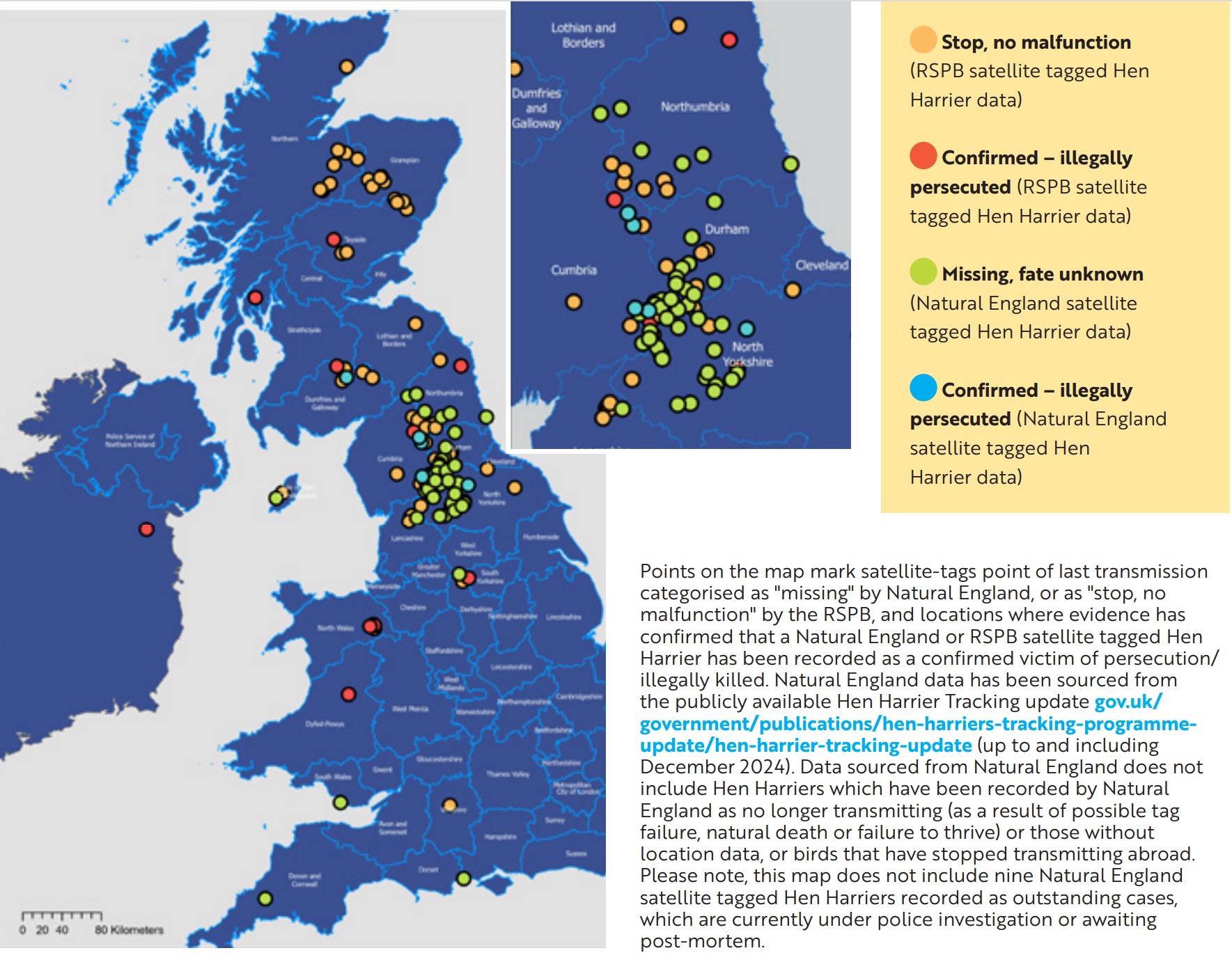
A new RSPB report – Hen Harriers in the firing line – shows that the majority of the 102 incidents occurred on or near grouse moors. Hen Harriers breed in the uplands of Britain and this is where they come into conflict with grouse shooting.
Hen Harriers are a rare, protected species, known for their acrobatic ‘skydancing’ courtship display over the uplands. The Hen Harrier is categorised as a red-listed species in the UK, due to its low breeding population levels, following historic declines as a result of human persecution.
Despite several conservation initiatives over the past twenty-five years, the Hen Harrier is now the most persecuted bird of prey in the UK for its population size.
The UK population increased between 2016 and 2023, however, 2023 was the worst recorded year for persecution. Hen Harriers remain far less abundant or widespread than they should be, and the current UK population estimate represents only a quarter of the potential population their ideal habitat can support, and in England it is less, about 10%.
Despite being legally protected, multiple studies and reports confirm that criminal activity is the main factor limiting the recovery of Hen Harrier in the UK, causing a reduction in nesting success, annual productivity, and survival of breeding birds. Despite decades of persecution no one in England has ever been convicted of an offence. Most of these crimes take place in remote areas where such activity is hard to detect and a criminal burden of proof against the perpetrators near impossible to secure.
Dr James Robinson the RSPB’s director of operations said “The last five years have seen a record number of illegally killed or disappearing Hen Harriers with 102 suspected or confirmed incidents, the majority happening on or close to grouse moors. This species will not recover until the criminal activity stops, and for this to happen we need regulation of the grouse shooting industry, specifically, the introduction of a licencing system for shoots in England, so estates proven by the Police and Natural England to be linked to raptor persecution would simply lose their licence to operate.”
Another recent study which investigated the illegal killing of Hen Harriers in association with gamebird management showed that the survival rates of Hen Harriers in the UK are “unusually low” with birds surviving for an average of just 121 days after leaving the nest, and persecution accounting for 27-41% of deaths of Hen Harriers aged under one year and 75% of deaths in birds aged between one and two years. It also highlighted a strong overlap between Hen Harrier mortality and the extent of grouse moors.
This new report contains the details of Hen Harriers being shot, their chicks being stamped on and one bird having its head pulled off whilst still alive. This alongside 112 satellite-tagged birds disappearing on or near grouse moors between 2010 and 2024 has led the RSPB to yet again call on the government to regulate the industry and licence grouse moors, as is now law in Scotland.
The Wildlife Management and Muirburn Act, passed in March 2024, means all grouse shoots in Scotland require a licence to operate, and this licence could be revoked if evidence suggests a crime has been committed. Licensing is based on evidence to a civil burden of proof, meaning that it is easier to take action when persecution has taken place. This progressive legislation will help ensure legal and sustainable management across a significant area of upland Scotland and introduces a much-needed deterrent for those who kill birds of prey for economic reasons. But England now lags behind.
This report comes ahead of a parliamentary debate at Westminster Hall on Monday 30 June on the future of Grouse Shooting, triggered by petition launched by the campaign group Wild Justice. Over 100,000 people signed their petition calling for a ban on driven grouse shooting, as they, like the RSPB, want to see an end to the illegal killing of birds of prey and other harmful practices associated with the grouse shooting industry. Action on this issue by Government in England is long overdue, and we will be expecting to hear how the Government intends to end the killing, before it is too late for England’s Hen Harriers.
ENDS
The RSPB’s new report can be downloaded here:
The RSPB is to be congratulated for putting this report together. A lot of the information contained within it is already well-known, but this report brings it all together in one place. What is new is the hotspot mapping of satellite-tagged Hen Harriers (both RSPB-tagged birds and Natural England tagged birds), and although the detail is coarse, the overall distribution pattern is clear, showing the main hotspots in areas where the land is intensively managed for driven grouse shooting.
The timing of this publication is also very helpful, given the forthcoming Westminster debate on Wild Justice’s latest petition calling for a ban on driven grouse shooting, which takes place next Monday (30 June 2025).
It’s clear from both the press release and the report that the RSPB prefers a licensing approach to regulate driven grouse shooting, rather than a ban. There will be many who disagree with that stance, me included, although I wouldn’t object if Labour committed to bringing in a licensing scheme because it’s better than doing nothing at all and will take us one step closer to getting a ban when the licensing scheme inevitably fails. But now is not the time to argue about that.
The bigger picture here is that the Labour government, and MPs from other parties, have an opportunity to put on record what they think about the scale of the criminal raptor persecution that continues on many driven grouse moors.
The ongoing illegal persecution of raptors is the most difficult of all the issues associated with driven grouse shooting for the shooting industry to defend. It’s a crime, it’s abhorrent, the public hates it, and the evidence showing the extent of it just keeps piling up.
The shooting industry has no defence for it so instead it has resorted to a long-running campaign of smearing those of us who have brought the persecution issue to the public’s attention, in a desperate attempt to discredit our reputations and integrity.
In the run up to this latest Westminster debate, several shooting organisations have tried to play down the significance of another debate on this issue and have argued that this latest debate is pointless and that MPs have more important things to be discussing and there’s ‘no threat here to grouse shooting’. It’s telling though, the amount of pro-grouse shooting propaganda those same organisations have been frenziedly pumping out in recent weeks – it reveals that they are indeed concerned that the public spotlight will once again be on their criminal and environmentally damaging activities.
It’s also been revealing to watch the different organisations contradictorily falling over themselves in a bid to impress their members, by each claiming to be ‘leading the charge/fight’ against us pesky campaigners. For example, on 29 May 2025 the Countryside Alliance ran this headline: ‘Countryside Alliance leads charge against Westminster anti grouse shooting debate‘ and on 10 June 2025 a BASC headline read: ‘BASC leads the fight for driven grouse shooting ahead of debate‘. This level of posturing is a bit of a giveaway as to their level of concern.
This latest report on the illegal killing of Hen Harriers on grouse moors deserves widespread exposure in the run up to the debate so I’d encourage you to email a copy to your MP, ahead of Monday’s debate, and let them know that this issue matters to you and should be of deep concern to them.
I’m not expecting an immediate change of policy to result from Monday’s debate – that would be naive. And I’m fully expecting the usual sneering and snorting from certain members, especially those with a vested interest in maintaining driven grouse shooting, although a lot of those who behaved so appallingly at the first debate nine years ago will no longer be there.
But what I am interested in is listening to those MPs who can demonstrate any modicum of environmental awareness, ecological understanding and intolerance of wildlife crime. It’ll be those MPs, hopefully from across all parties, who we’ll want to work with in the future because we have no intention of dropping our campaign, no matter which party is in Government in the coming years.
 Raptor Persecution UK
How can the game shooting industry and their apologists continue to claim that the industry is whiter than white when the evidence is quite clearly to the contrary?
[Ed: comment deleted as libellous]
I’ve written to my MP but don’t hold out much hope that the status quo in the Yorkshire Dales will change – how this criminal killing can go on in, supposedly, one of our most highly protected landscapes is a scandal and nature in general is being throttled by the management of many of our uplands
All wildlife should be protected, anyone Gamekeepers and Land Owners should be prosecuted to the full extent of the law including imprisonment.
I just hope that the debate sparks the interest of new (mainly relatively young) MP’s, if nothing else. And they hear enough that concerns them to want to know more and to not be satisfied with accepting the usual lines of rosy fiction & a few cherry-picked truths – that is used to press the whole of the ugly truth out of view. This will hopefully lead enquiring minds to stick with this subject and to ask the questions – why is it impossible to independently scutinise the economics of this industry with accurate facts and figures, why are so many of the owners untraceable amidst a tangle of overseas companies, why do we not even know how many grouse are killed nationally or even by each estate / business – nevermind how many birds and mammals are killed (legally, nevermind illegally) just to produce those numbers of grouse.
It says most of these reports are on or near Grouse moors. Maybe this is because the majority of harriers live on or near moors.
“Maybe this is because the majority of harriers live on or near moors.”
Yes, exactly that. But…. these are actively-tracked, satellite-tagged, birds, whose reliable equipment suddenly stops broadcasting without any prior warning, and which then disappear from the face of the earth!
No carcass is ever found. No satellite tag is ever found. Search parties and, sometimes, sniffer dogs are sent out immediately to the last transmission point and find… nothing!
Sometimes, these suspicious incidents happen at night at Hen Harrier roost sites. But no satellite tag is found.
And with all the bird watchers around, these birds are never, ever, seen again…
Why?
Look at the number of orange and green dots in the mapping data. Why are they the vast majority?
Keith, there are different types of ‘moors’, including grouse moor, heather moor [dominated by heather but not managed for grouse shooting] and grass moor, as defined in the recent HH national survey. The distribution of breeding HHs is definitely not restricted to ‘grouse moors’.
Do the Hen Harriers that don’t nest on grouse moors ever visit the grouse moors to take prey ? (ones that live close enough if any) (sorry for being so uneducated on this)
Also, I’ve just read that the GWCT say that their team have ‘briefed’ MP’s ahead of the parliamentary debate triggered by Wild Justice’s petition to ban driven grouse shooting – are they allowed to do that ? and do Wild Justice or others get the opportunity to do so ? Some of the comments and pro-shooting arguments I read on the GWCT page I was on make me sick – but nothing new.
On your first point – yes, absolutely. The males will consistently range out to their regular “favourite” successful hunting spots to supply their female/young with food. This is precisely the problem on at least one large nature reserve.
The nest may well not be on a keepered grouse moor but when there is that phase during late spring/early summer on a nearby keepered moor when it is bursting at the seams with fluff-balls of tasty young grouse all on ground (burnt / mowed to be generally very short) that has very little cover for the mother to easily get the young into – it is extremely easy pickings. Same goes for Red Kites, Gulls and various other species, who are not much interested in grouse at all the vast majority of time.
This is the factor that feeds the “lore” of warped and ingrained owner/agent/keepers sense of righteous entitlement to protect “their grouse” from predatory birds “coming in” from elsewhere. Also was a (flawed) part of the justification for the brood meddling thing.
“Also, I’ve just read that the GWCT say that their team have ‘briefed’ MP’s ahead of the parliamentary debate triggered by Wild Justice’s petition to ban driven grouse shooting – are they allowed to do that ?”
spaghnum has fully answered your first question, and the answer to the above is broadly ‘yes’.
See https://www.parliament.uk/get-involved/contact-an-mp-or-lord/lobbying-parliament/
Thanks for the link Keith – suppose I could’ve / should’ve looked that up myself. And thanks for the info / reply spaghnum.
Ruth, I have just now sent your last paragraph to my MP with another reminder about the debate. He is a new young MP who maintains he is concerned about animal and environmental issues, so let’s see if he makes it to the debate and speaks up.
Thanks, lesleymarian, and well done for engaging with him.
The policy of the current administration which appears to be to continue and intensify the war on wildlife and the natural world started by the previous administration causes me to be pessimistic about the outcome of the debate.
It was depressing that only one side showed up to the debate. A number of grouse-shooting supporters came along and regurgitated the position of the shooting industry uncritically but there was really no-one there to challenge them, with the honourable exception of Olivia Blake. Once again we were treated to an economic ‘analysis’ of grouse shooting that simply ignored the costs to society and an ecological fantasy that suggested that keepered moors represent the pinnacle of biodiversity in Britain. And again, the distasteful spectacle of being told over and over how much everyone in the grouse shooting industry deplores the killing of birds of prey which nevertheless continues apace with virtually no adverse consequence for the estates that benefit from it or the organisations that promote grouse shooting.