
Just before Christmas 2024, Natural England published a blog that included information on the fates of two satellite-tagged brood-meddled hen harriers that had previously been listed as ‘Missing, Fate Unknown’.
These two young brood-meddled harriers (R3-F1-22 and R2-F2-20) had both ‘disappeared’ two years earlier, in December 2022, within days of each other, from the same winter roost site in the North Pennines.
Natural England’s December 2024 blog was the first time that NE had announced that the corpses of the two hen harriers had been found (one in April 2023 and the other in June 2023) and that both corpses contained shotgun pellets (three and two pellets, respectively).
In January 2025 Natural England updated its hen harrier satellite tracking database. Thanks to a sharp-eyed blog reader (you know who you are!), it was noticed that NE had finally, and quietly, published the grid references of where the dead hen harriers had been found (previously this detail had been withheld, apparently at the request of the police).
Natural England’s database now provides the following information about these two harriers:
Female, [Brood meddled]: R3-F1-22, Tag ID: 213921a, Date of last contact (i.e. date the satellite tag stopped functioning): 14th December 2022. Dead. Location: North Pennines NY708423. ‘Suspected illegally killed’. [Body found 10 April 2023].
Female, [Brood meddled]: R2-F2-20, Tag ID: 55144, Date of last contact: 7 December 2022. Dead. Location: North Pennines NY730372. ‘Suspected illegally killed’. [Body found 29 June 2023].
When I mapped these two grid references they were just under 5.5km of each other:
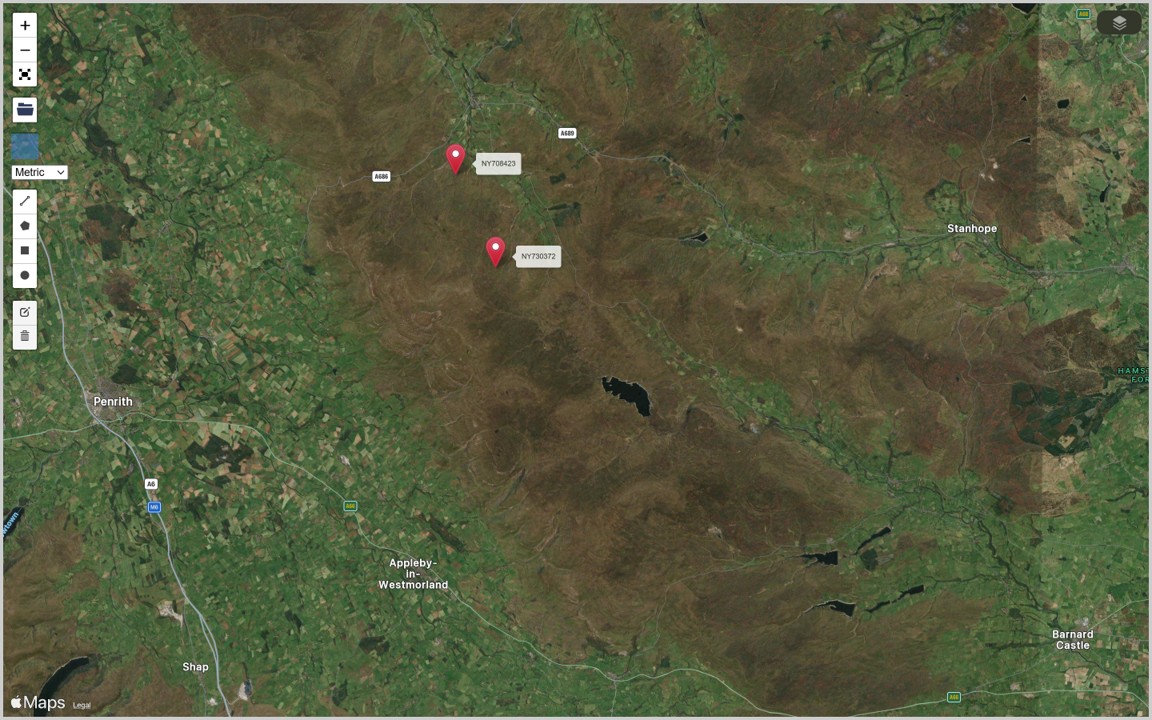
The dead hen harriers were both found on moorland managed for grouse shooting near Garrigill, in Cumbria:

Nobody has been charged with shooting these two harriers, presumably due to a lack of evidence – there’s no doubt they’d been shot at but where, and when, and by whom, remains unproven in a court of law.
The fact that the harriers disappeared from the same roost site within a week of each other, and their shotgun pellet-riddled corpses were found within 5.5km of one another on an area of grouse moor, is obviously just another one of those pesky coincidences that seem to happen so frequently unfairly in the world of driven grouse shooting (e.g. see here, here and here).
So keen is Natural England not to attribute the shooting of these birds to their deaths, the NE database states: ‘suspected illegally killed‘ [emphasis by me].
I was curious about this area of grouse moor and who owned it, so I looked up Guy Shrubsole’s earlier mapping work on his fantastic Who Owns England? website:

Guy’s map shows an area he calls ‘Townshends’ although he clarifies in his 2016 grouse moor database that this was the name of the owners, not the name of the estate. His database shows the owner as The Honourable Mrs Charlotte Anne Townshend and he reports that a CAP payment of £12, 178.33 was paid in 2014 registered under ‘The Honourable Mrs Townshend’.
The grid reference where the dead brood meddled hen harrier R2-F2-20 was found seems to be right in the middle of the estate area mapped by Guy, but the grid reference for the other dead hen harrier, R3-F1-22 appears to be outside of Guy’s mapped area, just to the north.
But it looks like Guy has only partially mapped this estate. The notes that accompany Guy’s map indicate that he mapped 4,200 acres but I think it extends further than this, and that the estate actually covers 9,500 acres of moorland and a further 2,000 acres of grassland.
Why do I think that? Well, it was actually revealed in written evidence submitted by another of the estate’s owners, a Mr James Townshend, to a Westminster parliamentary committee taking evidence on grouse shooting in 2016 prior to the debate of Mark Avery’s petition to ban driven grouse shooting.
Not only does Mr Townshend identify himself as one of the owners of Garrigill Estate, he writes quite specific details about the extent of the landholdings, hence why I think Guy’s map provides only partial coverage of this estate.
Ironically, Mr Townshend also writes about how he thinks “good grouse moor management…has a significant beneficial impact on…hen harriers“.
Here’s his full written submission:
I think that the Garrigill Estate extends further north than Guy’s map (and if so would likely include the area where hen harrier R3-F1-22’s shot corpse was found).
Why do I think it extends to the north rather than in any other direction?
Well, because in March 2021 a sporting agency published this job advert for a trainee grouse moor gamekeeper on the ‘Garrigill & Rotherhope Estate“. Rotherhope lies to the north of Guy’s mapped area.

It’d be interesting to know whether the Garrigill [and Rotherhope] Estate is a member of the Moorland Association. It’d also be interesting to know whether this area has been classified as a hen harrier persecution hotspot by the Hen Harrier Taskforce. The criteria for classification include ‘repeat locations for suspected crimes involving hen harriers’. I’d say that finding two dead hen harriers within 5.5km of one another, both with shotgun injuries, would qualify as a hotspot.
Unfortunately the identities of these hotspots are being kept ‘secret’ by the police in order to “build trust” (see here). There’s clearly an armed criminal at large in the area – why wouldn’t you want to warn the public about that?
I can see why prominent landowners might not want a ‘persecution hot spot’ status made public but I’m pretty sure the Honourable Mrs Townshend would want the criminal caught if his actions were threatening the wildlife on Garrigill Estate. She was a former patron of Dorset Wildlife Trust until her resignation in 2013 and her spokesman was quoted in the Dorset Echo at the time, saying: “Mrs Townshend… will continue to ensure that her estates are managed to the highest standard for the benefit of wildlife and conservation“.
No doubt she was furious last month then when her Ilchester Estate in Dorset was fined nearly £28,000 by the Environment Agency for “deliberately flouting” the conditions of a licence to abstract water from an ecologically sensitive chalk stream, using ‘the equivalent of three Olympic-sized swimming pools worth of water during a drought’ (see here).
Hang on a minute. The Ilchester Estate? That rings a bell. Ah yes, that’s the estate that made several donations to support West Dorset’s Conservative MP Chris Loder, he of “Dorset is not the place for eagles” fame.
It’s a funny old world, isn’t it?
 Raptor Persecution UK
These are general points, not specifcally about these incidents. I have been making these points for a very long time. To kill Hen Harriers in such a consistent and highly efficient way, requires a massive amount of time and effort, and almost certainly coordination, by those responsible, both sharing methodology and intelligence on Hen Harrier roosts, and other intelligence necessary to avoid detection. We are not talking about a gamekeeper or whoever, going about their other activities, coming across a Hen Harrier by chance, it coming within shotgun range and them shooting it. A shotgun has a maximum range of about 50m, depending on the choke of the shotgun, pellet type, cartridge, guage. 50m is towards the further end, and 65m would be around the absolute maximum.
Anyone who has tried to photograph Hen Harriers, like me, even when you know where HHs are roosting, knows you very rarely get within that sort of distance. To do this with consistency, would require several people, spending a great deal of time and effort. All this was confirmed in the footage released by the RSPB in October. However, I was saying this for many years before this. I say this not to blow my trumpet, but to illustrate that if you have enough insight, experience and mastery of analytical thinking methods, it is possible to work out what these people must be doing, from circumstantial evidence.
If you have gamekeepers, or whoever is involved in this, and at the very least all gamekeepers on most driven grouse moors must at the very least, know what is going on. Because you can’t have a team of people spending inordinately long periods of time in the field, on these estates, without the full knowledge of all tiers involved in shoot management, from the lowest under-keeper, through to overall estate managers, land agents, to the owners. It seems it is mainly keepers doing the dirty work, and with them putting so much time and effort into this, it would have to be with the full knowledge of the whole hierarchy. After all, if you were paying a team of keepers, you would want some idea of what they were doing most of the time you were employing them, and that they weren’t just sitting in a pub for most of the time you are paying them. We already know this is occurring on the vast majority of managed driven grouse moors, from satellite tag data. This is truly organized crime, by very dishonest people, who go to enormous lengths to mislead the public, the police etc., about their activities.
My big question, as this is the case is why aren’t the authorities, the police, the government, putting far more effort into establishing the nature of this vast organized crime network. Instead of this piecemeal, reactive approach, which only reacts, in a very uncoordinated way, when there is solid evidence of a Hen Harrier/raptor being killed? This is not how the government and police deal with other persistent organized crime. If it was, then the police would hardly ever catch organized drug dealers, and other gangsters (because that is what these people are).
Thanks for explaining this, as I’d been thinking that this must be the case, but living way down South in Gloucestershire, my knowledge of the driven grouse moor industry is extremely limited.
[Ed: Thanks rainbowrussell but the way your comment was worded is potentially libellous so can’t be published, although I am aware of Mrs Townshends interest in fox hunting, e.g. see this fascinating article published in 1999:
https://www.independent.co.uk/news/millionaire-blocks-nature-reserve-in-hunt-ban-protest-1106771.html
Youve said it all steb1 I’ve only seen a hen harrier once in my lifetime and it was in Mull after driving round for a week. You are right it has took an enormous amount of planning effort and expertise to find and kill these birds almost like the SAS of the grouse shooting industry and it’s time the Government Police and other organizations take this as organized crime these scumbags are on the same level as drug dealers and other lowlife but they have money and titles just ban Grouse shooting and end these arocities . Get rid of Natural England and Moorland association they are the Putin and Trump of the grouse shooting industry.
The fact that you have only seen one Hen Harrier once in your lifetime only implies that you have been looking in the wrong places .
Although no a common sight HH are seen regularly in the right habitat at the right time of the year . If you go looking for them you will find them .
Partly agree and partly disagree. You can find them but it is quite an effort, and it really shouldn’t be half the challenge that it is. You mention right habitat and right time of year, true. But the other vital ingredient is lack of persecution. If added together, the North York Moors and the Lammermuirs (just as examples) contain well over one hundred thousand acres of keepered moorland habitat but (from memory – someone please correct me if I’m wrong) has no regular breeding pairs and very few single birds staying around for long. Tarras Valley (a part of former Langholm grouse moor) is about 6000 acres, has no keepers, is in effect an island surrounded by “foxy” forestry plantations, yet you have a good chance of seeing at least two nesting pairs each season. If there was at least a similar number of pairs at this ratio throughout the grouse moor regions then the casual wildlife observer would tot up a few sightings of them from time to time without going much out of their way.
With 44,000 hectares of perfect moorland habitat, only a few hen harriers are seen on the North York Moors each year. I believe there has not been any breeding here for over 30 years.
Yes, essentially correct, from Birds in South-east Scotland 2007-13, c/o Andrew Sandeman et al:
“Although data between 1988-94 are limited, Hen Harriers attempted,
sometimes successfully, to breed in the Lammermuir, Pentland and
Moorfoot Hills. During 2008-13, a few unsuccessful breeding attempts
were made in these hills. The pattern appeared to be of birds displaying
early in the season but not being present in later visits. Breeding records
were concentrated in the Tweedsmuir Hills, with considerably fewer in the
Moorfoots and Lammermuirs, and virtually none in the Pentlands and the
most southern hills. Since 2006 LBRSG has monitored potential breeding
areas more intensively. Despite this, more nesting attempts per annum
(3-7) were recorded during the earlier period.”
Within last three seasons there have been some encouraging signs, incl breeding attempts in an area that was formerly keepered (to 2022), but still very little in the Lammermuirs which is the biggest chunk of habitat.
Stephen Welch, Lothian SOC bird recorder
Thanks Urtica, thanks Lothian recorder. My personal opinion is that neither of these contiguous grouse moor areas will ever hold even a small fraction of the harriers that they ought to, while the status quo remains. In my eyes they are pretty much closed circles, with every estate singing off the same hymn sheet and a casual wildlife observer or even a serious birder would need to put in a huge amount of hours or have a lot of luck to see harriers in either.
I question whether there is an argument for saying the authorities who are suppose to investigate these crimes and bring the criminals to justice are colluding with those who commit the criminal offences. This would include the police and the landowners who seem to subvert the process by keeping the details secret plus failing to engage in investigations to detect those responsible. It has all the hallmarks of a conspiracy to me.
Extremely fine piece of digging… the tentacles of the xxxxx xxxxx xxxxx shooting industry go very, very deep:-(
Unfortunately for the rest of us, the people whose favourite hobby is shooting are the ones who make up the rules.
[Ed Comment partially deleted because written in this context it would be libellous]
I agree Francis it stinks like a stink pit of rotten corruption I’ll scratch your back if you’ll scratch mine wink wink nod nod old chap. The fact is we are not stupid
Judging by the proximity of the two, and especially of the last signal (NY692415) to the location of the corpse of R3-F1-22 (NY708423)…and thinking of the general likelihood that of all the harriers that may use the same roost area, the law of averages dictates that only a minority of them are likely tagged – then it is hard not to conceive of the notion that more than these two tagged ones were “biffed” in that area over that winter roosting period 22/23. Something of a warzone, perhaps.
interesting stuff. Bless her she is only worth around £400m. The fine for misuse of the water resources lf £28k must have hit her hard bless.
[Ed: This section removed as potentially libellous]
There needs to be a change in the law in England and Wales in line with Scotland and larger fines or prison time for those who employ thosenwhoncarry out the dirty work..the problem is proving it to a standard that it will hold up in court.
Laughably even when the RSPB had xxxxx video evidence of xxxxxxx xxxxxx shooting a female Hen Harrier coming off a nest, it was thrown out of court in Scotland as it was seen as entrapment..ridiculous given that the camera was there to monitor the nest as opposed to catch people deliberately perpetrating the illegal act of killing a protected species on the nest.
Keep up the good work.
Why is Natural England tracking these birds ?? Can they be trusted If they know where they are how do you know they are not supplying this information to the people who are successfully killing them. For 2 to be shot so close to each other seems very co incidental why isn’t this job given to someone more trustworthy and capable of protecting them.
i roam North Yorkshire moors and no there is no breeding pairs as far as I am aware XXXXX knowingly shot my precious pair of red kites at Westerdale 1 week apart 2 yrs ago. Broke my heart had followed them for a couple of weeks.
Karen writes “why isn’t this job given to someone more trustworthy and capable of protecting them.”
Good question. Maybe because not enough governments care enough.
Many of us hoped the Labour gov. would, but it’s not distinguished itself yet in this matter – unless I’ve missed something.
“I was curious about this area of grouse moor and who owned it, so I looked up Guy Shrubsole’s earlier mapping work on his fantastic Who Owns England? website…
But it looks like Guy has only partially mapped this estate. The notes that accompany Guy’s map indicate that he mapped 4,200 acres but I think it extends further than this…”
By amazing coincidence, the Labour Government have this very day announced that they are ‘expecting’ the Land Registry to “open up existing data and information on land, improving its accessibility and lowering the barriers to access asap” and to identify (for the first time) the owners of land in England and Wales…
Guy is asking for help push this along:
https://whoownsengland.org/2025/03/06/huge-win-government-announces-plan-to-open-up-land-registry/
Again it is all very interesting if they expose who owns the land will this mean people landowners their employees will be accountable fined licences rebuked if crimes are committed on the land . This needs to be taken very seriously these birds and wildlife need protection. This carnage can not continue.
“Again it is all very interesting if they expose who owns the land will this mean people landowners their employees will be accountable fined licences rebuked if crimes are committed on the land .”
The Westminster announcement applies to England and Wales only. It does not apply to Scotland or the Wildlife Management and Muirburn (Scotland) Act 2024.
Public, indeed even Government knowledge, of land ownership is ‘patchy’ in England and Wales, especially.
Not all land is registered in either the Land Registry in England and Wales or the Land Register of Scotland.
In England and Wales, the laws which force new owners to register their land is relatively recent. This means that land (estates) which have passed down families for generations – and which has, therefore, never been sold – has never been centrally registered in England and Wales, and therefore never needs to be centrally ‘updated’ (such details of ownership are spread across a myriad of local records and archives).
Scotland (alone) has something called the sasine register, which holds descriptive records of ancient land ownership going back centuries, and is being phased out in favour of the Land Register of Scotland. But I am informed that about 35% of the sasine register is not yet on the Land Register of Scotland. One of the (major) difficulties is that the sasine register is not map based.