
Last week I wrote a blog about three separate proposals to release White-tailed Eagles in Cumbria, Wales, Severn Estuary and Exmoor National Park in a strategic attempt to bolster and connect the current populations in Scotland, Ireland, Northern Ireland and southern England (see here).
A journalist from The Times has picked up on that blog and an article was published yesterday in The Sunday Times featuring quotes from the National Farmers Union (NFU), who, predictably, do not support the proposals.
The article is behind a paywall so I’ve reproduced it below:

The white-tailed eagle was persecuted to extinction in the British Isles by gamekeepers, farmers and collectors over several centuries, culminating in the last known wild bird being shot dead in 1918.
But now the nation’s largest bird of prey could once again become a common sight thanks to a new set of rewilding schemes across England and Wales.
The birds, also known as sea eagles, were first reintroduced to Scotland in the Seventies by conservationists, and a similar effort was started on the Isle of Wight in 2019. Until then, the last recorded breeding pair in southern England was in 1780.
Now these small populations are set to be bolstered and connected by a growing number of separate reintroduction projects planned in Cumbria, Wales, the Severn Estuary and Exmoor.
But the reintroduction of the birds, which are legally protected under the Wildlife and Countryside Act 1981, has caused a backlash from farming groups and landowners, who claim they could harm their livestock, primarily lambs, and the environmental schemes they already carrying out.
They also want compensation schemes in place should their livestock start falling prey to the fourth largest eagle in the world.
The Welsh farmers union told The Times it does not support efforts to reintroduce the white-tailed eagle, known as the “flying barn door” thanks to its two-metre wingspan.
Hedd Pugh, the NFU Cymru rural affairs board chairman, said there are “no longer any truly wild areas in Wales”, with all the countryside being “a managed landscape — created, shaped and maintained by farmers over generations”.
“There is a real concern that any reintroduction of this species would cause risk to animal health and welfare and have an impact on livestock production, with newborn lambs particularly at risk,” he said.
“There is also the unknown effect the white-tailed eagle could have on other birds, wildlife and protected species.”
Pugh said that NFU Cymru believes species recovery efforts “should firstly focus on supporting species that are already present in Wales before reintroduction is considered.”
After their reintroduction in Scotland 50 years ago, there are now there are an estimated 150 breeding pairs in the country.
Juvenile white-tailed sea eagles can roam 200km beyond their nest site and when settled, the its hunting territory can be up to 70 sq km.
The eagle is found in dozens of European countries, with no substantial recorded problems relating to livestock attacks, but farmers in Scotland have consistently said their lambs are being killed by the reintroduced species.
The Scottish government launched its Sea Eagle Management Scheme in 2015, which gives money to affected farmers, in acknowledgment that lambs are being taken.
A research paper published at the end of 2023, analysing more than 11,000 food fragments found in sea eagle nests, found lamb accounted for 6 per cent of prey items. However, some nests in the study contained more than 30 per cent lamb remains.
Victoria Vyvyan, the president of the Country Land and Business Association, acknowledged reintroducing species can be beneficial but said “it must be backed by clear research and plans to manage risks like predation, otherwise it risks livestock and livelihoods”.
“It’s crucial to listen to rural communities, address their concerns, and offer fair compensation for any losses,” she said. “Conservation must protect the environment without harming those who rely on it for a living.”
The NFU said reintroductions can play a role in delivering nature recovery but highlighted “concerns about the adverse impacts a reintroduction could have”.
Richard Bramley, NFU environment forum chair, has called on the government to develop and implement a framework “which outlines the process it will follow when managing species reintroductions in England to help minimise impact, risks and any unintended consequences”.
“We also ask that where it is shown there will be an impact that this is properly funded,” he said.
In 2019, Natural England granted a licence to release about 60 birds on the Isle of Wight as part of a reintroduction project led by Forestry England and the Roy Dennis Wildlife Foundation.
The foundation is now considering releasing up to 20 eagles in Exmoor national park over a three year period. The park said it has been doing “a lot of liaison with local landowners and shoots regarding white-tailed eagles already visiting Exmoor”.
The Eagle Reintroduction Wales project is also looking into the feasibility of bringing the eagle back to southeast Wales and the Severn Estuary.
The Cumbrian white-tailed eagle project is exploring the possibility of bringing the birds back to the southern part of Cumbria. The University of Cumbria, Cumbria Wildlife Trust, the Lifescape Project, RSPB, the Wildland Research Institute and the Lake District national park authority want to see their return, after the last recorded white-tailed eagle breeding attempt was near Haweswater in 1787.
Research has already been undertaken to assess prey availability, habitat suitability and a population viability assessment has been completed.
The team is now carrying out a social feasibility study and has launched a questionnaire to evaluate the public’s attitudes and views on a potential reintroduction.
ENDS
I suppose I shouldn’t be surprised that this newspaper only published quotes from those who hold what seem to be ‘anti-eagle’ views – where are the quotes from conservationists with opposing views, or farmers from southern England who have direct experience with the reintroduced WTEs from the Isle of Wight?
And although I’m pleased that journalists from The Times are using this blog as a material source, I’m less impressed that large chunks of my research/writing have been plagiarised and passed off as the journalist’s own work. It’s not a difficult or onerous task to give credit to the original source, e.g. with a simple link.
As for the concerns raised by the NFU and Country Land & Business Association about the proposed releases of White-tailed Eagles – a quick look again at that map showing the widespread dispersal of satellite-tracked WTEs that were released on the Isle of Wight indicates that the eagles are on their way, with or without more releases, and in some cases are already there (Exmoor National Park), although not yet breeding as far as I’m aware.
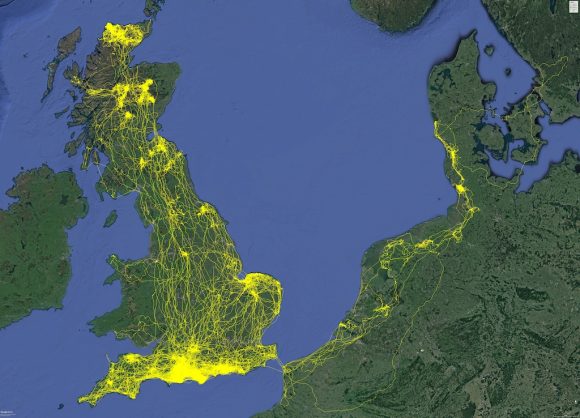
This map also raises another issue. One of the requirements to justify the translocation of a species is that the species in question shouldn’t be able to get there of its own accord, e.g. through natural expansion of the population.
Given the dispersal capabilities of those WTEs on the coast of southern England, and of the expanding WTE population in Argyll in Scotland, it seems to me it’s quite likely that WTEs will reach these proposed release areas of their own accord sooner rather than later. Sure, translocations would speed things up, but given the proximity of the proposed release areas to where WTEs are already established, I do wonder whether it’d be a good use of valuable funding, as much as I’d like to see WTEs in more places.
Given the academic credentials of all those involved in each of the three release proposals, I don’t doubt that they’ll be giving this careful consideration.
 Raptor Persecution UK
It would be difficult for this article to be more one-sided, with the calumny compounded by the wholesale selective scraping of your work by Will Humphries without credit or acknowledgement.
This is faux ‘journalism’ on behalf of a powerful establishment lobbying faction that can depend on the willing ears and keyboard fingers of embedded hacks to hold the line.
Next time readers of this excellent blog encounter a news story on any subject bearing The Times’ imprimatur they should recall the skewed priorities on display in this case.
Hedd Pugh, the NFU Cymru rural affairs board chairman, said there are “no longer any truly wild areas in Wales”, with all the countryside being “a managed landscape — created, shaped and maintained by farmers over generations”. Presumably, he’s including the Wye Valley in this statement, polluted beyond recognition by this “management”.
Depending on how you define “truly wild” there might not of been any truly wild areas in the UK for at least 4,000 years. A lot of species can live and breed in habitats that have been modified, to a greater or lesser extent, by human activity. Hedd Pugh is correct to say there’s no truly wild areas in Wales i.e. areas that are totally free from human influence but if he genuinely believes this means white tailed eagles couldn’t live and breed in Wales he’s showing his ignorance of the fact a lot of species can do really well in human modified environments. The obvious alternative interpretation of his comments is that he’s got an irrational prejudice against eagles and is desperately trying to justify his prejudice..
This was the Times that well known voice of impartiality and reason – I am not surprised that there was an element of plagerism either, their Journos are fairly poor I have criticised them to IPSo about Picture choice for articles and got no where.
I am now even more aware what NFU actually means No F***** Understanding – Scottish Farmers are making a mint out of livestock “taken” by eagles. As you say these birds are widespread across Europe without any issues concerning livestock.
The only positive aspect of this article is they didn’t trot out ” They could take Small Children and family pets” which I have seen quoted
Scottish Badgers with OneKind, CIWF and RSPB summarised evidence about the significant factors in lamb deaths in an evidence-based letter to the Scottish Minister in June 2024 – here is an extract –
Recent publications point to predation by wild animals being an uncommon cause of lamb deaths, although this can vary by the specifics of the situation:-
White-tailed eagles.
A recent published study encompassing 92 white-tailed eagle territories over 20 years to 2017 reports that marine items (seabirds and fishes) have become the most important breeding season food in Scotland for white-tailed eagles. Lamb now comprises typically up to 6% of food either live predated or most likely scavenged, and further dietary shifts are expected as the population expands to access rich upland and freshwater habitats.
[Reid, R., Grant, J.R., Broad, R.A., Carrs, D.N. and Marquiss, M. (2023). The breeding season diet of White-tailed eagles in Scotland. Scottish Birds 43(4): 305-318. Researchgate pdf]
Foxes.
There is relatively little Scottish research to evidence the proportion of lamb losses caused by fox predation, but existing studies cited in a 2016 review and a 2019 Scottish Government report point to this being below 2% of lambs born
[C.M. Dwyer, J. Conington, F. Corbiere, I.H. Holmøy, K. Muri, R. Nowak, J. Rooke, J. Vipond, J.-M. Gautier (2016). Invited review: Improving neonatal survival in small ruminants: science into practice, Animal, 10(3). https://doi.org/10.1017/S1751731115001974] While natural fox behaviour will include killing lambs and scavenging carcasses their natural diet includes a diverse range.
Badgers.
In a 2024 NatureScot report, DNA and post-mortem analyses of lambs suspected of badger predation, conducted by Science and Advice for Scottish Agriculture, strongly suggest that badgers do not kill lambs and rarely scavenge carcasses, which ties in with previous findings
[George, S.C., Campbell, S., Martineau, H., Hale, C., Kaden, J., and Webster, L.I.M. (1 September 2024). Are Eurasian badgers responsible for lamb predation? An investigation using farmer interviews, post-mortem examination and molecular tools. https://besjournals.onlinelibrary.wiley.com/doi/10.1002/2688-8319.12370%5D.
[Ed: thanks George. I’m afraid this is part of an ongoing campaign by the usual suspects. I’ll not post your comment because it might give others ideas]
Fair enough, I certainly see you point…. but .ii thought you should know. More power to you.
The various NFU iterations are opposed to virtually ALL reintroductions on principle. This has nothing to do with protection of biodiversity already present because if it cannot be shot for sport ( or for some pursued with hounds illegally) it has no place in their world of agriculture. Of course WTE have an undeserved reputation based on at best hearsay that they take lots of lambs and despite science saying otherwise guess who they prefer to quote. Quotes about Welsh habitats are laughable as much of upland Wales is or has been ravaged by sheep overgrazing or reseeding for sheep grazing ( Producing a meat that only 15% of meat eaters eat regularly). The times along with other right wing press is in reality no friend of wildlife or wildlife restoration if it has the remotest chance of impinging at all on agricultural profit. If you thought the fuss over beavers was bad wait until the release of WTE or GE for that matter is imminent in Cumbria, Wales or the Pennines when the full weight of the NFU/CA etc will be brought to bear against despite what any science might say. Also remember the NFU does not represent anything like all farmers either.
Being from the Isle of Wight, where we have seen several years of WTE releases, and now have mature pairs setting up territories. Over the several years of the programme there have been no reports at all of any harm done to livestock. They are regularly seen in their preferred sites, and their diet has been studied, and (spoiler alert) it does not include children, pets or livestock.
I think the ‘loss of livestock’ issue is a red herring. We hear the same old story from the farming lobby every time i.e. whatever the ‘problem’ [contrived by or caused by us] we want compensation. You want us to stop ripping out hedges? Pay us compensation. You want more wild flowers? Pay us compensation. You want less sewage in the rivers? Pay us compensation. You want more beavers? Pay us compensation. You want more access? Pay us compensation. Eagles? Hell, no! Pay us compensation. And if you don’t we’ll keep polluting your rivers, ripping out hedges, spreading diseases [bird flu, bTB etc.], blocking footpaths, spreading mud on roads, demanding IHT exemptions, demanding subsidies, tax free fuel and any other thing we can think of that no one else gets…
Re predation of lambs: I was once in discussion with a shooting apologist online, and quoted the 6% figure (or some similar low figure) for the proportion of the WTE diet that is made up of lambs. His response was something along the lines of “well, you wouldn’t be happy if you were losing 6% of your livelihood”.He didn’t seem to appreciate that “6% of the WTE’s diet is lamb” and “6% of lambs are eaten by WTEs” are two very different statistics. I pointed out that even if I decided that my diet would be 100% bacon, it was unlikely that I’d manage to get through all the bacon on the shelves of my local Tesco.
Regarding white-tailed eagles spreading of their own accord – it seems that many raptor species do not readily settle down to breed in the areas that they regularly visit, which is why, for example, ospreys had to be reintroduced to England despite that fact that the whole Scottish population obviously passed through England on the way to/from Scotland every year. Releasing young birds seemingly encourages them to return to breed where they were released. This seems to be why white-tailed eagle re-introductions are relevant even within flight range of existing populations. This maybe also applies to justification for golden eagle re-introductions in south Scotland, which is in theory in easy reach of existing populations? (Roy Dennis’s book “Restoring The Wild”covers these topics).
It is established that WTE’s diet can comprise 6% lamb but it must be very difficult (from nest surveys) to establish the cause of death. There appears to be a very clear congruence of WTE territories in Scotland with large areas of free-range/sheep.
Does anyone know of research on the mortality rate of lambs in these areas before WTEs arrived or in hill areas eg Wales/Pennines still unoccupied by WTEs or GEs? Though some farms bring their sheep in-bye to lamb I believe many lambs are born on the hill or put back on the hill whilst still very young and vulnerable to weather/accidents etc.
I agree with Hedd Pugh NFU Cymru that there are no really wild areas left in Wales and that it is a managed landscape; what I am unsure of is when everyone else agreed that Wales could be totally dominated and managed by farming?
Unsurprising that the NFU are opposing the release of white tailed eagles. This is the same group that petitioned the government to allow the use of neonicotinoids despite all the scientific evidence of how damaging these chemicals are to bees and other essential pollinators.
The comments about predation of livestock always remind me of the times I have had the pleasure of walking in Scotland’s hills in winter. On many occasions you find many sheep carcasses on the hills presumably dead from exposure.
on one occasion on Ben Lawyers the farmer had piled dozens next to the main access gate to the fells (presumably he was going to remove them in a job lot) and then complain that there were too many predators on his land (that had enjoyed and free carrion meal to see them over the winter)
So when I walk I the hills in winter a dead sheep no longer become an expected sight, then I will take the NFU seriously when they complain about predators, since at the moment they don’t appear to care that much about the fate of their sheep.
Based on my knowledge of genetics/inbreeding in the long term the Isle of Wight/Southern England population of white tailed eagles will be vulnerable to going extinct due to small number of individuals in the population. Imo the best way to overcome this potential problem is to link this population with the much larger population in Scotland via populations in South Wales, North Wales and the Solway Firth/Lake District with reintroductions rather than waiting for natural recolonisation.
Fantastic comments from all I agree pollution removing hedgerows use of harmful pesticides etc and like I’ve said before I’ve witnessed appalling sheep cruelty where we live no regard for their welfare it’s the kettle calling the frying pan grimy arse .