
The following is a guest blog by someone who wishes to remain anonymous, although I know their identity.
STOBO HOPE – DID GWCT ‘ADVICE’ HELP AVOID AN ENVIRONMENTAL IMPACT ASSESSMENT ON THE DESTRUCTION OF BLACK GROUSE HABITAT?

Regular readers may be familiar with Stobo Hope, a large area of heather moorland with wildlife including golden eagles and the second largest black grouse lek in the Scottish Borders. Wild Justice helped fund a successful judicial review by the Stobo Residents Action Group (see here) to try and save this habitat from a giant Sitka spruce plantation. The Scottish Government conceded the petition for judicial review in September 2024 before going to court, cancelling the taxpayer funded £2 million contract after realising that vast areas (potentially up to 400 hectares) had been blanket sprayed with herbicide (see here), in August 2023.
It strongly seems to me that government body Scottish Forestry, True North Real Asset Partners (managing the Stobo scheme and the Forestry Carbon Sequestration Fund in Guernsey) and forestry agents Pryor and Rickett Silviculture were all desperate to avoid an Environmental Impact Assessment (EIA), which was successfully ‘screened out’ in January 2024 before the contract was awarded in February 2024.
Scottish Forestry will apparently determine again if an EIA is required, claiming they will take into account ‘all other new relevant information’ (see here). At the moment all work at Stobo has been stopped by court order so any work is unlawful. The Forestry Carbon Sequestration Fund (based in a tax haven) has now lodged a petition for judicial review with the Court of Session in Edinburgh (December 2024) to try and cancel the enforcement notice by Scottish Forestry (see here).
It turns out that the Game and Wildlife Conservation Trust (GWCT) were ‘advising’ Pryor and Rickett Silviculture (see here) and True North Real Asset Partners (see here), on how to ‘improve the suitability of the proposed planting area for black grouse’, despite the RSPB, reputable ecologists and NatureScot explaining that black grouse would leave due to the forestry scheme.
Scottish Forestry appear to have relied on recommendations (that were subsequently partially implemented) by the GWCT to help conclude that black grouse would not be significantly affected by the scheme so an EIA could be avoided. If an EIA was required, it would require a much more rigorous assessment of the ecological impacts of the proposal and require further public consultation which probably would have resulted in the scheme being no longer viable for the Forestry Carbon Sequestration Fund.

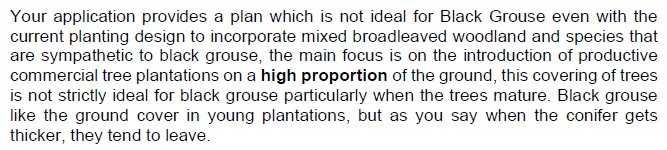
Pryor and Rickett Silviculture were seemingly keen to follow up the GWCT’s advice on predator control, so applied to NatureScot for a fox hunting licence with nineteen dogs, but this was refused. The intended fox hunting was supposedly to reduce black grouse predation (see here), but seemed to be more for sporting than conservation purposes. NatureScot explained that there was no evidence of long-term benefit from the proposed fox hunting. As with the RSPB’s prediction of lek extinction at Stobo, NatureScot stated black grouse ‘tend to leave’ plantations of the kind proposed at Stobo:
How Scottish Forestry makes questionable claims to avoid EIAs
Virtually all woodland creation schemes in Scotland avoid an EIA, with just 4 EIAs for 729 ‘conifer option’ screening applications since 2015, according to a FoI response in March 2023 (see here). This appears to be due to forestry managers implausibly claiming that no significant negative environmental impacts will result from an environmentally destructive forestry scheme.
If a significant impact is said to result for woodland creation proposals above a certain size, an EIA is typically needed. Scottish Forestry simply repeats its contracted ecologist’s claims in its ‘screening opinion’ to determine no EIA is required prior to awarding a forestry contract. As a result, tens of thousands of hectares of priority wildlife habitats outside protected sites across Scotland are being damaged or destroyed by commercial forestry. These priority habitats and species are those that Scottish Ministers consider to be of principal importance for biodiversity conservation in Scotland. Under the Nature Conservation (Scotland) Act 2004 (see here), all public bodies in Scotland have a duty to further the conservation of biodiversity when carrying out their responsibilities. Scottish Forestry appear to be either unaware or negligent in its failure to deliver this duty.
At Stobo, ecologists Mabbett and Associates, now called Arthian Ltd (see here) in its ‘EIA update letter’ (January 2024) claimed the scheme ‘will not have a significant impact’:

Scottish Forestry used this statement to justify their decision to approve the scheme without an EIA and award a £2 million grant for a giant, mostly Sitka spruce plantation of nearly seven square kilometres at Stobo, claiming this scheme was ‘not likely to cause a significant negative environmental effect to black grouse’:

Scottish Forestry repeated this claim for golden eagles (Stobo is a significant area for this species) and for priority habitats such as upland heathland, purple moor grass and rush pasture and numerous other features of nature conservation value in its EIA ‘screening opinion’. These habitats host priority species such as the small pearl-bordered fritillary butterfly, hen harrier, cuckoo, reed bunting and red grouse. Scottish Forestry also claimed that it was unlikely there would be significant negative environmental impacts from the cumulative effects of neighbouring proposed or completed woodland creation schemes, resulting in fourteen square kilometres of contiguous moorland being fragmented by nearly ten square kilometres of predominantly commercial coniferous forestry.
Map of the proposed woodland
For the Stobo plantation, of the planted area, 72% is Sitka spruce, with a further 10% of commercial Scots pine and Douglas fir, so commercial coniferous forestry amounts to 82% of the planted area. The map below does not show three new plantations to the north, west, south or a proposed plantation to the east, creating a giant spruce plantation across what was previously contiguous moorland.

Scottish Forestry claimed there would be 246.4 hectares of open ground within 1.5 km of the lek, but omitted to mention that this remaining open ground would be heavily fragmented by 463.6 hectares of trees. Furthermore, much of this open area within 1.5km is sub-optimal habitat on exposed hilltops and ridges far from the lek and mostly unplantable anyway.

Black grouse need large areas of contiguous moorland – typically bog, dry dwarf shrub heath, marshy and acid grasslands. A 2014 report (No. 741) commissioned by Scottish Natural Heritage (see here) – now NatureScot – found that in the Southern Uplands only 5% of moorland patches less than ten square kilometres (1,000 hectares) were occupied by black grouse:

The approximate location of the Stobo estate is circled red below, showing its relative isolation to other leks, several of which have since become extinct in the last ten years:

The ‘Black Grouse Habitat Management Area’ for Stobo
The forestry scheme applicants proposed a ‘Black Grouse Habitat Management Area’ within 1.5km of the lek to supposedly ‘mitigate’ the effect of planting nearly seven square kilometres of moorland. The stated open area within this habitat management area is only 84 hectares.
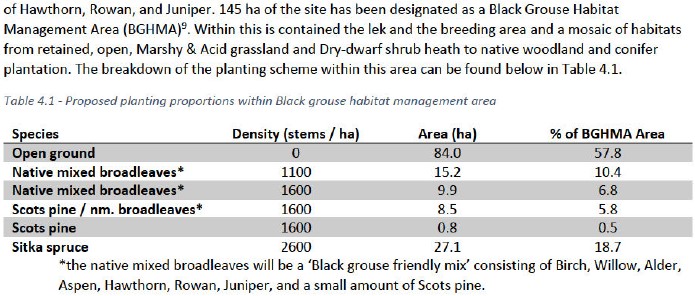
The GWCT stated in its January 2022 report for the forestry applicants that ‘the planting will likely have a significant impact on the visual landscape, land use and ground nesting birds’ and the planning process would ‘recommend measures to mitigate against any impacts of significance’:

The GWCT then stated later in the report that ‘the inclusion of low-density mixed broadleaves and areas of open ground within the site are unlikely to sufficiently limit the impacts of the planting plan on wading birds or black grouse’, then suggesting a ‘comprehensive predator control programme as part of any mitigation measures’:


A later report by the GWCT (March 2023) suggests that efforts had been made to increase the open area within 1.5km of the lek, recommending that 40% open ground should be retained ‘within the vicinity of a lek site’:

The final open area within 1.5 km of the lek could be around 35%, based on the 246.4 hectares in Scottish Forestry’s screening opinion, but much of this area is relatively unsuitable due to fragmentation and being on exposed ridges. The RSPB explains to the forestry agents (red text below) that the GWCT’s recommendation of 40% open ground applies to whole plantations, not just the ‘habitat management area’:


Another report (No. 545) commissioned by Scottish Natural Heritage and published in 2013 (see here), investigating habitat use by black grouse in Scotland, states:

The findings in this report (and other papers) suggest that schemes such as at Stobo will be unviable for black grouse. Areas around leks were on average, two-thirds moorland and the report suggests ‘a lekking group will likely require a continuous moorland area adjacent to forest habitats, that is at least five square kilometres’ (i.e. at least 500 hectares). At Stobo, Scottish Forestry has ignored both the large area of moorland required for an individual lekking group and the cumulative impacts of multiple woodland creation schemes. The 2014 Scottish Natural Heritage Commissioned Report No. 741 refers to ‘little consideration for landscape-scale conservation’:

The same report provides recommendations for conservation measures in Southern Scotland, suggesting that heather moorlands with leks should be ‘adequately protected from any future significant change in land use’:

This report also points out that ‘predator management in isolation may not prevent further declines without the provision and maintenance of suitable habitats’:

Did the GWCT advice influence Scottish Forestry into avoiding an EIA?
It appears that Scottish Forestry relied on specious mitigation measures such as a negligible reduction in planted area, predator control and a ‘Black Grouse Habitat Management Area’, to claim that the Stobo scheme was ‘not likely to cause a significant negative effect to black grouse’, thus avoiding an Environmental Impact Assessment (EIA). The decision by Scottish Forestry to not have an EIA would of course, seem to have huge financial benefits for the Forestry Carbon Sequestration Fund, as the hundreds of hectares of moorland that the Stobo lek needed could now instead be planted with Sitka spruce. Furthermore, Scottish Forestry incorrectly claimed the cumulative impacts of several forestry schemes were taken into account, despite research suggesting habitat connectivity with other large moorland areas was required for long-term viability of black grouse metapopulations.

Did GWCT staff ignore its own research to help forestry managers and Scottish Foresty avoid an EIA?
The two Scottish Natural Heritage Reports (Nos 545 and 741) referenced in this blog showing woodland schemes like that at Stobo would be unviable for black grouse, were both authored by the GWCT. Two of the authors of these reports, Dave Baines and Phil Warren, are widely acknowledged as leading experts on black grouse with over 60 years of combined experience, but it is unclear if they were invited to advise on the Stobo proposals which were authored by the GWCT Advisor, Scotland. After several email exchanges between the GWCT and Pryor and Rickett Silviculture, the GWCT Advisor, Scotland eventually concluded in May 2023 that ‘I believe you now have a considered design that goes as far as practical in terms of accommodating for black grouse’.

This is far from a glowing endorsement of the proposals or indeed any kind of acknowledgement that there would be no significant impacts on black grouse.
Although some of the SNH reports’ content may be biased in favour of shooting interests, they do appear to demonstrate general habitat needs and the extent of these habitats required for black grouse.
Why did Scottish Forestry choose to ignore the RSPB’s prediction that lek extinction would result from the scheme?

The RSPB also stated there was a failure to assess the impact of the loss of habitat and nesting sites through afforestation, explaining that the forestry agents in their ‘woodland operational plan’ incorrectly asserted that the RSPB’s issues with the scheme had been resolved.

Picture courtesy of Ted Leeming photography (Copyright protected)
Harry Humble, CEO of True North Real Asset Partners, was probably very pleased with the GWCT’s advice, claiming in the Scotsman (see here) that ‘more than 140ha of the scheme has been designed specifically to favour black grouse, with an enhanced mix of species and open space provision in line with best practice derived from decades of research’.
Why did the GWCT appear not to tell Pryor and Rickett Silviculture and True North Real Asset Partners that its own research over many years showed the proposed Stobo scheme would likely cause black grouse lek extinction, instead of saying: ‘I believe you now have a considered design that goes as far as practical in terms of accommodating for black grouse’?
Another exercise in ‘Greenwashing’ by Scottish Forestry?
Whoever invested in the Forestry Carbon Sequestration Fund must have been very pleased that Scottish Forestry decided to ignore the RSPB and seemingly disregard readily available, published black grouse research, such as that by the GWCT, commissioned by what is now NatureScot, demonstrating black grouse disappear from areas planted for commercial coniferous forestry. Hundreds of hectares of spruce at Stobo and on neighbouring land was in part permitted by Scottish Forestry under the false premise that the Stobo woodland creation scheme was ‘not likely to cause a significant negative environmental effect to black grouse’. This incorrect claim by Scottish Forestry and similarly incorrect claims relating to impacts on other wildlife and important habitats for many other woodland creation sites must certainly have helped financial gains through land values, carbon credits and funds in offshore tax havens, but sets a terrible precedent for our disappearing moorland landscapes.
 Raptor Persecution UK
This is a sad and sorry tale. It seems that what is required is a mandatory Environmental Impact Assessment for all planting schemes over 100 hectares to ensure that a rigourous assessment of their impact is taken into account.
There should also be legislation to prevent offshore based companies from owning land in Scotland and benefitting from Scottish Government grants.
“It seems that what is required is a mandatory Environmental Impact Assessment for all planting schemes over 100 hectares to ensure that a rigourous assessment of their impact is taken into account.”
Necessary, but not sufficient, I’m afraid…. What is to stop hundreds of contiguous 99 hectare schemes being submitted individually?
From the truly excellent report above: “The map… does not show three new plantations to the north, west, south or a proposed plantation to the east, creating a giant spruce plantation across what was previously contiguous moorland”
And “Scottish Forestry also claimed that it was unlikely there would be significant negative environmental impacts from the cumulative effects of neighbouring proposed or completed woodland creation schemes”
What fool would believe that, considering the following… ?
“The 2014 Scottish Natural Heritage Commissioned Report No. 741 refers to ‘little consideration for landscape-scale conservation’”
Landscape-scale consideration is equally important as individual scheme size.
Brilliant report…what now?
Sent from my Galaxy
The whole thing stinks. There are grave concerns over the independence of some of these official bodies. The offshore based company will be far from transparent and no doubt seeking to minimise tax liabilities. The use of these companies is increasing and this should worry us all. This company is registered in Guernsey, a notorious tax haven. I found this news article on a Google search:
https://gsy.bailiwickexpress.com/gsy/news/court-battle-looms-commercial-forestry-project/
I note it states, “The Royal Society of Edinburgh accused the Scottish Nationalist Party of ploughing millions into tree planting projects based on questionable data, with more than 33,000 hectares planted this decade”. “It found that carbon captured by trees would be less than a third of what was initially estimated because of the timber industries’ desire to fell trees while they are still young”.
Who regulates ecology consultants? Isn’t it a case of ‘who pays the piper”?
[Ed: I can’t publish that, Keith, it’s the wrong side of the libel line]
I was a freelance ecological consultant for a few years. On three occasions I was asked by the agency who employed me to change my reports to suit the requirements of the developer. Naturally I refused. Work from that agency dried up.
Thankyou for your integrity.
Outrageous!
We import over 80% of our timber needs, it’s about time we got serious about planting a lot more productive conifer forests and get over the fact that they will have a few negative impact
“We import over 80% of our timber needs”So? We also import at least 50% of our food, the vast majority of our electric and other vehicles, almost all our petroleum gas and crude oil, all our televisions and most other electronic equipment, most of our pharmaceuticals… £876billion in 2023.
“it’s about time we got serious about planting a lot more productive conifer forests and get over the fact that they will have a few negative impact”
Why? What’s so special about timber but not pharmaceuticals?