Ruabon Moor gamekeeper prosecution – why the case was discontinued

Earlier this year I blogged about the prosecution of a gamekeeper from Ruabon Moor, near Wrexham, Wales in relation to wildlife crime offences alleged to have been committed in 2022: Using a trap to kill or take a wild bird and possession of an article capable of being used to commit a summary offence.

The first court hearing was heard at Wrexham Magistrates Court on 28 March 2024 but by April 2024 the case had been discontinued without public explanation (see here).

The circumstances of this case, and the reason it was discontinued, have now been reported in the RSPB’s 2023 Birdcrime Report (page 25), reproduced here:

Hawk trap in Wales – case discontinued by the Crown Prosecution Service

In March 2022, an RSPB Investigations Officer discovered a large cage trap in an area of private woodland bordering Ruabon Moor, near Wrexham, Wales.

The trap consisted of two compartments, one lower section contained two live Magpies and one upper section fitted with a trigger-mechanism door. Decoy birds, such as Magpies, are often used lawfully in cage traps to attract other Magpies which perch on the trigger mechanism, causing the trap door to close on them and they are then dispatched under license by the trap operator. However, the design of this trap gave concern – notably the thickness of the trigger perch – which was considered only capable of being triggered by a large and heavy bird, likely one with a greater mass than a Magpie or Carrion Crow.

It was decided that the cage trap was interesting enough for the RSPB to deploy remote surveillance cameras. Whilst it is unknown who placed the trap, the subsequent footage obtained showed an individual attending the trap and no one else. On the final RSPB visit, all three RSPB cameras and the trap had gone. Interestingly, Goshawks were noted in the area during the RSPB visits, a species that is slowly expanding its range and increasing in numbers, after years of persecution nationally.

The RSPB reported the trap to North Wales Police and shared the footage which had been gathered. A police investigation was launched and the individual in the footage was subsequently identified and charged by the police with offences relating to the possession and use of the trap. The case reached court, but in March 2024 was discontinued by the Crown Prosecution Service (CPS), on the grounds that it was not in the public interest to prosecute, as the penalties for any subsequent conviction were low, there were potential identification issues and that no birds had been seen to have been killed.

RSPB, North Wales Police and the National Wildlife Crime Unit were surprised at this outcome and questioned the decision directly with the Chief Crown Prosecutor for England and Wales. The matter was passed to CPS Wales and Iwan Jenkins, the Deputy Chief Crown Prosecutor for Wales, who in a letter stated: “I believe that in this case the decision not to proceed should have been the subject of further discussion.” He continued “The matter required more detailed discussion and consideration before arriving at the final decision.” Sadly, by then it was too late.

It is unknown what the trap was being used for, or what the outcome of the case would have been if it had progressed, but as a result of the CPS decision not to prosecute the defendant is now fully cleared of any wrongdoing. Going forward, it is hoped that much better dialogue can be achieved between prosecutors and the specialist agencies who spend valuable resources investigating wildlife related incidents.

ENDS

The RSPB’s 2023 Birdcrime report can be found here.
Golden eagle dies in rare collision with wind turbine in south Scotland

The South Scotland Golden Eagle Project (SSGEP) has today announced the death of a young golden eagle after it collided with a wind turbine in Galloway in August this year.

The bird was a three-year old male called ‘Sparky’. He wasn’t one of the eagles translocated to south Scotland from the north by the SSGEP, but rather he fledged from one of the few remaining nests in south Scotland prior to the translocation project, but was carrying a satellite tag provided by that project, which helped in the swift recovery of his corpse.

Of course, Sparky’s death from collision with a turbine blade is a tragedy, but it’s important to view it from a broad perspective.

Golden eagle mortality from wind turbine collisions in Scotland is, thankfully, a rare occurrence. That’s not down to luck, or chance. It’s largely to do with detailed wind farm planning and choosing areas for turbines that are not located in habitats preferred by golden eagles.

A group of expert golden eagle ecologists, collaborating under an umbrella organisation called the Golden Eagle Satellite Tag Group (GESTG) has developed several models to predict significant areas of topographical use by golden eagles based on thousands of satellite tag records. The most recent model, called the GET (Golden Eagle Topographical) model, is now commonly used in Environmental Impact Assessments for judging the potential impact on golden eagles by proposed new wind farm sites across Scotland, and it works pretty well.

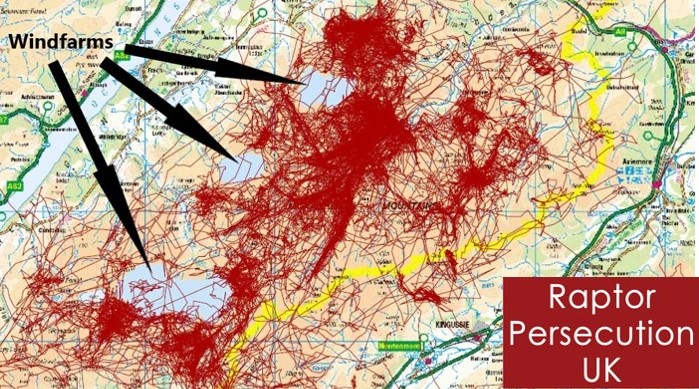
As an illustrative example, here is an image showing the movements of a satellite-tagged golden eagle that Chris Packham and I are tracking in the Monadhliath Mountains, on the western edge of the Cairngorms National Park. The red lines show the eagle’s movements around the footprint of three large windfarms and you can see that avoidance behaviour by the eagle is quite clear. (Thanks to Dr Alan Fielding for the data analysis and map).

This eagle’s avoidance strategy is not uncommon. Peer-reviewed scientific research papers by the GESTG have demonstrated that both young, dispersing non-territorial satellite-tagged golden eagles (here), as well as older territorial satellite-tagged eagles (here) will generally avoid wind farms if they have not been sited in prime golden eagle habitat.

I don’t know much about the Environmental Impact Assessment undertaken for the Windy Rig Wind Farm in Galloway where Sparky was killed but it’s probably worth noting that it was consented in 2017 (and became operational in 2022) at a time when there were very few golden eagles in south Scotland so perhaps golden eagle collision risk wasn’t assessed to be high.

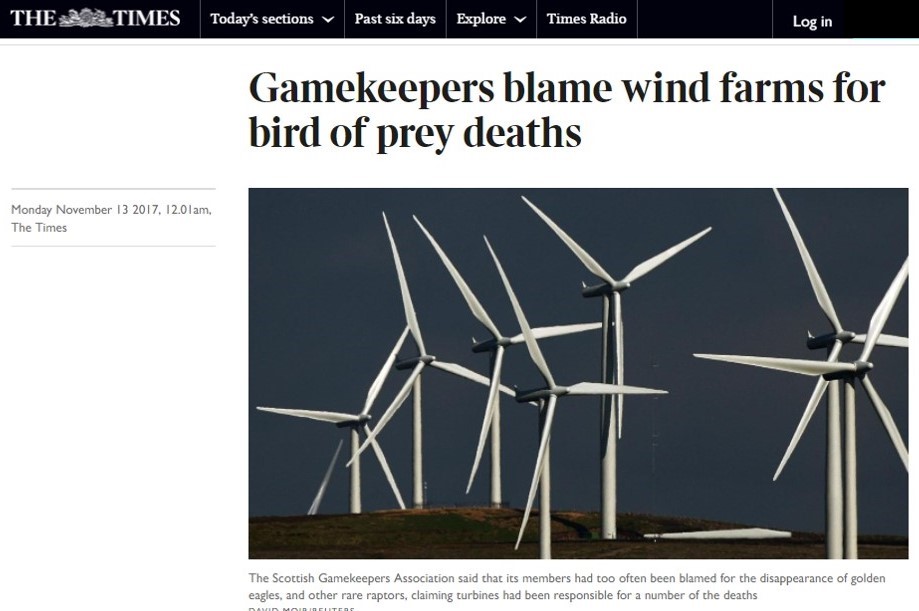
I fully expect the death of Sparky to be pounced upon by the raptor persecution deniers within the game-shooting industry, who will no doubt be jumping up and down, pointing fingers and announcing, ‘There! See? We told you that wind farms are killing golden eagles, it’s not us gamekeepers“, as they’ve been doing for years, for example this headline from 2017:

Alas, for them, the scientific evidence simply doesn’t support their claims (read the two linked papers above and also see Chapter 8 of the authoritative 2017 report by Drs Fielding & Whitfield: Analysis of the Fates of Satellite Tracked Golden Eagles in Scotland, where the authors examined whether any of the 41 tagged eagles that had ‘disappeared’ in suspicious circumstances were within the vicinity of a wind farm (spoiler alert – no, they weren’t, but illegal killing on a number of grouse moors was indicated).

Raptor collisions at wind farms has been a huge problem in some countries, notably in the USA at Altamont Pass in California where a long network of turbines was installed along the very ridgeline that migrating golden eagles use to take advantage of wind updrafts as they fly south. Anti-wind farm campaigners often point to these sites and assume that just because many golden eagles were killed at sites such as Altamont, it must mean that golden eagles are being killed at other wind farm sites. That’s simplistic nonsense, but some from the grouse-shooting industry have jumped on this to try and deflect attention away from the illegal shooting, trapping and poisoning of golden eagles that goes on in Scotland.

But it doesn’t wash anymore, and thank goodness the Scottish Government saw through the propaganda when it made the decision to introduce a grouse moor licensing scheme a couple of years ago.

That’s not to say that we should be unconcerned about golden eagles colliding with turbines – of course it needs to be monitored and the imminent construction of even more on-shore turbines needs to be carefully curated to ensure they’re built in the most appropriate locations, but thanks to ongoing satellite tag data analysis by experts in the GESTG, those potential impacts can be minimised.

A landmark day in Scotland as snare ban commences

It’s a landmark day in Scotland as the new snare ban commences.

A full ban on the use of snares was passed by the Scottish Parliament in March 2024 as part of the Wildlife Management & Muirburn (Scotland) Act (here) and the ban finally takes effect today, 25 November 2024.

This is a significant victory for animal welfare campaigners, especially the League Against Cruel Sports, OneKind and Scottish Badgers, but also many others, who have spent decades putting forward evidence that these devices, recently and cynically named ‘humane cable restraints’ by the game-shooting industry, are actually cruel, indiscriminate and inhumane and have no place in modern society.

Campaigners from OneKind & Scottish Badgers join MSPs to celebrate. Photo: OneKind

The game-shooting industry did its best to disrupt the commencement date. A consortium of the usual suspects (Scottish Land & Estates, Scottish Gamekeepers Association, Scottish Countryside Alliance, BASC Scotland, Scotland’s Regional Moorland Groups and the Scottish Association for Country Sports), joined this time by the National Farmers Union of Scotland, wrote an overly-dramatic letter in October to the Convenor of the Scottish Parliament’s Rural Affairs & Islands Committee to complain about the commencement of the ban.

They suggested that the principles behind the snare ban had ‘not been afforded the customary levels of parliamentary scrutiny’ (even though this subject has been a topic of political debate and public consultation for at least 15 years!), and they complained that Ministers hadn’t conducted a Business & Regulatory Impact Assessment (BRIA) prior to the commencement of the snare ban, and they strongly suggested that this should afford a delay to the commencement of the ban.

The Committee duly wrote to Agriculture Minister Jim Fairlie, who dismissed the concerns:

As of today, the use of snares in Scotland is unlawful. If you find one, take a photograph of it in situ, record the location and report it immediately to Police Scotland and/or the Scottish SPCA. Ask for a reference code so you can follow up on what action was taken, especially if it was found on a grouse-shooting estate (a set snare is a breach of the new licence).

You might decide you want to cut/destroy the unlawful snare. The law on this is murky and open to interpretation. If you are concerned that the snare will remain set/operational and the police/SSPCA can’t attend for some time, I’d suggest your best option (to protect wildlife and to protect yourself from potential legal action) is to advise the police/SSPCA what you intend to do and the reason for that decision, BEFORE you do it. NB: This is not formal legal advice – you are responsible for your own actions!

Warrant executed in connection to illegal trading of wild birds’ eggs

Press release from South Yorkshire Police:

WARRANT EXECUTED IN CONNECTION TO ILLEGAL TRADING OF BIRDS’ EGGS

On Thursday 21 November 2024, officers executed a warrant in the Thurnscoe area for offences relating to illegal wildlife trading.

An illegal haul of wild birds’ eggs. NB: NOT connected to this investigation. Photo by RSPB

The operation was supported by the National Wildlife Crime Unit (NWCU), who worked alongside our motorcycle and rural crime team, neighbourhood officers and other specialist roles including search officers and digital media investigators.

This warrant was part of a wider operation, co-ordinated in the UK by the NWCU to tackle international organised illegal wildlife trade, specifically the taking, possessing, and trading of wild bird’s eggs.

A recent report from the UN office on drugs and crimes explains how some of the species most affected by wildlife crime – like rare orchids, succulent plants, reptiles, fish, birds, and mammals – receive little public attention, though wildlife trafficking appears to have played a major role in their local or global extinctions.

Beyond the direct threat to the population of species posed by wildlife trafficking, this crime type can also disrupt delicate ecosystems and their functions and processes – including their ability to help stabilize the climate and mitigate climate change.

Wildlife crime also threatens the socioeconomic benefits people derive from nature, including as a source of income, employment, food, medicine, culture, and more. It further corrodes good governance and the rule of law through corruption, money-laundering and illicit financial flows.

Detective Inspector Harrison from NWCU said “The taking, possessing, and trading of wild bird eggs is illegal and overall, it is believed that these crimes are less common than they were. However, clearly it still goes on and as the overall number of birds is declining it can be argued that this crime has an even greater impact now than it did years ago.

These criminals are very well organised and connected. The rarer a species is, the higher its demand and value to these criminals. Policing is under pressure now with competing demands and priorities. In amongst that work, it is important that we can still take action to protect our wildlife.

I can`t thank the police officers, staff, and partners enough for their help and support during this operation. The investigation is ongoing and there is more work to do but this sends out a strong message to all wildlife criminals. If anyone has information regarding any suspected wildlife crime, they should contact their local police force.”

As our efforts to crackdown on Wildlife and Rural crime continue, Chief Inspector Peter Spratt added: “This warrant is just one example of the ongoing work to strengthen our fight against both wildlife and rural crime.

In addition to enforcement activity on the frontline, we have invested in training over 40 additional officers to deal with these types of offences and continue to develop better connections with rural communities and creating a stronger force against those intent on committing wildlife and rural crimes in South Yorkshire.

To support our ongoing work, I urge anyone with information about wildlife or rural crime, or who sees any suspicious behaviour, to contact us as we are stronger with your help”.

As part of the warrant, a 57 year-old man was arrested and has since been released on police bail.

ENDS

UPDATE 1st December 2024: Another man arrested in coordinated police investigation into illegal trading of wild birds’ eggs (here)

Lincolnshire man faces trial in relation to poisoned red kite & buzzards

Further to the blog on 30 September 2024 (here) and 17 October 2024 (here), a trial date has been set for a Lincolnshire man in relation to the discovery of a poisoned red kite and two buzzards between 2017 and 2022.

Buzzard photo by Ruth Tingay

John Bryant, 40, of West Ashby, Horncastle, appeared at Boston Magistrates Court on 20 November 2024 where he pleaded not guilty to two charges of using a trap to kill or take a wild bird, six charges of possessing an article capable of being used to commit a summary offence, and two charges of contravening health & safety regulations.

Mr Bryant was released on unconditional bail and a trial date was set for 6 March 2025.

NB: As this case is live comments are turned off until criminal proceedings have concluded.

UPDATE 12 March 2025: Lincolnshire gamekeeper guilty of multiple offences in relation to deaths of red kite and buzzards (here)

Petition to ban driven grouse shooting passes 10,000 signatures

On Friday afternoon, Wild Justice’s new petition calling for a ban on driven grouse shooting was launched.

It reached it’s first target of 10,000 signatures at 8am this morning. This means the new Labour Government will have to respond. That’ll be interesting!

If you look at the associated map, so far signatures have come from every single parliamentary constituency across the UK except for three:

Airdrie & Shotts

Uxbridge & South Ruislip

West Ham & Beckton

It’s also very noticeable that the constituencies with the highest level of support so far include areas where driven grouse shooting is prominent. This mirrors the results of previous petitions on this subject.

Ten thousand signatures is an excellent milestone to reach, but we’re not finishing there. We want a parliamentary debate and for that we need 100,000 signatures.

If you can help reach this target please sign the petition HERE.

Thank you!

Suzanne Hall, wife & mother of convicted peregrine launderers ‘no longer a serving police officer’

Last week I blogged about the status of a fraud allegation against Suzanne Hall, a serving police officer and the wife and mother of convicted peregrine launderers Timothy and Lewis Hall (see here for background).

Young peregrines at a nest site in Scotland. Photo (taken under licence) by Ruth Tingay

There was uncertainty about whether Hall’s fraud trial had been dropped and efforts to confirm the status of the prosecution with the Crown Office and Jedburgh Sheriff Court proved fruitless.

Thanks to the blog reader who today sent me a copy of an article that was published in the Border Telegraph on 20 Nov 2024, there is now some clarification. Here’s what the article said:

FRAUD CHARGE DROPPED

A former police officer accused of a fraud involving almost £10,000 has walked free after the charge was dropped. Forty-six-year-old Suzanne Hall had been charged with telling Scottish Borders Council she had just moved into her home at Lamberton Holdings, in Berwickshire, with her family in December 2020.

The charge had alleged it had been her sole or main residence sine August 2015, and she was due the local authority £9,613 in back dated council tax.

Hall had pleaded not guilty to the charge and a trial date had been fixed for Tuesday [19 Nov 2024] at Jedburgh Sheriff Court with an intermediate hearing on November 4.

But the case did not call on November 4 and the trial was cancelled.

A spokesperson for the Crown Office and Procurator Fiscal Service said: “It is the duty of the Crown to keep cases under review, and following full and careful consideration of the facts and circumstances of the case, including the available admissible evidence, the Procurator Fiscal decided that there should be no further criminal proceedings at this time.

The Crown reserves the right to proceed in the future should further evidence become available“.

The fraud charge originated from a police raid on her home in May 2021 in relation to the illegal sale of peregrine falcons.

Hall – who was a serving police officer at the time – initially faced wildlife charges but her pleas of not guilty were accepted by the Crown in December 2023.

The fraud charge remained outstanding but has now been dropped for the time being.

Police Scotland confirmed this week she is no longer a serving officer.

ENDS

Wild Justice launches new petition calling for a ban on driven grouse shooting

Yesterday saw the launch of a new petition from Wild Justice calling for a ban on driven grouse shooting.

At 10,000 signatures the Government has to issue a response.

At 100,000 signatures the petition will be considered for a debate in Westminster Hall.

All the previous petitions on this subject happened under a Conservative Government. How will the new Labour Government respond?

Let’s find out!

If you’d like to support this petition and you’re a British citizen or UK resident, please click HERE to sign (and remember to check your email to click on the confirmation button).

Many thanks!

Revealed: letter of expulsion to Andrew Gilruth (CEO, Moorland Association) from Head of National Wildlife Crime Unit

Back in July, the Moorland Association announced that it had been removed from the Raptor Persecution Priority Delivery Group (RPPDG), the national police-led ‘partnership’ that’s supposed to tackle illegal raptor persecution (see here for announcement).

Photo via Suffolk Police

The expulsion appeared to have been triggered by a Moorland Association blog, where the grouse moor owners’ lobby group looked to be trying to sabotage the work of the police’s new National Hen Harrier Taskforce, being led by the National Wildlife Crime Unit (NWCU) which I wrote about here, although later FoI documents revealed that prior to that blog being published, the NWCU had already warned Moorland Association CEO Andrew Gilruth that they thought he was “wasting time and distracting from the real work” of the Hen Harrier Taskforce (see here).

The Moorland Association then claimed to be “perplexed” and “bemused” by the expulsion in a hilariously distorted rebuttal blog.

Up until now, we hadn’t seen a copy of the expulsion letter written to Andrew Gilruth by the Head of the NWCU so we only had the Moorland Association’s typically contorted version of events.

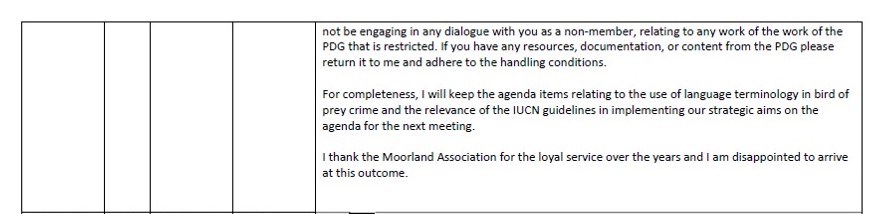
After a further couple of rounds of FoI requests, the expulsion letter has finally been released. The reasons for the expulsion are laid out very clearly and expose the Moorland Association’s claims of being “perplexed” and “bemused” as being what I see as yet another example of disingenuous spin – a skill for which I consider Andrew Gilruth has somewhat of a reputation from his days at GWCT.

Here’s the expulsion letter/email:

The expulsion letter refers to alleged breaches of conduct against the terms of reference of the Raptor Persecution Priority Delivery Group (RPPDG), the so-called ‘partnership’ in which Andrew Gilruth represented the Moorland Association, having taken over the role after Amanda Anderson left the Moorland Association at the end of 2023.

To fully understand the NWCU’s rationale for writing the expulsion letter, you need to see those RPPDG terms of reference. Here they are:

It seems that the NWCU’s justification for concluding that Gilruth had “brought the credibility of the RPPDG into disrepute” was well-evidenced and entirely reasonable.

There’s something else of interest in those terms of reference:

  • If an individual is removed, the organisation they represent should seek to identify a suitable replacement. If no replacement is found, then the organisation could be removed from participating,

and

  • Organisations that have been removed can reapply if a suitable candidate is
    identified.

What isn’t clear at the moment is whether it’s the Moorland Association that has been expelled from the RPPDG or whether it’s just the CEO, Andrew Gilruth.

I don’t know whether the Moorland Association has identified another representative to replace Gilruth but I understand that a formal complaint has been made (predictable or what?!) about the expulsion, no doubt “wasting [more] time and distracting from the real work” of the Hen Harrier Taskforce and the RPPDG.

More detail on Hawk & Owl Trust’s withdrawal from hen harrier brood meddling sham

Back in September, an article appeared on the Birdguides website announcing the Hawk & Owl Trust’s withdrawal from the hen harrier brood meddling sham (see here), although the details were vague and I couldn’t find a statement on the Hawk & Owl Trust’s own website.

For new blog readers, hen harrier brood meddling was a 7-year conservation sham (2018-2024) sanctioned by DEFRA as part of its ludicrous ‘Hen Harrier Action Plan‘ and carried out by Natural England, in cahoots with the very industry responsible for the species’ catastrophic decline in England. In general terms, the plan involved the removal of hen harrier chicks from grouse moors, they were reared in captivity, then released back into the uplands just in time for the start of the grouse-shooting season to be illegally killed. It was plainly bonkers. For more background see here and here.

Hen harrier photo by Laurie Campbell

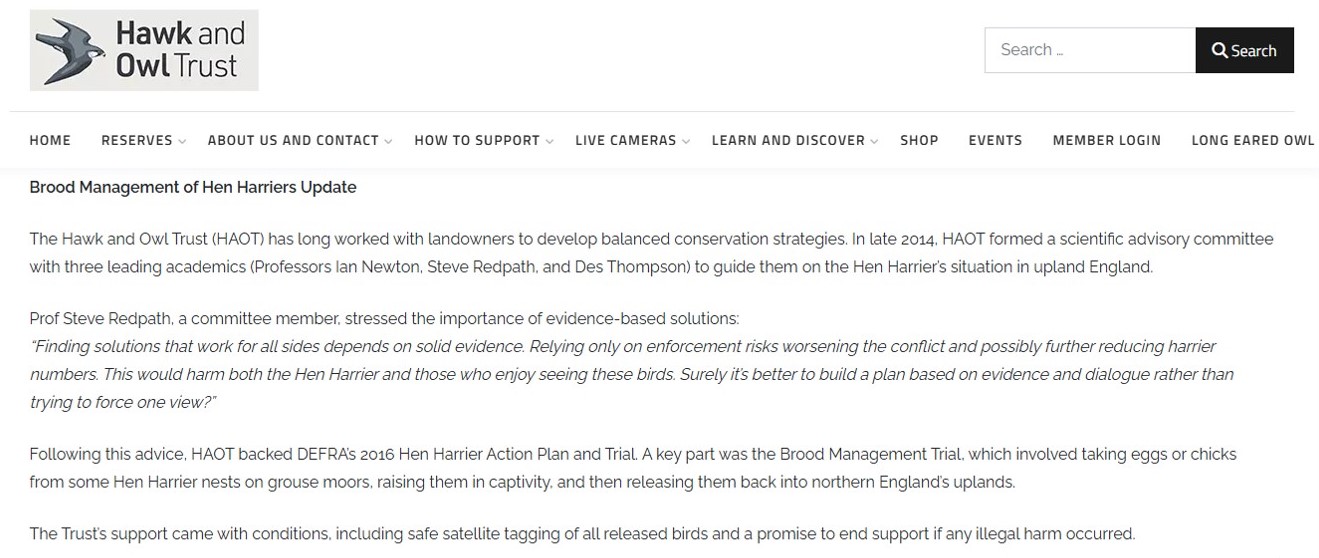
Two days ago the Hawk & Owl Trust published the following statement on its website (reproduced here as things have a habit of ‘disappearing’ from that site):

It’s a weird statement, first trying to justify the Hawk & Owl Trust’s involvement in this conservation sham by suggesting it took advice from three leading academics, forgetting to mention that one of those leading academics had been proposing a brood meddling trial for years (so he was hardly independent) and his university department was probably set to benefit financially from his involvement by receiving public money in the form of associated research grants. Oh, and also forgetting to mention that a Director of the Hawk & Owl Trust was also at the centre of the brood meddling sham and her organisation was also set to benefit financially by being paid for undertaking the brood meddling. Conflict of interest, much?

The statement then goes on to state that the Hawk & Owl Trust’s involvement came with conditions – including “a promise to end support if any illegal harm occurred“. This is a promise that the Hawk & Owl Trust broke over and over again, despite having many opportunities to honour it (e.g. here), including the killing of a hen harrier (Rowan) whose satellite tag the Hawk & Owl Trust had funded (see here, here, here, here, here and here).

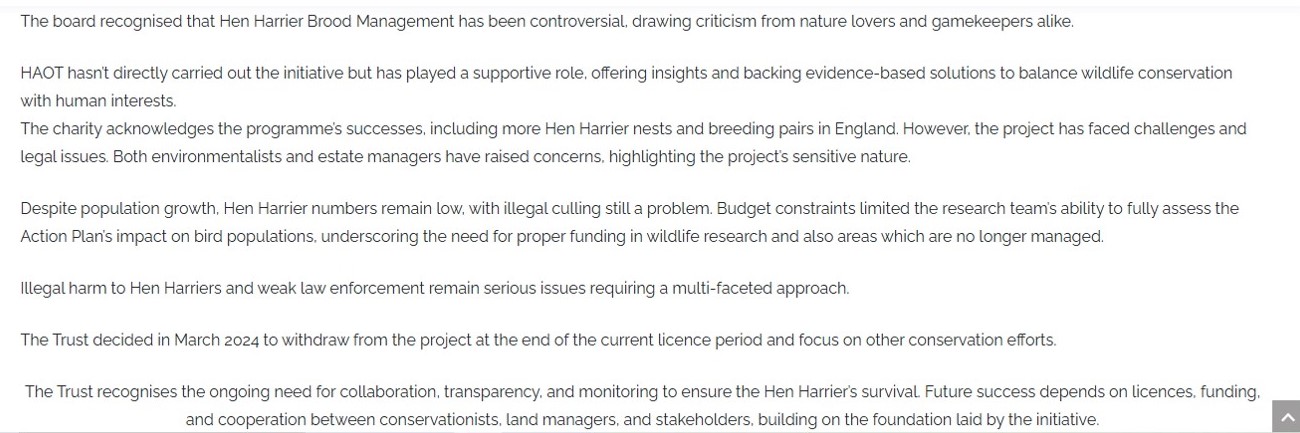
The statement then attempts to minimise the Hawk & Owl Trust’s role in the sham by saying: “HAOT hasn’t directly carried out the initiative but has played a supportive role, offering insights and backing evidence-based solutions to balance wildlife conservation with human interests“.

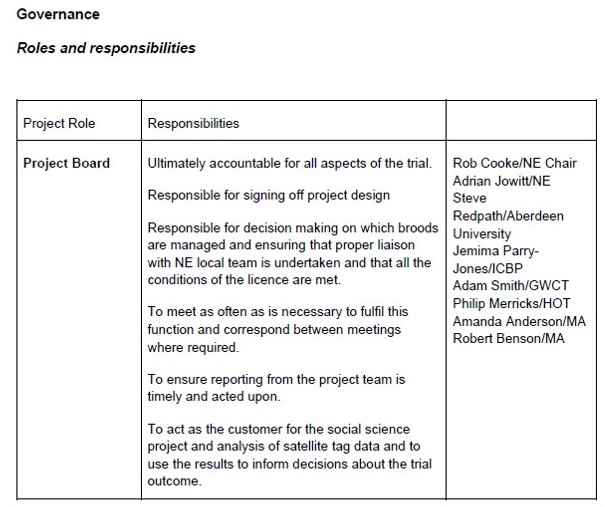
Er, the Hawk & Owl Trust was directly involved in the brood meddling sham – its Chair, Philip Merricks, served on the Hen Harrier Brood Meddling Project Board, a position that brought with it all the associated responsibilities for the brood meddling sham, as detailed in this Natural England document:

It looks like the Hawk & Owl Trust is trying to re-write history here, but there’s no getting away from it – it was in up to its neck with the brood meddling sham right from the start, and it stayed there right through to the bitter end.

The final sentence in the Hawk & Owl Trust’s statement is just bizarre. Having spent the rest of the statement trying to play down its role and acknowledging that illegal persecution of hen harriers continues to be an issue, it says this:

Future success depends on licences, funding, and cooperation between conservationists, land managers, and stakeholders, building on the foundation laid by the initiative“.

What licensing is that, then? The licences that the Moorland Association is so desperately keen for that would allow the brood meddling of hen harriers to continue as a routine part of grouse moor management, rather than just as part of a seven-year trial?

Or is the Hawk & Owl Trust suggesting that the licensing of grouse shooting is the way forward, where grouse shooting estates would have their licences revoked if raptor persecution crimes continued on that land?

It’s not clear to me whether the Hawk & Owl Trust is endorsing brood meddling as a long term solution or not. But who knows? And frankly, who cares? The Hawk & Owl Trust trashed its reputation and credibility amongst raptor conservationists by getting in to bed with the grouse shooting industry seven years ago. It could have got out of bed at any time but instead it chose to get further under the duvet, pulled a mask over its eyes and stuck in some earplugs. I don’t value its opinion any more.