
Regular blog readers will know that the Scottish Parliament voted through a complete ban on the use of all snares (and so-called ‘humane cable restraints’) as part of the Wildlife Management & Muirburn Scotland Act 2024 earlier this year (here).
It was recently announced that the ban will commence with immediate effect on 25 November 2024.
Those who have followed the long campaign to bring regulation to the grouse shooting industry’s activities will also be well aware of that industry’s outright hostility to even the concept of a potential grouse moor licensing regime, dating back many years (e.g. here, here, here and here).
The amateur dramatics continued in 2020 (here) when the Scottish Government finally announced its response to the Werritty Review and told the world that grouse moor licensing would definitely be introduced, largely down to the continued illegal persecution of raptors on many driven grouse moors.
The subsequent hysterical scaremongering from the industry included declarations that grouse moor licensing would ‘threaten’ and ‘damage’ the rural economy; an oft-used but wholly unsubstantiated claim by this lot, e.g. on land reform, see here; on the removal of an exemption on business rates, here; and on the introduction of vicarious liability to tackle raptor persecution crimes, here.
Has the rural economy fallen flat on its arse as a result of these measures? Not according to the grouse shooting industry, which is still declaring itself indispensable to the Scottish economy (a claim strongly contested by others, e.g. see here).
It’s no surprise then to see the industry wheel out the so-called ‘negative financial effect’ claim once again, this time on the eve of the snare ban commencement.
A consortium of the usual suspects (Scottish Land & Estates, Scottish Gamekeepers Association, Scottish Countryside Alliance, BASC Scotland, Scotland’s Regional Moorland Groups and the Scottish Association for Country Sports), joined this time by the National Farmers Union of Scotland, has written an overly-dramatic letter to the Convenor of the Scottish Parliament’s Rural Affairs & Islands Committee to complain about the commencement of the ban.
They’ve written to the Convenor because this committee is due to consider the The Wildlife Management (Consequential Amendments) (Scotland) Regulations 2024 (which is the formality by which the snare ban will be commenced) at a meeting on 6th November 2024.
Here’s the hyperbolic letter:
I’m not sure what they’re on about in paragraph 2, suggesting that the principles behind the snare ban “were not afforded the customary levels of parliamentary scrutiny, which is extremely regrettable“. Eh?
Actually, the subject of snares has been debated repeatedly in the Scottish Parliament over many, many years (at least 15 yrs). It has also been the subject of public consultations, and there was a full parliamentary evidence session at Stage 1 of the Bill to which several of these organisations contributed (here). Christ, the grouse shooting industry was even given extra time to submit more evidence, as a gracious gesture by the then Environment Minister, Gillian Martin, so all this portrayal of themselves being victims of procedural unfairness is hilarious.
Their letter reveals their latest ploy to disrupt the will of Parliament – to complain that Ministers haven’t conducted a Business & Regulatory Impact Assessment prior to the commencement of the snare ban, and they strongly suggest that this should afford a delay to the commencement of the snare ban.
I’m sure that in a strictly technical sense, they may have a point, although my understanding of BRIAs is that they are not compulsory and should be proportionate to the new regulation being proposed, but the absurdity of this latest complaint is hard to ignore.
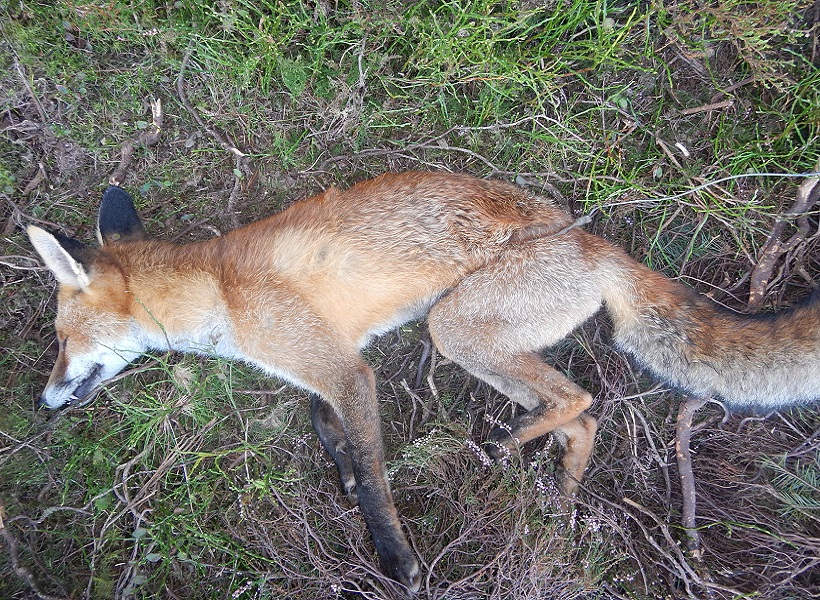
The snare ban doesn’t prevent gamekeepers from continuing to kill foxes. And the foxes they are killing (e.g. 200 per year on one estate whose gamekeeper gave evidence to the Bill committee) are probably at such high densities thanks in large part to the availability of unnaturally-high levels of gamebirds that create an over-abundance of prey that will attract foxes to the estate. Its a problem of the industry’s own making.
To suggest that an estate might face financial ruin if gamekeepers can only shoot foxes in the face rather than asphyxiate them with a wire noose reveals an awful lot about the mindset of these so-called ‘guardians of the countryside’.
Imagine arguing against a ban on a device that causes so much unnecessary suffering to any poor animal unfortunate enough to be caught in it, let alone suggesting that your business can’t function without being able to inflict such cruelty. If that’s the case, they shouldn’t be in business at all.
The Convenor of the Rural Affairs Committee, Finlay Carson MSP (who, along with his fellow Conservatives voted against the Wildlife Management Act) has responded to the letter of complaint by writing his own letter, on behalf of the Committee, to Minister Jim Fairlie (gosh, it’s almost as if this was all pre-planned). Here’s the Convenor’s letter to the Minister:
It’ll be interesting to see how the Minister responds. One to watch.
UPDATE 4th November 2024: Rural Affairs Committee to consider attempts to disrupt impending snare ban in Scotland (here)
UPDATE 25th November 2024: A landmark day in Scotland as snare ban commences (here)
 Raptor Persecution UK
reference to the protection of ground nesting birds cracks me up.Why not just say ‘intensively reared grouse for killing by gun for fun’
Killing foxes to protect biodiversity only confirms their biodiversity is very selective..
Highly comical that the dark side should be seeking official guidance on what methods of control should be used to replace snaring!
allow all the game shooting estates or individuals to set as many snares as they wish BUT BAN THEM FROM BEING ALLOWED TO SHOOT TRAP OR KILL ANY WILD BIRD OR ANIMAL ON LAND THEY SHOOT OVER FOR ANY SORT OF PAYMENT FOR EVER.
this way both sides win.
And the wild animals and birds are saved from a horrific dearh
This reminds me if what’s happening on Midhope Moors here in S Yorks. The company managing the grouse moors are supposed to be removing a temporary, green plastic, track that was laid down to get access to restore some blanket bog, I think more than 7 years ago. But, the company, Dunlin Ltd, have made repeated legal challenges against the ruling that they should remove the track. Their tactics seems to be to wait until the time is almost up for complying with the latest deadline for them to start work on removing the track and restoring the heathland habitat it passes through, and then submit yet another legal challenge against the planning authority.This way, time passes and the track becomes more embedded in to the vegetation; and its breaking up too. I suppose it has a financial cost to the Peak District National Park planning dept. to deal with this. And, the legal challenges must cost the company money too. I suppose the grouse moor people hope eventually they will wear down the planning enforcement team and they’ll give up, or the over time case will get forgotten by planning officers who replace the current ones. Or maybe Dunlin Ltd. hope PDNP will give up the flight due to the costs.
Thanks, Wendy.
For those interested in this case the following links provide further detail:
https://markavery.info/2018/02/17/tracking-midhope-moor-case-peak-district/
https://democracy.peakdistrict.gov.uk/documents/s44016/ID2MidhopeOpeningRemarksFINAL2072021HashiMohamed.docx.pdf
https://democracy.peakdistrict.gov.uk/documents/s43392/MIDHOPEDANPROOF051120.pdf
https://acp.planninginspectorate.gov.uk/ViewCase.aspx?Caseid=3215789&CoID=0
Well, if they can’t do without laying loops of wire about the place to keep killing enough foxes, then this begs the question what does a keeper do with his time and his equipment these days?
Estates dispensed with the “overworked Old Bob and his Underkeeper” model of keepering twenty plus years ago. The standard model is now “high investment = high expectations” model of saturation keepering. Overkill manpower levels of energetic young “Beatkeepers”, four, six or more of these zipping about the Estate on modern quads & ATV’s using well planned networks of modern tracks – not wasting time walking long distances. They are furnished with superb quality rifles & scopes, with night vision & thermal vision that would put the SAS to shame…and they are skilled at using them, especially in conjunction with yet more technology – Fox-Pro and similar calling devices. They have semi-auto 5, and 8 shot pump shotguns for anything closer. They are decked out in high quality modern all weather clothing that means they can stay out in rotten weather. There are trail cameras, and night vision drones available to assess and target fox movements. And of course there still remains “man’s best friend” to sniff out ye olde adversary. Most keepers retain several terriers for foxing.
But they are insistent that they just cannot do without hundreds of wire nooses and the associated cave-manhorror show? Do they think that everyone on the “anti” side of this argument is totally stupid?
Even a newcomer might be forgiven for beginning to draw one possible conclusion – that they are using their time and the above equipment to very carefully and very cautiously go about killing “other things” shall we say…and that they just haven’t got time to mess about with humane fox killing methods – especially when it can more easily be done with snaring!
Very explicit and enlightening. Lots of food for thought there. Thanks SM.
Spaghnum Morose you are very familiar with the modern game keeping practices, very well put and and sadly all very true!! You must live on or near a large commercial shoot just as I do!!
Well said SM you are completely spot on with your analysis of modern keeper using all the necessary tools and equipment to carry out these monstrosities so life is less miserable. And always at daft o’clock when most of us are in bed .
Thanks all, just wanted to rid anyone of the notion that it is a beleaguered, rheumatic Seth Armstrong type character who has 12, 000 acres of unforgiving moorland to cover by himself – and on foot – who is begging to be allowed to carry on snaring. This is a modern, well managed, well equipped industrial workforce operating to the same principles of industrial efficiency as a workforce would in an urban setting.