
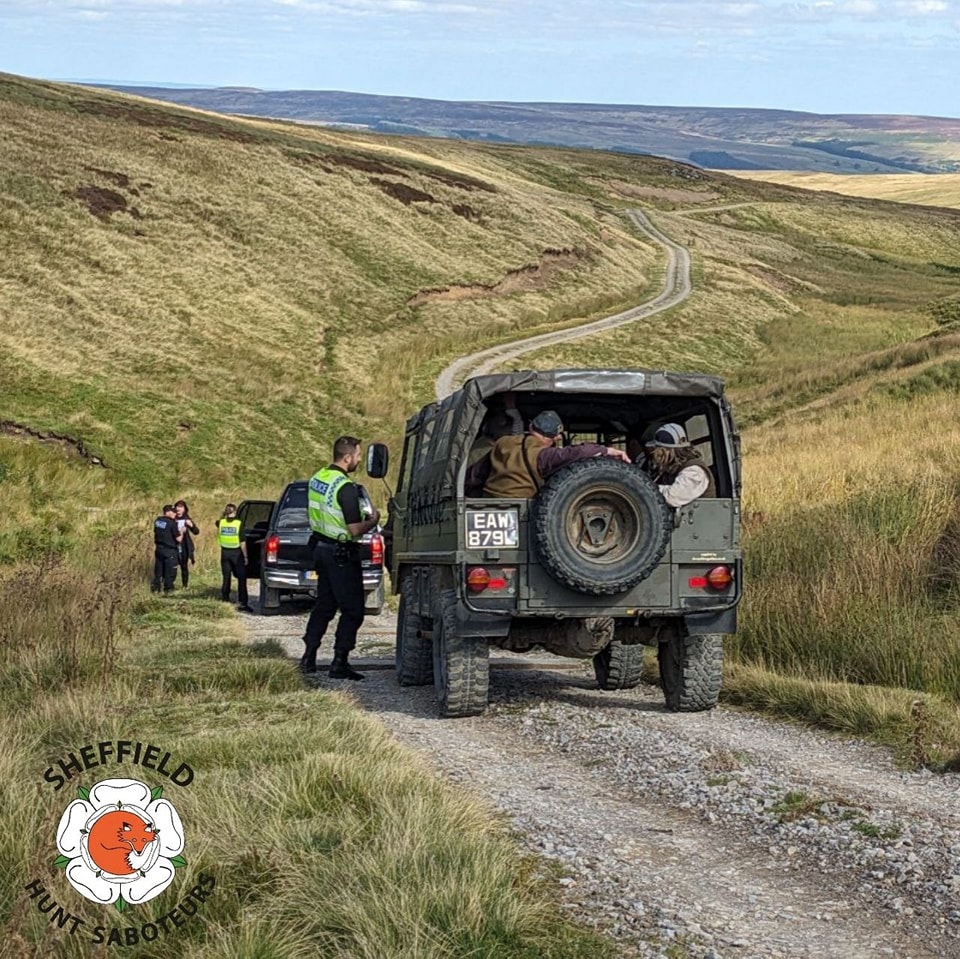
Following the disruption of a grouse shoot on Wemmergill Estate in County Durham on the Inglorious 12th (see here), the Hunt Saboteurs were out again yesterday and this time managed to disrupt a grouse shoot on Stean Moor in Nidderdale, North Yorkshire.
Stean Moor was previously owned by one of the Queen’s good mates, the now late Lord Vestey (see here for obituary, and also see pages 116-117 in Guy Shrubsole’s fascinating book, Who Owns England?).
The Hunt Sabs managed to disrupt two shooting days there last year (see here).
For details of yesterday’s disruption, please see here.
 Raptor Persecution UK
well done Sabs, keep the irritation up as those people [Ed: rest of comment deleted as libellous]
Absolutely excellent! I comment as a current regular donator to Hunt Sabs. May they live long and prosper in their disruptive endeavours!
apologies if you thought my comment was libellous, I get upset when our Raptors & Hare are persecuted.
well done sabs is such a stupid comment it’s just the same as saying well done to the rioters or looters even football hooligans. These people are breaking the laws with violence and intimidation. They should be jailed like the rest but seem to operate with the government turning a blind eye.
without grouse moors there would be no henharriers as all the rest of the rspb and similar reserves produce nothing but vermin.why don’t sabs try to get the government to overhaul the hedgehog laws and organise a cull on badgers to save them from extinction. Curlew and all ground nesting birds are being driven to extinction by badgers and foxes.look at what labour is going to do to the environment with a massive house building project.not to mention the carbon outputs from such a criminal environmental project.
it’s because of the grouse moors that the harriers are being shot??
So you class Bitterns, Avocets, Common Cranes, Black tailed Godwits, Little Terns, Dartford Warblers, Bearded Tits etc etc as vermin then. That tells us everything we need to know about you.
“These people are breaking the laws with violence and intimidation.”
No, they are not. Where is your evidence?
“without grouse moors there would be no henharriers as all the rest of the rspb and similar reserves produce nothing but vermin.”
And yet Hen Harriers managed to thrive long before grouse shooting was invented. Apparently, RSPB reserves produce an abundance of wildlife, as anyone who has ever visited can testify.
“Curlew and all ground nesting birds are being driven to extinction by badgers and foxes.”
And yet Curlew and other ground nesting birds also thrived long before game shooting was invented. But if you lot introduce an unnatural over-abundance of prey species, it is no wonder your actions lead directly to an increase in predators.
So the imbalance is all your fault.
“look at what labour is going to do to the environment with a massive house building project”
That is a consequence of having unlimited net immigration contributing to an unsustainable population increase, according to these figures from the Office of National Statistics:
https://www.bbc.co.uk/news/uk-68139947#:~:text=The%20Office%20for%20National%20Statistics,500%2C000%20more%20births%20than%20deaths.
Eh !!!!!!!
Medication required.
And, seeing as there are no driven grouse moors just across the channel your belief is, presumably, that no Hen Harriers should exist there. I spent a week and a half in France back in May and spotted three of them hunting over agricultural land. How amazing is that….?
Excellent:-)
😂😂😂
please explain with your wisdom how the Hen Harriers survived for millios of years without the help of grouse moors
I think that the sabs are doing a good job stopping British wildlife from being abused for so called fun. I don’t agree with badger cull either and I went on a demonstration against the badger cull in London with Born Free.
You just wonder how those Curlews survived for hundreds of thousands of years without those heroic fields sports types, waging war against Badgers and Foxes. FYI, the main reason for the decline of Curlews and Lapwings isn’t predators, but changes in farming practice. I’m sure you don’t really care about carbon emissions.
I’m not sure immigration and Grouse shooting have much in common but to offset the propaganda of the last few years net migration into the UK is currently 0.5% of the population – 1 new migrant for every 200 citizens. And, of course, immigrants come in all shapes and sizes but most are neither illegal or a drain on the state – remember that the French population of London would make it France’s 7th biggest city. Despite the Brexit rubbish Britain needs to be open to the world – and dropping some outdated traditions like driven grouse shooting.
“I’m not sure immigration and Grouse shooting have much in common”
They haven’t, but I was replying to a comment by ‘Skylark’, whereas you are replying to the main report.
“to offset the propaganda of the last few years net migration into the UK is currently 0.5% of the population”
That is completely untrue.
In just the last two years net immigration into the UK has exceeded 2% of the total population. See
https://www.ons.gov.uk/peoplepopulationandcommunity/populationandmigration/internationalmigration/bulletins/longterminternationalmigrationprovisional/yearendingdecember2023
‘Population estimates show that net migration was a major component of population growth (of the UK) over the past two decades (Figure 1), making up 60% of population growth from 2004 to 2022.”
and
“Official figures projected that the UK’s population would grow from 67 million in 2021 to 77 million in 2046, and that net migration would account for 92% of this growth”
https://migrationobservatory.ox.ac.uk/resources/briefings/the-impact-of-migration-on-uk-population-growth/#:~:text=Population%20estimates%20show%20that%20net,growth%20from%202004%20to%202022.
Uncontrolled population growth is the overriding reason for loss of habitat, and loss of habitat is the overriding reason for loss of bio-abundance.
Well done Sabs!
Question. I used to hawk grouse on the Outer Hebrides on hills not used for driven shooting but primarily for stalking. So is it the intensive driven shooting everyone objects to and would walked up over dogs be acceptable? I am a one for the pot man, always have been. And the good thing about hawking and walked up shooting is not only does it provide healthy wild food, exercise is taken. Would the sabs desist if that happened?
seems to me we all have different views on the environment, but overpopulation is the main factor behind the fast deteriorating wild habitat of our country. We have (especially england), far too many people and the need for infrastructure to match. It wont make much difference whether we shoot grouse, pheasants, badgers, foxes or whatever!, we are a nature depleted country!, ive travelled all over the western palearctic birding, and butterflying, and believe me this country is poor indeed for wildlife. And will only get worse.
Hi John,
I’m not sure on what evidence you’re basing your claim that “overpopulation is the main factor behind the fast deteriorating wild habitat of our country”.
If you read the 2023 State of Nature Report the evidence points to agricultural intensification and the effects of climate change:
https://stateofnature.org.uk/wp-content/uploads/2023/09/TP25999-State-of-Nature-main-report_2023_FULL-DOC-v12.pdf
and why has agriculture intensified, to keep up with the greater need for food to feed the ever increasing population in this country and worldwide. In 2011 there were 1 Billion people worldwide,in 2024 that jumped to 7 billion. Don’t take much to work out that food production needs to increase. Less people less food production, more ground for wildlife..
“In 2011 there were 1 Billion people worldwide,in 2024 that jumped to 7 billion”
Cough. The time when the world’s population was approximately one billion was around 1800 – 1804, according to the UN:
https://www.un.org/development/desa/pd/sites/www.un.org.development.desa.pd/files/files/documents/2020/Jan/un_1999_6billion.pdf
We hit six billion around the year 1999. It took just ten more years to reach seven billion…
Yes intensive agriculture is a huge contributor to declining wildlife, and the reason for it, is to feed ever increasing populations of people!. Land use for housing, and all the infrastructure needed to support this,has massive impacts on habitat for nature. I visited latvia, before and after the exodus, of half its population, to work in the west. The difference was staggering!, farms and villages were abandoned, and wildlife literally doubled in a few years. Less people also means less dogs, less cats, less domestic animals, and the huge amount of land required for their upkeep!. Obvious really!
Thanks, John. That’s fair comment, although I’d argue that intensive, unsustainable farming isn’t the only option. It’ll be interesting to see whether this new Govt will bring in some change (for the better) to the post-Brexit farming policy.
Keith ur bang on!, and the only sensible way out of it, asap, is population decrease,FAST!, either thro war, famine, disease, and all the horrors that will bring!, or we get smart, and control breeding. Not everone likes the idea, and a generation will have to pick up the tab, and work longer!, less hours i would hope, the older we get!. But what a fantastic sacrifice!. 1 child per couple, and in 50 yrs, population halved!, then we work out the right sustainable numbers for the health of mother earth.
“If you read the 2023 State of Nature Report the evidence points to agricultural intensification and the effects of climate change:
https://stateofnature.org.uk/wp-content/uploads/2023/09/TP25999-State-of-Nature-main-report_2023_FULL-DOC-v12.pdf “
I’d say that both of those factors are inter-related to the significant increases in the human population: one locally and the other globally.
Agricultural mechanisation arose from the Industrial Revolution, and by the 1800’s the yield per unit area of land in the UK had increased many fold over that of the Middle Ages.
The UK population in the Middle Ages fluctuated from around 1 million to nearly 4 million, whereupon it fell back to about 2 million by the 1400’s (disease, famine etc..)
The UK population by 1800 was more than 10 million.
The report, however, tends to deal with the modern intensification of agriculture (chemicals, genetics) from the middle of the 1900’s, where the UK population has been able to increase from around 50 million to an estimated 69 million today.
These changes in agriculture both enabled our UK human population to increase and are driven by that increase (hence, inter-related), but – today – the UK is also more reliant upon food imports.
The problem conservationists have is precious little reliable environmental data prior to the 1970s exists. According to the RSPB, 30 million House Sparrows are thought to have vanished from the UK since the 1970s.
Has modern agriculture led to the loss of so many House Sparrows? And could we really have 69 million people living in the UK today without modern agriculture?
Similarly, climate change is driven by the very technology required for 8 billion people to live on this planet. Without fossil fuels, for just one example, we would not have the fertilisers required to feed anywhere near that number – and which are set to continue increasing:-(
If – just imagine – we could stop all greenhouse emissions instantly, today, it would still take at least a thousand years for atmospheric CO2 to return to pre-industrial levels. In the meantime, temperatures and sea levels would continue to rise before eventually falling back…
On the other hand, if we continue burning fossil fuels until all reserves are exhausted, it will take many tens of thousands of years before atmospheric CO2 returned to pre-industrial levels.
World population in the year I was born = 2.5 billion.
World population now = 8.2 billion. Says it all.
But we also need to consume less, especially in the “developed” world.