
Apparently there won’t be much grouse shooting taking place this year when the season opens on Monday (12th August). According to various reports from the grouse shooting industry, this is due to a combination of factors including a cold wet spring and an extraordinarily high worm burden on many moors.
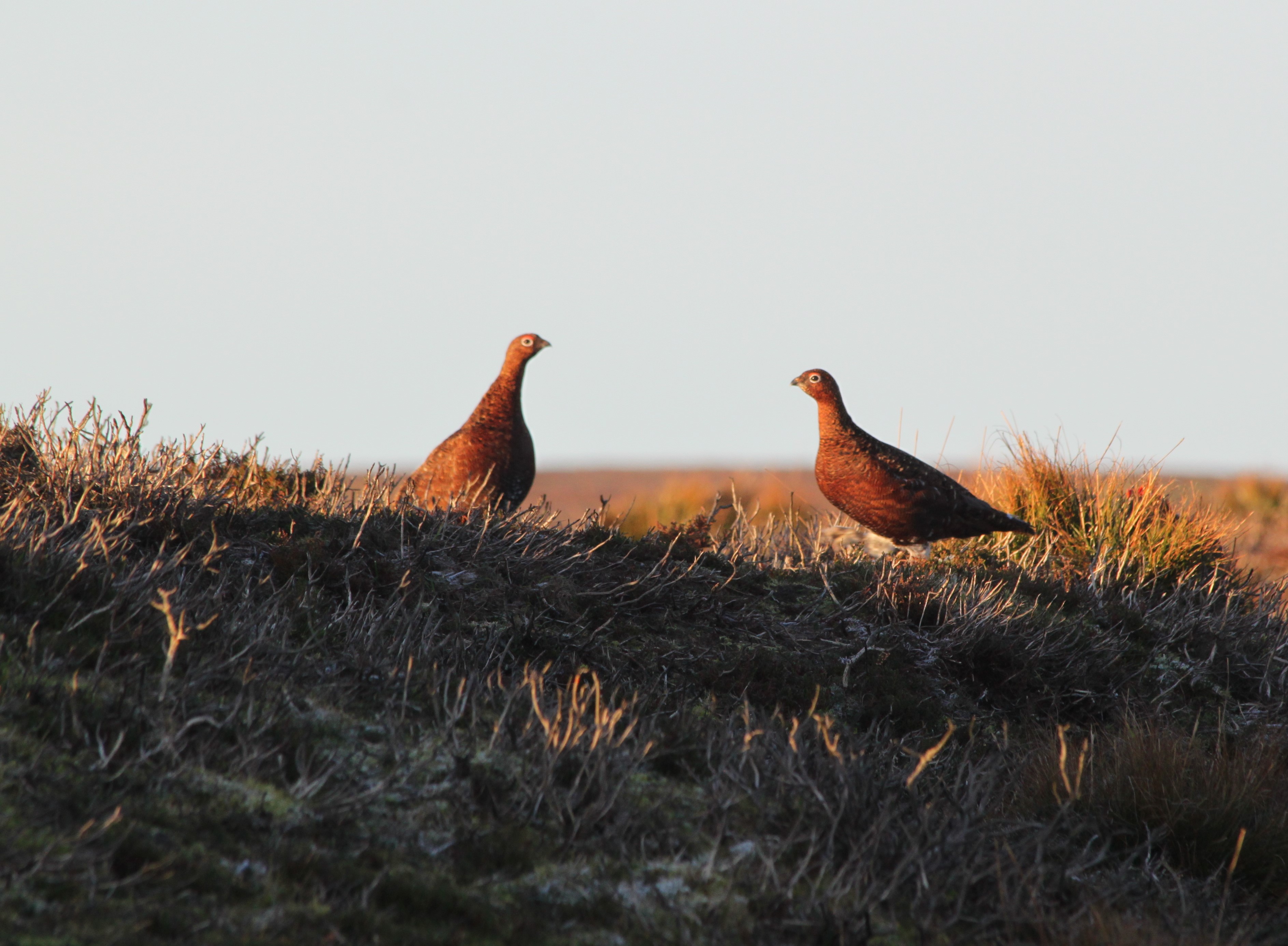
They may not be shooting many red grouse but they’re more than making up for it by shooting themselves in the foot instead, particularly in Scotland.
I’ve read quite a few newspaper articles in the last few days about the so-called Glorious 12th but a couple of them stood out – whoever is advising the shooting organisations on their PR strategy is hanging them out to dry! Not that I’m complaining, if they want to make complete fools of themselves it saves me a job.
The first article that made me laugh out loud was an opinion piece in The Scotsman by Peter Clark, BASC’s Scotland Director:
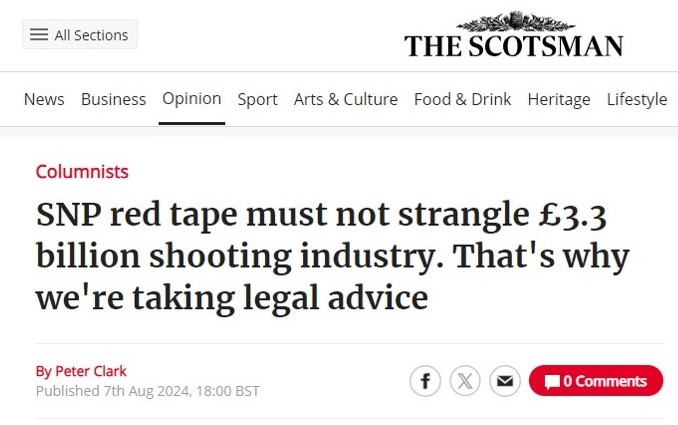
I’m not going to reproduce the whole article because it’s too dull – you can read it here if you want to – but I do want to highlight a couple of points.
His opening paragraph goes like this:
“Grouse shooting is crucial to rural upland communities, with the start of the season representing the culmination of a year’s hard work, grit, and determination. Unfortunately, this season doesn’t look as promising as previous ones, with counts looking less positive“.
I wondered if the grit he refers to is the tonnes and tonnes of toxic, medicated grit that grouse moor managers chuck out on the moors, with minimal regulation, to medicate the so-called ‘wild’ red grouse to stop the natural, cyclical population crashes caused by parasites? I somehow doubt it – the industry’s leaders prefer to keep this dodgy practice under the radar.
Peter’s article goes on (and on) about how much shooting is worth to the economy, but predictably he lumps ALL types of shooting together rather than just focusing on grouse shooting, presumably to make grouse shooting look more economically viable than it actually is. It’s a common tactic. He also fails to include in his calculations the economic costs of grouse shooting to society. Again, a common ploy by the defenders of this so-called ‘sport’.
But the real PR disaster comes further down the article where he’s discussing the new grouse moor licences that have been introduced for the first time this year as the Scottish Government’s latest attempt to stop the illegal persecution of birds of prey on grouse moors. Peter writes:
“We clearly communicated to Jim Fairlie, the Scottish Government’s minister for agriculture and connectivity, before the Wildlife Management Bill became an Act that he should pursue amendments to make it more practical.
These proposed adjustments included removing provisions for adding additional game bird species to the shooting licenses, eliminating expanded investigative powers for the Scottish Society for Prevention of Cruelty to Animals, and refining the scope of what are considered to be “relevant offences” under the licencing scheme. These offences include those under wildlife legislation, ranging from the Wildlife and Countryside Act 1981, right through to the new Hunting with Dogs (Scotland) Act 2023. The British Association for Shooting and Conservation (BASC) was clear that the scope of the relevant offences was too broad, given that the sole focus of this licensing regime from its inception was to tackle raptor persecution.
Despite presenting strong evidence of the risks these aspects pose to the sector, our specific proposed changes were not included. While the BASC and other shooting organisations successfully won amendments to the Bill and challenged many aspects of what was originally proposed, ultimately, the shooting community now faces new layers of regulation.
Consequently, BASC is defending its members and seeking legal advice regarding the final version of the licensing scheme, which has now been implemented ahead of the start of the season“.
So let me get this right. Peter seems to be arguing that it’s just not fair that grouse shooting licences could be suspended and/or revoked if offences, other than those relating to raptor persecution, such as badger persecution or the hunting of foxes with more than two dogs, are uncovered on grouse moors!
“BASC is defending its members…” he says. What, by saying that BASC members shouldn’t be sanctioned if these other types of wildlife crime are uncovered??
Is he for real?!!
BASC is not alone in making the industry look ridiculous. In another article, published yesterday in the Guardian (here), BASC, along with industry lobby groups Scottish Land and Estates (SLE) and the Game and Wildlife Conservation Trust (GWCT) are also arguing that the licensable area to which these new regulations apply should be restricted to just the grouse moor area and that’s it’s ‘unnecessary and unfair‘ if the licence applies to other parts of an estate.
Eh? Where’s the logic in that? It’s blindingly obvious that estates would simply restrict their illegal activities to estate land next to the grouse moor, e.g. shooting a sleeping eagle as it roosts in trees on the edge of the moor, thus carefully avoiding culpability and a licence sanction, let alone a criminal prosecution.
The raptor killers have been exploiting this loophole for a long time – the most favoured practice being placing poisoned bait on the tops of fenceposts on an estate’s boundary line, especially at the top of a hill, making it more likely that a poisoned raptor will die further downhill on an adjoining estate and thus putting that neighbouring estate in the frame for the illegal poisoning.
As for the extent of the licence coverage being “unnecessary“, if that were so, why would the shooting organisations be so keen to limit the licence’s geographical extent if they’ve got nothing to hide?
There’s a quote at the end of the Guardian piece from Professor Colin Galbraith, Chair of NatureScot’s Board, discussing the entire coverage of an estate with a licence:
“If they’re not doing anything wrong, why worry about it?“.
Quite.
 Raptor Persecution UK
Interesting, as ever! Thank you for keeping us so very well informed.
if the do called sporting shooters estates stopped killing raptors to line their own pockets there would be no need for licences.But as they cannot be trusted to protect them they must hanyave the brakes applied and hard. Any raptor found to have been killed by anything other than natural causes NEAR ANY SHOOTING ESTATE the estate must be shut down for 3 years as a lesson. The shooting estates do not cars about anything other than killing all and any natural raptors they think may kill one of their birds. I used to shoot never driven shoots just natural shoots which was most enjoyable
Numbers meant nothing, if you got 2 or 3 birds or rabbits we were more than pleased but all the estates want is high numbers.FINITO
“Any raptor found to have been killed by anything other than natural causes NEAR ANY SHOOTING ESTATE the estate must be shut down for 3 years as a lesson”
That’s a very good way for any criminal estate to close down any ‘innocent’ estate, and remove their ‘competition’, don’t you think?
It seems ludicrous of these people to say for years that it is not their fault that birds of prey numbers are so low on grouse moors and then start whining when the laws on persecution are tightened up if they are as they clain ( nothing wrong) then they have absolutely NOTHING to fear from the licensing scheme now do they.
Once again poor weather will hit the amount of grouse shooting and, according to shooting organisations, hit local economies. Surely those communities should wake up and realise that, with climate change making shooting even more unpredictable and unreliable, it is time to switch to landscape restoration and increasing biodiversity which, studies have shown, boosts employment and investment in local communities. For the sake of our climate and nature they must act soon and the government must back them with finance as the Scottish Government does
“Surely those communities should wake up and realise that… “
Should they? It is not the ‘communities’ who decide how land is managed and what it is managed for; it appears, unfortunately, to be the sole preserve of the land-owners. What mechanisms of power do such ‘communities have? The ‘communities’ have to just like it or… move away.
“For the sake of our climate and nature they (the communities) must act soon and the government must back them with finance as the Scottish Government does”
Are you asking for the taxpayer (ie. all the ‘communities’) to pour money into the land-owners pockets?
Yes that’s what happens in Scotland. A community buy-out is the only answer to the status quo – if large corporations do it then it’s a bit better but there’s no guarantee that they will do what’s best for nature, the community and the climate. Unfortunately you can’t just compulsory purchase/redistribute land without compensating the landowner as in any other situation. The rich landowners will rarely give up shooting so what else do you suggest? The next best is to pay them to manage their land for nature through Defra money but, again, there’s no guarantee they will do it well
I think your above point is valid but must be seen in relation to potential changes in land values. This is the fear at the heart of SLE’s objection to licensing. Namely that millions, perhaps billions of pounds of land values will be wiped out of the system (i.e. their members hands) if (and it is a big IF, I accept that) Licensing successfully squeezes down on those estates (most of them!) that cannot run their business within the law. This in turn would mean that grouse shooting is just one element of upland land management instead of the pre-eminent one. Other things would be seen as being just as economically viable, and buy-outs by conservation minded organisations and maybe communities would not suffer by having to pay high prices for what the land is nominally worth as an intensive big-bag raptor-killing driven grouse moor.
Yes I can see that happening if grouse shooting is no longer viable for whatever reason, particularly if the weather continues to reduce the number of shooting days. That could force landowners’ hands and sell offs may ensue. Perhaps it could come into public control (say through National Park ownership) if there was a change in tax on wealth and deals were done. It’s happened before
“Perhaps it could come into public control (say through National Park ownership)”
As far as I know, the National Parks in Scotland do not own any land.
Yes but they and park authorities in England could buy land if it comes on the market as national park authorities do in other countries
“Yes but they and park authorities in England could buy land if it comes on the market as national park authorities do in other countries”
National Parks in the UK are set up entirely differently to those of other countries.
https://en.wikipedia.org/wiki/National_parks_of_the_United_Kingdom#:~:text=Despite%20their%20name%2C%20they%20are,usually%20include%20permanent%20human%20communities.
“In the United Kingdom, an area designated as a national park may include substantial settlements and human land uses that are often integral parts of the landscape. Land within national parks remains largely in private ownership. These parks are therefore not “national parks” according to the internationally accepted standard of the IUCN[2] but they are areas of outstanding landscape where planning controls are a little more restrictive than elsewhere.”
Indeed our national parks may not be set up fundamentally like foreign ones are (which is a whole different issue) but the authorities already do own land in their parks. Is there a ban on them owning land? No so why can’t they take on more and why can’t the purpose of parks be changed to emphasise nature as well as human enjoyment etc
“but the authorities already do own land in their parks.”
Not in Scotland, as far as I know, and just a very small amount in Wales and England.
“No so why can’t they take on more”
Because they have no independent source of income. They are administrators, only.
“why can’t the purpose of parks be changed to emphasise nature as well as human enjoyment etc”
There has just recently been a Government consultation on the role of National Parks. Did you participate, and what did you recommend?
I recommended just that. As I said, finance can come from government funds like in Scotland. Wherever it comes from, the rich landowners model of lairds and squires hasn’t served our countryside well and it’s time for change. Hopefully we’ll get it before it’s too late for nature and the climate…
“A community buy-out is the only answer to the status quo”
No, it is not. Not every ‘community’ has the wherewithal.
“The rich landowners will rarely give up shooting so what else do you suggest? “
Me? I would ban shooting. But I do not demand that ‘surely communities should wake up’, as if it is somehow their fault, or within their power to change things, when I know that ‘communities’ rarely have such power.
Communities do have the power in Scotland and the government gives them the wherewithal
“Communities do have the power in Scotland and the government gives them the wherewithal”
That is genuine news to me. Can you tell me how much money the Scottish Government has given to local communities to enable them to buy out shooting estates? What is the total Government funding pot for these exercises?
My admittedly limited understanding of Scottish affairs is that, in stark contrast to your claims, the Scottish Green Party have actually called on the Scottish Government to stop subsidising shooting estates.
https://greens.scot/news/no-public-money-for-shooting-estates
The chickens of years and years of appalling behaviour under a friendly Government are coming home to roost in flocks – the political environment has obviously taken a nose dive for shooting since this legislation started and they can look forward to a degree of implementation that they wouldn’t have expected at its conception. Sadly, lack of success in shooting Grouse this year doesn’t appear to have extended to Hen Harriers and other raptors.
Aah, as ever, the extravagant claims about billions of pounds, which, if one can ever track down the source of them, turns out to be nonsense.
I note that yer man there claims £5 billion for golf; however, when looking into some of these sort of claims over the planning application for Coul Links, I found that all of what was claimed there went back to a sales pitch by one of the big consultancy firms, which was then repeatedly used and expanded without attribution, to the point it took me a day of serious google fu to locate it.
If one can track down claims of tourist related expenditure to source (my local council kindly told me how they did it) it is often a proprietary “black box” model with absolutely no indication of what the inputs are nor how valid and accurate they are. Oddly this model produces results which local councils keen to demonstrate that tourism = mucho moola are happy with.
After a lot of looking I am yet to see any of these claims which would stand up to decent, evidenced scrutiny. But if anyone knows of any good studies showing support for such claims, please let me know.