
A couple of weeks ago I blogged about the new National Hen Harrier Taskforce – a police-led initiative to tackle the ongoing persecution of hen harriers on driven grouse moors (see here).

The Taskforce’s proposed strategy for tackling hen harrier persecution on grouse moors is based on a new framework designed to tackle all types of Serious Organised Crime that was launched by the Home Office last year (see here). It’s based on a three-step plan of ‘Clear, Hold, Build‘.
Step one (‘Clear‘) involves police officers relentlessly pursuing organised crime members within a community (or in this case, an industry), using all available powers to ‘clear’ the offenders from specific locations.
Step two (‘Hold‘) sees officers undertake continued high visibility activity to ensure other serious organised criminals can’t move in and operate in the vacuum created by step one.
Step three (‘Build‘) relates to building local community resilience and trust, through partnership-working, to ensure that Serious Organised Crime doesn’t reoccur at that location.
When I wrote about the Taskforce a few weeks ago (here) I mentioned a similar police initiative, called Operation Artemis, that was launched to tackle hen harrier persecution on grouse moors in 2004, some twenty years ago. That initiative crashed and burned within three years because grouse moor owners refused to cooperate with the police. The new Taskforce has a more sophisticated theoretical approach and stronger enforcement support, but the basic premise is the same: establish a partnership between landowners and the police to target the hen harrier killers.
However, as we’ve come to learn, partnership-working is only successful if all partners have the same objective and there are no conflicts of interest.
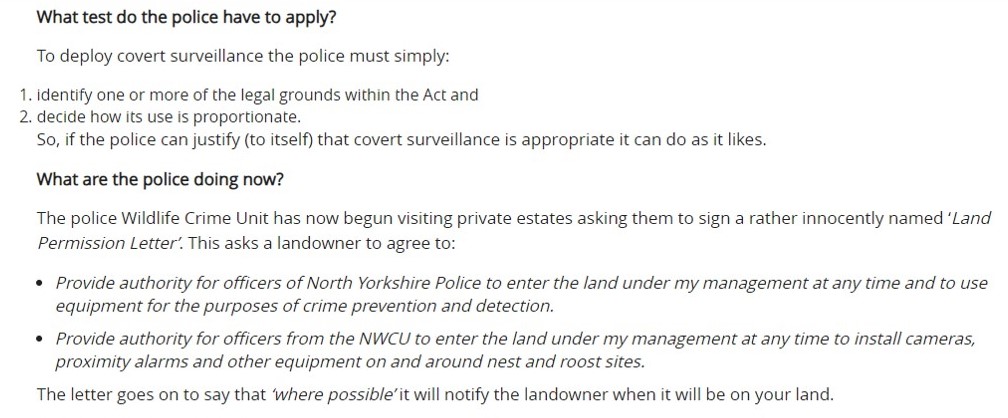
In an extraordinary blog posted on the Moorland Association’s website on 8 July 2024, (the Moorland Association is the lobby group representing grouse moor owners in England), it is suggested that the police are ‘bypassing regulation’ by asking grouse moor owners to sign a letter giving permission for the police to enter land at any time and use equipment for the prevention and detection of crime. This includes the installation of cameras, proximity alarms and other equipment on and around hen harrier nest and roost sites.
The Moorland Association is advising its members not to sign any letters authorising police access without first taking legal advice because, it suggests, this is an attempt to ‘bypass regulation on surveillance’.
I don’t see any issue with the Moorland Association advising its members to seek legal advice – that’s standard due diligence – but to state that the police are ‘bypassing regulation on surveillance‘ seems to me to be incendiary.
Here is a copy of the Moorland Association’s blog, screen grabbed here because it has already been altered from its original version (more on that below).



I’m not sure who wrote the Moorland Association’s blog because there’s no name attached to it but my money would be on the author being the Moorland Association’s CEO, Andrew Gilruth. Why do I think that? Well Mr Gilruth built an impressive reputation for presenting distorted information when he worked as Director for Communications for the GWCT (e.g. see here, here and especially here) and the Moorland Association’s blog has all the familiar hallmarks.
For example, the opening paragraph of the Moorland Association’s blog goes like this:
‘Most will remember the irony of RSPB staff falling foul of the courts in order to try and catch others breaking the law – and then expressing outrage when their evidence was thrown out of court here. In short, judges felt the police could not use others to circumvent the law on covert surveillance‘.
I’m not sure of the relevance of including this statement about the RSPB’s video evidence in the context of the Moorland Association’s blog about police surveillance, other than to (a) try yet again to undermine the credibility of the RSPB and (b) contrive an image that the police have previously ‘used others’ to ‘circumvent the law on covert surveillance‘.
It is accurate for the Moorland Association to point to the court case in 2015 where the judge ruled the RSPB’s video evidence as inadmissible. As regular blog readers will know, there have been a number of court cases where the RSPB’s evidence has been ruled inadmissible (e.g. here and here) but what the Moorland Association’s blog conveniently fails to point out is that there have also been a number of cases where the RSPB’s video evidence has been accepted by the courts and has, in fact, been crucial to the conviction of criminal gamekeepers, including these recent cases in 2022 here, again in 2022 here, and in 2023 here.
Far from the police ‘using others to circumvent the law‘, the police have worked legitimately and lawfully in partnership with the RSPB many times to convict criminal gamekeepers, both with and without the use of covert surveillance.
This successful partnership really agitates many in the game-shooting industry and I’d argue that’s the reason the Moorland Association’s blog opens with that paragraph – to infer that the police have a track record of ‘circumventing the law on covert surveillance‘ and to place this thought firmly in their members’ minds before moving on to discuss why the Moorland Association believes the police’s latest tactics on the Hen Harrier Taskforce are of ‘concern‘.
The rest of the blog appears to be a distortion of what the police are asking landowners to do. It’s surely obvious that the police aren’t asking landowners for permission to undertake covert surveillance – it would hardly be ‘covert’ if they’re telling the landowner that’s what they intend to do!
Rather, what it seems the police are actually asking for is permission to visit the moor at any time (Step one of the three-step strategy) and to install equipment (including proximity alarms and cameras) ‘on and around nest and roost sites‘, to catch the criminals that are killing hen harriers. You know, the criminals that the landowners and their gamekeepers claim to have no knowledge of, but who are repeatedly turning up on their estates, armed, to commit serious crime.
This isn’t covert surveillance in the sense of spying on people who live and work on that estate – hen harriers don’t tend to nest close to people’s houses and, as hen harriers are a Schedule 1 protected species, nobody should be anywhere near their nest sites without a disturbance licence anyway, so the likelihood of a landowner or their employees being ‘covertly surveyed’ by a nest camera is pretty implausible, assuming they’re not involved in the crimes being committed at those sites.
I note that the Moorland Association blog appears to have been edited since it first appeared on 8th July – it now includes a ‘note’ (under the sub-header ‘Should I sign one of these letters?‘) to clarify the police’s position that what they are asking for does not amount to covert surveillance. That’s an interesting edit. I wonder if it’s been added on legal advice to try and soften the Moorland Association’s accusations against the police? I imagine the police’s reaction to the Moorland Association’s original blog would not be favourable, given that it’s not conducive to partnership working and also seems to be verging on defamation.
The wider context of this Moorland Association blog is of most interest to me. Here is an organisation that repeatedly claims to have a ‘zero tolerance’ policy against raptor persecution, and yet here it is giving a pretty good impression of an organisation intent on sabotaging the police’s attempts to tackle raptor persecution (as well as other Serious Organised Crime) on grouse moors.
If I was a landowner, and armed criminals were repeatedly coming on to my estate to kill protected wildlife, I’d be on the phone to the police without hesitation, asking them to respond. Not just for the sake of the wildlife but for the safety of my family, my employees, my neighbours and the visiting public. I’d be asking for an armed response unit and would give them permission to do whatever they thought necessary, for however long it took to catch the gunmen. Wouldn’t this be the response of any reasonable, law-abiding citizen who had nothing to hide?
It’ll be fascinating to see what the police’s response is to the Moorland Association’s blog, assuming they’ve seen it. From the presentations I’ve heard from DI Mark Harrison, the officer from the National Wildlife Crime Unit (NWCU) leading the National Hen Harrier Taskforce, he’s playing strictly by the rules, being transparent, and initially taking a softly, softly approach with landowners, refusing to embarrass estates by naming them publicly as hen harrier persecution hotspots because he wants to work in partnership with them.

I’ve been cynical of his ‘partnership’ approach and have suggested that all he’s doing is shielding the criminals. However, DI Harrison has been very clear that his tactics are part of a longer-term strategy and that if landowners refuse to cooperate, it makes it easier for him to take the next step and upgrade the tactics to something far more serious.
The Taskforce isn’t just looking at wildlife crime. It is also intent on tackling offences such as theft (of satellite tags), criminal damage (of satellite tags), fraud offences, criminal use of firearms, and potential conspiracy offences relating to encouraging or assisting crime. Some of these are very serious offences, triable either way (i.e. can be heard in a higher court that has greater sentencing powers than a magistrates court) and thus there are more serious consequences for anyone convicted of these offences than being convicted for a wildlife crime offence.
The tactics that he’ll be empowered to use are far more intrusive than anything these grouse moor estates will have faced before, he won’t need their permission to deploy them and they won’t know what’s happening until it’s too late.
Let’s see if the Moorland Association’s inflammatory blog will trigger a response from DI Harrison and the NWCU, resulting in the Taskforce ramping up its tactics on any grouse shooting estates where a landowner refuses to sign up.
UPDATE 23 July 2024: Moorland Association booted off the Raptor Persecution Priority Delivery Group (RPPDG) here
UPDATE 22 November 2024: Revealed: letter of expulsion to Andrew Gilruth (CEO, Moorland Association) from Head of National Wildlife Crime Unit (here)
 Raptor Persecution UK
Any estates that object to police activity have obviously got something to hide and will be a good indication of where the criminals are active. And I suspect a lot will object because raptor persecution is systemic in the industry.
Good luck to DI Harrison and his team – I hope the MA blog represents their usual brashness over illegal raptor persecution thinking the establishment will have their back and the police operation will be pressured but this time, fingers crossed, that proves an over-confidence and real action is taken
Good old Andrew – having pretty much trashed the reputation of the GWCT he’s now ended up at a gig with an organisation that has little or no reputation to trash
Essentially the response of the MA is exactly what one might expect had they something to hide. The police say we can solve these crimes with a co-operative approach, the MA say not so sure about that indeed we may be opposed to this giving every indication of exactly where and amongst whom the problem lies. It also of course shows what absolute bunkum and window dressing their “zero tolerance” approach to persecution is. One might say to them is this wise or in their best interests with the change of government, who might be easily persuaded to go down the Scottish route of licensing.
There are a few very good estates out there when it comes to real zero tolerance and all evidence suggests they are indeed few, and at the other end of the scale some absolute villains with most in the middle. One might say which of these is the MA attitude representing and aiding and what are the others going to do about it, interesting times.
I agree with you, the number of grouse estates that leave ALL raptors alone, ALL of the time are very few. A minority, definitely. I would hope that those offering the public “Wildlife Tours”, “Curlew Safaris” and “Black Grouse Lekking Tours” will be enthusiastic signatories. For if not, then potential customers will be entitled to ask why not, and/or draw their own conclusions.
Likewise a potential paying visitor to the Castle & Gardens of estate “X” “Y” or “Z” might also like their conscience to be eased by noting that the estate is fully signed up and is genuithelping and not hindering the police.
Might also be worth parents asking the Headteacher which Estate the school intends to take their children to visit for a “Let’s Learn Moor” day / “Estates that Educate” day. Be interesting to see if all of those estates are enthusiastic in giving the police the requested freedom to operate?
It is clear that if they have nothing to hide, then they won’t object to having some surveillance close to the hen harrier nests and roost sites. We are always being told that CCTV is for the public benefit and those with nothing to hide cannot have anything to worry about. This is no different, it only applies to protecting hen harriers and has no other purpose. It is open to speculation why this proposal has met with such a strong reaction to it.
I have to agree with bogtrotter why do the police have to ask for permission and if the land owners hav’nt anything to hide what’s the problem!! From what I’ve seen and read over the years the landowners shoot ,trap ,poison any bird of prey that’s flying any were near or on there land. Whether the birds have transmitters on them or not there fare game and as usual nothing is ever done about it.
Dear GWCT, (
| info@gwct.org.uk |
) I quote from your website:
“Now is the time for us to show our support for woodcock
By Dr Andrew Hoodless, GWCT Director of Research. Camouflaged, small and active at dawn and dusk, it’s no wonder that woodcock remained a mystery for so long. Throughout the past 20 years, members like you have made it possible for us to shine a light on this cryptic bird, which is now red-listed.
Thanks to our work, we now know that most of the woodcock we see in winter breed in Russia, Scandinavia or the Baltic states, but a small minority are resident birds that remain in Britain all year round. Recent surveys show that these British breeders are in trouble. However, it is essential that any decisions are made with robust evidence. ”
It’s really lovely to hear that you are so concerned about this red-listed species.
Top suggestion that will make the biggest difference to the survivorship of the Woodcock – don’t shoot them. Shooting woodcock is unsurprisingly bad for woodcock – it hurts a lot and stops them breeding next year – mainly, because they’re dead!
When you go on to claim that your organisation is the “only” one that can provide Defra with “robust evidence” – What about the British Trust for Ornithology? RSPB? Wildlife Trusts etc?
I look forward to hearing from you,
Best wishes
David
David David Moorse, 15 Rushclose, Shanklin PO37 7NW
My concern here is with the contempt shooting estates and their customers have for hard-fought-for legislation and its difficult enforcement, with regard to the slaying of birds of prey along with any other form of life they class inimical to their game birds.
We live in a mire of dreadful criminal activity here in Scotland and the rest of the UK, plus the world scene. Many law of those in law enforcement face stigma and danger to their lives. Regular visits to the papers and other sources, to study what dreadful cases are being arraigned in our law courts, should convince anyone of compassion for the vulnerable, human and animal, that determined action by our law enforcement officers warrants admiration, and thanks for ensuring some decency exists, and gives some confidence that punishment will at least ensue. We live in a time when many members of the public are supporters of humane causes relating to wildlife and other animal abuse. Indeed, the shooting estates and their egregious dominance of such a vast area of Scotland, has caused disgust and anger, that those involved are so powerful that they can have a negative effect on the attempts to protect endangered species. Many ask why those who shoot game birds, can spend so much time and money on such a vile activity, when such resources could be used to lessen suffering in this vale of tears. It is pitiful to find that many who have been successful in some form of public entertainment or sport feel that to complete their status, they take up a bloodsport, and in this case “shooting”, with concomitant “toff” socialising. However, those with real “soul” can become valiant supporters of those organisations working to make the natural environment be as it should, without the distortion of cruel activities.
I’ve always felt that the instances where cases against gamekeepers for raptor persecution have been thrown out due to inadmissible evidence, expose the hypocrisy of the various shooting organisations and the shooting press with respect to their self-asserted abhorrence and zero tolerance of raptor crimes. If they genuinely abhorred these crimes their reaction when someone who is clearly ‘bang to rights’ but gets off on a legal technicality should surely be outrage that the criminal has got away with it but, no, they all rejoice instead at the fact that the RSPB has been stymied. Their zero-tolerance of raptor persecution is a convenient fiction and this latest MA blog post once again shows that them to have very little (if any) genuine commitment to preventing such persecution.
I’m at a loss to understand how NWCU is supposed to be failing to apply IUCN Guidelines on Human-Wildlife conflict and coexistence. This seems to be just another attempt to muddy the waters and stir up spurious outrage amongst MA members.