The case against Ruabon Moor gamekeeper Stuart Hart has been discontinued.
Hart, 47, had faced two charges – Using a trap to kill or take a wild bird (in this case, a Goshawk) and possession of an article capable of being used to commit a summary offence (see here and here for earlier blogs).
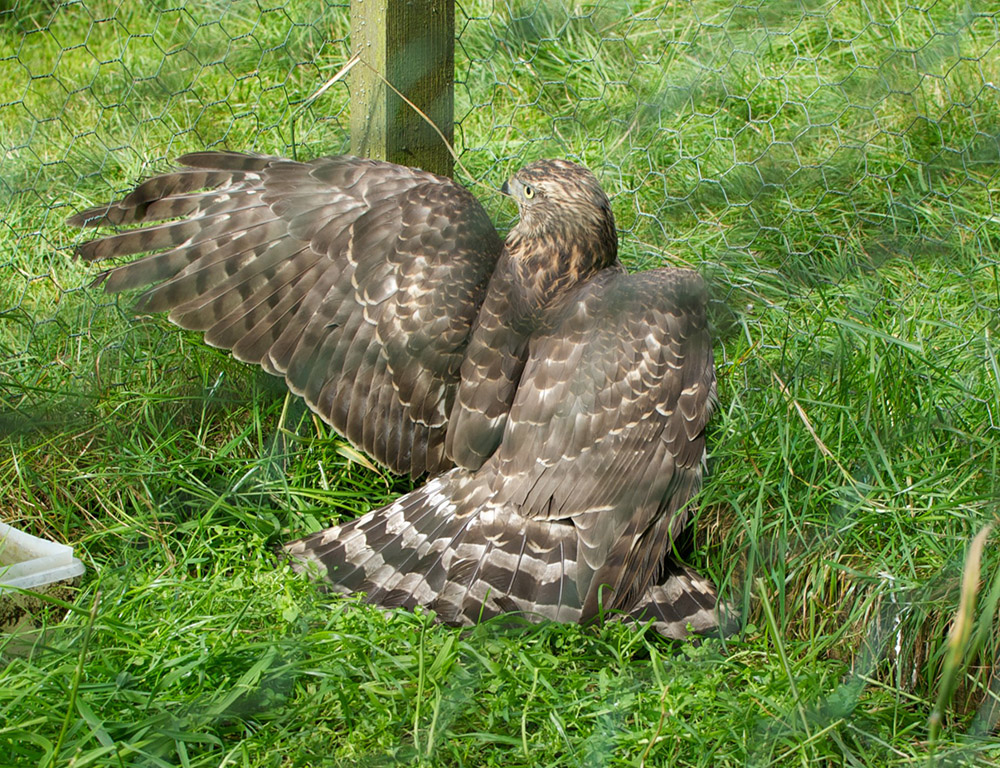
Young goshawk in a cage trap. Photo by RSPB (file photo, not linked to this case)
The first hearing in this case was held at Wrexham Magistrates on 28 March 2024. Hart had not entered a plea as his defence solicitor told the court he considered there had been procedural errors in the way the case had been brought. He also told the court that he wanted to challenge the admissibility of the RSPB’s video evidence (here).
The case was adjourned and was due to be heard again today (30 April 2024). However, according to the court, the case has now been discontinued.
Interesting. More to come on this…
UPDATE 26 November 2024: Ruabon Moor gamekeeper prosecution – why the case was discontinued (here)
A new scientific research paper published yesterday suggests that prescribed burning, including muirburn on grouse moors, continues to ‘fall short of sustainable practices’.
The research was authored by scientists at the RSPB and was published in the peer-reviewed journal Remote Sensing in Ecology and Conservation:
Annual extent of prescribed burning on moorland in Great Britain and overlap with ecosystem services (Shewring et al. 2024).
The paper presents an assessment of the annual extent of prescribed burning occurring on moorland in Great Britain (2017-2022) and further assesses the overlap of burning with key upland ecosystem services. Using high resolution satellite images of the GB uplands for five consecutive burning seasons, the authors developed a semi-automated method to detect and map the new burn scars in moorland vegetation.
This new method has enabled a more rapid assessment of the annual amount of burning that occurred across the GB uplands over five burning seasons (2017/18 to 2021/22) and further allowed researchers to look at where burning is coincident with known fire-sensitive features (e.g. peat soils, protected areas, steep ground and alpine habitats).
The study detected burning in many protected areas, with those in the North of England, and especially the North York Moors SAC/ SPA, subject to the highest percentage area burned.
Evidence of burning on a grouse moor in the North York Moors National Park. Photo: Ruth Tingay
Over these five burning seasons, an average of 15,250 ha of vegetation was burnt each year (59% of GB burned area was in Scotland with 39% in England).
In England, the area mapped as burnt during the 2021/22 burning season dropped to 1,859 ha, a decline of 73% when compared with the average of the four previous burning seasons – a pattern not repeated for Scotland.
The decline in the overall area burnt in England during the 2021/22 burning season is coincident with the new Heather and Grass etc Burning (England) Regulations that came into force in May 2021. Researchers will now use the method to map the extent of burning for the last two burning seasons in England to see if the decline has continued.
I’m sure it’ll also come in handy for monitoring the forthcoming adherence to the new regulations under the Wildlife Management & Muirburn (Scotland) Act. It’s easy to hide away evidence of illegal raptor persecution – not so easy to hide evidence of illegal muirburn.
Clearly any decline in burning on sensitive features like peatlands is welcome. However, despite the decline in the area burnt in England during the 2021/22 burning season, the study still found that 41% of the area mapped as burnt was on deep peat. These findings are consistent with the reports of burning the RSPB receive via its burning app, with one-third of reports received apparently of fires on deep peat.
Last year, two grouse moor owners were convicted for burning on deep peat in protected areas, one in the Peak District (here) and one in Nidderdale; embarrassingly, that estate was owned by a Board member of the Moorland Association (here).
For further summary information about this latest research I’d recommend this blog written by the lead author Mike Shewring, and this blog by co-author Pat Thompson.
The British Trust for Ornithology (BTO) is advertising for a Scottish Raptor Monitoring Officer to support the well-established Scottish Raptor Monitoring Scheme (SRMS).
This is a part-time position (3 days per week) on a fixed two-year contract. Salary: £25,110 per annum + 11% employer pension contribution.
The Scottish Raptor Monitoring Scheme is seeking a people-person who is keen to share their passion for raptors and raptor monitoring, to take a coordinating role within the Scheme on behalf of all its partners and keep SRMS data contributors informed and engaged with our work. The successful candidate will promote, organise and deliver both face-to-face and online training, which may include raptor monitoring survey techniques and online data entry to existing and new audiences. They will be responsible for continuing to build and nurture a community of engaged and motivated volunteers delivering data to inform the conservation of Scottish raptors.
The League is looking to fill this role quickly and will be reviewing applications on a rolling basis. To apply, submit your CV and a covering letter to people@league.org.uk
The British Trust for Ornithology (BTO) is advertising an exciting new position as the Welsh Raptor Monitoring Coordinator, to support the newly-funded Welsh Raptor Monitoring Project.
This project is funded by the Nature Networks Programme and is being delivered by the Heritage Fund, on behalf of the Welsh Government.
This is a permanent, full-time role based in the BTO Cymru office in Bangor, although you will be able to work from home part of the time on a hybrid working regime. Salary: £30,135 per annum + 11% employer pension contribution.
The role will involve developing, coordinating and promoting the project and its data collection methods, training and reporting.
Closing date for receipt of applications is Sunday 5th Mayand interviews will be held at Bangor during the middle of the week commencing 13th May. If you have any questions, please contact recruitment@bto.org
For further details and to apply for this position, please click here.
Press release from North Yorkshire Police (23 April 2024):
SUSPECTED SHOOTING OF A BUZZARD ON NORTH YORK MOORS
Our Rural Task Force is appealing for information following the suspected shooting of a buzzard in the North York Moors National Park.
The Buzzard is thought to have been killed near to Laskill, Bilsdale, on Thursday 4 April, and we’re appealing for anyone who saw any suspicious people or vehicles in the area to please come forward.
Buzzards and all other birds of prey are legally protected by the Wildlife and Countryside Act 1981. To intentionally kill or injure one is a criminal offence which could result in an unlimited fine or up to six months in jail.
If you have any information that could help please email tom.gaunt@northyorkshire.police.uk or call North Yorkshire Police on 101, select option 2 and ask for PC Tom Gaunt.
If you wish to remain anonymous you can contact Crimestoppers on 0800 555 111 or online at crimestoppers-uk.org
Please quote NYP reference 12240059635 when passing on information.
ENDS
This is a bit of an odd press release. The appeal for information is in relation to a ‘suspected shooting’ so I guess we can assume an injured/dead buzzard wasn’t found otherwise it’d have been x-rayed which would have confirmed whether it’d been shot or not.
It wouldn’t be a surprise to learn that another buzzard had been shot here though. This so-called National Park, where the landscape is dominated by driven grouse moors, is a well-known hot bed of raptor persecution where there are repeated crimes against birds of prey, mostly involving shooting or poisoning (e.g. here, here, here, here, here, here, here).
West Yorkshire Police are appealing for information after the discovery of a shot buzzard that was found dead in the East Morton area of Bradford, which is on the edge of Ilkley Moor.
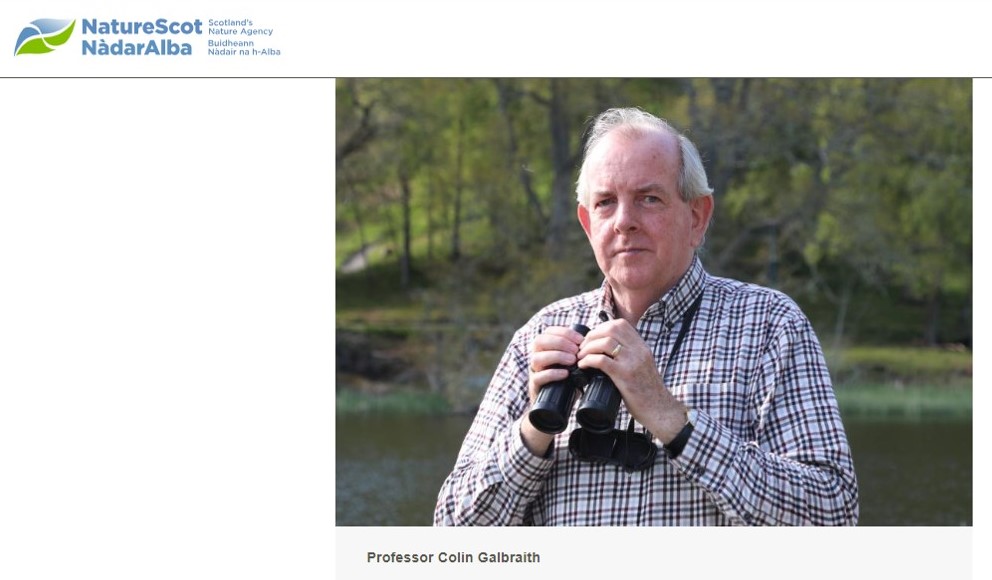
Many of you will know that Professor Colin Galbraith was appointed Chair of NatureScot’s Board last year (see here); a four year appointment until June 2027.
Screen grab from NatureScot website
Professor Galbraith was invited to speak at the Scottish Gamekeepers Association’s (SGA) recent AGM (1 March 2024) and I was curious about what he said to them. This is pertinent to another issue that I’ll come on to in another blog.
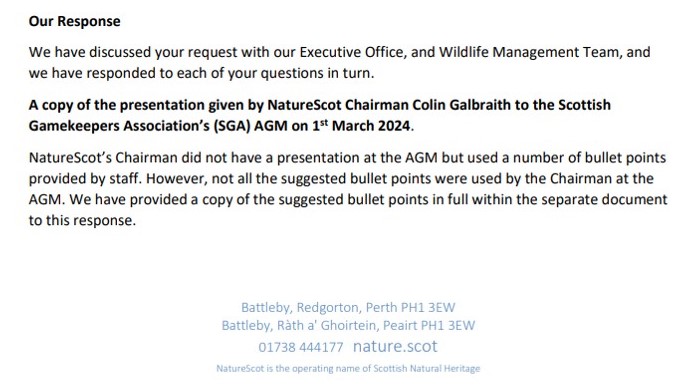
I submitted an FoI to NatureScot asking for, amongst other things, a copy of Professor Galbraith’s presentation to the SGA.
Here’s part of the response I received from NatureScot:
Here is a copy of the bullet points provided to Professor Galbraith by NatureScot staff for his speech at the SGA’s AGM:
Press release from North Yorkshire Police (18 April 2024):
HEN HARRIER OPERATION ON THE HUNT FOR SUSPECTS IN THE YORKSHIRE DALES
On Wednesday, (17 April 2024), a National Harrier Task Force operation was held at an undisclosed location in the Yorkshire Dales.
Our Rural Task Force deployed with the National Wildlife Crime Unit on a warrant to search land and premises that are suspected to be linked to the illegal killing of Hen Harriers and the theft of satellite tags.
Photo supplied by North Yorkshire Police
Photo supplied by North Yorkshire Police
Police Sergeant David Lund, of the Rural Task Force, said:
“The searches were conducted by dedicated police officers and staff who used detection dogs, drones, radio tracking and metal detectors.
“We are pushing the boundaries with new tactics and equipment as well as with innovative new partnerships. This includes the use of wildlife crime detection dogs and drones.
“With these additional assets, we are able to expand our search parameters significantly which will strengthen our chance of bringing perpetrators to justice.
“We want to send a strong message that the persecution of Hen Harriers will not be tolerated in North Yorkshire.”
The investigation is ongoing and North Yorkshire Police’s Rural Task Force are appealing for anyone with information about suspected offending to get in touch.
If you can help, please make a report via the North Yorkshire Police website or by calling 101, option 4, and speak to the Force Control Room.
Alternatively, contact Crimestoppers anonymously on 0800 555 111 or make an online report.
ENDS
This is very encouraging and well done to North Yorkshire Police for publicising what looks to be an enthusiastic search effort.
The location hasn’t been disclosed but from the photos provided by the police it’s quite clear this is a grouse moor (muirburn strips in the background and a medicated grit tray and marker to the right of the officer holding the metal detector) and it wouldn’t be difficult to make an educated guess about which estate this is.
It’s also not clear whether the search warrant was granted on the basis of a new, yet-to-be-reported recent hen harrier persecution incident or whether it was based on previous evidence of widespread hen harrier persecution in the Yorkshire Dales National Park – e.g. at least 24 of the 123 hen harriers known to have ‘disappeared’ in suspicious circumstances or been illegally killed in the UK since 2018, took place in the Yorkshire Dales National Park, with a number of them clustered around one particular area – see here.







 Raptor Persecution UK