
Four years ago in February 2020, nine UK game-shooting organisations made a massive U-turn after years and years and years of defending the use of toxic lead ammunition, and said they wanted to drag the industry into the 21st Century by making a five-year voluntary transition away from lead ammunition (see here).
A lot of us were sceptical because (a) we rarely trust anything the industry tells us; (b) previous ‘voluntary bans’ by the industry on a number of issues have been spectacularly unsuccessful (e.g. see here, here and here); (c) the ongoing failure of the shooting industry to comply with current regulations on many issues, including the use of lead ammunition over wetlands in England (here) and in Scotland (here), means there should be absolutely zero confidence in its ability and/or willingness to stick to any notional voluntary ban; (d) the Scottish Gamekeepers Association refused to sign up to the proposed five-year transition period because they believe there is insufficient evidence to support the claim that lead can have damaging impacts on humans, wildlife and the environment (here); and (e) in the very same year that nine shooting organisations committed to the five-year transition, BASC announced it was set to fight a proposed EU ban on the use of lead ammunition on wetlands (see here).
We were right to be sceptical.
A Cambridge University-led research project called ‘SHOT-SWITCH‘ has been monitoring the progress (or not!) of this five-year voluntary transition by purchasing pheasants from supermarkets and other retailers across the UK each year and having them lab tested to determine whether they’ve been shot with toxic lead ammunition or with non-toxic ammunition.
The project is now in its fourth year. Reports on the project’s findings in the previous three years have been published in the well-regarded scientific journal Conservation Evidence:
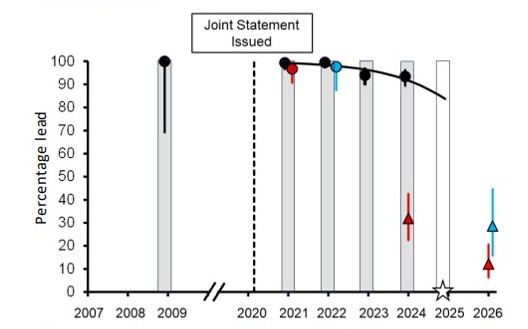
2020/21 season results here – 99.4% of tested pheasants (n = 180) had been killed with lead ammunition.
2021/22 season results here – 99.5% of tested pheasants (n = 215) had been killed with lead ammunition.
2022/23 season results here – 94% of tested pheasants (n = 235) had been killed with lead ammunition.
Guess what? The 2023/24 season results have just been published and 93% of tested pheasants (n = 229) had been killed with lead ammunition.
Here’s the latest paper for the 2023/24 season:
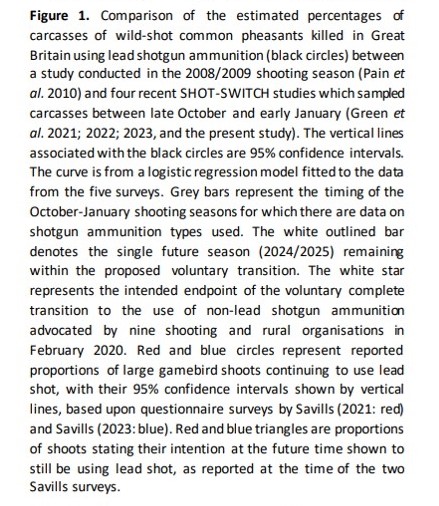
This graph from the latest paper says it all:
It’s going well, isn’t it? In fact I’m sure I’ve read comments from the game shooting industry proclaiming ‘great progress’. Liars.
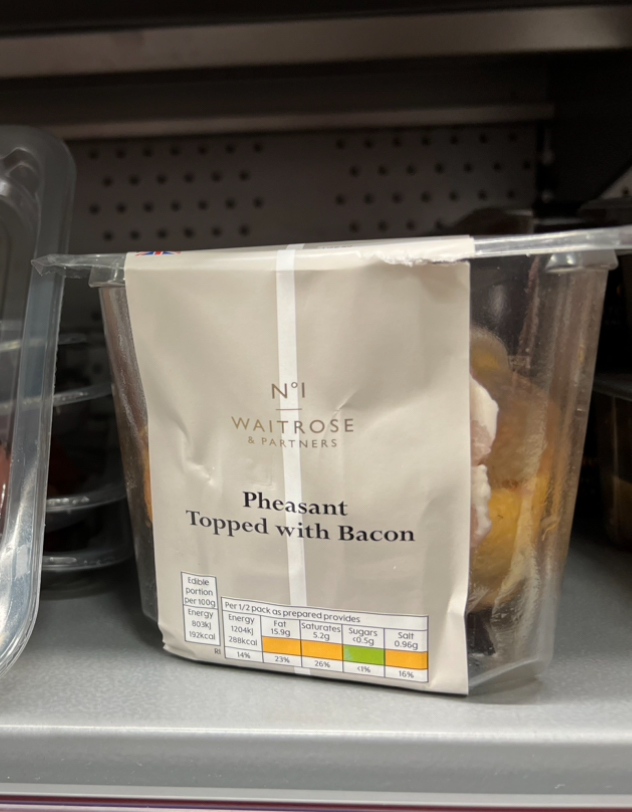
It’s interesting to see Waitrose re-stocking pheasants again this year. You might recall that twice before Waitrose has said it would no longer stock gamebirds shot with toxic lead ammunition, and twice it has been found to be doing exactly that after Wild Justice tested some of its products (see here).
This year Waitrose was very late to the game meat-selling party, only stocking its shelves in late January. And once again, according to the Shot-Switch results, Waitrose pheasants were found to contain lead shotgun pellets. What’ll be their excuse for the contamination this time? It’s just embarrassing that they can’t find a UK supplier of lead-free gamebirds, and even more embarrassing that they promote this stuff as part of the Waitrose No 1 “the very best” range. I’d hate to see their very worst range.
I note with amusement that Waitrose won Best Large Retailer of the Year at BASC’s Eat Game Awards last night. I don’t know what the judging criteria was but perhaps it included a willingness to sell game meat contaminated with poisonous lead shot whilst shouting very loudly in the other direction about toxic lead shot being unacceptable.
In addition to the Shot-Switch study, which examines the shot pellets found inside gamebird carcasses, over the last few years conservation campaign group Wild Justice has also been testing gamebird meat from supermarkets and other retailers to examine the level of lead found inside these birds (e.g. see here).
More samples were bought in the 2023/24 shooting season from a range of retailers and the results are expected in the next few weeks. Watch this space.
 Raptor Persecution UK
Presumably there is the required warning on the packet that this product ‘may contain lead shot’? If not is that not a case for trading standards to look into?
I believe the FSA are the sole arbiters of food safety in the UK, and they do not require ‘game’ meat destined for human consumption to be either tested for lead, or to contain warnings on the packet.
Here is what the FSA say about lead in ‘game’:
https://www.food.gov.uk/our-work/lead-shot-game#:~:text=If%20you%20are%20preparing%20wild,potentially%20harmful%20levels%20of%20lead.
The FSA are far more concerned about lead poisoning of farm animals than they are about lead poisoning of people from consuming ‘game’ meat:
https://acss.food.gov.uk/sites/default/files/multimedia/pdfs/publication/leadpoison0209.pdf
Curiously, it is the HSE which has been asked to look into the risks to the environment and to human health of using lead ammunition:
https://consultations.hse.gov.uk/crd-reach/lead-in-ammunition/#:~:text=HSE%20have%20identified%20risks%20from,uses%20of%20ammunition%20containing%20lead.
This consultation closed on 10th December 2023. The results are yet to be published – the BASC claim that the HSE have asked for an extension of the time allowed to report back:
https://basc.org.uk/hse-requests-extension-to-timeline-on-lead-ammunition-restrictions/