
Parliamentary briefing by a coalition of conservationists ahead of Stage 2 of the Wildlife Management Bill

Three conservation organisations held a parliamentary reception at Holyrood yesterday to brief MSPs ahead of the forthcoming Stage 2 of the Wildlife Management & Muirburn (Scotland) Bill.

Members of the Scottish Raptor Study Group, RSPB Scotland and REVIVE, the coalition for grouse moor reform, were joined by many members of the Rural Affairs & Islands Committee (the Committee tasked with voting on the Bill’s Stage 2 amendments) and a few other MSPs also attended.
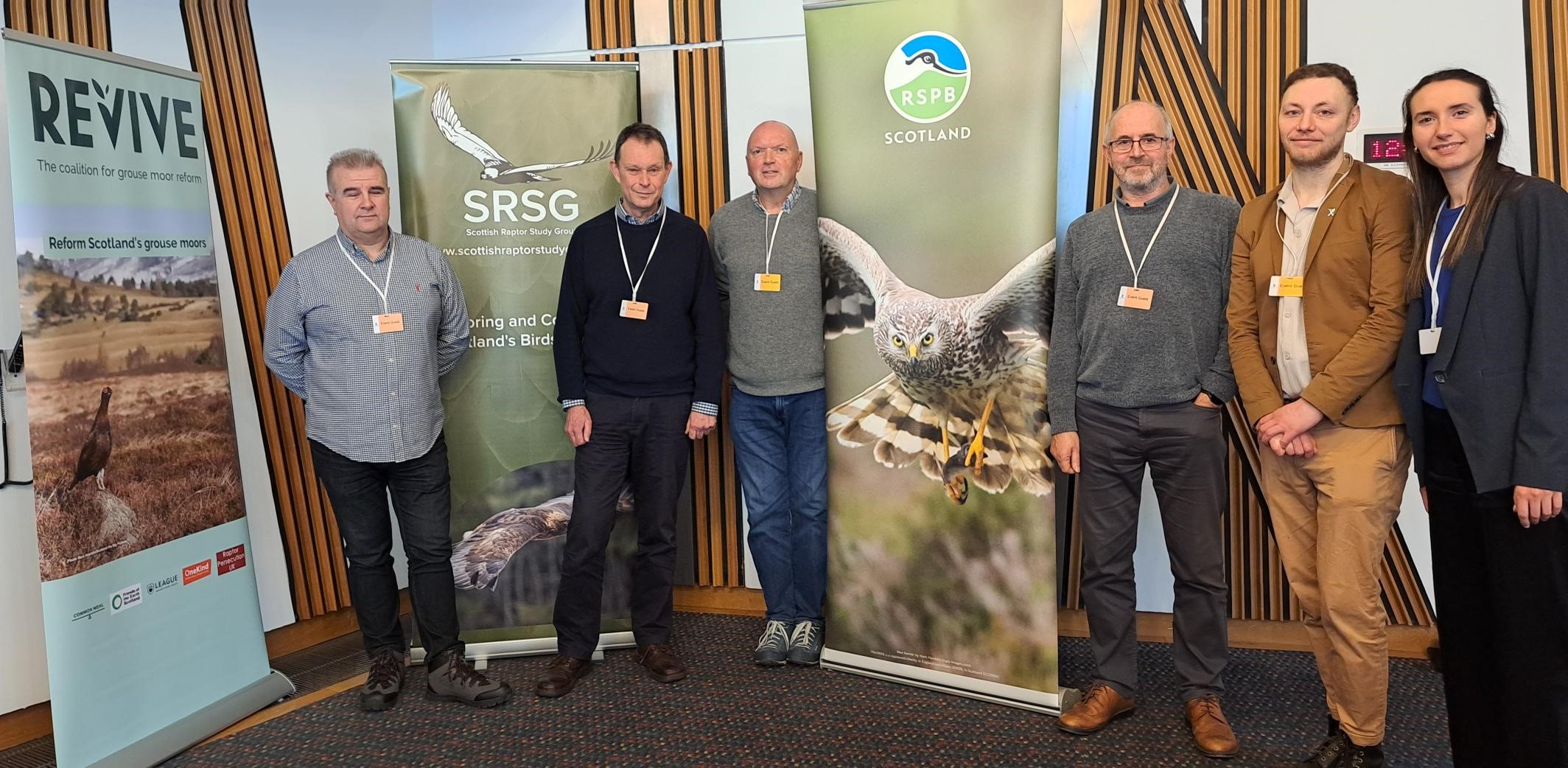
Representatives from SRSG, RSPB & REVIVE. Photo by REVIVE
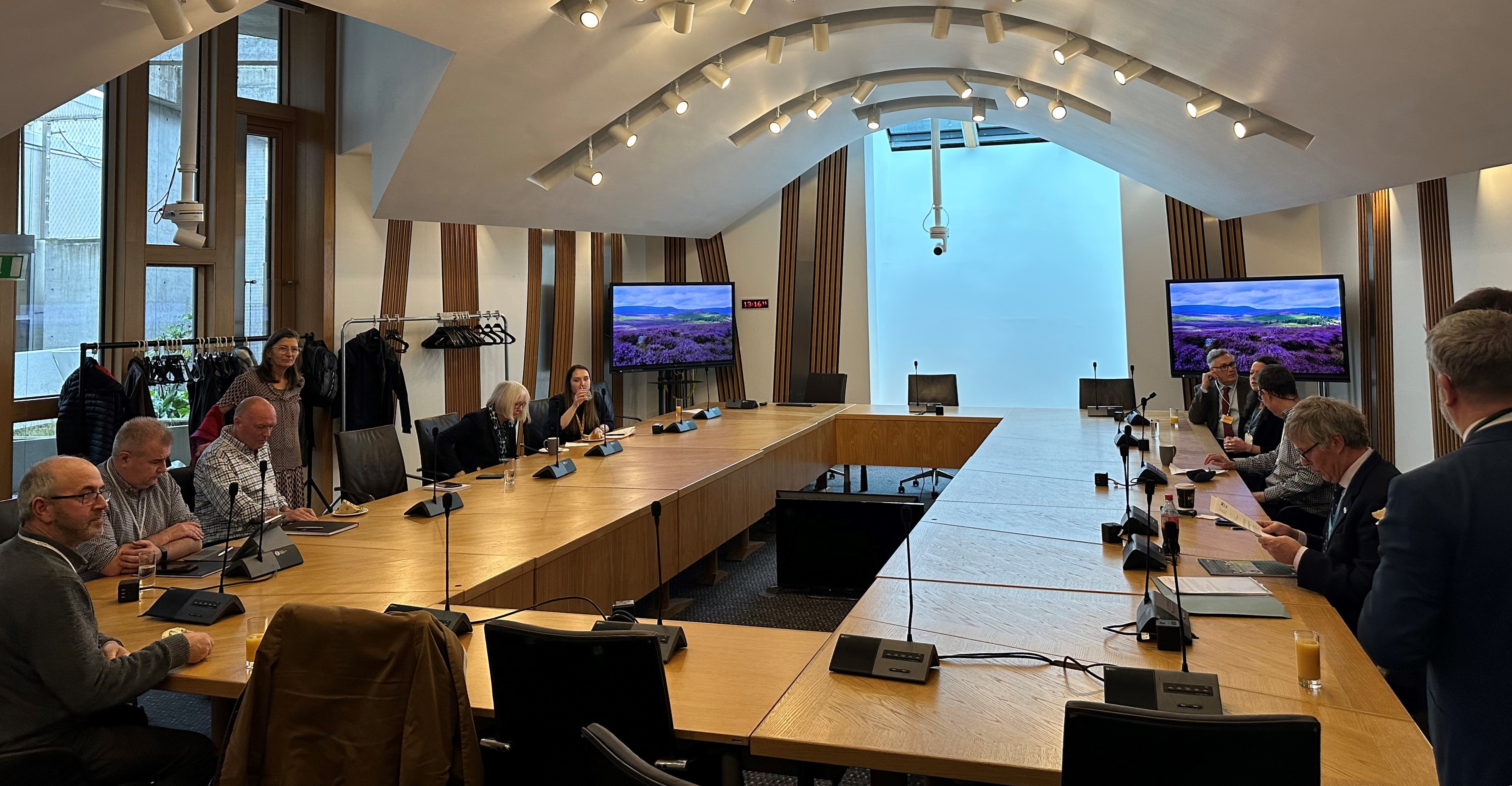
Productive round-table discussion. Photo by REVIVE

The timing of this reception was fortuitous, thanks to Rural Affairs Committee Convenor Finlay Carson suddenly deciding on the eve of the Committee’s planned session to delay the consideration of the Stage 2 amendments by two weeks (see here and here). This provided an opportunity for conservationists to further brief MSPs on various issues relating to the Bill, ahead of the Committee’s session which is now scheduled to begin next week.

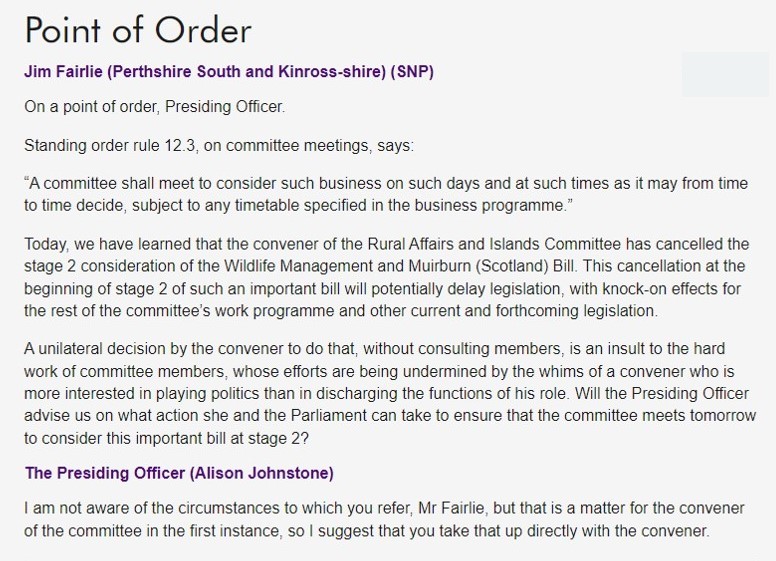
Interestingly, the fall-out from Finlay Carson’s decision to delay proceedings resulted in Committee member Jim Fairlie MSP (SNP) raising a point of order about it with the Parliament’s Presiding Officer (Alison Johnstone) on the day that Mr Carson made his decision (23 Jan 2024). From Alison’s response, it seems that Committee Convenors have a disproportionate yet legitimate level of power which allows them to thwart the will of Parliament. It’s quite an eye-opener:
Another consequence of Finlay Carson’s decision to delay proceedings is that MSPs were allowed an extended period of time in which to lodge amendments to the Bill at Stage 2. I note that Conservative MSPs Edward Mountain and Rachael Hamilton took advantage of that (legitimately) and have lodged further amendments to those they’d already lodged.

I haven’t been through these with a fine-toothed comb because I haven’t had the time, but I did note that Edward Mountain has lodged a further amendment suggesting that the withdrawal of wildlife trap licences should be based on the criminal burden of proof rather than the civil burden of proof (the Bill currently proposes a civil burden of proof which is an easier threshold to meet). Interesting, but not surprising.

The Rural Affairs & Islands Committee will begin its consideration of the Stage 2 amendments next Wednesday (7 February 2024). It will be one of two sessions (the date of the second session has yet to be announced) and will begin at 08.30hrs; earlier than the usual 9am start and probably a reflection of how many amendments there are to be considered.
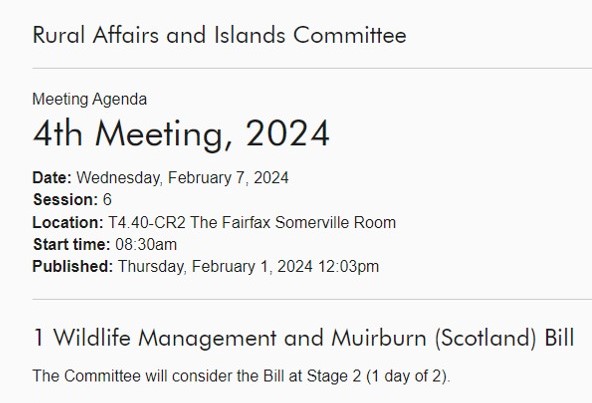
It’s expected that the session will be available to watch live on Scottish Parliament TV, as usual.

If I have time I’ll write further about the specific Stage 2 amendments prior to the first Committee meeting next week.
Man fined for illegally selling peregrine chicks in Scotland

Press release from Police Scotland (1st February 2024):

Man to pay £7,000 in fine & confiscation charges following peregrine falcon case

A 61-year-old man has been ordered to pay over £7,000 in fine and confiscation charges after pleading guilty to advertising and selling peregrine falcon chicks without the required legal documentation under the Control of Trade in Endangered Species Regulations 2018.

Gary MacFarlane from Blackridge, West Lothian, was fined £2,100 when he appeared before Livingston Sheriff Court for sentencing today, Thursday, 1 February, 2024.

He previously pleaded guilty to 11 charges at a hearing at Livingston Sheriff Court on Thursday, 26 October, 2023, where he was ordered to forfeit £5,220 in cash which had been seized from his home address.

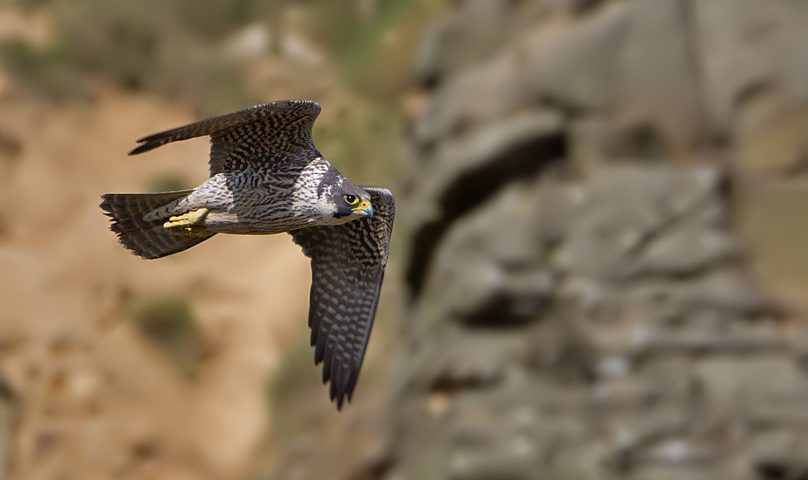
Peregrine photo by Pete Walkden

The charges included four counts of advertising and selling peregrine falcons without Article 10 certificates being issued, which is a requirement under the legislation for selling such protected species.

He also admitted seven counts of making false declarations in terms of the parent lineage of the chicks. 

Detective Constable Steven Irvine, of the National Wildlife Crime Unit, said:

This case sends a strong message to those who flout regulations in terms of our endangered and protected species that Police Scotland will thoroughly investigate these crimes and bring those responsible to justice.

Gary MacFarlane sold protected chicks for his own profit and under false pretences which led to an extensive police investigation involving significant support from partner organisations including the SSPCA, the Scottish Government’s SASA forensic unit, the Animal Plant Health Agency, the National Wildlife Crime Unit and raptor specialists.  

Members of the public have a vital role to play in tackling wildlife crime and I would encourage anyone with information or concerns about this type of criminality to contact Police Scotland on 101 or Crimestoppers anonymously on 0800 555 111.”

ENDS

This is a strange press release. I’m assuming it refers to the theft and illegal laundering of wild peregrines being passed off as captive bred birds, (‘He admitted seven counts of making false declarations in terms of the parent lineage of the chicks‘) but if it was the theft and illegal laundering of wild peregrines this hasn’t been stated explicitly, it’s rather just inferred.

Nor does the press release say when the offences took place, nor whether this case is linked to Operation Tantallon – the high profile police investigation into the theft and illegal laundering of peregrines in Scotland which saw part-time gamekeeper Timothy Hall and his son Lewis Hall convicted in December 2023. They are due for sentencing on 12 February 2024 (see here).

However, an article from a court reporter in The Herald (here) provides a bit more detail, saying the offences took place in June 2021 and came to light after buyers tipped off the Animal Plant & Health Agency (APHA) that MacFarlane was selling peregrines without the A10 certificates required for the sale of this species.

UPDATE 2 February 2024: Falconer’s conviction for illegal selling of peregrine chicks in Scotland was NOT related to laundering of wild peregrines (here).

More shameful fly-tipping of shot gamebirds – Cumbria this time

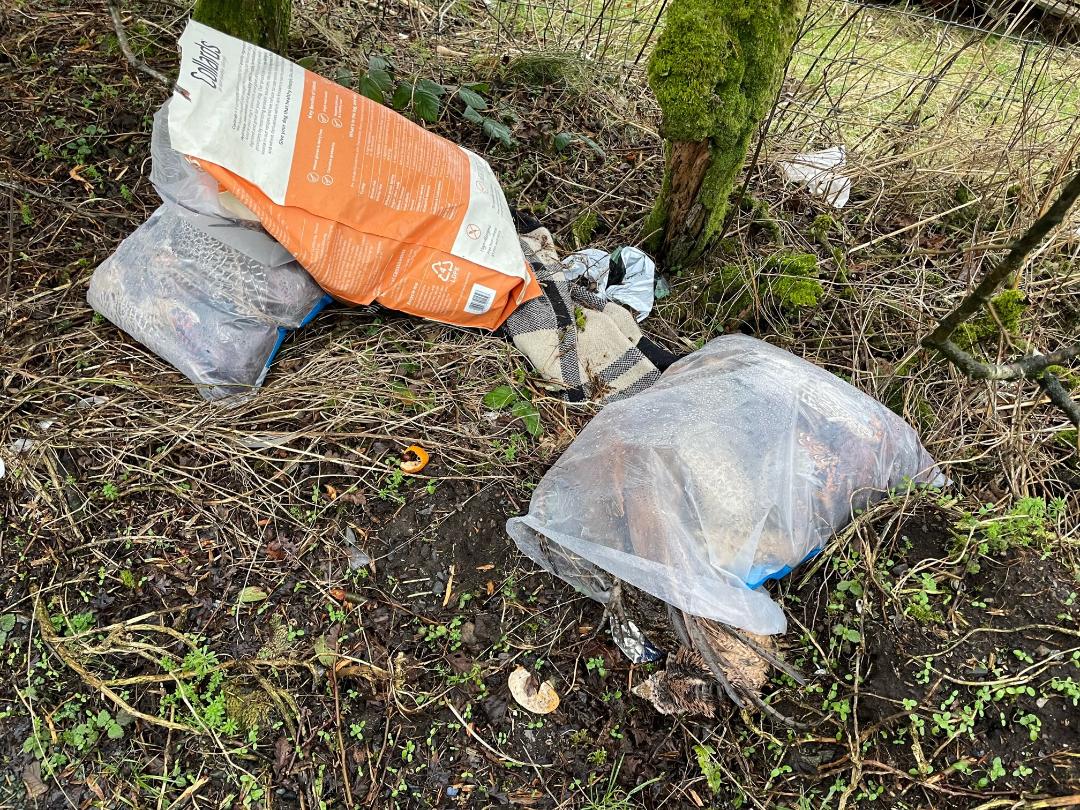
More shot pheasants and red-legged partridges have been dumped by the side of the road, this time shoved inside three large plastic sacks and thrown in a hedge next to a lay-by on the road between Egremont and Cockermouth in West Cumbria. They were found on Thursday 22 January 2024.

Many thanks to blog reader Catherine who sent in these photos. She emptied the sacks and counted 19 pheasant carcasses and 14 red-legged partridge carcasses. She said all had had their breast meat removed.

Regular blog readers will know that this is a common and widespread illegal practice. The disposal of animal by-products (including shot gamebirds) is regulated and the dumping of these carcasses is an offence, whether they’ve had the breast meat removed or not.

Previous reports include dumped birds found in Cheshire (here), Scottish borders (here), Norfolk (here), Perthshire (here), Berkshire (here), North York Moors National Park (here) and some more in North York Moors National Park (here) and even more in North Yorkshire (here), Co. Derry (here), West Yorkshire (here), and again in West Yorkshire (here), N Wales (here), mid-Wales (here), Leicestershire (here), Lincolnshire (here), Somerset (here), Derbyshire’s Peak District National Park (here), Suffolk (here), Leicestershire again (here), Somerset again (here), Liverpool (here), even more in North Wales (here) even more in Wales, again (here), in Wiltshire (here) in Angus (here), in Somerset again (here), once again in North Yorkshire (here), yet again in West Yorkshire (here), yet again in mid-Wales (here), even more in mid-Wales (here), more in Derbyshire (here), Gloucestershire (here) and more in Cheshire (here).

Unless someone was seen dumping these shot gamebirds, there’s no way of knowing who did it or from which gamebird shoot they originated. There’s no requirement for shoot managers to fit identifying markers to their livestock, which would make them traceable, because gamebird ‘livestock’ absurdly changes legal status to ‘wildlife’ as soon as the birds are released from the rearing pens for shooting (see Wild Justice’s blog on Schrodinger’s Pheasant for details).