
The SSPCA has issued the following press release in response to the recent conviction and sentencing of part-time gamekeeper Timothy Hall and his son, Lewis Hall, for the illegal laundering of Scottish peregrines which they were selling for high prices to buyers in the Middle East.
This press release contains details about the poor conditions provided by Timothy Hall for the raptors found at his address, and the subsequent return to the wild of the stolen peregrine chicks.
Berwick men receive ban for illegally selling peregrine falcons
Timothy Hall previously pled guilty to the charges and was sentenced to a five-year ban from possessing or breeding birds of prey and 220 hours of community service at Jedburgh Sheriff Court today.
His son Lewis Hall was sentenced to 150 hours community service.
48-year-old Timothy Hall of Lamberton, Berwick Upon Tweed pled guilty in December to being responsible for nine birds of prey of various breeds. Failing to ensure a suitable environment, allowing a build-up of faeces and urates, and not providing an appropriate supply of water for bathing or drinking and did thereby expose the birds to disease or injury.
Lewis Hall, 23, of Fordyce Cottage, Duns, pled guilty to acquiring for commercial purposes, keeping for sale, and selling wild peregrine falcon chicks between 2020 and 2021.
Scottish SPCA specialist investigator, Mark Rafferty, said, “These birds are a protected species and it is illegal to disturb their nests or illegally breed them.
“During April 2021, information came to light that several Peregrine Falcon nesting sites around the Scottish Borders and East Lothian had seen thefts of eggs and chicks over a prolonged period of time.
“We carried out a raid, alongside the Police National Wildlife Crime Unit (WECU), where we found a number of peregrine falcon chicks and a number of adult birds at Hall’s address in Berwick.
“The entire housing/aviary situation was completely unsuitable in terms of size and design for the species being held in each unit. The lack of clean water, and failure to remove the excessive accumulation of faecal and animal tissue waste posed unacceptable health risks to the birds housed within.
“None of the birds were presented with an environment where breeding was likely either naturally or artificial insemination.
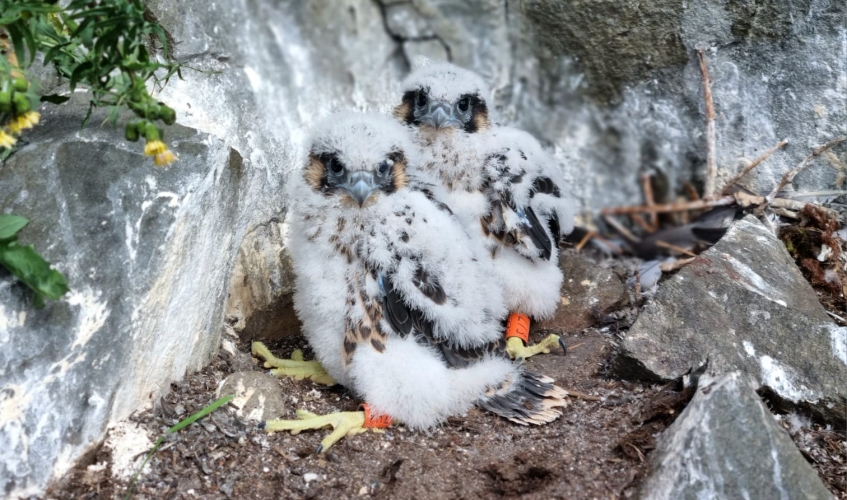
“Our team were able to take the peregrine falcon chicks to surrogate nests and monitor them from a distance. Once they had developed fully they were able to return to the wild safely.
“We are extremely disappointed at the sentencing result today. This was a specialised case which has taken years to appear in court. Our team, along with the Police Wildlife Crime Unit and David Anderson, Raptor ecologist from the Scottish Raptor Study Group , worked hard to provide sufficient evidence and DNA testing to get a better result.”
“If anyone is concerned about an animal, they can contact our confidential animal helpline on 03000 999 999.”
ENDS
 Raptor Persecution UK
So, they made a lot of money selling chicks, but could not provide suitable facilities for the birds. Obvious they were only interested in profit, and not in birds or their welfare.
Great work by all agencies in this court case and conviction of the accused.
Sadly these two did not receive a suitable sentence but merely a slap on the wrist.
I hope these cruel selfish nasty people rot in hell , cowardly cruel nasty pair
“We are extremely disappointed at the sentencing result today”
But what is the Scottish legal system going to do about that? Nothing?
A contemptible sentence by the Sheriff. How was justice served? Is the Sheriff in the right job?
These enemies of beautiful wild life will get there pay back because every one does that is cruel and wicked all in the name of money what low evil things you are .the lowest of low
These pathetic sentences offer no deterrent to these lowlifes whatsoever. It is the same across the board with animal cruelty cases. It’s the main reason activities like this and illegal foxhunting etc continue as they do. A lot of people work very hard to get these characters convicted and then the judge gives them a slap on the wrist. If they started getting some jail time then these activities would disappear very quickly.
So who do we write to to tell the legal system we think their decision making is a shambles? It’s not like there’s a CEO to bombard with protests. Is it the government for setting sentencing guide lines, is it the Home Secretary, or Sheriff’s office in Scotland? Is there a body to hear feedback or protests? We can’t say nothing to anyone when the legal system is so unfit for purpose that it simply doesn’t deliver justice even when these people plead guilty!
I wish I knew the answers to your very valid questions.
I don’t know what the maximum penalty for these crimes is but would imagine it’s at least several years in prison. There doesn’t seem much point asking the Scottish government to increase the penalties for wildlife crime if judges are going to continue handing out pathetic sentences, unless the law is changed so that there’s an appropriate minimum sentence for these crimes.
“So who do we write to to tell the legal system we think their decision making is a shambles?”
You write to your Parliamentary representative.
In England and Wales (and Northern Ireland!) there is a very good public system for questioning sentencing. Nothing to do with sentencing guidelines… (that is another matter). It is an *official* way for any member of the general public to tell the Attorney General that some particular sentence is, in their opinion, inadequate, regardless of the guidelines. If *any* member of the general public does so, the Attorney General is legally bound to consider the case.
They may agree (in which case the Attorney General will launch an official Appeal that the sentence is too lenient) or they may disagree.
But what *also* happens in reality is that if the Attorney General starts getting rather a lot of complaints, they will consider whether the legal system is properly reflecting the public’s attitude to sentencing. It is a way that the legal system, in England and Wales, tries to keep in touch with the general public. It is a safety valve.
However(!), this facility for the general public is not available for all types of crime. And, wouldn’t you guess it, neither animal abuse nor wildlife crime sentencing are included!
The details are here:
https://www.gov.uk/ask-crown-court-sentence-review
https://www.ppsni.gov.uk/unduly-lenient-sentences#:~:text=In%20certain%20types%20of%20cases,when%20the%20sentence%20was%20imposed.
There is a ground swell of cross-party support for extending the Unduly Lenient Sentences Scheme for all types of crime within England and Wales, both within Parliament (there have been many debates) and within the legal system itself. As its proponents say, it is simply illogical to exclude certain type of crimes.
It is a good Scheme, but it needs extending to all crimes, and that means, for us, extending to animal abuse and wildlife crimes.
But the situation in Scotland is even worse: they have no Unduly Lenient Sentencing Scheme at all. The general public are not provided with any means of registering with the legal system their feelings about any sentence at all. It is a closed shop within the profession in Scotland.
See https://www.mygov.scot/after-the-verdict/the-appeals-process#:~:text=A%20sentence%20is%20regarded%20as%20'unduly%20lenient'%20if%20it%20falls,and%20Advice%20service%20(VIA).
It is General Election year: write to your Parliamentary representative and ask for the Unduly Lenient Sentences Scheme to be *extended* to all crimes (or to animal abuse and wildlife crimes), or… ask for an Unduly Lenient Sentences Scheme to be introduced for *all* crimes, depending upon where you live.
Why the animal welfare and conservation charities have not organised a mass campaign on this beggars belief, because they are always banging on about how some sentence or other does not reflect the harm done etc. And yet, here we have an answer: give the public some power.
I can feel all your despair as is mine a joke they should be sent to prison like you all say there is no deterrent for these abhorrent greedy people the law is a disgrace.
Making money and yet only getting community service which is no punishment at all. Keeping them away from the community would be of more benefit. Cost of resources leading to conviction and money made from selling these poor birds would be an appropriate fine that would deter this behaviour in the future. Justice system needs to be overhauled.
I think its a pathetic sentence it certainly doesn’t send out the right message to other would b nest thieves .
We may yet learn about HMRC’s investigation. Which might turn into a nightmare for the family.
Meanwhile the RSPB and likeminded others should be raising the issue with their supporters and considering ways to apply appropriate pressure to the judiciary.
Were any of the raided nests on National Park or AONB land, Wildlife Trust or regeneration reserves?
Xxxxx xxxxx xxxxx xxxxx xxxxx xxxxx
Good riddance.
…. and so say all of us!
One aspect of the case which puzzles me a bit is why was no financial penalty imposed (fines, costs etc.). They must have some money stashed away somewhere from their ill-gotten gains, though maybe there are rules about imposing fines etc. in circumstances in which they might be paid from the proceeds of crime.
I wonder who gets to decide what form the community work to which they have been sentenced should take? Pity that we don’t have a say in the matter as I reckon that we could come up with some choice suggestions.
It says HMRC have an interest. They may not tread in a light-footed manner investigating the profits made.
[Ed: I can’t publish that – it’s libellous]