Following yesterday’s post about ‘in excess of 100 hundred pheasants’ found dumped in mid-Wales (here), blog reader Colin Penny (@colinpenny66) has alerted me to another mass gamebird dump this month, this time in Derbyshire.
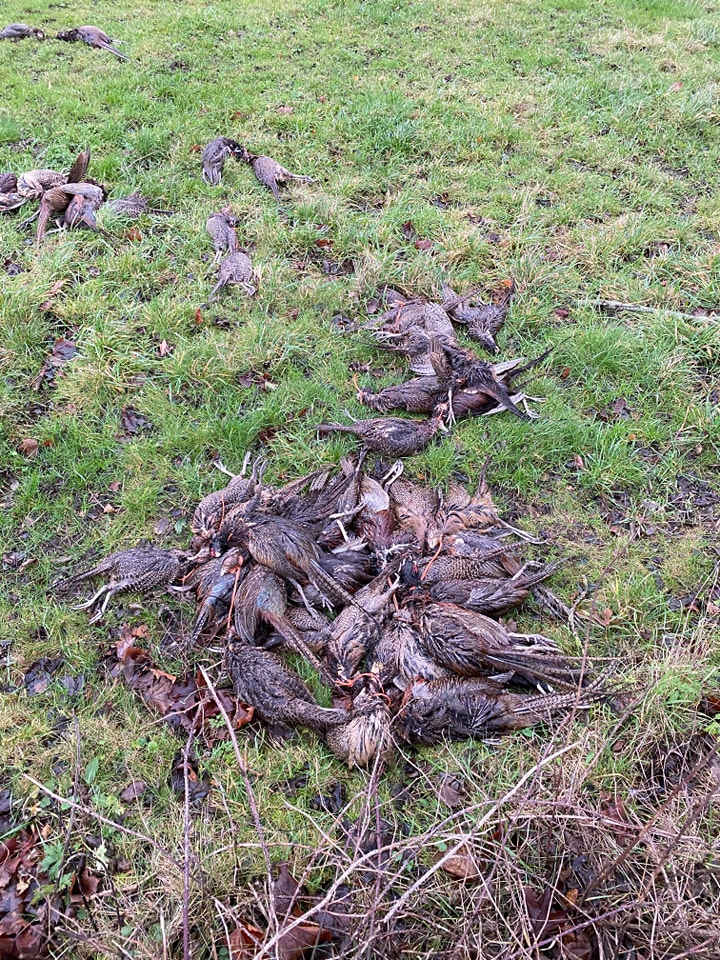
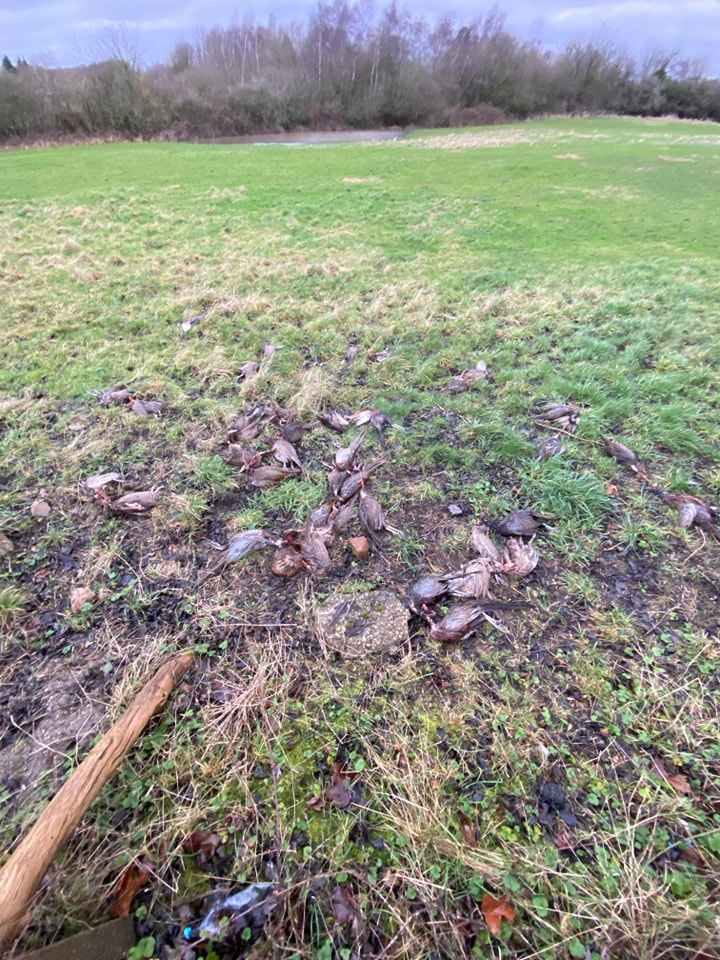
118 shot pheasants were found dumped in a horse field at Shipley near Ilkeston on 27th December 2023 according to a post on a Facebook page called ‘Spotted Ilkeston Town’:
This horse field is located at the entrance of a housing estate called Shipley Lake, where more pheasants and at least one duck were found dumped in the middle of the road, presumably the result of a Boxing Day shoot:
Photo by Colin Penny
Keep an eye out for piles of illegally dumped shot gamebirds along hedgerows, roads, laybys, local woodland, fields, rivers etc. It happens every year, despite the desperate claims of the shooting industry reps who pretend that, “Every bird shot in Britain goes in to the food chain” (Tim Bonner, Countryside Alliance).
If you have any photos of dumped gamebirds please send them in so they can be added to the ever-increasing dossier of widespread illegality, which so far has been reported from:
Cheshire (here), Scottish borders (here), Norfolk (here), Perthshire (here), Berkshire (here), North York Moors National Park (here) and some more in North York Moors National Park (here) and even more in North Yorkshire (here), Co. Derry (here), West Yorkshire (here), and again in West Yorkshire (here), N Wales (here), mid-Wales (here), Leicestershire (here), Lincolnshire (here), Somerset (here), Derbyshire’s Peak District National Park (here), Suffolk (here), Leicestershire again (here), Somerset again (here), Liverpool (here), even more in North Wales (here) even more in Wales, again (here), in Wiltshire (here) in Angus (here), in Somerset again (here), once again in North Yorkshire (here), yet again in West Yorkshire (here), yet again in mid-Wales (here) and even more in mid-Wales (here).
In October 2023, Kelvin Birtles of Saffron Road, Wigston appeared at Leicester Magistrates Court where he pleaded guilty to three offences – the possession of two dead badgers (in breach of the Protection of Badgers Act), the possession of two dead otters (in breach of the Wildlife & Countryside Act) and the possession of nine dead birds including three buzzards, four tawny owls, one barn owl and one swan, which were all found in his freezer during a joint police and trading standards raid in April 2023. Sentencing was deferred for background reports (see blog here).
Birtle re-appeared at Leicester Magistrates Court on 15th November 2023 where he told the court he didn’t know he needed a licence, that some of the items were for his taxidermy hobby, and that some had been roadkill that he’d removed from near a school because ‘he didn’t want kids to see them smashed up on the road’.
He received a 12 month community order requiring him to carry out 120 hours unpaid work. He was also ordered to pay £85 costs and £114 victim surcharge.
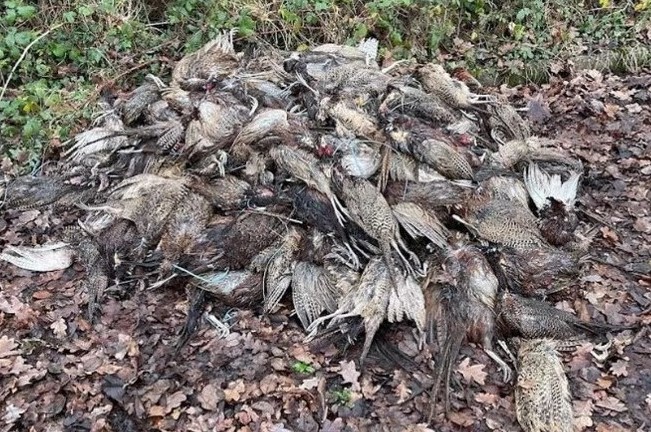
Dyfed-Powys Police is appealing for information after the discovery of ‘in excess of 100 dead pheasants’ found dumped by the side of the road at Heol Cropin Dafen in Llanelli, Wales on 13th/14th December 2023:
Photo by Dyfed-Powys Police
Media outlets are describing this as a ‘mystery‘ and ‘baffling‘ but regular blog readers will know that the dumping of shot gamebirds is not a new phenomenon, it’s been happening throughout the UK for years:
E.g. in Cheshire, Scottish borders (here), Norfolk (here), Perthshire (here), Berkshire (here), North York Moors National Park (here) and some more in North York Moors National Park (here) and even more in North Yorkshire (here), Co. Derry (here), West Yorkshire (here), and again in West Yorkshire (here), N Wales (here), mid-Wales (here), Leicestershire (here), Lincolnshire (here), Somerset (here), Derbyshire’s Peak District National Park (here), Suffolk (here), Leicestershire again (here), Somerset again (here), Liverpool (here), even more in North Wales (here) even more in Wales, again (here), in Wiltshire (here) in Angus (here), in Somerset again (here), once again in North Yorkshire (here), yet again in West Yorkshire (here) and yet again in mid-Wales (here).
It happens because the market for buying millions of shot gamebirds every year just isn’t there, evidenced by this photograph taken by a blog reader (@TLWforCumbria) in Cumbria in October 2023 where a market stall holder was trying to give them away:
The disposal of animal by-products (including shot gamebirds) is regulated and the dumping of those carcasses by the road in Wales is an offence.
It’s also a breach of the Code of Good Shooting Practice, which states that ‘Shoot managers must ensure they have appropriate arrangements in place for the sale or consumption of the anticipated bag in advance of all shoot days‘.
Will anyone be prosecuted? Of course not. There’s no requirement for the shoot managers to fit identifying markers to their livestock, which would make them traceable, because gamebird ‘livestock’ absurdly changes legal status to ‘wildlife’ as soon as the birds are released from the rearing pens for shooting (see Wild Justice’s blog on Schrodinger’s Pheasant for details).
UPDATE 30 December 2023: Over 100 shot pheasants dumped in Derbyshire (here)
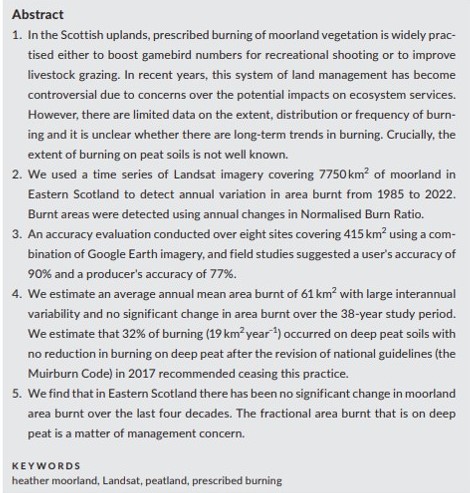
A new peer-reviewed scientific study has revealed that burning on deep peat is widespread on many Scottish grouse moors.
This is despite a revision to the national guidelines (the Muirburn Code) in 2017 which states that burning on peatland should not take place unless it is part of a habitat restoration plan approved by the statutory regulator, NatureScot.
It’ll come as no surprise whatsoever to regular blog readers that these findings suggest that the revised guidelines ‘have not been widely adopted by land managers‘.
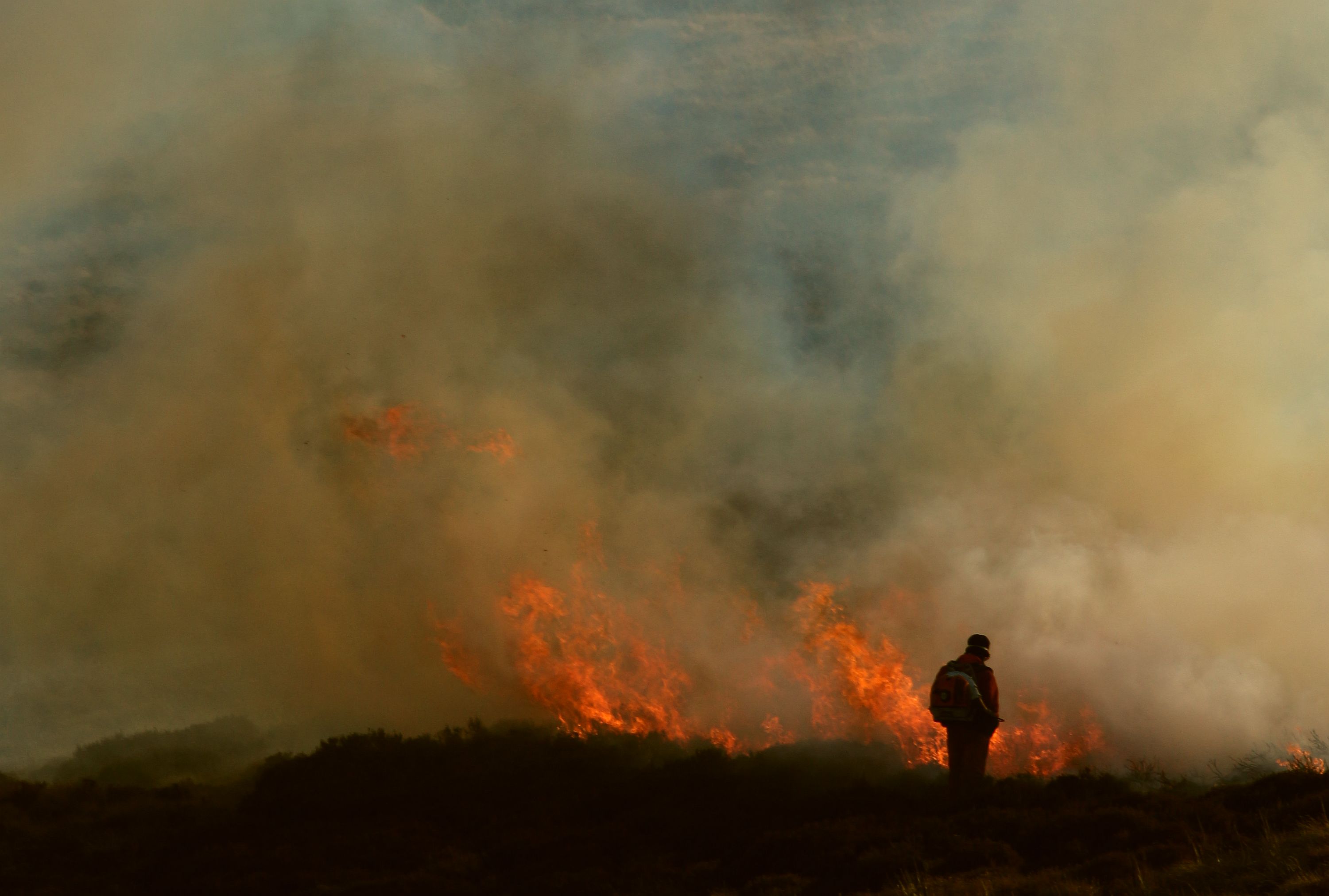
Grouse moor fire in Cairngorms National Park, Feb 2022
The paper, Assessment of peatland burning in Scotland during 1985-2022 using Landsat imagery, was authored by B.D. Spracklen and D.V. Spracklen and was published on 14 December 2023 in the journal Ecological Solutions and Evidence.
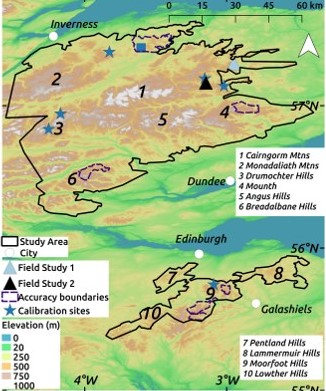
Here’s the study area, which includes a large portion of Scotland’s grouse moors:
Here’s the abstract:
This new paper should help inform MSPs and Ministers as we approach Stage 2 of the Wildlife Management and Muirburn (Scotland) Bill in January, where proposals to introduce a licensing scheme for muirburn are set to be challenged by the grouse-shooting sector, which seems to think that burning the moors to facilitate excessively large numbers of red grouse for a few selfish people to shoot for fun is more important than the global climate crisis.
Yet again, what this latest paper does is to demonstrate that any licensing scheme will require robust monitoring AND enforcement measures for it to be effective because if that’s not in place, the entitled ones will simply carry on as normal.
The paper is open access and can be read/downloaded here:
A part-time gamekeeper and his son have pleaded guilty to multiple offences related to the illegal laundering of peregrines in Scotland – a serving police officer has been cleared.
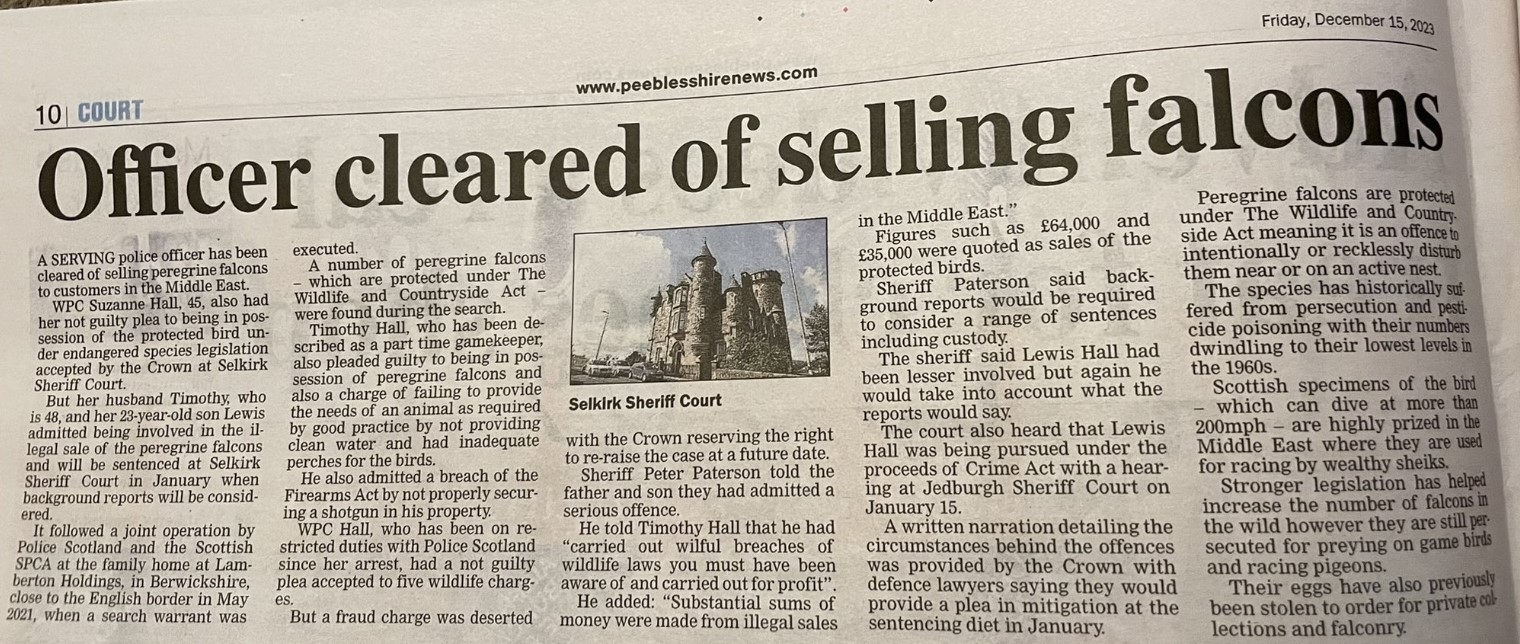
Many thanks to the blog reader who sent me this article from the court section of Peebleshire News, published yesterday (Friday 15 December 2023):
Here is the text:
Officer cleared of selling falcons
A serving police officer has been cleared of selling peregrine falcons to customers in the Middle East.
WPC Suzanne Hall, 45, also had her not guilty plea to being in possession of the protected bird under endangered species legislation accepted by the Crown at Selkirk Magistrates Court.
But her husband Timothy, who is 48, and her 23 year old son Lewis admitted being involved in the illegal sale of the peregrine falcons and will be sentenced at Selkirk Sheriff Court in January when background reports will be considered.
It followed a joint operation by Police Scotland and the Scottish SPCA at the family home at Lamberton Holdings, Berwickshire, close to the English border in May 2021, when a search warrant was executed.
A number of peregrine falcons – which are protected under the Wildlife and Countryside Act – were found during the search.
Timothy Hall, who has been described as a part-time gamekeeper, also pleaded guilty to being in possession of peregrine falcons and also a charge of failing to provide the needs of an animal as required by good practice by not providing clean water and had inadequate perches for the birds.
He also admitted a breach of the Firearms Act by not properly securing a shotgun in his property.
WPC Hall, who has been on restricted duties with Police Scotland since her arrest, had a not guilty plea accepted to five wildlife charges.
But a fraud charge was deserted with the Crown reserving the right to re-raise the case at a future date.
Sheriff Peter Paterson told the father and son they had admitted a serious offence.
He told Timothy Hall that he had “carried out wilful breaches of wildlife laws you must have been aware of and carried out for profit”.
He added: “Substantial sums of money were made from illegal sales in the Middle East”.
Figures such as £64,000 and £35,000 were quoted as sales of the protected birds.
Sheriff Paterson said background reports would be required to consider a range of sentences including custody.
The Sheriff said Lewis Hall had been lesser involved but again he would take into account what the reports would say.
The court also heard that Lewis Hall was being pursued under the Proceeds of Crime Act with a hearing at Jedburgh Sheriff Court on January 15th.
A written narration detailing the circumstances behind the offences was provided by the Crown with defence lawyers saying they would provide a plea in mitigation at the sentencing diet in January.
Peregrine falcons are protected under the Wildlife & Countryside Act meaning it is an offence to intentionally or recklessly disturb them near or on an active nest.
The species has historically suffered from persecution and pesticide poisoning with their numbers dwindling to their lowest levels in the 1960s.
Scottish specimens of the bird – which can dive at more than 200 mph – are highly prized in the Middle East where they are used for racing by wealthy sheiks.
Stronger legislation has helped increase the number of falcons in the wild however they are still persecuted for preying on game birds and racing pigeons.
Their eggs have also previously been stolen to order for private collections and falconry.
ENDS
This investigation, code named Operation Tantallon, has been long-running (see here) and complex (see here). The investigative team, hailing from a multi-agency partnership, was recognised for its efforts when it was awarded the Wildlife Crime Operation of the Year Award at the 2022 UK Wildlife Crime Conference (here).
I hope that fuller details of the case will be made available after sentencing in January.
UPDATE 14 January 2024: Sentencing in Scotland tomorrow for part-time gamekeeper and son guilty of international peregrine laundering (here)
UPDATE 15 January 2024: Sentencing of part-time gamekeeper & son deferred in international peregrine laundering case (here)
UPDATE 15 January 2024: More detail revealed about international peregrine laundering case in Scotland (here)
UPDATE 12 February 2024: Part-time gamekeeper Timothy Hall and his son Lewis Hall avoid custodial sentence for laundering of wild peregrines in Scotland (here)
UPDATE 12 February 2024: Commentary on the staggeringly inadequate sentencing of Timothy and Lewis Hall, convicted for illegal laundering of wild peregrines in south Scotland (here)
UPDATE 14 February 2024: It’s soul destroying to find nests have failed” – inside the battle against Scotland’s falcon thieves (here)
UPDATE 15 February 2024: SSPCA press release on conviction of part-time gamekeeper Timothy Hall and his son Lewis Hall for illegal laundering of Scottish peregrines (here)
UPDATE 26 June 2024: Prosecutors seeking to recover £164,000 from Scottish peregrine launderer Lewis Hall (here)
UPDATE 10 October 2024: Scottish court orders convicted peregrine launderer Lewis Hall to pay back thousands under Proceeds of Crime Act (here)
UPDATE 23 November 2024: Suzanne Hall, wife & mother of convicted peregrine launderers ‘no longer a serving police officer’ (here).
For anyone who still wants to pretend that the grouse shooting industry isn’t responsible for the systematic extermination of hen harriers on grouse moors across the UK, here’s the latest catalogue of crime that suggests otherwise.
[This male hen harrier died in 2019 after his leg was almost severed in an illegally set trap that had been placed next to his nest on a Scottish grouse moor (see here). Photo by Ruth Tingay]
This is the blog I now publish after every reported killing or suspicious disappearance.
“They disappear in the same way political dissidents in authoritarian dictatorships have disappeared” (Stephen Barlow, 22 January 2021).
Today the list has been updated to include the three most recently reported victims: ‘Dagda’ found shot dead on Knarsdale grouse moor in May 2023; ‘Saranyu’ who ‘disappeared’ in Durham in September 2023 (no further details available yet from the RSPB), and ‘Inger’ who ‘disappeared’ on a grouse moor in the Angus Glens in September 2023.
I’ve been compiling this list only since 2018 because that is the year that the grouse shooting industry ‘leaders’ would have us believe that the criminal persecution of hen harriers had stopped and that these birds were being welcomed back on to the UK’s grouse moors (see here).
This assertion was made shortly before the publication of a devastating new scientific paper that demonstrated that 72% of satellite-tagged hen harriers were confirmed or considered likely to have been illegally killed, and this was ten times more likely to occur over areas of land managed for grouse shooting relative to other land uses (see here). Incidentally, a further scientific paper published in 2023 by scientists at the RSPB, utilising even more recent data, echoed these results – see here).
2018 was also the year that Natural England issued a licence to begin a hen harrier brood meddling trial on grouse moors in northern England. For new blog readers, hen harrier brood meddling is a conservation sham sanctioned by DEFRA as part of its ludicrous ‘Hen Harrier Action Plan‘ and carried out by Natural England (NE), in cahoots with the very industry responsible for the species’ catastrophic decline in England. For more background see here and for a critical evaluation of the trial after 5 years see this report by Wild Justice.
Brood meddling has been described as a sort of ‘gentleman’s agreement’ by commentator Stephen Welch:
“I don’t get it, I thought the idea of that scheme was some kind of trade off – a gentleman’s agreement that the birds would be left in peace if they were moved from grouse moors at a certain density. It seems that one party is not keeping their side of the bargain“.
With at least 113 hen harriers gone since 2018, there is no question that the grouse shooting industry is simply taking the piss. Meanwhile, Natural England pretends that ‘partnership working’ is the way to go and DEFRA Ministers remain silent.
Data compiled by RPUK. *No hen harriers brood meddled in 2018
‘Partnership working’ according to Natural England appears to include authorising the removal of hen harrier chicks from a grouse moor already under investigation by the police for suspected raptor persecution (here) and accepting a £75k ‘donation’ from representatives of the grouse shooting industry that prevents Natural England from criticising them or the sham brood meddling trial (see here). This is in addition to a £10k ‘donation’ that Natural England accepted, under the same terms, in 2021 (here).
So here’s the latest gruesome list. Note that the majority of these birds (but not all) were fitted with satellite tags. How many more [untagged] harriers have been killed?
February 2018: Hen harrier Saorsa ‘disappeared’ in the Angus Glens in Scotland (here). The Scottish Gamekeepers Association later published wholly inaccurate information claiming the bird had been re-sighted. The RSPB dismissed this as “completely false” (here).
5 February 2018: Hen harrier Marc ‘disappeared’ on a grouse moor in Durham (here).
9 February 2018: Hen harrier Aalin ‘disappeared’ on a grouse moor in Wales (here).
March 2018: Hen harrier Blue ‘disappeared’ in the Lake District National Park (here).
March 2018: Hen harrier Finn ‘disappeared’ near Moffat in Scotland (here).
18 April 2018: Hen harrier Lia ‘disappeared’ in Wales and her corpse was retrieved in a field in May 2018. Cause of death was unconfirmed but police treating death as suspicious (here).
8 August 2018: Hen harrier Hilma ‘disappeared’ on a grouse moor in Northumberland (here).
16 August 2018: Hen harrier Athena ‘disappeared’ on a grouse moor in Scotland (here).
26 August 2018: Hen Harrier Octavia ‘disappeared’ on a grouse moor in the Peak District National Park (here).
29 August 2018: Hen harrier Margot ‘disappeared’ on a grouse moor in Scotland (here).
29 August 2018: Hen Harrier Heulwen ‘disappeared’ on a grouse moor in Wales (here).
3 September 2018: Hen harrier Stelmaria ‘disappeared’ on a grouse moor in Scotland (here).
24 September 2018: Hen harrier Heather ‘disappeared’ on a grouse moor in Scotland (here).
2 October 2018: Hen harrier Mabel ‘disappeared’ on a grouse moor on the edge of the Yorkshire Dales National Park (here).
3 October 2018: Hen Harrier Thor ‘disappeared’ next to a grouse moor in Bowland, Lanacashire (here).
23 October 2018: Hen harrier Tom ‘disappeared’ in South Wales (here).
26 October 2018: Hen harrier Arthur ‘disappeared’ on a grouse moor in the North York Moors National Park (here).
1 November 2018: Hen harrier Barney ‘disappeared’ on Bodmin Moor (here).
10 November 2018: Hen harrier Rannoch ‘disappeared’ on a grouse moor in Scotland (here). Her corpse was found nearby in May 2019 – she’d been killed in an illegally-set spring trap (here).
14 November 2018: Hen harrier River ‘disappeared’ on a grouse moor in the Nidderdale AONB (here). Her corpse was found nearby in April 2019 – she’d been illegally shot (here).
16 January 2019: Hen harrier Vulcan ‘disappeared’ in Wiltshire close to Natural England’s proposed reintroduction site (here).
28 January 2019: Hen harrier DeeCee ‘disappeared’ in Glen Esk, a grouse moor area of the Angus Glens (see here).
7 February 2019: Hen harrier Skylar ‘disappeared’ next to a grouse moor in South Lanarkshire (here).
22 April 2019: Hen harrier Marci ‘disappeared’ on a grouse moor in the Cairngorms National Park (here).
26 April 2019: Hen harrier Rain ‘disappeared’ on a grouse moor in Nairnshire (here).
11 May 2019: An untagged male hen harrier was caught in an illegally-set trap next to his nest on a grouse moor in South Lanarkshire. He didn’t survive (here).
7 June 2019: An untagged hen harrier was found dead on a grouse moor in Scotland. A post mortem stated the bird had died as a result of ‘penetrating trauma’ injuries and that this bird had previously been shot (here).
5 September 2019: Wildland Hen Harrier 1 ‘disappeared’ on a grouse moor nr Dalnaspidal on the edge of the Cairngorms National Park (here).
11 September 2019: Hen harrier Romario ‘disappeared’ on a grouse moor in the Cairngorms National Park (here).
14 September 2019: Hen harrier (Brood meddled in 2019, #183704) ‘disappeared’ in the North Pennines (here).
23 September 2019: Hen harrier (Brood meddled in 2019, #55149) ‘disappeared’ in North Pennines (here).
24 September 2019: Wildland Hen Harrier 2 ‘disappeared’ on a grouse moor at Invercauld in the Cairngorms National Park (here).
24 September 2019: Hen harrier Bronwyn ‘disappeared’ near a grouse moor in North Wales (here).
10 October 2019: Hen harrier Ada ‘disappeared’ on a grouse moor in the North Pennines AONB (here).
12 October 2019: Hen harrier Thistle ‘disappeared’ on a grouse moor in Sutherland (here).
18 October 2019: Member of the public reports the witnessed shooting of an untagged male hen harrier on White Syke Hill in North Yorkshire (here).
November 2019: Hen harrier Mary found illegally poisoned on a pheasant shoot in Ireland (here).
November 2019: Hen harrier Artemis ‘disappeared’ near Long Formacus in south Scotland (RSPB pers comm).
14 December 2019: Hen harrier Oscar ‘disappeared’ in Eskdalemuir, south Scotland (here).
December 2019: Hen harrier Ingmar ‘disappeared’ in the Strathbraan grouse moor area of Perthshire (RSPB pers comm).
January 2020: Members of the public report the witnessed shooting of a male hen harrier on Threshfield Moor in the Yorkshire Dales National Park (here).
23 March 2020: Hen harrier Rosie ‘disappeared’ at an undisclosed roost site in Northumberland (here).
1 April 2020: Hen harrier (Brood meddled in 2019, #183703) ‘disappeared’ in unnamed location, tag intermittent (here).
5 April 2020: Hen harrier Hoolie ‘disappeared’ on a grouse moor in the Cairngorms National Park (here)
8 April 2020: Hen harrier Marlin ‘disappeared’ on a grouse moor in the Cairngorms National Park (here).
19 May 2020: Hen harrier Fingal ‘disappeared’ on a grouse moor in the Lowther Hills, Scotland (here).
21 May 2020: Hen harrier (Brood meddled in 2019, #183701) ‘disappeared’ on a grouse moor in Cumbria shortly after returning from wintering in France (here).
27 May 2020: Hen harrier Silver ‘disappeared’ on a grouse moor on Leadhills Estate, Scotland (here).
2020: day/month unknown: Unnamed male hen harrier breeding on RSPB Geltsdale Reserve, Cumbria ‘disappeared’ while away hunting (here).
9 July 2020: Unnamed female hen harrier (#201118) ‘disappeared’ from an undisclosed site in Northumberland (here).
25 July 2020: Hen harrier Harriet ‘disappeared’ on a grouse moor in the Yorkshire Dales National Park (here).
14 August 2020: Hen harrier Solo ‘disappeared’ in confidential nest area in Lancashire (here).
7 September 2020: Hen harrier Dryad ‘disappeared’ on a grouse moor in the Yorkshire Dales National Park (here).
16 September 2020: Hen harrier Fortune ‘disappeared’ from an undisclosed roost site in Northumberland (here).
19 September 2020: Hen harrier Harold ‘disappeared’ on a grouse moor in the Yorkshire Dales National Park (here).
20 September 2020: Hen harrier (Brood meddled in 2020, #55152) ‘disappeared’ next to a grouse moor in North Yorkshire (here).
24 February 2021: Hen harrier Tarras ‘disappeared’ next to a grouse moor in Northumberland (here)
12th April 2021: Hen harrier Yarrow ‘disappeared’ near Stockton, County Durham (here).
18 May 2021: Adult male hen harrier ‘disappeared’ from its breeding attempt on RSPB Geltsdale Reserve, Cumbria whilst away hunting (here).
18 May 2021: Another adult male hen harrier ‘disappeared’ from its breeding attempt on RSPB Geltsdale Reserve, Cumbria whilst away hunting (here).
24 July 2021: Hen harrier Asta ‘disappeared’ at a ‘confidential site’ in the North Pennines (here). We learned 18 months later that her wings had been ripped off so her tag could be fitted to a crow in an attempt to cover up her death (here).
14th August 2021: Hen harrier Josephine ‘disappeared’ at a ‘confidential site’ in Northumberland (here).
17 September 2021: Hen harrier Reiver ‘disappeared’ in a grouse moor dominated region of Northumberland (here)
24 September 2021: Hen harrier (Brood meddled in 2021, R2-F-1-21) ‘disappeared’ in Northumberland (here).
15 November 2021: Hen harrier (brood meddled in 2020, #R2-F1-20) ‘disappeared’ at the edge of a grouse moor on Arkengarthdale Estate in the Yorkshire Dales National Park (here).
19 November 2021: Hen harrier Val ‘disappeared’ in the Lake District National Park in Cumbria (here).
19 November 2021: Hen harrier Percy ‘disappeared’ in Lothian, Scotland (here).
12 December 2021: Hen harrier Jasmine ‘disappeared’ on a grouse moor (High Rigg Moor on the Middlesmoor Estate) in the Nidderdale AONB in North Yorkshire (here).
9 January 2022: Hen harrier Ethel ‘disappeared’ in Northumberland (here).
26 January 2022: Hen harrier Amelia ‘disappeared’ in Bowland (here).
10 February 2022: An unnamed satellite-tagged hen harrier ‘disappeared’ in a grouse moor dominated area of the Peak District National Park (here). One year later it was revealed that the satellite tag/harness of this young male called ‘Anu’ had been deliberately cut off (see here).
12 April 2022: Hen harrier ‘Free’ (Tag ID 201121) ‘disappeared’ at a ‘confidential site’ in Cumbria (here). It later emerged he hadn’t disappeared, but his mutilated corpse was found on moorland in the Yorkshire Dales National Park. A post mortem revealed the cause of death was having his head twisted and pulled off. One leg had also been torn off whilst he was still alive (here).
April 2022: Hen harrier ‘Pegasus’ (tagged by the RSPB) ‘disappeared’ on a grouse moor at Birkdale in the Yorkshire Dales National Park (here).
May 2022: A male breeding hen harrier ‘disappeared’ from a National Trust-owned grouse moor in the Peak District National Park (here).
May 2022: Another breeding male hen harrier ‘disappeared’ from a National Trust-owned grouse moor in the Peak District National Park (here).
14 May 2022: Hen harrier ‘Harvey’ (Tag ID 213844) ‘disappeared’ from a ‘confidential site’ in the North Pennines (here).
20 June 2022: Hen harrier chick #1 stamped to death in nest on a grouse moor in the Yorkshire Dales National Park (here).
20 June 2022: Hen harrier chick #2 stamped to death in nest on a grouse moor in the Yorkshire Dales National Park (here).
20 June 2022: Hen harrier chick #3 stamped to death in nest on a grouse moor in the Yorkshire Dales National Park (here).
20 June 2022: Hen harrier chick #4 stamped to death in nest on a grouse moor in the Yorkshire Dales National Park (here).
17 August 2022: Hen harrier (brood meddled in 2022, #R1-M1-22) ‘disappeared’ on moorland in the Yorkshire Dales National Park (here).
September 2022: Hen harrier ‘Sullis’ (tagged by the RSPB) ‘disappeared’ on a grouse moor in Cumbria (here).
5 October 2022: Hen harrier (brood meddled in 2022, #R3-M2-22) ‘disappeared’ on moorland in the Yorkshire Dales National Park (here).
10 October 2022: Hen harrier ‘Sia’ ‘disappeared’ near Hamsterley Forest in the North Pennines (here).
October 2022: Hen harrier (brood meddled in 2021, #R1-F1-21) ‘disappeared’ in the North Sea off the North York Moors National Park (here).
December 2022: Hen harrier female (brood meddled in 2020, #R2-F2-20) ‘disappeared’ on moorland in Cumbria (here).
1 December 2022: Hen harrier male (brood meddled in 2021, #R1-M1-21) ‘disappeared’ on moorland in the Yorkshire Dales National Park (here).
14 December 2022: Hen harrier female (brood meddled in 2022, #R3-F1-22) ‘disappeared’ on moorland in the North Pennines AONB (here).
15 December 2022: Hen harrier female (brood meddled in 2022, #R2-F1-22) ‘disappeared’ on moorland in the Yorkshire Dales National Park (here).
30 March 2023: Hen harrier female (brood meddled in 2022, #R1-F3-22) ‘disappeared’ in Yorkshire (here). Notes from NE Sept 2023 spreadsheet update: “Final transmission location temporarily withheld at police request“.
1 April 2023: Hen harrier male (brood meddled in 2022, #R2-M1-22) ‘disappeared’ in Yorkshire (here). Notes from NE Sept 2023 spreadsheet update: “Final transmission location temporarily withheld at police request“.
April 2023: Hen harrier ‘Lagertha’ (tagged by RSPB) ‘disappeared’ in North Yorkshire (here).
April 2023: Hen harrier ‘Nicola’ (Tag ID 234078) ”disappeared’ in North Yorkshire (here).
April 2023: Untagged male hen harrier ‘disappeared’ from an active nest on RSPB Geltsdale Reserve in Cumbria (here).
April 2023: Another untagged male hen harrier ‘disappeared’ from an active nest on RSPB Geltsdale Reserve in Cumbria (here).
April 2023: Untagged male hen harrier ‘disappeared’ from an active nest in Durham (here).
4/5 May 2023: Satellite-tagged male hen harrier called ‘Rush’ ‘disappeared’ from a grouse moor in Bowland AONB in Lancashire (here).
17 May 2023: Satellite-tagged hen harrier called ‘Wayland’ ‘disappeared’ in the Clapham area of North Yorkshire, just north of the Bowland AONB (here).
31 May 2023: Hen harrier male (brood meddled in 2022, tag #213932, name: R2-M3-22) ‘disappeared’ in Northumberland (grid ref: NY765687) (here).
xx May 2023: Hen harrier male called ‘Dagda’, tagged by the RSPB in Lancashire in June 2022 and who was breeding on the RSPB’s Geltsdale Reserve in 2023 until he ‘vanished’, only to be found dead on the neighbouring Knarsdale grouse moor in May 2023 – a post mortem revealed he had been shot (here).
11 June 2023: Hen harrier male (brood meddled in 2021, tag #213922, name: R2-M1-21) ‘disappeared’ at a confidential site in the Yorkshire Dales National Park. Notes from the NE spreadsheet: “Final transmission location temporarily withheld at police request“ (here).
12 June 2023: Hen harrier male (brood meddled in 2020, tag #203004, name: R1-M2-20) ‘disappeared’ on a grouse moor in Co. Durham (grid ref: NY976322) (here).
6 July 2023: Satellite-tagged female hen harrier named ‘Rubi’ (tag #201124a) ‘disappeared’ on a grouse moor in Co. Durham (grid ref: NY911151) (here).
23 July 2023: Hen harrier female (brood meddled in 2023, tag #55154a, name: R1-F1-23) ‘disappeared’ on a grouse moor in Co. Durham (close to where ‘Rubi’ vanished), grid ref: NY910126 (here).
29 July 2023: Hen harrier female (brood meddled in 2020, tag #55144, name: R2-F2-20) ‘disappeared’ at a confidential site in the North Pennines. Notes from the NE spreadsheet: “Dead. Recovered – awaiting PM results. Final transmission location temporarily withheld at police request“ (here).
9 August 2023: Satellite-tagged hen harrier called ‘Martha’ ‘disappeared’ on a grouse moor (Westburnhope Moor) near Hexham in the North Pennines (here).
11 August 2023: Satellite-tagged hen harrier called ‘Selena’ ‘disappeared’ on a grouse moor (Mossdale Moor) in the Yorkshire Dales National Park (here).
11 August 2023: Hen harrier female (brood meddled in 2023, tag #201118a, name: R3-F1-23) ‘disappeared’ in Co. Durham (grid ref: NZ072136) (here).
15 August 2023: Satellite-tagged hen harrier called ‘Hepit’ ‘disappeared’ on a grouse moor (Birkdale Common) near Kirkby Stephen in the Yorkshire Dales National Park (here).
24 August 2023: Hen harrier female (brood meddled in 2023, tag #55155a, name: R1-F2-23) ‘disappeared’ at a confidential site in Northumberland. Notes from the NE spreadsheet: “Final transmission location temporarily withheld at police request“ (here).
August-Sept 2023: Satellite-tagged hen harrier called ‘Harmonia’ ‘disappeared’ in the Yorkshire Dales National Park (here).
September 2023: Hen harrier female ‘Saranyu’, tagged by the RSPB in Cumbria in June 2023, ‘disappeared’ in Durham in September 2023 (no further details available yet – just outline info provided in 2022 Birdcrime report) (here).
September 2023: Hen harrier female ‘Inger’, a female tagged by the RSPB in Perthshire in July 2022, ‘disappeared’ on a grouse moor in the Angus Glens in September 2023 (here).
To be continued…….
Not one of these 113 incidents has resulted in an arrest, let alone a prosecution. I had thought that when we reached 30 dead/missing hen harriers then the authorities might pretend to be interested and at least say a few words about this national scandal. We’ve now reached ONE HUNDRED AND THIRTEEN hen harriers, and still Govt ministers remain silent. They appear not to give a monkey’s. And yes, there are other things going on in the world, as always. That is not reason enough to ignore this blatant, brazen and systematic destruction of a supposedly protected species, being undertaken to satisfy the greed and bloodlust of a minority of society.
And let’s not forget the response from the Moorland Association Chair (and owner of Swinton Estate) Mark Cunliffe-Lister, who told BBC Radio 4 last month that, “Clearly any illegal [hen harrier] persecution is not happening” (here).
With 24 hen harriers known to be ‘missing’/killed so far in 2023, this has already been the worst year for hen harrier persecution since brood meddling began in 2018. The persecution figure is expected to rise further when Natural England decides to publish its hen harrier persecution data from October, November and December 2023, probably in the new year (see here).
Further to the news that Amanda Anderson is leaving the Moorland Association (see here), her replacement has now been announced and it comes as no surprise to anyone to see that Andrew Gilruth has been wheeled in to prop up the dinosaurs of the dying grouse shooting industry.
Grouse shooting butt in North Yorkshire. Photo: Ruth Tingay
Gilruth is a perfect fit.
His cherry-picking skills are legendary from when he was working for the GWCT, particularly in relation to the apparent misrepresentation of scientific opinion on grouse moor management (e.g. see here, here and especially here).
He’s also got some interesting connections (here).
His twitter account reveals an enthusiasm for promoting the views of several well known abusive trolls in the game-shooting industry, particularly when it provides him with an opportunity to take pot shots at the usual targets such as the RSPB, Chris Packham, Wild Justice etc, although he seems to take a more cynical approach to his own tweets, which he frames as innocent observations such as, “Odd that….“, and “Strange how…” and his all-time favourite, “Astonishing that….” before adding a veiled snide comment.
In my view, Gilruth’s credibility is on a par with that of the Moorland Association’s current Chair (see here). He’s well suited to his new role.
UPDATE 13 March 2024: Chief Executive of Moorland Association donates £10,000 to Tory Minister Guy Opperman (here)
UPDATE 1 August 2024: Police call out Moorland Association for “wasting time & distracting from the real work” of Hen Harrier Taskforce (here)
UPDATE 22 November 2024: Revealed: letter of expulsion to Andrew Gilruth (CEO, Moorland Association) from Head of National Wildlife Crime Unit (here)
Press release from RSPB Scotland (12 December 2023):
Lambs not a major food source for breeding white-tailed eagles in Scotland
New study finds proportion of nests with evidence of lamb as prey declines over 20-year period
A new study assessing the diet of breeding White-tailed Eagles (Haliaeetus albicilla) – also known as Sea Eagles – in Scotland between 1998 and 2017 has found that marine prey of seabirds and fish is the most important food source for them, whilst the occurrence of lamb in their food has decreased as more pairs have established.
Photo: Amanda Fergusson
Analysis of food remains shows an incredibly diverse diet during the breeding season; 11,375 different food items were recorded in 293 samples from nest sites in 92 White-tailed Eagle territories across Scotland and 121 species were recorded with 70 species of bird, 17 species of mammals and at least 30 species of fish.
Food remains collected by the study. Photo by Robin Reid
Food remains collected by the study. Photo by David Carrs
Food remains collected by the study. Photo by David Carrs
The study, published as a peer reviewed paper “The breeding season diet of White-tailed Eagles in Scotland” in the Scottish Ornithologists’ Club journal Scottish Birds, began in 1998 when there were only 18 pairs of White-tailed Eagles in Scotland, mostly in the Inner Hebrides. By 2017 there were at least 122 pairs across the country, and 58 nests were sampled in that year.
The analysis showed that in that time the proportion of lamb remains in nests have decreased; at the start of the study period between 1998 and 2002, 15 nests were sampled and lambs accounted for more than 30% of items in five of those nests. However, as the White-tailed Eagle population expanded, pairs establishing in new territories tended to feed on fewer lambs, so by the end of the study in 2017 lambs accounted for 30% or more of items at five of 58 nests sampled.
White-tailed Eagles are major scavengers, with inexperienced birds from the first round of releases in the 1970s and 1980s attracted to areas where dead sheep or lambs were readily available. A previous study found that lambs tended to be scavenged when already dead and as carrion. That study also indicated that on occasion live lambs were killed, however that these lambs taken were often smaller than average so more vulnerable to predation.
Despite many hours of field observations in other monitoring of White-tailed Eagles the scale of live lamb predation has proved very hard to quantify. Following the original settlement pattern on the islands of Mull and Skye in particular subsequent generations began breeding in areas where natural live prey was more readily available, with a shift in diet as a result. In its conclusion the paper states that “the previously widespread view that lambs are an important food for White-tailed Eagles has been superseded; the prevailing evidence now is that marine items (seabirds and fishes) are the most important breeding season food in Scotland.”
The most common species found in nests is now Fulmar – 30% of items per nest – with lamb now only accounting for 6% on average. As this study was based on prey remains, fish, young birds and smaller items are likely to be under-represented in it as these remains are more easily digested or decomposed. The result is that this study will have over-estimated the importance of large mammals and birds in the diet.
The study also recorded differences in diet based on the geographical location of the nests, supporting previous studies that show White-tailed Eagles are generalist foragers – taking a wide range of prey types – and able to adapt their diet to what is readily available locally. At coastal territories seabirds and fish made up most of the food remains. At nests in territories further in inland foods such as wetland birds and rabbits dominated. The study authors note that as White-tailed Eagles continue to recolonise historic territories away from the coast species such as Mountain Hare and freshwater fish are likely to become important food sources.
The paper is an important contribution to the growing body of knowledge about the diet of these birds with robust field data and analysis vital in feeding into policy and management, such as the Sea Eagle Management Scheme (SEMS) promoted by NatureScot to support farmers and crofters in areas where White-tailed Eagles are present. The SEMS is due to be reviewed and updated in 2024.
The paper authors highlight that as the study method focused on nests where breeding was successful, future studies using tracking devices on eagles to monitor foraging behaviour and identify feeding perches will be needed to help identify food remains of juvenile or immature birds, and adult birds outside the breeding season.
Robin Reid, one of the paper authors said: “This publication has been made possible through collaboration between many researchers and fieldworkers and with support from several organisations. As a result, the findings are based on large and robust dataset with prey remains collected from the majority of White-tailed Eagle territories occupied in Scotland during the study period. It has been fascinating to see how the diet varies between individual territories and across regions. The wide range of prey items recorded demonstrates that the White-tailed Eagle is an opportunistic and adaptable predator and scavenger, consistent with findings from studies elsewhere across the species range in Europe.”
Eilidh McNab, Development Officer for the Scottish Ornithologists’ Club who published the paper said: “The SOC is delighted to support the publication of important research in Scottish ornithology through our quarterly journal, Scottish Birds. It is fantastic to see the return of such charismatic and iconic species as White-tailed Eagles to Scottish skies, and it is heartening that the population is expanding into areas where they have not been seen in over a century. This paper offers a fascinating insight into the diet of our largest bird of prey, and greatly adds to the knowledge base of their feeding behaviours in Scotland.”
Duncan Orr-Ewing, Head of Species and Land Management at RSPB Scotland and member of the National Sea Eagle Stakeholder Group said; “This study will be invaluable for an evidence-based approach when drawing up the next Sea Eagle Management Scheme and targeting of available resources to geographical areas where support is most needed. We also hope that the results of this study will provide some reassurance to famers and crofters in connection with their concerns about livestock predation and when noting the largely natural diet of most breeding White-tailed Eagles in Scotland.”
ENDS
The paper’s full citation is as follows:
Reid, R., Grant, J.R., Broad, R.A., Carrs, D.N. and Marquiss, M. (2023). The breeding season diet of White-tailed eagles in Scotland. Scottish Birds 43(4): 305-318.
Unfortunately this paper is not ‘open access’ so I’m not allowed to publish it here. If you’d like to read it you’ll either have to become a member of the Scottish Ornithologists’ Club or contact one of the authors directly for a PDF.
2023 has been the worst year for the illegal killing of hen harriers on grouse moors since the ludicrous DEFRA / Natural England hen harrier brood meddling trial was given the green light in 2018.
Photo by Pete Morris/RSPB Images
By September this year, the number of confirmed ‘missing’/dead hen harriers in 2023 stood at 21 birds. However, the RSPB’s annual Birdcrime Report, which was published a couple of weeks ago (here), included previously withheld information about three more satellite-tagged hen harriers that have gone this year:
Hen harrier Saranyu, a female tagged by the RSPB in Cumbria in June 2023, who ‘disappeared’ in Durham in September 2023 (no further details available yet).
Hen harrier Inger, a female tagged by the RSPB in Perthshire in July 2022, who ‘disappeared’ on a grouse moor in the Angus Glens in September 2023 (here).
Hen harrier Dagda, a male tagged by the RSPB in Lancashire in June 2022 and who was breeding on the RSPB’s Geltsdale Reserve in 2023 until he ‘vanished’, only to be found dead on the neighbouring Knarsdale grouse moor in May 2023 – a post mortem revealed he had been shot (here).
So that takes this year’s total (so far) to 24 ‘missing’/dead hen harriers and this number is expected to rise as I understand there are other incidents that haven’t yet been publicised. This is the highest number of (known) persecuted hen harriers in six years and includes nine of Natural England’s brood meddled harriers:
*No brood meddling took place in 2018, the year Natural England issued the first licence
Do these disgraceful figures indicate to you that Natural England’s brood meddling scheme is working? (Remember, one of the objectives of this ‘trial’ is to test whether grouse moor managers would stop illegally killing hen harriers if nestlings were removed from grouse moors, under licence, reared in captivity and released elsewhere).
If you listen to the spin of the grouse shooting industry, the brood meddling trial is being declared a pure and unmitigated triumph for hen harriers. The Moorland Association (Natural England’s main ‘partner’ in the trial which brings with it a level of perceived credibility to those who don’t know any better) issued a press release in mid- November to announce that the (short term) survival rate of brood meddled hen harriers was greater than the (short term) survival rate of un-meddled harriers, but conveniently forgot to mention the persecution figures and that 56% of all the brood meddled chicks had since ‘disappeared’ / been illegally killed (see here). The Moorland Association’s horseshit propaganda was recently regurgitated in the national press, including the Daily Mail (obvs) and as far as I can see, Natural England did nothing to challenge the narrative.
The chairman of the Moorland Association even told BBC Radio 4 in August this year that, “Clearly, any illegal [hen harrier] persecution is not happening” (here) when clearly, it so obviously is.
Then in late November, Dr Alistair Leake, GWCT’s Director of Policy wrote a letter to the Guardian (and a copy was posted on GWCT’s website) stating that the hen harrier brood management [meddling] scheme “is surely a shining example of human / wildlife conflict resolution that would be the envy of other countries trying to find similar solutions“.
It is quite obvious to anyone with functioning eyesight that not only has the illegal killing of hen harriers continued since the brood meddling trial began, but that the extent of the (known) killing has got worse.
The hen harrier killers are now so brazen and out of control that they don’t even care if they take out brood meddled harriers – birds that they initially mostly left alone in the early years of the trial.
They can afford to be so audacious about their crimes because they know that (a) they’re NEVER caught, (b) never prosecuted, (c) never convicted, (d) the grouse shooting industry’s representative bodies will shamelessly deny the criminality even exists and (e) the industry will still get a brood meddling licence from Natural England to keep the harriers off their grouse moors, even in Special Protection Areas specifically designated to protect hen harriers, because Natural England doesn’t have the balls to call them out and won’t pull the plug on the trial because it doesn’t want to lose face and admit it’s been taken for a mug for all these years.
It’ll be interesting to see Natural England’s next update on the fates of its tagged hen harriers (last update was September 2023 – next one will be due in the new year) to see what this year’s final tally of hen harrier killing has been and whether that figure, the highest in the six years since brood meddling began, will influence Natural England’s decision to continue with its brood meddling licence in 2024.
The Shooting Times has been forced to publish an apology to Chris Packham for its inaccurate reporting of Chris’s libel win against Fieldsports Channel Ltd and one of its journalists, Andrew (Ben) O’Rourke:
Chris won his libel case (here) on 6 November 2023 after Fieldsports Channel Ltd admitted it was responsible for false and defamatory publications about Chris and submitted an apology to the court for publishing such “baseless and damaging allegations of dishonesty” that “fell far below the standards expected of responsible, impartial journalists” (see here) and agreed to pay Chris £30,000 in damages and costs, £10,000 of which had already been paid in October.
This was a related but separate libel claim to the proceedings Chris won earlier this year against Dominic Wightman and Nigel Bean for defamatory material published by Country Squire Magazine between 2020-2021 (see here).
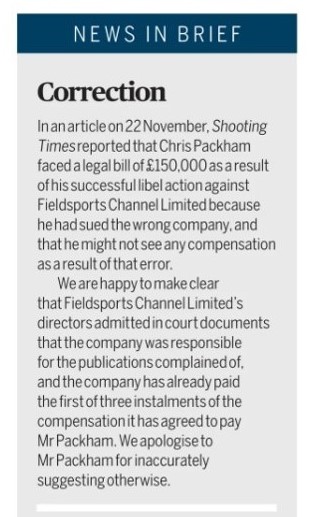
The Shooting Times stupidly published a news article in its 22 November 2023 edition, claiming that Chris ‘could face a legal bill of £150,000’ because he had ‘sued the wrong company’ in his libel action against Fieldsports Channel Ltd:
The apology has been published in this week’s edition of Shooting Times (6th December 2023).
If the fake news story sounds familiar, it’s because it’s based on the same fake news story published by the Daily Mail on 7th November 2023, for which it, too, had to apologise (see here).
The fake news story was also published in Sporting Gun and an apology is expected in that paper when it goes to press later this month.








 Raptor Persecution UK