
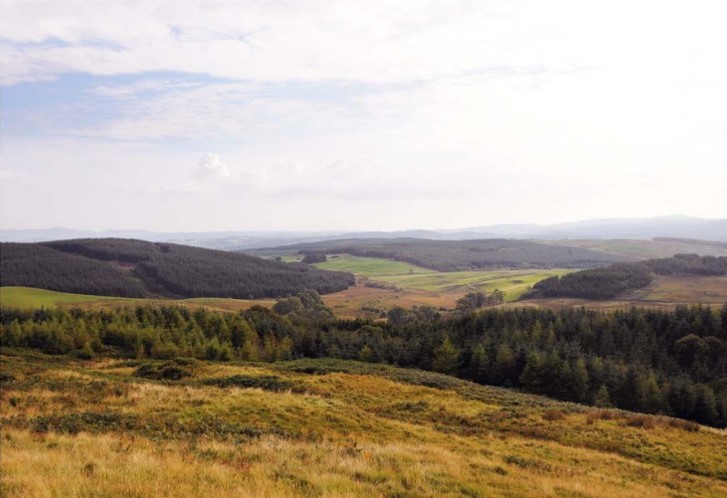
On 26 September 2023, two gamekeepers were convicted at Dumfries Sheriff Court for offences committed on Overlaggan Estate in 2021, a pheasant, partridge, duck and goose- shooting estate in Dumfries & Galloway.
David Excell, 54, pleaded guilty to deliberately trapping and killing a pine marten and failing to comply with the conditions of his firearms licence. Kenneth McClune, 61, pleaded guilty to failing to comply with the conditions of his firearms licence.

You might recall that I wrote about this case (here), and I mentioned that I thought there was something odd going on because I was pretty sure that four men had been charged originally and that the alleged offences included the illegal killing of birds of prey, according to a press statement issued by Police Scotland in October 2021 (see here).
But when gamekeepers Excell and McClune were convicted at Dumfries Sheriff Court in September 2023, there was no mention of the other two defendants, nor of the alleged raptor persecution offences, which I thought was odd, so I’ve done some research.
First I asked Police Scotland about the case, to determine whether the raptor persecution charges were going to be heard in a separate case, or whether the charges had been dropped, and if so, why? Police Scotland refused to comment and instead pointed me in the direction of the Crown Office.
The Crown Office told me this:
“As you were not directly involved in this case there is a limited amount of information which I can give you as we need to ensure compliance with Data Protection legislation.
I can, however, advise you that there were four accused persons in this case and there were charges involving raptors. COPFS have a duty to review the available evidence throughout the life of a case. This review includes the assessment of evidence, the availability and strength of evidence against each accused and outcome focus for a case.
On the day of the trial pleas were offered from two of the accused in the terms that you are aware of [Ed: i.e. the guilty pleas from gamekeepers David Excell and Kenneth McClune in relation to firearms offences and the killing of the pine marten]. In light of this new circumstance the case was reviewed by the prosecutor. I can assure you that this decision was not taken lightly and was ultimately done so based on a careful analysis of the evidence. COPFS takes the prosecution of offences involving raptors and all other wildlife crime extremely seriously and prosecutorial action will be taken if there is sufficient evidence and if it is in the public interest to do so”.
When I asked the Crown Office to specify what were “the charges involving raptors“, the Crown Office told me this:
“All I can advise you further is that there were three charges under s1(1)(a) of the Wildlife and Countryside Act 1981 involving raptors.
The rules around what information we can provide and to who are outlined in s6 of the Victims and Witnesses (Scotland) Act 2014. Subsection 2 outlines the categories of individuals who are entitled to information upon request. You do not fall within any of those categories in relation to this case.
Even if you did, COPFS are only required to provide information in relation to the ‘nature’ of the charges on a complaint, not the details of them. So had you been a witness in this case, I would have been unable to provide you with any more information than I already have.
I am sorry that I cannot provide you with any more details about the case. You will hopefully appreciate that, in an effort to assist you as much as possible, I have provided you with more information than I was technically required to give you under the Victims and Witnesses (Scotland) Act 2014“.
So there we have it. The raptor persecution charges were dropped, with no explanation given, and we’re not even allowed to know the details of those charges, let alone why they were dropped, other than there were three charges and they related to S1(1)(a) of the Wildlife & Countryside Act, which refers to the killing, injuring or taking of a wild bird. We don’t know whether that involved poisoning, shooting or trapping in this case.
Presumably there was sufficient evidence to warrant the charges being placed against the four individuals in the first place so we can conclude that raptor persecution crimes were indeed committed, but the resultant dropping of those charges and the subsequent (and lawfully legitimate) position of both Police Scotland and the Crown Office means that effectively those crimes have been covered up, and the public has no (lawfully legitimate) access to the details.
How is that ‘justice being seen to be done’? All it does is provide the game-shooting industry a platform to perpetuate the myth that gamekeepers are no longer killing birds of prey on land that’s managed for gamebird shooting.
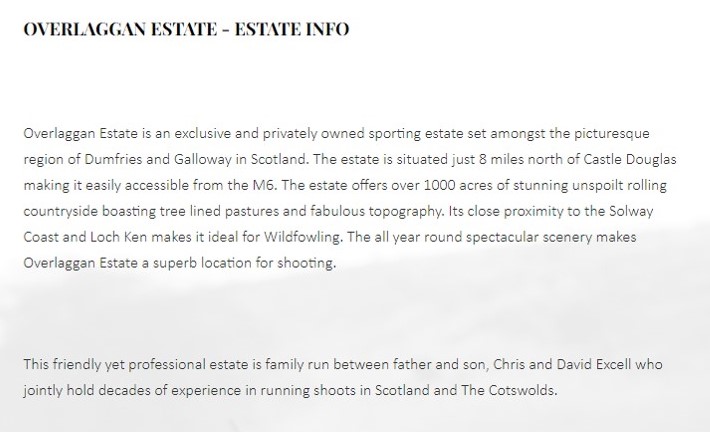
At the time the offences were committed, Overlaggan Estate was marketed on the Sporting Lets website as offering the following ‘sport’:

The owner of Overlaggan Estate was not identified in the Sporting Lets promotional material but details of the management team were given as follows:
Police Scotland announced the charges against the four men in a press release in October 2021. Interestingly, Overlaggan Estate was put on the market in February 2022. Here’s the sales brochure:
The estate has since been sold and the farm is now owned by James Pringle Jack, according to Andy Wightman’s brilliant website, Who Owns Scotland:
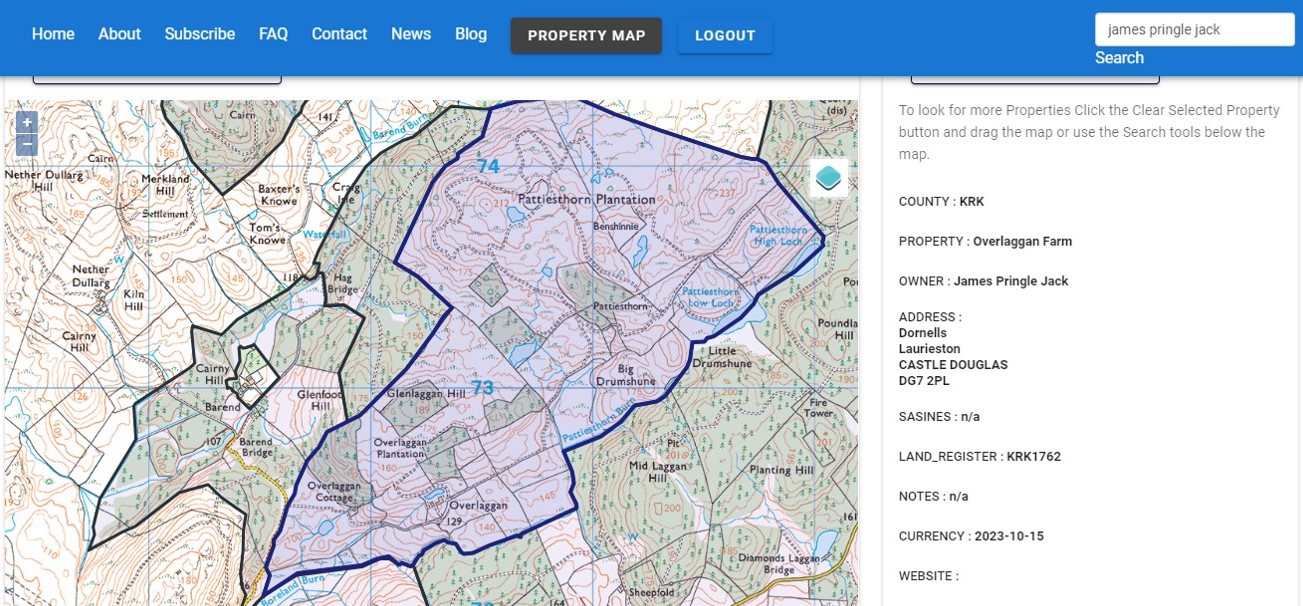
James Pringle Jack owns several other estates in the area, including Hensol and Dornells. It is not known whether Mr Jack operates a pheasant/partridge shoot at Overlaggan or whether any of the previous staff are still employed there. There is no suggestion that wildlife crime continues on the estate.
It’ll be interesting to see whether a General Licence restriction is imposed for the offences committed on the estate in 2021.
 Raptor Persecution UK
Appalling.
Is there really no legal way of finding out about the dropped charges? Shouldn’t (or wasn’t) an appeal be made for further info?
The response from the Crown Office seems clear, referring to the Victims & Witnesses (Scotland) Act 2014. They didn’t even need to tell me as much (actually very little) as they did!
Is the name Excell common thereabouts, or might ‘gamekeeper’ David E be related to, or the actual estate owner David E?
Perhaps the Court doesn’t provide occupation and address?
David Excell definitely not the estate owner – he was a gamekeeper.
Is this James Jack related to Alister Jack, the MP and Scottish secretary?
Brother
Thank you
“Is there really no legal way of finding out about the dropped charges?”
I have had a look at English and Welsh law in this respect:
“Prosecutors must be aware that decisions to terminate prosecutions are susceptible to judicial review… Accordingly, a full note of the reason for the decision is essential. The more difficult the decision, the more important it is to have a detailed note showing how the evidential and the public interest stages of the Full Code Test have been applied.”
See https://www.cps.gov.uk/legal-guidance/termination-proceedings-including-discontinuance
It is clear in English and Welsh law that victims have full rights to disclosure, without resorting to judicial review.
In Scots law (hey, I’m not a lawyer, but this is what is published) I found:
“Dropping charges
You cannot drop charges once the police have reported a crime to us. See the Scottish Government guide or learn more about our role in the justice process.”
See https://www.copfs.gov.uk/contact/common-questions/#:~:text=Dropping%20charges,role%20in%20the%20justice%20process.
This is clearly ambiguous wording. It does not apply to the COPF themselves.
“If the procurator fiscal decides to take no further action
You’re entitled to information about the decision on request from the Crown Office and Procurator Fiscal Service”
Again, the above is ambiguous wording. Who is the “you” being referenced?
From https://www.copfs.gov.uk/services/victim-services/victims-right-to-review/
it is clear that the people being referenced are the “victims” only.
“This guide explains how the victim of a crime can ask COPFS to review a decision not to take action or to stop prosecuting a case after it has started in court.”
So, no judicial review *allowed in this respect*, under Scots law, to the general public (unless someone can supply contrary evidence…?)
That is another thing which needs changing.
All very odd considering that the law needs to be seen to be obeyed and transgressions seen to be dealt with publicly, it is afterall on our behalf that the law is applied. The only folk who benefit are the nearly criminals and their pals.
The usual nod and wink from above.
Interesting to note that this is but 10 miles from Bellymack Hill red kite feeding station. My money is on kites being killed
I’ve stayed just down the road from this estate on many occasions: there are red kites all around there, as you are close to the original release site; buzzards are quite common too; at leasst 2 pairs of ospreys breed within the county.
Take your pick…
So you can plead guilty as charged and be convicted, and then have the charges dropped. Surely at the start someone would of seen the possibility of being found guilty unlikely and advised to plead not guilty. I would of thought that charges related to firearms would be obvious. Did someone make a monumental cock up in the paperwork, or fail to do their job properly ?.
The charges that gamekeepers Excell and McClune pleaded guilty to were not dropped – they were convicted and sentenced accordingly (in relation to the killing of the pine marten and firearms offences).
The charges that were dropped were those relating to raptor persecution. It’s not known whether those charges also applied to Excell and McClune, or just to the other two defendants (whose names have not been released).
Thanks Ruth, I misunderstood, presumably the convictions and sentences will become known at a later date /.
The convictions and subsequent sentencing were reported on an earlier blog:
Stinks like a keepers pit
As a resident of Castle Douglas, I am never surprised at any outcome from the Sheriff’s Court at Dumfries. The owner of the estates mentioned is [Ed: rest of comment deleted as libellous]
This sentence “COPFS takes the prosecution of offences involving raptors and all other wildlife crime extremely seriously and prosecutorial action will be taken if there is sufficient evidence and if it is in the public interest to do so” or some slight variation of it is always trotted out in cases like these, like a one-liner gag that some stand-up comedians specialise in. The laugh aloud bit being the “if it is in the public interest” part. I always think they should be made to explain why it isn’t in the public interest when they drop charges, as it often seems that the default setting is that the prosecution of raptor crimes just isn’t in the public interest . If the decision to drop these charges in this case rests on that point, surely we have a right to know exactly why it wasn’t in our interests?
I would be interested to know if the Freedom of Information Act could be used to obtain information here. I should have thought they would have to comply with that. My reaction is it is the customary nod, wink and a shake of the hand in operation here. Although I live quite near to this I have not heard anything about this estate. I intend to make some enquiries and will post details here if I succeed in finding anything of interest.
Unlikely that you could use FoI here, as the matter concerns personal information, which is more of a data protection matter.
Some info available online:
[Ed: I’m not going to publish that, Frances. James Jack is the current landowner but was not at the time the offences took place in 2021 so commentary about him is unfair]
Is there any chance of a vicarious liability charge being brought against the landowner, selling up and doing a runner does not preclude him from his responsibilities, I would have also thought the public would be due a return on the subsidies paid out for the failure to meet the environmental standards set. I fail to see how any court can say this is not in the public interest
The same thought always crosses my mind with a ‘public Interest’ quote – how many letters from concerned citizens would it take to establish such after the event. Perhaps the RSPB and other like-minded organisations might give it some consideration?
The earlier comment remains interesting…
“The actions of a few individuals do not reflect the positive steps taken by most land owners and managers to maintain and encourage wildlife in our countryside“.
Personally I would hope the green party could raise questions in the Scottish parliament asking why it is not in the interest of the public to know why criminal charges brought by the Police on a matter deemed one of the highest priority of wildlife crime’s in the UK can seemingly be disregarded on the whim of a single person. It raises the question once again that some people deem themselves as “UNTOUCHABLE”
So it’s just another filthy greasy cover-up…
Unless I am mistaken raptor persecution is a national wildlife crime priority. Therefore one would hope that the Prosecutor Fiscal would have very good reasons to discontinue a case involving raptor persecution, as such cases are surely in the national and public interest?
I also assume that the procedures for Police Scotland to charge a suspect are similar to those in the England and Wales, and that before a person is charged the evidence must pass a basic evidential threshold test. This might suggest that at the time the suspects were charged, there was some belief that case had a realistic chance of success in the courts?
So the decision to drop the case is very strange and I can understand the suspicion that something untoward has taken place.
According to the Police Scotland website in relation to Sect 6 Victims and witnesses (Scotland) Act 2014, – the people who can ask for information regarding a case are outlined as-
1/the victim of the offence or the alleged offence,
2/a witness to the offence,
3/a person who is going to give evidence about the offence or the alleged offence,
4/a person who has given a statement to a police officer or to a prosecutor about the offence or the alleged offence.
5/If you are a relative of a victim who has died you may be able to ask for information where the victim’s death has been, or may have been, caused by the offence or alleged offence.
So where does this leave wildlife cases, where the victim is not a person, and wildlife doesn’t have a voice of its own?
Surely interested parties in protecting and preserving wildlife, such as the RSPB, SSPCA, Wild Justice etc should have some rights to ensure justice is properly administered when it comes to wildlife crimes?
Ruth- you are right to ask questions about this case, the lack of information you have been provided is disappointing, and I really hope a MSP reads this blog, and raises questions in the Scottish parliament regarding changing the law to allow representatives of bodies protecting wildlife to act on wildlife’s behalf and to have the same rights regarding information on wildlife cases as they would have, if they were the victim.