
Episode two of the Guardian’s mini podcast series investigating the illegal killing of birds of prey on grouse moors has been released this morning.
For those who missed episode one, please click here.
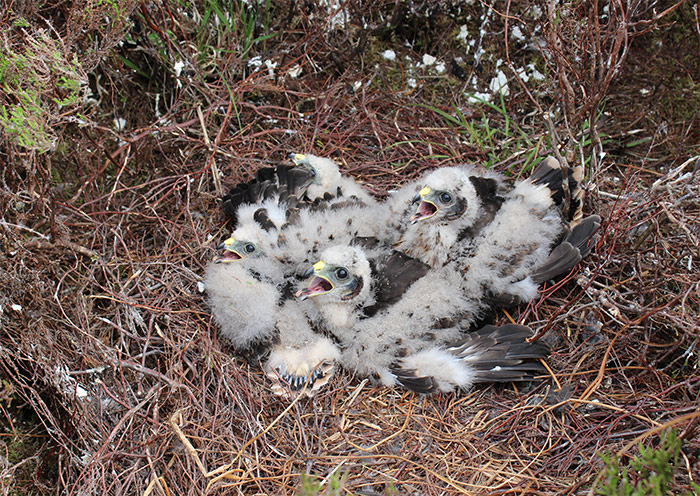
In episode two, journalist Phoebe travels to the Yorkshire Dales National Park in an effort to try and see the location of the nest where an entire brood of hen harrier chicks had been stamped to death the previous year.
She talks a lot about the great big wall of silence about the case, especially from Natural England – many of you will recognise the frustrating lack of accountability and transparency.
She interviews a couple of RSPB investigators and then finally gets an interview with Stephen Murphy from Natural England, who apparently had to be accompanied by a minder from DEFRA. Stephen apparently believes that there’s been “a reduction in the intensity of persecution and the hen harriers are prospering from that…”. Really, Stephen? Jesus Christ. 98 missing/dead hen harriers since 2018 suggests otherwise (here).
There’s also a report of a discussion Phoebe had with John Holmes, NE’s Director of Strategy, who apparently doesn’t see any conflict of interest in Natural England receiving an £85K ‘donation‘ from BASC, with an attached clause that prevents NE from saying anything untoward about BASC and hen harriers.
The episode ends with Phoebe chatting to a cafe owner named Alan, who happens to be a grouse shooter and seems unable to be able to contain his hatred of Chris Packham.
Listen to Episode two here.
UPDATE 17th August 2023: Link to third & final episode here.
 Raptor Persecution UK
I am at a loss to understand the motivation that a fieldworker like Stephen actually has here. That’s even before you think of the minder sent, to keep an eye on what is spoken about. I don’t understand people continuing this work, when it’s so obvious what’s going on. As for NE accepting money from a shooting group, that should be enough for anyone to walk away. Just bizarre.
“A reduction in intensity of persecution” – they’re having a laugh aren’t they? Just a quick analysis of the 98 Hen Harrier disappearances and deaths since 2018 on the blog shows a disturbing consistency of figures; 21 in 2018, 19 in 2019, 16 in 2020, 12 in 2021, 21 in 2022 and 9 so far in 2023. Disgraceful and shaming for those involved in the supposed protection of this wonderful species
No wonder the UK is the least biodiverse country in Europe. Statutory provision for wildlife is not fit for purpose. How long is this going to go on for?
Well that was all a bit depressing but I guess at least, if it’s being promoted by a national newspaper, then some of the people who never knew this was happening will be more aware.
The cafe owner gave us a textbook example of the way cognitive bias leads a person to ignore facts, especially those that contradict their beliefs. For example, local hotels in his area would be just as busy (possibly even more so) if they were full of hikers, cyclists and nature watchers as they are with shooters. Also, shooting is seasonal whereas all the other activities happen all year round. And the idea that Wales is a ‘wasteland’ because they don’t shoot grouse…?! Jesus wept! All too familiar hatred for Chris Packham, as well [heavy sigh]…
On a different note, I was interested to hear that NE needed landowner’s consent to monitor nest sites. I have a friend who works for the Environment Agency and she told me they have an annually renewed warrant to enter any property to investigate various issues like pollution or flooding. It seems odd that NE can’t be issued with similar warrants (both agencies are part of Defra) where there is a clear issue regarding their work. Perhaps Wild Justice could investigate/campaign for this?
“both agencies are part of Defra”
All from http://www.gov.uk:
Natural England is an executive non-departmental public body, sponsored by the Department for Environment, Food & Rural Affairs.
As an NDPB, Natural England has a separate legal identity and is expected to operate at arms’ length from government, carrying out its statutory functions with technical expertise, impartiality and transparency.
EA is an executive non-departmental public body, sponsored by the Department for Environment, Food & Rural Affairs, supported by 1 public body.
Arm’s-length bodies ( ALB ) are a specific category of central government public bodies that are administratively classified by the Cabinet Office.
(Un)Natural England annually issues licences for all kinds of birds to be legally shot, and I would love to know who or what body is responsible for stipulating which ones and when. I know the RSPB has input, which is shocking in itself.
The only way to end raptor persecution (supposedly to preserve the grouse chicks) is to recognise that grouse shooting is a blood sport and ban it by law … without loopholes.
“I would love to know who or what body is responsible for stipulating which ones and when.”
That would be Natural England itself. It is the only statutory body for such issues.
“I know the RSPB has input, which is shocking in itself.”
No, it is not (shocking). The RSPB has no statutory authority whatsoever, but it can sometimes be consulted about various issues, to which it may respond as it sees fit.
There are many reasons why individual licenses are granted for the killing of birds, but the RSPB will have no expertise or remit to comment on any Health and Safety issues, or commercial considerations, which are almost always required by Natural England.
“The only way to end raptor persecution (supposedly to preserve the grouse chicks) is to recognise that grouse shooting is a blood sport and ban it by law … without loopholes.”
Raptors are persecuted by other shooting interests than just grouse.
We who seek a humane way of managing the natural environment of the land mass and marine environment of the biological entity we call the British Isles, should be grateful that we are not dealing with the situations facing other similar areas of the planet, where hellish conditions can prevail for those trying to enforce protection of endangered species. Saying that, I am not seeking to play down the serious, and sometimes dangerous, experiences those who are employed to protect particularly sensitive areas for wildlife conservation here. We must keep in mind, that those so-employed by Government agencies and local Councils, are not armed or trained in self-defence skills, whereas, in other countries such as those in South America and Africa, many wardens have been grossly intimidated or murdered by poachers or mercenary forces acting for logging/oil-gas/plantation developers/mining companies, as have been witnessed in Brazil, on genocidal and egregious scales. Protecting Gorillas and other Great Apes has been a disconcerting and dangerous task, with many dedicated wardens killed. In saving Rhino and Elephant populations, suitably trained teams armed and with tracker dogs, have achieved great success against the poachers acting for Far Eastern interests. In the USA, the Trump era brought in a clearance of protection laws for endangered species and sensitive habitats, and today, the rescinding of bad laws and the restoration of protection has been a slow process, with Grizzlies, Wolves and many other creatures facing a grim future.
What can be said for the UK, can be obviously stated, is that we have a determined and well-placed element of reactionary forces that just will not concede that we live in an era of serious climate change and loss of biodiversity, with a poor infrastructure in policing, enforcing and adjudication of the laws to protect the environment and wildlife. Moreover, we have a very biased political set-up showing a lack of real concern over how bad the situation is, as it represents those powerful industrial and financial institutions, whose interests are certainly not for protecting anything other than some negative vested cause. Some cracks have appeared, with certain Ministers being described as embarrassments, and younger members wanting to see the back of them, as they represent “cringe”. Those parts of our media that decry people such as Chris Packham and various protesters against environmental abuse, are only playing to an audience that wants off the hook of responsibility for what is happening to the Earth. Chris and those others are acting valiantly, they being the foot-soldiers in the incipient battle that could be the Armageddon for humanity, and innocent creatures unfortunately having to go down with it. This is now the Battle for Middle Earth, as Tolkien would have it; another person who was concerned about the damage of the Industrial Revolution and the horrors of a World War.
COMPROMISE!, as in all conflicts, or conflict of interest. Allow grouse shooting on estates that abide by the law, close down the ones that dont. Raptors are a protected species, and it is a crime to persecute them. If estates have smaller bags of shot grouse, so what!, accept it or dont do it. Introduce strong penalties for law breaking keepers, and landowners, with stiff jail terms, but praise legally managed estates!, with healthy numbers of birds of prey, after all waders and many other species of birds, benefit hugely from the control of vermin.
This is not a ‘conflict’. To suggest it is to assume there are two sides that are somehow both ‘in the wrong’. People who want an end to wildlife crime are no different to people who want an end to theft, fraud or any other criminal activity i.e. the majority of normal, decent human beings. The people who commit these crimes are perpetrators, not ‘victims’. We do not ‘compromise’ with criminals.
There are wider issues with all driven game shooting, which also are of concern to normal, decent human beings. The destruction of habitat and biodiversity, lead pollution, loss of amenity, flooding etc. but on top of that there is the basic question of killing for ‘fun’.
If a group of school children were found to be organising themselves to breed and kill pet hamsters then we would be very concerned. Social services would be called and psychiatrists would be deployed. Somehow our society has allowed itself to be anaesthetised to the shooting industry because of ‘tradition’ and deference to establishment landowners and their supporters in the Press and Parliament.
There is no ‘compromise’ to be had. There is no ‘conflict’. There are just people who kill for fun and/or money, and the rest of us who wish they would stop and do something more constructive with their time.
Ah John, you give yourself away by using a key word— Vermin. All the evidence and is as much the presence or absence of birds with successful breeding, as it is about reported bird crime suggests that most grouse moors break the law. One only has to look at the distribution of Peregrine breeding sites on grouse moors and then discover that almost all of them fail to rear young or in this day and age lay eggs, it has been thus for near enough 25-30 years ( post Langholm 1). Even those few moors that don’t persecute benefit from persecution by others. Penalties are not the problem, although it would be more than justified if magistrates used them to the full rather than giving out the slapped wrists, it is detection of enough evidence to convict. After all wildlife criminals are protected under the law the same as the rest of us ( and rightly so) until that evidence is before a court. Given how difficult it is to get that evidence it is currently almost impossible to sort the good guys from the bad and there no current way of stopping the bad guys shooting anyway.
Two separate things to do with the wider things from the pod cast it really is ludicrous that NE to not have right of access and have to ask for it, certainly time that was changed.
The picture on the front of the podcast is a Pallid not Hen Harrier.
Ruth I am trying to understand NE and their co-operation with this bunch of people. I get that they are needing to get onto the estates, so to a extent they need to “work with them,”, but what would actually happen if they said, no we’re not doing this anymore? These estate owners who work with NE are they a shiny example with a genuine interest in living with birds of prey, or are they just doing this for some sort of political reason? If NE stepped away how much harder would investigations be into wild life crime?
Sadly part two gave an unchallenged platform to the same old lies.
I don’t think I got the straight-talking from NE that I had hoped for (now have more questions than answers) and it showed how underpowered and narrowly focussed their strategy is (i.e. no remit or manpower or apparent passion in catching the baddies themselves). Good old fashioned Dales straight-talking was however provided by Alan who could have walked off the set of League of Gentleman, Monty Python or Harry Enfield. I would love to hear him carry on talking , I imagine him saying the same thing in more or less the same way in rising pitch of his voice, until his blood pressure got the best of him and he had to pack in. Also, it was a reminder that the landowners are effectively in control of the NE fieldworkers because they apparently control their access! An impossible starting point to recover from. Good to hear the remark from the RSPB bloke “I’m going nowhere, I’m not going to stop”. Made me look at myself too and come to the conclusion that I’m not either. Looking forward to part 3…
Bloody townies, comin’ up bloody ‘ere, tellin’ us what t’ bloody do!
Alternatively, “Bloody townies, comin’ up bloody ‘ere, tellin’ us to obey the law!”
This was painful to listen to. So many lies told. Just because something is a tradition doesn’t mean it’s right to continue with it. NE seems to have come to some sort of insidious trade-off with the shooters, a pact with the devil, allowing a certain number of raptors to be killed while wringing their hands but not taking any action, just to keep their Lords and masters in government on the right side of their big donors.
As for the cafe owner, what stuff and nonsense. Eco-tourism brings in way more income and visitors and is all year round. What a dreadful man. Hope I never find myself on his premises
Just listened to episode 3.
One seemingly terrified “acting inspector” of North Yorkshire Rural Task Force, and more lies from the MA: they actually try to claim credit for the recovery in the Buzzard and Red Kite population! Once again, the lies go unchallenged.
We need to trash the myth that grouse shooting provides jobs and makes millions of pounds.
The Scotsman, York Press and the Daily Express are some of the papersall owned by right wing investors who espouse this myth.
For a start less than one percent of the population partake in this vile pastime, and I am sure no bricklayers, or bus drivers will be part of their number.
They talk about permanent jobs when they only murder grouse for 4 months, the jobs will be already permanent with employees already working on the estate and then diverted to the shooting.
No jobs would be lost and gamekeepers could divert from their disgusting killing of raptors.
The economics don’t make sense, who makes all these millions the estate managers.
They drive their top of the Range Rivers to Lord Snootys 40 bed mansion, they eat their they sleep their and don’t leave the estate.
I would like them to publish figures of the jobs and where to money is made, and incidentally how many Tory politicians from the Lord’s and Commons either attend or have an interest in grouse moors
These people do not go to local hotels, b&bs, restaurant,cafes,gift shops and local attractions if the moors were opened local people would benefit financially instead of a few millionaires.
I would also like to hear Natural England and conservation charities calling out these newspapers, I could say playing tiddlywinks makes millions but without evidence it is of course nonsense
Grouse shooting and other shooting of game birds is not for “toffs “,I was a ordinary working class tradesman, and the vast majority of my fellow shooters through the years were the same,and I always eat what I shot 👍
“Grouse shooting and other shooting of game birds is not for “toffs “… ”
From https://www.gunsonpegs.com/shooting/grouse#:~:text=%C2%A34400per%20gun%20%2D%20VAT%20inc.
“Morton Sporting, North Yorkshire – £2933per gun – VAT inc.
Upperwood Estate, Lancashire – £3000per gun – VAT inc.
Morton Sporting, Northumberland – £5200per gun – VAT inc.”
“… and I always eat what I shot”
From https://www.who.int/news-room/fact-sheets/detail/lead-poisoning-and-health#:~:text=At%20high%20levels%20of%20exposure,intellectual%20disability%20and%20behavioural%20disorders.
“Lead in the body is distributed to the brain, liver, kidney and bones.
There is no level of exposure to lead that is known to be without harmful effects.”
It seems to have adversely affected xxxxx xxxxx
The Hampton report was commissioned (2004) and passed into Westminster law (2006) under the last Labour Government.
It required, among many other things, that statutory (regulatory) bodies such as Natural England (then English Nature) take primary consideration – when considering regulations – of being “proportionate and flexible enough to allow – OR EVEN ENCOURAGE – economic progress” (my emphasis).
See BERR ‘Regulators’ Compliance Code’ 17 December 2007, Part 1, General Introduction, 1 Purpose of the Code:
Click to access file45019.pdf
“Its purpose is to promote efficient and effective approaches to regulatory inspection and enforcement which improve regulatory outcomes without imposing unnecessary burdens on business”
It was part of the ‘business first’ obsession of the Blair administration, even carried into the natural environment and its statutory body.
So, for the first time, English Nature (Natural England) had to take into account the economic consequences of its activities when deciding or enforcing regulations regarding the natural environment.
Before Hampton, all English Nature had to worry about was the effect of a proposal on wildlife. After Hampton (when English Nature became Natural England, in 2006) it was required to ‘balance’ that consideration with the economic consequences.
But English Nature/Natural England has no economic expertise: how could it possibly argue against the business case for ‘damaging wildlife’? Or, indeed, why should it have to do so?
We see the consequences.