
Further to the horrific story about how charity cyclist Tony Parsons had been killed and then subsequently buried in a stink pit by the McKellar twins on the infamous Auch Estate near Bridge of Orchy in the Scottish highlands (see here), more information has emerged in this grisly case.
The Daily Record has reported that the McKellar twins’ father was Tom McKellar, who was convicted in 2012 for the illegal possession of a banned pesticide (Carbofuran) and two hand guns at his home on the Auch Estate where he worked as a farm manager (also described in some publications as a gamekeeper)- see here and here for some background to that case.
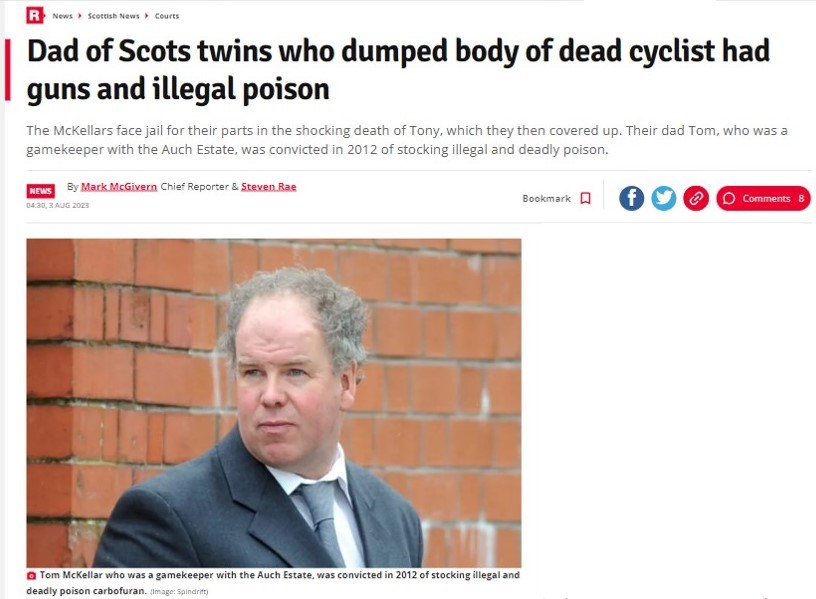
The article in the Daily Record (here) also includes comments made by locals about the McKellar twins and it reports that the brothers ‘worked as stalkers on a hunting estate‘ and ‘had been exposed to the killing of animals for much of their lives‘.
The article continues:
‘The boys had grown up in a life where shooting animals, trapping them was a way of life, part of the running of a shooting estate that protected the game bird and deer stocks. They were both working on the land from a young age and soon working as deer stalkers. Their father was said to be highly regarded in the local community but the fact he had illegal guns and hugely toxic, illegal poison at his property didn’t exactly make him look like the best role model‘.
The article also states: ‘The men eventually buried Tony’s body in a “death hole” that was full of the rotting remains of foxes, grouse and other animals that had been killed on the estate‘.
I’m not sure that grouse shooting takes place on the Auch Estate – the habitat doesn’t look as though it would support commercial driven grouse shooting at any rate. The estate is best known for offering deer stalking and fishing, although the estate agent’s brochure from the 2020 sale does say that walked-up shooting is available and mentions rough shooting for woodcock:
Further information about the site where Tony’s remains were found was reported in an STV article (here) published last September when the case moved to trial at the High Court in Glasgow. The article reports that Tony’s body was ‘hidden under animal remains with bleach also poured on his remains‘. (Thanks to a blog reader for sending the STV link).
There has been a lot of online commentary about this gruesome case, which isn’t surprising given the shocking crimes committed by the McKellar twins. Some have questioned why I’m reporting the case on this blog. I don’t feel the need to justify what gets reported on here but in this case I thought it would have been obvious given the estate’s history as a raptor persecution crime scene, the relationship of the McKellar twins to Tom McKellar, and the use of a stink pit to bury a body.
I think it’s also interesting to highlight that a crime as serious as this one can remain hidden on large estates like Auch for years. We often refer to raptor persecution crimes on vast, privately-owned sporting estates as being the ‘tip of the iceberg’ because inevitably estate employees have every opportunity, and of course the motive, to hide the evidence of their criminal activity. The crimes that are uncovered are usually only discovered by chance.
The killing of Tony Parsons and his burial in a stink pit on the Auch Estate by two individuals who lived and worked there only came to light because someone had the courage and decency to report it to the police when Alexander McKellar confessed to her what he and his brother had done.
I see a lot of parallels.
The McKellar twins are due to be sentenced later this month.
UPDATE 25th August 2023: McKellar twins from Auch Estate sentenced for killing cyclist & burying his body in a stink pit (here)
UPDATE 13 AUGUST 2025: New BBC documentary provides shocking insight into appalling crimes on Auch Estate, Bridge of Orchy (here)
 Raptor Persecution UK
Anyone with an interest in Raptor persecution can see the connections. Well done for bringing this to our attention. This site is, as always, a chink of light in an otherwise horrific situation.
We wonder does the dreadful stink pit which attract carrion feeders and which usually have a ring of snares to randomly and extremely cruelly catch unwary victims, have dangerous illegal poisons also added.?
I’ve never come across but …
I have seen bird ladder traps with perching posts on them located within 100ft of stink pits.
Also I’ve seen stink pits at the centre of tracks with snares and bait dropped on the stink pit side of most of the snares leading to the stink pit.
In addition, I’ve reported poisoned rabbit bodies placed next to pheasant pens.
I agree strongly that the article should have been published on this site. Many shooting estates court publicity by donating unwanted game birds to charity, hosting one sided education visits for children and generally placing a positive spins on activities that the public in general tend to frown upon.
These estates and their followers tend to hide what they view as negative events from the public eyes and it is good to see how the media hav e acted as they should in this matter — though if these men were primarily gamekeepers then this should have been widely stated too.
Research has illustrated convicingly that those who are cruel to animals are more likely to act more aggressively than others towards members of their own species, and I cannot, even in my kindest moments, understand why many of the activities designed to manage country sports could not be viewed as cruelty… from neglected snares and Larsen traps and on to stink pits, illegal poisoning, maimed non target species and the likes.
That’s where the evidence points but how true it is to real live it is will be the decision of each individual to decide.
They need barbarians to do this kind of work as I have said before a gamekeepers main job is killing things… so this is not a healthy environment for raising children look at what foxhunters do with a new member of a hunt at their first kill .After a while these people get so used to blood guts cruelty the lot. It’s disgusting to any right minded person its not killing for food but these people are living in the past unfortunately.
Sent from Yahoo Mail on Android
I’ve lived in the countryside most of my life (continuously for the last 26 years) and I’ve always felt that there is a darkness about some of the people here. There is a combination of factors that leads to this darkness, although I hope rarely to the extent that this case has descended to.
It starts with a kind of rural isolation which prevents the development of a wider context to life and how the rest of the world lives and works. It leaves such people prone to inculcation with a narrow ‘culture’ of views, attitudes, behaviours and activities that are presented as both ‘tradition’ and ‘identity’.
Killing living creatures for ‘sport’ is perceived as a ‘necessity’ to maintain this culture/tradition/identity. It becomes so routine that the cruelty and deviance from normal social behaviour of it is barely noticed. In many cases it is revelled in and often used as a means to differentiate their identity from those of outsiders (‘townies’ etc.).
The psycho-dynamics of this often lead to physical violence towards people as well as animals (a basic internet search reveals copious peer reviewed evidence of this). Not all the time, of course, but often enough as anyone who has Sabbed or Monitored a fox hunt will tell you.
The police are unfortunately ill equipped by their own habits, culture and training to deal with this. In my experience of police liaison during the badger culls and later with a broad range of wildlife crime, there is a complete failure to comprehend the significance of these broad sociocultural and psychological symptoms to the extent they dismiss any reports as the alarmist whigeing of ‘activists’ and ‘cranks’. Rural violence and cruelty to animals, even when laws are broken, is rarely pursued as far as interview, let alone arrest or prosecution.
As I pointed out in my response to the current Firearms Licencing Consultation (https://www.homeofficesurveys.homeoffice.gov.uk/s/firearms-licensing/), the police are not capable of making decisions (and should not be expected to) on whether individuals are suitable to hold firearms. They cannot possibly be expected to understand the wider sociological complexities of the real issues involved and instead a dedicated national civilian service (under the supervision of the police) should be formed with links to multiple agencies feeding them information on individuals.
This case is clearly extreme but it does highlight what is going wrong out here in the countryside and how far wrong it can go if steps aren’t taken to address the underlying issues that lead up to it.
I believe firearms licensing is one of those aspects of police work which many police forces have civilianized. Which begs the question what training do these civilians receive, and whether they are better or worse than police officers at judging a persons suitability to a firearms licence holder.
But I do agree with you, judging a persons suitability to be firearms licence holder is a complex issue, and is something which would probably be better undertaken by dedicated professionals who should be given access to a lot of background information on a prospective licence holder in order to reach a meaningful decision as to whether that person is suitable to possess any sort of firearm, whether that be a Sect1 firearm, shotgun or air weapon.
I suspect no one really knows how much wildlife is killed or persecuted by those who really shouldn’t ever be given to access to firearms. I believe serious questions need to be asked regarding the proliferation of firearms ownership in the countryside, something which seems to be accepted, but in reality is something that probably needs to be challenged, as I suspect far too much wildlife is killed in circumstances where it probably isn’t justified or where the killing is unlawful.
I suspect that it is very doubtful that many of the so called “pest species” of bird killed under the guise of the GL are lawfully killed with strict adherence to the terms within the GL?
However, I suspect any attempt to try and reduce gun ownership in the countryside would probably have the CA frothing at the mouth, with claims of yet an another attack on countryside traditions?
Absolutely spot on. There’s an awful lot of romanticisation of rural life and people in my opinion and experience – while it seems perfectly OK for them to denigrate any ‘townies’, so the goodwill isn’t reciprocated. I’ve always felt that the persecution of predators by gamekeepers isn’t just a cold blooded, selfish action to improve game numbers there’s some sort of resentment, hatred they’re a target for too. That also extends to the people trying to protect them, their attacks on social media are incredibly repugnant, they sound/act like a bunch of football hooligans trying to wind up the other side as much as possible for the ‘aggro’. It’s no big surprise certain young men from low income urban areas are drawn to being gamekeepers, I grew up in one of these areas and the casual cruelty and killing of wildlife I witnessed I’ll never forget. For some being able to do that and be paid for it is a dream. This is a shocking case, but is it that surprising?
This case goes a long way to show that being brought up in that environment can lead to very unhealthy attitudes. Just imagine a father explaining to his young sons the purpose of traps, poisons, weapons, stink pits etc. I hope these 2 criminals don’t have children of their own.
As a retired police officer, I have to say that police officers are quite capable of deciding whether people are suitable to hold a firearms or shotgun certificate. I had at least two persons relieved of their guns.
I have to wonder whether there would have been a very different outcome to the incident of the cyclist being knocked off his bike, if the father of these two defendants had gone to prison for the crimes he committed?
Did that failure of the courts to impose a far harsher sentence than it perhaps could and should have done when the father was convicted, have any influence on how his two sons later behaved when they knocked the cyclist from his bike?
I think there is probably good evidence which supports the view that some of those living in isolated rural communities which rarely see the sight of uniformed police or the presence of authorities can develop a sense of being untouchable when it comes to breaking the law.
It could be argued that if a persons crimes go undetected and then if and when some of those crimes are eventually discovered, but are then menially punished in a way which neither acts as a deterrent to further future offending or appears lenient, then could this lead to that person believing that since the chances of getting caught are minimal, and any punishment which will be imposed will also be minimal, then there is little purposes in changing their offending behaviour?
This is no different from risk management principles when low probability incidents but with a high impact are deemed high risk.
This might be something the courts might want to consider in those cases where the chances of an offender being caught and prosecuted are very limited. Something which then might suggest that the best way to deter repeat offending is to ensure that when an offender is caught they face a harsh penalty so that they fully understand that they face real consequences to their criminal actions?
I have to wonder whether the prevalence of raptor persecution incidents would diminish if those responsible understood that should they be caught, then they would face a minimum of 6 months in prison, with a lifetime ban on owning or possessing firearms?
Sadly, it would seem that the way the law and the courts view wildlife crimes appears heavily tainted by speciesism.
The often very lenient punishments handed out to wildlife criminals seems to almost suggest that it is acceptable to abuse animals and wildlife in ways which would be utterly condemned if similar abuse was inflicted on humans.
I would suggest that this is perhaps a failure in the law to both catch up or understand the magnitude of parliaments decision that animals are sentient beings.
Because if it is recognised that animals are sentient beings and that causing unnecessary suffering to animals is wrong, then surely when a person is convicted of causing unnecessary suffering to an animal, shouldn’t the offender face comparable penalties to that which would be imposed if the victim was human?
The growing scientific evidence shows very clearly that animals are not merely “dumb brutes” but are often intelligent and sophisticated in their behaviour. Just because this behaviour is different from that of humans doesn’t mean we shouldn’t recognise it.
If tough penalties were imposed on those convicted of animal abuse then this might also go some way to prevent those criminals who early in their pattern of offending behaviour are convicted of animal abuse crimes to go on to commit even more violent and abhorrent crimes on humans?
I think a very good starting place would be for all humans to understand and recognise that an animals life is just as important to that animal as a humans life is to a human, and that humans are just another species in world of many species. If we did this, then we might not be in the position we are now in, with a nature depleted planet, many species facing extinction and a planet likely to overheat thanks to our wanton destruction of the environment.
I hope Tony Parsons and hus family get justice and reparation.A good man died trying to help others.
RIP.
Ruth – you made the right judgement call in highlighting this terrible event. Thank you for everything you do.