10 million blog views feels like a significant milestone.
Many thanks to all the friends, colleagues, collaborators, supporters, followers, commentators and funders, who make this worthwhile.
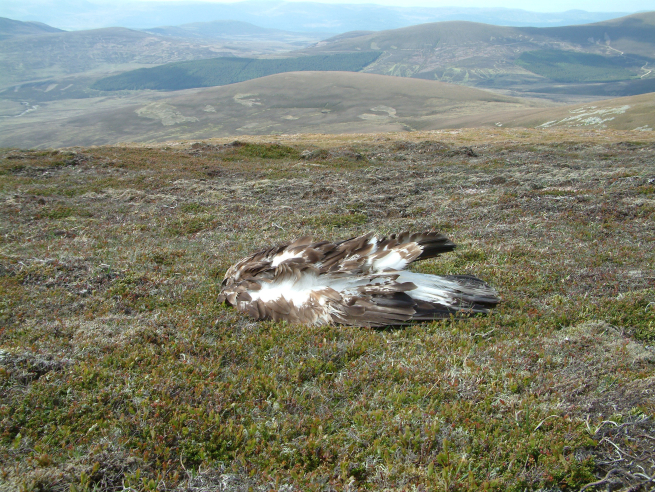
Here’s the photograph that I publish every time a new milestone is reached. This is a golden eagle that was found dead on a grouse moor in the Cairngorms National Park in 2006. It had been illegally poisoned. It epitomises everything in its pitiful, poignant, senselessness.
Photo: RSPB
Unfortunately there is still a lot more work to do, as evidenced by the recent discovery of two young white-tailed eagles found poisoned on a grouse moor in Northern Ireland in May 2023:
Photo: RSPB
The illegal killing of birds of prey in the UK continues and so must this blog. It can often feel like no progress is being made, but it is, albeit more slowly than any of us would like.
I read a report over the weekend where representatives of the game-shooting industry said they felt ‘under siege’ from campaigners. That’s good, some of them have been allowed to get away with far too much for far too long, often assisted and shielded by the very authorities who should be holding them to account.
Change will only come when enough of us demand it.
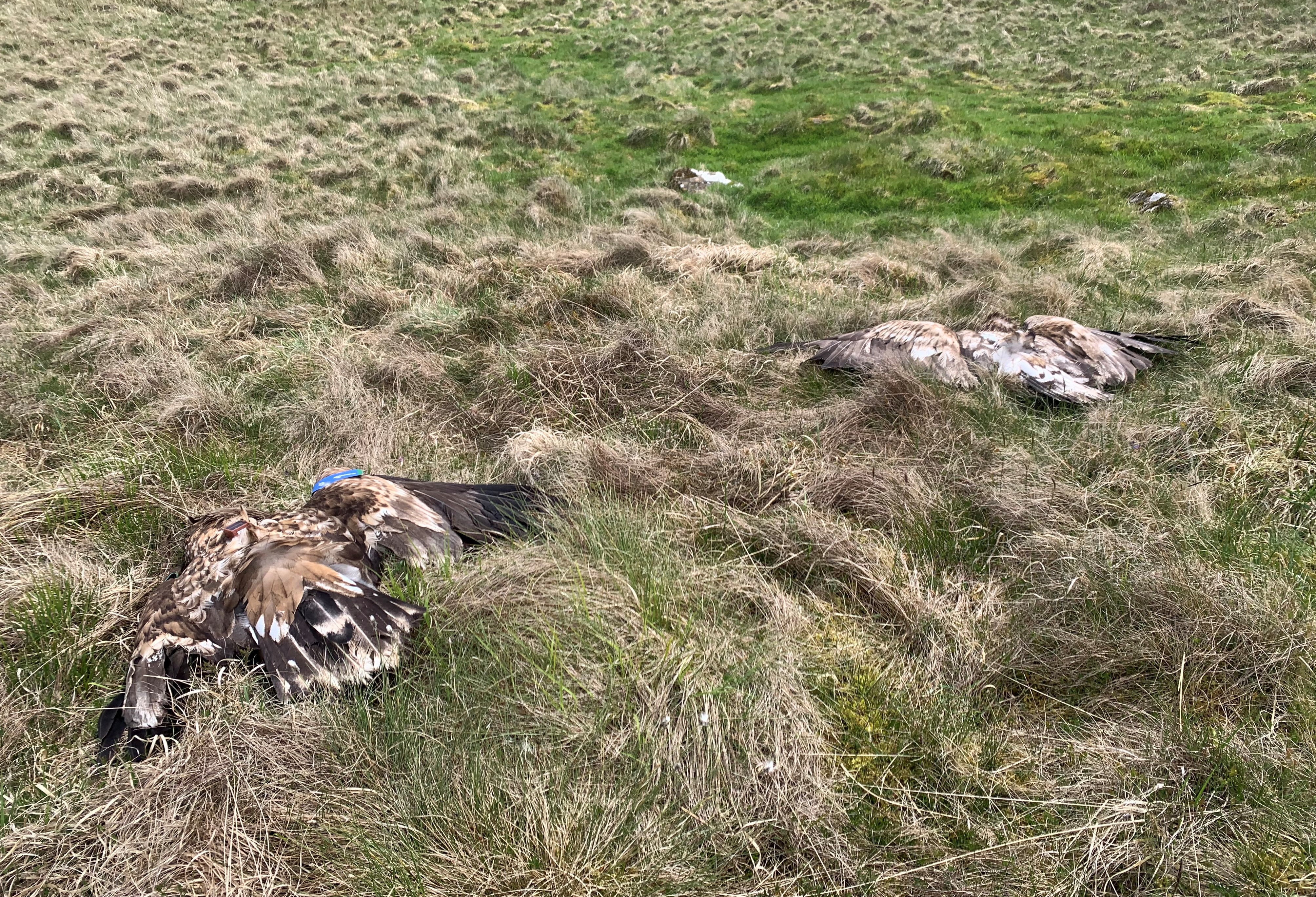
Further to the news on Friday that the two white-tailed eagles found dead on Northern Ireland’s only driven grouse moor at Glenwherry in the Antrim Hills had been illegally poisoned (see here), the Northern Ireland Raptor Study Group (NIRSG) has launched a new petition calling for a ban on the possession of dangerous pesticides.
The two poisoned white-tailed eagles. Photo: Northern Ireland Raptor Study Group
Here is the petition text:
Pesticides which have been deemed toxic to non-target plants and animals have been banned for use across many countries, including Northern Ireland. However, although ‘banned for use’, these dangerous substances are still being used, unlawfully, to target protected birds of prey.
There have been 64 confirmed incidents of abuse of banned or highly toxic chemicals to target birds of prey in Northern Ireland since 2009. However, prosecutions are notoriously difficult to attain because unless an individual is actually seen to be laying out a poisoned bait, it is virtually impossible to determine who laid the bait that subsequently kills a protected species. To date, we are not aware of any successful prosecutions for poisoning protected wildlife in Northern Ireland.
Scotland faced a similar problem with illegal wildlife poisoning so in 2005 it introduced new legislation making it an offence to be ‘in possession’ of certain banned substances (Possession of Pesticides (Scotland) Order 2005). The substances listed were those known to be used to illegally target birds of prey. This legislation has led to the successful prosecution of many individuals who were found to be in possession of the named banned substances, for example where it was discovered in their vehicles, at their work premises and even in their homes. Not only has the poison been confiscated and destroyed, these prosecutions have doubtless saved the lives of countless species and raptors that otherwise would have been targeted.
The banned pesticides are not just a threat to wildlife and the wider environment; many of them can have fatal consequences for any human (adult or child) who happens to inadvertently come into contact with them, for example by touching a poisonous bait laid out in the countryside.
In light of the most recent illegal poisoning of two young white-tailed eagles in County Antrim in May 2023, we are seeking an urgent review of the use of banned pesticides to kill wildlife in Northern Ireland, leading to the creation of a new law which prohibits the ‘possession’ of named, highly toxic poisons.
If a pesticide has already been banned for use on the basis of its toxicity and threat to humans, wildlife and the wider environment, there can be no justification for keeping it.
Please help our campaign by signing this petition (you don’t have to be a resident of Northern Ireland to sign). Thank you.
The poisons we would like to see prohibited for possession are:
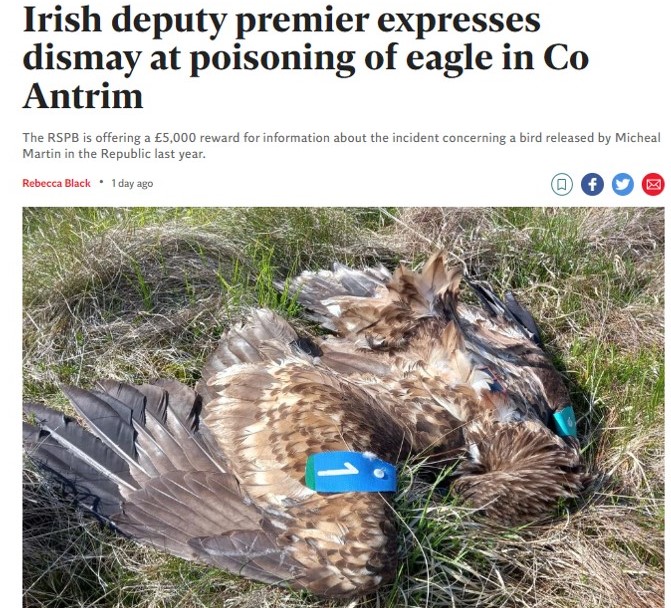
Indeed, condemnation has even come from Michael Martin, the Irish Deputy Premier (the second most senior officer in the Irish Government) who had released one of these eagles last year as part of the reintroduction project in the Irish Republic:
The RSPB is offering a £5,000 reward for information leading to a conviction (see here).
The Northern Ireland Raptor Study Group’s press release (here) describes the location where the two eagles were found poisoned as follows:
‘Glenwherry Hill Farm is owned by the Department of Agriculture, Environment and Rural Affairs (DAERA) and operated by College of Agriculture, Food and Rural Enterprise (CAFRE). This area has many young student farmers, conservationists and volunteers carrying out field work and studies on a daily basis. It also is the part of the Glenwherry Hill Regeneration Partnership (GHRP) and a site for driven grouse shooting and winter woodcock shooting and a site of the Curlews in Crisis restoration project‘.
I think it’s notable that the NIRSG resigned from the ‘partnership’ in 2020 over ‘incompatible management objectives’. The moorland management has recently shifted from walked-up grouse shooting to becoming managed for driven grouse shooting.
Dr Marc Ruddock of NIRSG is quoted:
“We know these parts of the Antrim Hills intimately having monitored birds of prey there for many years and seen various visiting golden eagles and white-tailed eagles there in the past. We are horrified and devastated at the death of these two young eagles. We sincerely hope that this is not a reflection of a renewed intolerance of birds of prey in county Antrim and within Northern Ireland. White-tailed eagles eat fish and seabirds but also other birds, rabbits and hares and more often scavenge dead animals in the countryside. They, along with other native birds of prey, are an essential component of a healthy ecosystem and for such indifference and intolerance to be displayed towardsnative eagles by somebody in this area is distressing“.
Dr Eimear Rooney of NIRSG said, “These majestic creatures are part of our ancient heritage and deserve to be revered, not poisoned and left to rot on a hillside. The suffering these birds must have felt in their final moments, and then dying side by side, it is just heart-breaking. Birds of prey are essential in balancing a healthy ecosystem and are already under pressure from loss of suitable nesting and foraging habitat. With the additional losses of birds through illegal poisoning, whether targeted at them or not, it is a massive blow to conservation efforts in Northern Ireland and on the island of Ireland.
“We have been contacted by many people outpouring their upset at the death of these eagles, and people are incensed that these pesticides, many of which are banned due to toxicity to human health, and which unbelievably remain in use illegally, causing the destruction of our native wildlife, and yet are not illegal to have in your possession”.
If you want to sign the NIRSG’s new petition calling for a ban on the possession of dangerous pesticides in Northern Ireland please click HERE.
UPDATE 3 March 2025: 50,000 people support the Northern Ireland Raptor Study Group’s petition to ban possession of dangerous, raptor-killing pesticides (here)
UPDATE 17 June 2025: 50,000-signature petition calling for ban on possession of poisons, handed in to Stormont, Northern Ireland (here)
In May this year, the Police Service of Northern Ireland (PSNI) appealed for information after the discovery of two dead white-tailed eagles found next to one another in suspicious circumstances on moorland in Ballymena, County Antrim (see here).
The corpses were sent for post mortem and toxicology results have now confirmed they were both poisoned by Bendiocarb.
The two poisoned white-tailed eagles. Photo: Northern Ireland Raptor Study Group
The PSNI has issued the following statement this afternoon:
POLICE INVESTIGATE POISONING OF TWO WHITE-TAILED EAGLES
Police are appealing for information from the public, after the confirmed poisoning of two white-tailed eagles.
Police investigating the circumstances following the discovery of two dead white-tailed eagles, in the Glenhead Road area of Ballymena on Monday, 15th May, can confirm the birds were subsequently poisoned.
Following a post-mortem examination, both birds tested positive for the insecticide bendiocarb.
How the birds came into contact with the insecticide remains part of an ongoing investigation, and the Police Service of Northern Ireland is committed to working with partners and members of the public to determine how the birds consumed the toxic insecticide.
Rural and Wildlife Crime Superintendent Johnston McDowell said: “Sadly, police can confirm the two majestic birds found on land in the Glenhead Road area were poisoned, following a post-mortem examination.
“The test results suggest that an individual not only has access to the insecticide bendiocarb but has placed this into the outside environment illegally, so that wild birds have been able to consume it.
“Bendiocarb is present in the trade product Ficam D, a powder which is only permitted for indoor use to control crawling insects such as wasps and ants, so using this active ingredient in fields would be a breach of Biocidal Products Regulation (BPR).
“The illegal killing of these beautiful birds in a popular rural area is disgraceful, and for any individual to think that they can ignore the law and lay poisonous bait which has led to the killing of these birds, is unacceptable and will not be tolerated.
“Officers with support from the National Wildlife Crime Unit, have been on the ground conducting house-to-house enquiries, engaging with local residents and landowners, in the areas of where the birds were gravitating towards, before they were found deceased.
“The Police Service of Northern Ireland will continue to work with our partners to tackle this criminal activity, investigate any reports made to us and prosecute offenders. In this case we have liaised with our partners in the Partnership for Action Against Wildlife Crime (PAWNI) Agri-Food and Biosciences, Royal Society for the Protection of Birds, NI Raptor Study Group, Health and Safety Executive for Northern Ireland, Northern Ireland Environment Agency and received additional support from the National Wildlife Crime Unit. Police have a strong multi-agency support group which we are very grateful for, but we need the help of the public too.
“There must be people in the community who are aware of individuals committing these offences, and who can come forward and assist police with any information they have.
“If you notice any suspicious activity in rural areas, notice a dead or injured bird of prey, please call police on 101, or alternatively you can make a report via Crimestoppers anonymously on 0800 555 111 or online at http://crimestoppers-uk.org. Alternatively, you can submit a report online using the non-emergency reporting form via http://www.psni.police.uk/makeareport/.
“We are also very grateful to our partners in the charity Royal Society for Protection of Birds (RSPB) who are offering a reward of £5000 for information leading to the prosecution of those involved in the poisoning of the two white-tailed eagles. The charity is completely independent from the police and can be contacted on their confidential Raptor Crime Hotline on 0300 999 0101 or online at crime@rspb.org.uk.”
ENDS
I’ll have more to say about this case, not least to discuss the location where the poisoned eagles were found – the only moor that’s managed for driven grouse shooting in Northern Ireland.
More soon…
UPDATES:
Press release from Northern Ireland Raptor Study Group (here)
Poisoned eagles found on grouse moor in Northern Ireland: New petition calls for ban on the possession of dangerous pesticides (here)
UPDATE 3 March 2025: 50,000 people support the Northern Ireland Raptor Study Group’s petition to ban possession of dangerous, raptor-killing pesticides (here)
UPDATE 17 June 2025: 50,000-signature petition calling for ban on possession of poisons, handed in to Stormont, Northern Ireland (here)
Following the recent confirmed shooting of at least two red kites (with a third one suspected) near Westerdale in the North York Moors National Park (see here), the North York Moors Park Authority has issued the following statement:
Following the most recent report from North Yorkshire Police regarding a Red Kite found with gunshot wounds, the North York Moors National Park is issuing the statement below.
Tom Hind, Chief Executive Officer of the North York Moors National Authority, said:
“We are appalled to hear of recent shootings of Red Kite in the North York Moors. Wildlife crime and raptor persecution are illegal, immoral and have no place in this National Park.
“Those behind these callous acts should recognise the disservice they have done to the entire North York Moors community. Ultimately those responsible may find they have shot not only a wonderful bird of prey, but also themselves in the foot.
“It is vital that anyone with information about these incidents, or any other wildlife crime in our region, call North Yorkshire Police on 101. We cannot let this crime go unpunished.”
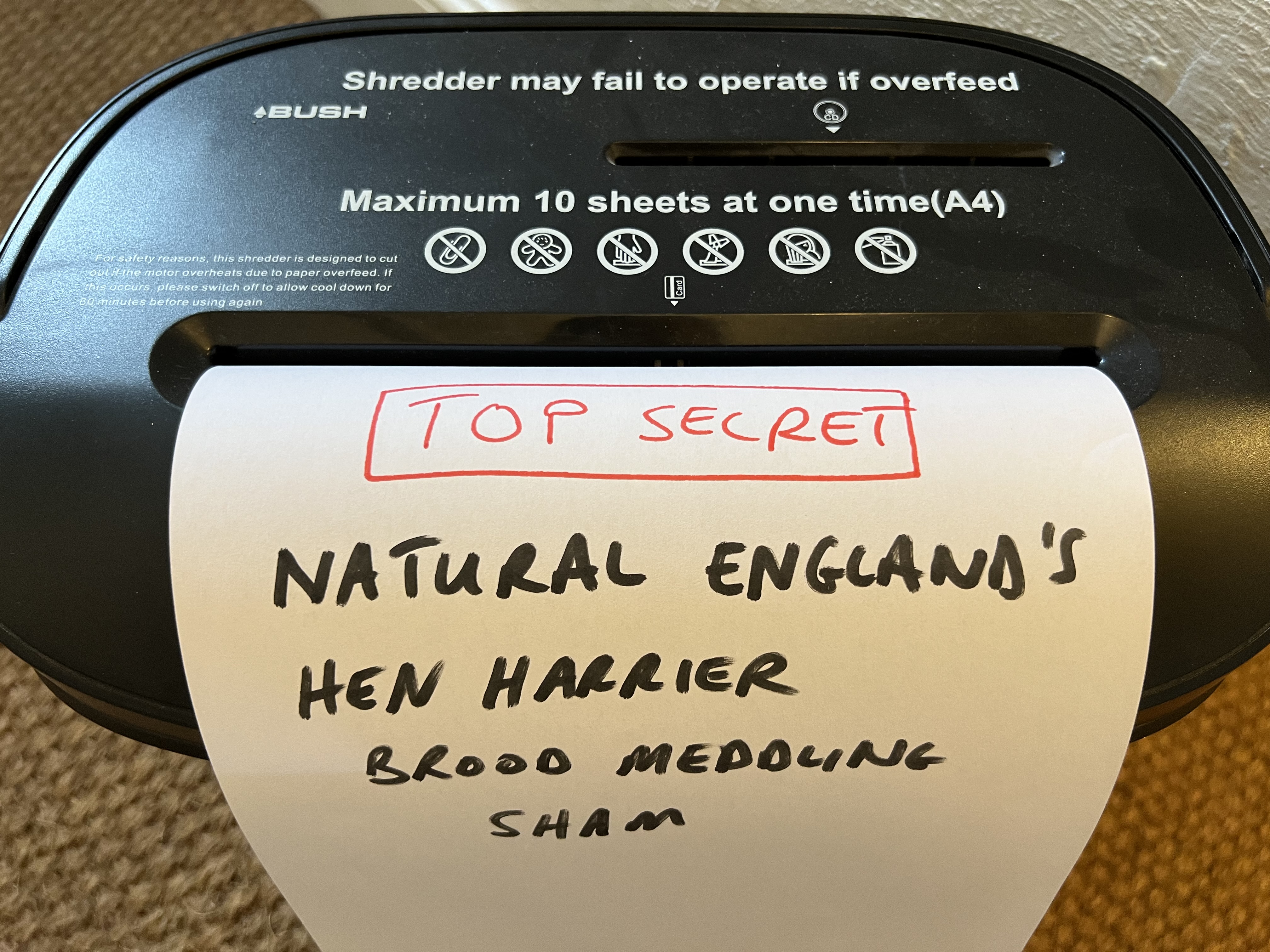
For several months now I’ve been waiting for Natural England to respond to a number of Freedom of Information/Environmental Information Regulation requests that all relate to the hen harrier brood meddling ‘scientific trial’.
For new blog readers, hen harrier brood meddling is a conservation sham sanctioned by DEFRA as part of its ludicrous ‘Hen Harrier Action Plan‘ and carried out by Natural England, in cahoots with the very industry responsible for the species’ catastrophic decline in England. In general terms, the plan involves the removal of hen harrier chicks and eggs from grouse moors, their rearing in captivity, then their release back into the uplands just in time for the start of the grouse-shooting season where they’ll be illegally killed. It’s plainly bonkers. For more background see here.
The information requests I made are related to Natural England’s questionable decision to extend the brood meddling ‘trial’ this year (see here) and the questions are all pretty straight forward, I think. If this so-called ‘scientific trial’ was being managed properly, the information I requested should have been readily available.
Apparently not! I wonder what it is that Natural England is so reluctant to reveal?
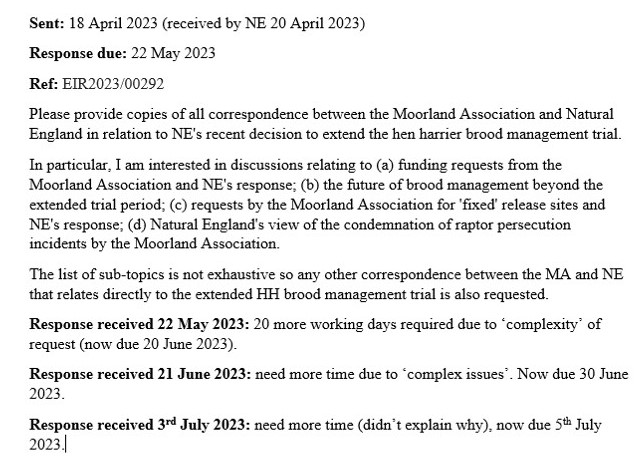
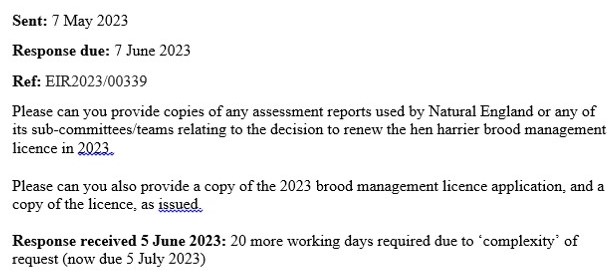
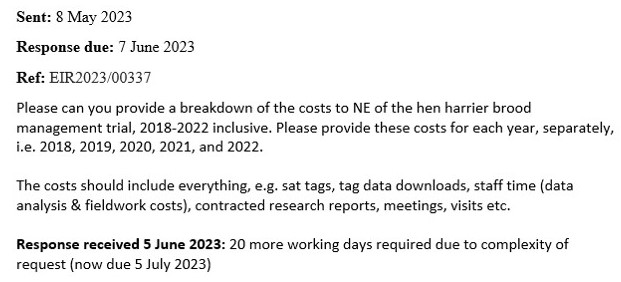
Here are the requests and Natural England’s responses, to date:
So far Natural England has had 51 working days to respond to this request and has missed four deadlines. The most recent deadline (yesterday) passed without any form of communication or explanation from Natural England. I’ve written, again, this morning, to chase up.
So far Natural England has had 40 working days to respond to this request and has missed two deadlines. The most recent deadline (yesterday) passed without any form of communication or explanation from Natural England. I’ve written, again, this morning, to chase up.
So far Natural England has had 40 working days to respond to this request and has missed two deadlines. The most recent deadline (yesterday) passed without any form of communication or explanation from Natural England. I’ve written, again, this morning, to chase up.
Press release from League Against Cruel Sports (27th June 2023):
CELEBRATIONS OUTSIDE THE SENEDD AS WALES BANS BRUTAL WILDLIFE TRAPS
Members of the Senedd joined animal welfare campaigners from the League Against Cruel Sports this evening to celebrate a historic vote to ban snares in Wales.
It followed the unanimous passing of the Agriculture (Wales) Bill in the Senedd earlier today which contained measures to outlaw these cruel and indiscriminate wildlife traps.
Will Morton, head of public affairs at the League Against Cruel Sports, said:
“The Welsh Government deserves huge credit for banning snares, inherently inhumane traps, which are completely incompatible with high animal welfare standards.
“Wales is leading the way in protecting wildlife from cruelty and we’re calling on the UK and Scottish Governments to follow their lead and ban these brutal devices.”
The attendees included 13 members of the Senedd as well as animal welfare campaigners from across Wales.
Up to 51,000 snares lie hidden in the countryside at any one time according to UK government figures. Defra figures
They are used predominantly by shooting industry gamekeepers on pheasant and partridge shoots to trap wildlife.
The same Defra research show almost three quarters of the animals caught are not the intended target species. So, this will include hares, badgers and people’s pets.
This snared badger found in Wales suffered for several days and had to be euthanised due to the extent of her injuries. Photo: RSPCA
Polling carried out by YouGov in Wales in January 2021 showed 78 per cent of the Welsh public wanted snares to be made illegal.
The ban will come into force two months after receiving royal assent so snares should become illegal in Wales later this year.
Will Morton added: “Today we are celebrating the move to end the cruelty inflicted on animals by the use of barbaric snares, something that will have the support of the vast majority of the Welsh people.
“It’s a fantastic move for animal welfare and we look forward to snares being banned in the rest of the UK soon.”
ENDS
As many of you will know, the Scottish Government is currently considering a ban on snares as part of its Wildlife Management and Muirburn (Scotland) Bill.
In December 2022 the Scottish Animal Welfare Commission recommended that ‘the sale of snares and their use by both public and industry are banned in Scotland, on animal welfare grounds‘ (see here). As part of that report, evidence provided by the Scottish SPCA demonstrated that 75% of tagged snares were set illegally but even legally-set snares caused catastrophic injuries to both target and non-target species (see here).
In April 2023, Scottish charity OneKind published a new report also exposing the cruelty of snares and called for a complete ban (see here).
Some evidence on snaring has been heard by the Scottish Parliament’s Rural Affairs & Islands Committee as part of their Stage 1 scrutiny of the Wildlife Management & Muirburn (Scotland) Bill but the Government’s provisions won’t be heard until the Bill reaches Stage 2 in the autumn.
During the evidence session, discussion centred on a new type of snare, cynically called a ‘Humane Cable Restraint’. However, as OneKind’s Policy Officer, Kirsty Jenkins points out (here), “There is no design alteration or method of use that can make snares humane – the fundamentals of the method cause suffering“.
Chairman of the Scottish Gamekeepers Association (SGA), Alex Hogg, gave evidence at Stage 1 of the Bill and claimed that the new snare design is “almost like a dog collar” (see here), implying that its use doesn’t cause the snared animal any suffering.
Interestingly, he used a similar analogy in another Parliamentary committee evidence session back in 2010 when the Wildlife & Natural Environment (Scotland) Bill was under consideration, including an option to ban snaring. Here’s what he had to say about snaring then:
“Those snares are set at certain times of the year to try to protect ground-nesting birds and lambs from foxes. Nine times out of 10, the animal will go into the snare in the hours of darkness. When it enters the snare, its instinct is to lie like a dog or hide, especially in the hours of darkness. When we check our snares first thing in the morning, which we normally do—we have a snaring round; we check the snares at daylight and onwards through to breakfast time—we will dispatch the animals that have been held in them. The snare must close to a certain tightness to be able to hold the animal. The old-fashioned snares locked, so the tighter they got, the more the animal was strangled. However, the snares that we now have are non-locking; they can slip back again. They will hold the animal in the same way as a choke lead on a dog that is pulling too hard” (see here).
Presumably these non-locking snares that Alex implied were virtually harmless are the same snares that the SGA are now calling to be phased out on welfare grounds?!
During the most recent evidence sessions scrutinising the Wildlife Management & Muirburn (Scotland) Bill, Alex Hogg also refers to the new, so-called Humane Cable Restraint (i.e. the ones that the Scottish Animal Welfare Commission recommends are banned) as follows:
“The other important thing that I forgot to say was that scientists are using them. They are using them to catch foxes, tag them with radio collars then let them go. That proves to me that the fox has never been damaged” (see here).
I’ve heard this justification for snare use several times, and I’m aware that the GWCT has been using snares to trap foxes so that radio collars can be fitted before the fox is then released, but so far I’ve been unable to find any peer-reviewed scientific paper referring to the snaring method used. I’d be utterly amazed if the approved scientific method used by the GWCT involved leaving the snared fox for up to 24 hours before attending to it, as a gamekeeper is permitted. Any ethical committee overseeing this research method would undoubtedly raise an objection, so Alex’s comparison is somewhat disingenuous, in my opinion.
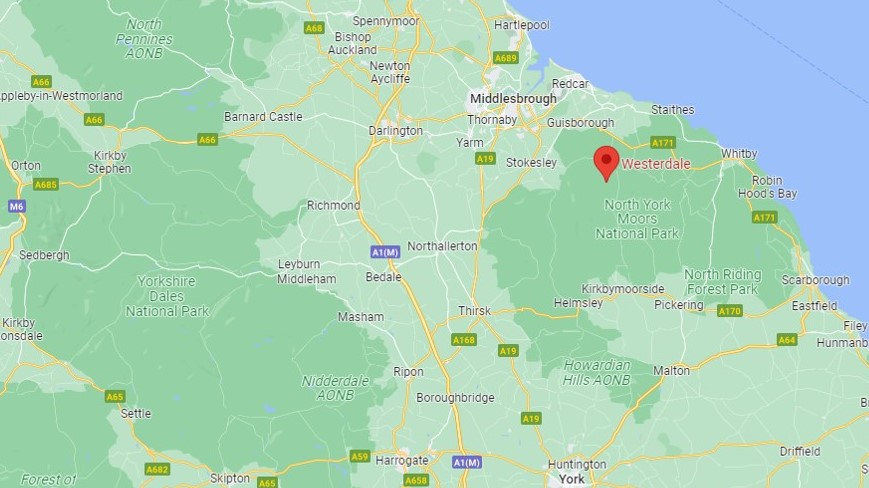
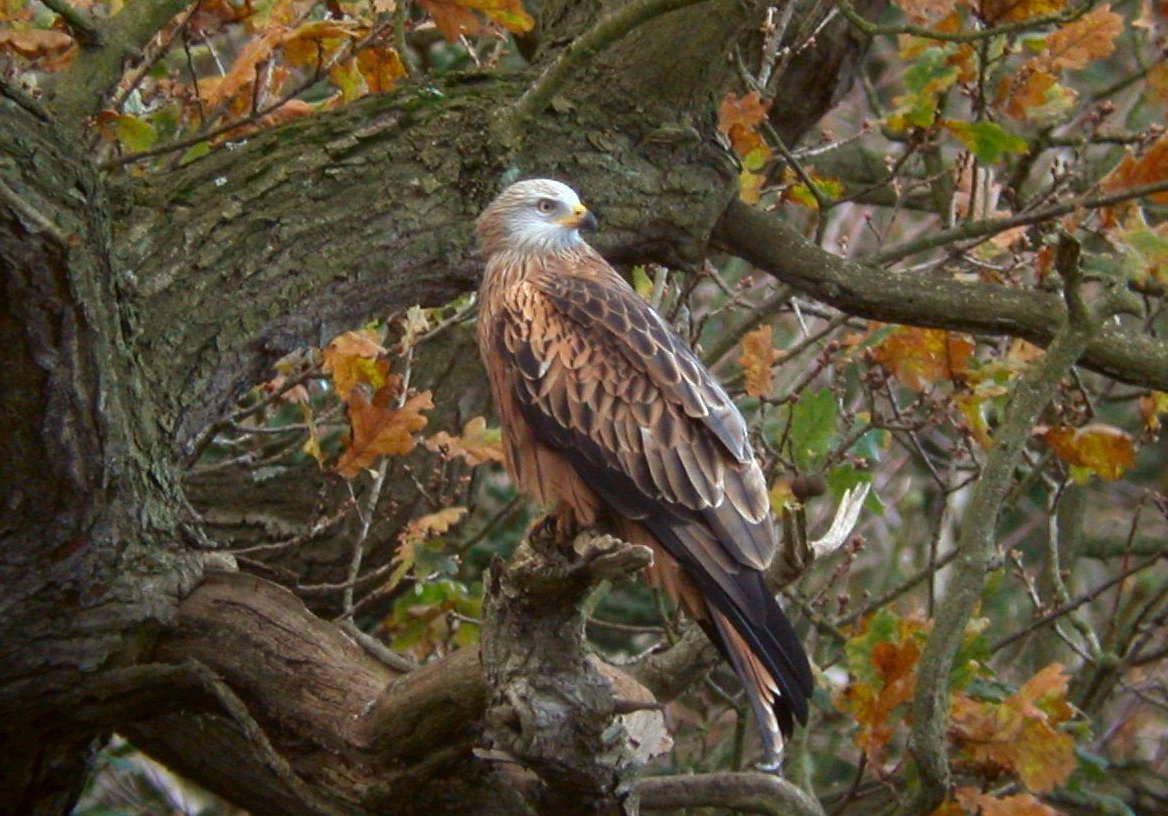
A couple of weeks ago, North Yorkshire Police appealed for information after a red kite was found with shotgun injuries near Westerdale in the North York Moors National Park on 13th June 2023. It didn’t survive (see here).
Red kite. Photo by Ben Hall (RSPB Images)
Today, North Yorkshire Police has issued another appeal for information after the discovery on 26th June 2023 of a second shot kite in the same area (which also didn’t survive its injuries) and suspicions that a third kite has also been shot, based on photographs taken on 23rd June 2023 provided to the police by walkers.
The appeal for information by North Yorkshire Police’s Rural Task Force is a bit bizarre, to say the least. Here it is:
NORTH YORK MOORS: APPEAL FOR INFORMATION ABOUT THE SHOOTING OF A RED KITE
North Yorkshire Police’s Rural Task Force is appealing for witnesses and information about the shooting of a Red Kite on the North York Moors near Westerdale.
The Red Kite, suffering with gunshot wounds, was found by a local farmer at 9.30pm on Monday 26 June in Westerdale. Sadly, despite being taken to a vet it did not survive its injuries.
This incident follows another recent shooting of a Red Kite in the area on Tuesday 13 June. North Yorkshire Police have also received information that there may be a third injured Red Kite, photographed by walkers on Friday 23 June, on the opposite side of the valley.
We believe that these incidents are linked. This disturbing criminal behaviour and persecution of innocent birds of prey will not be tolerated and must cease immediately.
Police are renewing their appeal for any information in relation to raptor persecution. Anyone with information that could assist our investigation should email Jack.donaldson@northyorkshire.police.uk
If you spot a dead or injured bird, poisoned bait or a pole trap, please note the location, take a photo and call North Yorkshire Police on 101 to report it.
If you wish to remain anonymous, you can pass information to Crimestoppers on 0800 555 111.
Please quote police reference 12230107850 when passing on information.
Red kites were saved from national extinction by one of the world’s longest-running protection programmes and have been successfully reintroduced to England and Scotland. Red kites are listed under Schedule 1 of The Wildlife and Countryside Act.
North Yorkshire Police in collaboration with the British Association of Shooting and Conservation (BASC), Countryside Alliance, Moorland Association and the National Gamekeepers Association take a zero-tolerance approach to raptor persecution. All agencies agree that ‘there is no excuse for illegally killing of any bird of prey and unreservedly condemn all such acts. Any individual convicted of a crime against a bird of prey will be expelled from the organisation’.
Police are aware that local gamekeepers will come under suspicion, however we will investigate with an open mind, gathering information from a variety of sources, and not be led by assumptions.
In response to the ongoing persecution against birds of prey in the North Yorkshire Moors, North Yorkshire Police Rural Taskforce Officers have increased marked and unmarked patrols in target areas to protect wildlife and deter offenders.
ENDS
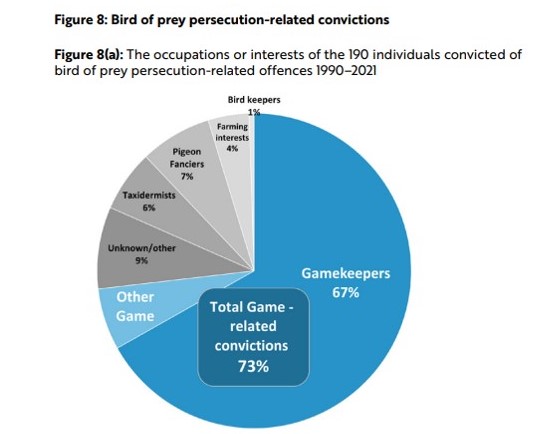
This looks very much like North Yorkshire Police has been ‘got at’ by the shooting lobby. How else do you explain the police including what is blatant propaganda in their own press release, from an industry responsible for the vast majority of raptor persecution crimes?!
Data from the RSPB’s latest Birdcrime Report
How many members of the public are wandering around this grouse-moor dominated landscape with shotguns, taking pot shots at birds of prey?
How many members of North Yorkshire Police’s Rural Taskforce have links to the game-shooting industry?
Meanwhile, supposedly protected birds of prey continue to be targeted and killed in what is supposed to be a National Park.
UPDATE 7th July 2023: Red kite shootings: statement from North York Moors National Park (here)
UPDATE 9th October 2023: Buzzard shot & critically injured in North York Moors National Park (here)
Last month, Police Scotland and the Scottish SPCA issued an appeal for information in relation to the discovery of a critically-injured red kite near Closeburn in Dumfries & Galloway on 5th June 2023 (see here).
The kite’s injuries were so severe it had to be euthanised, and the Police/SSPCA were keen to trace the man who had handed in the kite.
Red kite. Photo by Doug Simpson
In an update published on the BBC News website (here) it is reported that this kite had suffered gunshot injuries.
It’s also reported that the person who handed in the injured kite has now been traced and inquiries are ongoing.
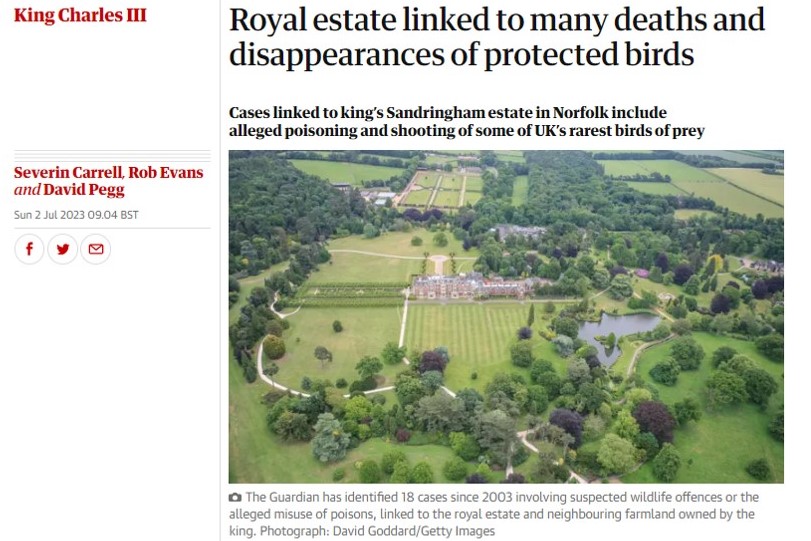
The Royal’s Sandringham Estate and surrounding farmland in Norfolk has been frequently linked to the alleged deaths and disappearances of birds of prey over the years (see here for previous blog).
Today, journalists from The Guardian have published even more alleged incidents, not previously reported.
Today’s article (here), which identifies 18 reported cases since 2003, is the result of detailed investigative work undertaken by Severin Carrell, Rob Evans and David Pegg and includes some fascinating FoI documents.
Press release from North Yorkshire Police (30 June 2023):
MAN SENTENCED AFTER DEATH OF BARN OWL NEAR SCARBOROUGH
A man has been sentenced after the death of an owl that was trapped on an allotment plot in Hunmanby.
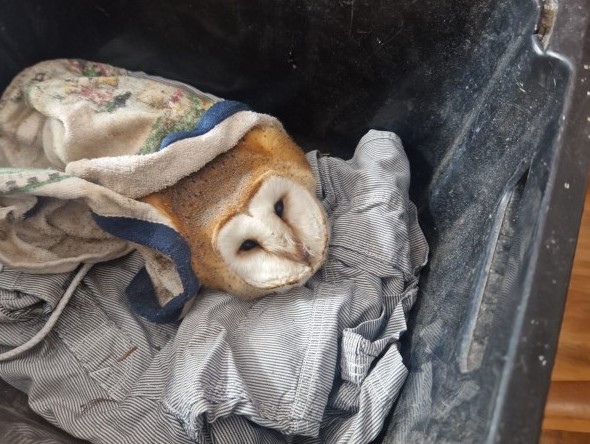
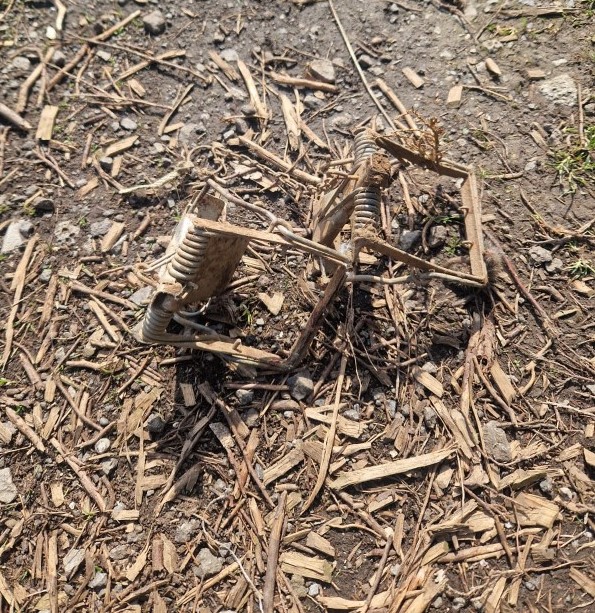
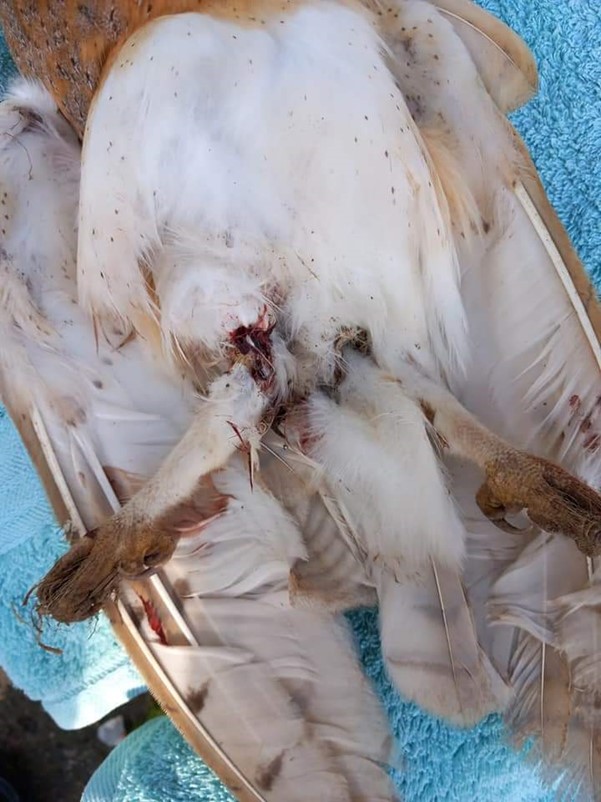
On 8 April 2023, a dog walker discovered a badly-injured adult Barn Owl caught in a spring-operated trap in the allotments at Sands Lane, Hunmanby. Despite the bird being rescued and taken to a vet, the injuries to its legs were so severe that it had to be euthanized.
When spoken to by police, the tenant of the plot, Leslie Shooter, 57, stated that he had set a number of traps to control rats. However, he had not covered the traps as required by law, resulting in the trapping of the bird.
Barn Owls are particularly susceptible to disturbance and human interference. They are listed under Schedule 1 of the Wildlife and Countryside Act 1981, giving them legal protection. The species is also an early breeder, with a typical season being March to September, so any issues affecting adult breeding birds during this time brings additional risks to dependant eggs and young.
Spring-operated traps, often referred to as ‘Fenn’ traps, can be legally operated in the UK, but their use and target species is strictly controlled by legislation. Potential offences include use whilst uncovered, neglect in checking and use to capture wild birds.
Following an investigation by North Yorkshire Police, Shooter was charged with using an animal trap in circumstances for which it is not approved, causing a trap to be set to cause injury to a wild bird and causing unnecessary suffering to a protected animal.
After pleading guilty at Scarborough Magistrates Court on 29 June 2023, Shooter was sentenced to a community order with 100 hours’ unpaid work requirement, as well as £199 of costs and surcharges.
PC Graham Bilton, Wildlife Crime Officer for North Yorkshire Police, who investigated the incident alongside the RSPCA, said: “Raptor persecution is a national wildlife priority but unfortunately despite the legal protection offered to these birds it continues to be a problem throughout the UK.
“The incident in question, which resulted in the tragic death of the barn owl, could have been avoided had the defendant used the traps in a responsible and lawful way.”
Geoff Edmond, RSPCA Inspectorate Wildlife Lead, said: “This has been a very distressing incident and I would like to thank the member of the public who took this Barn Owl to the vet even though sadly – due to its horrific injuries – it could not be saved.
“I believe this incident will have caused upset and concern for the community of Hunmanby, many of whom will have enjoyed watching this Barn Owl.
“By correct training in and knowledge of the use of this trap, this death should not have occurred. I would urge anyone using traps to ensure they are fully conversant with the legislation surrounding them.
“I am grateful that the RSPCA continues to work in partnership with North Yorkshire Police to tackle wildlife and rural crime.”
Mark Thomas, RSPB Head of Investigations, added: “Raptor persecution is a national issue, impacting on a range of threatened species including public favourites like the Barn Owl, which in this case was inexcusably trapped in a heinous manner. Our thanks go to North Yorkshire Police for bringing this case to justice and highlighting the issue.”






 Raptor Persecution UK