
Press release from conservation campaign group Wild Justice (25th July 2023):
A SIGHT FOR SORE SSSIs: Protected areas in England are in a worse state than previously thought
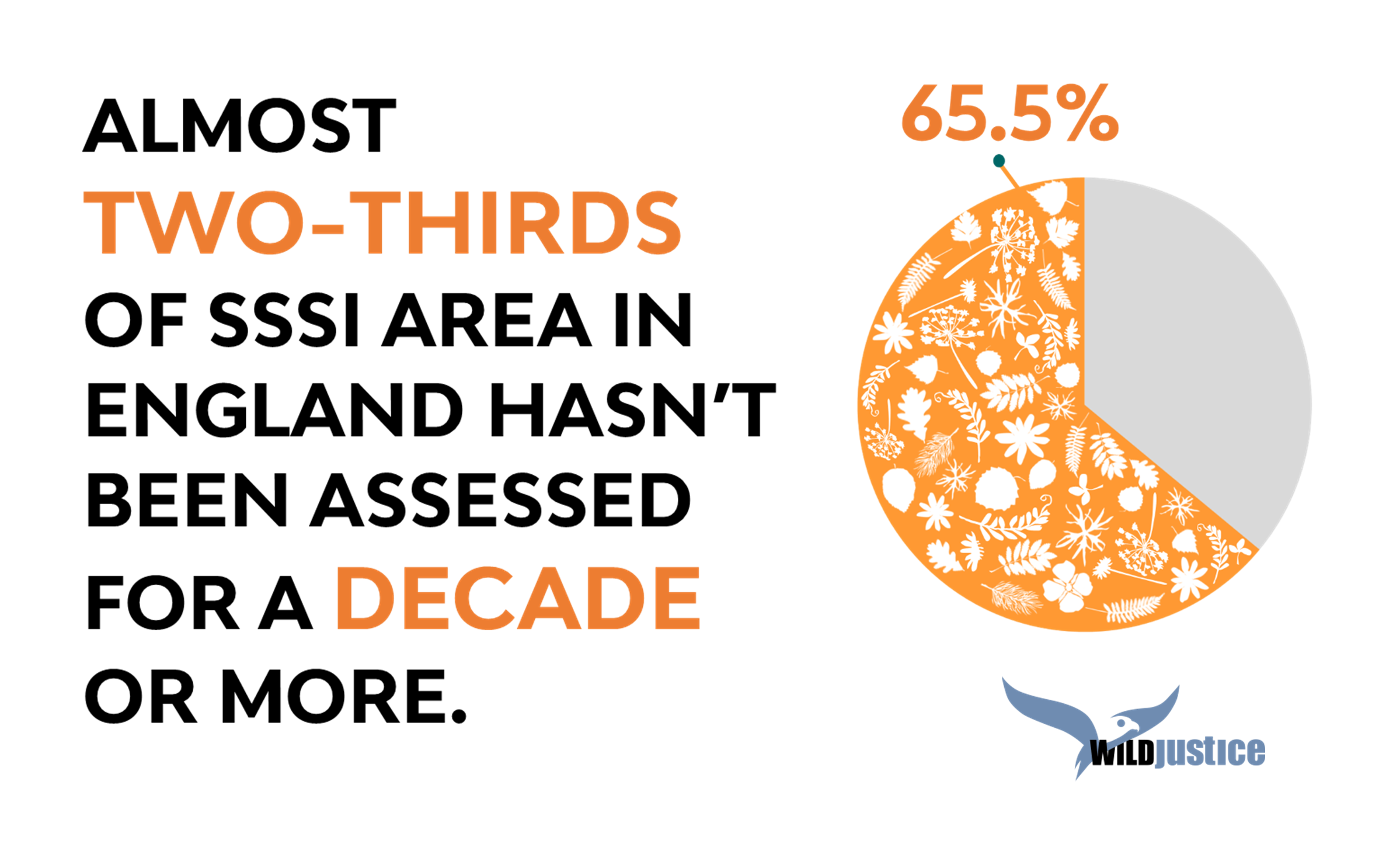
A majority of English Sites of Special Scientific Interest haven’t been assessed by Natural England for over a decade, and are thought to be in a worse condition than currently reported.
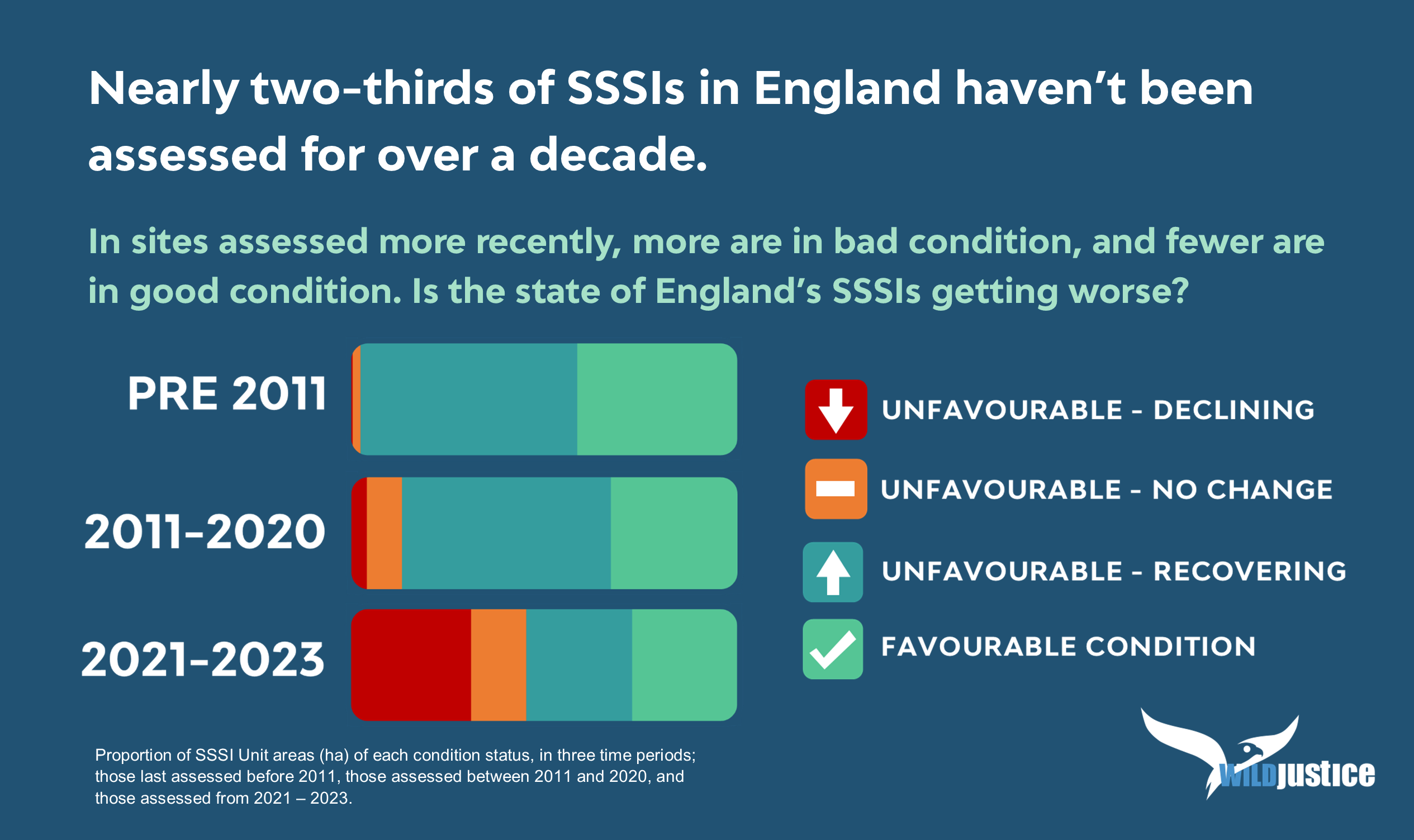
- An up-to-date analysis of Natural England’s data on SSSI condition shows that SSSI condition is worse than the latest Defra published figures. Sites assessed more recently have a lower percentage deemed to be in a good or improving condition, and a higher percentage deemed to be in a bad or worsening condition than those assessed longer ago.
- Two-thirds of Sites of Special Scientific Interest in England haven’t been assessed in more than a decade. Over 80% of sites haven’t been assessed for five years or more.
- A report by Wild Justice predicts that if the backlog of condition assessments were to be rapidly updated, English SSSIs would be shown to be in a worse state than current estimates admit.

Some of England’s most protected areas are likely to be in a worse state than currently reported, according to up-to-date analysis carried out by Wild Justice. The ‘Sight for Sore SSSIs’ report [linked at foot of blog] looked at when Sites of Special Scientific Interest (SSSIs) in England were last assessed, and revealed that the majority haven’t been evaluated in over a decade. Analysis of the most recently assessed sites suggests the overall condition of SSSIs is likely to be worse than Defra’s current figures show.
SSSIs are areas of land designated for their wildlife and biological value. Over 4,000 of the UKs 7,000 SSSIs are found in England. These places often contain rare habitats and species, and are therefore protected from development or certain activities or management. Their condition, or ‘status’ should be regularly assessed by Natural England to determine any changes in land management that might be needed to maintain or improve a site. Each SSSI is made up of between 1 and dozens of Units, each of which has been assessed as to its condition at some point since it was designated. A Unit’s condition can be classified in one of six ways; Favourable, Unfavourable – Recovering, Unfavourable – No Change, Unfavourable – Declining, Part Destroyed and Destroyed.
According to data acquired by Wild Justice, an organisation campaigning on wildlife issues in the UK, current estimates of English SSSI condition are likely to be inaccurate. This is because the time elapsed since the last assessment of any particular site, and the potential for that site to have changed during that time, isn’t taken into account when the figures for SSSI condition are provided by Defra. Wild Justice argues that if a protected meadow hasn’t been monitored for ten years, it’s quite possible that management or environmental factors could have affected the site’s condition during that decade.
The figures analysed by Wild Justice seem to support this idea. In site units last assessed over a decade ago, the proportion of ‘Favourable’, or ‘Unfavourable – Recovering’ sites are higher than site units assessed in the past few years. A similar effect can be seen with ‘Unfavourable – No Change’, and ‘Unfavourable – Declining’ sites; with higher percentages of these statuses in more recently assessed site units. This implies that as site assessments are brought up to date, the proportion of higher quality sites is revealed to be less, and the proportion of lower quality sites is revealed to be higher than it appears at first glance.
Mark Avery, Co-Director of Wild Justice said:
“It seems that most of our English SSSIs have been neglected when it comes to monitoring their condition. The fact that two-thirds of these special places haven’t been looked at in over 10 years by Natural England is troubling and disappointing. Especially as it looks like our most special areas are being damaged, and the public are none-the-wiser. The system has fallen into disrepair and we can have little faith in the published Defra figures on some of our most protected areas.”
Off the back of this analysis, Wild Justice are calling for Defra and Natural England to publish annual updates on the condition of English SSSIs, as well as their date of last assessment. Wild Justice believes a rapid catch-up needs to be prioritised in the next few years, setting a new standard of 80% of English SSSI Units having had their condition assessed in the last 5 years. Natural England should carry out an urgent review of the resources needed to ensure that English SSSIs are in Favourable condition.
ENDS
Wild Justice’s report can be read/downloaded here:
 Raptor Persecution UK
Similar story in Wales – sites with SSSI status going to rack and ruin. Overgrazed, undergrazed, total neglect.
If the word ‘protected’ meant anything atall then literally tens of thousands of ‘protected’ badgers would not have been slaughtered just to (falsely) pacify farmers who (incorrectly) believe they are solely responsible for the spread of BTB. The word like many others implemented by a useless and out of touch administration is solely designed to shut people up. Bit like signing petitions that change absolutely nothing…ever. !
Anyone surprised by this report must have been living in a bubble for a very long time. Admittedly there has been a lot for the country to cope with but one would have thought this was why there are so many different departments in government but we all should know this government only cares about money the environment never enters its head and I for one especially after hearing the labour leaders comments about tree huggers do not think Labour will do any better.I don’t hug trees myself most of the ones I see are too dirty from all the shite in the atmosphere.
The Government’s Green Facade falls apart and as both Parties distance themselves previously promised developments the pre-planned fraud is exposed as SSSi’s, join sewage, housing, transport and the rest of the neglected infrastructure.
Yes, a lot has gone on but this Government showed its true colours literally from day one – when it abolished the Sustainable Development Commission and a raft of other environmental measures including the England Tree Strategy I led. It went on to slash Natural England and nothing much has changed since as we go through endless will-they-won’t-they remove the protections to wildlife under the EU Directives. Lost in the mists of time – but not in the Wild Justice graphics – is the real and serious drive the Labour Government made right up to 2010 to get our SSSIs back on track – and it tipped many from unfavourable to unfavourable recovering and on track to favourable. All that went in one day and we have lived through over a decade of Government greenwash – which unbelievably has been far too effective, sucking in our conservation organisations and fooling far too many.
Good Old English Nature. 100% on the job. And some sarcastic folk say they are not worth the money.
Good old Tony the Tory Juniper
Natural England’s planned budget for 2022-23 (published 27th July 2022) is £261.6 million, which represented a 34% increase over 2021-22.
From the Natural England action plan 2022-23…
Natural England say one of their five 2022-23 progress Indicators is: “Improve confidence in our sites of special scientific interest (SSSIs) data and information to support delivery of the 25 Year Environment Plan goal to get 75% of SSSIs into favourable condition.”
Their High-Level programme outcomes for 2022-23 include: “a new approach to improving the condition of SSSIs” and “increase focus on improving the condition of Natural England managed sites of special scientific interest (SSSIs)”, while on SSSI regulation and enforcement: “implement recommendations to improve delivery of protected sites casework” but just £4 million is allocated for that.
There is a Parliamentary e-petition “Increase Natural England’s budget to £1 billion” which was started 18th May 2023. It has (at the time of writing) just 30 signatures! (And quite a few of those are from Wales and Scotland!)
See https://petition.parliament.uk/petitions/637828
30!
Great petition. People please sign the petition. I’ve just made the total signatures to 34! Please just act. Thanks.
I have increased the number of signatures to 35!
But even if the petition reaches sufficient numbers for a debate in parliament – I don’t see this current government or any other government formed by one of the other major parties, will really put protecting nature and the environment at the heart of their policies.
The climate emergency agenda has been going on long enough now for this current government to start to implement all the promises it has made – the last I heard was that very little of substance had actually been done!
If politicians can’t even get their act together to implement meaningful action to start to tackle something that will have as serious consequences as global warming, then it is very doubtful they will increase funding to enable NE to actually protect nature and the countryside – something which outside this forum and other similar conservation forums, is something the vast majority of the population really don’t care about, especially if it impacts on peoples ability to continue with their high consumption lifestyles !!!
For example – how many people are actually prepared to put their hands in their pockets and buy high welfare, environmentally responsible British farm produce when at the supermarket all they want is the cheapest price for goods in their shopping basket ! Many motorists want to drive big SUV’s rather than a smaller car, which has better environmental credentials to both produce and use.
Are enough questions being asked about how all the precious metals required for electrification will be sourced? There is a serious risk that the government could permit deep sea mining which will cause unknown damage to the oceans.
Politicians simply play for the votes – and so will implement policies which get them votes -so it is doubtful increasing funding for nature is high on their list of priorities!
But it’s worth signing the petition in the hope that it does reach enough signatures to cause parliament to have to debate how tax payers is spent. If NE were better funded they may be more inclined to take on the vested interests operating in the countryside?
And if you aren’t aware of the risks of deep sea mining please do a bit of research- Greenpeace seem to be championing this cause to try and alert people to the dangers this new dirty industry could cause.
Well done to Wild Justice, exposing more ineptitude from Unnatural England.
I wish all UK wildlife NGOS would merge into a single super NGO and then take over from statutory provision.
The latter continues to fail our beleaguered wildlife.
Are they really protected now? ACW.
Is it possible these are being run down as that they can remove the SSSI status which would allow the Tory property developer friends to move in? They are already building on green belt land. I have seen building of whole villages going on in Wiltshire as well as numerous housing developments. These are all on green belt land. Is anything safe under this government of spivs and crooks?
I’ve signed.
Greencroft Heath, County Durham, continually the object of arson attacks. Who assesses?