
10 million blog views feels like a significant milestone.
Many thanks to all the friends, colleagues, collaborators, supporters, followers, commentators and funders, who make this worthwhile.
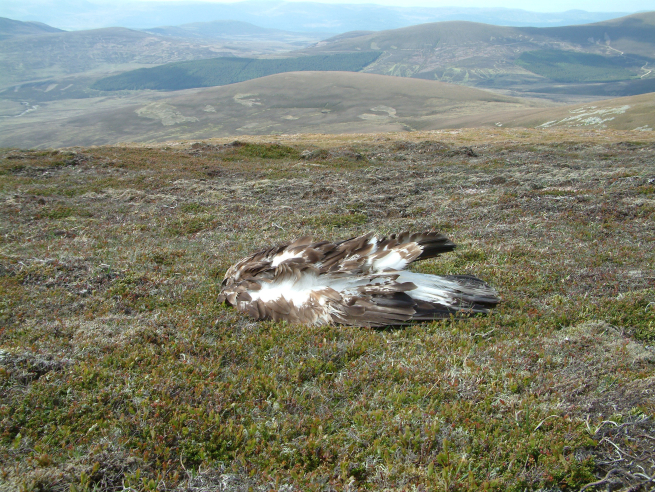
Here’s the photograph that I publish every time a new milestone is reached. This is a golden eagle that was found dead on a grouse moor in the Cairngorms National Park in 2006. It had been illegally poisoned. It epitomises everything in its pitiful, poignant, senselessness.
Unfortunately there is still a lot more work to do, as evidenced by the recent discovery of two young white-tailed eagles found poisoned on a grouse moor in Northern Ireland in May 2023:

The illegal killing of birds of prey in the UK continues and so must this blog. It can often feel like no progress is being made, but it is, albeit more slowly than any of us would like.
I read a report over the weekend where representatives of the game-shooting industry said they felt ‘under siege’ from campaigners. That’s good, some of them have been allowed to get away with far too much for far too long, often assisted and shielded by the very authorities who should be holding them to account.
Change will only come when enough of us demand it.
Onwards!
 Raptor Persecution UK
I mostly just scan the emails, maybe go on to the blog one time in 3. So there are possibly lots more followers than the 10 million mentioned.
It’s terrible that people still want to kill birds and raptors. And worst of all when some of the deaths occur on royal estates; what sort of example is that setting for game keepers and the like?
A wish a could do more,
Just another dig at country ways of life are you sure you antis didn’t kill a bird of prey an deliberately place it on a particular grouse Moor in order to strengthen your cause .
“Just another dig at country ways of life…”
Surely a typo there, you clearly mean ‘country ways of death…’
“are you sure you antis didn’t kill a bird of prey an deliberately place it on a particular grouse Moor in order to strengthen your cause .”
The Police don’t think so. All the convictions are of gamekeepers.
Not one of you bullshit merchants represent real country people. You’re fake, through and through.
….what’s a real country person then coops??
A fair question…
In the context of my statement, “The Countryside” is an artificial construct, behind which those who are incapable of providing any intelligent argument in defence of their pastimes, hide; much the same way that fascists masquerade as patriots. My point is that, despite all the whining and victimhood of the self-styled “countryside lobby” rural dwellers are not defined by the recreational abuse of wild animals, and many of those who indulge in “country pursuits” actually live in the heart of cities and towns. There are many serious issues affecting rural areas, but the sheer dishonesty of those like Mr McHugh (who are only truly concerned with protecting their own narrow interests) only serves to divert attention and lessen public sympathy.
So (although I freely admit to subjectivity) “real” country people don’t pollute the soil with thousands of tonnes of lead each year, or dump millions of non-native “gamebirds” into our ecosystems, to the detriment of native species.
Nor do they leave poison baits in the open, which endanger not only supposedly protected species, but also pets and local people, including, of course, their children.
They don’t betray the communities which they pretend to represent by exacerbating the effects of flooding in areas like Hebden Bridge.
They don’t fill the air, which local people breathe, with smoke and particulate matter for days on end, by setting fire to our uplands.
They don’t damage ecosystems, by removing vital components such as native predators (either legally or illegally).
They don’t set illegal traps, which cause untold suffering.
In short, they cherish the environment in which they live, including it’s wildlife and people.
…..thankyou…that’s a very detailed and very thought provoking reply! I totally agree with what you say…but I could never have explained it like that!!
Personally, I think it’s a bit of a dog’s breakfast. But in my defence, it was late, and I was distracted by the Police raiding my inner-city crackhouse!
The majority of grouse moors have moor in common with Gordon Gekko and Threadneedle Street than any “country ways”. People need to give up on the idea of grouse moors as a bucolic fantasy land, populated by the likes of Seth Armstrong pottering about with his old s/s in the crook of his arm. Such places are few and far between in the real world.
The antis then gave the eagle to anti windfarm campaigners to place beneath turbines. When not in use it’s kept frozen and is brought out every so often to be photographed on a grouse moor of the antis choosing.
So many thanks for all you have done and continue to do Ruth. Not sure that congratulations is the right word, I’m sure you would prefer to be putting your skills to other uses, but boy, are you needed!
Enough of us will demand change when enough of us know what’s going on. In a better, fairer world, the media would be crawling all over your blog and publicising your work. Somehow we must find a way to counter vested interest.
I feel the RSPB is slowly waking up to the fact that this subject won’t alienate their members but actually enrage them. More articles please RSBP.
One day 10 million views will become 10 million knowledgable people. Then we win.
Again Ruth, thank you.
Great work – keep up the fight.
Thank you for your excellent blog and for keeping us informed on what is going on with raptor persecution. It must be so frustrating and soul destroying at times, but what you are doing is so important. It is really appreciated.
Congratulations on reaching this milestone. It must be a sign that the hard work is worthwhile. I guess that readers will be distressed that that the persecution is still happening, but if we work together it will stop. The tide is turning.
Can I add my thanks for the blog and the information contained within it. It is invaluable and very educational. One day all your efforts will be rewarded, Ruth!
Fantastic, I hope you can keep it up. 👍
10 million – a tremendous achievement. Ruth, you are an absolute hero! Heartfelt thanks for all the meticulous and painstaking work that you do – long may it continue.
Hi Ruth, the work you do is unbelievable, dedication and commitment every day without respite. Truly admirable and long may it continue from yourself, your successors and all of the rest of us until this scourge is a thing of the past.
(ps send us a happy picture of celebration as well as a dreadfully sad one? Thanks again)
Ian
Hi Marian
I’ve signed up to this organisation. These shooting estates should be prosecuted and named and shamed for killing these amazing raptors. It’s all to protect the shooting interests.
More heartache !
Take care.
Sharon
Heartfelt thanks for your tireless efforts. Without the blog we would be nowhere. This killing of raptors must stop, it simply must, it cannot go on, we’re in a raging storm that must subside, we all need your effort. Many thanks.
Fantastic Ruth, if everyone keeps the pressure hopefully people will see sense good will prevail hopefully these perpetrators have poisoned themselves and there industry, and shot themselves in the foot !!
Poignant pictures but very sad we need to see these birds soaring safely and beautiful these past few weeks have been very emotional and harrowing for decent folk well done again everyone.
Many thanks for all your hard work, Ruth putting these blogs together.
It must be absolutely heart wrenching most of the time with the deplorable stories you publish about the cruelty to our wildlife and especially our majestic raptors.
Hopefully and eventually there will be enough support and outrage that our pathetic government will have to take serious action against these shooting estates. There are far too many coincidences for them to say it has nothing to do with them
Thank you for all your hard work. It is very sad that it is necessary.
Many thanks for all your hard work, Ruth putting these blogs together.
It must be absolutely heart wrenching most of the time with the deplorable stories you publish about the cruelty to our wildlife and especially our majestic raptors.
Hopefully and eventually there will be enough support and outrage that our pathetic government will have to take serious action against these shooting estates. There are far too many coincidences for them to say it has nothing to do with them
A Brief Review of the Position of Raptors in Scotland
I have looked at the RSPB Report on raptors. I have never been convinced that legislation to protect birds was in any way effective in actually protecting them.
Gamekeepers have been convicted, but not their employers. I have never heard of any instance of a employer sacking a gamekeeper as result of a conviction for criminal activity carried out during the course of their employment.
While the reasonable approach of applying the principle of vicarious liability seems to be appropriate, it is not often used.
Landowners seem to be Teflon figures, untouchable by reason of claims of ignorance and by reason of their position in society.
A video that shows a bird killer in flagrante was ruled as inadmissible as evidence as a result of some abstruse legal argument. Had the video recorded the murder of a person, would the same argument have been accepted?
Click to access Link_Wildlife_Crime_Sentencing_Briefing_02062017.pdf
The conclusion reached in the report is that we cannot effectively protect our natural heritage and that birds are fair game for anyone.
How may that be changed?
Let’s look at some possibilities.
Sanctions. Typically those caught killing a protected bird are fined quite small amounts, in the £1000 – £5000 range. A significant amount for a gamekeeper to be sure.
However, the red kites in Galloway are said to be worth £7m a year to the economy. There are 200 red kites. Each one is worth £7m/200, or £35,000 a year to the economy. As red kites live for an average of ten years, the loss to the economy may be said to be £350,000 per bird.
It would seem fair to make that the minimum fine for a bird of prey, with an additional punishment fine of £5000 in addition.
(As the EU has apparently set limits on such fines, it would seem that UK birdlife will benefit from Brexit.)
The average fine is quite low, less than £1400. In the context of kites, eagles and sea eagles whose value I assess elsewhere as upwards of £300,000 per bird it is trivial.
https://www.gov.scot/publications/wildlife-crime-penalties-review-group-report/pages/7/
Setting a minimum tariff for killing any bird of prey at a level commensurate with the value of the bird would seem reasonable.
My figures suggest that all raptors should be considered extremely valuable and a tariff of fines ranging from a minimum of £50,000 to a maximum of £500,000, per bird, would seem entirely reasonable.
The reintroduction of sea eagles was very expensive. A more detailed analysis is given below. This puts the lifetime value of a sea eagle to the Scottish tourism industry at £500,000.
There are two aspects of sea eagle reintroduction being considered, the actual cost (Investment) and the resulting revenue, (or Return on Investment), derived from the attraction that the birds add to an area.
Investment
Releases
Rum* £200,000
Wester Ross £200,000
Mull £200,000
East of Scotland £287,000
Monitoring
Six years at £50k pa £300,000
________
£1,187,000
Notes
The figures for Rum*, Wester Ross and Mull relate to activities that took place between 1970 and 1990 and no detailed costings are available. The figures are extrapolated from the recorded costs of the East of Scotland releases.
No monetary value has been included for the substantial input of the dedicated volunteers whose ongoing work has been essential to the project.
The figures do not include any of the significant costs related to capturing the birds in Norway, and their safe handling and transportation to Scotland.
As there are currently around 66 pairs of birds this average value as an investment is around (£1187k/132) or £9000 per bird.
Return on Investment
Tourism Income on Mull is estimated to have been boosted by around £5m per year by tourists specifically interested in sea eagles. A link to the Report on this is below.
Elsewhere in Scotland no specific studies have been carried out in
respect of sea eagle impact on tourism. It is reasonable to say that there is some impact. We have frequently seen the rush of amateur ornithologists to sightings of rare bird visitors, for example.
Let us say that this beneficial impact on local tourism is one tenth of that on Mull. This is my, hopefully conservative, premise.
There is a figure given in respect of increased employment on Mull as a result. This is around £1.5m. This relates to jobs supporting sea eagle tourism, again per the Report. However, as this may come out of the £5m income, it has not been included as a ROI figure.
I have taken the increased employment factor elsewhere as being zero, by way of taking a conservative approach in the absence of any real figures.
Annual Income per pair
Mull, £5m/14 = £350,000 per pr
Rest of Scotland, = £35,000 per pr
Total Annual Income
Mull £5m
Rest of Scotland £1.8m
______
£6.8m
These crude calculations give a ROI of £6.8m for all of the birds.
(an average of £51,000 per bird)
Assuming a life span of ten years the overall return from each bird is around half a million pounds.
The overall annual boost to tourism income in Scotland is around £7m.
Superficially at least, this puts sea eagles up into the Top Twenty visitor attractions in Scotland, somewhere between Stirling Castle and the Royal Yacht Britannia.
Click to access wildlifeatwork_tcm9-282134.pdf
(No longer available.)
Compensation to farmers.
Farmers, (and owners of grouse moors) continually complain that they suffer losses as a result of the predations of raptors . The evidence that raptors take livestock is minimal. Instead of arguing, it would be sensible to introduce a no-quibble compensation scheme for those who have lost livestock, e.g. lambs, as a result of attack by raptors. The compensation would be based on the market value of the animal had it reached market. So if a three week old lamb is taken its value is calculated on the average value of contemporaneous lambs sold at the next relevant market. In addition the cost of the veterinary fee for authenticating the kill, as well as out of pocket expenses, would also be awarded.
The claim that loss of stock is affecting blood lines and breeding needs to be proven, or at least demonstrated. It seems improbable such losses are so significant and that that hill farmers keep sheep stud books.
Compensation to Farmers in Respect of Loss of Livestock (Example)
Medium Lamb. (one)
Market Price £2.82 per kilo
Weight 45 kilos
Value 45 x 2.82 = £126.90 (Carlisle Market)*
Vet Fee = £120.00 (or as invoice)
________
Total compensation. £ 246.90 (say £250)
Even at one or two hundred cases a year the cost would be trivial in relation to the value being added to the economy by raptors annually.
*https://www.qmscotland.co.uk/market/prices/bordermarkets
Compensation to Sporting Estate Owner
The need for hard facts and the use of cost- benefit analysis.
We are repeatedly told of the value of sporting estates (and here I am referring only to grouse and pheasant estates and not to deer) as employers, and as the source of financial input to the local economies, This received view has aways resulted in preferential treatment for estates over local wildlife.
Is there any proof of this? Have the accounts of sporting estates been forensically analysed to establish if this long-standing claim is true?
From an outside viewpoint, the employment of two or three gamekeepers and a few part-time beaters would not seem to add much to the economy.
The value of pheasant shooting.
No doubt the income to the sporting estate and the owners may be significant, an overall figure* for Scotland would be around £1bn per year, but the value of the “trickle-down” effect, if any, needs to be identified.
*https://www.exclusivelyscottish.com/shooting-quarry/pheasant-shooting.php
By contrast the value of wildlife to the wider economy is becoming clearer.
The calculation as to the value of red kites and sea eagles, for example, is noted above.
On a nation-wide basis which contribution is greater, sporting estates, or wildlife? On that same basis, which has the greater potential for increased economic contribution?
Should pheasants, partridges and grouse be declared to be protected species, and should it be made illegal to hunt them or shoot them in any season?
If our wildlife is eliminated it cannot be replaced. If sporting estates are eliminated, the land is still available for generating income, via forestry, and by wildlife tours.
Poisons
It seems as if every other field in Scotland has a shed filled with deadly poisons, some of which have long been illegal to use if not to possess. These include cypermethrin, alphachloralose, isophenphos, and our all time favourite, carbofuran.
Is it not time that all of these were made illegal to possess as well as use? The sanction for possession should be raised to a very high level, such as five years in prison for a first offence. We need to be very clear. The people who possess these poisons do so for one reason only, to kill wildlife. The gamekeeper knows this, his employer knows this and we need to make sure that these crimes are automatically covered by the principles of joint enterprise, vicarious liability and conspiracy.
Other Points
The data available seems to be somewhat approximate. I have therefore taken a very conservative approach to the calculation of the all figures. I have ignored golden eagles, with simplicity in mind, as well as looking at information available.
That information indicates that the annual value of red kites and sea eagles to the Scottish economy, in the tourism sector, is around £14 million per year.
In general I am wary of “business plans” that claim that supporting bicycle tours, new railways, art galleries and so on are worth a specific amount, as there appears to be a lack of robust methodology or rigorous post facto audits.
My thanks to Andrew Stevenson at Natural Heritage Scotland for financial information on the costs of re-introductions.
(Note : I compiled the above around 2109 and failed to interest the RSPB and others.)
Thanks for posting this. I will read it tonight..
That looks like quite a lot of hard work, so thanks for that.
I am surprised that “an overall figure for Scotland would be around £1bn per year” is given under the heading “The value of pheasant shooting”. I can find no such figure in the URL provided.
You write: “The conclusion reached in the report is that we cannot effectively protect our natural heritage and that birds are fair game for anyone.
How may that be changed?
Let’s look at some possibilities.
Sanctions”
There is another way that sanctions could be changed. Scotland does not allow its citizenry to appeal any criminal sentence for leniency. Yet England and Wales do.
Is it reasonable that Scots, alone, are not allowed to appeal a sentence for its leniency?
The Scots should introduce such a scheme. By doing so, society at large is allowed to set the tariff for crimes committed, and the criminal justice system is seen to keep step with changing social mores.
In England and Wales, the Unduly Lenient Sentencing Scheme excludes wildlife crime and animal abuse. That must change, but there is no reason why such a Scheme in Scotland should exclude wildlife crimes and animal abuse.
What would the Scottish public think was a suitable sentence for illegally killing a Golden Eagle?
Why does Scotland keep the court of public opinion out of their justice system?
The figure for shooting is from this website below. However, there are various estimates and the arguments are presented. The figures are quite wildly different and there is no real basis for the calculations. I think the general notion is to present figures that suggest real value to the wider economy rather than just profits for shooting estates. As with a number of areas the benefits are predicted and are not verified. (See Cycling Tour of Britain for nebulous financial benefit calculations, or the Business Case for the Borders Railway.)
An objective forensic analysis would be helpful.
https://www.shootinguk.co.uk/shooting/value-of-shooting-141673
Hi Antoine,
Further to your estimated figures per the value of Sea Eagles to Mulls economy, an RSPB report published on 28th March 2022 states that the figures are a minimum of £4.9 million to a maximum of £8 million per annum. So that would increase you quoted value figures considerably if they were based on the higher amount.
The Revive Coalition quote the value amount of Scotlands GDP if you take as an example the size of Ben Nevis as 100% then Grouse Shooting would contribute in value the size of a bottle of Irn Bru, so miniscule in those terms !! although the shooting fraternity quote something like £22 million plus per annum those being some of the last figures i saw quoted from them.
Colin
Thanks for the update. I was being conservative using the figures then available. There is stark contrast between a countryside for wildlife, and the countryside of the sporting estate, in terms of morality, aesthetic appeal, and a positive view of life. Even so, I do think that the figures stack up in favour of a living countryside rather than an area dedicated to providing living targets for business men to shoot at for fun.
Thankyou Ruth. You are making a difference. Keep on keeping on. You have my utmost admiration.
In my lifetime, I have been inspired and informed by courageous people who have been involved in using their persuasive prowess and charisma to focus public opinion and support for humane causes, with Ruth and her consorts being part of that compassion movement; bringing our society into a greater awareness of the cruelty and abuse of power we have being witnessing for so many weary years regarding our birds of prey and other threatened creatures. Shooting estates that encourage or condone the killing of such creatures wield too much influence over our politicians and the processes of law on wildlife crime. Ruth has brought decency to this subject of wildlife persecution, and has given concerned people a centre point for concentrating opposition to this malign overlordship, that sadly sits like an alien force over large areas of the countryside. I salute you!
It is outrageous that you have had to keep this blog going for long enough to reach ten million views. Sadly, it is still needed but I am sure you are making a difference. Keep shining a light on the illegality that afflicts the population of raptors that are perceived as inconvenient to the shooting industry and eventually it will be brought under control. Thank you and well done for you have achieved so far.
Which is worse, feeling under siege or feeling ignored, ridiculed or otherwise dismissed as an irrelevance? If gamies want a better press they have the answer in their own hands – shop those who break the law or encourage/require others to break it.
Very well done Ruth and Co. Where would we be without you?
I agree with Ruth that the poisoning of Raptors is quite barbaric, after all there is no way they can be cooked and eaten if they are poisoned. Perhaps this is why Grouse Moor Managers don’t poison them anymore. The real issue here is that someone is still using poison to reduce the number of predators that take ground nesting birds, that include Curlew, Hen Harrier, Skylark etc. So why is it always the Grouse Moor Managers and owners that are blamed and not the twitchers and raptor bloggers.
Simply pathetic.
Fully agree. One of the most bizarre blogs I’ve ever come across on here.
He’s got form for this kind of crap…
” after all there is no way they can be cooked and eaten if they are poisoned. Perhaps this is why Grouse Moor Managers don’t poison them anymore.”
Nobody eats raptors. You have just made that up.
“The real issue here is that someone is still using poison to reduce the number of predators that take ground nesting birds, that include Curlew, Hen Harrier, Skylark etc.”
That would be game keepers, then, wouldn’t it?
“So why is it always the Grouse Moor Managers and owners that are blamed and not the twitchers and raptor bloggers.”
Because all the prosecutions are for people associated with shooting, and not one for any “twitchers and raptor bloggers”.
It has all been said above Ruth in highly eloquent terms , but thank you
Antione Bisset
Thankyou for sharing your work….I really enjoyed reading it…..and it is the first time I have ever seen figures showing the value of a particular bop to the local economy….and the type of fine it should result in….if it is linked to anyone found responsible for its demise!
It really is about time our justice system took a basic lesson in economics…and started dishing out relevant ‘capital & earnings loss fines’… based on the loss to the local economy…..to anybody found guilty of killing a particular bop!
Employers and employees are equally responsible as to what goes on within the grounds of any estate….as the culture is always set at the top of any organisation! The courts have to recognise this…..if attitudes are ever to change towards bop persecution….hit the estate owners hard as well!
Excellent stuff……let’s hope the relevant authorities take note!!
Well done Ruth and the Team for the courage and determination you have all exhibitied over the years, and for the mature and responsible manner in which you have responded to the various and constant abuses you have all been subject too. The lot os you are an example to us all — especially in the area of sacrifice — which so many balk at. Thank you all.
It is long since time that the Estates where these raptures are found slaughtered that legislation allows for banning shoots that season & or heavy fines.
Bravo Ruth that is a great milestone. I visit this blog daily, (although I rarely comment) as it keeps me up to date with all the latest goings on regarding the persecution of our raptors. Your efforts are very much appreciated and I offer heartfelt thanks and admiration for your tenacity!
That’s good going as it’s not very long at all since you were at 9 million views so well done, thank you.
THANK YOU SO MUCH
Thank you for everything you do. You and the team provide so much verified info and are the nucleus for everyone supporting the cause.
Fantastic milestone Ruth…may your fantastic dedication and many skills keep on coming!…
Thank you, I must say I am very impressed by your determination.
I’ve spent many happy holidays Mull Skye Scotland it’s so special seeing these birds Lakes it’s makes the holiday and I’m happy to give my money to do this. So it makes sense the financial gains are massive.
The land owners and gamekeepers are predominantly protecting grouse, using other ground nesting birds as the excuse for killing is a false farce again propaganda whatever suits it’s crap . There are loads of curlews, lapwings and skylarks on the moors where the red Kites were shot and a barn owl regularly seen but they leave that alone . Went to a fantastic lecture on owls in a local community centre they analysed loads of owl pellets and they don’t take small birds so they are left alone it’s all very contentious .
Well done Ruth. Every blog view is a nail in the coffin of those who kill our raptors. Your persistence and dedication is to be admired.
Absolutely, well done Ruth for all your hard work and the meticulous blog. Incredibly valuable.
Well done for all your hard work and putting up with the all the vile abuse you get. I doubt the Werrity review and grouse moor bill would of happened with people like you, Mark Avery, Chris Packham, the raptor study groups and others.