
Further to the news on Friday that the two white-tailed eagles found dead on Northern Ireland’s only driven grouse moor at Glenwherry in the Antrim Hills had been illegally poisoned (see here), the Northern Ireland Raptor Study Group (NIRSG) has launched a new petition calling for a ban on the possession of dangerous pesticides.

Here is the petition text:
Pesticides which have been deemed toxic to non-target plants and animals have been banned for use across many countries, including Northern Ireland. However, although ‘banned for use’, these dangerous substances are still being used, unlawfully, to target protected birds of prey.
There have been 64 confirmed incidents of abuse of banned or highly toxic chemicals to target birds of prey in Northern Ireland since 2009. However, prosecutions are notoriously difficult to attain because unless an individual is actually seen to be laying out a poisoned bait, it is virtually impossible to determine who laid the bait that subsequently kills a protected species. To date, we are not aware of any successful prosecutions for poisoning protected wildlife in Northern Ireland.
Scotland faced a similar problem with illegal wildlife poisoning so in 2005 it introduced new legislation making it an offence to be ‘in possession’ of certain banned substances (Possession of Pesticides (Scotland) Order 2005). The substances listed were those known to be used to illegally target birds of prey. This legislation has led to the successful prosecution of many individuals who were found to be in possession of the named banned substances, for example where it was discovered in their vehicles, at their work premises and even in their homes. Not only has the poison been confiscated and destroyed, these prosecutions have doubtless saved the lives of countless species and raptors that otherwise would have been targeted.
The banned pesticides are not just a threat to wildlife and the wider environment; many of them can have fatal consequences for any human (adult or child) who happens to inadvertently come into contact with them, for example by touching a poisonous bait laid out in the countryside.
In light of the most recent illegal poisoning of two young white-tailed eagles in County Antrim in May 2023, we are seeking an urgent review of the use of banned pesticides to kill wildlife in Northern Ireland, leading to the creation of a new law which prohibits the ‘possession’ of named, highly toxic poisons.
If a pesticide has already been banned for use on the basis of its toxicity and threat to humans, wildlife and the wider environment, there can be no justification for keeping it.
Please help our campaign by signing this petition (you don’t have to be a resident of Northern Ireland to sign). Thank you.
The poisons we would like to see prohibited for possession are:
· Aldicarb
· Alphachloralose
· Aluminium phosphide
· Bendiocarb
· Carbofuran
· Mevinphos
· Sodium cyanide
· Strychnine
· Chlorpyriphos
· Diazinon
ENDS
The outrage caused by the illegal poisoning of these young eagles has led to widespread media coverage, e.g. The Irish Post, Belfast Live, Belfast Telegraph, Irish Examiner, ITV news, BBC news, Irish Mirror
Indeed, condemnation has even come from Michael Martin, the Irish Deputy Premier (the second most senior officer in the Irish Government) who had released one of these eagles last year as part of the reintroduction project in the Irish Republic:
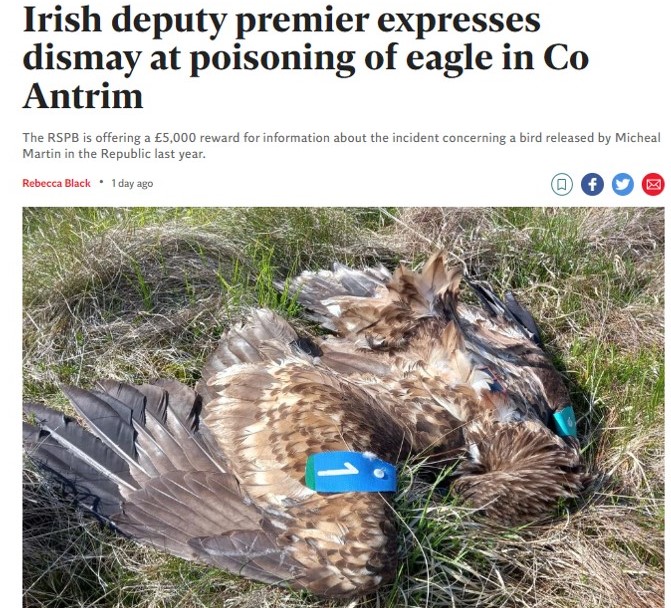
The RSPB is offering a £5,000 reward for information leading to a conviction (see here).
The Northern Ireland Raptor Study Group’s press release (here) describes the location where the two eagles were found poisoned as follows:
‘Glenwherry Hill Farm is owned by the Department of Agriculture, Environment and Rural Affairs (DAERA) and operated by College of Agriculture, Food and Rural Enterprise (CAFRE). This area has many young student farmers, conservationists and volunteers carrying out field work and studies on a daily basis. It also is the part of the Glenwherry Hill Regeneration Partnership (GHRP) and a site for driven grouse shooting and winter woodcock shooting and a site of the Curlews in Crisis restoration project‘.
I think it’s notable that the NIRSG resigned from the ‘partnership’ in 2020 over ‘incompatible management objectives’. The moorland management has recently shifted from walked-up grouse shooting to becoming managed for driven grouse shooting.
Dr Marc Ruddock of NIRSG is quoted:
“We know these parts of the Antrim Hills intimately having monitored birds of prey there for many years and seen various visiting golden eagles and white-tailed eagles there in the past. We are horrified and devastated at the death of these two young eagles. We sincerely hope that this is not a reflection of a renewed intolerance of birds of prey in county Antrim and within Northern Ireland. White-tailed eagles eat fish and seabirds but also other birds, rabbits and hares and more often scavenge dead animals in the countryside. They, along with other native birds of prey, are an essential component of a healthy ecosystem and for such indifference and intolerance to be displayed towards native eagles by somebody in this area is distressing“.
Dr Eimear Rooney of NIRSG said, “These majestic creatures are part of our ancient heritage and deserve to be revered, not poisoned and left to rot on a hillside. The suffering these birds must have felt in their final moments, and then dying side by side, it is just heart-breaking. Birds of prey are essential in balancing a healthy ecosystem and are already under pressure from loss of suitable nesting and foraging habitat. With the additional losses of birds through illegal poisoning, whether targeted at them or not, it is a massive blow to conservation efforts in Northern Ireland and on the island of Ireland.
“We have been contacted by many people outpouring their upset at the death of these eagles, and people are incensed that these pesticides, many of which are banned due to toxicity to human health, and which unbelievably remain in use illegally, causing the destruction of our native wildlife, and yet are not illegal to have in your possession”.
If you want to sign the NIRSG’s new petition calling for a ban on the possession of dangerous pesticides in Northern Ireland please click HERE.
UPDATE 3 March 2025: 50,000 people support the Northern Ireland Raptor Study Group’s petition to ban possession of dangerous, raptor-killing pesticides (here)
UPDATE 17 June 2025: 50,000-signature petition calling for ban on possession of poisons, handed in to Stormont, Northern Ireland (here)
 Raptor Persecution UK
Bizarre that with just one driven grouse moor in NI someone manages to poison not 1 but 2 White Tailed Eagles.
This makes me so angry the Grouse Shooting should be banned it’s crule disgusting and archaic
As most of these poisons are already banned its a big increase in the penalties for possession and supply that’s called for preferably hard time in prison.
Sent from Yahoo Mail on Android
Better still a law to say that for each poisoned or shot raptor,game shooting will be suspended for 5 years. There is no stiffer penalty to shooter and land owner
The Grouse farms need to be shut down.
It’s crule disgusting behaviour and it’s 2023 not ancient times or hunting.
The poison. Pellets all toxic to all wildlife and it’s also Harming the environment. The lead poison in the soil
“The Grouse farms need to be shut down”
I don’t think such a thing exists.
These wonderful raptors were poisoned elsewhere and placed where they were found in order to blacken the game shooters. If they were killed with an insecticide, as appears to be the case, they would not die close to each other, but more likely many miles apart.
The rationale behind the killing was not to protect game birds, but rather to hasten the end of shooting.
Just wondering how you came to your opinion about them being placed deliberately? I can’t bring to mind any documented cases where evidence was “set-up” as you imply. Can you point me to some? My opinion – I’m 90% sure this will have a connection with game shooting interests, and I base this opinion largely on the scores of similar cases that are documented.
“These wonderful raptors were poisoned elsewhere and placed where they were found in order to blacken the game shooters”
How do you ‘know’ that? Or, are you just ‘making it up’?
“If they were killed with an insecticide, as appears to be the case, they would not die close to each other, but more likely many miles apart.”
They were killed with bendiocarb, which is known to be fast acting. Bendiocarb inhibits acetylcholinesterase, an enzyme required for normal transmission of nerve impulses. You cannot fly when you are paralysed.
For example, a carcass of a pigeon stuffed with bendiocarb was found less than three feet from the carcass of a Buzzard which had just fed on it, in Bridgend, Wales in March of this year.
So, not ‘miles apart’ at all.
“The rationale behind the killing was not to protect game birds, but rather to hasten the end of shooting.”
So you claim to know who did it and why? Or, are you just ‘making it up’ again because you want to protect the real criminals?
I carried out an analysis in some depth on the above subject, in respect of Scotland. I was unable to interest anyone in my resulting summary.
I would like it published on this website, please.
May this be arranged?
I can send the Report to the website operator for publication, only stipulation is that is is not edited. I accept responsibility for what I write.
[Ed: Hi, by all means send it through but I’m afraid I retain editorial control as I’m responsible for what’s published. So for example if you’ve written anything defamatory, whether intentionally or not, I’d still be responsible for publishing it. If there’s nothing defamatory or personally abusive then I wouldn’t need to edit it]
Go for it, Antoinett. I, for one, would love to read it.
Thanks for your response.
Where do I send it, email address, please?
[Ed: dimlylit100[AT]hotmail.com]
Please send me the petition. I have many wildlife campainers as my contacts
Sharon- just click on the link at the bottom of post- which takes you to the Change.Org website where you can sign the petition. The sooner these dangerous pesticides are banned and possession becomes illegal, so that those who are found in possession can be prosecuted the better.
Thank you John I’ve found it. Birds of prey and other creatures have been trapped and snared on royal estates suffering lingering and agonising deaths, all to protect shooting interests. Xxxxx xxxxx xxxxx xxxxx xxxxx xxxxx xxxxx xxxxxx xxxxxx xxxxx
This appalling crime must be stopped immediately and the lives of these beautiful, magnificent birds protected. It is is beyond belief that they are being poisoned for no justifiable purpose.
This must STOP NOW!
Hi
Whilst great that NIRSG are raising the profile of this dreadful incident, I confess I’m slightly confused as the legislation comparable to what exists in Scotland was introduced in NI in 2011 by Section 15 of the Wildlife and Natural Environment Act (Northern Ireland) 2011 – see https://www.legislation.gov.uk/nia/2011/15/section/15. So whilst the offence is already in place, the problem (as with similar legislation brought in for E/W under Section 43 Natural Environment and Rural Communities Act 2006) – is that the NI government never got around to populating the list of relevant pesticides as was done in Scotland nearly two decades ago. Most of the key pesticides used for wildlife poisoning are already banned, and illegal to store, but wildlife poisoners are always looking for new products. Bendiocarb is a good example – once it was realised in the nougties how effective it was for poisoning raptors and other wildlife it became very popular and very much helped by the fact it was an approved product so technically there was no offence (outside Scotland) to have it held in a suitable pestcide store, despite the fact they may have absolutely no legitimate reason for having the product in the first place. Having the list prepared means pesticides, which may already be approved for legimate uses, can be quickly added if they start being used illegally for wildlife poisoning. Perhaps somebody should ask why NI gov have not populated the relevant list (Westminster gov decided they wouldn’t populate the list for E/W despite the offence being introduced in 2006 and later recommendations from an Environment Audit Committe Report in 2012 – see https://committees.parliament.uk/committee/62/environmental-audit-committee/news/179595/environmental-audit-committee-publishes-report-on-wildlife-crime/).
One key thing to remember is that the majority of prosecutions for raptor persecution come as a result of follow up searches (whether land/outbuildings/vehicles or, where the necessary information is available, via a search warrant issued by a court). In the last couple of years RPUK has reported on several prosecutions following on from such multi-agency searches. Follow up searches are the key action to increasing the chances of getting offenders into court. Unfortunately, NI has a long history of not always doing follow up searches after wildlife poisoing incidents, or not doing them promptly enough when there is reasonable suspicion of who may be a suspect. This problem has also occured on many other occasions elsewhere in the UK. Sometimes it is indeed necessary to wait for toxicology or post-mortem resuts, which can be weeks or even months, before further action can be taken. However, in many cases reasonable suspicion of an offence exists from the very outset (e.g. a dead red kite lying next to a cut open rabbit carcass) and the location of these items and surrounding land use may quickly identify potential suspects. In these situations fast responses by police and other statutory & supporting agencies can dramatically increase the chance of finding evidence before it can be disposed of. A case in Norfolk in 2013 is a really good example of where a prompt follow up statutory search yielded a really good result – see https://raptorpersecutionuk.org/2014/10/01/stody-estate-gamekeeper-convicted-of-poisoning-10-buzzards-a-sparrowhawk/ and https://community.rspb.org.uk/ourwork/b/investigations/posts/how-bad-does-it-have-to-get
So whilst I fully support what NIRSG are doing – a key question to be asked is why has a suitable list not already been prepared after more than 12 years since the possession of pesticides offence was first introduced in NI?
Additionally, I don’t recall a pesticide amnesty being run in NI, as per the one in Scotland https://raptorpersecutionuk.org/2015/05/06/pesticide-disposal-scheme-reveals-massive-stash-of-banned-poisons/ , and that may also be a route to take some products out of circulation.
Agree about the searches being done before the fact that the RSPB /Police are poking around hits the bush telegraph. Once news is out, all the little bottles, sachets, tubs will go into tupperware container(s) into a well covered hole covered in a wood in an obscure part of the Estate, until the heat blows over. Except for those exceptionally arrogant keepers who assume ‘they will never get me’ etc.
What a surprise “dead raptors on a grouse moor” there’s a few gamekeepers who need prosecuting alongside the landowners who employ them!!
Exactly the only driven grouse moor in Ireland. It’s simple BAN GROUSE SHOOTING. As previously said there is no need for this to be allowed to continue in this day and age . The landowner’s and gamekeepers need to be held accountable and severe meaningful justice sought for all crimes against wildlife and animals not just a slap on the wrist.
The Raptor Persecution Group seems to have gone the same way as some of the bigger organisations like the National Trust, RSPB etc just a members club for antis to air their bigoted views, and agree with each other and, also run by antis.
‘just a members club for antis to air their bigoted views, and agree with each other and, also run by antis’
The ‘antis’ referenced here meaning those people who are opposed to criminal activity.
The only “Raptor Persecution Group” are the chicken-shit, criminal scum who infest our countryside, degrading our natural heritage to further their own tiny-minded ends.