
Blog reader Andy Amphlett went for a walk on Moy Estate last weekend.
Moy Estate will be familiar to regular blog readers as it’s featured here many times over the last 13 years. Most recently, the estate has been sanctioned with a three-year General Licence restriction, imposed by NatureScot after the discovery of a poisoned red kite and ‘incidents in relation to trapping offences‘ (see here). And in March this year, estate gamekeeper Rory Parker was convicted for shooting a sparrowhawk on Moy (see here).
Victorian attitudes appear to persist at Moy Estate, as Andy discovered last Saturday when he found 14 dead moles hung by their snouts on a barbed wire fence:
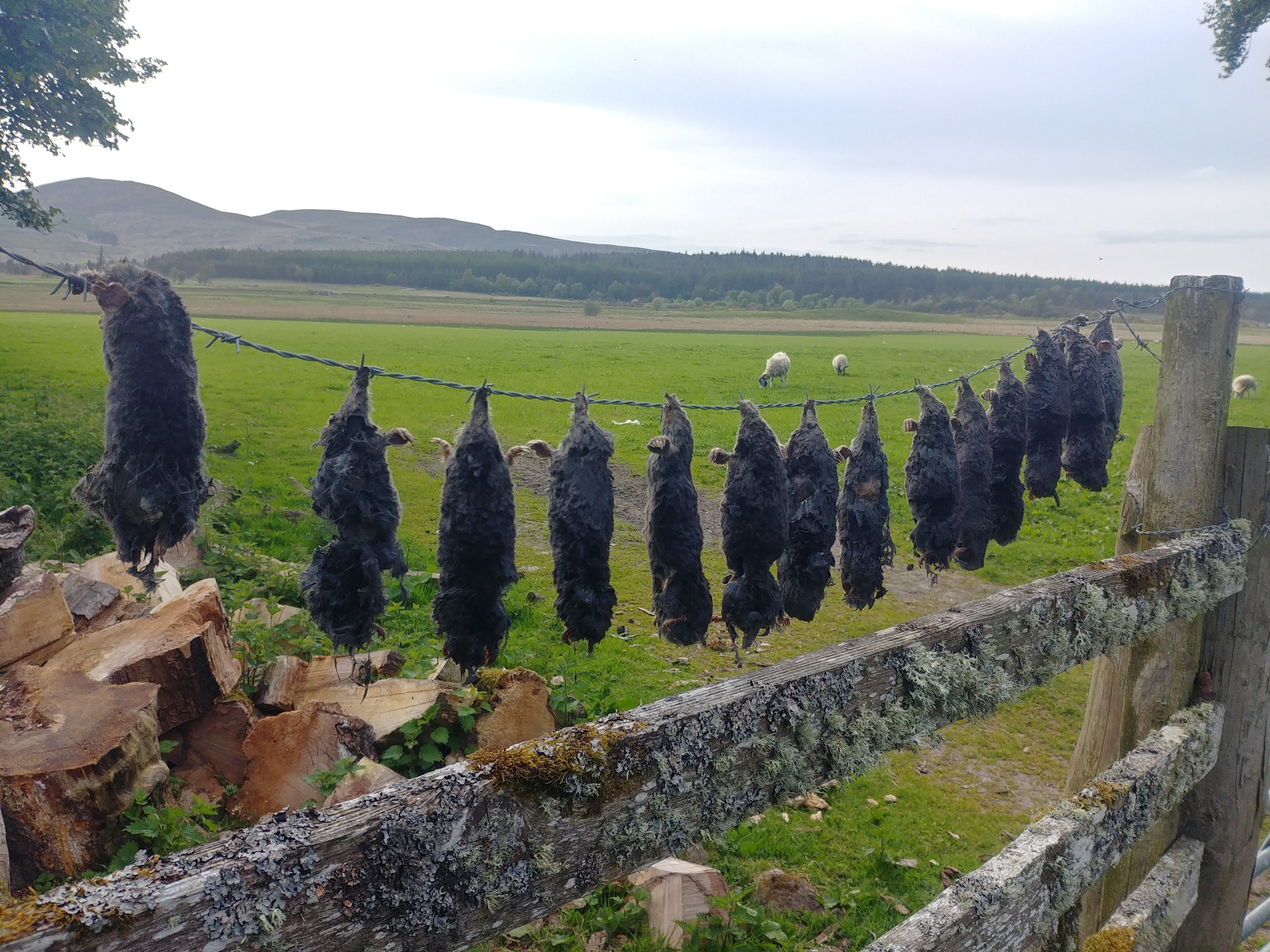
This disgusting activity isn’t illegal, and was once a common sight on UK shooting estates when victims would be hung on what was known as a ‘gamekeeper’s gibbet’ to demonstrate to the landowner that ‘vermin control’ was taking place.
It’s hard to believe though that anyone still thinks it’s appropriate or acceptable to brag about how much wildlife has been killed. What purpose does it serve? And why are moles still being killed anyway?
Without any sense of irony, this is the sign at the entrance to Moy Estate, just a few hundred metres away from the strung-up moles:
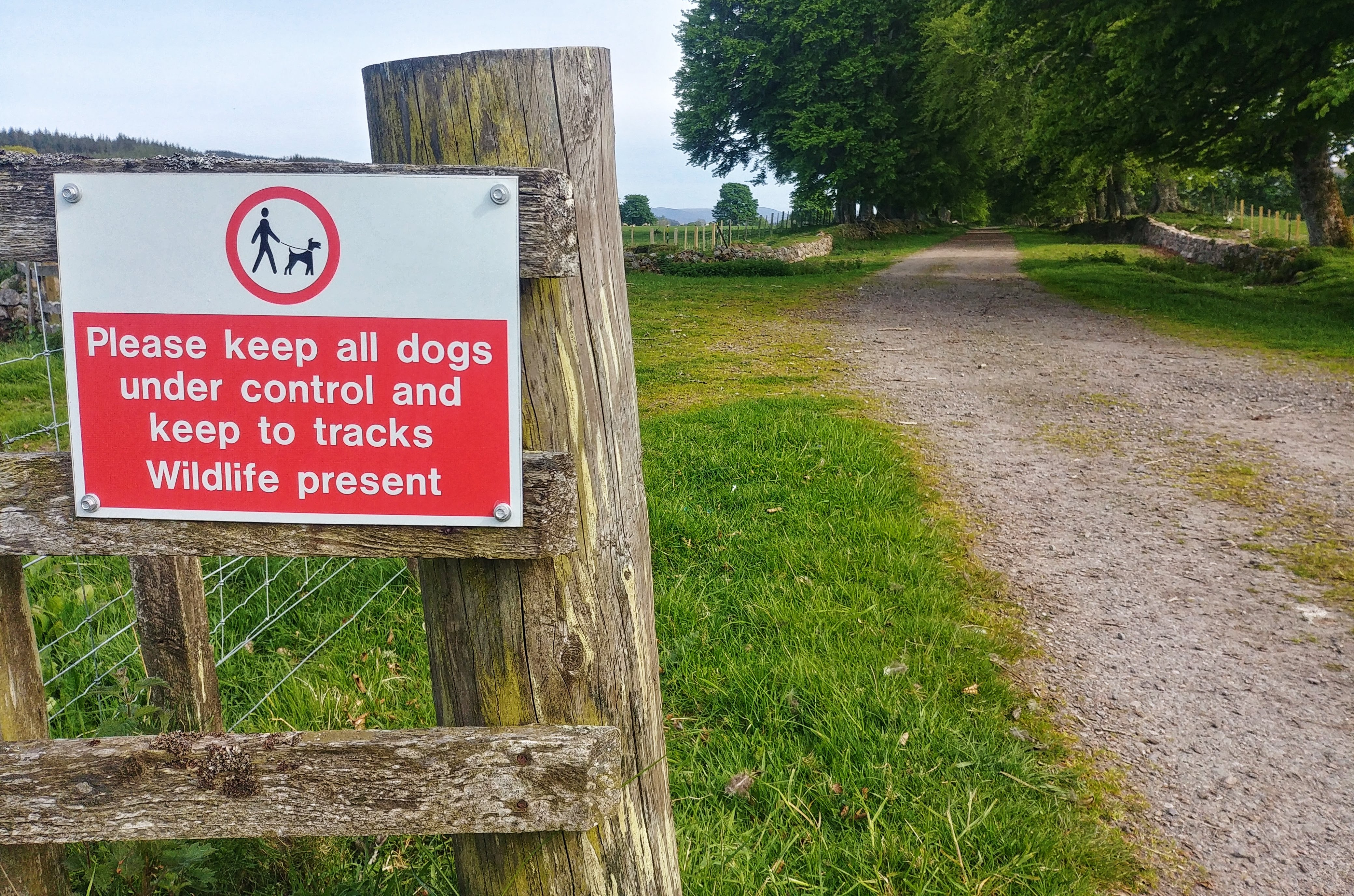
Yeah, wildlife is present but a lot of it’s quite likely to have been killed.
And I’m pretty sure that this sign might be in contravention of the Scottish Outdoor Access Code, which does not insist that walkers ‘keep to tracks’ except in certain circumstances. It just makes me question what an estate might be wanting to keep from public view…
See here and here for two excellent blogs written by Nick Kempe about Scottish access signs and what is/isn’t permissible for those exercising their access rights and those controlling that access.
A report has been made to Highland Council about the Moy Estate sign.
 Raptor Persecution UK
What possible harm are moles doing?
They make mole hills which get picked up when the grass is cut for hay or silage. The soil contains listeria which contaminates the silage and can fatally poison the cattle or sheep that it is fed to.
May we see the published, peer-reviewed, supporting evidence for this statement?
This is how molecatchers display how many they have caught. If you are the landowner it ensures you aren’t paying for someone else’s moles @£10per mole it adds up. 1 mole hill spoils 1m³ of silage through contamination.
I agree about it lowering quality of silaging, but think there’s no need to hang them up. If trust is an issue* it might be better to bag them up & just show the farmer directly, or leave the bag at the gate of farmyard. Or even text a photo these days?
*if the molecatcher was (unlikely) a rogue, he could be bringing a few moles along with him anyway from elsewhere to add to his tally!
https://www.fwi.co.uk/livestock/beef/silage-soil-contamination-warning-listeria-cases
Notwithstanding the single, citation-free, bullet-point “get on top of mole problems”…
What this is, is a magazine article.
What it is not, is published, peer-reviewed, supporting evidence of anything at all.
According to the science COVID WAS GOING TO KILL EVERYONE but it didn’t. Now WHO want autonomy to shut down people’s free movement on a whim. Now we are all going to die if we don’t switch to renewables. Any scientist with a different opinion is lambasted and ostracized. Because it does not fit the agenda
Despite its complete and utter irrelevance to the subject at hand…
Can you provide a link to any published, scientific paper that includes the claim “Covid is going to kill everyone”?
Take your time…
Yes, you may. Nothing stopping you looking it up.
I’ve done just that. If it’s that easy to find, I suggest that you help us all out by providing a link. Unlike some, I’m here to learn.
When I delved a bit deeper into this, it is apparent listeria is naturally present in soil.
Killing moles doesn’t eliminate listeria.
It should be possible to simply flatten off the mole hills, with a roller, so that when silage is cut the soil doesn’t contaminate the silage, especially if the grass isn’t cut too short.
From what I have read the listeria bacteria multiply quickly in silage where air is present, being particularly problematic in poorly fermented silages that are not acidic enough.
It is the feeding of poor quality silage to livestock which is perhaps the issue?
Research has also shown that moles are in fact good for the land as they aerate the soil, eat various grubs which can harm crops, as well as assist with natural drainage and help prevent compacting of the soil. This perhaps could encourage a greater variety of wild plants to grow, which might be beneficial in restoring wild flower meadows?
No doubt this comment will generate some discussion, but it would seem killing moles isn’t really necessary, but is a historic tradition that some are reluctant to let go of- especially if they can make money from it.
Perhaps there needs to be a reassessment of agricultures relationship with moles?
It would be interesting to get others views on this?
Yes, I had a trawl around as well, John. I found no scientific evidence which directly implicated Moles. Livestock will, after all, ingest a considerable amount of soil throughout their lives, with or without the presence of Moles.
I must add, that as a little lad, I used to accompany my late father (a one-time gamekeeper/estate dogsbody) when he checked his employer’s many Mole traps. It wasn’t a pretty sight, and on no occasion was Listeria mentioned. It was simply to keep the boss’s huge lawns in an unaturally pristine state. I’m proud that I didn’t inherit his aptitude for needless killing.
How can you flatten the molehills with a roller, then cut it? Nor can you cut the grass short. Farmers are always saying yields are down, due to weather, too hot/cold/dry/wet.
Mole runs are beneficial for draining soil.
Lived in the country all my life. Never met a poor farmer yet. Despite what they all want you to believe !
So you’re going to roll the grass before cutting? You obviously know absolutely zero about the process.
Round our way it’s common practice to roll silage fields in the spring. The ground is quite stony and any stones lying on the surface could cause a lot of damage to the grass cutters.
There’s a lot of care and skill in making good silage and some farmers are better at it than others. If it doesn’t turn out as well as it might I suppose it’s easier to blame molehills rather than your own shortcoming.
Rolling silage fields seems to be a widespread practice, not just a local one.
‘Rolling in the Stones’
https://www.silageconsultant.co.uk/blog/rolling-in-the-stones
How the f**k do you roll molehills in a silage field you muppet
Its ok John, they are all going to cough up another 50p per pint of milk and £1 per kilo for meat to pay for the diesel and labour to do this genius idea, and tomorrow I will be cutting someones hair, giving a dental filling, fitting a gas boiler because I also know how to do everyone elses job too🤨
You can’t roll all of the molehill without rolling the grass that .makes it uncuttable. Agroecology methods with integrated farmsteading would be a more practical solution.
Thank you for being clear and balanced in your comment.
But what you have to understand is that too many farmers and their political representatives don’t do science, they do anecdote and the school of life / hard knocks (with apologies to the many decent farmers working to farm in harmony with nature).
Quote from Mr Alick Simmons, in letter to Guardian 2017.
” As a veterinarian with over 30 years’ experience in controlling livestock disease, I am confident in stating that the assertion that moles play anything more than a trivial part in transmission of disease to livestock is risible.”
Alick Simmons [UK Government’s Deputy Chief Veterinary Officer (2007-2016) and the UK Food Standards Agency”s Veterinary Director (2004-2007)]
I know who I believe!
Have you read his book “Treated Like Animals”? It’s very good
It does not look like there is a silage crop waiting to be cut.
The rapid move to intensively manage grass to facilitate multiple cuts of silage fodder led to the biggest reduction in biodiversity in decades. Wildflowers, inverts and wading birds have all gone……. I am surprised the moles still find them attractive?
Not to say a drastic reduction in the lands capacity to absorb rainfall and slow its percolation into upland river systems.
The day coming when acting like morons killing our wildlife will be a prison sentence ! I will do everything to help convictions .
I totally agree!These estates are not monitored closely enough and they xxxxx xxxxx xxxxx xxxxx xxxxx xxxxx xxxxx xxxxx xxxxx xxxxx Maybe its times for Scottish government to buy these lands to be run properly and take them out of the hands of xxxxx xxxxx Make them all national preserves as other countries do. Very little of Scotlands land is owned bu Scots anyway so time this was addressed.
And just who is going to pay for this wonderful idea! And pay for the management of it?
City dwellers that visit once or twice a year? Lets get real people.
Totally agree as I am from farming background and know that the damage to livestock and the heart break it has on farmers is far more worse than a few moles even though I don’t like the idea of killing animals. I am not a vegetarian by any means but would people rather see livestock put down for getting TB off wildlife perhaps you should all just give your heads a bloody good shake
Again, nothing to do with Moles.
I think you’ll find that the disease you’re referring to is Bovine TB. The wildlife “got it off” livestock (which all end being “put down” either way). It’s in the name.
https://www.daera-ni.gov.uk/articles/what-bovine-tuberculosis-tb
And, by sheer coincidence…
https://www.farminguk.com/news/cattle-to-cattle-btb-transmission-most-common-form-of-disease-spread_62709.html
Another from a “farming background” who would rather trust anecdote and propaganda than peer-reviewed science and actual facts. Did all of these Luddite farmers fail to go to school?
Where I live there is plenty of Common Ground, every year some of that Is used by a mixture of cattle some of the cattle are long horns, molehills are all over the place, there is an abundance of wildlife fox’s badgers, you name it they are their, It doesn’t seem to be a problem, who manages it ? Nature manages it, alongside with people that use it.
You could roll the grass a day or so before cutting! That would ensure enough time for the grass to stand upright again.
Not rocket Science mate !
And enough time for the moles to create more hills. Like anything else in our man made countryside, control and management is necessary. This sometimes involves the culling of excesses in certain species. It’s normal, needed and acceptable practice.
Your comment is entirely subjective, isn’t it?
Excess-an amount of something that is more than necessary, permitted, or desirable.
Can you produce any peer-reviewed evidence that the UK Mole population exceeds carrying capacity?
Well, the western human has been killing other humans by the millions for trumped up reasons, sooooo…
Well said 😁 someone with sense
The mole is a protected species in Germany. Why don’t they have the same problem there?
Don’t eat animals then hay/silage won’t be needed. Farmed animals are domesticated not wild and are taking wildlife’s homes and habitats, far more than crops just grown for human food.
I really think building projects take far more of the wild life natural habitate than any field being used for grazing livestock or growing crops
In my experience of being raised in a rural village, land owners/farmers can alway justify killing whatever they fancy as long as it suits their interests.
You are talking rubbish, farmers dont just kill anything they want to, they work hard to put food on yours and my table
Sick
None
OMG! This is why townies should keep their noses out of the countryside. Their burrows collapse under the weight of cattle and horses whilst running. The animals break their legs and are therefore put down.
What a load of bull tosh… Guess you’re scared when chasing fox’s that your horse will trip and fall! Born and bred in the country, I’m not a follower of evil traditions that are stuck in the dark ages! Oh, I’d better go. I have a witch dunking to attend… Just saying…
Ridiculous
Try again
Wish I could have put it that well
Plenty,
I don’t not like it so cruel 😞
They can devastated acres of grassland very quickly, in crops like lettuce cabbage etc the plants just die or never mature when the roots are disturbed also animals can be badly injured if putting a foot into the soft spot left by a mole hill
How many incidents of this nature were attributed to mole tunnels in say 2022. I bet less than 5.!
Moles are an integral and essential part of the British countryside. Killing them achieves nothing. Hanging the corpses is just a medieval practice not appropriate in 21st century.
Is this not a crude attempt to injure raptors? Of you think of it as a raptor trap then the legality would change.
Moles cause damage to land cattle break legs in the holes left by them just one reason they are trapped
“cattle break legs in the holes left by them”
Another bold claim. I suspect this is a vanishingly rare occurrence but since you are making the claim perhaps you could oblige us by providing some credible statistics to back it up.
Your quite right Jane, there simply part of the eco system and they probably been around longer than us, but don’t quote me on that.
Gotta say I am nearly 65 years old and as yet don’t ever recall seeing one of these nasty all over the place moles and maybe will never see one as they are being killed for digging in soil ????
I would like to think that some people somewhere might think this native species has a right to survive in this country
Pretty uneducated write up by an obvious anti, Mole numbers are controlled by a pest controller, they are strung on gibbet line as proof of catch, for way of invoice if you like as they are paid per head. Moles spread listeria to the grass which will be passed on the cattle that will graze the grass.
Andrew, can you show us all the peer reviewed evidence linking moles to the spread of Listeria? You’re just spreading false propaganda.
From Northern Diver’s comment on this thread…
Quote from Mr Alick Simmons, in letter to Guardian 2017.
”As a veterinarian with over 30 years’ experience in controlling livestock disease, I am confident in stating that the assertion that moles play anything more than a trivial part in transmission of disease to livestock is risible.”
Alick Simmons [UK Government’s Deputy Chief Veterinary Officer (2007-2016) and the UK Food Standards Agency”s Veterinary Director (2004-2007).
Furthermore: As we all are now well aware, Listeria occurs naturally in soil, which livestock ingest with or without the help of Moles.
https://pubmed.ncbi.nlm.nih.gov/6879152/
https://www.nature.com/articles/s41598-020-74317-0
https://www.sciencedirect.com/science/article/pii/S0048969719326543
https://www.journalofdairyscience.org/article/S0022-0302(82)82238-8/pdf
https://www.tandfonline.com/doi/pdf/10.1080/00288233.1968.10431444
From this last link (Healy, 1968)…
“Mean soil ingestion per cow on the private
farms ranges from about 400 to 700 lb per year. Soil ingestion at Massey
ranges from about 400 Ib per year on the lighter-stocked No.1 Unit (town
milk supply) to over 1.000lb of soil per cow per year on the heavily-
stocked No. 3 Unit.”
So, let’s not have any more crap about people being “uneducated”.
The poor little things are doing nothing wrong.its the sick people who think their have the right to kill a helpless animal.
If you had livestock you would know that moles can destroy a grazing pasture
If we didnt catch moles the nice green grass in every field would look like its been dug up things do need controlling
And the muck from the mole hills gets in the bails of hay and passes disease to the live stock
Do at least try to pay attention.
Common sight here in North Yorkshire along with dead corvids strung up on posts. Sick victorian activity should be made illegal.
And widespread in the lower Lune Valley farmers fields in Forest of Bowland AONB. Medieval mindset!
Obviously not the four-legged species wildlife needs to beware of. Another fine for Moy? That doesn’t seem to work and neither does conviction.
I am a huge supporter of responsible access and believe that most times any restrictions from estates are complete bollocks and purely for their own benefit no matter what they say.
However I do remember about 20 years ago getting a Winter job of path creation to a view point sited on a well visited moor on a Scottish estate. That Spring a pair of Hen harriers nested very close to the new path & I was paid to return to block off and disguise that access track. Two Harriers successfully fledged that year and successful nesting has happened most years since in that area.
The management of access is paramount but often underfunded and this can leave the right to roam open to abuse by both some landowners and some of those those exercising their rights
So true. Footpaths are expensive to manage and people leave their rubbish behind along with their bbqs and the fires they start.
There is no excuse for anyone to leave litter in the countryside (or anywhere else). Most people are responsible and don’t leave litter but let’s not imagine that it is only ‘townies’ who do litter. Anyone who spends much time in the countryside will be familiar with all manner of agricultural detritus that gets left lying around such as baler twine, bits of silage wrapping, empty agrichem containers, redundant machinery, etc, etc. Not all farmers do this, of course, but we have all seen it.
Too much money, too much land, too much ego and not the slightest bit of empathy or compassion for other sentient beings on this planet. Oldy worldy victorian bravado mindset to say the least.
Moles affect small subsistence farmers too. They DO NOT pay a mole catcher because of tradition or just for the fun of it. It has a huge effect on yields and small family farms are going out of business every day and sold to wealthy land owners and property developers. He who controls food production controls the population. I used to live on a small farm if foxes just went about there business eating rabbits and rats and mice they ran free but once they kill their fist lamb they come back night after night for more. They don’t even eat all of their first kill they want a fresh one. If the killing started the farmer would pay a gamekeeper to scope out the area of the first kill and shoot the fox. Loads were left. I had a dalmatian that used to play in the fields with the foxes. The gamekeeper would be away in the early hours so he’d display the fox somewhere to let the farmer know he got it. Some years it never happened and some year it happened once or twice. Same goes for moles, I confess I don’t know a lot about moles but find it difficult to believe farmers who are tight with their money would pay a gamekeeper unless it would cause a big problem. The gamekeeper comes very late at night and early hours of the morning.
Can you show us all the peer reviewed evidence for these bold claims? Considering how confident you are that this is true, you’ll be surely be able to supply plenty (farming ,amazing articles don’t count, if that wasn’t clear…)
It’s not the killing of moles that I object to – I accept it’s necessary in certain places at certain times – but the sad attitude that the killers work must be put on display.
This may be the work of a self-employed molecatcher, it used to be seen as equivalent to an advert in a shop window. Doesn’t seem right these days, though in decline it’s not a rarity in North Yorkshire, Cumbria and Northumbria. I am sure some photos on Facebook would suffice to promote business. However, in general I’m actually in favour of bringing back the keepers gibbet – it would be great for everybody to see what estates like Moy are killing in terms of quantities and varieties of species, and they could form an opinion on whether it was justifiable or not and on what grounds.
14 dead moles. That’s small fry!
Here in the last year in the North Pennines Area of Outstanding Natural Beauty I’ve come across 260 moles strung up on various fence lines to fields with grazing sheep and lambs!
This is my understanding of the law.
If the moles died of a disease communicable to a human then they automatically are classed as dangerous wild animal material (Category 1) (Article 8 EU Animal By-Products Regulations) and should be disposed of by an authorised waste carrier. This is a legal requirement under Article 12 of the EU Control Regulation.
Moles are slaughtered because the soil they dig up contains bacteria and can contain pathogens which can be harmful to people and animals such as Listeriosis (which can cause Listeria) and Clostridium Botulinum (which can cause Botulism). These bacteria can multiply in the damp conditions of silage so can be dangerous to animals eating spoilt silage.
However, if the moles were healthy animals when killed they became an animal by-product when they were used as a disgusting display to show employers the location they were killed and the number of animals killed. They are therefore covered by the Animal By-Product Regulations and must not be accessible to livestock. In some of the cases I’ve come across the moles have dropped on to the ground. I notice that in the blog photo sheep are grazing in the field.
The Animal By-Products (Enforcement) (England) Regulations 2013
“S4.—(1) Animal by-products, including catering waste, must not be brought on to any premises if farmed animals would have access to such animal by-products.”
https://www.legislation.gov.uk/uksi/2013/2952/regulation/4/made
The Animal By-Products (Enforcement) (Scotland) Regulations 2013
4.—(1) Animal by-products, including catering waste, must not be brought on to any premises where farmed animals are kept.
https://www.legislation.gov.uk/ssi/2013/307/regulation/4/made
Where an animal by-product no longer serves a purpose and has been abandoned, animal carcasses become waste for the purpose of the Waste Framework Directive and therefore they fall within the remit of S34 Environmental Protection Act 1990.
https://www.legislation.gov.uk/ukpga/1990/43/section/34
Environmental Protection Act 1990
S34 Duty of care etc as respects waste.
(England and Wales)
“(1) Subject to subsection (2) below, it shall be the duty of any person who imports, produces, carries, keeps, treats or disposes of controlled waste … to take all such measures applicable to him in that capacity as are reasonable in the circumstances—
(b) to prevent the escape of the waste from his control or that of any other person;”
(Scotland)
“(1) Subject to subsection (2) below, it shall be the duty of any person who imports, produces, keeps or manages controlled waste or, as a broker or dealer, has control of such waste, to take all such measures applicable to him in that capacity as are reasonable in the circumstances—
(b) to prevent the escape of the waste from his control or that of any other person;”
If the fame keeper was guilty he should of lost his gun licence and the estate owner as well.
I fear that the wealthy follow traditions born of ignorance arrogance,inferiority and self importance. Their only way of asserting their superior, arrogant and beligerent attitude is inflict their cruelty on those who have no voice and are defenceless.
Recognise yourselves. You are ignorant and consumed with asserting your belligerent ignorant self appraising bullying on those who are vulnerable.
You sicken me.
If a wild animal attacked your dog or cat and was about to kill it……would you allow the killing and just go…oh well ill need to get another pet or would you do everything in your power to kill the animal and save your pet from certain death?
Are you suggesting that Moles are actually attacking livestock? And that those livestock are pets?
“Should have”
Please use English
Love a bit of grammar. Can we do the apostrophe next please?
If the game keeper was guilty he should of lost his gun licence and the estate owner as well.
Who is the Estate owner? These people are XXXXX XXXXX XXXXX and are never named
Sooner the better
Well I’m a animal lover I believe every animal has th right to live same as a human
Without wildlife our planer would be dull and boring
Animals mammals all sorts of life should have the same rights as humans live there life to the full and be left alone, and it’s so awfull and upsetting to see these pictures.
why do this anywhere
They have to survive right eat drink make a home no different to humans is it, and humans build homes don’t they.
To many buildings in this world the animals ain’t got a clue where to go apart from out in dangerous roads getting killed why because humans are taking away there habbitat they have nowhere else to go same with moles leave the wildlife alone stop cutting forest down stop building on there lands where there safe things would change for the better
Moles need to be controlled.
You simply cannot cut grass and store it as hay or silage if it’s full off soil.
Hearing your comments such as “simply flatten the hills” shows how dangerous it is to allow people with zero practical experience to think they can have an input into practical conservation.
Sheep also ‘bed down’ on mole hills to have their lambs. This causes infections in their navals.
Imagine mowing your garden if it was 10% piles of soil.
Moles are hung on the fence so the farmer can see how many have been caught, mole catchers are paid per mole. Leaving the moles alongside the field they are caught in shows the farmers that the mole catcher is only charging for x amount of moles and not charging numerous farmers for the same mole.
“This causes infections in their navals.”
Please can you direct us to any scientific, peer-reviewed evidence in support of this statement?
Can you provide any that disprove it?
Now this is curious.
None of the following (or any of the other articles I’ve read on Navel Ill) include any reference to a certain word. Can you guess what that word is? I’ll give you a clue, boys and girls. It rhymes with holes.
https://www.agriland.ie/farming-news/what-can-i-do-to-avoid-lambs-getting-navel-joint-ill/
https://businesswales.gov.wales/farmingconnect/news-and-events/technical-articles/navel-pathway-disease-after-birth-managing-livestock-disease-improve-welfare-and-production
https://extension.wsu.edu/animalag/content/preventing-navel-ill/
https://vetericyn.com/blog/how-to-prevent-navel-infections-in-livestock/
https://www.clydevetgroup.co.uk/post/navel-ill-joint-ill-treatment-prevention
Research it yourself. And while you are at it, have a look at tetanus.
No need to be so evasive. If there’s any reliable evidence that molehills pose a threat to livestock why not share it?
Hardly a defence. Remind me not to employ you in a defence of anything
Not good to see in modern times. I was told once by a sheep farmer that when he brought his sheep off the moors onto lowland fields in the winter, the mole hills- which can be quite large- covered a lot of grass that his sheep should be eating. I stated to count the mole hills in one field and lost interest after 500. There was no mention of disease being spread, just the area of grazing that wasn’t available. I suppose that makes some sense when he is paying per sheep in a field for winter grazing.
If you don’t like country ways stay out of the countryside.
It’s Farmer “get orf moy laaa-aaand” Palmer!
We trust you’l be keeping your beak out of all urban issues then?
Such a high opinion of yourself. What are your qualifications may I ask apart from entitlement?
This is yet another example of the xxxxx xxxxx xxxxx xxxxx that exist in this place. They operate a xxxxx xxxxx xxxxx xxxxx xxxxx xxxxx xxxxx xxxxx xxxxx xxxxx xxxxx xxxxx xxxxx xxxxx xxxxx. Police Scotland advise me there is no law of trespass in Scotland, so it is unlawful stating people have to keep to tracks.
I wouldn’t let my dog stray from the path there… Who knows what traps and poison he’ll find.
For tenant farmers its usually part of the rental agreement that they have to control moles.
I catch over 2 thousand a year. All of them are hung on the fence to show a good job had been done. I’ve never had any one moan or report them, far too many townies about these days.
Strange how we as humans decide what is and isn’t vermin.
It’s easy to see how the relative sides in the rural/country (now artificial for the most)divide structure the defence of the positions they take. We have one side who invariably tend to look for scientific evidence to sustain their views while the other side prediminantly take tradition or the words of anonymous others (most likely to be employers or foremen/bosses) for theirs.
Nuff said.
Yes George.
It’s funny how the self-styled “countryside” lobby were only too happy to take “townie” taxpayers cash, in the form of subsidies, for decades. Yet as soon as those taxpayers raise the slightest hint of a query into certain land “management” methods that they’ve subsidised, it’s open season on anyone who’s nearest neighbour is closer than half a mile away.
“The Countryside” is, indeed a complete fiction.
“Townies” pay for the billions in countryside subsidies remember that bumpkins.
Bunch of wet wipe dossers in this comment section. Go cry at the neat counter in your local Asda or something.
“wet wipe dossers”! That’s a new one.
No doubt from another “rural authority”.
Yet again landowners who shouldn’t own land and no nothing about how nature work. Moles do absolutely no damage to anything like badgers don’t. It’s xxxxx xxxxx xxxxx xxxxx xxxxx xxxxx xxxxx xxxxx xxxxx xxxxx xxxxx xxxx xxxxx xxxxx xxxxx xxxxx xxxxx. Its about time we shut the grouse shooting down, sold off the land to sensible owners to plant food and nature. Xxxxx xxxxx xxxxx xxxxx xxxxx.
After a lot more reading on this subject, it would seem the research indicates that moles are most active during late autumn and spring, which is when most tunneling activity takes place. Once a mole has created its network of tunnels then there is usually very little surface activity.
Research has also indicated that if moles are eradicated from an area, then new moles will simply move in and create more tunnels and new molehills.
And so the killing cycle repeats, which is great for the mole catcher as it ensures money is continually going into their pockets!
All the information suggests that it is important to minimize soil contamination in silage, but the research into moles could suggest the best way to avoid this soil contamination in silage is simply to allow a resident mole to create its tunnels in early Spring before the grass is cut, flatten the molehills, and then let the mole get on with its life underground.
There is plenty of evidence to suggest that the killing of moles is often not necessary, and is often both ethically and economically unjustifiable.
I also note some of the comments blame moles for deep holes in the ground which cause livestock to break legs. Mole tunnels are approximately 4cm deep by 5cm wide. Even if the tunnel collapses I find it hard to believe that a depression 4 cm deep in the ground is going to cause cattle to trip and break legs, and there are many other reasons why holes might form in the ground. But those with entrenched ideas probably find it much easier to blame the mole rather than look for other explanations.
Sadly like so many things in the life there are those who choose to ignore the latest proper scientific research and review their practices in line with this, to ascertain if the methods they are using are still necessary or best practice, and instead rely on old wives tales and “traditional” methods. Methods which of course are eagerly promoted by those who are making money from them.
There will be occasions when mole populations do need to be controlled. But hopefully the move by the government in the way farm subsidies are paid will make many review their relationship with nature and the environment, and stop carrying out unnecessary harmful practices, which might be in everyone’s benefit.