
The conservation campaign group Wild Justice has just published the findings of its latest research into the level of toxic, poisonous lead shot found in gamebirds (pheasants and partridges) on sale in supermarkets and from some online traders during the 2022/23 shooting season (see here, here and here for their most recent blogs).
In 2020, nine UK game-shooting organisations made a massive U-turn after years and years and years of defending the use of toxic lead ammunition, and said they wanted to drag the industry into the 21st Century by making a five-year voluntary transition away from lead ammunition (see here).
A lot of us were sceptical because (a) we rarely trust anything the industry tells us; (b) previous ‘voluntary bans’ by the industry on a number of issues have been unsuccessful (e.g. see here, here and here); (c) the ongoing failure of the shooting industry to comply with current regulations on many issues, including the use of lead ammunition over wetlands (here), means there should be absolutely zero confidence in its ability and/or willingness to stick to any notional voluntary ban; (d) the Scottish Gamekeepers Association refused to sign up to the proposed five-year transition period because they believe there is insufficient evidence to support the claim that lead can have damaging impacts on humans, wildlife and the environment (here); and (e) in the very same year that nine shooting organisations committed to the five-year transition, BASC announced it was set to fight a proposed EU ban on the use of lead ammunition on wetlands (see here).
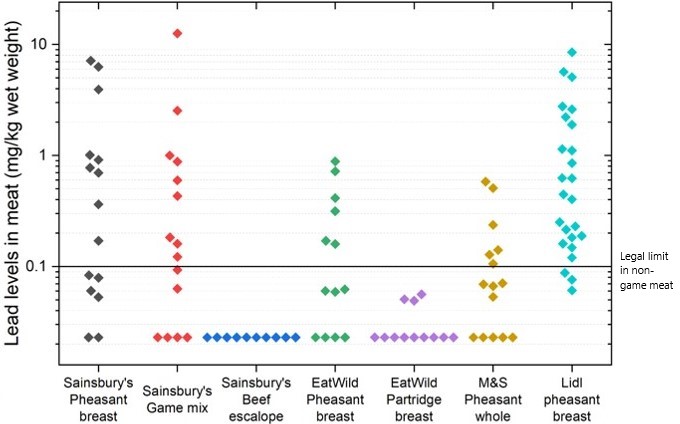
Wild Justice’s latest results demonstrate that, with the exception of the partridge breasts sold by ‘Eat Wild’, all of the gamebird meat tested contained high levels of poisonous lead, well above the legal limit set for non-gamebird meat such as pork, chicken, lamb and beef.
The gamebird shooting industry has just two years left, within its own proposed five-year voluntary transition period, to get its act together on this public health issue.
And it’s not just a public health issue. It’s also an issue of sustainability. We’re often told (by the industry) that gamebird shooting is sustainable. But have a look at the Wild Justice blog about the pheasant breasts it bought and tested from Lidl stores in Northern Ireland and the Irish Republic (here). According to the packaging, Lidl pheasant breasts were shot in the UK, then sent to Poland for processing, then shipped to Northern Ireland & the RoI to be put on the shelves in Lidl stores!
No matter how much the industry spins the narrative, this cannot possibly be described as sustainable in any way, shape or form!
 Raptor Persecution UK
Unbelievable. No other producer of food and drink in the UK would be allowed to knowingly sell poisoned products.
Where is the FSA in all this?
The FSA is here: https://www.food.gov.uk/safety-hygiene/lead-shot-game
Their basic message is that consuming lead is dangerous and that you should ‘minimise lead consumption as much as possible.’ This is all very well if you are aware of the presence of lead through, for example, knowing the history and source of the product. However, anyone further down the food chain would not have this knowledge and receives no protection whatsoever from the FSA. This is a scandalous dereliction of duty.
Says it all. Sheer hypocrisy.
It might be thought, simplistically, that the removal of identifiable pieces of lead ammunition from potential food items would avoid the risk of lead poisoning (as well as preventing orthodontic disasters!). That this was not the case was graphically demonstrated in the process of releasing Red Kites in Yorkshire, starting in 1999.
The young kites had their blood sampled twice before they were released. We were puzzled to find that the lead levels in the second batch of blood samples were higher than in the first. They were fed mainly on rabbit which had been rifle shot by the estate’s gamekeepers.. Each rabbit was carefully checked for obvious signs of the presence of lead ammunition. In only one instance was a lead pellet found. In all other cases there was a very obvious hole where the flattened pellet had exited the carcass.
Medical matters relating to the birds were overseen by ZSL (London Zoo) and it was agreed that a sample of shot rabbits would be examined by them. Detailed examination found that very small fragments of lead were present, presumably caused when the lead pellet struck bone in the rabbit. Such fragments had not been visible when the rabbits were checked initially and would not, in any event, have necessarily been immediately adjacent to the external wounds. They were of such a small size that they would readily pass into the digestive system of anything which fed on them. Moreover, it is also probable that their size would have rendered them unlikely to have been ejected in regurgitated pellets.
No doubt the situation where lead shot is involved would present similar hazards to the experience with lead pellets, as described – possibly worse where the target was struck by multiple pieces of shot.
I should point out that I, and most other falconers, have fed rifled rabbit to my hawks with no ill effect. I have been doing this for some forty years. I deem this safe because they are almost always head shot (and the head removed) and if not, then the area of penetration is not used. What falconers should never do is feed hawk-caught game because the bird may have been pricked, recovered and the pellet still be in the body. The use of quality air rifles provides hawks with fresh food but a potential ban on single-shot lead ammunition makes the rifle less efficient and may fail to ensure a clean kill. I look forward to an as-good alternative.