
There was an interesting case heard at Banff Sheriff Court yesterday where Scottish gamekeeper Terry Lindsay, 40, was facing a charge relating to the use of a trap that was alleged to have been illegally-set on Fyvie Estate in Aberdeenshire.
The trap at the centre of the trial was a clam trap (also known as a Larsen Mate trap) that had been baited with a pheasant carcass and placed next to a pheasant release pen on 26th August 2020. The use of these traps, baited with meat, is lawful (although highly contentious – see this blog from 10 years ago!) as long as certain General Licence conditions are met.
Here’s a photo of the trap. For readers unfamiliar with how they work, the spilt perch above the bait is designed to collapse when a bird lands on it, which causes the two metal sides of the trap to close (like a clam), capturing the bird inside the trap where it will remain until the trap operator comes along to either release the bird (if it’s a non-target species, such as a raptor) or club it to death if it’s a legitimate target species (e.g. crow).

A write-up of the case was published yesterday in the Press & Journal (behind a paywall) but unfortunately the article includes a number of inaccuracies. For the purpose of clarification, I’ve reproduced the P&J article (below), followed by my understanding of the case.
Here’s the article published by the P&J yesterday:
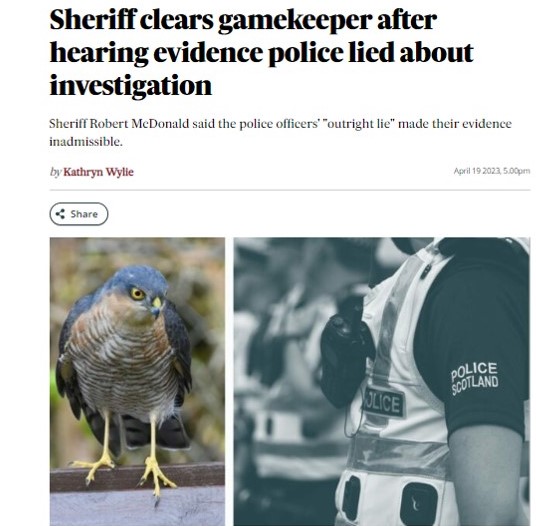
A gamekeeper has been cleared of illegally trapping a protected bird after it emerged police officers lied during the course of the investigation.
The case against Terry Lindsay collapsed when Sheriff Robert McDonald heard evidence that officers misled two people about why they were on the Fyvie Estate.
Police had received a tip-off that a sparrowhawk was “beside” a trap but lied to estate staff about why they were there – instead saying it was to look for a missing person.
Sheriff McDonald said that “outright lie” made the police officers’ evidence inadmissible and acquitted Mr Lindsay, 40, less than an hour after the trial started at Banff Sheriff Court.
“It seems to me that the critical point is the lying,” Sheriff McDonald said.
“I think the evidence of the search is inadmissible. It’s fatal that police have told an outright lie to two members of the public who, as I pointed out, had some authority as to who comes onto the land.
“That compounds it. I find the evidence inadmissible.”
A Police Scotland spokesman said: “We are aware of the outcome in court and the full circumstances leading to yesterday’s trial are being reviewed.”
The verdict was met with “disappointment” by the RSPB, the bird welfare charity which initially came across the trap and reported its whereabouts to police.
Pc Alison Davis told the trial she and her sergeant, Gary Johnston, spent about an hour scouring the estate on August 26 2020 after an RSPB informant made them aware there was a “trap with a bird beside it”.
She told procurator fiscal Gerard Droogan they were approached by a gamekeeper and the laird, Sir George Forbes-Leith, and told both that they were searching for a missing person.
“There was no truth in that as far as I am aware,” Pc Davis said, before adding: “He [Sgt Johnston] said to me afterwards that he was concerned that any evidence would be lost, or words to that effect.”
Mr Lindsay’s defence agent Paul Anderson asked Pc Davis why neither conversation was included in her statement.
She replied: “I didn’t consider them to be witnesses. I didn’t think of that as relevant to the inquiry. That’s why it’s not in my statement. It was certainly not intentionally left out.”
Mr Anderson asked: “Two lies were told in the space of one hour to two separate members of the public?”
“Yes,” replied the officer.
During her evidence, Pc Davis also explained how they eventually found the trap with a sparrowhawk inside around 20 metres from a pheasant breeding operation on the estate.
The bird was alive, she took photos of it and they released it, before placing the trap in the back of the van, she said.
Mr Anderson said this decision to lie, alongside a decision to search the land “without reasonable cause to suspect someone was committing an offence”, made any police evidence “unreliable and uncredible”.
“There were lies told to two members of the public within one hour about why police were on the land,” he told Sheriff McDonald.
“It’s inexcusable. The evidence is so tainted it cannot be considered by the court.”
He added the lies became “fatal to the search” and invited the sheriff to offer an acquittal.
Sheriff McDonald agreed and Mr Lindsay, of North Haddo, Fyvie, was acquitted of the charge under the Wildlife and Countryside Scotland Act 1981.
Speaking after the case, the RSPB said more needed to be done to regulate the use of traps.
Ian Thomson, RSPB Scotland’s head of investigations, told The Press and Journal: “While we are disappointed that this case was dismissed after the court considered witness evidence from the police, we remain concerned that traps authorised by the General Licences issued annually by NatureScot continue to be poorly regulated, with no compliance monitoring, and are widely misused and abused.
“We hope that provisions introduced by the Wildlife Management and Muirburn Bill, currently being considered by the Scottish Parliament, bring better training, accountability and tighter regulation of such devices that are in widespread use on gamebird shooting estates in particular.”
A Fyvie Estate spokesman said: “As per other legally set Larsen traps, a sparrowhawk was caught and upon Mr Lindsay checking the trap, he found the police in attendance. The sparrowhawk was released unharmed by police officers.
“All traps are licensed and tagged, and a meat bait return form is completed as per Nature Scot guidelines showing the release of non-target species caught. The beauty of this type of trap is that they are checked several times a day and birds can be released unharmed.”
ENDS
My understanding is that the main inaccuracy in this article is that the RSPB did not report a sparrowhawk being “beside” a trap to Police Scotland. Rather, the RSPB reported what appeared to be an illegally-set trap. It was suspected to be illegally-set because the trap didn’t appear to have a trap registration number attached to it (this is one of the conditions of the General Licence) so quite rightly, the RSPB reported it to Police Scotland for investigation.
By the time Police Scotland attended the scene, a raptor had been caught in the trap. It’s been reported that this was a sparrowhawk but the photographs suggest it was a goshawk. The species ID isn’t a significant issue though – it’s not unlawful to trap a raptor inside a clam trap, whatever species it is; it only becomes unlawful if the raptor isn’t released, unharmed, as soon as it’s discovered by the trap operator during the daily trap check. In this case, the police officers released the unharmed hawk, so no problem there.
Those are the two main inaccuracies in the article, as far as I’m aware.
What happened in court, according to the article, I’ll have to take at face value.
It seems the fact that the two Police Scotland officers lied to the estate owner and to the gamekeeper about their reason for being on the estate is not disputed. Unfortunately, the article doesn’t examine why the police officers lied about it. If they had reasonable suspicion that a crime may have been committed, they had full authority to enter the estate and conduct an initial land search, without a warrant. There was no reason for them to lie about the purpose of their visit – they had the authority to be there, under Section 19 of the Wildlife & Countryside Act 1981, which states:
‘If a constable suspects with reasonable cause that any person is committing, or has committed, an offence under this Part, he may, for the purpose of exercising the powers conferred by subsection (1), enter any land other than a dwelling or lockfast premises‘.
So why lie about their reason for visiting the estate? Why did they pretend they were looking for a missing person?
The only explanation I can think of (and this is pure speculation because I haven’t spoken to the two officers about it), is that they weren’t specialist Wildlife Crime Officers and so didn’t understand the extent of their powers to access the land and search for evidence.
If that is the case, it still doesn’t justify them lying to the landowner and the gamekeeper, but it perhaps provides an explanation of sorts.
Whatever their reasoning was, however, their actions are an embarrassment to Police Scotland and I hope that the ‘review of the full circumstances’, as stated in the P&J article, leads to lessons being learned.
For clarity, and for the benefit of anyone who might comment on this case, please note that gamekeeper Mr Lindsay was acquitted and any evidence about the alleged illegally-set trap was not put before the court because the Police Officers’ evidence was deemed inadmissible.
 Raptor Persecution UK
Typical police cock-up where wildlife crime is concerned, you have to wonder because it happens on so many occasions, is it done on purpose ?.
It is one explanation. There are others.
Another angle. If the Police had told the truth, one phone call to a member of staff could xxxxx xxxxx xxxxx xxxxx xxxxx xxxxx xxxxx xxxxx xxxxx xxxxx. xxxxx xxxxx xxxxx xxxxx xxxxx xxxxx xxxxx xxxxx xxxxx xxxxx xxxxx. If the officers had said in their report that they lied to protect [Ed: potential] evidence from being tampered with to prove a wrongdoing what would be the outcome???
The first issue here is that this type of trap, baited with a carcase, should not be legal, because it is bound to catch raptors, and I think I am not being too controversial in saying [Ed: rest of paragraph deleted as libellous. Your points are valid, but they can’t be ascribed to this case because nobody has been convicted of wildlife crime].
Also, the claim the police lied here seems to be dubious. Subterfuge in police investigations is necessary, or otherwise hardly any crimes would be detected. Clearly it is wrong if the police lie about evidence used to convict someone. But using subterfuge, not to alert [Ed: suspected] criminals to the fact the police are investigating their [Ed: alleged] crimes, is an important part of policing and always has been.
I think it should be that the police or proper authority, should have the right to inspect organized managed shoots, and they should all have to be licenced shoots. This has always being the case with licenced premises selling alcohol, places serving food etc, because if inspections are by appointment, it is hardly likely that the relevant authorities will find evidence of illegal actions. We live in an age, where the police are allowed to stop and search vehicles, people etc. And yet managed shoots, where there is strong evidence, that criminal actions are rife, and may indeed be standard practice, cannot be inspected. In other words, there is one set of rules for them, and another set for the rest of the public.
Governments have the ability to clamp down on illegal raptor persecution, using methods and laws in common use elsewhere, but managed shoots are given special dispensations, that allow them to engage in widespread criminality, which will never be detected or prosecuted, because the authorities aren’t allowed unannounced inspections, as is common elsewhere.
I’m with you 💯 percent
I wonder how many of those clam traps are out there now, baited in the same way? Certainly hundreds, maybe thousands. They are easily stored or stashed in nearby bushes when not in use, highly portable (some are smaller than this one), easy to set and can be set very quickly and discreetly next to the familiar perching spots of several target species.
[Ed: comment deleted as libellous]
[Ed: comment deleted as libellous]
Sad to say, but this appears to be a case of Police incompetence by not understanding their powers and being properly prepared for what may happen.
Quite what Scottish law says about Police Officers ‘not telling the whole truth’ or ‘outright lying’ during an investigation, but outside of a formal interview, is – as far as I can tell – not specifically addressed.
Neither can I find any guidance on the judiciary directing cases over such a matter, because the Police certainly did not lie to the court (which would be serious).
Maybe, the Sheriff was ‘winging it’ and ‘inventing new law’?
I’m no lawyer or expert on the police, or their procedure. But I know enough, that I would have thought it highly unusual, if the police carrying out preliminary inquiries or observations about a [Ed: suspected] criminal matter reported to them, would tell the possible xxxxx/suspects that their xxxxx activity had been reported to them, and this was what they were investigating them. If this were how it worked hardly any criminals would get caught or detected.
Totally agree Stephen , this seems a very simple case of the police not tipping off potential suspects. End of! Don’t knock the police, anyone concerned about raptor persecution would have lied in these circumstances imo.[ maybe they should have sent a letter requesting an inspection…….]
This is a good example of why certain groups only want police to be able to deal with wildlife crime.
This is a basic wildlife crime investigation failed because of police failures.
SSPCA should be given additional powers this will provided valuable expert skills and resources.
Make sure to comment on up and coming goverment consultation.
I wonder how often situations similar to this occur annually?-
I’m surprised that Scottish Access Law doesn’t give police officers responsible access to the countryside. In fact, I don’t believe it.
Question ‘Why are you on my land?’
Answer ‘We are responsibly exercising our right of access, under the 2003 legislation’.
For the life of me I cannot understand why the police are not allowed to mislead suspects, or other people with whom they don’t want to share their actual purpose, whilst undertaking an investigation. What matters is that they don’t lie in their evidence when something goes to court.
What I would like to know is precisely what the gamekeeper was charged with. If the charge made it clear that the offence was the setting of an untagged trap, in a situation where it would otherwise not have been illegal had it been tagged, then I would suggest that the case should have proceeded, notwithstanding the subterfuge quite acceptably (in my opinion) used by the Police. Meeting the two people and what was said to them had absolutely no bearing on the case. In the absence of any indication that the evidence adduced was either inaccurate or misleading, the case should have either been heard or adjourned for clarification of what was actually at issue.
Absolute idiots.
What were they thinking?
How often does this happen I wonder
If this is the best way the polis have to spend their time then we are doomed. Absurd. No wonder my tax is so high.
Perhaps – thinking of efficiencies, the police combined their trip to the locality with some routine home inspections of gun cabinets for Shotgun Cert / FAC applications or renewals in the area? That shoddy system is – as we all know, heavily subsidised by everybody’s taxes. Which isn’t right, is it?
And of course a fair system for checking on curious looking trapping operations – that would not oblige the police to scratch about looking at traps themselves – would be to bring in a fee paying “commercial shoot licensing scheme” whereby a small percentage of the profits from shooting operations would effectively pay for site inspections by trained enforcement officers.
Perhaps you need to do some more research.
I have a shotgun certificate and it’s not heavily subsidised.
My latest renewal cost me £50 and a £30 letter from My doctor to say I have no mental health issues that would effect my ability to keep my certificate that I’ve held for over 20 years.
A lot people fail to appreciate that people who hold certificates are much more likely to be law abiding citizens as any crime will likely result in removal of said certificate.
I can assure you that the process is far from shoddy
I am in the same boat regards renewing my certificates, from first application aged 16. I say it is a shoddy system – and many people on the shooting forums would agree – because of the idiosyncratic way in which application systems are run, which vary greatly from one county constabulary to another. And of the role of the personal attitude of specific Firearms Licensing Officers. BASC have plenty to say on this point alone. But it is the case as has been explained many times that our fees do not actually cover the administration of the system, the shortfall being made up by general policing budget. I personally would be content to pay £150 per year for an overhauled system that was fit for purpose. Any more than that and I suppose it would force my mind on whether I really ought to pack in altogether, which would be a good thing for many people to do as well.
Why should certificate holders have to pay anything? Having to have a certificate certainly doesn’t benefit the holder. Certification is supposed to be for “public protection” therefore should be funded by the public as is everything else that is for the publics protection.