
There have been a number of written Parliamentary questions in recent weeks relating to wildlife crime, and particularly to addressing raptor persecution.
Here’s the first one, submitted by Caroline Lucas MP (Green Party):
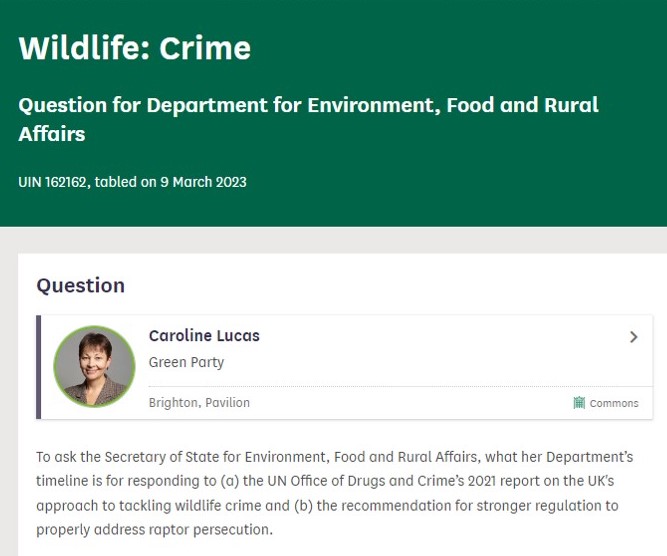
The report to which Caroline is referring is the UN Office of Drugs and Crime’s Wildlife and Forest Crime Analytical Toolkit Report: United Kingdom of Great Britain and Northern Ireland (2021), which is basically a comprehensive review of the prevalence of wildlife crime in the UK and an assessment of judicial responses. The report provides a series of recommendations that the UK and devolved Governments could implement to better address the issues.
The summary recommendation for addressing raptor persecution is as follows:
‘To bolster the legislative framework required to properly address raptor persecution, the WCA and licensing regime across the entire UK should be synthesised and aligned. As it currently stands, the discrepancy in sentencing, vicarious liability, disqualification powers, and more (for example, operationalisation of the pesticide provisions in the WCA), presents a confusing picture to law enforcement and the public. Though raptor persecution has been set as a priority for the UK, the differences in the statutory and licensing regimes present many obstacles to ensuring raptors receive the same level of protection across the entire UK‘.
You can download the report here:
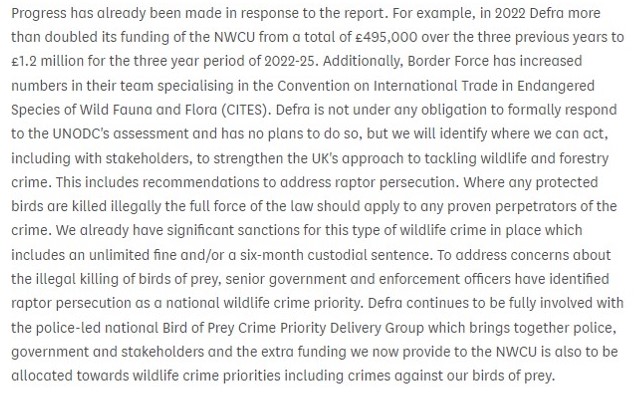
Caroline’s written question was answered last Friday by Trudy Harrison, the Parliamentary Under Secretary of State in DEFRA, as follows:

As we’ve come to expect from DEFRA, this is little more than airy waffle.
Harrison says: “Where any protected raptors are killed illegally the full force of the law should apply to any proven perpetrators of the crime“.
Yes, it should, but it routinely isn’t.
Harrison says: “We already have significant sanctions for this type of wildlife crime in place which includes an unlimited fine and/or a six-month custodial sentence“.
Indeed, these sanctions are in place but there has only ever been one custodial sentence handed down to a raptor-killer – and that was in Scotland in 2015 when gamekeeper George Mutch was given a four-month custodial sentence for crimes he committed in 2012 (here). There haven’t been any others since then, and a custodial sentence has never been handed down in England, Wales or Northern Ireland for raptor persecution crime.
Harrison says: “To address concerns about the illegal killing of birds of prey, senior government and enforcement officers have identified raptor persecution as a national wildlife crime priority“.
Raptor persecution was identified as a national wildlife crime priority in 2009. That’s 14 years ago, and hundreds of birds of prey have been illegally killed in the UK since then.
Harrison says: “Defra continues to be fully involved with the police-led national Bird of Prey Crime Priority Delivery Group which brings together police, government and stakeholders“.
This so-called Priority Delivery Group has been in place since 2011 and has delivered absolutely nothing of meaningful effect since then, largely due to the fact it is dominated by pro-shooting organisations who have a stranglehold on any progress that could have /should have been made. In my view, it’s a partnership sham, designed to look as though efforts are being made to effectively tackle illegal raptor persecution in England and Wales (see here).
Harrison says: “The extra funding we now provide to the NWCU is also to be allocated towards wildlife crime priorities including crimes against our birds of prey“.
The additional funding for the NWCU is really the only meaningful effort that DEFRA has made in over a decade, but it’s for the seven national wildlife crime priorities, not just for raptor persecution. The NWCU has played a valuable role in raptor persecution investigations in recent years, often partnering with others on multi-agency raids, and whilst that has been a significant and welcome move, the bottom line is that the NWCU can’t force any police authority to investigate raptor persecution, as we saw so clearly with the botched investigation by Dorset Police into the poisoned white-tailed eagle. NWCU officers were just as frustrated as the rest of us but they can only offer advice and training to Police forces; they can’t compel them to run a decent investigation, no matter how much they would want to.
 Raptor Persecution UK
As usual they say much but do little.
The response is a load of recycled tosh and weasel words (sorry weasels) that we have come to expect from politicians of all parties. I hope Caroline Lucas and her colleagues will fire off some follow up questions. If nothing else, it will keep the issue in the public eye.
Basically we need a licencing scheme for all shoots across the UK (not just Scotland), with loss of the shoots licence for wildlife crimes being committed. We need vicarious liability fines of high enough level to deter crime, much harsher sentencing so that the police can offer deals in return information leading to further arrests, so the whole pack of cards come tumbling down.
However with the current UK government’s line on helping their mates and donors out, the chances of anything happening, except more raptor deaths, is zero.
I’m sure nobody is in the least surprised at the total lack of interest in the pursuit any kind of serious investigation into the persecution of Raptors. The efforts of the people responsible for the policing of this problem are an insult to any decent person. Its frustrating and annoying. The perpetrators are the lowest form of life, the police do next to nothing, and the likes Caroline Lucy’s do nothing about the Police. We’re having to deal with a system which is rotten to the core, and will remain so until the people that work within the system earn the money they take from the taxpayer’s pocket!!!!!
Should be Caroline Lucas, not Lucy’s
Let’s not forget that in 2016 the NWCU nearly closed but won a reprieve in the last few weeks of its funding.
https://amp.theguardian.com/environment/2016/mar/01/uks-national-wildlife-unit-wins-late-reprieve-from-closure
And the article pointed out that (even then) £25m had been spent on slaughtering badgers whilst the NWCU only required £500,000. Priorities indeed.
The real problem is a Justice one and the requirement for evidence of a raptor crime actually taking place. Without that, any enquiry into any particular incident will go nowhere due to this fact.
Without undercover officers targeting likely offenders, and capturing them in the the act of committing a crime any such crimes will not proceed to court.
The costs of doing this are immense although the police forces of the UK already are efficient at targeting drug cartels and bringing them to justice. Government money would need to be available to organisations who could carry out such work in partnership with the police. This would be a big ask in the present climate and therefore would not happen.
Having worked in this arena (crime)for a considerable time, I agree. There are two issues, the burden of proof (presuming a death can be deemed a crime, which is not an insignificant hurdle) and operational effectiveness/feasibility. The easiest defence is to create the merest element of doubt, a conviction ‘beyond reasonable doubt’ is then almost impossible and vulnerable to appeal. The ‘balance of probability’ as applied to civil law is certainly operationally and practically helpful but how that would occur is difficult to imagine. The second issue is the realistic task of the prosecution. The scenes of raptor crimes are invariably isolated, open to the elements and lay undiscovered for how long we don’t know. The reason murder detection rates in the UK are generally very good is that from the point of crime/scene identification an open cheque is created: presumably the public expect this. The scenes are often covered, accessible and often the crime is witnessed (physically or otherwise). The resources (police, forensic services, CPS and others ) allocated are colossal both in teams of bodies and costs. Prevention is always the mantra. Remove/severely restrict the cause. It is so easy to be defeatist given experience. Thank you Ruth et al .I will continue to write to my MP and support in any way I can.
What are the plans of the Labour and Liberal parties to tackle these crimes, come the day?
A very good question. They, and the Greens, need to be visible between now and the next election in setting out their views and proposals on these matters, so ensuring that the issues get a good airing.. There must be votes to be gained by these parties setting up their shops properly and showing that they understand what the issues are and where the problems lie.
“What are the plans of the Labour and Liberal parties to tackle these crimes, come the day?”
Cough! Well, the Labour Party has been in power at Westminster from 1964 to 1970, and then from 1974 to 1979. After that, it also held power between 1997 and 2010…
While the Lib Dems held the balance of power at Westminster between 2010 and 2015… (and appear to even support the Tories in Scotland on hunting with dogs…)
Wildlife crime received very little attention in any of those administrations. Getting Labour to ban hunting was like trying to get blood out of a stone at the time…
Whatever: the penalties are pathetic: that is the true indicator of the priorities of the governments and the government departments involved
Investment in the NWCU increased to £1.2 million over three years shared between 30.3 million taxpayers works out at 1.32p per person per annum. I’m willing to pay at least 10x that.
The crux of the problem is, in my opinion, that only minority parties take this seriously because any Party with a realistic path to power answer to those who have an interest, financial or political or simply social networking, in maintaining the Status Quo. Let’s be realistic here, Driven Grouse Shooting is not the sport of anyone but those in Social Class A who use the hegemonic powers that usually accompany that status to frustrate any efforts ot make it function within the law. The positions of power these individuals hold also extends to the career paths of those employed by the Organisation they and thgeir friends have prominent position in. To believe otherwise is simply a denial of the facts. I maintain that this has been adequately illustrated by the countless years of frustration by many dedicated individuals to bring change in their practises only to see their efforts brought to an abrubt halt by inexplicable decisions not to investigate or prosecute while those founf guilty generally attract paltry sentences out of line with the seriousness of the offence/s they were founf guilty of.
Madness has been defined as doing the same thing over and over again while expecting different results.
Something has to change — and it will not come from the areas where an uninformed observer might expect it too. Ever!
Hi George, likely you meant your last sentence in the political sense but it made me think a bit about where some change might come from that might suprise the “uninformed observer”. And I think for me it is the banning of medicated grit. People generally don’t realise just how critical it is. Kick that leg of the three-legged-stool away, and at a stroke you have removed the economic viability of the highly intensive DGS model and thereby the current (mid-90’s to present day) level of highly intensive raptor persecution will be significantly reduced (although still far from eliminated).
Yes indeed, Spagnum. medicating wild creatures for sport has many implications, not least other conditions that might spring from it and negatively affect human health too. The publicity around it must be direct. to the point and very visible in terms of promotion.
So many of us play within the unseen rules in regards to heirarchy that are passed on to us through social interactions and education that are so limiting.
The trouble seems to be that so many with the capabilities to turn new creative ideas into reality are hamstrung by their employment due to the source of the power we are fighting as these characters habitually use their position to inhibit employees. I am very aware of the extremely hard choice folk in those positions find themselves in.
Undermining the financial aspect of it would possibly have the consequence of reducing the intensive management which is now the dominant model.
i do have my suspicions that DGM’s have a hierarchial role too in announcing that “one has arrived” in the world of power and finance if invited to a top tier grouse moor. I fancy that this operates at lower levels too with the military industrial complex prominent in every area.
I would be interested to know, Ruth, whether Wild Justice may be able to deploy its legal team to get these laws reviewed to show how poorly they are implemented and how criminals are given free rein as a result. Solve one crime and you’ll probably find more.
My other thought is that thousands of people could bombard Prince William’s inbox. He is the president? of the BTO and, ironically, a prominent shooter. And make life so uncomfortable for him that there may be a shift in attitude, however small
Rachel,
It’s not as straightforward as that, I’m afraid. There needs to be a ‘legal hook’ on which to base a challenge. For example, the main type of legal action WJ has been involved in so far has been on bringing judicial reviews, but this is dependent on finding a fault either in a public authority decision, or in the process used to reach that decision. Not only that, an action for a judicial review is time limited (it has to be brought within 3 months of the decision being made) and within that 3 months you first have to engage in pre-action protocol correspondence to give the public authority an opportunity to respond to the challenge before you can even begin to apply to a court for permission to proceed.
Personally I wouldn’t support a bombardment of correspondence to William. It’s been done before (to other members of the royal family) and is clearly not going to change their mindset. In my view, it’s far more useful, and productive, to write to your own MP/MSP etc about your concerns. They are the law-makers and things will only change if they can see that these issues are important to their constituents (=votes).
Thank you very much for your reply.
I completely get what you say. Let’s hope there will opportunities in the future