In July last year, the Scottish Government finally got around to establishing an independent Taskforce to consider whether the Scottish SPCA should be granted additional powers to help investigate raptor persecution and other wildlife crime (see here).
As a quick recap, the SSPCA’s current powers (under animal welfare legislation) limits their investigations to cases that involve a live animal in distress (including some wildlife crimes). The proposed new powers would allow them to also investigate wildlife crimes under the Wildlife & Countryside Act legislation, e.g. where the victim is already dead, and also incidents where a victim may not be present (e.g. if an illegally-set pole trap or a poisoned bait was discovered). See here for further detail.
This Taskforce, chaired by Susan Davies FRSB, was established after 11 long years of political can-kicking by the SNP only because the Scottish Greens insisted on its inclusion in the historic Bute House Agreement, the power-sharing policy document published by the two parties in 2021:
‘The independent taskforce to consider whether the Scottish Society for the Prevention of Cruelty to Animals (Scottish SPCA) should be given extra powers to investigate wildlife crime will be asked to report back in a timeframe that will allow any changes to the Scottish SPCA powers to be delivered by legislation implementing changes to grouse and other wildlife management in the course of this parliamentary session‘.
It was expected that the Taskforce’s recommendations would feed into the forthcoming draft legislation on grouse moor licensing (the Wildlife Management (Grouse) Bill) that is expected to progress to Stage 1 of parliamentary scrutiny in the coming weeks (see here).
Indeed, in December 2022, the Scotsman ran an article suggesting that the Scottish Government had said the Taskforce’s review was complete and would be published ‘within weeks‘ (see here), just in time to be considered alongside the Wildlife Management (Grouse) Bill.
However, as has happened so often on this particular issue, it looks like the Scottish Government has moved the goal posts.
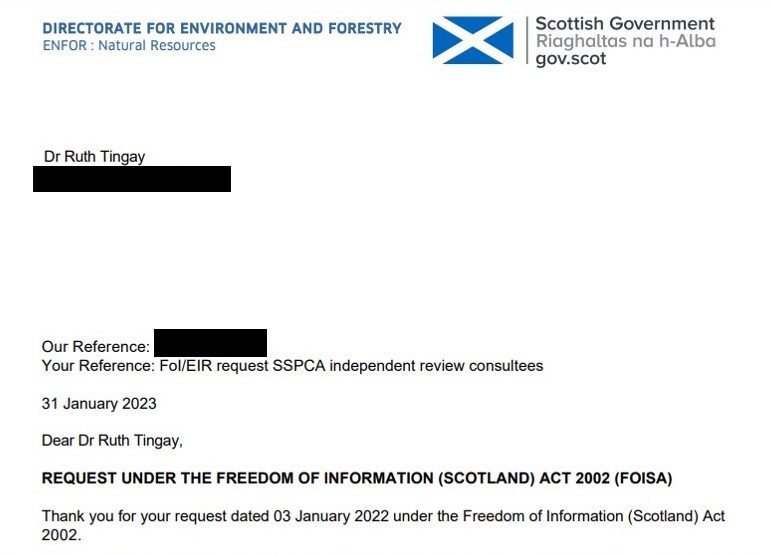
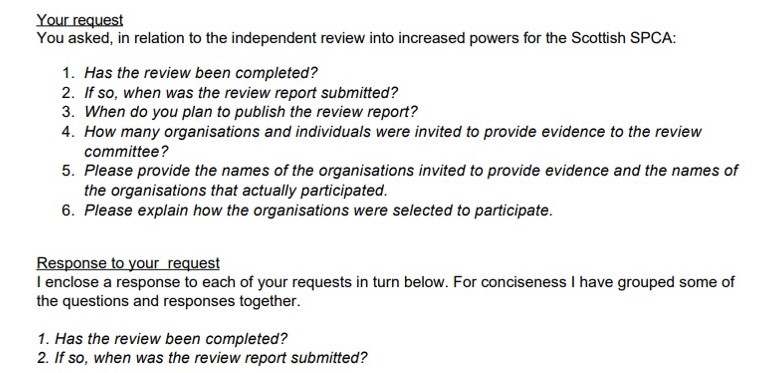
I submitted a Freedom of Information request to the Scottish Government at the beginning of January 2023, asking, amongst other things, for details of when the Taskforce’s review would be published.
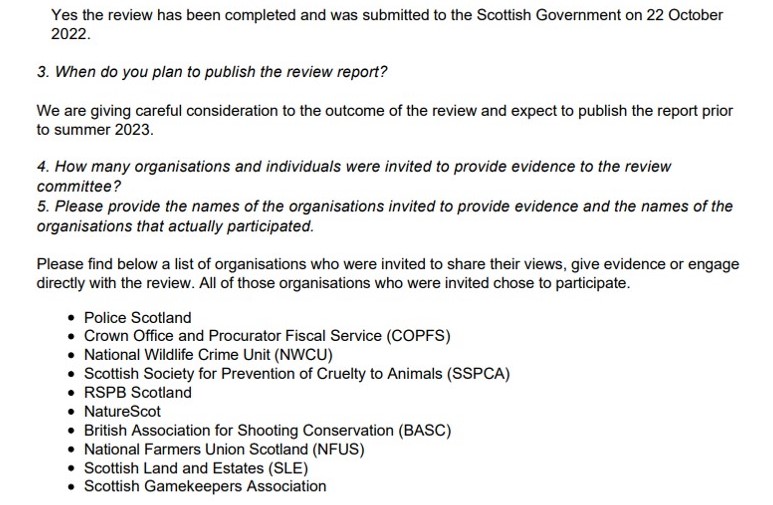
The Government’s response, which I received yesterday evening, said the review had been submitted to the Government on 22nd October 2022 but wasn’t expected to be published until ‘prior to summer 2023‘. That’s quite a different response to the one the Scotsman reported of the Government expecting it to be published ‘within weeks‘.
Does that mean the Taskforce’s recommendations won’t be fed into the Scottish Parliament’s consideration of how the forthcoming grouse shooting licencing scheme will operate and be enforced? How does that meet the requirements laid out in the Bute House Agreement between the Scottish Greens and the SNP?
But that’s not the only concern uncovered by the FoI response.
I also asked the Scottish Government some questions about which organisations and individuals were invited and had contributed evidence to the Taskforce review. The answer is alarming to say the least, with invited participants heavily weighted to the game-shooting industry:
Apart from RSPB Scotland, where were the invites to other conservation and wildlife organisations such as Scottish Badgers, Scottish Raptor Study Group, OneKind, League Against Cruel Sports, REVIVE coalition, Scottish Wildlife Trust, Scottish Environment Link etc? Why were they excluded, when they all have legitimate and evidenced concerns about the poor level of wildlife crime enforcement that has led to the proposed extended powers for the SSPCA?
Why were the majority of invited non-governmental organisations those who have previously been vociferous in their opposition to increased SSPCA powers (e.g. see here, here and here) and who presumably, despite their rhetoric about having a ‘zero tolerance’ for raptor persecution/wildlife crime, are still dead set against measures that would help tackle it?
I’ve gone back to the Scottish Government to ask for the ‘key list of stakeholders and those who had previously engaged with [the Scottish Government] on the matter of SSPCA powers‘ that was provided to the Taskforce Chair, to determine whether this bias was determined by the Scottish Government or by the Taskforce Chair.
Either way, if the Taskforce recommendations do not support increased powers for the SSPCA, this inherent bias in participation leaves the Government wide open to a potential legal challenge by conservationists who could argue that their exclusion from participating in the review has resulted in an unfair process.
There is an alternative view. Let’s say that the Taskforce review does recommend increased powers for the SSPCA, then by inviting an overload of anti-SSPCA game shooting organisations, the Taskforce Chair has cleverly covered off any opportunity for them to suggest their views were under-represented in the review process.
Unfortunately, it looks like we have many more months of waiting to find out what, exactly, the Taskforce review recommends. And if our experience of the Werritty Review is anything to go by, we may be waiting a further year for the Government to set out its response to the Taskforce’s recommendations.
UPDATE 7th February 2023: Scottish Government will provide response at same time the Taskforce review on SSPCA powers is published (here).
UPDATE 7th March 2023: More detail provided on why key conservation organisations were excluded from Scottish Government’s review on increasing SSPCA powers (here).
For those new to this subject, here’s the political timeline, now in its 12th year, that has led to the current position:
February 2011: Increased powers for the SSPCA was first suggested by MSP Peter Peacock as an amendment during the Wildlife & Natural Environment (Scotland) Bill debates. The then Environment Minister Roseanna Cunningham rejected it as an amendment but suggested a public consultation was in order.
September 2011: Seven months later Elaine Murray MSP (Scottish Labour) lodged a parliamentary motion that further powers for the SSPCA should be considered.
November 2011: Elaine Murray MSP (Scottish Labour) formalised the question in a P&Q session and the next Environment Minister, Stewart Stevenson MSP, then promised that the consultation would happen ‘in the first half of 2012’.
September 2012: Nine months later and nothing had happened so I asked Paul Wheelhouse MSP, as the new Environment Minister, when the consultation would take place. The response, in October 2012, was:
“The consultation has been delayed by resource pressures but will be brought forward in the near future”.
July 2013: Ten months later and still no sign so I asked the Environment Minister (still Paul Wheelhouse) again. In August 2013, this was the response:
“We regret that resource pressures did further delay the public consultation on the extension of SSPCA powers. However, I can confirm that the consultation document will be published later this year”.
September 2013: At a meeting of the PAW Executive Group, Minister Wheelhouse said this:
“The consultation on new powers for the SSPCA will be published in October 2013“.
January 2014: In response to one of this blog’s readers who wrote to the Minister (still Paul Wheelhouse) to ask why the consultation had not yet been published:
“We very much regret that resource pressures have caused further delays to the consultation to gain views on the extension of SSPCA powers. It will be published in the near future“.
31 March 2014: Public consultation launched.
1 September 2014: Consultation closed.
26 October 2014: I published my analysis of the consultation responses here.
22 January 2015: Analysis of consultation responses published by Scottish Government. 233 responses (although 7,256 responses if online petition included – see here).
I was told a decision would come from the new Environment Minister, Dr Aileen McLeod MSP, “in due course”.
1 September 2015: One year after the consultation closed and still nothing.
25 February 2016: In response to a question posed by the Rural Affairs, Climate Change & Environment Committee, Environment Minister Dr Aileen McLeod said: “I have some further matters to clarify with the SSPCA, however I do hope to be able to report on the Scottish Government’s position on this issue shortly“.
May 2016: Dr Aileen McLeod fails to get re-elected and loses her position as Environment Minister. Roseanna Cunningham is promoted to a newly-created position of Cabinet Secretary for the Environment.
12 May 2016: Mark Ruskell MSP (Scottish Greens) submits the following Parliamentary question:
Question S5W-00030 – To ask the Scottish Government when it will announce its decision regarding extending the powers of the Scottish SPCA to tackle wildlife crime.
26 May 2016: Cabinet Secretary Roseanna Cunningham responds with this:
A decision on whether to extend the investigatory powers of the Scottish SPCA will be announced in due course.
1 September 2016: Two years after the consultation closed and still nothing.
9 January 2017: Mark Ruskell MSP (Scottish Greens) submits the following Parliamentary question:
Question S5W-05982 – To ask the Scottish Government by what date it will publish its response to the consultation on the extension of wildlife crime investigative powers for inspectors in the Scottish SPCA.
17 January 2017: Cabinet Secretary Roseanna Cunningham responds:
A decision on whether to extend the investigatory powers of the Scottish Society for the Prevention of Cruelty to Animals will be announced in the first half of 2017.
31 May 2017: Cabinet Secretary Roseanna Cunningham rejects an extension of powers for the SSPCA ‘based on legal advice’ and instead announces, as an alternative, a pilot scheme of Special Constables for the Cairngorms National Park (here). It later emerged in 2018 that this pilot scheme was also an alternative to the Government’s 2016 manifesto pledge to establish a Wildlife Crime Investigation Unit as part of Police Scotland – a pledge on which it had now reneged (see here).
November 2019: The pilot scheme of Special Constables in the Cairngorms National Park was an absolute failure as a grand total of zero wildlife crimes were recorded by the Special Constables but plenty were reported by others (see here).
June 2020: Mark Ruskell (Scottish Greens) proposed further powers for the SSPCA at Stage 2 of the Animals and Wildlife Bill. The latest Environment Minister, Mairi Gougeon persuaded him to withdraw the proposed amendment on the basis that she’d consider establishing a taskforce to convene ‘this summer’ to consider increased powers (see here).
December 2020: Mark Ruskell (Scottish Greens) submits two Parliamentary questions asking about the status of the taskforce and who is serving on it (see here).
January 2021: New Environment Minister Ben Macpherson says the taskforce has not yet been appointed but that it is “expected to be established later this year“ (see here).
September 2021: In the 2021 to 2022 Programme for Government it was announced that the ‘independent taskforce [Ed: still to be appointed] will report before the end of 2022’ (see here).
May 3 2022: In an interview with Max Wiszniewski of the REVIVE coalition for grouse moor reform, new Environment Minister Mairi McAllan said: “It’s imminent and I wish I could tell you today but we are just finalising the last few points for the membership but I’m hoping to be able to make an announcement about that in the next few weeks“ (see here).
1 July 2022: Scottish Government announces Susan Davies has been appointed to lead the taskforce review and will ‘publish a report later this year’ (see here).
27 December 2022: A Scottish Government spokesperson tells Scotsman journalist the taskforce has completed its review and its findings will be published ‘within weeks’ (see here).
31 January 2023: An FoI response from the Scottish Government to this blog’s author reveals the Taskforce’s review was submitted to the Scottish Government on 22nd October 2022 and will be published ‘prior to summer 2023’.
7 February 2023: Scottish Government tells journalist from The Scotsman that it will provide a response at the same time the Taskforce review on SSPCA powers is published (here).






 Raptor Persecution UK