JOB VACANCY: Red Kite Field Officer, Northern Ireland

RSPB job advert

Red Kite Field Officer (Fixed Term)

Reference:NOV20218665
Expiry date:23:59, 12 December 2021
Location:RSPB Northern Ireland
Salary:£18,100.00 – £20,080.00 Per Annum
Benefits:Pension, Life Assurance, 26 days Annual Leave (pro-rata)
Duration:6 months

Are you passionate about species conservation? Interested in gaining valuable research and monitoring experience, while working with one of the UKs most recognisable raptors? RSPBNI is looking for an enthusiastic individual with experience in monitoring birds of prey for a six-month post in County Down, Northern Ireland.

The role

Red Kites were reintroduced to Northern Ireland in 2008 and since then the local population has been monitored by a dedicated team of staff and volunteers.

Your role will be to collect data on wintering and breeding Red Kites at their strongholds in the Dromara Hills and surrounding areas. This will include winter roost surveys, nest finding and monitoring to assess productivity, associated data entry, and supporting and coordinating a team of volunteers. The post holder will need to have previous experience in finding and monitoring raptor nests.

This is an exciting opportunity to work alongside a passionate team in one the most spectacular places in Northern Ireland. Please note that the successful candidate will be required to work unsociable hours, including the occasional weekend, depending on the weather.

Key activities will include:

  • Winter Red Kite roost watch surveys.
  • Nest location and monitoring of Red Kites.
  • Developing and upkeeping relationships with stakeholders and landowners.
  • Delivering appropriate species protection for priority species in identified geographical/priority areas.
  • Manage all relevant data to ensure it is stored and analysed appropriately to allow review of work programmes and future planning.
  • Build appropriate positive relationships with key external partners and stakeholders so that RSPB’s monitoring of species and habitats, policies and messages are understood within relevant partnerships and fora.
  • Contribute to the delivery of RSPB’s conservation programme away from reserves focussing on monitoring and species protection to help deliver Saving Nature Outcomes.
  • Supporting and coordinating a team of volunteers – including on tasks such as data management, monitoring, and wing-tagging.

Essential skills, knowledge and experience:

  • Higher level qualification in a relevant subject or ability to show equivalent work experience e.g., field season conducting raptor surveys.
  • Knowledge of bird and wildlife ecology, habitat requirements and identification to enable credibility in the role.
  • Organisational skills e.g., maintenance and analysis of datasets, and managing conflicting priorities.
  • Ability to work effectively as a team player both internally and externally.
  • Effective communication skills (verbal, written and presentational) – including an ability to speak confidently and cogently in public to a variety of audiences.
  • Ability to be diplomatic.
  • Experience of working to survey, protect and/or manage important sites, species or habitats.
  • Experience of managing volunteers and setting clear work priorities.
  • Experience of working with land managers e.g., farmers, woodland owners
  • Ability to rapidly analyse significant quantities of information, prioritise and balance a diverse workload often to tight deadlines.
  • Knowledge of the wildlife and habitats of the operational area of this role
  • Experience of public engagement work e.g., attendance at county shows and events.
  • Experience of productive Partnership working.
  • Specialist conservation knowledge in relevant habitat /species areas.

This is a Contract, Full Time role for 6 months. The RSPB reserves the right to extend or make this role permanent without further advertising dependent on business needs at the end of the contract term.

We are looking to conduct interviews for this position from 21st December 2021. For further information please contact Neal.Warnock@rspb.org.uk.

As part of this application process you will be asked to complete an application form including evidence on how you meet the skills, knowledge, and experience listed above.

The RSPB is an equal opportunities employer. This role is covered by the Rehabilitation of Offenders Act 1974.

ENDS

Organic farm ‘East Coast Organics’ subjected to online hate campaign for supporting Chris Packham and grouse moor reform

Five years ago a small rural company in Lancashire (Bowland Brewery) was subjected to a disgraceful online hate campaign by gamekeepers and others from the game-shooting industry, simply because the brewery was supporting an RSPB hen harrier conservation project by donating profits from the sales of its Skydancer beer to the project. A promotional photograph of Chris Packham and Mark Avery enjoying the beer was apparently enough to enrage some gamekeepers to the point where they couldn’t control the urge to target the brewery with a torrent of online abuse and threats (see here).

This hate campaign back-fired somewhat after decent, ordinary people read about what was going on and turned out in their droves to buy the beer online and support the brewery (e.g. see comments here).

Five years later, you might have thought the gamekeepers would have moved on from such tactics, especially as they’ve been complaining a lot about the alleged online abuse they claim to be suffering (see here). You’d also think that now the police are paying close attention to the social media accounts of those applying for firearms and shotgun licences (e.g. see here), especially following the mass shooting / murders in Plymouth carried out by a licenced gun user earlier this year (see here), then maybe the more intemperate gamekeepers might have learnt some self control before hurling abuse and threats at people who just happen to hold a different opinion to them.

But no, apparently not.

This time the target of abuse is a small, rural company called East Coast Organics, who farm and then use electric vehicles to deliver their organic produce to customers within a 25 mile radius of the farm in East Lothian.

Last week, East Coast Organics posted this comment on their Facebook page in support of the forthcoming REVIVE coalition conference on grouse moor reform:

This simple, innocuous statement seems to have triggered the usual suspects in the gamekeeping /game-shooting world and the East Coast Organics Facebook page was flooded with abuse and threats by some pretty vile and stupid men and women who were being egged on by a particularly unpleasant narcissist from their community who has been at the centre of abuse and harassment campaigns for years.

Fortunately, East Coast Organics has reported those involved in the hate campaign to Facebook and many of the comments have now been removed. The more sinister trolls have also been reported to the police. A few fake reviews remain on the page but many have also now been removed.

Unlike Bowland Brewery, East Coast Organics doesn’t sell its produce nationwide, which is a shame. But if you live within 25 miles of their farm (check whether they deliver to your postcode here, includes much of Edinburgh) please consider showing them some solidarity and support by buying one of their fruit/veg boxes. You might also want to consider writing a supportive review on their Facebook page.

Rural Affairs Minister Mairi Gougeon is a fan after a recent visit to the farm and will no doubt be horrified to learn about these latest attacks:

Another red kite shot in Essex

Less than two weeks ago Essex Police announced they were working with the RSPB to investigate the suspicious death of a red kite found in the Uttlesford district (see here).

This morning, Police Wildlife Crime Officer Jed Raven has informed me of another incident, this time the shooting of a red kite.

The details are limited but here is what has been provided so far:

Crime reference number: 42/265786/21

14 November 2021, 2pm.

Galleywood Road, Chelmsford, Essex

Suspect(s) unknown have shot a red kite using what is believed to be a shot gun. The red kite was shot through its wing.

It’s not clear whether the shooting was witnessed and took place at this location at the stated time, or whether this time and location is where the injured kite was discovered.

I understand the kite is currently at a wildlife hospital but I don’t know whether it survived its injuries.

Hopefully more information will emerge as the investigation progresses.

Many thanks to PC Jed Raven for getting the news out. If anyone has any information about this latest crime please contact Essex Police on Tel: 101 and quote crime reference 42/265786/21.

UPDATE 21st November 2021: Update on shot red kite in Essex (here)

UPDATE 14th December 2021: Shot red kite successfully rehabilitated and released in Essex (here)

Chris Packham backs grouse moor reform group ahead of key meeting

An article published in The National today:

A TV wildlife expert has backed the work of a grouse moor reform group ahead of a key national conference.

Chris Packham has praised the work of Revive ahead of its national conference this weekend. The wildlife expert, TV presenter and conservationist, who is currently at COP26, will host the event. Themes will include issues surrounding intensive grouse moor management in Scotland and examine where this fits within the land reform debate.

The one-day event, People, Wildlife & Environment, run by Revive, has sessions on more wildlife on our moors, energising our environment and land reform, people and power. [See the full programme here]

Speakers include National columnist, broadcaster and campaigner Lesley Riddoch, ecologist Dr Helen Armstrong, Ruth Tingay from Raptor Persecution UK, RSPB Scotland’s Duncan Orr-Ewing, MSPs Colin Smyth, Paul McLennan and Mark Ruskell and former MSP Andy Wightman among others.

Packham said: “As we digest the events of COP26 I’m excited to be staying in Scotland to tackle another real and serious concern, which is the management – or mismanagement – of grouse moors and the circle of destruction which surrounds these.

Scotland’s grouse moors are firmly in the public eye, thanks to Revive and I’m delighted to be hosting their national conference.

Revive is an organisation I wholeheartedly support, it is a movement of people taking action because they care about our wildlife and our environment. The desire for reform is growing every single day. Scotland deserves better and our wildlife and environment needs this more than ever.”

Campaign manager for Revive, Max Wiszniewski, added: “We’re thrilled that Chris Packham is hosting our conference this weekend. He has been a firm supporter since our launch three years ago and has been pivotal in the progress Revive has made towards our vision for better land use alternatives.”

The conference takes place on Sunday at the Perth Concert Hall.

ENDS

Please note, tickets will not be on sale at the door. If you’d like to book, please buy your tickets in advance here

Scottish grouse moors set on fire in Cairngorms National Park while world leaders discuss climate emergency in Glasgow

Press release from REVIVE, the coalition for grouse moor reform:

11th November 2021

Scotland’s Muirburn Shame

National Park burns while world leaders discuss climate emergency in Glasgow

Scottish landowners are being accused of putting two fingers up to COP26 as they cause environmental damage through muirburn during the global climate conference.

REVIVE, the coalition for grouse moor reform has published graphic footage of muirburn in the Cairngorms National Park, highlighting the hypocrisy of the practice as Scotland hosts UN climate talks to reach agreement to tackle the climate emergency. The footage filmed by REVIVE partners, the League Against Cruel Sports Scotland, shows large swathes of moorland burning intensively.

[Gamekeepers setting fire to heather on peatland on Edinglassie Estate, Cairngorms National Park last week. Photo by League Against Cruel Sports Scotland]

League Against Cruel Sports Scotland Director, Robbie Marsland said: “It beggars belief that heather burning on this scale is happening at the very same time as a global summit on climate change.

Every year thousands of hectares of heather goes up in smoke in Scotland’s highlands and much of it is on deep peat. The heather is burnt to increase the number of grouse that can be shot for entertainment. 

Our film also shows the dramatic impact of the burning – a treeless brown desert stretching to the horizon. But this is just the impact which is visible. What we can’t see is the carbon stored on this land leaking into the atmosphere, undermining efforts to reduce climate emissions. In the context of the international conference on the climate crisis this to me, looks like these landowners are putting up two fingers to COP 26.”

Muirburn involves burning heather moorland to provide unnatural habitats for game birds to increase numbers for sport shooting. The practice is an issue of growing concern due to the increasing extent and intensity of burning on grouse moors, and particularly the effects of burning over deep peat.

Dr Richard Dixon, Director of Friends of the Earth Scotland, a REVIVE coalition partner said: “Allowing landowners to burn land indiscriminately puts our vital peatlands at incredible risk by allowing the carbon it stores to leak into the atmosphere, undermining other efforts to reduce climate emissions.

This is a very serious issue for grouse moors, because much of that land is high in peat, and peaty soils contain a massive amount of carbon. With the eyes of the world on Scotland’s climate action, the management of all our peat-rich grouse moorland will have to improve radically to contribute to national efforts to cut emissions.”

The Scottish Government recently announced a series of measures to license grouse moors, including addressing issues such as muirburn, following the Werritty Review of grouse moor management.

Campaign Manager for REVIVE Max Wiszniewski added: “With every sector under pressure to reduce carbon emissions and help tackle the climate emergency it is staggering that muirburn for a purpose as unnecessary as increasing the number of grouse that can be shot for entertainment is deemed acceptable. Scotland’s vital peat reserves are under constant threat from the damage caused by increasingly intensive muir burning on grouse moors and we would urge the Scottish Government to ban this environmentally damaging practice.

The footage shows moor land in the Highlands quite literally on fire with huge plumes of smoke billowing into the atmosphere. Muirburn is just one of a number of unpalatable practices in the circle of destruction that surround grouse moors causing significant environmental, social and animal welfare concerns.”

Muirburn season runs from 1st October until 15th April in Scotland. [Ed: and incredibly can be extended to 30th April with landowner permission!]

ENDS

Here is a short video:

The Daily Record also has an article on this today (here), which provides detail of the identities of the estates featured in this footage – reported to be Edinglassie Estate and Allargue Estate. If you can look beyond the tabloid sensationalism, it’s an interesting read.

I particularly liked this bit:

[Robbie] Marsland, [Director of League Against Cruel Sports Scotland] said arguments put up by estate owners for burning the heather are bogus.

He said: “The people who burn the land regularly claim they do it to help conserve lapwing. However, the clue of their real motive is rather obviously in the title of the moors. They’re not called lapwing moors, they’re called grouse moors“.

There’s also a quote from Stuart Young, Chief Executive of Dunecht Estates (which includes Edinglassie Estate) whose reported comments included this:

Controlled fires following the official Muirburn Code do not damage the peat underneath and also serve as an essential management tool to prevent and reduce the extent and severity of uncontrolled wildfires which are a really serious threat to the nature conservation and carbon sequestration benefits provided by moorland“.

It’s cleverly worded, but of course fails to acknowledge that not all grouse moor owners comply with the (mostly voluntary) Muirburn Code. With the intensification of grouse moor management in some areas of Scotland comes an increase in the extent and intensity of rotational heather burning. These fires have even been lit on areas of deep peat (forbidden by the voluntary Muirburn Code, which many land managers seem to simply ignore) causing damage to protected blanket bog habitat – in fact 40% of the area of land burned for grouse moor management in Scotland is on deep peat according to a 2019 report commissioned & published by the Revive Coalition (see here).

Meanwhile, last month conservation campaign group Wild Justice was refused permission for judicial review of the much criticised and frankly grossly inadequate regulations brought in by DEFRA to limit vegetation burning on peatland soils in the uplands of England. Wild Justice has appealed this ruling and a decision is expected in early December.

Ps. REVIVE’s annual conference will take place in Perth this Sunday (14th Nov) and tickets are still available (here). Speakers include Chris Packham, Lesley Riddoch, Andy Wightman and others (see programme here). Please note, the start time has been put back to 11am to accommodate attendees arriving on public transport.

I look forward to seeing some of you there.

Police warn dog-walkers after suspected wildlife poisoning in Derbyshire woodland

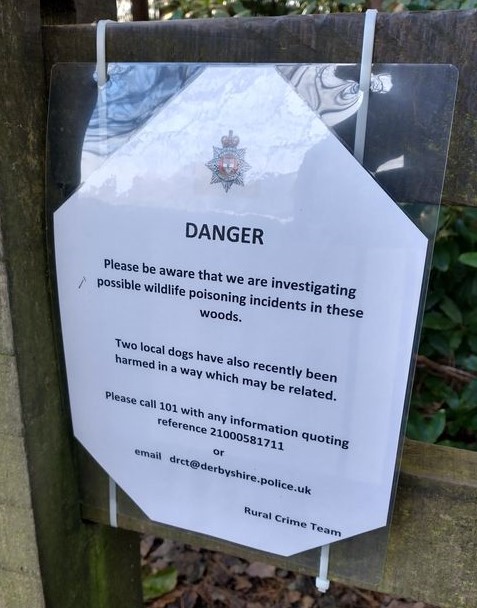
Derbyshire Constabulary are warning dog-walkers to be careful as they investigate suspected wildlife poisoning in a Derbyshire woodland.

Two dogs are reported to have become ill after visiting Swinepark Wood at Lea, near Matlock and the police say this may be related.

The police have posted warning signs at entry points to the woods:

There doesn’t appear to be any further information about the type of poison suspected to be in use or whether any wildlife has been affected but the fact that the police have been proactive in issuing these warnings about the risk to public and pet safety is a welcome move from a police force who have previously been criticised for their attitude towards raptor poisoning incidents (e.g. see here and here).

Well done, Derbyshire Constabulary’s Rural Crime Team.

Gamekeeper convicted for pesticide and firearms offences but buzzard-poisoning charge is dropped

Last week I blogged about how a Suffolk gamekeeper was due at Ipswich Magistrates Court to face a charge of poisoning a buzzard, having already pleaded guilty to several pesticide storage and firearms offences (see here).

This case stemmed from a multi-agency raid last January (here) after the discovery of an illegally poisoned buzzard in September 2020 which had been found close to pheasant-rearing pens near Lakenheath.

[The illegally-poisoned buzzard found close to the pheasant-rearing pens. Photos by RSPB]

The case was heard yesterday and it appears that the buzzard-poisoning charge was dropped, probably due to insufficient evidence, because despite the gamekeeper having this particular poison (Bendiocarb) in his possession, the prosecution would need to demonstrate that he was the person who laid the poisoned bait that subsequently killed this buzzard. The fact that the poisoned buzzard was found in close proximity to his workplace, and that he had the same poison in his possession, is simply not enough.

We can all draw our own conclusions of course, based on the balance of probability, but in English law the balance of probability is insufficient to convict for this particular offence. That’s not the fault of the police, the RSPB, the Crown Prosecution Service or the magistrate.

In this case, the gamekeeper, Shane Leech, 33, of Maids Cross Hill, Lakenheath, Suffolk, was convicted of six charges relating to pesticide and firearms offences and was given a Community Order of 80 hours unpaid work, ordered to pay £105 costs and a £95 Victim Surcharge.

I’ll leave it to you to decide whether the punishment fits the crime(s) and whether it offers any semblance of a deterrent to anyone who might be considering committing similar offences.

The RSPB has published two blogs about this case. The first one provides an overview of the case and offers praise to the work of Suffolk Police and the Crown Prosecution Service (see here).

The second blog is a more detailed discussion about the difficulties of bringing a successful prosecution for the illegal poisoning of birds of prey (see here). It also includes this shocking image of a pile of dead pheasants apparently being prepared for human consumption in the same room where the poison was being stored illegally!

Your opportunity to help improve the Welsh General Licences – a guide to responding to NRW’s public consultation

The Welsh Government’s statutory nature conservation agency, Natural Resources Wales (NRW), is currently hosting a public consultation on its proposed changes to the General Licences (the licences which permit the killing of certain bird species, in certain circumstances, typically for public health & safety, for the protection of crops and livestock, and for nature conservation purposes).

This consultation is a direct response to a successful legal challenge by Wild Justice (see here) who had argued that the previous General Licences were too loose and permitted too much ‘casual killing’ without lawful or scientific justification.

It’s good to see NRW reviewing the terms of the General Licences and it’s especially pleasing to see that the review includes suggested improvements to the regulations on trap use. There are, however, some idiotic proposals on the table. For example, NRW argues that it’s not planning to introduce a mandatory trap registration and tagging scheme because previously there has been ‘very little demand’ for trap registration by trap users!!!! Good grief, NRW! Of course the trap users aren’t going to want trap registration or a tag that could identify the trap operator, because then they’d be identifiable when a trap offence has been committed. Without an identification tag, the trap operator(s) can deny all knowledge and simple give a ‘no comment’ response to the police. That’s how they avoid prosecution, duh!

Birds of prey, especially buzzards, are accidentally caught inside crow cage traps because they’re attracted by the decoy bird or dead animals/food inside the trap. It’s not an offence to trap a bird of prey, but it is an offence for the trap operator not to release it, unharmed, within 24 hours. Some trap operators, particularly on game-shooting estates, do not release the trapped raptor and it dies in the trap. If there isn’t a tag on the trap identifying the trap operator, a prosecution is not possible. Photo by RSPB.

It’s now important that NRW hears from as many people as possible to encourage them to enact the good proposals for their General Licences and ditch the ridiculous ones.

The public consultation is open to anyone (e.g. you don’t have to reside in Wales to participate) and it’s available online until this Thursday, the 11th November.

Wild Justice has provided a helpful template for responding to the consultation and I’d urge as many of you as possible to please get involved and let NRW know the strength of feeling on the welfare and conservation of wild birds. This is NOT about trying to ‘shut down shooting’ or even to eradicate species control as many in the game-shooting industry are falsely claiming; this is about ensuring the General Licences are scientifically and lawfully appropriate, that trap operators are held to account, and that the General Licences no longer permit the casual killing of hundreds of thousands of birds.

Please visit the Wild Justice blog HERE for the suggested template and you’ll also find the link to NRW’s consultation there too.

Many thanks.

Grouse moor management implicated as ‘Pennine finch’ suffers massive population decline

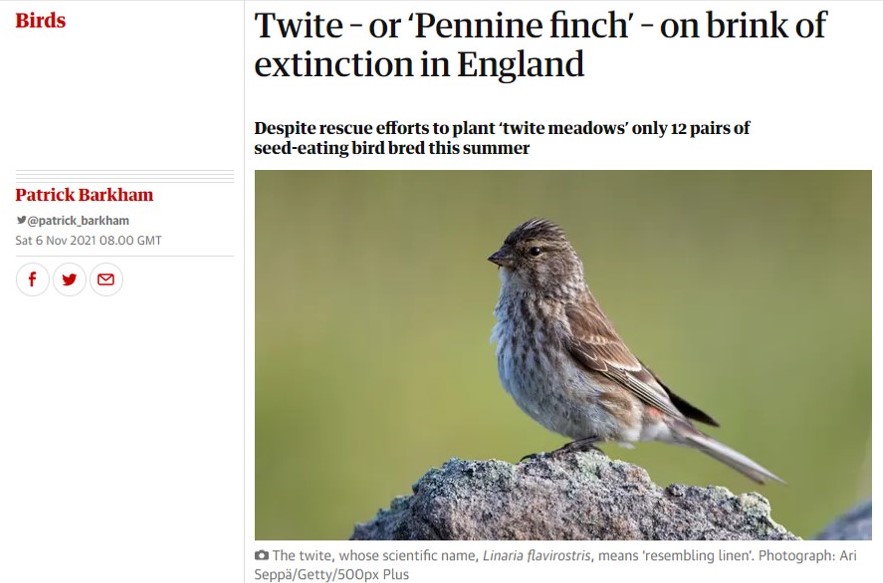
An article published in yesterday’s Guardian implicates grouse moor management as being partly responsible for a massive population decline in Twite, a small bird also known as the ‘Pennine Finch’.

Researchers are concerned that this species is on the brink of extinction in England due to a combination of factors including less wild seed in upland meadows, climate change and the loss of tall heather in uplands, resulting in Twite nesting in bracken where they appear to be more easily preyed on by stoats and weasels.

According to research undertaken by PhD student Jamie Dunning, in the Twite’s core area of the south Pennines large areas of grouse moor are unsuitable for the birds because the moors are burnt and the heather is not allowed to grow tall enough for Twite to nest in it.

It’s a fascinating article about a poorly-known species that scientists and conservationists at the RSPB and Natural England are trying to rescue. The article is available in full here.

Carbon emissions tax proposed for grouse shooting estates

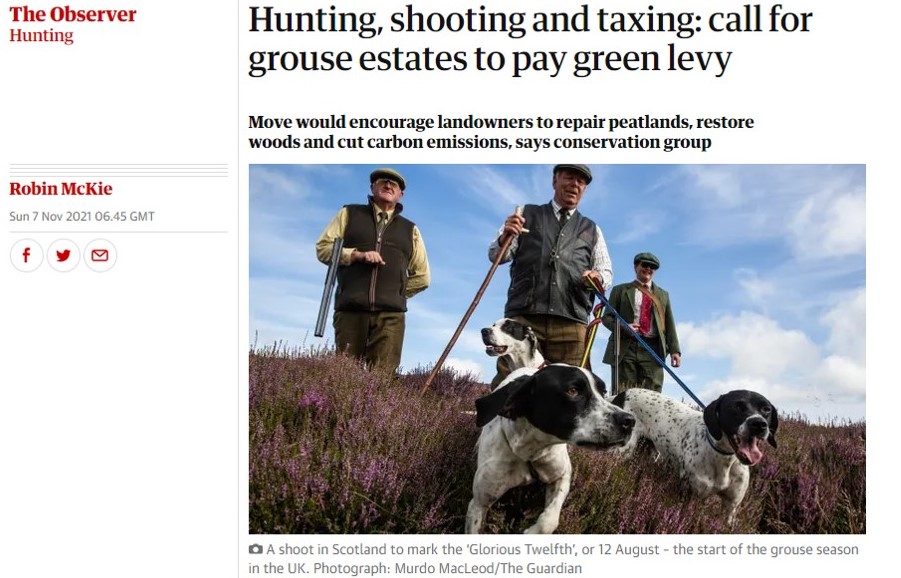
There’s an article in today’s Observer featuring a proposal by the John Muir Trust that grouse-shooting (and deer) estates should be taxed for their carbon emissions to encourage them to minimise their management intensity.

It’s an interesting proposal for dealing with the critical issue of carbon emissions from muirburning and all its associated damage (e.g. habitat damage to blanket bog, increased flood risk, increased air pollution) but of course it doesn’t address all the other environmental horrors associated with driven grouse shooting, such as the illegal killing of birds of prey, the use of poisonous lead ammunition, the virtually unregulated mass distribution of a veterinary drug (via medicated grit) known to be an acutely toxic environmental contaminant, the virtually unregulated slaughter of hundreds of thousands of wild birds and mammals to ‘protect’ the stock of red grouse for shooting etc etc.

Still worth a read though.

The article can be read in full here