Shot red kite: was it found on the Salperton Park Estate?

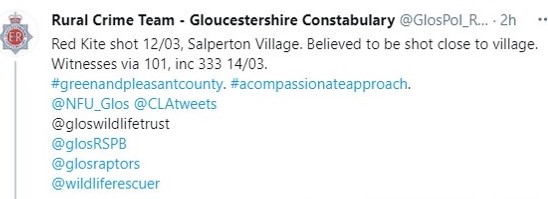
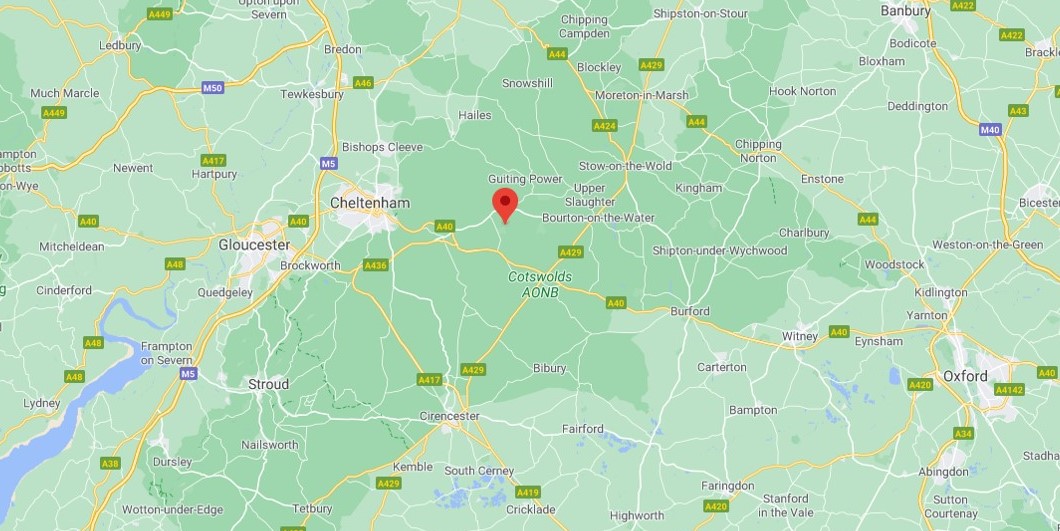
Last Thursday, Gloucestershire Police tweeted about a red kite that had been found injured on 12th March 2021, ‘believed to have been shot close to Salperton Village’ in the Cotswolds.

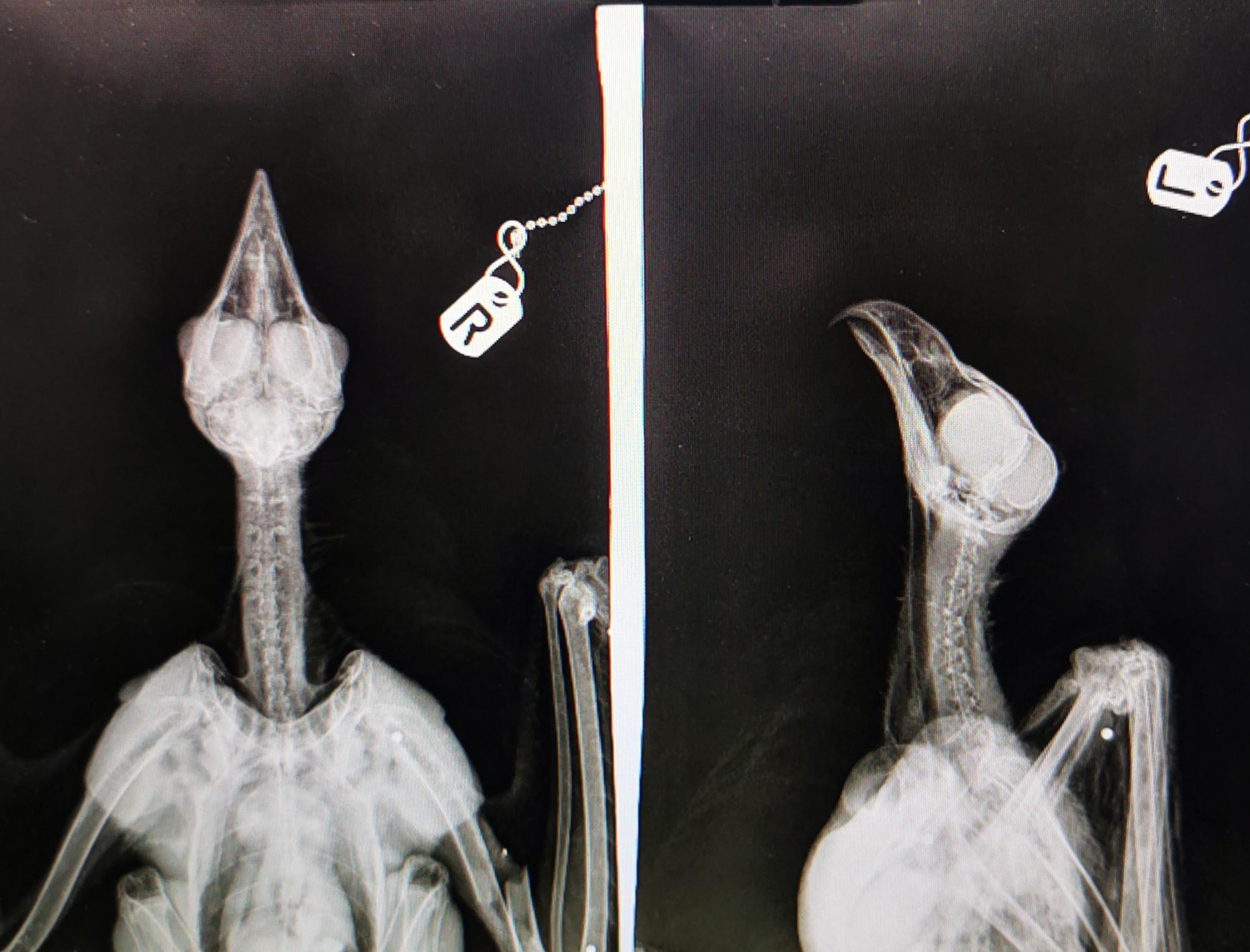
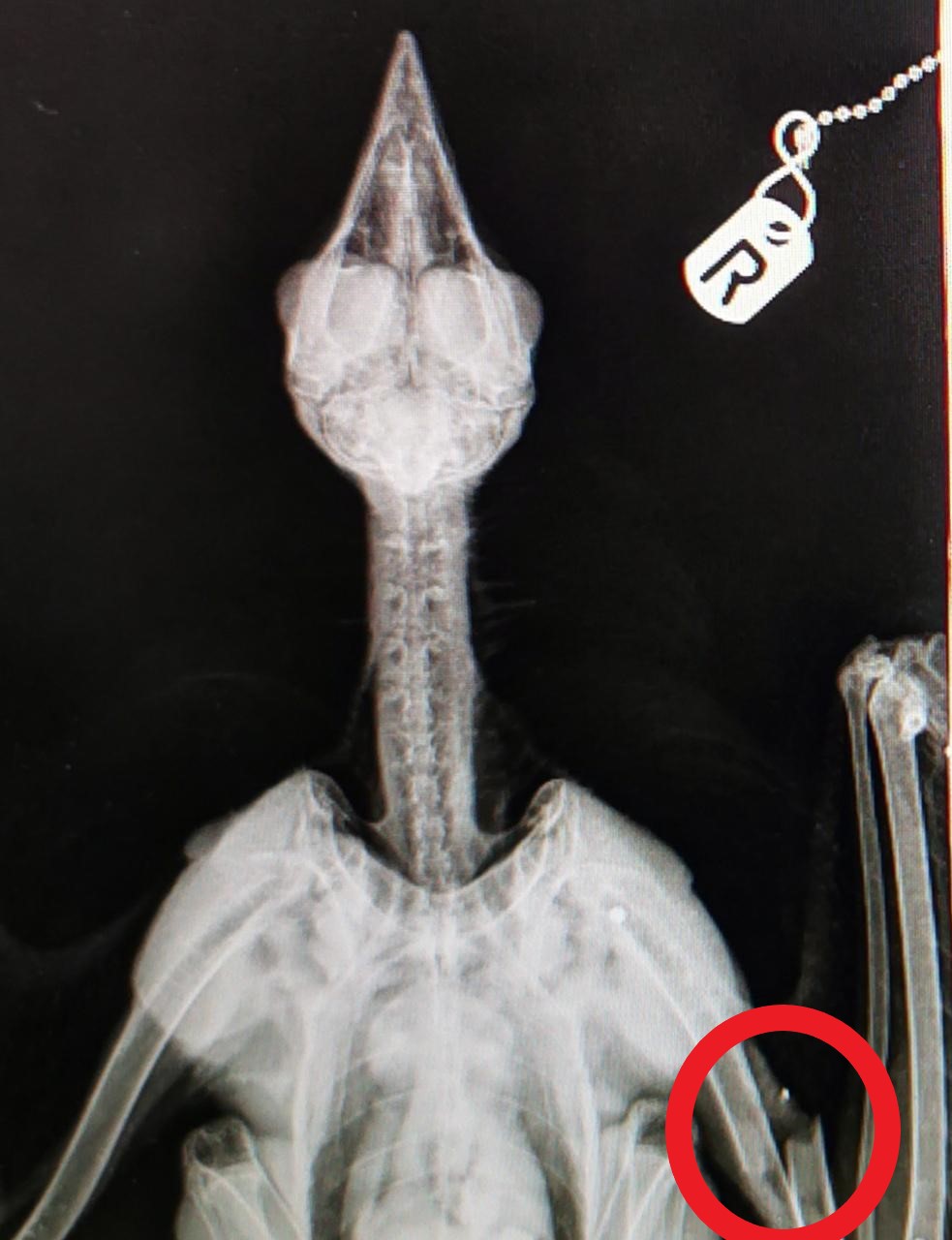
Judging by the accompanying x-ray, the kite had suffered a catastrophic wing injury and it seems unlikely it would have been able to fly far from where it had been shot (see here).
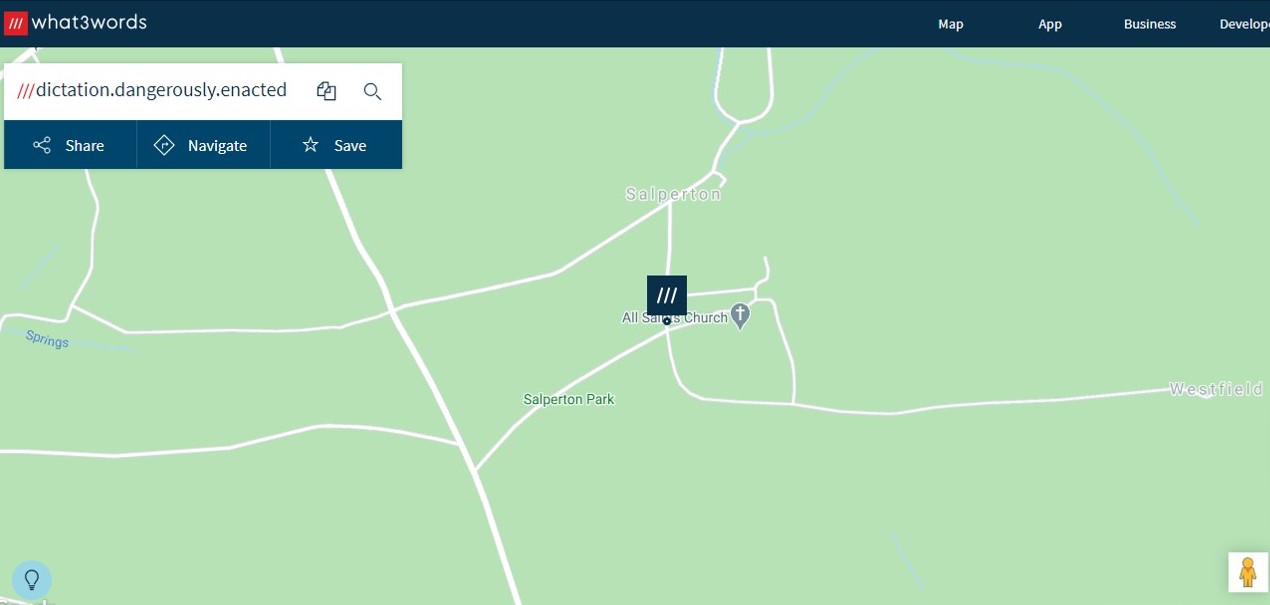
Gareth Jones from the Glos Raptor Study Group later tweeted that the kite had been found on the Salperton Estate and that it was ‘not the first incident found on this estate either‘. Gareth gave a site reference (What3Words) of dictation.dangerously.enacted which is located close to All Saints Church on the Salperton Park Estate:
The Salperton Park Estate in the Cotswolds is reported to host ‘one of the country’s most celebrated partridge shoots‘ over 4,000 acres, and is listed on Mark Osborne’s William Powell sporting agency website as being one his ‘hand-picked estates’ (see here).

Today there is a media article in the Wiltshire & Gloucestershire Standard about the shot red kite, including a quote from the RSPB, but once again, the Salperton Park Estate is not mentioned as being the location where this injured red kite was reportedly discovered:
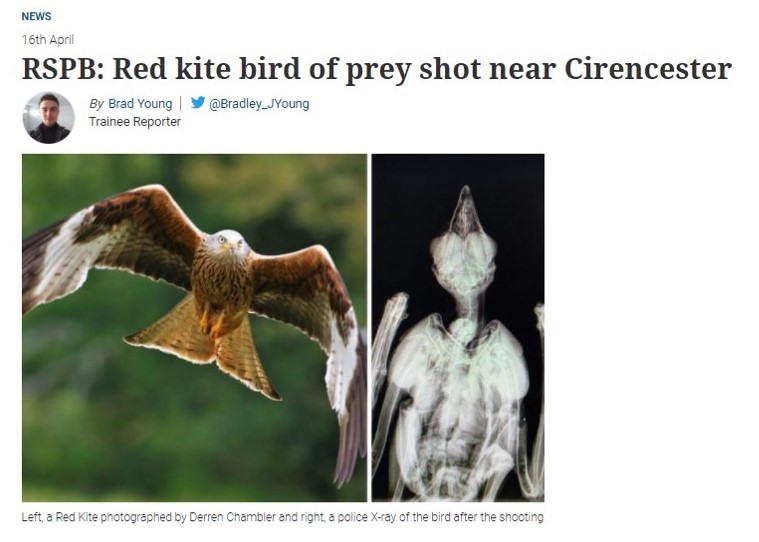
The article just states that the shot red kite was found ‘close to the village of Salperton’.

Was the red kite found on the Salperton Park Estate and if so, why is there such reluctance to state this fact? If it wasn’t found injured on the Salperton Park Estate then the police should be clarifying where it was picked up.

As the police are appealing for witnesses, surely it’d make sense to give as much locational detail as possible?

In addition, if local raptor worker Gareth Jones is to be believed (and I have no reason not to), if this is not the first incident reported from this estate then all the more reason to publicise it. It doesn’t automatically mean that an estate employee is responsible for the crimes because there are a significant number of tenants renting properties at Salperton Park – how many of those might have access to a shotgun would be for the police to determine as part of their investigation, especially if this location is turning in to a persecution hotspot.

UPDATE 20th April 2021: Further news on this on today’s Gloucestershire Live website (here). Article reproduced below in case it vanishes:

Bird of prey shot in Cotswolds village dies as police condemn ‘unacceptable crime’

A bird of prey that was shot in a Gloucestershire village has been euthanised as police condemn the “unacceptable crime”.

On Friday March 12, a member of the public discovered the Red Kite by the roadside in the Cotswold village of Salperton.

The bird was alive but unable to fly due to its severe injuries – it has suffered multiple bone fractures.

It was taken to the Vale Wildlife Hospital and, following an X-ray, it was discovered the bird had been hit with a shotgun.

It is believed it had been shot close to the village, as it would have been unable to fly or glide with its injuries. The bird had to be euthanised due to the severity of its injuries.

Gloucestershire Constabulary said it was an “unacceptable crime and one which will be dealt with robustly”.

PC Ash Weller from the Rural Crime Team said: “This is an unacceptable crime and one which will be dealt with robustly if the offender is identified”.

An X-ray of the bird revealed multiple bone fractures caused by the lead shot, therefore suggesting a shotgun was used.

“We are exploring all avenues as this could have been someone travelling through the area rather than someone local to the area.

“We are working closely with shooting and animal protection organisations, who are equally appalled by this act and are assisting us with our enquiries.”

An officer from the Royal Society for the Protection of Birds said the species had almost been driven to extinction in the 19th century and that the shooting of one was a “blow”.

Jenny Shelton, investigations liaison officer at the RSPB, said: “Red kites are a joy to encounter on a country walk, or even soaring over our homes, identified by their long, red wings and distinctive forked tail.

“We can’t take these birds for granted. only 40 years ago they were a rare sight having been driven almost to extinction in the UK the 19th century.

“To know that they are still being illegally killed is a blow to anyone who enjoys and values the natural world. All birds of prey are protected by law and if anyone has any information that might help with this police investigation, I urge you to come forward.”

ENDS
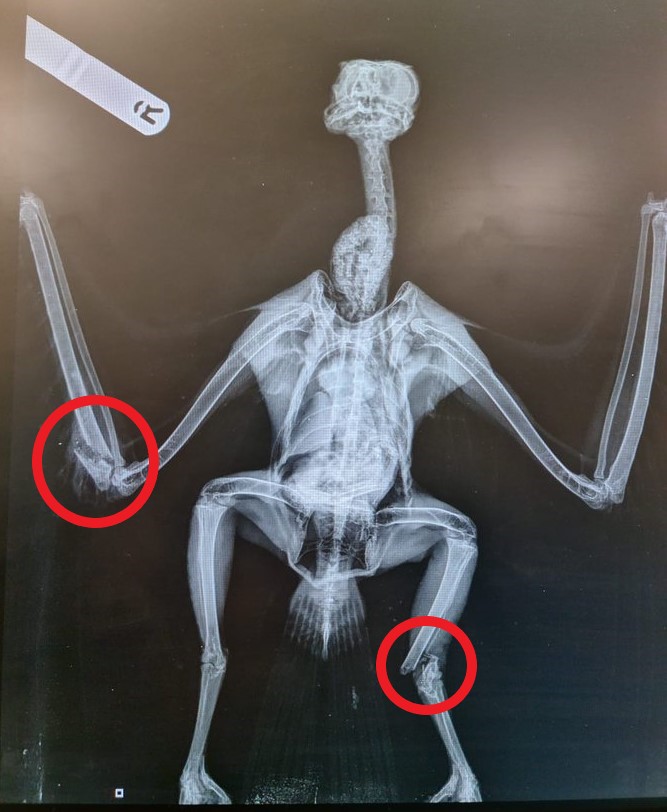
Norfolk Police appeal for information after discovery of dead kite, believed shot

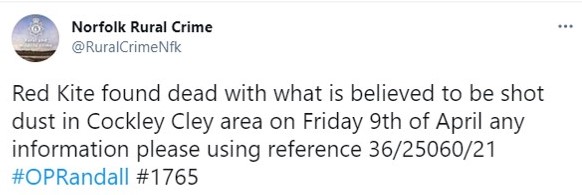
Norfolk Police are appealing for information after the discovery of a dead red kite in the Cockley Cley area of Norfolk on Friday 9th April 2021.

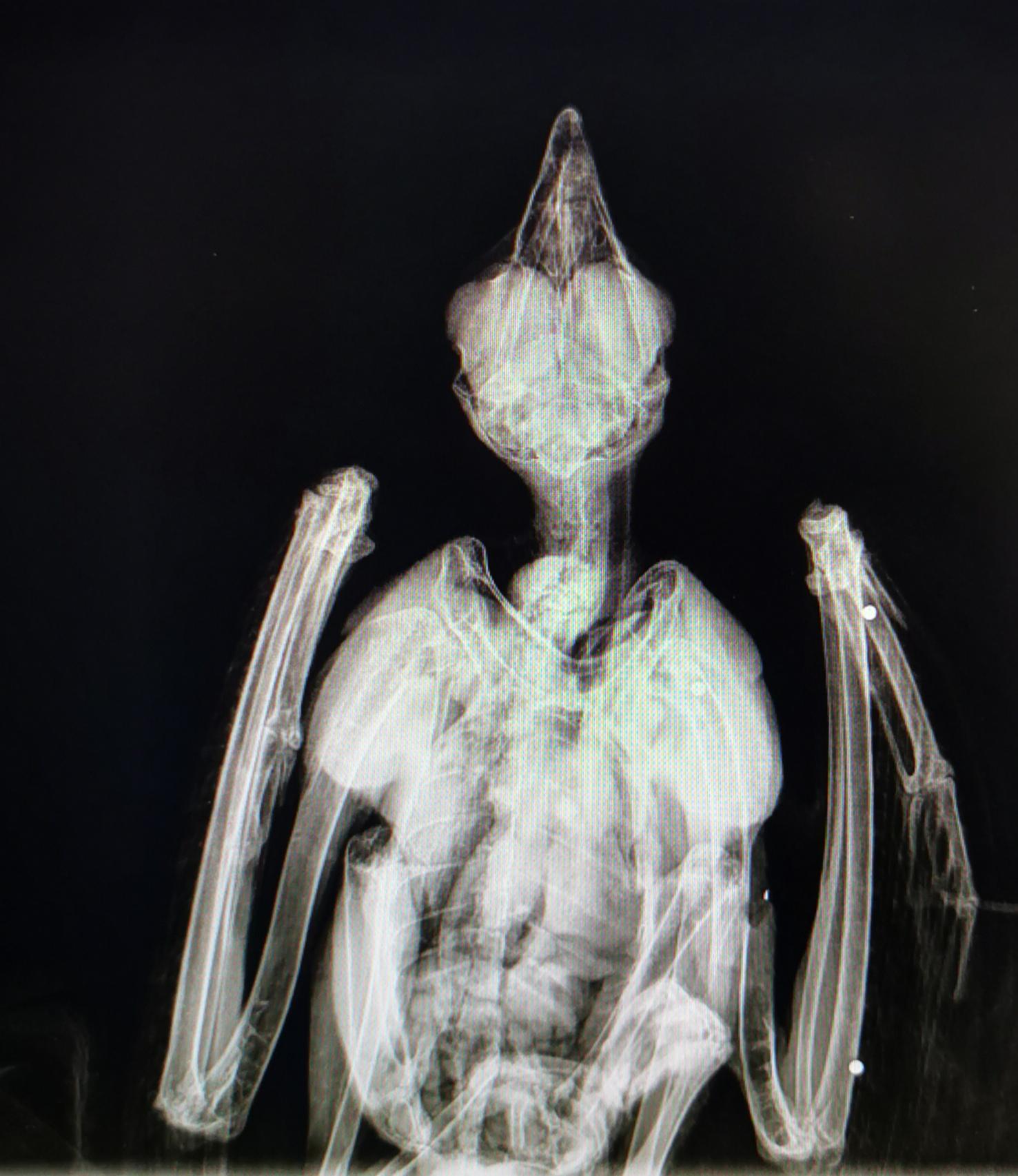
An x-ray shows the kite has broken bones in its leg and wing. The police believe the kite has been shot.

Anyone with information please contact Norfolk Police on 101 and quote reference 36/25060/21.

I couldn’t find a press release about this incident on the Norfolk Police website.

[The x-ray of the dead red kite. I have added the red circles to highlight the injuries]

UPDATE 23rd April 2021: Red kite believed to have been shot and hung from a tree (here)

Red kite shot in Cotswolds

A red kite has been shot in the Cotswolds AONB close to the village of Salperton.

It was shot on 12th March 2021 and the Gloucester Police rural crime team has announced it on Twitter this evening, along with some x-rays of the kite showing shotgun pellets and a broken humerus.

Disappointingly, there isn’t any further detail available. I couldn’t find a crime reference number or a press release appealing for witnesses.

[UPDATE: Thanks to those who have pointed out that ‘inc 333 14/03’ in the police’s tweet is probably the crime reference number]

[UPDATE #2: Thanks to Gareth Jones from the Glos Raptor Group who has confirmed this red kite was found on the Salperton Estate. He thinks a press release is forthcoming]

UPDATE 19th April 2021: Shot red kite – was it found on the Salperton Park Estate? (here)

Police & Crime Commissioner candidates asked to prioritise wildlife crime

Police and Crime Commissioner (PCC) candidates standing for election in England on 6th May have been asked to declare their commitment to prioritising wildlife crime.

Wildlife and Countryside LINK (often referred to as just LINK) is the largest environment and wildlife coalition in England, bringing together 58 organisations for the protection of nature (there are also LINK groups in Wales and Scotland). The Wildlife Crime Working Group is one of LINK’s sub-groups and it has today written to all of the PCC candidates inviting them to state whether they will commit to prioritising wildlife crime.

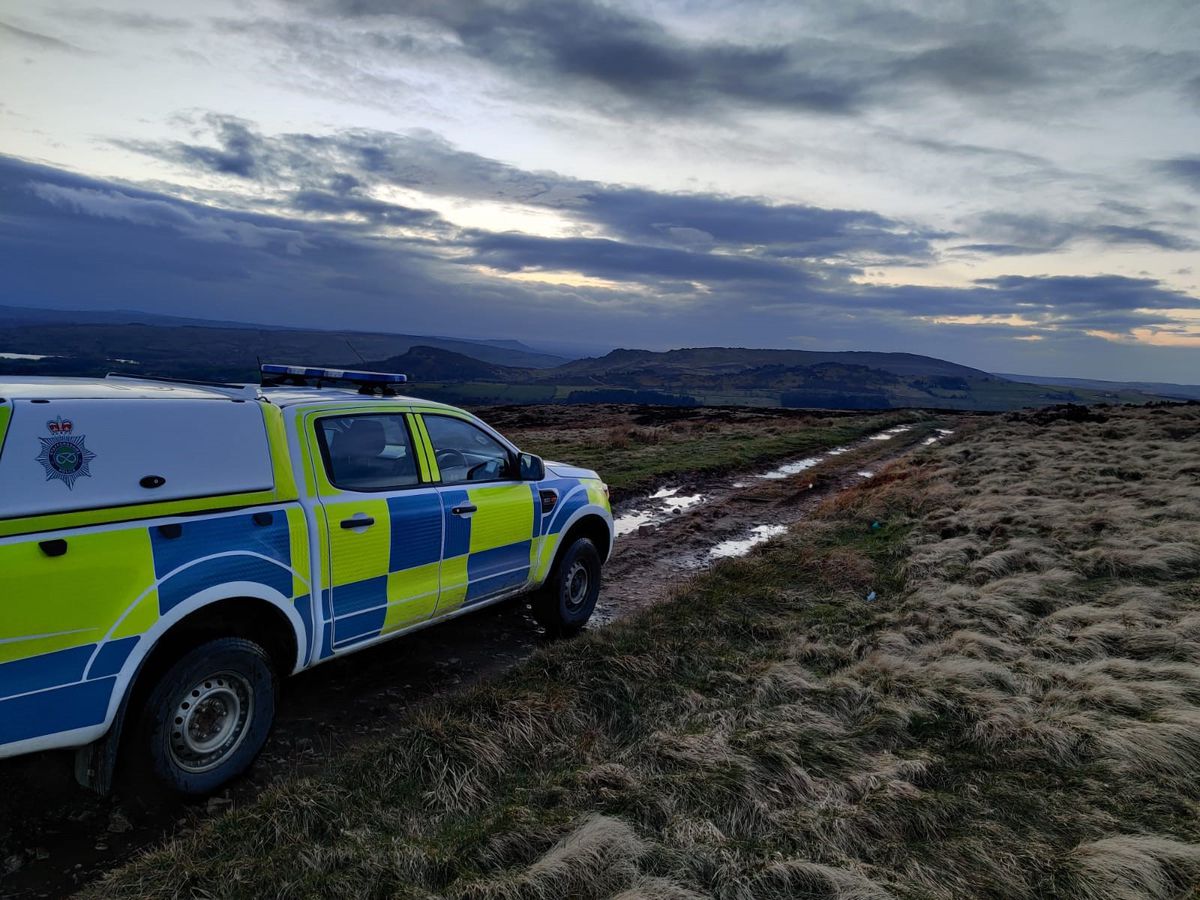
[Rural & wildlife crime policing in Staffordshire. Photo from Staffordshire Police]

The latest figures collected by LINK suggest that at least 3,800 wildlife crimes were reported to police forces in 2019. This is just a snapshot of the number of animals being illegally hurt and killed every single day, sometimes for ’fun’, sometimes for profit, sometimes in sheer callousness. However, just ten people were convicted of wildlife crimes in the same year. That’s a shockingly low return.

LINK’s Wildlife Crime Working Group believes that many police forces are constrained by too few resources, limited training opportunities and ineffective reporting systems.

The group believes that Police and Crime Commissioners have a crucial role to play by increasing support for wildlife crime policing within the police plans and budgets they control, giving their officers increased access to wildlife crime training and by adding their influential voices to calls to national policing action.

LINK has asked all PCC candidates to commit to the following:

If elected as Police and Crime Commissioner, I commit to:

• Make tackling wildlife crime a key priority within my first police and crime plan, and to make budget provision to support this prioritisation;

• Increase wildlife crime training opportunities for officers in my force and liaise with the National Wildlife Crime Unit on best wildlife policing practice;

and

• Encourage the Home Secretary to make wildlife crimes notifiable, so that data on these crimes can be collected and used to inform policing.

Prior to the elections on 6th May and to help voters decide who to support, LINK will be reporting on which PCC candidates have made the commitment to prioritise wildlife crime.

Political hustings organised by REVIVE – the coalition for grouse moor reform

Here is your opportunity to quiz parliamentary candidates from Scotland’s five main political parties about their position on grouse moor reform.

REVIVE, the coalition for grouse moor reform, is hosting an online political hustings next Thursday (22nd April 2021) between 6-7.30pm on Zoom.

Candidates will be asked specifically to discuss the following aspects of grouse moor management:

  • Raptor persecution
  • Muirburn
  • Mountain hare slaughter
  • Snaring, trapping and killing of wildlife on grouse moors
  • Mass outdoor medication (medicated grit stations)
  • The use of lead ammunition
  • Unregulated tracks and roads

The following candidates have agreed to attend:

Mairi McAllan, SNP (former lawyer & special advisor to First Minister on Environment, Climate Change and Land Reform)

Laura Moodie, Scottish Greens [updated 19th April – change of candidate from Ariane Burgess]

Ian Davidson, Scottish Labour (who also featured at the Scottish Gamekeepers Association hustings last month – see here)

Alan Reid, Scottish Liberal Democrats [updated 19th April – change of candidate from Molly Nolan]

Edward Mountain, Scottish Conservatives (who also featured at the SGA’s husting last month and describes himself as a ‘proud member’ of the SGA – see here)

The event will be chaired by Max Wiszniewski, REVIVE’s campaign manager and any questions you have for the candidates may be sent to Max in advance for consideration.

To attend this event you will need to register (for free!) HERE.

For those who can’t make it, the session will be recorded and will be available on YouTube later.

The REVIVE coalition for grouse moor reform comprises OneKind, Common Weal, League Against Cruel Sports, Friends of the Earth Scotland and Raptor Persecution UK. For more information on their work please visit their website here.

Eyes to the skies for hen harriers: RSPB Scotland asks public for sightings

Press release from RSPB Scotland (14th April 2021)

EYES TO THE SKIES FOR RETURNING HEN HARRIERS

Buzzard, kestrel… or hen harrier?

RSPB Scotland is asking everyone to keep their eyes peeled for one of the UK’s rarest birds of prey as they return to their breeding grounds this spring.

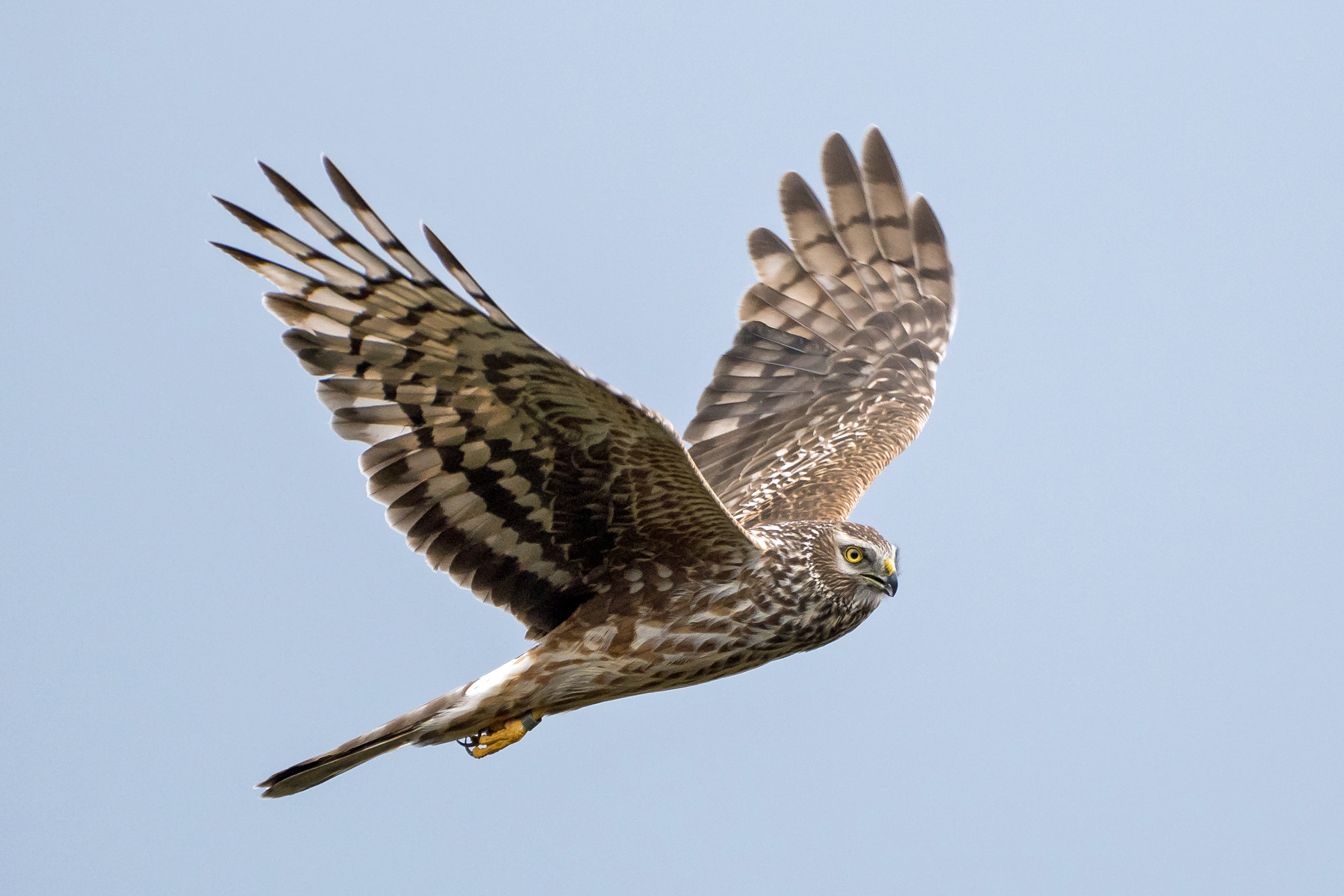
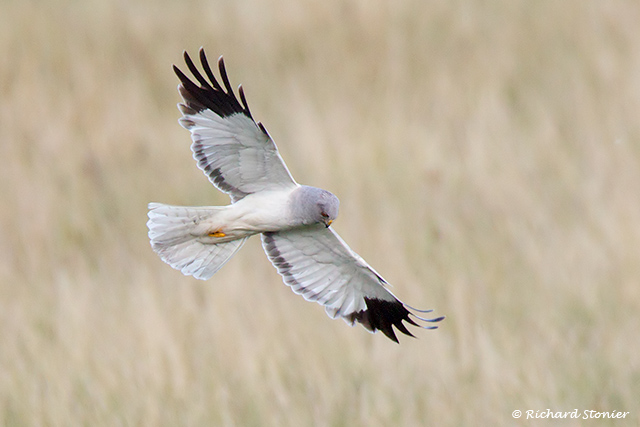
Hen harriers are medium-sized birds of prey, similar to a buzzard but with a slightly slimmer appearance, with long wings and a long tail. Female and young hen harriers are speckled brown and cream with horizontal stripes on their tails. The most striking feature is the patch of white at their rump. Males are slightly smaller and pale grey with black wingtips. Both have a round, owl-like face.

[Female hen harrier. Photo by Pete Morris]

[Male hen harrier. Photo by Richard Stonier]

As the weather warms up, these birds are becoming more visible as they start their long journeys away from their winter roosting grounds and up to the moors to breed. Hen harriers nest on the ground amongst heather or soft rush in upland areas. You maybe even lucky enough to encounter their skydancing display, a dizzying aerial show of rolls and dives, performed by either the male and female to mark their territory and demonstrate their vigour.

Hen harriers are the UK’s most persecuted bird of prey relative to its population size. Their Scottish population is of global importance, yet it remains far from stable largely as a result of illegal killing by humans.

The RSPB’s Jenni Burrell said: “We are calling on the public to email our Hen Harrier Hotline if they believe they’ve seen a hen harrier. This helps us build a picture of where these birds are. Please don’t hesitate to contact us if you see them – we welcome any sightings and appreciate your time.

Hen harriers are beautiful and elusive raptors and, unlike peregrines and kestrels, they are rarely seen in urban environments. So if it’s perched on your fence, it’s probably a sparrowhawk, if it’s in a tree by the roadside, it’s probably a kestrel or a buzzard… but if it’s over rough pasture or moorland, and matches the description above, then you might have seen a hen harrier.

Sadly hen harriers are a long way from reaching a healthy, self-sustaining population, and this is largely down to persecution by humans. Particularly where land is managed for the purpose of driven grouse shooting, natural predators like hen harriers can be viewed as pests and, despite being legally protected, the shooting, trapping and poisoning of hen harriers is a serious and ongoing problem.”

If you think you’ve seen a hen harrier, please email: henharriers@rspb.org.uk

Please include the date, time, location/grid reference and a description of the bird.

ENDS

Scottish farmers & landowners join forces with NatureScot to fight judicial review on beaver killing

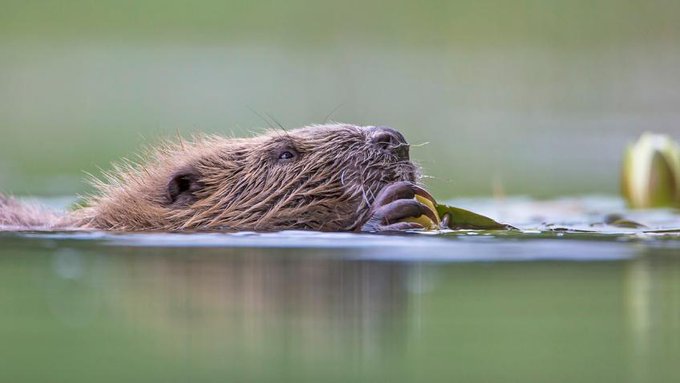
Beavers are slightly off topic for this blog, although they featured on here earlier this year when Scottish charity Trees for Life was crowdfunding to support an application for judicial review against NatureScot (formerly SNH) for allowing too many beavers to be killed under licence instead of exploring all other non-lethal avenues first (see here).

The Trees for Life crowdfunder was successful (here), helped along by many of this blog’s readers (thank you) and also by a £5K contribution from Wild Justice.

[Photo by Scotland: The Big Picture]

Trees for Life applied to the court for permission to proceed with their judicial review and the Scottish Court of Session granted that permission in February 2021, which means that a judge considered there was a valid legal challenge to be made with every chance of success (see here).

The case is due to be heard this year.

Meanwhile, on a slightly tangential note, the National Farmers Union Scotland (NFUS) has been whipping up hysteria about white-tailed eagles in western Scotland and the apparent ‘need’ to control them (which includes a proposal for ‘problem’ eagles to be shot) but I’ll be blogging about that separately.

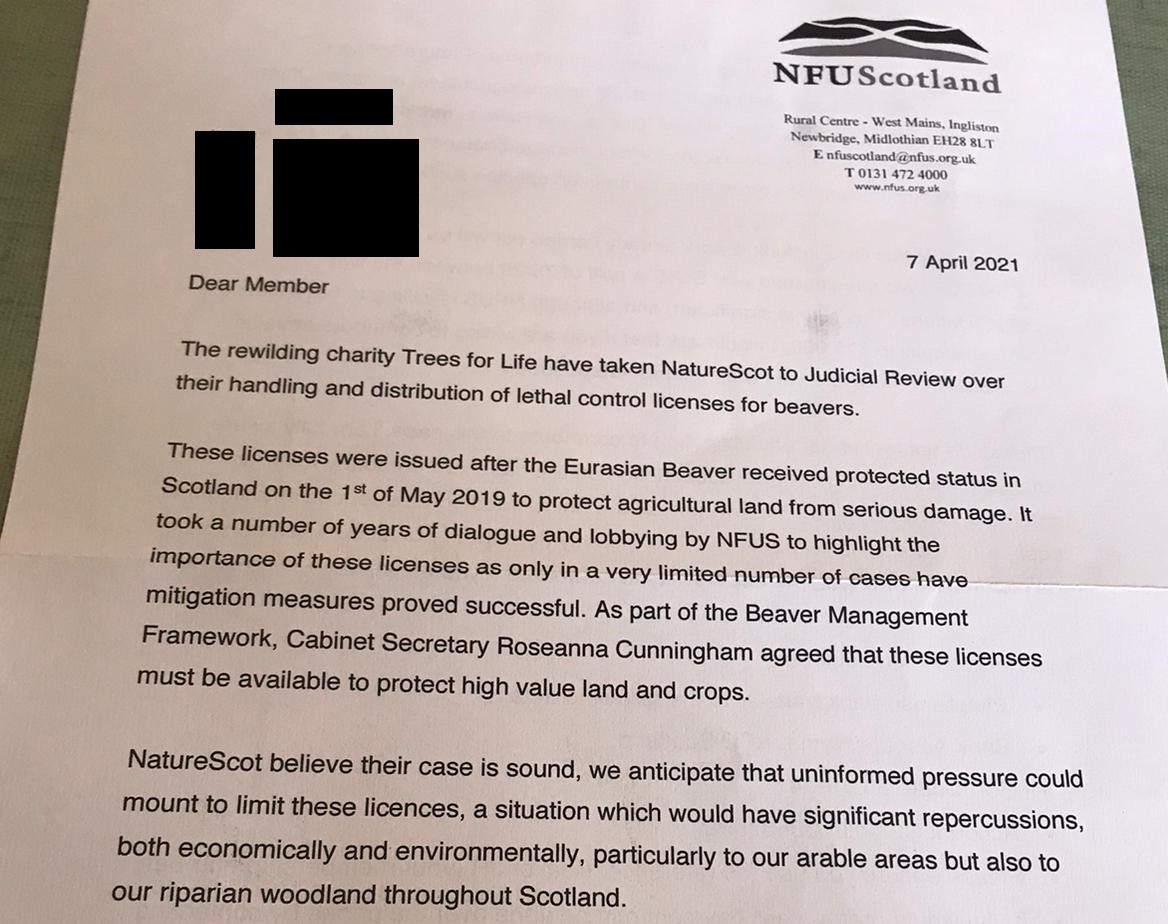
The reason I raise that now, in this blog about beavers, is because the NFUS has written to its members about the Trees for Life judicial review on beavers, and it has announced it is joining forces with landowners’ lobby group Scottish Land & Estates (SLE) to help support NatureScot to try and defend the judicial review.

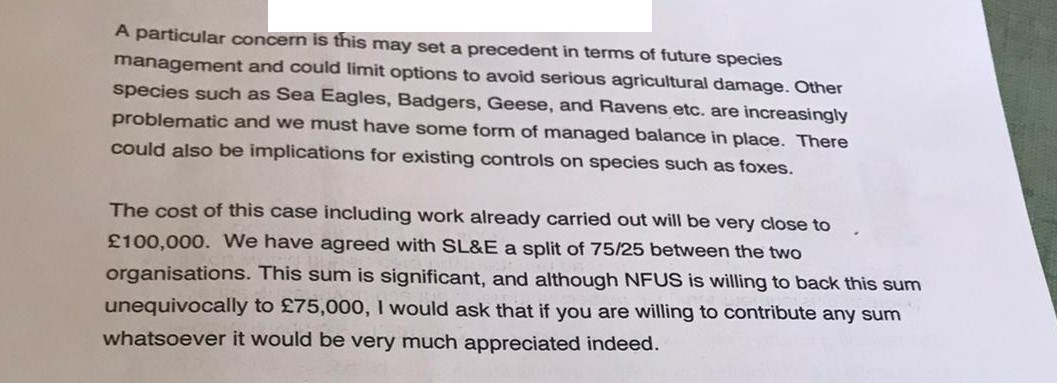
Why? Because according to the NFUS, if Trees for Life wins the judicial review, along with ‘uninformed pressure’ from conservationists, then there may be implications for the ‘control’ (killing) of other species including ‘sea eagles, badgers, geese and ravens’.

Here is a copy of the letter from the NFUS to its members, dated 7 April 2021 (thanks to the blog reader who sent me a copy):

It’ll be fascinating to read the NFUS / SLE legal argument for killing beavers as a first instead of a last resort; a legal argument that they ‘strongly believe is not understood by Trees for Life‘.

We’ll need to wait for court papers to emerge before any of this is made public.

NatureScot Chair Mike Cantlay writes puff piece for Scottish Gamekeepers’ rag

How come, if Scottish gamekeepers feel so downtrodden, unheard, overlooked, side-lined etc (e.g. see here), the Chair of Naturescot is writing puff pieces for their quarterly rag?

In the Spring 2021 edition of the Scottish Gamekeepers Association’s newsletter, Mike Cantlay blows some serious amounts of smoke up the SGA’s backside. It’s a shame his organisation isn’t as enthusiastic about revoking General Licences on shooting estates where there is strong evidence that raptor persecution continues.

Mike Cantlay isn’t the SGA’s only friend at NatureScot.

The recently-updated list of Board Members includes one David Johnstone, former CEO of Scottish Land & Estates whose responses to raptor persecution incidents leave a lot to be desired (e.g. see here and here) as does his view on vicarious liability (see here) and grouse moor licensing (e.g. see here and here).

Ah, nothing like a modernising, forward-thinking progressive to join the NatureScot Board, eh? Which Scottish Government Ministers approved the current intake of Board Members and how many candidates with expertise in wildlife, science and nature conservation were overlooked in favour of landowning Lord Johnstone?

Langholm Moor Community Buyout: re-advertising for an Estate Manager

In November last year the largest community buyout in south Scotland realised its ambitious goal by raising enough money to buy some moorland from Buccleuch Estates in Langholm with the intention of turning it from a former grouse moor in to a thriving nature reserve for the benefit of the local community, the environment and for visitors from further afield (see here).

The buy-out was officially completed in March this year (see here).

[Langholm Moor. Photo by David Lintern]

The Langholm Initiative, the organisation behind the buyout, is re-advertising a vacancy for an Estate Manager. This position was previously advertised in January but for whatever reason it’s now available again.

Here is the job advert:

ESTATE MANAGER

Salary: £35,000

Full-time, permanent

Closing date: 30th April 2021

This role is being re-advertised.

We are seeking to recruit an experienced and enthusiastic Estate Manager who has the skills and passion to help create the new Tarras Valley Nature Reserve, as well as over-seeing the day-to-day running of the first large-scale comunity owned estate in the south of Scotland.

This is a fantastic opportunity to be part of an ambitious project, and the post-holder will work closely with the appointed Development Manager.

This post is funded by the Esmee Fairburn Foundation. For more information on the role and application process, please click here to download the job pack from the Langholm Initiative website.

This ‘downtrodden gamekeeper’ act is fooling no-one

As campaigning for the forthcoming Scottish election gets in to full swing, I’ve been reading more and more about poor ‘downtrodden’ gamekeepers, how they’re not listened to, how hard done by they are, how they’ve been ‘vilified’ etc etc.

This article in last week’s Herald is a classic example, although pay close attention to who wrote it – Clare Taylor, Political Affairs Editor at The Scottish Farmer – her reference to farmers being “plagued” by the return of White-tailed eagles and commentary about “a growing obsession with rewilding” gives you a good idea about her environmental aspirations.

The truth is, rural affairs already have a very loud voice in the Scottish Parliament, in the shape of Fergus Ewing, Minister for Tourism and the Rural Economy who called himself “a friend in Government” to the Scottish Gamekeepers Association recently. Such a good friend in fact that he’s auctioning off a Holyrood tour (that should be free) to help the SGA’s fundraising activities (see here).

Clare Taylor’s tweet, promoting her biased article in the Herald, made me laugh:

After proclaiming that the Scottish Government ‘must stamp out the vilifying of individuals’, what does she think the accompanying photograph shows? Er, could it be a bunch of Scottish gamekeepers vilifying Chris Packham outside Perth Concert Hall, protesting about him having a job?

And are these the same gamekeepers who routinely vilify and abuse those of us campaigning against environmentally-damaging, unlawful and unsustainable grouse moor management (see here and here)?

And are these the same gamekeepers who continue to shoot, trap and poison birds of prey in the Scottish countryside?

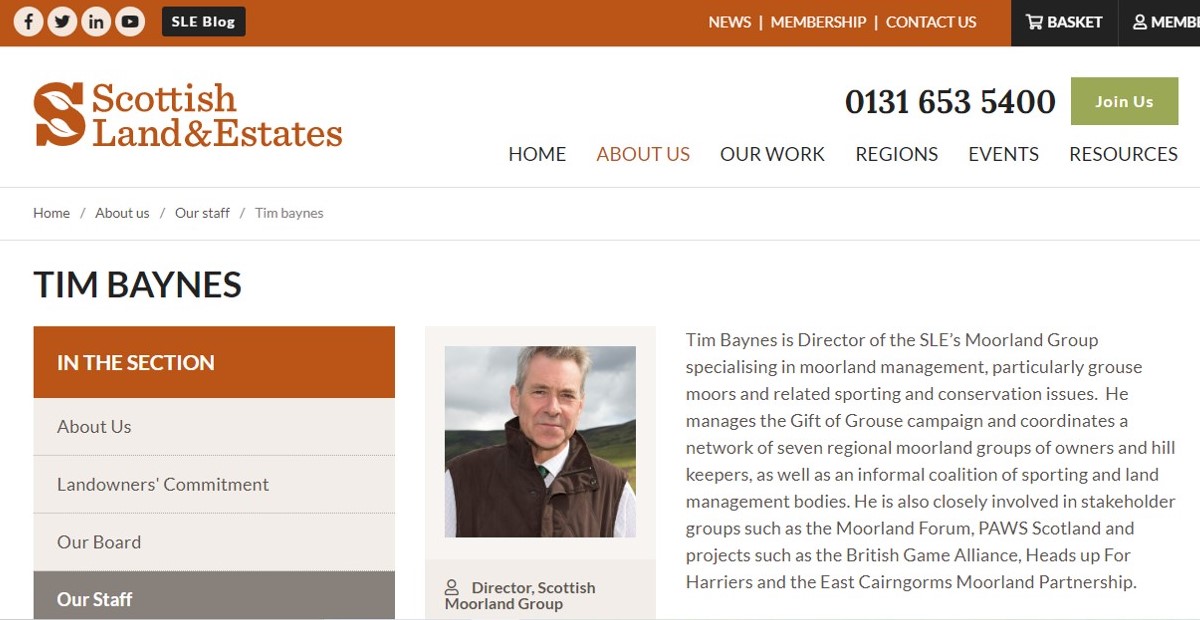
Clare’s article includes a quote from the co-ordinator of Scotland’s Moorland Groups. That’ll be Tim (Kim) Baynes then, a Director of the landowners’ lobby group Scottish Land & Estates – hardly someone without connections to politicians and civil servants, is he? Yet another influential voice speaking to power on behalf of gamekeepers.

Although Scottish Land & Estates’ CEO, Sarah-Jane Laing, was on here last week in the comments section claiming that ‘The Regional Moorland Groups which exist across Scotland are not part of the SLE structure‘.

Really? Well why then does Tim Baynes’s job description, on the SLE website, say that he’s the co-ordinator of those seven moorland groups??

And what about those seven regional moorland groups? They’re an interesting bunch. Grouse moors in five of those seven regions have been in the last three years, or currently are, under police investigation for alleged raptor persecution crimes (grouse moors in the regions covered by the Angus Glens Moorland Group, Grampian Moorland Group, Tomatin Moorland Group, Tayside & Central Moorland Group and the Southern Uplands Moorland Group).

And there are more ongoing police investigations linked to grouse moor management and raptor persecution that are yet to be publicised. Believe me, the public will be appalled when the news comes out and it’ll be a bloody brave (or desperate) politician that puts their name down to support this continued criminality.