The following is a guest blog written by someone who wishes to remain anonymous. I know who they are and I understand their reason for wishing to remain anonymous. When you’ve read the blog, you’ll probably understand, too.
This guest blog was originally submitted last week so some of the figures referring to the number of abusive attacks by the Scottish Gamekeepers Association since the beginning of the year will probably now be out of date.
Lies, damn lies & statistics
In November last year, the Scottish Government finally published some more results of their socio-economic review of driven grouse moors (see here). These findings contributed to the Government’s thoughts about how to finally respond to the Werritty review of grouse moor management.
That response, accepting the need for immediate introduction of grouse moor licensing, as well as the regulation of muirburn and the use of medicated grit, came on 26 November. It was widely welcomed by those who had fought long and hard for progress on this issue. But of course, immediately afterwards, and ever since, the announcement led to a considerable amount of wailing and gnashing of teeth from the grouse shooting industry.
Their initial over-the-top response predictably suggested impending rural Armageddon, but it was much the same as they had been saying since the prospect of grouse moor licensing increased when Professor Werritty published his report back in December 2019. Landowners’ lobby group Scottish Land & Estates called the licensing announcement “unnecessary, disproportionate” and “draconian”. A bit like poisoning a young white-tailed eagle on a grouse moor in a National Park?
A few days later the Scottish Gamekeeper’s Association chairman told the world he was “angry beyond expression”, before going on to express how angry he was.
Then, after further dummy-spitting and throwing their toys out of the pram, the SGA announced that they were going to march on Holyrood to protest because “everything to do with our way of life” was being scrutinised.
Just the same as the rest of us then.
I think they want us all to feel sorry for them. But the shooting industry’s latest bout of playing the victim card began just before the Werritty response announcement, when the Scottish Government’s review reports were published. The focus of the industry’s media blitz was a carefully cherry-picked bit of this work, included in the report on the rights of gamekeepers.
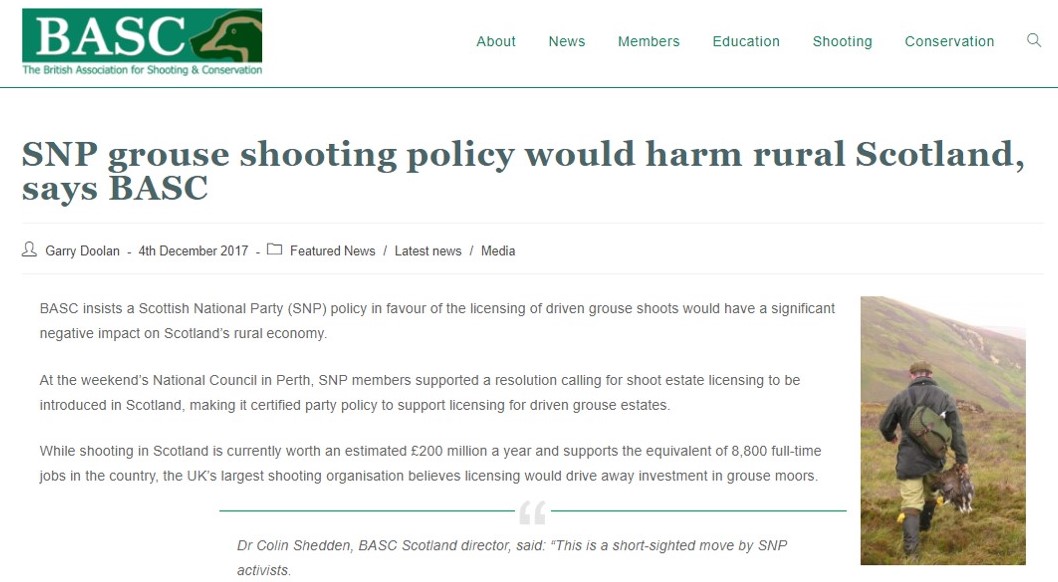
BASC, who were members of the research advisory group overseeing this review (along with SLE, RSPB, NatureScot & SGA), started the ball rolling with a press release saying that “as many as 64% of Scottish gamekeepers experience threatening behaviour or abuse from members of the public at least once every year”. Spokesman Ross Ewing goes on “It is clear that this contemptuous behaviour is in part a product of concerted and maligned campaigns against shooting”.
Readers of this blog will know that many individuals who publicly speak out against some management practices associated with shooting are frequent recipients of abuse and threats, personal attacks, smears or campaigns of intimidation.
Anyone who is the recipient of this sort of behaviour will confirm that it is abhorrent, and will condemn it out of hand.
The claims made by BASC do deserve some scrutiny, however, not least because they are being routinely repeated in the shooting media and elsewhere, even as recently as last week.
The “Employment Rights of Gamekeepers” report was produced for the Scottish Government by SRUC. In introduction, it acknowledges that it is “one of the first independent attempts to investigate the gamekeeping profession and develop a profile of the people involved in the sector, their terms and conditions of employment and opinions they have on issues that impinge on their working lives.” Significantly, it also says that “a number of biases inherently exist within surveys of this type” and goes on “the findings should therefore be viewed with these caveats in mind”.
Funnily enough, none of the media coverage we’ve seen seems to mentions this.
The details about threatening behaviour appear on pg 37 of the report and states – “56% of respondents had experienced abuse/threats ‘rarely’ (once or twice per year), with 7% reporting ‘occasional’ abuse/threats (once or twice a month) and 1% ‘often’ (one or twice per week). That adds up to 64% as claimed by BASC in their press release.
But let’s look a bit more closely at the figures.
Firstly, we need to remember that this work was being undertaken parallel to and with the intention of informing the Scottish Government’s ongoing consideration of the future of grouse moor management, with a recommendation for licensing a very real possibility.
The prospect of shoot licensing described by BASC as long ago as 2017 as having “significant consequences for rural people and businesses”, and the SGA’s chairman quoted in the 22 Feb 2017 edition of Shooting Times as saying licensing “would drive wives, children and grandchildren from their homes”.
Unequivocal, emotive and very strong language, that you would imagine if they had agreed would have had the gamekeeper members of BASC & SGA flocking to contribute to the Scottish Government-commissioned review of the rights of gamekeepers, therefore having their own input to the decision-making process?
The online survey ran for two months, up to February 2020. The published report states “Gamekeeper members of BASC Scotland and the SGA were individually sent details of how to participate in the survey by these membership bodies, who also took actions to encourage uptake through newsletter articles, social media campaigns (Facebook and Twitter) and a radio interview (BBC Radio Scotland Out of Doors – January 2020).”
That’s a lot of publicity and encouragement, and at a time when grouse industry representatives had repeatedly been claiming their industry was under threat, you can understand them perhaps throwing everything at what they thought we be a good opportunity for the strength of feeling to be articulated. Similarly, it’s reasonable to expect that if Scotland’s gamekeeping community believed what their representative organisations were telling them, they would have been champing at the bit to tell their story.
The results were clear.
152 responses were received, 10%-13% of the Scotland’s gamekeepers.
Let that sink in. Only 1 in 9 of Scotland’s gamekeepers were so convinced by the scaremongering by SGA and BASC that they could be arsed responding to the survey by a group commissioned by the Scottish government to inform their grouse moor review. Does that mean 8 in 9 of Scotland’s gamekeepers realise that there is nothing to fear from licencing if you are managing your ground within the law? Let’s hope so!
But this response rate also calls into question the sweeping claims subsequently made in the media about 64% of gamekeepers suffering abuse. Let’s remember the caveat in the report: “a number of biases inherently exist within surveys of this type”.
If I had suffered regular or even occasional abuse just because of my work, here was an outlet where I could be counted, the abuse would be documented, the government and the public would be aware. I would want to participate.
Clearly some did. However, this was not 64% of Scotland’s gamekeepers, but 64% of the 152 people who felt sufficiently motivated to bother filling in a survey that BASC & SGA were pushing hard for their gamekeeper members to participate in.
What this survey actually reveals is that 97 people received personal abuse simply because they are gamekeepers. Again, this abuse is condemned unreservedly. But, this is not the “almost two thirds of Scotland’s gamekeepers” shamelessly peddled to the media!
Therefore, it’s entirely right that we question not just the questionable conclusions and extrapolations from this very limited, strongly caveated dataset, but also the flagrant hypocrisy of those who have desperately tried to make some capital out of these figures.
The latter predictably features the pointless and increasingly marginalised SGA, who since the 1st January this year, have either through posting on their website, publishing in their magazine, hosting on their social media accounts or sharing other’s equally squalid content, have on at least twenty-two occasions made personalised attacks, or published/shared smears, misrepresentations and unsubstantiated allegations targeting at least 9 named individuals simply because they perhaps don’t share their enthusiasm for grouse shooting/mountain hare culls etc.
They also recently hosted photos of four un-named but readily identifiable individuals with accompanying unsubstantiated allegations of crime/malpractice as comments by their supporters on their Facebook page, and have made similar accusations or smears against nine other organisations on at least eighteen occasions this year already.
And just to show how far they will stoop, one of the people targeted by a recent post on the SGA’s Facebook page died almost four years ago.
Lovely people, the SGA.
ENDS

 Raptor Persecution UK