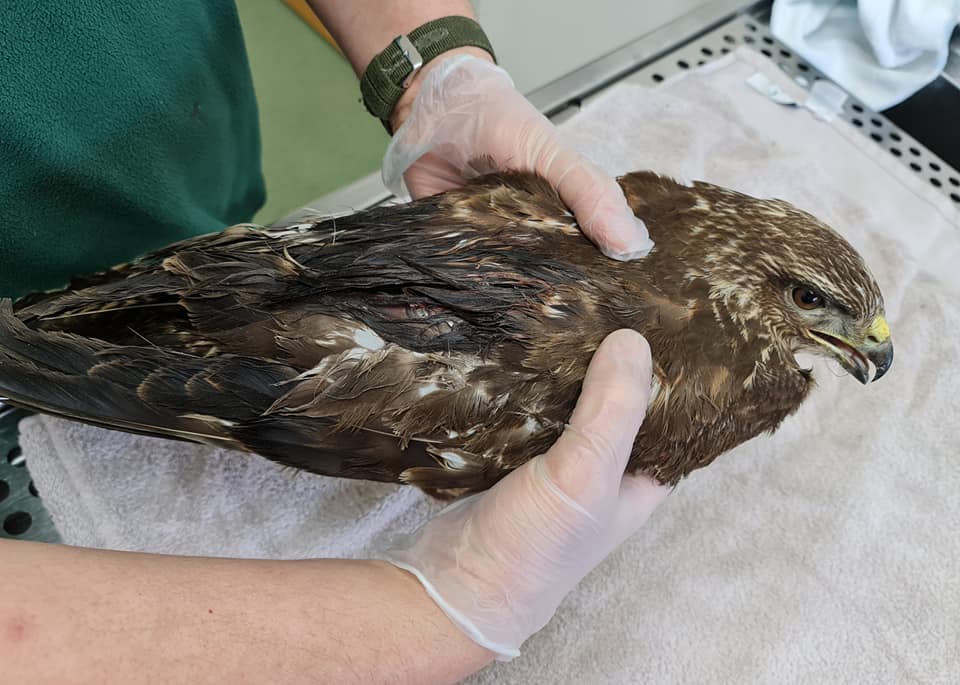
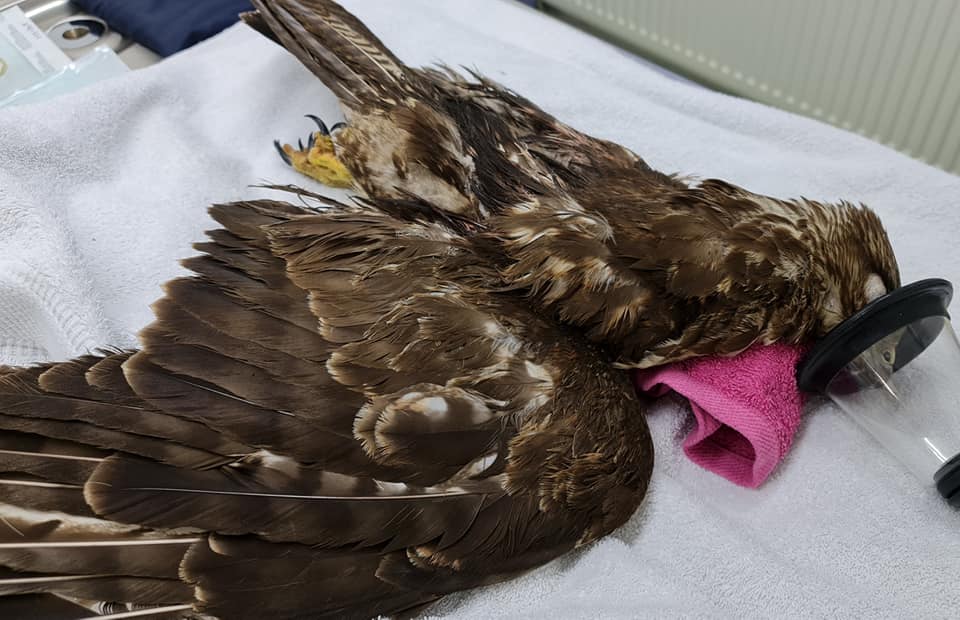
Buzzard shot & critically injured in Bedfordshire

Here is yet another grisly account of a buzzard being illegally shot in the UK, just four days after the last one was reported.

That one was in Cambridgeshire, this one was in neighbouring Bedfordshire.

According to social media reports by South Essex Wildlife Hospital, an injured buzzard was brought to them by an RSPCA inspector after being picked up at an undisclosed location in Bedford on Friday 5th February 2021.

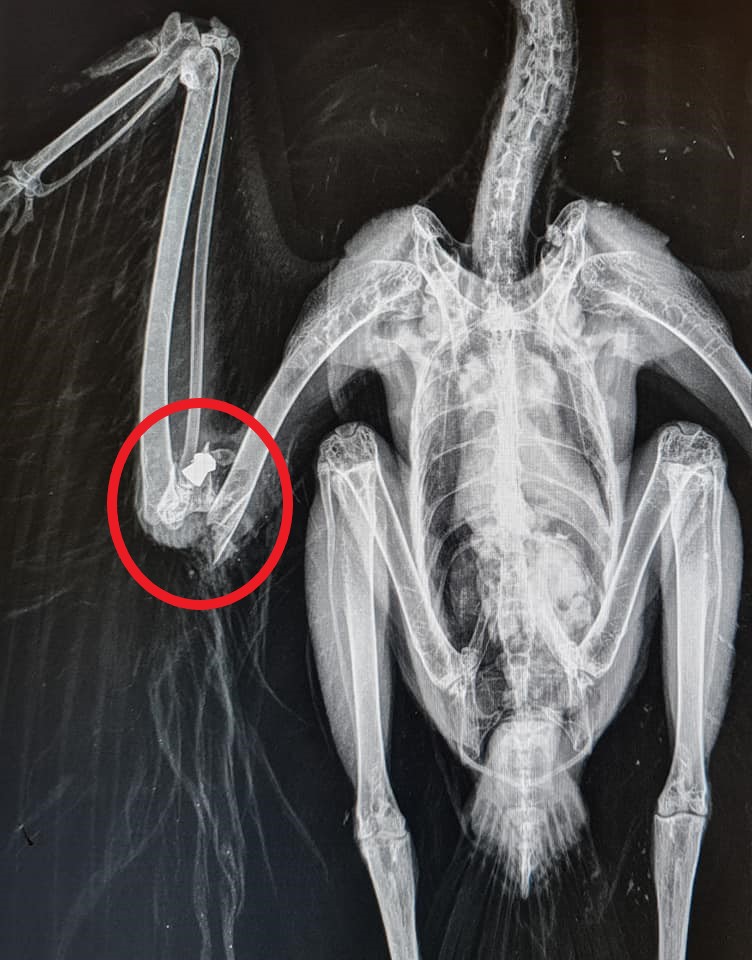
The vet diagnosed a fractured humerus and looking at the x-ray it looks like an air gun pellet has caused a catastrophic injury (photos by South Essex Wildlife Hospital, injury site on x-ray highlighted by RPUK).

I’m no vet but looking at its appalling injury it’s hard to see how this bird could have flown any distance from the location where it was shot.

According to the reports, the vet consulted with a specialist raptor vet in the US and it was concluded the damage was irreparable so a decision was made to euthanise the buzzard to prevent further suffering.

Apparently the RSPCA are making enquiries.

If you have any information about this crime please contact the RSPCA (0300-1234-999) or Bedfordshire Police (101) or the RSPB Investigations Team (01767-689551).

Alternatively, please call Crimestoppers anonymously on 0800 – 555111.

Sandringham Estate ‘supportive’ of proposed white-tailed eagle reintroduction

A proposal to consider the reintroduction of white-tailed eagles to Norfolk has been making the news for a couple of weeks now, ever since the Wild Ken Estate launched a public consultation, backed by a number of local landowners, to gauge opinion and support (see here).

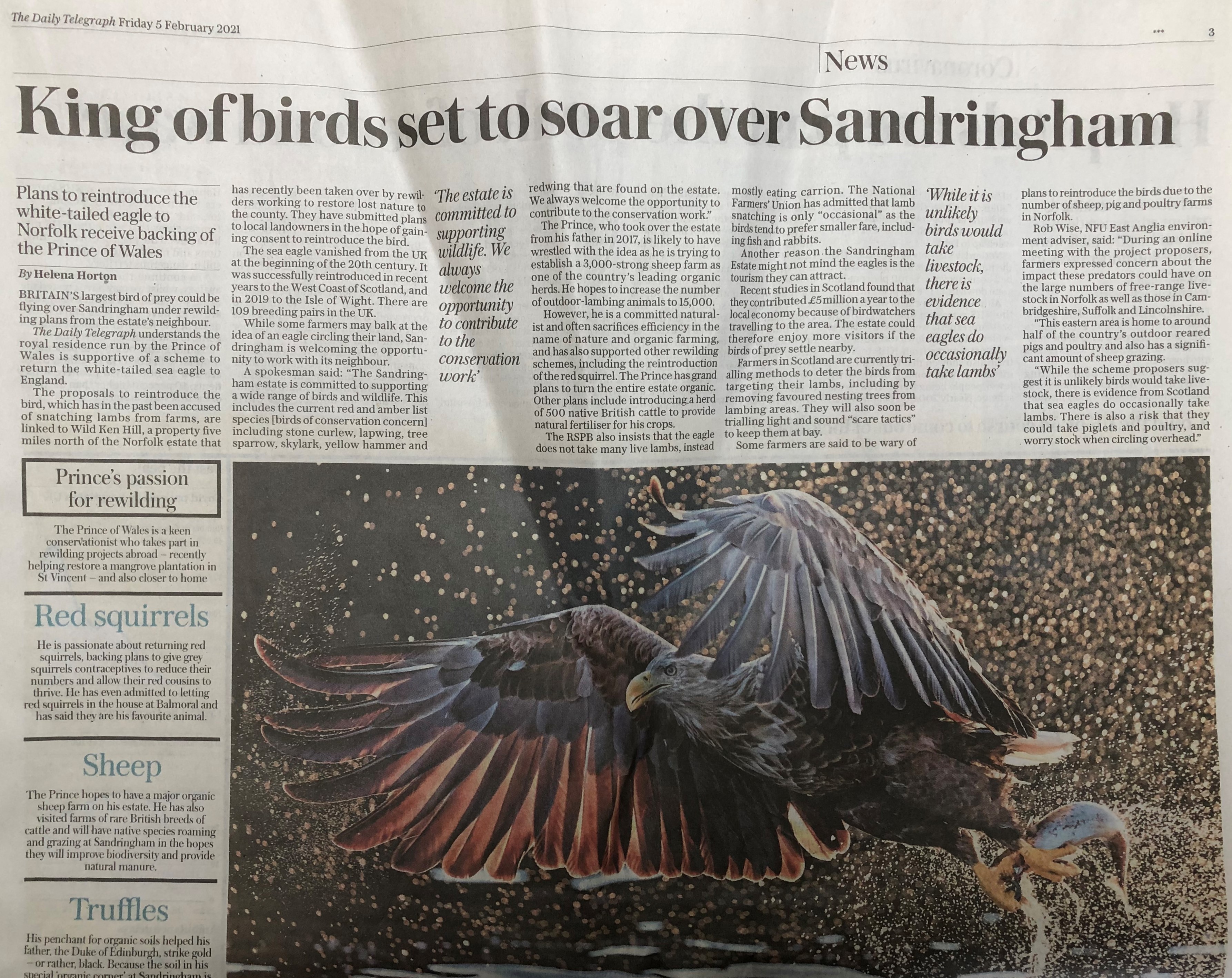
Not wanting to miss an opportunity for a bit of a Royal love-in, The Telegraph published this puff piece on Friday:

As so often with the Telegraph, there’s very little substance to support its claims, in this case that Sandringham and/or Prince Charles actually does ‘support’ a proposed reintroduction of white-tailed eagles to Norfolk. All it says is ‘The Daily Telegraph understands the royal residence run by the Prince of Wales is supportive of a scheme to return the white-tailed eagle to England‘.

Even the quote from the Sandringham Estate fails actually to mention sea eagles!

But perhaps things ARE changing at Sandringham. Perhaps the Sandringham Estate has moved on since being at the centre of numerous police investigations relating to birds of prey (e.g. see here, here, here, here). And perhaps if Charles really is in to conservation we’ll start to see some improvement in the management of his grouse moor in the Cairngorms National Park (e.g. see here and here) as well as at Sandringham.

We can but hope.

Meanwhile, folk would do well to continue to view the Telegraph’s level of understanding with healthy scepticism. Have a look at this ridiculous map, published alongside the Sandringham piece:

I don’t know where the Telegraph is getting its ‘facts’ from but it doesn’t appear to be from someone with any insight.

Why on earth would juvenile eagles be ranging 100km offshore in the North Sea??

And if they think that 200km is the ranging distance of a dispersing white-tailed eagle they need to take a look at the behaviour of some of the eagles reintroduced to the Isle of Wight – one travelled over 400 miles to hang out in southern Scotland for a while!

On-going hen harrier persecution raised in House of Lords

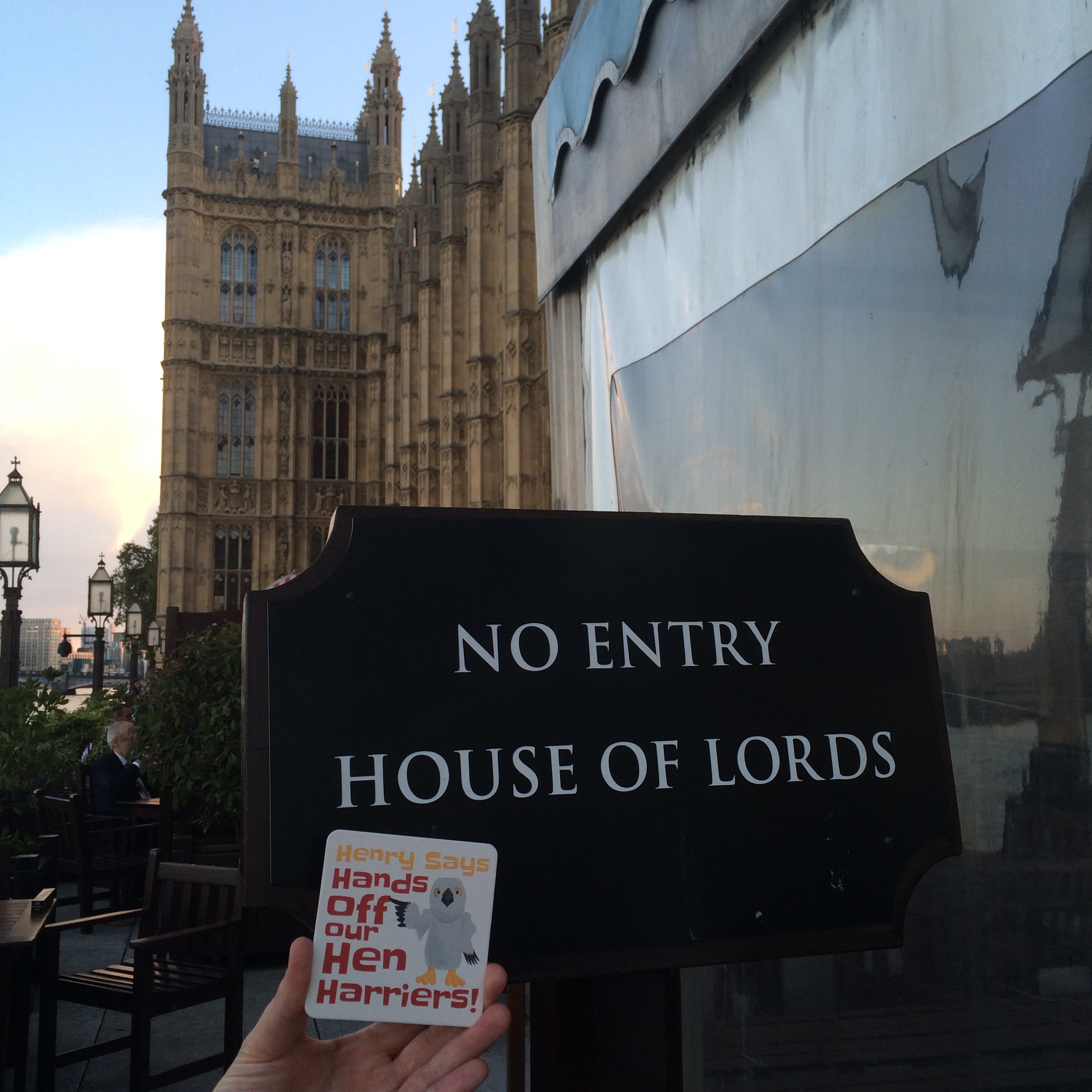
I’d wager that the subject of the illegal killing of hen harriers on driven grouse moors has been discussed many times in the House of Lords, probably on the terrace bar and probably accompanied by some hearty back-slapping, sniggering and cheering.

[Photo by Ruth Tingay]

Fortunately, the hen harrier does have some friends in high places, not least long-time supporter and Life Peer Natalie Bennett (Green party), who tabled the following written question on 21st January 2021 after learning that yet another satellite-tagged hen harrier had ‘vanished’ in suspicious circumstances (see here).

From Hansard: UIN HL12411, Baroness Bennett of Manor Castle –

To ask Her Majesty’s Government what plans they have to prevent the killing of satellite-tagged hen harriers.

Answered 4th February 2021 by Lord Goldsmith of Richmond Park, The Minister of State, Department for Environment, Food and Rural Affairs

All wild birds are protected under the Wildlife and Countryside Act 1981, which provides a powerful framework for the conservation of wild birds, their eggs, nests and habitats. The Government is committed to ensuring the protection afforded to wild birds of prey is effectively enforced. There are strong penalties for offenders, including imprisonment.

We are also committed to securing the long-term future of the hen harrier as a breeding bird in England. The Hen Harrier Action Plan sets out what will be done to increase hen harrier populations in England and includes measures to stop illegal persecution. The long-term plan was published in January 2016 and we believe that it remains the best way to safeguard the hen harrier in England. A copy of the plan is attached.

Raptor persecution is one of six national wildlife crime priorities. Each wildlife crime priority has a delivery group to consider what action should be taken and develop a plan to prevent crime, gather intelligence on offences and enforce against it. The Raptor Persecution Priority Delivery Group focuses on the golden eagle, goshawk, hen harrier, peregrine and white-tailed eagle. The National Wildlife Crime Unit, which is part funded by Defra, monitors and gathers intelligence on illegal activities affecting birds of prey and provides assistance to police forces when required.

So, five years on from the launch of DEFRA’s heavily criticised Hen Harrier Action Plan, which would be better re-named the Hen Harrier Persecution Plan, and with an embarrassing amount of evidence to demonstrate that the illegal killing of hen harriers is still rampant, this response from Zac Goldsmith is pathetically lame.

The evidence that hen harrier persecution continues relentlessly includes the devastating results of a peer-reviewed scientific study, based on Natural England’s own data and published in a high-ranking journal, demonstrating that at least 72% of satellite-tagged hen harriers are presumed illegally killed on grouse moors (see here).

There’s also the rather inconvenient tally of 51 hen harriers confirmed illegally killed or reported ‘missing’ in suspicious circumstances since 2018, when grouse moor owners pretended they’d be more tolerant of the species (here) and then the admission just a few days ago from Natural England’s Chair that “continuing illegal persecution [of hen harriers] is preventing the recovery we need to see” (here).

This issue is one of the most pressing wildlife conservation issues in the UK, and yet DEFRA has nothing more to offer than, ‘We believe the Hen Harrier Action Plan remains the best way to safeguard the hen harrier in England‘.

For how many more years is DEFRA going to hide behind it’s obviously-failing action plan? It’s been five years, and counting.

Here’s a more realistic view of the Hen Harrier Action Plan, from blog reader Dr Gerard Hobley.

Enough said.

Which English grouse moors will escape DEFRA’s so-called moorland ‘burning ban’?

Last week DEFRA published its long-awaited statement on proposed new legislation to ban burning on moorland (see here).

The statement included this: ‘The new regulations will prevent the burning of any specified vegetation on areas of deep peat (over 40cm depth) on a Site of Special Scientific Interest [SSSI] that is also a Special Area of Conservation [SAC] or a Special Protection Area [SPA] unless a licence has been granted or the land is steep or rocky

and this:

There will be specific circumstances where the ban does not apply, such as on steep land or where scree makes up half the land area. In addition, the Secretary of State may also issue licences for the burning of heather on blanket bog for the purposes of wildfire prevention, for a conservation purpose or where land is inaccessible to cutting or mowing machinery. These licences may cover several years so that they can be aligned with coherent management plans for sites‘.

DEFRA’s proposal has been widely criticised as being too constrained, having far too many loopholes and not being anywhere near what had previously been promised (e.g. see here).

Guy Shrubsole, formerly of Friends of the Earth and now at Rewilding Britain, whose research on Who Owns England is compelling reading, has put together some interesting material on which English grouse moors might be affected by DEFRA’s so-called ‘burning ban’ and which ones will probably not.

The following is what Guy posted on Twitter (@guyshrubsole) a few days ago, reproduced here with his kind permission:

How many grouse moor estates will the Government’s (very caveated) moorland burning ban affect? I’ve been looking at some maps…

Firstly, here’s a map of where grouse moors are in England, approximately, built by @beadyallen and me a few years ago:

Last week, the Govt said it would legislate to ban moorland burning – but its proposals contain many loopholes.

So, who owns the grouse moors that may be exempt from this burning ban?

First up: the Queen’s grouse moor in North Yorkshire: [Ed: this estate has featured previously on RPUK – see here]

In fact, most of the grouse moor estates in the North York Moors look like they’ll be exempted from a burning ban – because, despite all being designated sites (SSSIs, SACs and SPAs), Natural England considers the peat here to be ‘shallow’ rather than ‘deep’:

Outside of the North York Moors, there are also a number of other grouse moor estates that look like they could escape the Govt’s burning ban – because they’re not designated as SSSIs / SACs / SPAs.

This is despite them still containing lots of carbon-rich peat.

One of the likely exempt estates in the Yorkshire Dales is the East Arkengarth Estate, owned by a firm registered in the tax haven of Liechtenstein, and thought to belong to a Swedish businessman: [Ed: this estate has featured previously on RPUK – see here]

Another estate that might escape the burning ban is Knipe Moor in the North Pennines, belonging to Baron Hothfield.

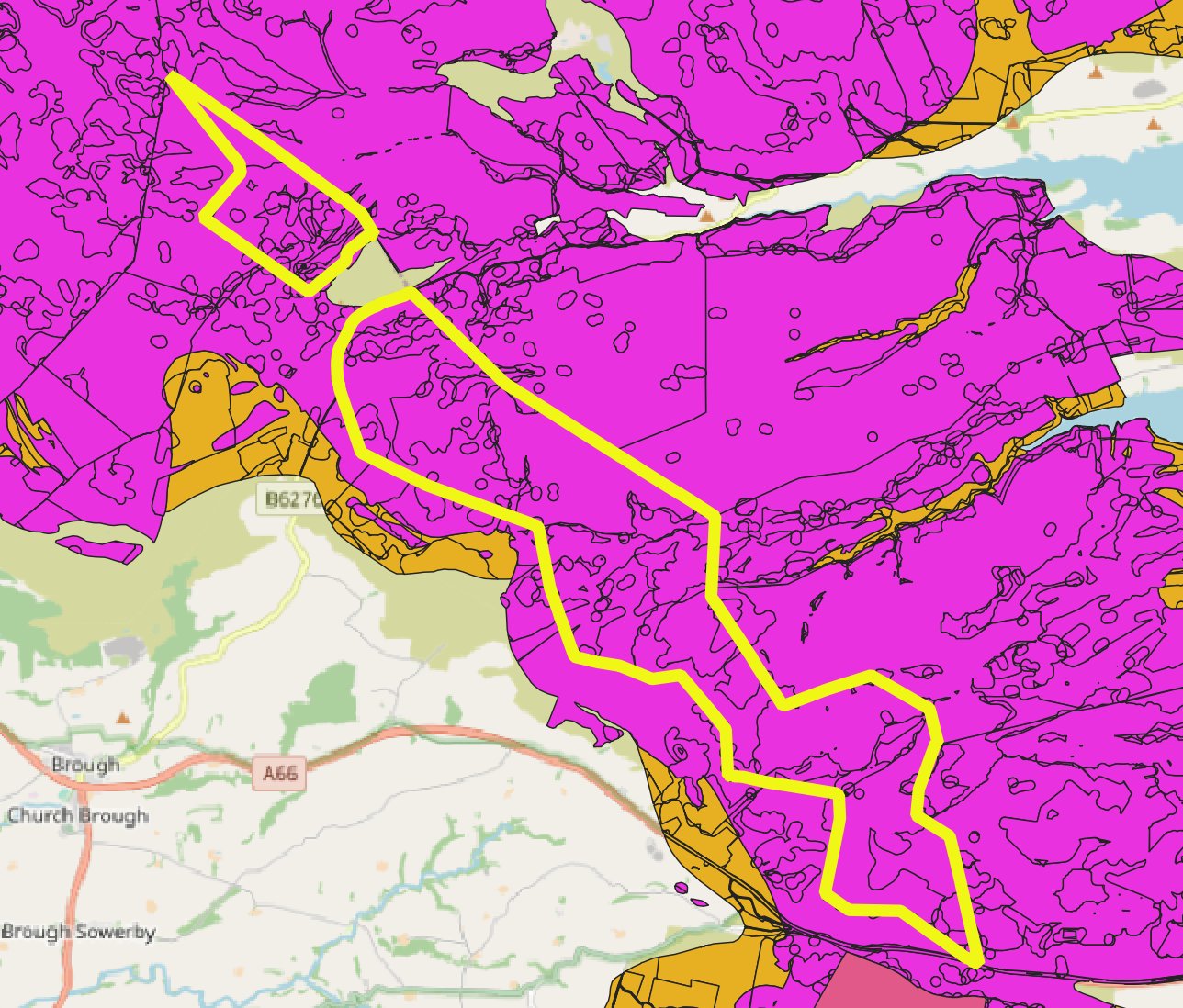
Knipe Moor is all deep peat but because it’s not classed as an SSSI (or SAC or SPA) it’s not covered by the ban. Madness – bad for climate and nature.

Another example of an estate likely exempt from the burning ban: the Lilburn Estate in Northumberland, owned by the founder of Persimmon Homes.

Owns a grouse moor, most of it deep peat. It’s also a SSSI – but because it’s not *also* a SAC or SPA, it’s exempt… [Ed: this estate has featured previously on RPUK – see here & here]

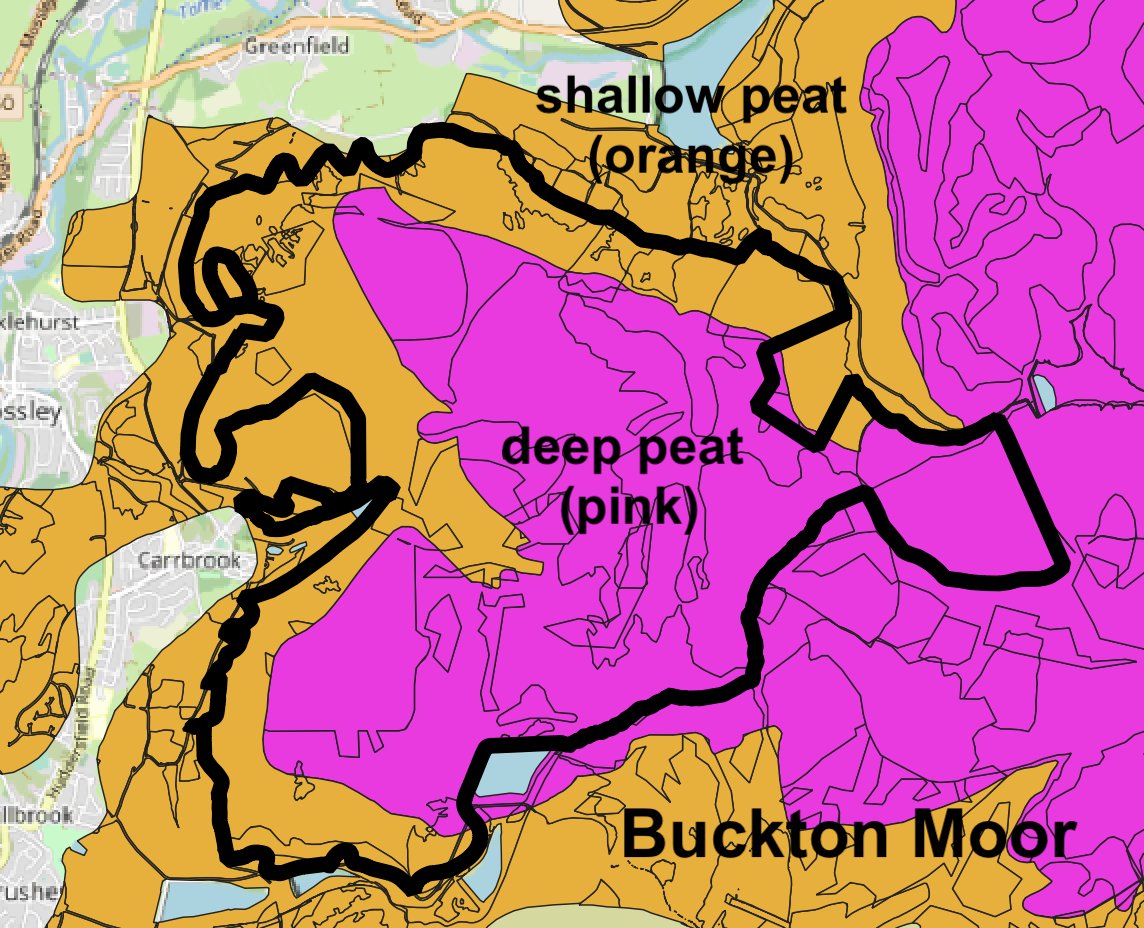
One last example of a grouse moor that’s likely exempt from the Govt’s burning ban: Buckton Moor on the edge of the Peak District.

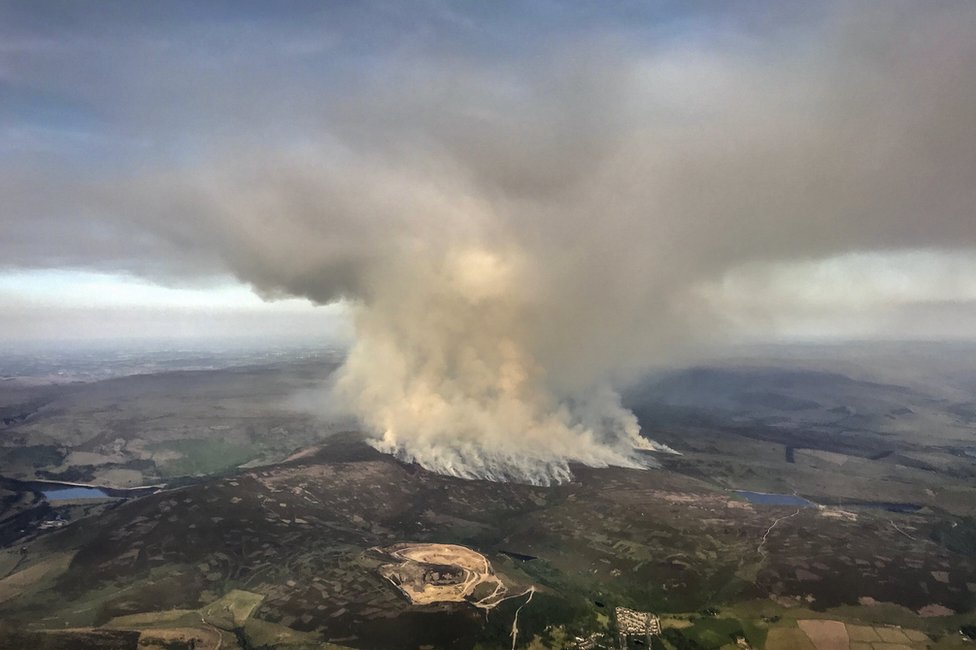
It’s not a designated site but it contains a lot of deep peat – and it’s where the massive Saddleworth fire happened in 2018!

And of course, any grouse moor estate can try to avoid the burning ban by applying to the Secretary of State to burn moorland for purposes of ‘conservation’ or ‘wildlife prevention’ [Ed: see caveats in DEFRA’s statement]

This is a nonsense; healthy peat bogs need water, not fire.

This thread gives some examples of the glaring loopholes in the Government’s moorland burning ban, and some of the estates that could benefit from its loose drafting.

@ZacGoldsmith please get rid of these loopholes – for the sake of the climate and upland wildlife!

ENDS

‘Public interest test’ proposed for large Scottish estates

Landowners could be barred from buying country estates or forced to sell off land if they are accused of neglect or abuse of power under proposals being studied by Scottish ministers.

The Scottish Land Commission (SLC), an influential advisory body, has recommended that all large or important land sales in Scotland should be subject to a legally enforceable public interest test to make sure the sale has wider social or environmental benefits.

In a detailed report to the Scottish government, the commission has told ministers any future sales involving estates over 10,000 hectares (24,710 acres), as well as any of economic or ecological significance, such as entire islands, should be included.

For the rest of Sev Carrell’s article, published yesterday in The Guardian, please click here

There are some potential implications here for massive, intensively managed driven grouse moors.

Police appeal after buzzard shot dead in Cambridgeshire

Press release from Cambridge Constabulary (4th February 2021)

Buzzard found shot in Horseheath

Police are appealing for information after a buzzard was found dead in Horseheath.

A member of the public found the bird of prey in a wooded area while on a walk on 29 January.

Cambridgeshire Constabulary’s Rural Crime Action Team (RCAT) are now working with the RSPB to find those responsible after it was discovered it had shot gun pellets in its body and wings.

PC Alun Bradshaw from the RCAT said: “Someone has deliberately shot this bird and we urge anyone with information to contact us.

All birds of prey are protected by law. If you notice a dead or injured bird of prey in suspicious circumstances, please notify us and the RSPB.”

RSPB Assistant Investigations Officer, Tom Grose, added: “Many of us will have enjoyed watching buzzards lately on our daily walks. They are a natural part of our countryside and a sign of a healthy ecosystem. Buzzards and other birds of prey are protected by law, yet all too often we received reports of them being illegally shot, trapped and poisoned.

At a time when the natural work and its wildlife are increasingly under threat, we all have an important role to play. If you have any information which may help this investigation, please come forward.”

Anyone with information is asked to contact us online via our web chat or call 101 quoting incident 239 of 30 January.

ENDS

Wildlife crime on grouse moors in the Peak District National Park – an illustrated talk by Bob Berzins

Bob Berzins is a conservation campaigner who has spent a number of years highlighting the ecological damage caused by grouse-shooting interests on the moors of the Peak District National Park (e.g. see guest blogs he’s written for Mark Avery here, here, here, here, here, here, here and here).

Regular blog readers will be well aware that the Peak District National Park has been identified as a hotbed of illegal raptor persecution for many years (e.g. see here) and this reputation continued, in and around this National Park (!) even when the country was in lockdown last spring (see here).

[A shot buzzard found critically injured at Rushup Edge, near Mam Tor in the Peak District National Park on 13th January 2020. It had to be euthanised. Photo via Derbyshire Constabulary]

Bob’s willingness to speak out about his findings on these Peak District grouse moors has led to him being targeted, like so many of us, by a campaign of harassment and intimidation from members of the grouse shooting industry, presumably in an attempt to silence him.

It’s a measure of the man that he hasn’t quietly slinked off, even in the face of the most malicious abuse, but has instead stood his ground and continued to share his experience and knowledge.

A few days ago he gave an illustrated presentation (online, of course) to the Sheffield Green Party. His talk was entitled ‘Wildlife Crime in the Peak District’ and it’s now available to watch on YouTube:

Gamekeepers responsible for more illegal raptor killing than any other profession

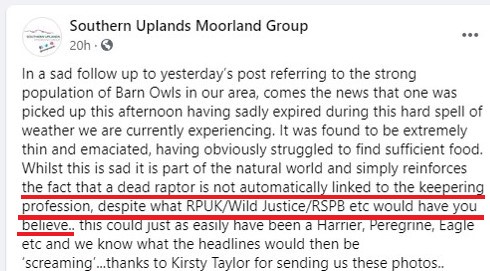
Somebody sent me a screen grab the other day of a statement posted on social media by the Southern Uplands Moorland Group (SUMG), which is one of a number of regional groups representing grouse moor estates around the country and designed to persuade the public that birds of prey are warmly welcomed and that gamekeepers love having birds of prey on their ground.

The statement published by the SUMG is fairly typical of the misrepresentation of facts that we’ve all come to expect from certain quarters of the grouse shooting industry. It reads as follows and I’ve underlined the sentence of interest:

Now, I can’t recall EVER saying on this blog that a dead raptor is automatically linked to the [game]keepering profession and there are numerous examples of illegal raptor killing offences that I’ve reported on here over the years where gamekeepers have quite clearly not been responsible (e.g. see here, here, here, here, here, here, here etc).

As a co-director of Wild Justice I’m also pretty certain that WJ has NEVER made such a claim. If there is such evidence, the SUMG are challenged to provide it.

I can’t speak for the RSPB but I can’t imagine they would EVER make such a ridiculous claim either.

Speaking for myself, I don’t even believe, as some do, that ALL gamekeepers are raptor killers. A lot of them are, of that there’s no doubt whatsoever, and some other gamekeepers will benefit from that killing even if they’re not doing the actual killing themselves, but I also know of some decent, law-abiding gamekeepers who are as thrilled at seeing a raptor as I am. I’ve met them and have worked with them, so I know they exist.

However, there’s no getting away from the undeniable evidence that shows overall, gamekeepers in the UK are responsible for more illegal raptor killing than any other profession. If you want to see the evidence, have a look at this pie chart published by the RSPB last year in their annual Birdcrime report:

Interestingly, one of the individuals included in the convicted gamekeepers section of this pie chart was a certain Alan Wilson, a member of the Scottish Gamekeepers Association who was convicted in 2019 of a catalogue of horrendous wildlife crimes he committed on the Longformacus Estate, a grouse/pheasant shooting moor in, er, the Southern Uplands (see here).

It strikes me that the Southern Uplands Moorland Group would do well to concentrate on ousting the criminals within the gamekeeping industry rather than smearing those of us who report on such crimes and who, quite legitimately, campaign for the Government to clamp down on the criminals involved.

Songbird Survival charity continues to call for licences to kill birds of prey

It’s usually the Scottish Gamekeepers Association making complete fools of themselves with wildly hysterical claims about the ‘damage’ that raptors might do to babies and toddlers, but never far behind is the massively ecologically-illiterate charity, Songbird Survival (SS).

The SS Chairman, Colin Strang Steel, is no stranger to these blog pages (e.g. see here and here). And here he is again, this time on the letters page of the Scottish Farmer (30 January 2021), calling, again, for licences to kill birds of prey (buzzards and sparrowhawks) in response to an earlier editorial about killing sea eagles (here).

His latest clamouring for licences is reproduced here:

Sir, – Your Editorial in The Scottish Farmer, January 16, made some eminently sensible proposals for dealing with rogue sea eagles.

The net needs to be widened, though, to include other avian and mammalian species which are largely responsible for the natural balance in this country having become so out of kilter, in favour of predators.

It is all very well for armchair conservationists to howl with protest at the mention of ‘control’ and trot out the usual platitude that nature will find its own balance. This, of course, is never going to happen while we are around, since man has controlled nature since Neolithic times.

At the top end of the apex predator lists are badgers, buzzards, foxes, and sparrowhawks, to mention just a few. They have no natural enemies and so it is hardly surprising that with the added benefit of protected status (except foxes) their numbers have just gone on multiplying, while their prey, like songbirds and waders, have gone in totally the opposite direction.

This has, not surprisingly, resulted in nature being out of balance and unless man is allowed to intervene more than current legislation permits, it is almost certain that we will not only see the demise of some of our best known and loved bird and small animal species, but attacks on livestock will only increase.

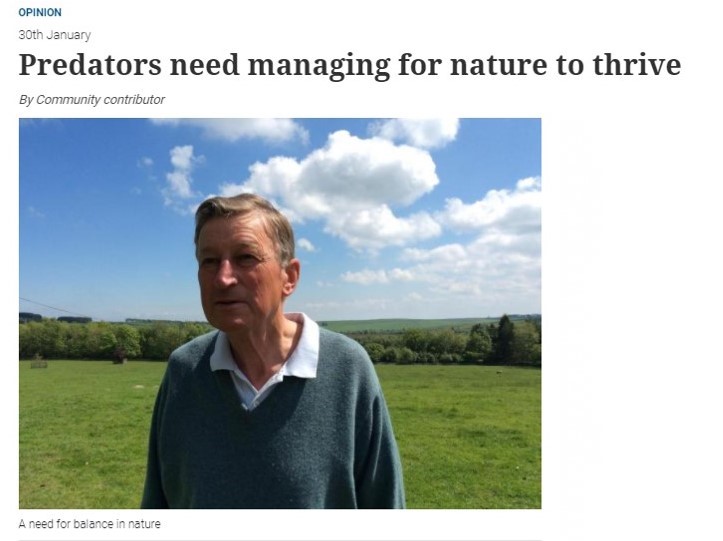
In an article about the threat posed by growing deer populations in The Scotsman on January 19, Duncan Orr-Ewing, of the RSPB, stated: “Nature seeks balance to thrive and by managing our deer populations, we can help nature to flourish.” It is not just deer populations which need managing for nature to thrive.

The idea of introducing even more apex predators, like lynx and wolves, should be treated with extreme caution as they can only contribute to the balance of nature going even further in the wrong direction once they become established and allowed to multiply unchecked.

Colin Strang Steel

Chairman of SongBird Survival,

Threepwood, Galashiels.

ENDS

I can’t think of anyone within the conservation community who takes SS seriously – whenever its name is raised, eyes roll, there are a few chortles and the conversation moves swiftly on. The SS is largely seen as an irrelevance and its Chair’s ill-informed views, made so frequently in publications like the above, do nothing to change anyone’s views.

The SS has recently announced a new CEO, Susan Morgan, who appears to be an experienced administrator but by her own admission is inexperienced in the field of conservation. She’ll fit right in at the good ship SS then. Perhaps her first project could be to fundraise for some much-needed training for SS trustees on the ecology of predator – prey relationships.

Multi-agency raid on Scottish grouse moor following reports of alleged wildlife crime

The Scottish SPCA and Police Scotland, along with other partners, have undertaken a search on a Scottish grouse shooting estate following reports of alleged wildlife crimes.

The multi-agency raid took place in November 2020.

A Scottish SPCA special investigations unit chief inspector, who cannot be named due to undercover work, said: “The Scottish SPCA is committed to the protection of all animals including wild animals.

We can confirm there is an ongoing investigation in to wildlife crime in the Tayside area.

This investigation is being carried out in conjunction with our partners from Police Scotland and we look forward to working with the wildlife crime unit as the case progresses“.

I understand this unnamed estate is in central Perthshire.

More details will be published when they’re made available.