Summary of petitions under consideration by Scottish Parliament’s Environment Committee on Tuesday

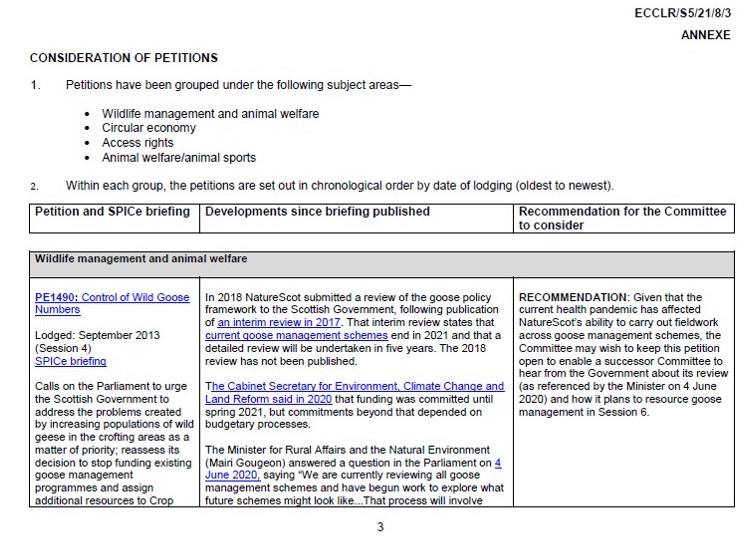
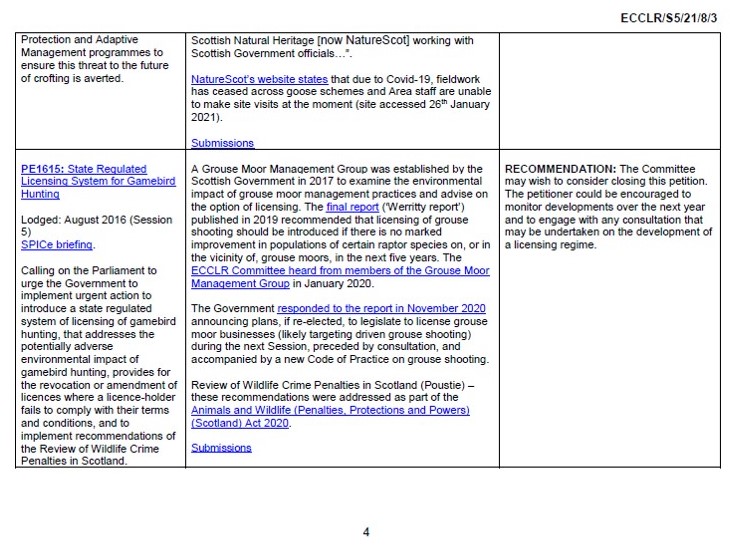
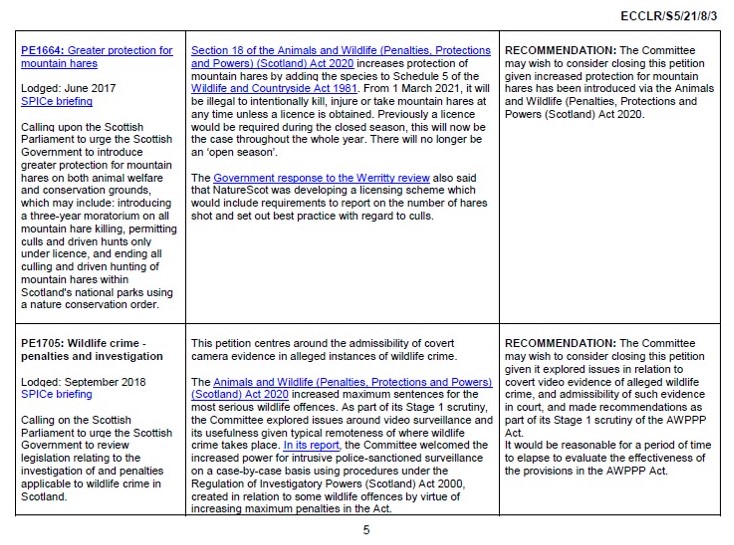
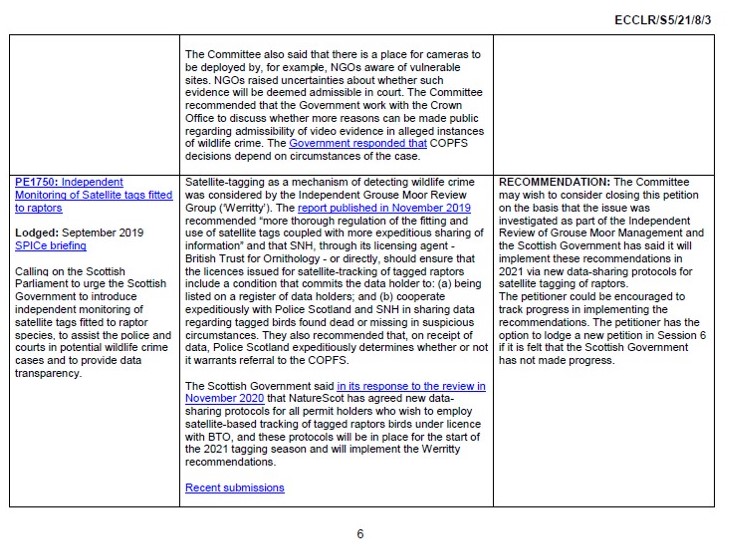
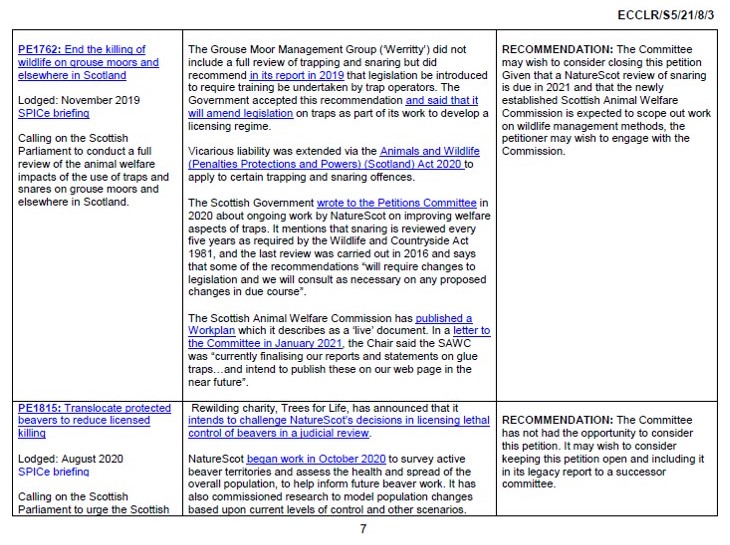
Last week I wrote about the Scottish Parliament’s forthcoming Environment, Climate Change & Land Reform (ECCLR) Committee meeting on Tuesday 23rd, when a selection of petitions will be considered including several of significant interest to this blog (see here), including gamebird licencing, mountain hares, wildlife crime penalties, raptor satellite tagging, and wildlife killing on grouse moors.

The official meeting papers have now been published on the ECCLR website and within those papers are recommendations for the Committee to consider for each of the petitions under consideration.

I’ll be discussing the petition from the Scottish Gamekeepers Association calling for ‘Independent monitoring of satellite tags fitted to raptors’ on this blog tomorrow and of course will be reporting on the ECCLR Committee’s decisions on the other relevant petitions after the meeting on Tuesday.

For now, here are the recommendations:

UPDATE 22nd February 2021: Scottish gamekeepers’ petition calling for independent monitoring of raptor satellite tags is ‘fact-free nonsense’ (here)

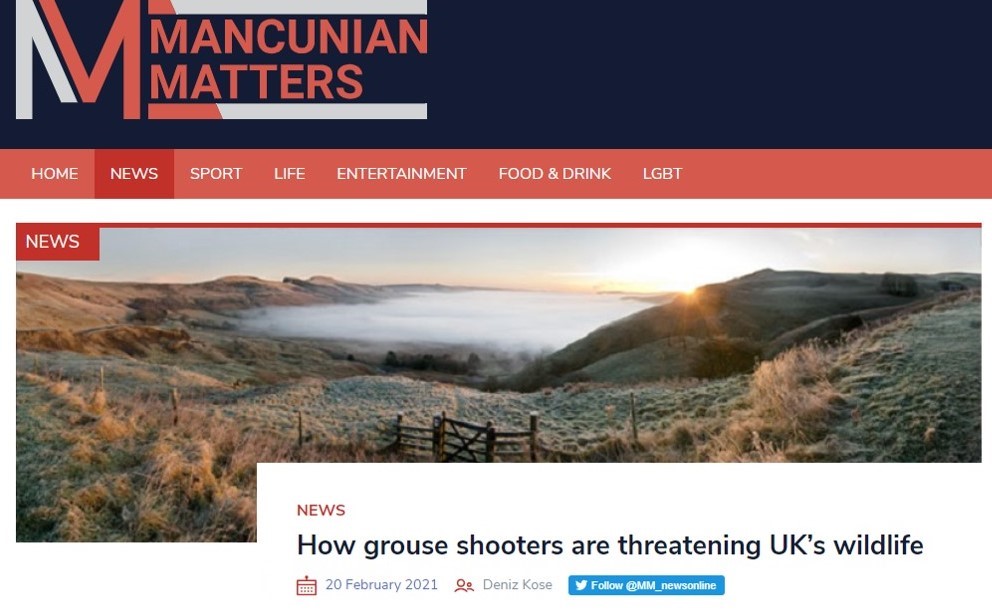
‘How grouse shooters are threatening UK’s wildlife’

Another new article, another new audience.

This time it’s an article published yesterday on Mancunian Matters, an online news website covering the Greater Manchester region.

Journalist Deniz Kose focuses attention on the work of local group Moorland Monitors, who describe themselves as a ‘grassroots community network working to protect persecuted wild species and wild spaces on driven grouse shooting estates’.

The article is worth a read (here) – it includes commentary from volunteer Bob Berzins about South Yorkshire Police’s ‘failure to act’ after the discovery of several illegally-set spring traps on a grouse moor in January 2019, which again serves to highlight the stark contrast between police forces – some are excellent and always right on top of their game, others, well, not so much, not all of the time.

It’s been that way for years, with enforcement in some forces seemingly based on an individual officer’s personality and/or links to the shooting industry rather than on upholding statutory regulation. It’s an issue that Chief Inspector Kevin Kelly, the new head of the National Wildlife Crime Unit, needs to get to grips with.

The Mancunian Matters article is likely to rile up the grouse shooting industry, not just because of its provocative headline but because it’s based on the testimony of the Moorland Monitors – a group that is utterly despised by the shooting industry. So much so that the Countryside Alliance, notorious for its unpleasantness, launched an e-lobby campaign in early February urging members to sign a petition asking Patagonia’s CEO to ‘immediately end both its promotion of, and working relationship with, Moorland Monitors’ after they found out that Patagonia had given a grant to the Moorland Monitors to help fund their work. Interestingly, the petition now seems to have vanished and Patagonia is still promoting the Moorland Monitors on the Patagonia website (here).

Still, I’ll bet that the hysteria generated by the Mancunian Matters article will be nothing in comparison to that generated yesterday by me posting the video of The Lounge Society, a teenage punk band from Yorkshire expressing their creative views on grouse shooting (see here).

In the video, the teenagers depict grouse shooters as rich, greedy, alcohol-swigging, blue-blooded, tweed-wearing toffs (that’s their interpretation, not mine) and the red grouse are symbolised by four lads (the band) wearing red/orange jumpsuits (the red grouse, geddit?). The grouse shooters use fake guns and pretend to chase, shoot and kill the lads in the red/orange jumpsuits (the grouse). But when the grouse shooters are sitting enjoying their lunch, the lads in red/orange jumpsuits (the grouse) come back to life and use fake guns to shoot the grouse shooters before walking off in to the sunset.

By sharing this video on this blog (and that’s all I did – share a video that’s been online for months – I didn’t produce or direct it!) according to some grouse shooting industry trolls it’s an indication that I’m ‘inciting violence against gamekeepers‘ and that I should be reported to the police, Government Ministers and probably MI5. Honestly, that is what has been written! These guys need to get a grip. It is interesting, though, to see them go in to meltdown over a music video showing some lads, representing zombie red grouse, using fake guns to pretend to shoot at some fake grouse shooters, but when real threats are made to real people, in real life, by people with access to real guns, (e.g. see here and here) not a word is spoken.

I think that puts the faux outrage in to perspective, don’t you? Especially when those real threats have come from some of the very same people now crying over a music video.

For those who missed it, here’s the video again. Take a look and make up your own mind:

The Lounge Society: teenage punk band in Yorkshire takes on grouse shooting

More and more, we’re seeing local residents and moorland communities finding courage and speaking out against the grouse shooting culture and its associated criminality that dominates and damages their daily lives.

We’ve heard from local communities in the Yorkshire Dales National Park (see here and here), from a community in the Nidderdale Area of Outstanding Natural Beauty (see here), from a local community in the North York Moors National Park (here), and from the community at Leadhills in South Lanarkshire (here).

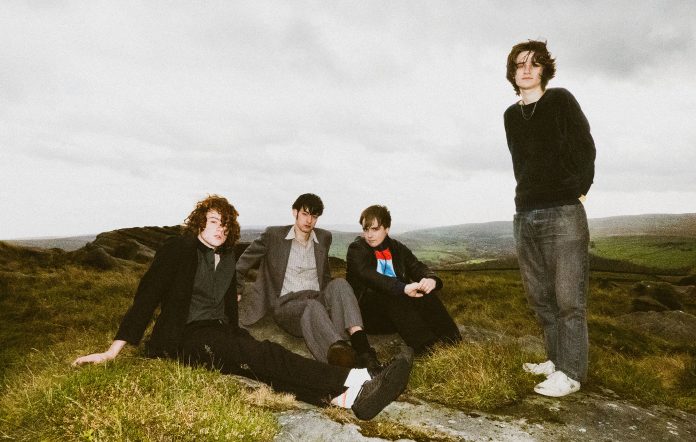
Here’s another example, this time from a punk band (The Lounge Society) created by teenagers who’ve grown up in West Yorkshire’s Pennine towns.

[Photo by Piran Aston]

The Lounge Society have a single out called Burn the Heather and according to an interview they’ve done with the NME ‘it takes aim at local landowners’ pre-grouse shooting ritual of burning the moor-top heather, with deerstalkers, wellies and tweed jackets in the accompanying video’.

NME asked guitarist Herbie May, ‘How did Burn the Heather come to be and what was the story behind that?’

Here’s his response:

There’s a continuing trend where a lot of wealthy local landowners will burn a lot of land for the sake of a bloodsport essentially to shoot grouse and other birds. That contributes to flooding and it’s generally very unpleasant and it can give rural areas a bit of a bad name and we wanted to express how ugly that is. It was just a local teenagers perspective on that lyrically. The groove is quite important to the track itself and to a lot of our music. We really set out to make people dance and make you move while getting across what we wanted to say about local issues and if that has any connection to issues which affect small towns everywhere“.

NME: I guess it smartly loops it into the wider political dialogue right now in many ways? 

Herbie May: “It is something that has gone on in the Tory party, over lockdown there were certain rules which seemed to specifically protect fox hunting. For a time you were allowed to go fox hunting but you weren’t able to play football in the park with your mates, so it does apply in other areas albeit in slightly different physical manifestations. The idea that there’s a class of people that have that much desire to kill living animals to the extent of making such brazen acts like that, it is shocking“.

To read the full NME interview please click here

UPDATE 21st February 2021: There’s more commentary about this video and the shooting industry’s irrational, hysterical meltdown about it here

Trial date set as man pleads not guilty to theft of peregrine eggs in Peak District National Park

A trial date has been set after a 60-year-old man pleaded not guilty yesterday to charges relating to the alleged theft of peregrine eggs in the Peak District National Park in Derbyshire last spring (see here).

Proceedings were brought following an investigation by Derbyshire Constabulary, supported by video evidence provided by the RSPB.

A trial date has been set for 28th July 2021.

NB: As this is a live case comments won’t be published until criminal proceedings have ended, thanks.

Gamekeepers lead disgusting hate campaign against conservationists (2)

WARNING: For those of a sensitive disposition this post will contain examples of grossly offensive material so if you’re likely to get upset by reading it I’d suggest you don’t go any further than this point.

Today’s post is a follow-on from last week’s post (Gamekeepers lead disgusting hate campaign against conservationists (1)) where I documented some of the abuse and harassment that has been levelled at me over the last six years because I campaign for an end to the illegal killing of raptors on game-shooting estates. Today’s post will focus on some of the abuse that’s been directed at my colleague Chris Packham and his step-daughter, Megan McCubbin.

These posts have been prompted by a recent campaign by gamekeepers complaining, with straight faces, that they are the victims of unfair abuse (see here).

Chris is no stranger to receiving harassment from the game-shooting and hunting industries for simply expressing his views and campaigning against animal cruelty and environmental destruction. The abuse has been going on for years:

The abuse comes from a variety of individuals with links to these industries, including these examples from Geva Blackett, former parliamentary officer for the SGA, married to Invercauld Estate’s factor (now retired), an SNP Councillor in Aberdeenshire and the former Deputy Convenor of the Cairngorms National Park Authority:

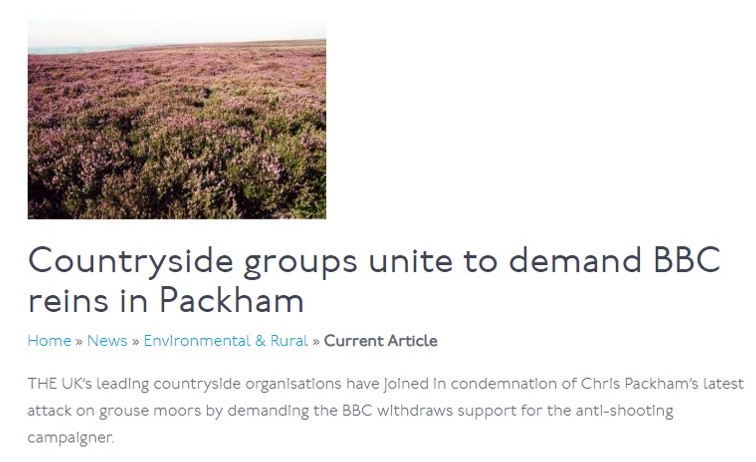
A common theme of attack has been in the form of petitions calling for the BBC to sack him (e.g. here) or ‘rein him in’ (e.g. here) and formal complaints being made to the BBC Trust (but not being upheld – see here and here) and much of this has been led by shooting industry groups such as the Countryside Alliance, Moorland Association, GWCT and BASC.

It’s little wonder, then, when the industry’s ‘leading’ organisations and prominent players are pursuing a hate campaign against Chris that gamekeepers and their supporters would also join in. One example was a gang of gamekeepers and their supporters who gathered outside a venue where Chris was working in Harrogate, shouting through a loud hailer about perceived job losses and who were so threatening that venue staff called the police to attend (see here). The irony of protesting about perceived job loss from an industry that has campaigned for Chris to lose his, wasn’t lost on any of us.

The abuse has certainly increased since Wild Justice launched in 2019 and some of that is well-documented, (e.g. see here but beware, it’s particularly unpleasant) and has included dead animals tied to his gate at home (e.g. see here and here), dead animals dumped on his drive (e.g. see here), human excrement sent through the post as well as a menacingly chilling death threat letter (see here).

His address has also been circulated on social media as have photographs of his driveway and gate.

All of this harassment, and other things that can’t yet be publicly divulged due to ongoing legal action, has been reported to the police.

More recently, the abuse has spread towards his step-daughter, Megan, and again this is likely to have been prompted by a particularly nasty attack on Megan published on the BASC website last year (here).

EVIDENCED EXAMPLES

This libellous post was written by Bert Burnett, a former Director of the Scottish Gamekeepers Association and a current columnist for the SGA’s quarterly rag for members, who routinely targets Chris, me, Wild Justice, RSPB and the Scottish Raptor Study Group:

Here’s Bert Burnett again with his vile, misogynistic language. Note the entry from ‘Glen Ample’ – this is the Facebook account of one Mike Holliday, a gamekeeper from Perthshire and a BASC Working Group member who recently wrote a letter of complaint to First Minister Nicola Sturgeon about the online abuse he and his colleagues had apparently suffered from ‘animal rights extremists’. I’ll be writing more about Mr Holliday and his own behaviour on social media in due course.

The following repulsive examples are from individuals who identify themselves as gamekeepers or are associated with the gamekeeping ‘profession’:

This one is from Ronnie Kippen, a gamekeeper from the Strathbraan area of Perthshire and apparently a committee member of the Scottish Gamekeepers Association who has also featured in some recent GWCT propaganda. He published this appalling post on 3rd Feb 2021:

Can you imagine being Chris, or Megs, or their family members and friends having to read this malicious abuse every single day? Where are the leaders within the game-shooting industry, standing up and you know, leading?

Thankfully there is some humour to be found amongst all this depravity. The gamekeeper who posted this wasn’t quite up on world affairs and genuinely thought he was on to something, until his more informed mates pointed out the obvious:

I think that’s probably enough for today.

There’ll be further blogs in this series coming soon.

UPDATE 18th July 2021: Organised crime, harassment & intimidation – another day on the grouse moors (guest blog) (here)

Police confirm banned poison Carbofuran found on Leadhills Estate, again

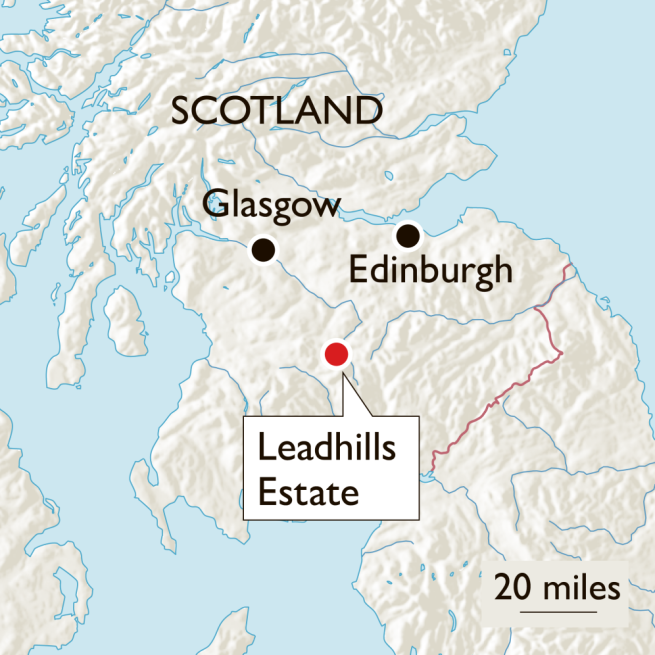
Police Scotland have confirmed the discovery of the banned poison Carbofuran on Leadhills Estate, a grouse-shooting estate in South Lanarkshire that has been at the centre of police wildlife crime investigations at least 70 times since the early 2000s.

The highly dangerous poison, which even in tiny amounts can kill humans and animals, was discovered in July 2020. Police Scotland have told the Daily Record:

We are aware of this incident and did investigate.

Forensics identified the substance as carbofuran, an illegal pesticide the use of which has been banned since 1991.

It is extremely concerning that this substance was found in a location which is accessible to the public. Anyone with further information about this incident should contact Police Scotland on 101.”

According to the Daily Record, ‘further enquiries were stopped after officers found no evidence to link the poison to any person or persons’.

There isn’t any explanation provided for why the public weren’t alerted to this discovery sooner.

As regular blog readers will know, Leadhills Estate is currently serving a three-year General Licence restriction, imposed in November 2019 following ‘clear evidence from Police Scotland that wildlife crimes had been committed on this estate’ (see herehere, and here). We know via FoI that one of the contributing factors to the decision to pull the GL was the discovery of the banned pesticide Carbosulfan in May 2019 (see here).

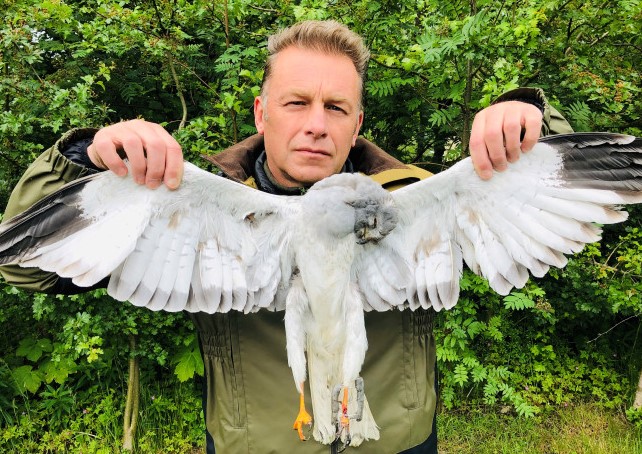
[Chris Packham holds a dead hen harrier whose leg was caught in an illegally-set trap on Leadhills Estate in May 2019. Photo by Ruth Tingay]

Since the General Licence restriction was imposed in late 2019, further alleged offences have been reported at Leadhills and are the subject of ongoing police investigations (see here) including the alleged shooting of a(nother) short-eared owl by a masked gunman on a quad bike as witnessed by a local resident and his eight year old son (see here).

And now the discovery of another batch of banned poison.

According to NatureScot’s Framework for GL Restrictions, ‘Individual restrictions will apply for a period of 3 years, but may be extended if evidence of further offences is obtained during this period’.

Let’s see whether NatureScot sees fit to extend the General Licence restriction at Leadhills Estate.

Petitions of interest to be heard next week at Scottish Parliament

A number of petitions, some of which have been live for several years and are of significant interest, will be considered next week at the Scottish Parliament.

The cross-party Environment, Climate Change, and Land Reform Committee (ECCLR) will be reviewing the status of these petitions that had previously been forwarded by the Petitions Committee. As we edge towards the end of the Parliamentary session, it may well be that the ECCLR Committee is trying to clear the decks – one of these petitions has been live since 2013!

Here’s the list:

PE1750: Independent monitoring of satellite tags fitted to raptors (submitted by Scottish Gamekeepers Association)

PE1755: Ban all single use plastics across Scotland (submitted by Stephen Henry)

PE1758: End greyhound racing in Scotland (submitted by Scotland Against Greyhound Racing)

PE1751: Create no wild camp zones in Scotland (submitted by Kirsteen Currie)

PE1762: End the killing of Wildlife on grouse moors and elsewhere in Scotland (submitted by OneKind)

PE1815: Translocate protected beavers to reduce licensed killing (submitted by Trees for Life)

PE1490: Control of wild goose numbers (submitted by Scottish Crofting Federation)

PE1615: State regulated licensing system for gamebird hunting (submitted by Scottish Raptor Study Group)

PE1664: Greater protection for mountain hares (submitted by OneKind)

PE1636: Require single use drinks cups to be biodegradable (submitted by Michael Traill)

PE1705: Wildlife crime – penalties and investigation (submitted by Alex Milne)

Certainly, some of these petitions could now be considered obsolete because progress has since been made, undoubtedly helped along by the petition itself. One of the petitions – the SGA’s embarrassingly ill-informed one about the monitoring of satellite tags fitted to raptors, will be discussed on here in the coming days.

The ECCLR Committee will meet on Tuesday 23rd February 2021 and I’ll add a video link here for those who wish to watch live proceedings. The official transcript will also be posted here when it becomes available.

UPDATE: The documents for the meeting on Tues 23rd February have now been published and are available to download here:

UPDATE 21st February 2021: Summary of petitions under consideration by Scottish Parliament’s Environment Committee on Tuesday (here)
UPDATE 22nd February 2021: Scottish gamekeepers’ petition calling for independent monitoring of raptor satellite tags is ‘fact-free nonsense’ (here)

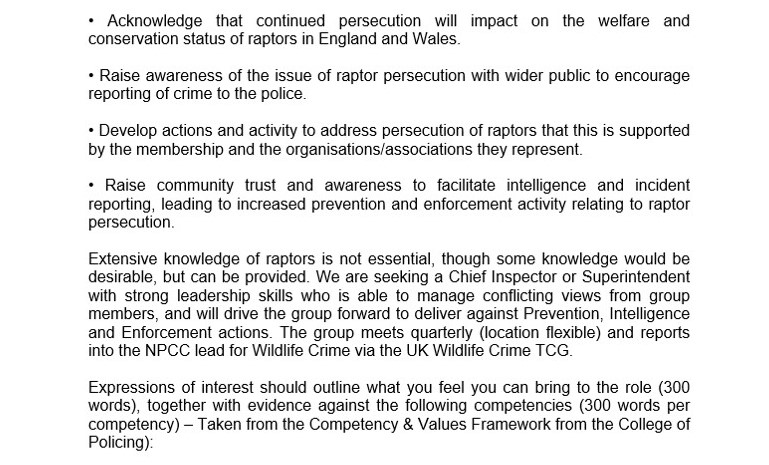
Senior police officer required to chair Raptor Persecution Priority Delivery Group (RPPDG)

The National Wildlife Crime Unit (NWCU) is recruiting for a senior police officer to Chair the Raptor Persecution Priority Delivery Group (RPPDG).

This is a poisoned chalice if ever there was one.

There are Priority Delivery Groups for the various National Wildlife Crime Priorities (e.g. raptor persecution, badger persecution, bat persecution, CITES, Freshwater pearl mussels, cyber-enabled wildlife crime and poaching) and the purpose of these delivery groups is ‘to progress the priority in relation to prevention, intelligence and enforcement’ (see here).

Some of these delivery groups are being quite effective – and that’s probably because all the members of the group share the same objective. For example, the badger persecution delivery group probably doesn’t have badger baiters sitting around the table ‘contributing’ to discussions about enforcement plans. And I’ll bet the CITES group doesn’t have international ivory traffickers in its membership, nor hare coursers in the poaching group.

But the raptor persecution group? Well, along with the likes of the RSPB and the Northern England Raptor Forum, the membership of this group also includes organisations like the Moorland Association, Countryside Alliance, BASC and the National Gamekeepers, some of whose members have been/are still under police investigation for alleged raptor persecution crimes. There are clear conflicts of interest and they don’t all share the same objective, no matter how hard some of the groups might pretend.

The RPPDG is, in my opinion, a partnership sham, designed to look as though efforts are being made to effectively tackle illegal raptor persecution in England and Wales. It’s been in existence since 2011 and the ‘delivery’ results speak for themselves – so far it has achieved absolutely sod all in terms of contributing towards the conservation of raptors in the UK and instead has frustrated the efforts of those organisations who are genuinely trying to stamp out persecution (e.g. see here).

Whoever takes on this role needs to be up for change. And that’s presumably why the NWCU is seeking a high-ranking officer for the position (Chief Inspector or Superintendent level). These groups need to be held to account and when they don’t deliver, or when they deliberately obstruct progress, they should be booted out.

Good luck to whoever gets the post.

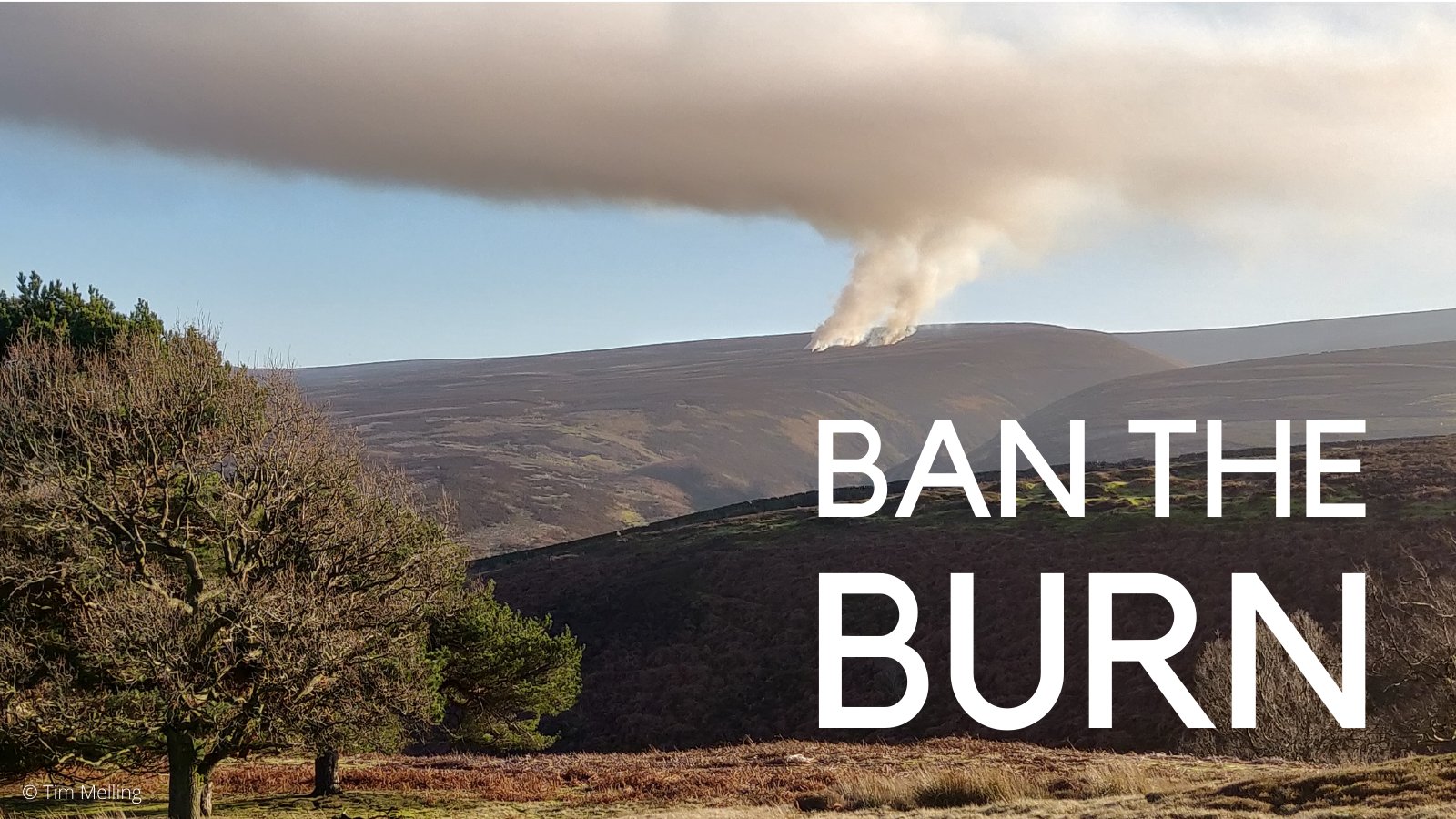
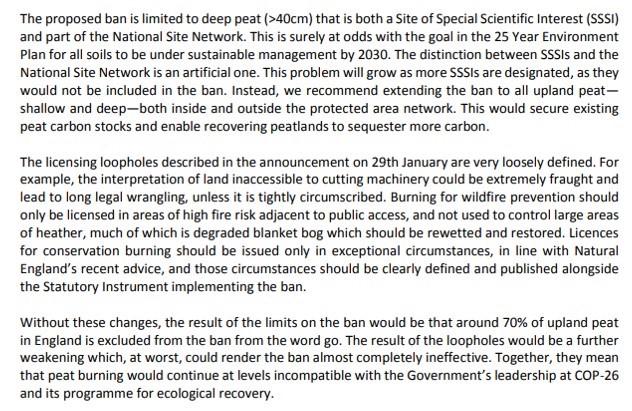
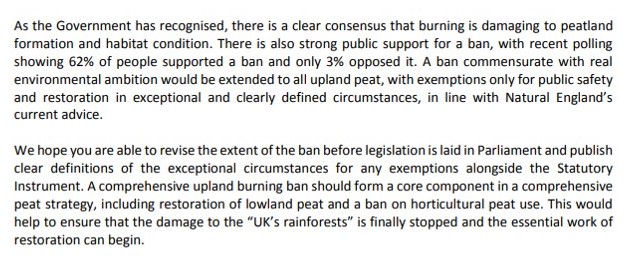
Environmental groups urge Govt to extend ban on moorland burning

At the end of January, DEFRA published a long-awaited statement on its proposal to ban burning on moorland (see here), although the proposal was heavily criticised as not going far enough and analysis by Guy Shrubsole demonstrated that many grouse moors would be exempt from the ban (see here).

[Photo by Tim Melling]

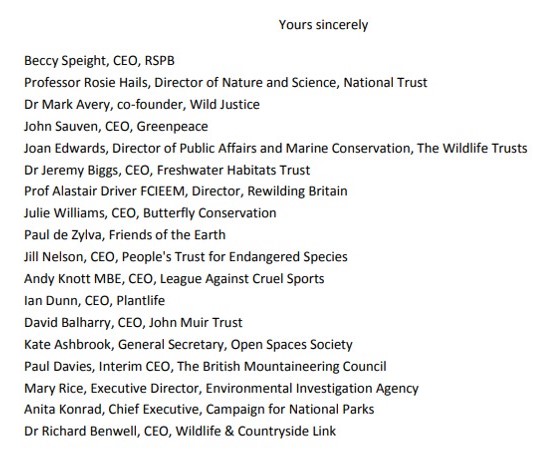
Today, the heads of 18 environmental groups have signed a letter to DEFRA Secretary of State George Eustice, urging him to extend the ban to make it more meaningful:

There is good coverage of this in today’s iNews (here) where a DEFRA spokesperson said the Government will set out further actions on England’s peatlands later this year.

Wild Justice testing Sainsbury’s gamebird meat for toxic lead ammunition

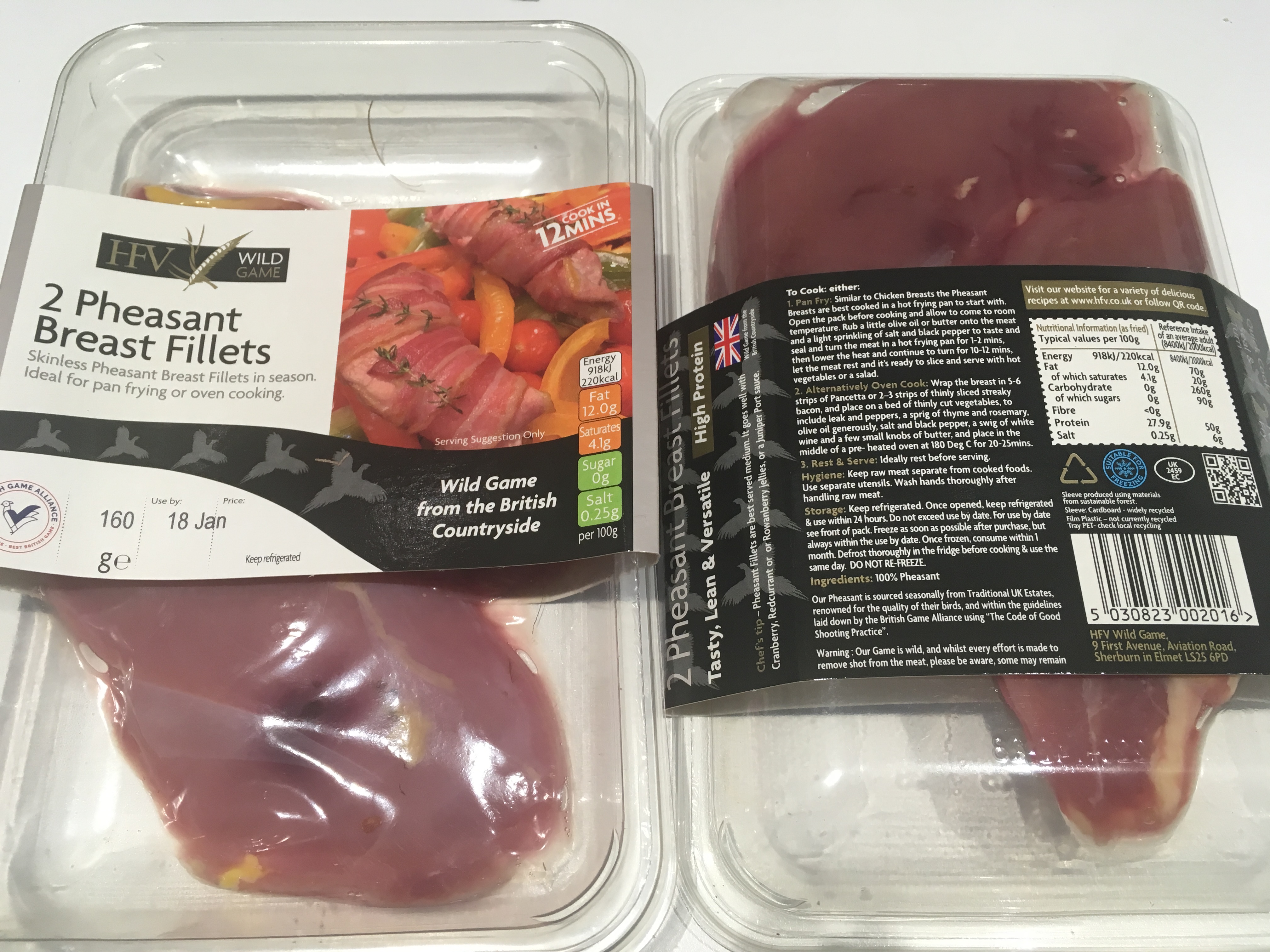
Last October Sainsbury’s started to sell gamebirds from a supplier in North Yorkshire, but has repeatedly refused to address customers’ concerns about the provenance of those pheasants and partridges, i.e. on which estates were they shot and what are those estates’ environmental credentials?

Sainsbury’s also claims, apparently without testing, that the gamebird meat it’s selling does not contain toxic lead ammunition (see previous blogs here, here and here).

[Photos by Dr Rob Sheldon]

Since then others have continued to press Sainsbury’s for information about whether these products contain poisonous lead ammunition but Sainsbury’s has continued to dodge the questions, instead directing customers to its supplier in North Yorkshire, who so far has ignored all requests for information (e.g. see Rob Sheldon’s blog here).

Wild Justice has lost patience with Sainsbury’s and is paying to have the products independently tested at a specialist laboratory. The results may show that this gamebird meat does not contain toxic lead ammunition, in which case great! At least everyone will know with certainty and transparency, instead of having to reply upon the crossing of fingers and hoping for the best.

For more details, please visit the Wild Justice blog here