51 hen harriers confirmed illegally killed or ‘missing’ since 2018

For anyone who still wants to pretend that the grouse shooting industry isn’t responsible for the systematic extermination of hen harriers on grouse moors across the UK, here’s the latest catalogue of crime that suggests otherwise.

[This male hen harrier died in 2019 after his leg was almost severed in an illegally set trap that had been placed next to his nest on a Scottish grouse moor (see here). Photo by Ruth Tingay]

Ten days ago this list totalled 48 hen harriers, all either confirmed to have been illegally killed or to have ‘disappeared’, most of them on or next to driven grouse moors.

They disappear in the same way political dissidents in authoritarian dictatorships have disappeared” (Stephen Barlow, 22 January 2021).

Today the list has been updated to include some others whose reported disappearances in 2020 have been confirmed, including Bronwyn (here) and Rosie (here), bringing the current running total to 51 hen harriers.

This disgraceful catalogue will continue to grow – I know of at least one more on-going police investigation which has yet to be publicised and I suspect there’s one other, although I’m still waiting for clarification on that one.

I’ve been compiling this list only since 2018 because that is the year that the grouse shooting industry ‘leaders’ would have us believe that the criminal persecution of hen harriers had stopped and that these birds were being welcomed back on to the UK’s grouse moors (see here).

This assertion was made shortly before the publication of a devastating new scientific paper that demonstrated that 72% of satellite-tagged hen harriers were confirmed or considered likely to have been illegally killed, and this was ten times more likely to occur over areas of land managed for grouse shooting relative to other land uses (see here).

2018 was also the year that Natural England issued itself with a licence to begin a hen harrier brood meddling trial on grouse moors in northern England. For new blog readers, hen harrier brood meddling is a conservation sham sanctioned by DEFRA as part of its ludicrous ‘Hen Harrier Action Plan‘ and carried out by Natural England (NE), in cahoots with the very industry responsible for the species’ catastrophic decline in England. For more background see here.

Brood meddling has been described as a sort of ‘gentleman’s agreement’ by commentator Stephen Welch:

I don’t get it, I thought the idea of that scheme was some kind of trade off – a gentleman’s agreement that the birds would be left in peace if they were moved from grouse moors at a certain density. It seems that one party is not keeping their side of the bargain“.

With 51 hen harriers gone since 2018, I think it’s fair to say that the grouse shooting industry is simply taking the piss. Meanwhile, Natural England pretends that ‘partnership working’ is the way to go.

‘Partnership working’ appears to include authorising the removal of hen harrier chicks from a grouse moor already under investigation by the police for suspected raptor persecution (here) and accepting a £10K bung from representatives of the grouse shooting industry that prevents Natural England from criticising them (see here).

[Cartoon by Gill Lewis]

So here’s the latest gruesome list:

February 2018: Hen harrier Saorsa ‘disappeared’ in the Angus Glens in Scotland (here). The Scottish Gamekeepers Association later published wholly inaccurate information claiming the bird had been re-sighted. The RSPB dismissed this as “completely false” (here).

5 February 2018: Hen harrier Marc ‘disappeared’ on a grouse moor in Durham (here)

9 February 2018: Hen harrier Aalin ‘disappeared’ on a grouse moor in Wales (here)

March 2018: Hen harrier Blue ‘disappeared’ in the Lake District National Park (here)

March 2018: Hen harrier Finn ‘disappeared’ near Moffat in Scotland (here)

18 April 2018: Hen harrier Lia ‘disappeared’ in Wales and her corpse was retrieved in a field in May 2018. Cause of death was unconfirmed but police treating death as suspicious (here)

8 August 2018: Hen harrier Hilma ‘disappeared’ on a grouse moor in Northumberland (here).

16 August 2018: Hen harrier Athena ‘disappeared’ on a grouse moor in Scotland (here)

26 August 2018: Hen Harrier Octavia ‘disappeared’ on a grouse moor in the Peak District National Park (here)

29 August 2018: Hen harrier Margot ‘disappeared’ on a grouse moor in Scotland (here)

29 August 2018: Hen Harrier Heulwen ‘disappeared’ on a grouse moor in Wales (here)

3 September 2018: Hen harrier Stelmaria ‘disappeared’ on a grouse moor in Scotland (here)

24 September 2018: Hen harrier Heather ‘disappeared’ on a grouse moor in Scotland (here)

2 October 2018: Hen harrier Mabel ‘disappeared’ on a grouse moor on the edge of the Yorkshire Dales National Park (here)

3 October 2018: Hen Harrier Thor ‘disappeared’ next to a grouse moor in Bowland, Lanacashire (here)

23 October 2018: Hen harrier Tom ‘disappeared’ in South Wales (here)

26 October 2018: Hen harrier Arthur ‘disappeared’ on a grouse moor in the North York Moors National Park (here)

1 November 2018: Hen harrier Barney ‘disappeared’ on Bodmin Moor (here)

10 November 2018: Hen harrier Rannoch ‘disappeared’ on a grouse moor in Scotland (here). Her corpse was found nearby in May 2019 – she’d been killed in an illegally-set spring trap (here).

14 November 2018: Hen harrier River ‘disappeared’ on a grouse moor in the Nidderdale AONB (here). Her corpse was found nearby in April 2019 – she’d been illegally shot (here).

16 January 2019: Hen harrier Vulcan ‘disappeared’ in Wiltshire close to Natural England’s proposed reintroduction site (here)

7 February 2019: Hen harrier Skylar ‘disappeared’ next to a grouse moor in South Lanarkshire (here)

22 April 2019: Hen harrier Marci ‘disappeared’ on a grouse moor in the Cairngorms National Park (here)

26 April 2019: Hen harrier Rain ‘disappeared’ on a grouse moor in Nairnshire (here)

11 May 2019: An untagged male hen harrier was caught in an illegally-set trap next to his nest on a grouse moor in South Lanarkshire. He didn’t survive (here)

7 June 2019: An untagged hen harrier was found dead on a grouse moor in Scotland. A post mortem stated the bird had died as a result of ‘penetrating trauma’ injuries and that this bird had previously been shot (here)

5 September 2019: Wildland Hen Harrier 1 ‘disappeared’ on a grouse moor nr Dalnaspidal on the edge of the Cairngorms National Park (here)

11 September 2019: Hen harrier Romario ‘disappeared’ on a grouse moor in the Cairngorms National Park (here)

14 September 2019: Hen harrier (Brood meddled in 2019, #183704) ‘disappeared’ in North Pennines (here)

23 September 2019: Hen harrier (Brood meddled in 2019, #55149) ‘disappeared’ in North Pennines (here)

24 September 2019: Wildland Hen Harrier 2 ‘disappeared’ on a grouse moor at Invercauld in the Cairngorms National Park (here)

24 September 2019: Hen harrier Bronwyn ‘disappeared’ near a grouse moor in North Wales (here)

10 October 2019: Hen harrier Ada ‘disappeared’ on a grouse moor in the North Pennines AONB (here)

12 October 2019: Hen harrier Thistle ‘disappeared’ on a grouse moor in Sutherland (here)

18 October 2019: Member of the public reports the witnessed shooting of an untagged male hen harrier on White Syke Hill in North Yorkshire (here)

November 2019: Hen harrier Mary found illegally poisoned on a pheasant shoot in Ireland (here)

January 2020: Members of the public report the witnessed shooting of a male hen harrier on Threshfield Moor in the Yorkshire Dales National Park (here)

23 March 2020: Hen harrier Rosie ‘disappeared’ at an undisclosed roost site in Northumberland (here)

1 April 2020: Hen harrier (Brood meddled in 2019, #183703) ‘disappeared’ in unnamed location, tag intermittent (here)

5 April 2020: Hen harrier Hoolie ‘disappeared’ on a grouse moor in the Cairngorms National Park (here)

8 April 2020: Hen harrier Marlin ‘disappeared’ on a grouse moor in the Cairngorms National Park (here)

19 May 2020: Hen harrier Fingal ‘disappeared’ on a grouse moor in the Lowther Hills, Scotland (here)

21 May 2020: Hen harrier (Brood meddled in 2019, #183701) ‘disappeared’ on a grouse moor in Cumbria shortly after returning from wintering in France (here)

27 May 2020: Hen harrier Silver ‘disappeared’ on a grouse moor on Leadhills Estate, Scotland (here)

9 July 2020: Unnamed female hen harrier (#201118) ‘disappeared’ from an undisclosed site in Northumberland (here).

25 July 2020: Hen harrier Harriet ‘disappeared’ on a grouse moor in the Yorkshire Dales National Park (here)

14 August 2020: Hen harrier Solo ‘disappeared’ in confidential nest area in Lancashire (here)

7 September 2020: Hen harrier Dryad ‘disappeared’ on a grouse moor in the Yorkshire Dales National Park (here)

16 September 2020: Hen harrier Fortune ‘disappeared’ from an undisclosed roost site in Northumberland (here)

19 September 2020: Hen harrier Harold ‘disappeared’ on a grouse moor in the Yorkshire Dales National Park (here)

20 September 2020: Hen harrier (Brood meddled in 2020, #55152) ‘disappeared’ next to a grouse moor in North Yorkshire (here)

To be continued……..

Anybody still wondering why the grouse shooting industry wants conservationists to stop fitting satellite tags?

Satellite-tagged hen harrier Rosie ‘disappears’ at roost site in Northumberland

Nine days ago I blogged about the suspicious disappearance of a satellite-tagged hen harrier called ‘Fortune’ who had vanished from an undisclosed roost site in Northumberland in September 2020 (see here).

Well guess what? Another one has gone, also from an undisclosed roost site in Northumberland.

This one was called ‘Rosie’, who was tagged (#57278) at a nest site (Northumberland 1) in July 2019 and the tag’s last known fix was 23 March 2020, also in Northumberland. Natural England has this marked in its database as ‘Missing fate unknown. At roost (site confidential)‘.

[Hen harrier Rosie when she was being tagged. Photo by Natural England]

Some of you may remember Rosie. She was previously reported as ‘missing’ in October 2019 (here) but then was reported to be alive and well later in the month (see here and here) and just wearing one of those Lotek tags whose limited functionality has proven to be problematic for tracking hen harriers (e.g. see here). I think it’s reasonable to assume that, ten months on and as there still hasn’t been a signal from her tag, then this is likely to be more than a tag reliability issue this time.

To be fair to Natural England, Rosie’s suspicious disappearance in March 2020 was not concealed – it was included in Natural England’s September 2020 tagged birds update but I didn’t spot it until now. Although perhaps if Natural England had bothered to publicise her suspicious disappearance at the time….

So, along with missing tagged hen harrier Fortune, that’s two gone at an undisclosed roost site in Northumberland this year. Whether that’s the same roost site only Natural England knows. Why can’t the roost sites be numbered, like the nest sites are, to disguise the actual location for security reasons but at least indicate positional proximity?

BASC’s £10K bung to Natural England to help fund winter roost monitoring doesn’t seem to be working very well, does it?

Rosie will now be added to the list of confirmed illegally killed/missing suspected killed hen harriers in the UK since 2018 – the running total is currently 50 but there’s more to come….standby.

Confirmation that hen harrier brood meddling estate was under police investigation

Cast your minds back to September 2020, when the RSPB claimed that a Natural England fieldworker had filmed a gunman, with an eagle owl, close to a hen harrier nest site in Cumbria (see here).

The RSPB, quite fairly, considered that the tethering of an eagle owl and the positioning of an armed man nearby was evidence that the eagle owl was being used as a decoy to attract in raptors (perhaps hen harriers) which could then be shot at close range. It’s an increasingly familiar sight on some grouse moors (e.g. see here), despite the use of a tethered live decoy being illegal (but let’s face it, the grouse shooting industry isn’t exactly feted for its adherence to the law).

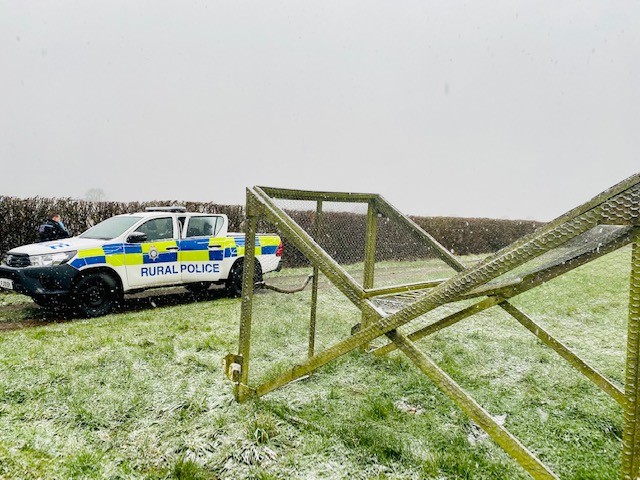
A police investigation in Cumbria ensued, but allegations were later made that a Natural England staff member had unintentionally frustrated the criminal investigation by contravening legal protocol and phoning up the suspected gunman and asking whether he was the person who’d been seen, with the owl decoy, near to the hen harrier nest the previous day (see here). The investigation came to an abrupt halt but Natural England denied that its staff member’s actions had any bearing on this decision (see here). We’ll never know for sure because Natural England can’t be trusted to be upfront about anything relating to the hen harrier and its precarious conservation status (e.g. see here for the latest example of why Natural England shouldn’t be trusted).

The other interesting aspect about this case was the suggestion that this estate was actively involved with Natural England’s insane hen harrier brood meddling trial last year. The suggestion was made in the RSPB blog although certainty was lacking due to the secrecy surrounding the location of brood meddled nest sites.

For new blog readers, hen harrier brood meddling is a conservation sham sanctioned by DEFRA as part of its ludicrous ‘Hen Harrier Action Plan‘ and carried out by Natural England (NE), in cahoots with the very industry responsible for the species’ catastrophic decline in England. For more background see here.

[A more realistic view of DEFRA’s hen harrier action plan. Cartoon by Dr Gerard Hobley]

Thanks to one of our blog readers making a Freedom of Information request to Natural England, it can now be confirmed that yes, this [unnamed] grouse-shooting estate where a gunman was filmed crouching close to a tethered eagle owl, in the territory of a pair of breeding hen harriers, was also one of the estates where Natural England licensed the removal of hen harrier chicks for brood meddling last year.

Although it took Natural England a couple of goes to confirm this, first of all denying it and then having to send an email two weeks later to correct the information:

It leaves you brimming with confidence in Natural England’s competence, doesn’t it?

The biggest joke in all of this is that the brood meddling trial is supposed to test whether those people responsible for killing hen harriers illegally would stop killing hen harriers if the chicks were brood meddled (removed from the grouse moor in June at the critical grouse-rearing stage and then returned to the wild in August). It’s a sort of ‘gentleman’s agreement’, as I saw it described by one commentator the other day. The problem is, there doesn’t seem to be many ‘gentlemen’ involved, or at least not honourable ones.

The irony of permitting brood meddling to take place on an estate under police investigation for suspected raptor persecution is not lost on any of us.

Buzzard found with shotgun injuries near Askham Richard, North Yorkshire

Press statement from North Yorkshire Police (19 January 2021)

Appeal for information after buzzard found containing shot at Askham Richard

On 12 December 2020, a  member of the public located a buzzard close to Askham Park near Askham Richard.

The female bird appeared to be injured and was unable to fly so an RSPCA Inspector attended and transported the bird to a local vet. Unfortunately the buzzard subsequently died.

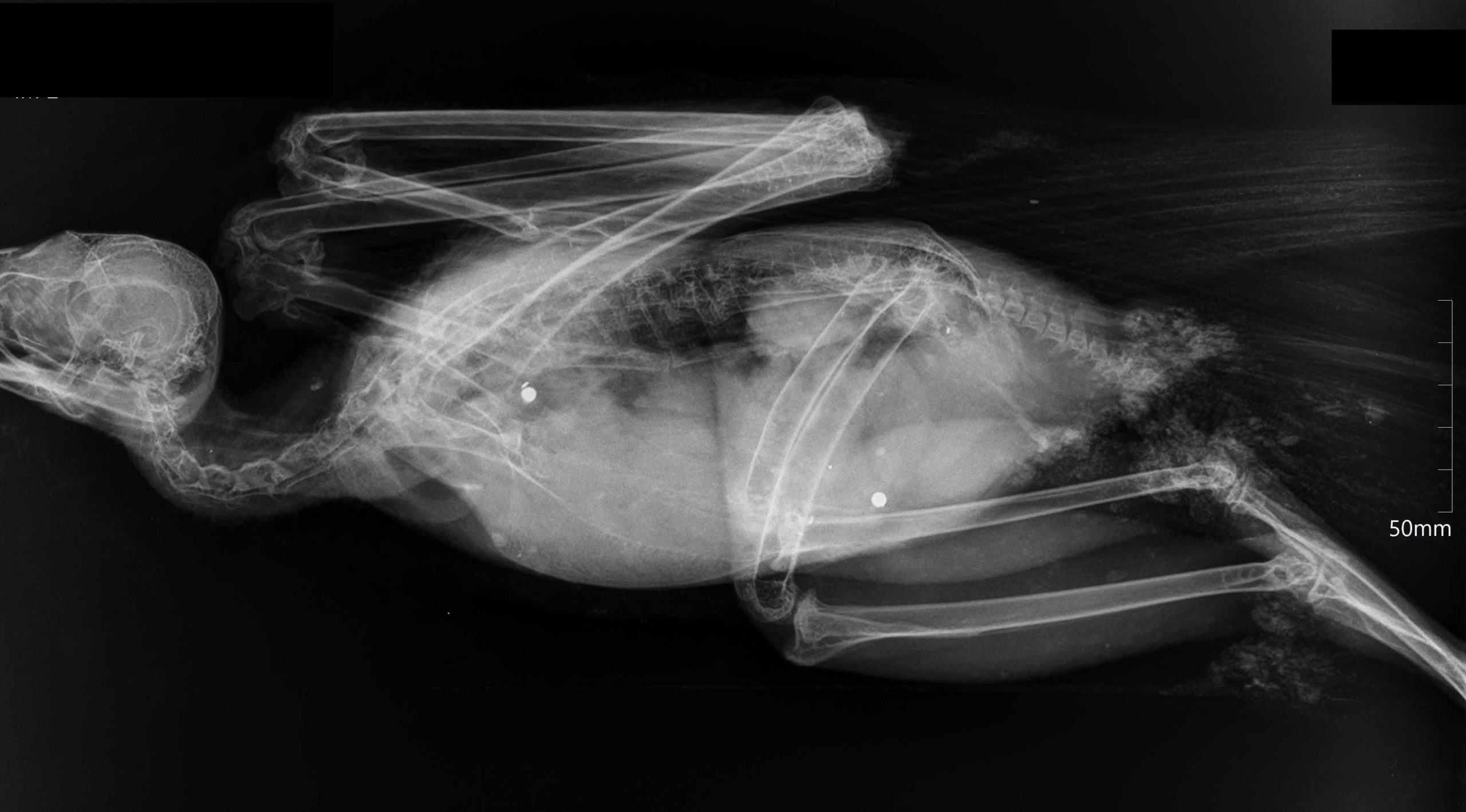
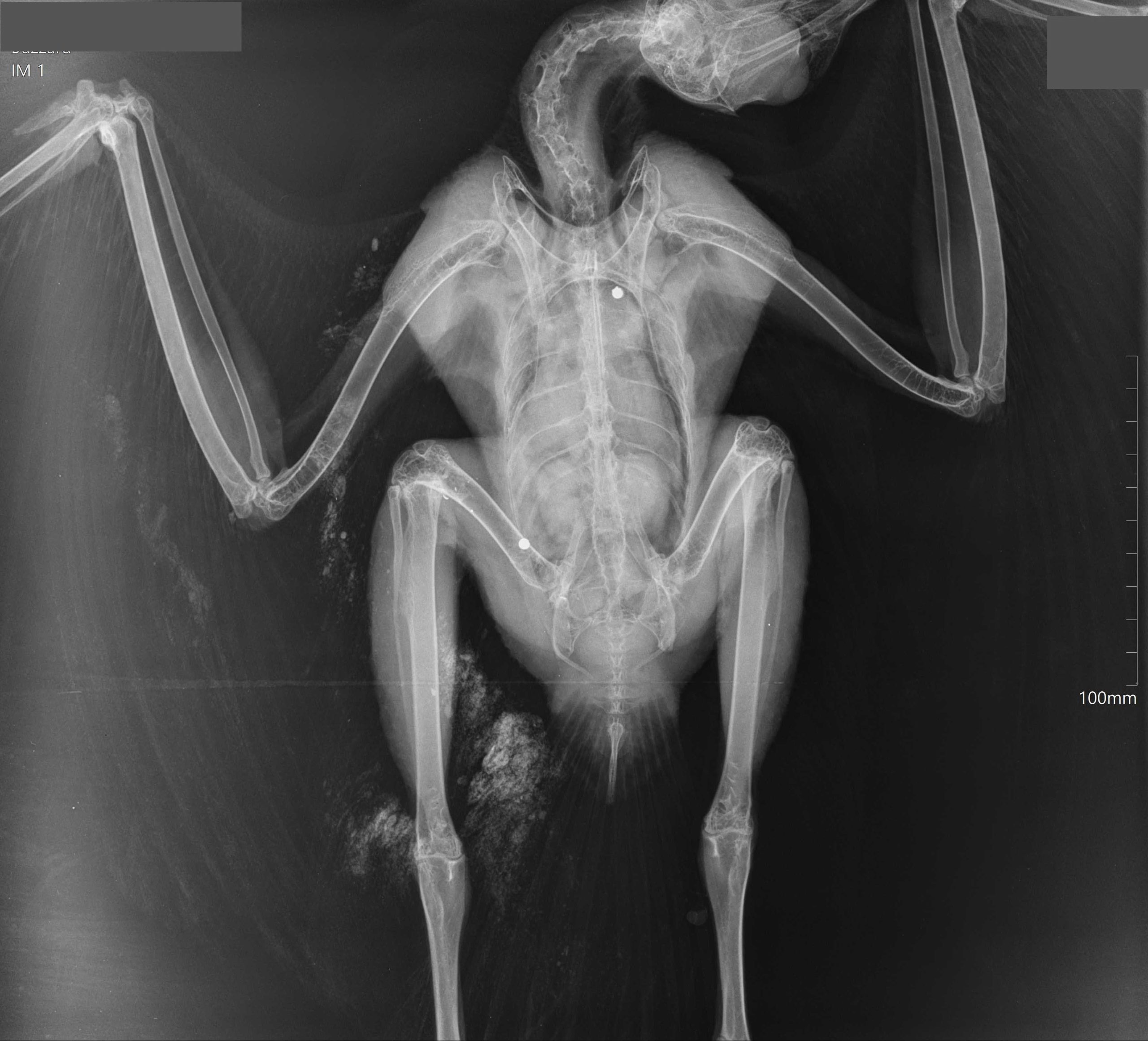
X-rays revealed that the bird had two pieces of lead shot within its body. 

Enquiries are ongoing but if you have any information which could help the investigation, please get in touch with North Yorkshire Police by calling 101 and quoting reference number: 12200227625.

ENDS

Hen harrier Bronwyn ‘disappears’ in North Wales

Six days ago I updated the list of hen harriers that were confirmed to have been illegally killed or were ‘missing’, suspected killed, since 2018.

The running total had reached 48 hen harriers (see here).

Thanks to an eagle-eyed blog reader, it’s been pointed out that I’d missed one – a satellite-tagged hen harrier called Bronwyn who vanished in 2019 in an area in North Wales where two other tagged hen harriers have also ‘mysteriously disappeared’.

[Young hen harrier Bronwyn just prior to fledging in 2019. Photo by RSPB]

You can read about the strange circumstances of Bronwyn’s disappearance on this RSPB blog (here). Sorry, I’m not sure how I missed this one.

So that brings the running total of illegally killed/missing hen harriers to 49, but that’s not the end of it. There are more to add to that list.

An update will follow shortly.

Police investigate illegal poisoning of a buzzard in Suffolk – guns & pesticides seized

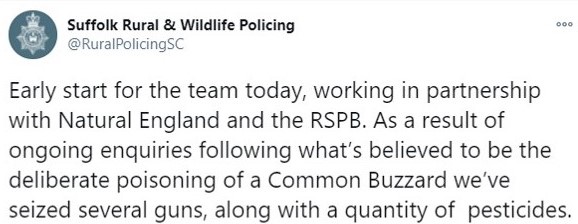
News is emerging of a multi-agency investigation today following the discovery of an illegally poisoned buzzard near Lakenheath in Suffolk.

Suffolk Police, Natural England and the RSPB Investigations Team attended and a number of guns and pesticides were seized. This is excellent partnership working and what a response!

The investigation continues and hopefully charges will be forthcoming.

[Photo from Suffolk Police]

UPDATE 24th August 2021: Another gamekeeper in court for alleged poisoning of buzzard (here)

UPDATE 9th November 2021: Gamekeeper convicted for pesticide and firearms offences but buzzard-poisoning charge is dropped (here)

National Wildlife Crime Unit – new head appointed

Press release from National Wildlife Crime Unit (NWCU), 18th January 2021

New lead for National Wildlife Crime Unit

Today marks the arrival of a new head of the National Wildlife Crime Unit, Chief Inspector Kevin Kelly.

Chief Inspector Kelly joins the national unit from his home force North Yorkshire Police. Ch Insp Kelly, who currently chairs the UK Badger Persecution Priority Delivery Group, has been a prominent figure in the wildlife crime arena for a number of years, seeing him become a highly decorated enforcer.

The NWCU is an intelligence and investigative support function that oversees and helps police forces implement the UK wildlife crime strategy set by the NPCC. The NWCU oversees the running and support of the Priority Delivery Groups for wildlife crime and works closely with advisory bodies and government agencies to support enforcement.

Chief Inspector Kelly says “I’m delighted, but there’s no time for complacency as this is going to be a tough role. I have spent all my service working in the fight against wildlife crime and to take this national role is a privilege. Today is a good day for our animals who are harmed or exploited and a bad day for criminals. I intend to lead this unit from the front, being visible on the ground and supporting colleagues with enforcement across the UK. Many people who abuse and exploit animals will abuse and exploit people, and I want to continue to show that when we effectively enforce wildlife crime, this feeds into the wider policing picture, both in the UK and internationally.

I also have a strong belief in partnership working. Effective partnerships help provide good practice and accountability and I want to see this built up nationally”.  

ENDS

This is a very welcome appointment. Kev has a great deal of experience of tackling illegal raptor persecution from his time spent on North Yorkshire Police’s rural taskforce. He’s renowned for his enthusiasm, energy and determination and is highly respected by those at the front end of the conservation community.

Best of luck to him.

Judgement in Wild Justice’s legal challenge of Welsh General Licences has significant implications

Statement from Wild Justice (18th January 2021):

Further success on General Licences – this time in Wales

Earlier this morning, His Honour Justice Jarman handed down his judgment on Wild Justice’s judicial review of Natural Resources Wales’s general licences. His judgment further limits the casual killing of birds under general licences and has implications for general licences in other parts of the UK. 

Wild Justice is delighted at the content of the judgment, and its implications, even though the judge did not go as far as saying that the current licences are unlawful.  

The judgment: The Wild Justice challenge of the Welsh general licences concerned the circumstances under which the licences can lawfully be used. And our main concerns were about the conservation licence (GL004) which authorises the killing of four corvid species (Carrion Crow, Magpie, Jackdaw and Jay) for the purpose of conserving wild birds.  

The judgment considered the following; For example, carrion crows, of which there are about 20,000 pairs in Wales, prey upon the eggs and chicks of ground nesting birds, such as curlews, of which there are less than 400 pairs left in Wales‘ and later stated ‘Thus, in the example given above NRW accepts that the relevant licence (004) should be used only to kill crows during the months between egg laying and when the chicks are well grown, namely April to July, and only in those areas where curlews nest, which do not extend to urban areas. It should not permit someone to kill a crow in the autumn or in an urban area on the basis that that bird might someday at some place take a curlew’s egg or chick‘.

In other words, you can only kill Carrion Crows under this licence where the Carrion Crows are a present danger to species of conservation concern – in those places at those times. Wild Justice believes that this is a highly significant and very welcome clarification.  

Justice Jarman further wrote ‘Written evidence was filed on behalf of WJ by one of its directors, Dr Mark Avery, on behalf of NRW by one of its managers Dr Sarah Wood, and on behalf of BASC by Glyn Evans, one of its heads. Whilst there was some disagreement between Dr Avery and Dr Wood, there was little if any difference between them on how the licences given for the purposes stated in them should work in practice. Mr Wolfe [counsel for Wild Justice] made it clear that WJ welcomed such clarification but submits that these clarifications should have been expressly imported into the wording of the licences. He points to the fact that Mr Evans interprets the licences more widely than NRW, and submits that that is a cogent reason why the licences should specify the circumstances of their use in greater detail‘. 

In other words, the licensing authority (NRW) agrees with Wild Justice that the licence should only be used where there is a ‘present risk’, and the court agrees with us both, but BASC had a different view which was rejected by the court.  

ENDS

For further commentary on this judgement and what Wild Justice suggests should happen now, please read this piece on Wild Justice’s blog.

Police investigate illegal killing of buzzards in Nottinghamshire

Press release from Nottingham Police (17 January 2021)

Investigation begins into killing of wild birds

A local man is assisting police with their enquiries in relation to the killing of wild birds.

Nottinghamshire Police officers have worked closely with the RSPB after they were called on 12 January following concern to wildlife in the Kneeton area.

All birds of prey are protected by the Wildlife and Countryside Act 1981. To intentionally kill or injure one is a criminal offence and could result in an unlimited fine or up to six months in jail.

Wildlife Crime Officers from Newark and West Bridgford officers were assisted by investigators from the RSPB.

Rushcliffe Inspector Craig Berry said: “Following excellent partnership work by the police and the RSPB we have interviewed a man under caution at the police station in connection with the death of buzzards.   

The incident was called into the RSPB following a report that the birds were killed  and officers are now making further enquiries.”  

Wildlife crimes are often under reported and can pose some practical difficulties in the investigation, however this example demonstrates the police will seek to gather evidence and prosecute offenders.

Officers have urged anyone with any information to contact police by calling 101, the RSPB or Crimestoppers and report similar matters.

ENDS

UPDATE 11th August 2021: Gamekeeper on trial for alleged killing of buzzards (here)

New Scottish wildlife crime investigator appointed

Press release from National Wildlife Crime Unit & Nature Scot (formerly SNH), 15 January 2021

Tackling raptor persecution, poaching and hare coursing will be the top priorities for a new wildlife crime specialist covering all of Scotland, appointed late last year.

As the Investigative Support Officer for Scotland for the National Wildlife Crime Unit (NWCU), PC Gavin Ross will be a source of expertise in wildlife crime at both the local and national level. He will work with individual police wildlife liaison officers, NGOs, the Scottish Government, NatureScot, RSPB, the SSPCA and Scottish Land and Estates. The position is funded by NatureScot.

PC Ross was the local community police officer for Dunbar, and has 21 years of police service and an extensive background in wildlife crime issues, community policing, problem solving and educational work.

Minister for Rural Affairs and the Natural Environment, Ben Macpherson, said: “Wildlife crime is despicable and tackling it has been a long-standing priority for the Scottish Government. We work closely with a number of agencies to ensure perpetrators are brought to justice. The Animals and Wildlife Act, which recently became law, increases the maximum penalties for the most serious wildlife crimes and extends the time available to Police Scotland to investigate.

The work of the National Wildlife Crime Unit is hugely valued by communities across Scotland and we are committed to supporting it. I look forward to working with PC Ross in the future and congratulate him on his new role.

PC Ross said: “When I was in Edinburgh, very early in my service, I became involved in investigating wildlife crime because of my interest and experience in this area. I’ve been a part-time wildlife crime officer throughout my whole service and the new job is the pinnacle of my career. I worked very hard preparing for my interview and was very keen to secure the job, which is a dream post. I am looking forward to settling into the role and working with all the different partner agencies which are so important in the fight against wildlife crime.

In the six weeks I’ve been in post I’ve concentrated on meeting many of the partner agencies we work with in wildlife crime. Unfortunately most of the meetings have had to be done virtually but I feel they have all been really positive and I look forward to building on these initial foundations, especially when we can meet face to face.”

The Head of the NWCU, Ch Insp Hubble said, “I was extremely pleased when PC Ross was successfully appointed as our new Scottish ISO and I am sure he is going to be a valuable asset to policing wildlife crime.”

Andy Turner, NatureScot Wildlife Crime Officer added: “Eliminating wildlife crime is huge priority for us, which is why we’ve provided funding for this post since 2014. Wildlife crime doesn’t just cause irreparable damage to Scotland’s nature: it also affects tourism, which in turn impacts on the economy. We are committed to working with NWCU, Police Scotland and other members of the Partnership for Action Against Wildlife Crime (PAW Scotland) to tackle this challenging issue.

We worked closely with Gavin’s predecessor Charlie Everitt to prevent wildlife crime and raise awareness.  I look forward to continuing to this important work with Gavin and the NWCU in the future.”

NWCU’s main role is to assist in the prevention and detection of wildlife crime by obtaining and distributing information from a wide range of organisations and by helping police forces investigate wildlife crimes. NWCU also produce analysis which highlights local or national threats.

The appointment of PC Ross comes after the retirement of PC Charlie Everitt, who had spent the last 11 years developing the role of Scottish ISO within the National Wildlife Crime Unit. Charlie furthered countless operations, provided expert advice to police wildlife liaison officers and acted as the key central point of contact between the police and a vast range of partner agencies. Charlie was well known throughout the Scottish wildlife crime arena and his professional knowledge, enthusiasm, and willingness to assist were beyond question. PC Ross recognised he had “big shoes to fill.”

ENDS