Revive coalition launches political manifesto calling for end to driven grouse shooting in Scotland

Press release from Revive, the coalition for grouse moor reform (6 May 2020)

REVIVE LAUNCHES 2021 MANIFESTO CALLING FOR AN END TO DRIVEN GROUSE SHOOTING

Coalition sets out its political asks one year ahead of Scottish elections

Revive, the coalition for grouse moor reform has published its manifesto outlining a number of asks, including an end to driven grouse shooting ahead of next year’s elections. These include tackling climate change, land reform, social justice and protecting Scotland’s wildlife and biodiversity.

Revive is a coalition made up of Common Weal, Friends of the Earth Scotland, League Against Cruel Sports Scotland, OneKind and Raptor Persecution UK, working for grouse moor reform in Scotland and campaigning to end the circle of destruction that surrounds grouse shooting.

Campaign Manager for Revive Max Wiszniewski said: “Driven grouse shooting, an intensively managed blood sport, is inherently unsustainable. Keeping the land managed as barren monocultures for this sport maintains a large area of Scotland’s land in an impoverished state.

This is why the Revive coalition has proposed alternative visions for our moors and launched the manifesto we hope political parties will adopt into their own. We believe this is in line with voters expectations and hope a year from now we can go to the polls with all parties committing to address the environmental crisis in our countryside caused by intensively managed grouse moors.”

Revive is calling for significant reform of Scotland’s grouse moors and is asking Scotland’s political parties to make the following commitments:

● Protect Scotland’s peatland by ending muirburn for the purpose of grouse moor management

● A ban on the use of medicated grit

● A change to the use of non-lead ammunition

● Regulation of off-road hill tracks

● Transformational land reform to be enacted on a national scale

● An end to the snaring, trapping and killing of Scotland’s wildlife for the purpose of increasing grouse numbers

● Licensing of all grouse moor estates

● A transition away from driven grouse shooting

Robbie Marsland, Director of the League Against Cruel Sports added: “Untold thousands of wild animals are killed on an industrial scale as part of rigorous predator control on intensively managed grouse moors just so there are more grouse available for sport shooting. The League is opposed to this senseless cruelty and wholeheartedly supports Revive’s Manifesto calling for an end to grouse shooting and the circle of destruction which surrounds grouse moors.”

The coalition argues that grouse moors managed for sport shooting is one of the least regulated industries in Scotland. Along with measures to tackle climate change and transformational land reform, Revive is proposing a licensing system to end the unsustainable elements of grouse moor management.

Director of Friends of the Earth Scotland, Richard Dixon said: “From their terrible toll on wildlife to their impact on climate change, grouse moors are a 19th century idea that should have no place in the 21st century. Scotland can do much better for local communities and nature.”

ENDS

You can read Revive’s manifesto here: REVIVE manifesto

To read Revive’s other publications (as noted in the manifesto) please visit the publications page on Revive’s website here

Prejudice, ignorance & pride are key drivers of gamekeepers’ desire to kill predators

When the full extent of the wildlife crimes committed by Scottish gamekeeper Alan Wilson was revealed last year (see here), it inevitably led to questions by most reasonable people about his motivation.

These questions weren’t restricted to the issue of illegal persecution; they also led to more general discussions about the legal killing of wildlife by gamekeepers, and these questions continue to dominate conversations about game shoot management in the UK.

[Gamekeeper Alan Wilson, convicted in 2019 of nine offences on Longformacus Estate. Photo Daily Record]

A new paper has just been published that provides insight from interviews with 20 gamekeepers in southern England about their motivation for killing predators (legally).

This research was undertaken by George Swan as part of his PhD, successfully completed in 2017. Obviously there are limitations and caveats associated with such a small sample size from a relatively restricted geographic area but the authors acknowledge these and place their results in an appropriate context.

This is an ‘open access’ paper which means that it’s freely available, in full, here.

The paper doesn’t start well. In a scene-setting paragraph about lowland gamebird management in the UK the number of annually released non-native gamebird species is given as ‘>20 million Pheasants and >2 million Red-legged Partridge’. This is a massive underestimate using out of date references.

The most recent estimate of released gamebirds is from 2016 (see here) and is approaching 60 million released gamebirds per annum (47 million Pheasants, 10 million Red-legged Partridge). These figures from the shooting industry are considered to be conservative and are highly likely to have increased again since 2016.

Incredibly, the exact figure is unknown because the game bird shooting industry is virtually unregulated. There is no statutory requirement to register a shoot nor to provide a record of the number of birds released and then shot. Indeed, in this latest paper the authors even acknowledge that they couldn’t themselves establish the size of any of the shoots involved in the survey ‘as the number of birds released was found to be a sensitive question‘!

Moving on to the gamekeeper interviews, the study’s main findings identify six primary motivations for killing predators. These are described as: professional identity, personal norms, potential penalties, perceived impact, personal enjoyment and perceived ease.

It’s really worth reading the detail of these motivators in the paper (jump to section 3 ‘Findings’ if you want to skip the pre-amble). The level of prejudice, ignorance (of ecological predator-prey relationships) and pride (e.g. ‘one gamekeeper explained how he controlled magpies, in part, because other gamekeepers ‘take the Mickey’ [mocked the respondent] when they saw this species on his beat‘) will be shocking to many. The notion of needing to control predators to ‘maintain balance’ is laughable in the context of releasing almost 60 million non-native gamebirds in to the countryside every year!

To be perfectly frank, none of this will come as any surprise to anyone who’s spent a couple of hours reading gamekeepers’ comments on social media. However, it is useful to have these attitudes documented and analysed in a formal scientific way. The authors propose this research could help to understand and mitigate ‘social conflicts’ over predator management.

For others, this research will be beneficial for those of us who consider that urgent regulation of the UK’s gameshooting industry is required. Indeed, many of the findings in this new paper support Wild Justice’s ongoing legal challenges against the General Licences in England and in Wales which, Wild Justice contends, unlawfully authorise the ‘casual killing’ of millions of birds without the gamekeeper having to justify why the killing is necessary and a last resort.

Incidentally, the crowdfunder to support Wild Justice’s legal challenge of General Licences in Wales is just short of reaching its target. If you’re able to help, please click here. Thank you.


Birds of prey still being killed despite lockdown

Since lockdown began in March there’s been widespread concern that the illegal persecution of birds of prey would escalate, especially on grouse moors (e.g. see here) where fewer people are around to witness the crimes and/or the aftermath.

The UK’s grouse moors have been the epicentre of raptor persecution crimes for years; Mark Avery astutely described the National Parks that are dominated by grouse moors (e.g. Yorkshire Dales, North York Moors, Peak District, Cairngorms) as “massive wildlife crime scenes” (see here).

But of course, the threat to UK raptors isn’t just restricted to areas managed for driven grouse shooting. These birds are targeted and killed in the lowlands too, and quite often (although not exclusively) on land being managed for pheasant and partridge shooting.

Just two weeks ago a red kite was reported as shot on land managed for pheasant shooting, with another two birds also suspected to have been shot at the same location (see here).

It seems that the conservationists’ concerns were well founded. Despite the country being in the midst of a national crisis, and despite the shooting industry’s claims to have a ‘zero tolerance’ of raptor persecution (see here), the killing continues.

Police Supt Nick Lyall, Chair of the Raptor Persecution Priority Delivery Group (RPPDG, the so-called partnership that aims to tackle the illegal killing of raptors) tweeted this yesterday:

Nick singles out North Yorkshire but we’re also aware of a spate of other suspected raptor persecution crimes during lockdown, in a number of other counties across England and Scotland. Most of these have yet to be publicised as police investigations continue but hold on your hats, folks, when they are finally publicised the list is going to be long and damning.

Scottish Gamekeepers Association ‘negotiating with Government’ for new offence of trap damage

News emerged this week, via the Scottish Gamekeepers Association’s (SGA) e-newsletter for members that it is currently ‘negotiating with Government’ for the creation of a new offence relating to trap damage:

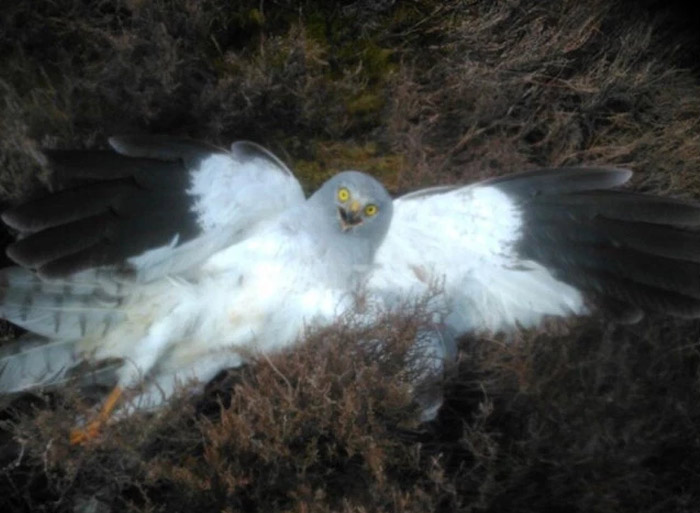
This is really quite interesting. The SGA, with others, has been arguing for several years that legally-set traps have been ‘tampered with’ or damaged by members of the public and these claims usually occur just after an illegally-set trap has been discovered and reported in the media. A recent example of this was the male hen harrier that was found in considerable distress with its leg almost severed in an illegally-set trap on Leadhills Estate (see here).

[Male hen harrier found with an almost severed leg, caught in an illegally-set spring trap next to its nest on Leadhills Estate (see here). Nobody has been prosecuted for this barbaric crime but the estate has had its use of the General Licence restricted by SNH as a direct result of this and other offences (see here)].

The implication of such claims has seemed clear – instead of accepting that some gamekeepers continue to break the law (e.g. by setting illegal traps), the shooting industry would rather deflect the blame on to so-called ‘animal rights extremists’ who are accused of ‘setting up estates’.

During a cross-party RACCE committee hearing in 2013, then Environment Minister Paul Wheelhouse said there was no evidence to support claims of widespread trap tampering/damage by ‘activists’ (see here) although it emerged that BASC was undertaking a survey to assess the extent of this alleged problem.

A couple of years later in 2015 that BASC survey revealed that trap tampering/damage did take place but according to industry evidence, it couldn’t be described as being a ‘widespread’ issue (see here).

In 2017 the SGA again complained of a so-called ‘escalation’ in trap damage and again attributed this to ‘activists’ but as we reported at the time (see here), yet again the evidence was lacking.

Let’s be clear here though. It is quite evident, just looking through social media, that some members of the public are indeed deliberately damaging traps to render them unusable, either because they have an ethical objection to the killing of native wildlife to increase gamebird stocks, or because they’ve become so frustrated with what they perceive to be a lack of enforcement action against the criminal gamekeepers, or because they believe the trap to be illegal. The legislation on trap use is complicated and many members of the public are simply unaware of what is legal and what is illegal. (For a basic introduction have a look at this from OneKind and this from Revive).

To be honest, we’d welcome some clarity on what constitutes ‘tampering’ or ‘damage’. At the moment it is not at all clear and trap tampering may not always constitute a criminal offence. For example, the SGA’s lawyer, David McKie, wrote in a 2013 edition of the SGA’s members’ rag:

As a matter of law, there is a significant difference between interference and vandalism.

Vandalism would involve the breaking of a crow cage trap by someone punching or kicking a hole in it, for example, or the deliberate smashing up of a Fenn trap. It would also include the cutting of snares.

Interference does not necessarily involve a criminal offence….That can involve the removal of traps from their set location, the release of decoy birds or the pulling of snares.

The police can probably not charge the individual with interference’.

In some cases there may be a legitimate defence to causing trap damage – e.g. if a trapped animal is seen to be injured inside a padlocked crow cage trap and needs urgent veterinary attention, but the location is remote and there’s no phone signal to call for help, it might be considered reasonable to cut the trap wire to extricate the wounded animal. Much will depend on the individual circumstances of each incident.

Another example might be the discovery of what is obviously an illegally-set trap. Is it an offence to disable it if there is absolutely no question that it’s been set unlawfully? As an example, here’s a pole trap that was photographed on an estate in the Angus Glens. It’s been an offence to set pole traps for over 100 years!

[An illegal pole trap, photograph by RSPB]

It’d be kind of ironic if a member of the public was prosecuted for disabling such a pole trap, when the person who allegedly set it (a gamekeeper was filmed by the RSPB attending the trap) had the prosecution against him dropped by the Crown Office because the video evidence was deemed inadmissible!

So, yes, regardless of the extent of trap tampering / damage, greater clarity is certainly required on what constitutes an offence. However, given how long we’ve been waiting for the Scottish Government to bring in new legislation to tackle the persistent illegal persecution of birds of prey on sporting estates, that’s happening at such a scale it’s known to be affecting entire populations of some of these species, the trap tampering offence that the SGA claims to be ‘negotiating’ should be way down the list of Government priorities.

UPDATE 12 May 2020: Parliamentary questions on proposed new offences for trap damage (here)

UPDATE 16 May 2020: Scottish Government denies ‘negotiating’ with gamekeepers on new offences for trap damage (here)

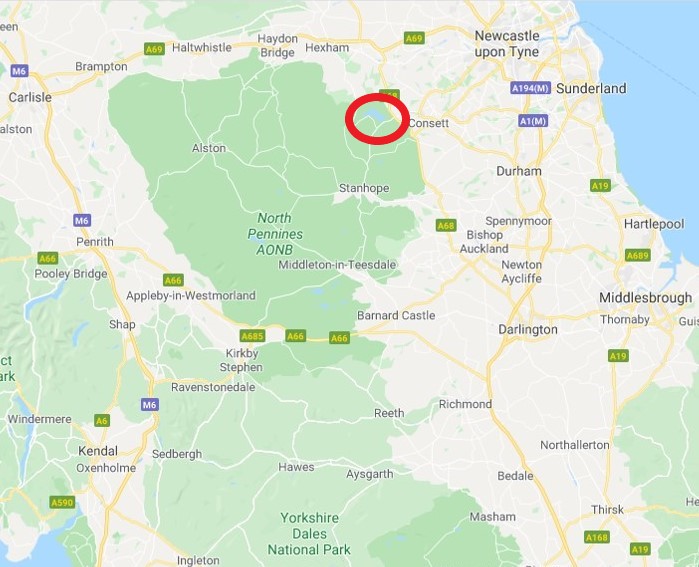
Satellite-tagged red kite ‘disappears’ on grouse moor in North Pennines AONB

Press release from RSPB (30 April 2020)

Red kite vanishes in suspicious circumstances

Durham Police, the RSPB, the North Pennines AONB Partnership and Friends of Red Kites are appealing for information following the disappearance of a red kite in County Durham.

The young bird was fitted with a satellite tag at Rowlands Gill, near Gateshead in June 2019 by Friends of Red Kites (FoRK) with NERF support. It has been monitored since by the RSPB.

[Red kite ‘KK’ being fitted with a satellite tag as a nestling. Photo via RSPB]

The bird, nicknamed ‘KK’, toured northern England, making it as far as the Peak District, then returned north and has been faithful to the Derwent Valley region ever since.

KK’s tag had been functioning normally until it suddenly and unexpectedly stopped transmitting. The last fix came from an area of driven grouse moor near the Derwent Reservoir on 17 April. It has not been heard from since.

Emma Marsh, RSPB England Director, said: “If you’ve seen a red kite wheeling high overhead you’ll know that they’re splendid birds. They enrich our landscapes and bring joy to many.

When a tag which has been functioning reliably suddenly cuts out, this gives us immediate cause for suspicion. The additional fact that the tag’s last data fix came from an area dominated by driven grouse shooting rings serious alarm bells.

The connection between driven grouse shooting and the illegal killing of birds of prey has been well documented. Sudden, unexplained disappearances of tagged birds of prey are happening far too often in these landscapes. Satellite tags continue transmitting even after death, so if this bird had died naturally we would expect to be able to recover it.”

Red kites are specially protected under the Wildlife and Countryside Act (1981) which makes it an offence to deliberately kill or injure this species. Those found to have done so could be given an unlimited fine and/or a prison sentence.

Harold Dobson, spokesman for the Friends of the Red Kites, said: “It’s 15 years since the first red kites were re-introduced in the Lower Derwent Valley. They are faring well in the valley itself and we enjoy watching these impressive, majestic birds of prey.

As mainly scavengers, the red kites are of no threat to anyone. However, we fear that human persecution is preventing them from naturally expanding their range: since 2010, seven red kites have been found poisoned or shot near the Derwent Gorge and surrounding Durham Moorland. We fear that this may be the tip of the iceberg and that many more persecuted kites are never found.”

Inspector Ed Turner, the lead for wildlife and rural crime for Durham Constabulary said: “The fate of this red kite is not yet clear, we are working with the RSPB to establish what has happened since its transmitter unexpectedly stopped on 17 April 2020. Until we can rule out the possibility that a crime has not been committed, then we will be taking this matter very seriously and if anyone has any information please contact the police quoting 22042020-0078.

Chris Woodley-Stewart, Director of the North Pennines AONB Partnership, said: “Though the fate of this bird isn’t certain, the fact that it was carrying two reliable trackers means this looks very like a crime may have been committed. This is an area where a significant number of kites have been shot or poisoned and we’d really appeal to anyone who knows anything that might help shed light on this incident to come forward.”

If you have any information about this incident, please contact the police on 101, quoting the reference number 22042020-0078. Alternatively, if you have information about birds of prey being killed or targeted near you, please call the RSPB’s confidential Raptor Crime Hotline on 0300 999 0101.

ENDS

GWCT in extraordinary attack on Bradford Council

The Game and Wildlife Conservation Trust’s (GWCT) reputation took another nosedive yesterday when it launched an extraordinary (and unsubstantiated) attack on Bradford Council.

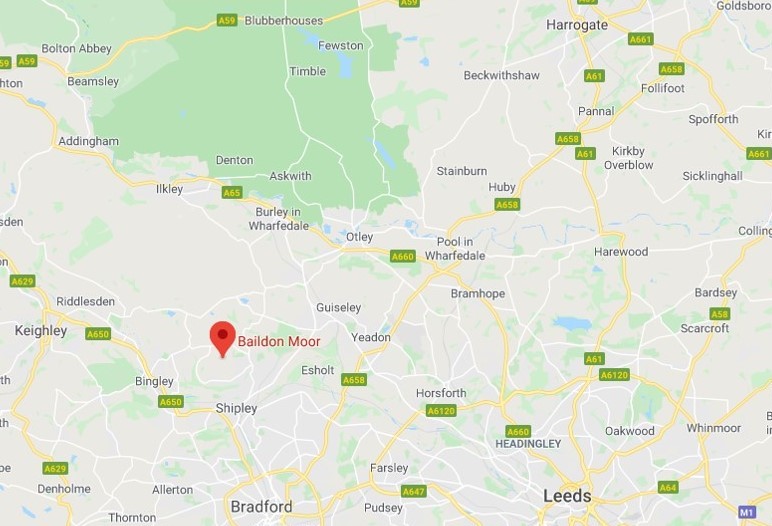
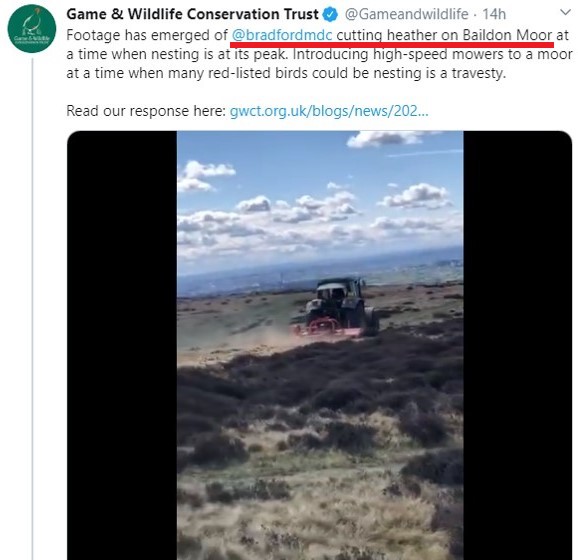
Video footage had emerged on Twitter of a tractor being used to cut heather on Baildon Moor at a critical time for ground-nesting birds. The moor is owned by Bradford Council.

GWCT was tagged in to the tweet and Andrew Gilruth, Director of Communications, went from nought to nasty without any apparent hesitation or pause for thought.

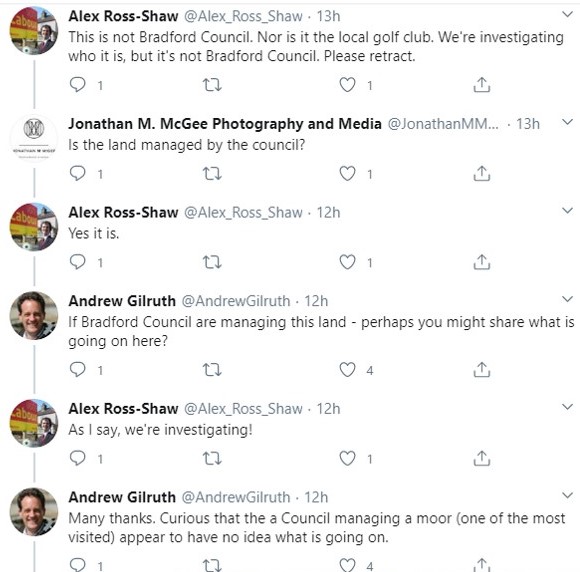
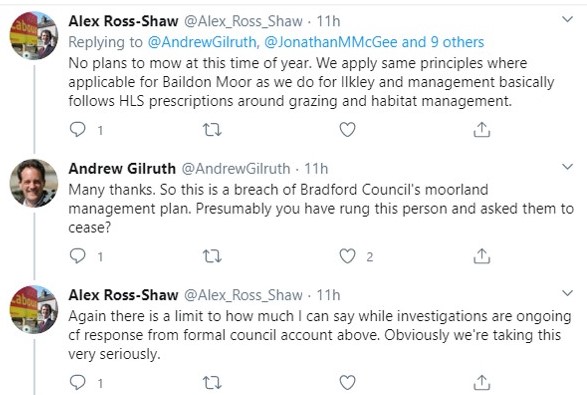
The video was posted on the GWCT’s YouTube account (here), a blog was posted on GWCT’s website (here) and a string of bullying tweets spewed forth to Bradford Council. The council was directly accused of causing the damage.

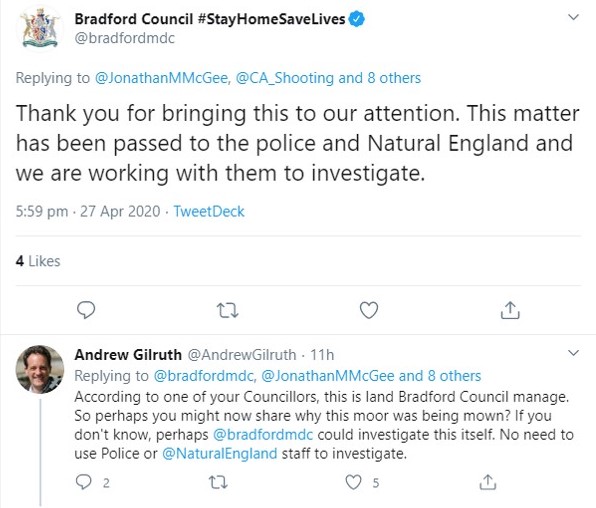
Bradford Council responded by saying it had not authorised the heather cutting and had reported the incident to Natural England and to the police. A councillor (Alex Ross-Shaw) also confirmed these details. GWCT then started to backtrack (although noticeably didn’t apologise) but the harm had already been done to Bradford Council’s reputation, not least thanks to Andrew Gilruth’s rather unpleasant sneering and spin-doctoring.

It’s not hard to understand the trigger for such nastiness. Many of you will recall it was Bradford Council that banned grouse shooting on Ilkley Moor in 2018 after a concerted campaign by locals (see here) and last year it threatened legal action after allegations that grouse shooters were driving red grouse off Ilkley Moor on to a neighbouring moor to be shot (see here).

For those of you not on social media here is a taste of the content:

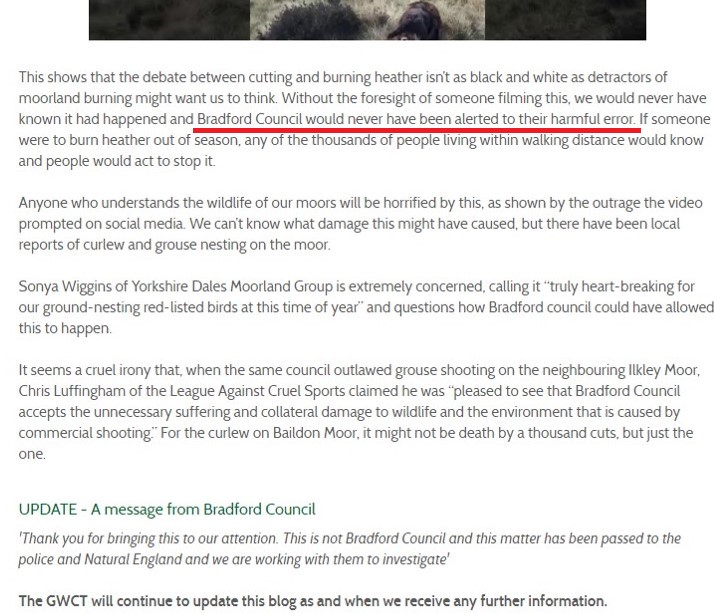
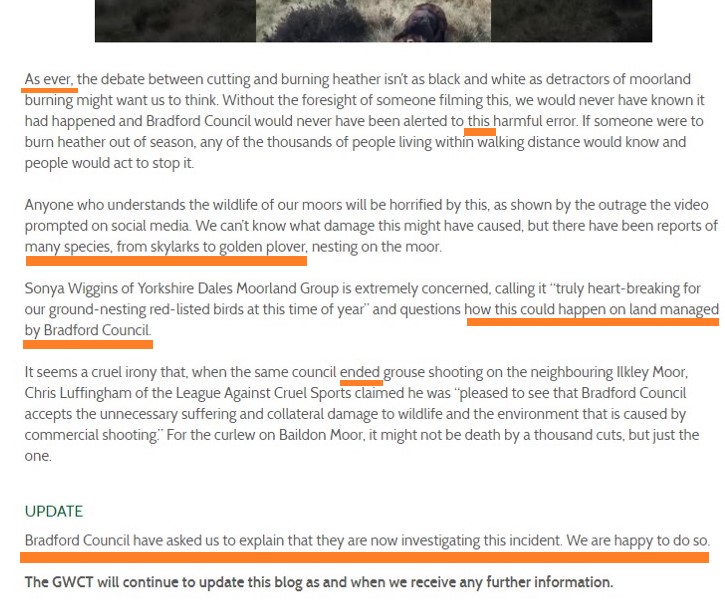
Interestingly it looks like someone’s had a quiet word with the GWCT  – perhaps it was Bradford Council’s lawyers, because this morning the GWCT blog has been carefully edited to remove the baseless accusations previously levelled at the council. The changes are underlined in orange:

Funniest of all, at the foot of the revised blog is this appeal for cash, to help GWCT continue its so-called ‘vital work’ (that’ll be smearing the reputation of those who don’t support grouse shooting).


Langholm Moor community buyout – an update

Last summer a local community got together to investigate the feasibility of buying part of Langholm Moor, to turn it from a knackered grouse moor into a nature reserve for the benefit of everyone, after the Duke of Buccleuch announced his intention to sell (see here and here).

A crowdfunder was launched to help pay for an initial feasibility study (here) (to which many RPUK blog readers contributed, thank you) and Kevin Cummings, who is leading the community buyout project, has written a couple of interesting guest blogs about the process, one for Mark Avery’s blog (here) and one for the Revive coalition (here).

Yesterday, those who contributed to the crowdfunder received an email from the project, as follows:

This is an update to the kind donors to our crowd funder. Something hopeful in these straitened times.

The feasibility study you helped fund is now complete and showed that the Langholm Initiative can sustainably manage the land and provide the significant community and environmental benefits we hoped for. It provides a hugely exciting vision, creating the ‘Tarras Valley Nature Reserve’ covering about 10,500 acres of moorland, woodland, farmland and including nearly 7 miles of the Tarras Water. 

We have a unique opportunity to create an ambitious legacy for the future. Langholm Moor, a special place with huge cultural importance and populated with some of our rarest and most beautiful wildlife, could become a community-owned nature reserve, supporting positive climate action, native woodland creation, small-scale renewable energy and sustainable business development.

You can read the details of our plans developed through the feasibility study here.

If you want to keep up to date and show support for our work you can join the Initiative.

Full membership is available to those living within DG13 and DG14 postcodes, associate membership for those living outside these areas   

Efforts are now underway to secure purchase funds, through an application to the Scottish Land Fund, and by seeking private donations in due course.

ENDS

Well worth taking a look around the project website (here) and reading the summary reports, starting with this prospectus (here) and this summary of the feasibility study and business plan (here).

Trapping and killing stoats – the new rules

The trapping and killing of wildlife to increase the number of gamebirds available for shooting parties is a daily routine for many gamekeepers.

It is legal to kill some species (e.g. stoats, weasels, foxes, crows) as long as certain conditions are met and it is illegal to kill other species (e.g. most birds including raptors, some mammals) unless a specific licence has been issued for limited purposes.

Earlier this month new legislation was enacted concerning the legal killing of stoats (see earlier blog, here) and there are now General Licences which include new rules and regulations, particularly around the use of Fenn traps, although there is still a lot of uncertainty on some issues.

[A Fenn trap set on a log, photo from the Untold Suffering report published by the Revive Coalition last year]

For those of you interested in this subject there are two excellent blogs that are worth taking the time to read:

The first one is by the animal welfare charity OneKind and it explains some of the welfare issues associated with Fenn traps and why these traps are no longer permitted to be used to trap and kill stoats. Read the blog HERE

The second blog is by author and former police wildlife crime officer Alan Stewart and it explains and critiques the new legislation relating to the killing of stoats. Read the blog HERE

If you’re out walking on your permitted exercise route and you spot one of these traps it’s worth taking a photo, noting the location (use the app What3Words, it’s brilliantly accurate and easy to use) and reporting it. Given the police are pretty busy at the moment it’s probably worth reporting it to OneKind and the RSPB. Their expert staff can assess the photograph and either advise you that the trap looks lawful or they can report it to the police if it looks dodgy.

With ‘friends’ like this, who needs enemies?

When Wild Justice announced last week that it was launching a new fund to support police officers investigating the illegal persecution of birds of prey in the UK (see here), not everybody welcomed the initiative.

That was hardly a surprise. Criticism was fully expected from those with a vested interest in maintaining the status quo, i.e. those who benefit the most from the difficulties faced by police forces in bringing the raptor-killing criminals to justice. The existence of this new fund will hopefully increase the opportunities available to the police to secure sufficient evidence against these criminals to proceed with prosecutions, so of course there’d be some who would try to undermine it from the outset.

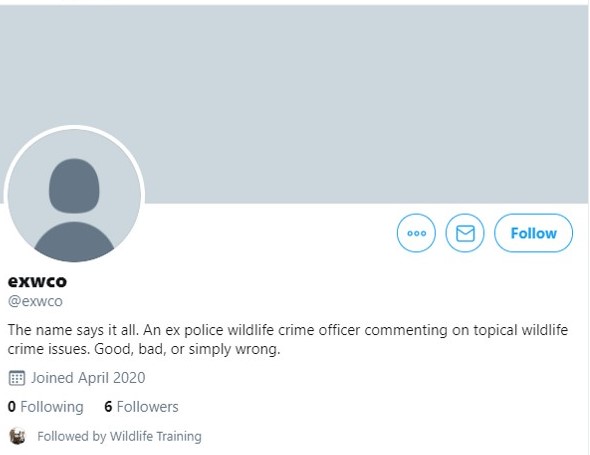
However, one particularly vocal critic emerged, on twitter and on this blog, who hid his identity behind the pseudonym ‘EXWCO’ [ex-wildlife crime officer, for those unfamiliar with the lingo] whilst making thinly-veiled accusations against Wild Justice as well as against Police Supt Nick Lyall (Chair of the Raptor Persecution Priority Delivery Group, RPPDG) and the National Wildlife Crime Unit (NWCU) as both had been named in Wild Justice’s original announcement. For those who missed ‘EXWCO’s’ comments on this blog, please see here.

To be honest, it was difficult to understand exactly what ‘EXWCO’ was objecting to – his criticisms were a bit all over the place but what was clear was that he disliked Wild Justice (fair enough), that he thought that the NWCU’s impartiality would be ‘compromised’ if it administered the new fund (because the money had come from Wild Justice – no, me neither) and that Nick Lyall’s credibility was undermined because he’d given a supportive quote (no, me neither). As has been pointed out by blog reader Gareth Jones on the earlier post, the NFU and other organisations fund / lend /sponsor equipment for a number of police forces so why should the Wild Justice fund be treated differently?

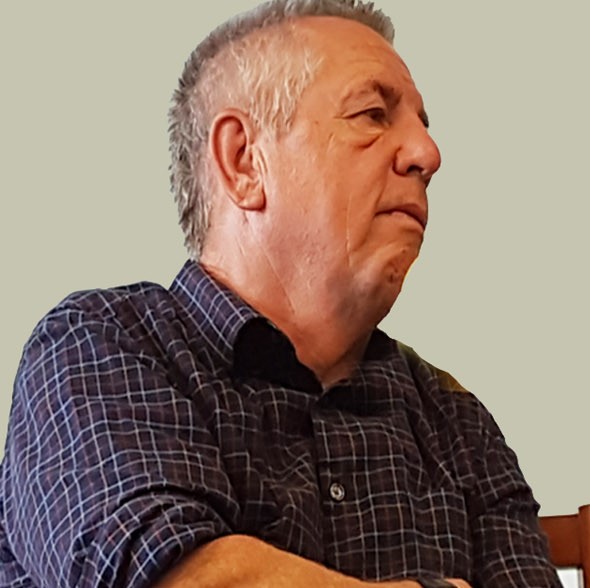
Yesterday, ‘EXWCO’ decided to reveal his identity to the public at large – it’s a guy called Pete Charleston, a former police wildlife crime officer and someone who has held other related roles since retiring from the police. He’s perhaps best known for his work with the Bat Conservation Trust and his role as Chair of the LINK Wildlife Crime Group, which is how I know him as I represent Wild Justice in that partnership and is why I’m so surprised that he’s chosen to behave as he has in response to Wild Justice’s new fund. I’m pleased to see that he has now resigned from his leadership position at LINK because, in my opinion, it’s clearly untenable in light of his online behaviour in recent days.

[Pete Charleston, photo by Charlie Moores]

As well as setting up his twitter account, Pete has also set up his own blog and written an introductory post which takes a few pot shots at RPUK, Wild Justice and Nick Lyall – see here.

It’s good to see he has also referenced his direct involvement in game shooting. That explains a lot, doesn’t it?

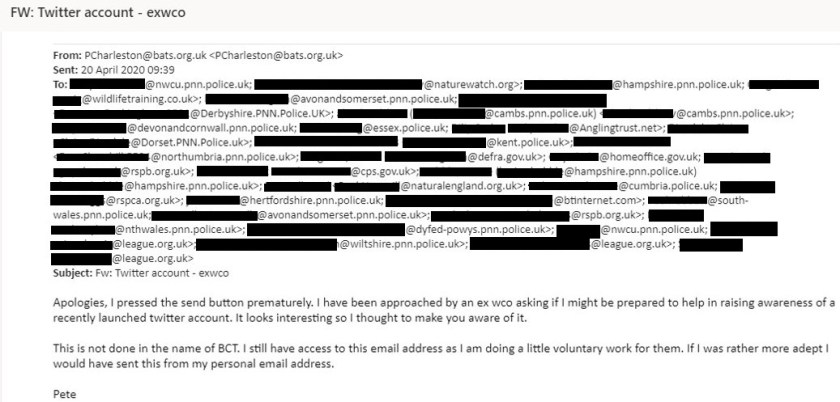
Just a couple of points. Pete has done his best (but failed in my opinion) to cast himself as an impartial observer and has questioned the impartiality of the NWCU and the credibility of Nick Lyall. He’s got some brass neck to be raising questions of credibility when you see what he sent around to a number of colleagues a few days ago:

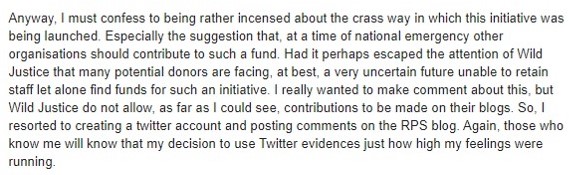
So he sends around an email attempting to distance himself as being the author of the new ‘EXWCO’ twitter account, but a few days later he admits on his very own blog that he created the account:

And for even more evidence of the shiniest brass neck in brass neck land, have a look at this tweet, sent from Pete’s account and addressed to the Countryside Alliance, BASC, NWCU, RPUK and Wild Justice:

Integrity and credibility? Yeah, right.

What a shame.

And all because Wild Justice chose to establish a fund to help police officers bring wildlife criminals to justice.

Northern England Raptor Forum (NERF) supports new raptor forensic fund

Following last week’s announcement of Wild Justice’s raptor forensic fund, which aims to provide financial assistance to support police officers investigating the illegal persecution of raptors in the UK (see here), the fund has been boosted by further contributions.

The Northern England Raptor Forum (NERF) has made a substantial donation of £1,000 to support the fund.

In a press release issued to announce its support, NERF said,

‘Unfortunately every one of our member groups has experience of raptor persecution within their own study areas. Many of us have also been involved in cases where the search for forensic evidence, vital to support the case, was not pursued because of lack of funding thereby resulting in the investigation being abandoned prior to trial. We believe that this initiative will make a very significant impact on the investigation of raptor related criminal cases‘.

Steve Downing, NERF’s Chair said:

As a former Wildlife Crime Officer I fully appreciate the complex decision making process that is used to assess competing applications for funding the forensic analysis of potential exhibits. Every application for forensic funding is justifiable, however it is understandable why some crimes take precedence over cases of raptor persecution. This raptor related forensic analysis fund is a very valuable tool that will make a tremendous difference in the battle to detect wildlife crime and Wild Justice is to be commended for introducing the scheme“.

To read NERF’s full press statement, which is excellent by the way, please visit here

In addition to NERF’s donation, the fund has also received a substantial donation from an individual member of the public who wishes to remain anonymous.

If anyone else would like to contribute to this new fund, please get in touch with Wild Justice by emailing admin@wildjustice.org.uk and entering ‘Raptor Forensic Fund’ as the subject header.

Thank you

As many of you will be aware, the launch of this fund has caused quite a bit of criticism from one individual in particular, who has used the pseudonym ‘EXWCO’ [ex-wildlife crime officer] to hide his identity whilst making some thinly-veiled accusations and threats. For those who haven’t read these, have a look at the comments thread on the previous blog post about this fund (here).

‘EXWCO’ has now revealed his identity and we’ll be examining this individual’s motivations and credibility later today.