Natural England ‘unable to protect wildlife’ say beleaguered staff

Press release from Prospect, Natural England’s staff trade union (10th November 2020):

Prospect launches second State of Natural England Report

A decade of austerity with pay cuts, budget cuts, cuts to grants and a decline in staff numbers is putting England’s natural heritage at risk.

That is the finding of the second report by Prospect into the State of Natural England which shows that the agency does not have the resources it needs to continue to adequately fulfil its responsibilities. The first report was published in 2019.

Over the past two years Prospect, the main union for workers in Natural England, has spoken to its members about their experiences at work, analysed budgets and grants, and assessed programmes. What we have found is an agency getting beyond crisis point.

Natural England is the body responsible for maintaining and protecting England’s natural environment. It is responsible for: protected sites such as national parks and Sites of Special Scientific Interest; countryside stewardship, helping farmers and landowners enhance the biodiversity of their lands; planning and development policy; the marine environment; ramblers’  favourites like the England Coast Path, and many more things which make our natural heritage what it is.

Natural England is at risk because its funding has been slashed and its workforce reduced. Natural England’s government-funded Grant in Aid budget has declined by 49% in six years and almost two-thirds over a decade. Over that time the agency has gone from more than 2,500 staff in 2010 to, we estimate, around 1,900 staff now.

Workers in Natural England were subject to a 1% pay cap for eight years. This has improved this year but the increase comes nowhere close making up for the real-terms losses of the past decade. There is also an 8.4% gender pay gap which shows little sign of being reduced.

This is the reality of government austerity and its effect on agency staff – highly qualified workers facing financial hardship, increased workloads, loss of pension accrual, terrible morale and looking to move elsewhere for a better deal. Successive ministers have made things worse by undermining and attacking the independence of the work of agency experts.

Prospect is calling for:

  • Natural England’s wide and important remit for people, nature and the green recovery, to be properly recognised and funded.
  • It’s autonomy as a non-departmental public body to be meaningfully restored.
  • The damage caused by the pay cap to be reversed and pay progression and pay equality, to be restored.
  • To achieve pay parity with the rest of Defra, particularly for pay scale minima and maxima.
  • To no longer be covered by the civil service pay guidance and be subject to an independent pay review body.

Download the full report.

Mike Clancy, Prospect general secretary, said:

There is a yawning gap between the government’s rhetoric on climate change, the environment and biodiversity and the reality of years of underfunding our environmental agencies.

Protecting nature means investing in the people who do that work. Natural England is at the heart of this agenda but it can only be effective if it is properly funded and the importance of its staff properly recognised.

The disproportionate cuts, out-dated and unfit pay framework, and significant pay inequality all need to be addressed. The UK has a world-class natural environment which is treasured by the public, but this natural heritage will suffer if the expert custodians of our natural heritage continue to be treated as second class public servants.

ENDS

There’s also an article on this in today’s Guardian (here).

It might help a little bit if Natural England bosses stopped defending the pouring of money in to the insane Hen Harrier brood meddling trial, a conservation sham sanctioned by DEFRA and carried out by Natural England, in cahoots with the very industry responsible for the species’ catastrophic decline in England.

Although the actual ‘meddling’ bit is apparently being funded in a secret financial arrangement between the Moorland Association (grouse moor owners’ lobby group) and the National Birds of Prey Centre in Newent – the cost of this has not been made public, which you’d think would be quite crucial when it comes to assessing the viability of this ‘trial’ – there is still considerable cost in terms of NE project staff time.

And then there’s the equally ridiculous NE project to ‘reintroduce’ hen harriers to southern England, another conservation sham aimed at drawing attention away from the criminal onslaught in the uplands, and for which NE is forking out thousands of pounds to send staff over to Europe, along with satellite tags bought by British tax payers, to fit to harriers in Europe in what looks like a way of ‘persuading’ the European authorities to send young harriers to the UK for the ‘reintroduction’. More details on this shortly.

The question of Natural England’s ability to conduct effective monitoring and enforcement of the new General Licences was raised in a Zoom call between Wild Justice and DEFRA officials yesterday. Judging by today’s report from Prospect, there’s very little indication that NE will be up to the task.

Laugh out loud hypocrisy from BASC

BBC Radio 4’s Farming Today did a short piece on DEFRA’s new General Licences this morning (available here for 29 days, starts at 8.55 min) and this included an amusing interview with Glynn Evans, Head of Gundogs and Game at BASC, the British Association for Shooting (and, ahem, conservation).

Glynn seemed a bit confused. BASC are said to have ‘welcomed’ the new licences but Glynn then said, “I don’t think it was right for them [Wild Justice] to bring their case [legal challenge]. I think where there’s an issue dialogue is the way forward“.

It’s worth reading Mark Avery’s take on this hypocrisy from BASC (here), where he points out that dialogue was the last thing on BASC’s mind last year when he and Chris Packham were banned from attending an interview at The Game Fair!

It’s also worth looking back at this RPUK blog from last year (here) where it was pointed out that BASC had itself attempted to launch a judicial review (that subsequently failed) following Natural Resources Wales’s ban on pheasant shooting on public land. Was ‘dialogue the way forward’ then, Glynn?

And, er, how about BASC’s big song & dance announcement this summer that it had launched a ‘seven-figure legal fighting fund’ to ‘push forward with proactive legal initiatives’?

There’s no issue with BASC, or anybody else for that matter, applying for a judicial review if they believe an issue is worth fighting for and they have a case that stands a reasonable chance of success – that’s what access to justice is all about and, indeed, is one of the main guiding principles behind the formation of Wild Justice.

But it is about time BASC reined in the hypocrisy and stopped trying to demonise Wild Justice for doing something that BASC is now bragging about trying to emulate!

DEFRA publishes latest version of General Licences following Wild Justice legal challenge

In February 2019 a new conservation campaign group, Wild Justice, launched its first legal challenge against the casual killing of millions of birds, as authorised by statutory agency Natural England under the guise of General Licences.

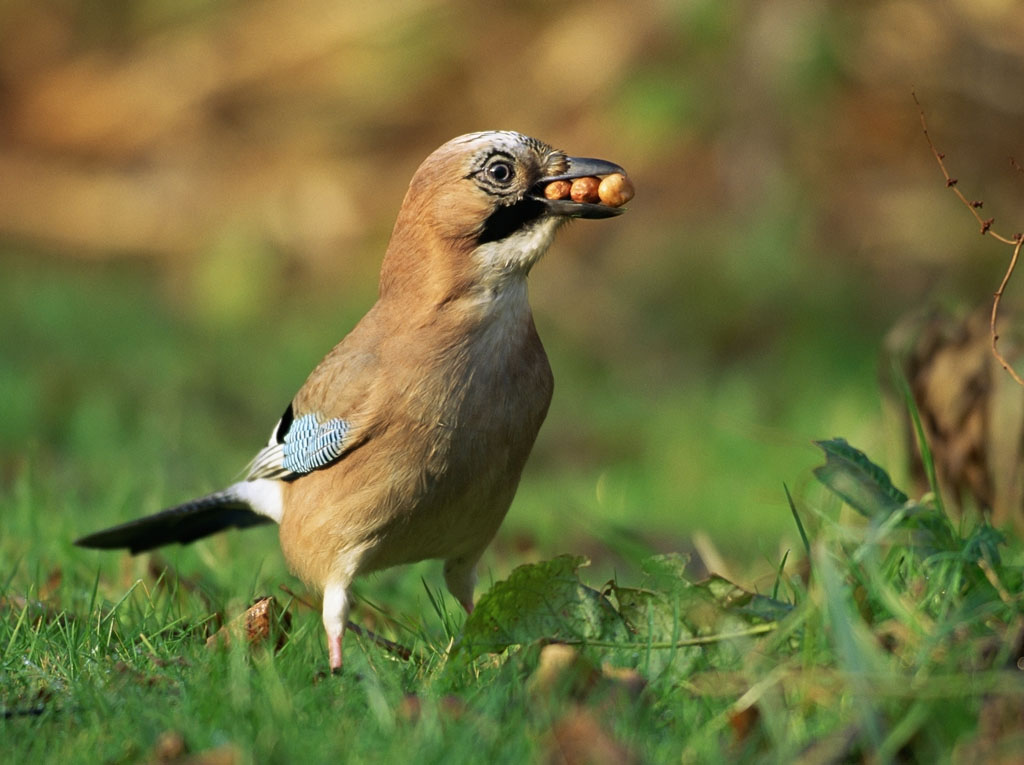
These General Licences have been published at the start of each year and have permitted users to kill unlimited numbers of birds such as Carrion Crows, Rooks, Magpies, Woodpigeons, Jackdaws, Jays and Ring-necked Parakeets.

[Common Jay photo by Andy Rouse]

General Licence users don’t have to apply to use the licences, don’t have to justify why killing the birds is necessary, don’t have to explain why alternative non-lethal measures such as scaring or proofing are ineffective or impracticable, and don’t have to report on how many birds are killed. All a person needs to do to ‘qualify’ to kill unlimited numbers of these birds is to claim to have read and understood the relevant General Licence.

Wild Justice believed the system was unlawful and argued that, amongst other things, it was Natural England’s responsibility to satisfy itself that killing was an appropriate last resort. Natural England disagreed so Wild Justice applied for permission to seek a Judicial Review.

Shortly afterwards, Natural England finally acknowledged the General Licences were indeed unlawful and pulled them at ridiculously short notice. DEFRA then removed the licensing authority role from Natural England and took it on itself, issuing temporary General Licences last year and this year, whilst having to conduct a scientific review, survey and consultation of the entire system.

The new General Licences that have been published today will become enacted on 1 January 2021. On a first glance through, they are certainly different – some species have been removed from the kill list of some of the General Licences (e.g. as of 1 January 2021 it’ll be unlawful to kill rooks or jackdaws under the guise of conserving bird species) and other species have more restricted terms of how and when that species can be killed (e.g. as of 1 January 2021 General Licence users will be able to kill Jays to protect Honey Buzzards – yep, that’s what the new licence says).

Further licence conditions relating to trapping regulations and killing birds on protected sites are due to be published before 1 January 2021.

Of course, these new General Licences will be the subject of close scrutiny, certainly by Wild Justice and no doubt by the shooting organisations, and are still open to further legal challenge if necessary.

The new General Licences for England can be viewed here:

Conservation licence GL34/GL40: here

Public health & safety licence GL35/GL41: here

Serious damage licence GL36/GL42: here

Wild Justice is also currently challenging the General Licences issued in Wales by Natural Resources Wales and the court hearing is due in mid December 2020 (see here for background to that case).

Proposal to reintroduce golden eagles to Wales: information withheld

Way back in February 2019, in a publicity fanfare, a claim was made that a licence application to reintroduce golden eagles to Snowdonia would be submitted to Natural Resources Wales (NRW) ‘by summer’ by an organisation called Wilder Britain (see here and here).

In November 2019 an FoI request to NRW revealed that no such application had been received (see here).

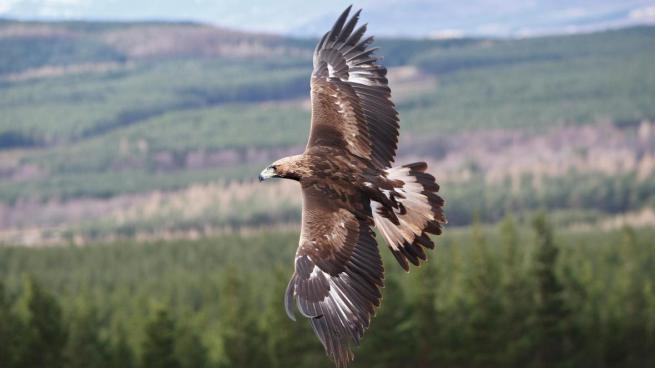
[A young golden eagle, photo Getty Images]

Dr Paul O’Donoghue of Wilder Britain was back in the press again in August this year, fundraising for his proposed reintroduction project, which raised questions about whether there was genuine intent to try and reintroduce golden eagles or whether it was just an ongoing publicity/fundraising stunt from the previous year (see here).

O’Donoghue hosted several poorly-attended public meetings this summer, some of them announced at very short notice, and these elicited some interesting commentary from those who managed to attend and also from members of the Welsh Parliament (see here and here).

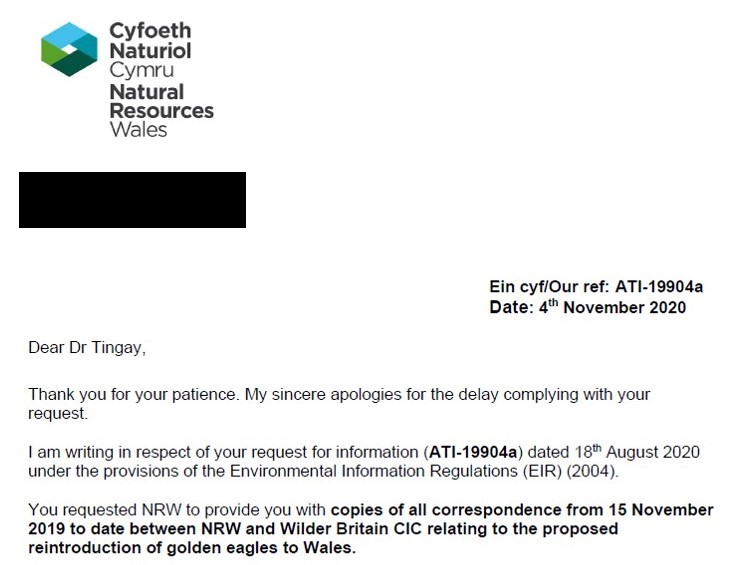
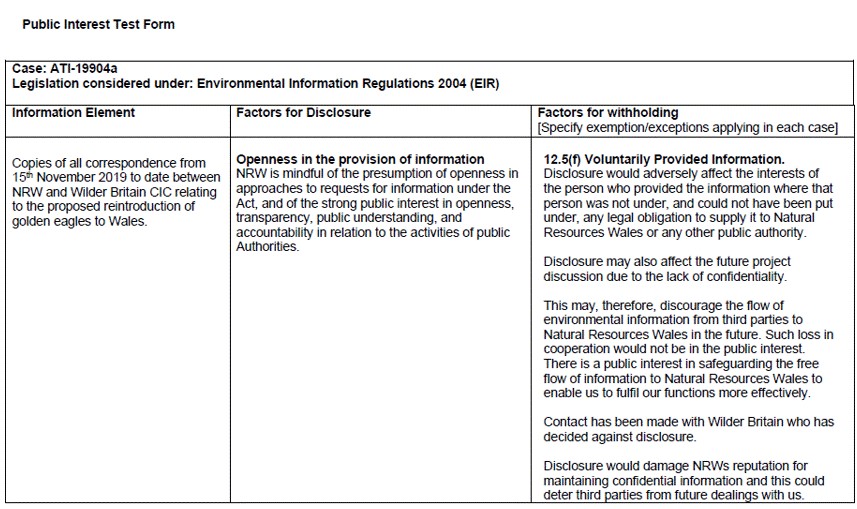
In August a Freedom of Information request was submitted to NRW to find out more details about O’Donoghue’s proposals. NRW has finally responded and has refused to release any information because it needed O’Donoghue’s consent and he has refused permission:

Interesting. An appeal has been lodged with NRW because I believe it’s in the public interest to see what advice NRW has been giving to O’Donoghue about a proposed reintroduction scheme.

Meanwhile, a more open and transparent organisation interested in a Welsh reintroduction of both golden and white-tailed eagles, under the project Eagle Reintroduction Wales, is continuing its involvement in online interviews and question & answer sessions which allow any interested member of the public an opportunity to find out more details, ask questions and listen to the responses.

The next one is this evening at 17.30hrs with ERW project manager Dr Sophie-lee Williams and can be watched here.

Man charged in relation to alleged theft of peregrine eggs in Derbyshire Peak District

Earlier last year Derbyshire Constabulary appealed for information after a pair of peregrines in the Peak District abandoned their breeding attempt in suspicious circumstances (see here).

It was later reported that eggs had been stolen from three peregrine nest sites in the Peak District this spring (see here) and officers from Derbyshire Constabulary believed they were being stolen for the Middle Eastern falconry trade.

Earlier this evening Derbyshire Constabulary issued a statement on Facebook, as follows:

Things sometimes take a while to come to fruition in our job, but two of our lengthy investigations have finally reached the point where people can be charged and summoned to court to answer for their actions.

The first involves the theft from a farm in the Bradwell area of a collection of vintage tractor parts which were part of a long-term project and labour of love on the part of the owner. Many of the parts were recovered and a salvage business underpinned by crime operating in neighbouring South Yorkshire was uncovered. The recovery of some stolen car parts from Buxton was a bonus too.

Our regular followers will know that we’ve invested a lot of time and effort into the problem of bird of prey persecution and trying to fathom where these illegally taken eggs are ending up and who’s involved. We were very pleased, therefore, back in the spring when we were presented with excellent video evidence of someone taking some peregrine falcon eggs from a breeding site in the Peak District. Thanks to the power of social media helping to identify the suspect we embarked on another long investigation which has now yielded charges, not only for the egg taking offences but for a firearms offence too.

Whilst this is very encouraging for us and those others we work with it doesn’t mean we’ve cracked it. Quite the opposite, in fact, and we’ll be putting next season’s plan together over the coming weeks.

ENDS

Well done, Derbyshire Constabulary.

Shame the RSPB wasn’t credited for providing the covertly-filmed footage, though.

NB: As this is a live prosecution comments won’t be published until criminal proceedings have concluded.

UPDATE 17 November 2020: Derbyshire man due in court in February for alleged theft of Peregrine eggs in Peak District (here)

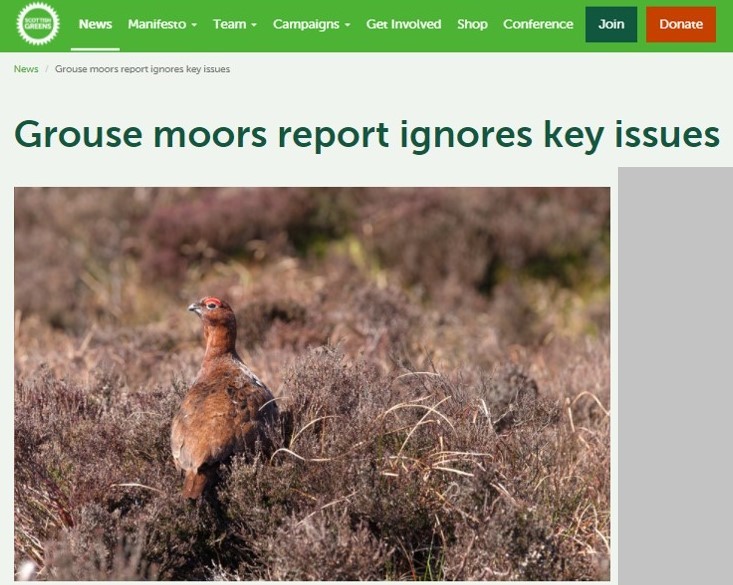
Grouse moor report ‘ignores key issues’, say Scottish Greens

Press release from the Scottish Greens following the recent publication of the latest Scottish Government-commissioned report on the socioeconomic and biodiversity impacts of grouse moor management:

Commenting on the publication of a new Scottish Government report into grouse moor management, Scottish Green rural economy spokesperson John Finnie said:

It is welcome that The Scottish Government is exploring alternatives to grouse moors. This report shows that alternative uses would boost Scotland’s rural economy. A move to conservation or renewable energy, for example, would dwarf the economic impact of grouse moor management. Previous research has shown this would also create new jobs, especially in forestry.

However, while this research recognises the growing public and political concern about grouse moors, it ignores some key issues. For example, the persecution of eagles and other raptors damages Scotland’s reputation as an eco-tourism destination, yet there’s no mention of it.

It also fails to address the damaging impact of muirburn on our climate ambitions.

The Scottish Government has dragged its heels for almost a year since the Werrity review published its limited findings. During that time we’ve seen the burning of peatland and the killing of wildlife continue. People have been shooting grouse even during COVID restrictions.

Scotland’s land needs to be freed up for the economic and social benefit of all of its people and used in ways that contributes to a thriving rural economy and natural environment. It’s time for the Scottish Government to get on with it.

ENDS

Eagle Reintroduction Wales Project – 2 x live interviews coming up

As regular blog readers will know, there are currently proposals to reintroduce eagles to Wales by two organisations with very different approaches: Wilder Britain and the Eagle Reintroduction Wales Project.

The Eagle Reintroduction Wales Project, led by Dr Sophie-lee Williams, is currently assessing the feasibility of reintroducing golden and white-tailed eagles across Wales and has conducted extensive research to inform its proposals. Some of this research has already been published in peer-reviewed journals (e.g. here) and more output is expected shortly. The ERW Project is working with Cardiff University (where Sophie-Lee has just completed her PhD on this topic) and is liaising closely with a network of national and international eagle experts.

There are two forthcoming opportunities to ask Sophie-lee about any aspect of the project:

Facebook live interview/Q&A session on Sunday 8th November at 17.30hrs. Interview hosted by Mike Raine here

Facebook live interview/Q&A session on Tuesday 10th November at 19.00hrs. Interview hosted by Bywyd Gwyllt Glaslyn Wildlife here

Hopefully these live interviews will be recorded so if you can’t make the live session you can catch up with the videos later.

For previous blogs about the proposals to reintroduce eagles to Wales please see hereherehereherehereherehereherehere and here for background.

Another raptor poisoner convicted in Spain

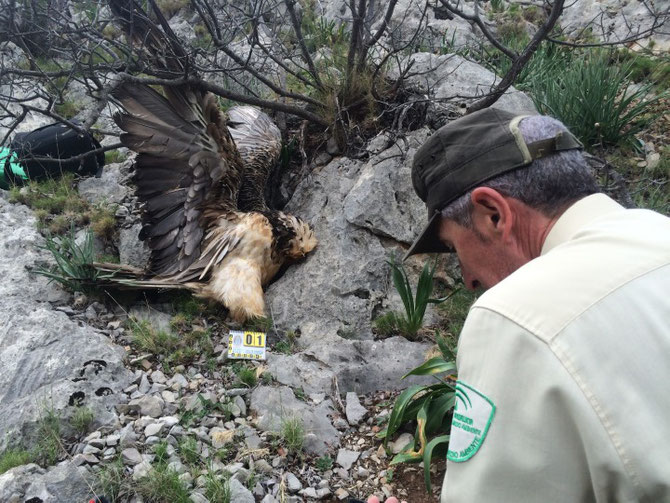
A farmer has been convicted of laying out poisoned baits in the Sierra Magina Natural Park in Andalucía in 2016 that killed two Bearded vultures from a reintroduction programme, as well as one Cinereous vulture, a golden eagle and numerous mammals.

He’s been fined 4,500 Euros and is banned from working as a cattle rancher for three years, although this sentence is apparently being appealed.

Further details about this case, including an extensive multi-agency investigation, can be read on the Vulture Conservation Foundation website here.

[One of the poisoned Bearded vultures, photo via Vulture Conservation Foundation]

Tackling the illegal poisoning of birds of prey is taken seriously in Spain with, for example, the deployment of specialist poison detection dogs and investigators given the authority to conduct unannounced spot checks in areas of suspicion. In recent years successful prosecutions have resulted in massive fines, custodial sentences and extended hunting disqualifications for those convicted of laying poisoned baits (e.g. see herehereherehere and here).

Meanwhile, over here the illegal poisoning of birds of prey (and anything else unfortunate to consume the bait) continues without consequence. These are some of the cases reported this year alone, many during lockdown, and none of them are heading towards a prosecution:

The illegal killing of a white-tailed eagle found on a grouse moor inside the Cairngorms National Park in Scotland (here), the mass poisoning of 23 buzzards in a field in Co Cork, Ireland (here), the poisoning of four peregrines on Guernsey in the Channel Islands (here), the poisoning of a family’s pet dog, believed to have consumed a poisoned bait intended for birds of prey in Nidderdale, North Yorkshire (here), the poisoning of a buzzard found dead on a grouse moor in the North York Moors National Park (here), the poisoning of a buzzard in Nidderdale, North Yorkshire (here), the poisoning of a buzzard and a kestrel in Derbyshire (here), the poisoning of three peregrines and a buzzard in Staffordshire (here), the poisoning of a peregrine in South Yorkshire (here) and the poisoning of two peregrines in North Yorkshire (here).

There may well be further poisoning cases that haven’t yet been publicised.

Parliamentary question – economic impact of wildlife crime linked to grouse moor management

There’s been a fair bit in the press in recent days on the alleged positive impact of grouse moor management on the Scottish rural economy, following the publication of a series of new reports.

Representatives and supporters of the grouse shooting industry will, of course, tend to focus on the assumed economic benefits and rarely, if ever, will they mention the economic costs of this damaging industry.

So this is a really important parliamentary question that’s been lodged by Scottish Green’s MSP Alison Johnson:

Question S50-04745. Alison Johnstone, Lothian, Scottish Green Party. Lodged 4/11/2020.

To ask the Scottish Government what assessment it has made of the impact on the rural economy of wildlife crime linked to grouse moor management.

Current status: Due in Chamber on 12/11/2020.

I’m not sure which Minister will be answering this question next Thursday but I look forward to the response.

Here’s a photo of a police officer examining the corpse of a white-tailed eagle, found illegally poisoned with a banned pesticide on a grouse moor inside the Cairngorms National Park earlier this year (see here). [Photo by Police Scotland]

He wasn’t the first victim and he certainly won’t be the last. Raptor persecution, whether that be poisoning, shooting or trapping, is still rampant on many Scottish (and English) grouse moors, despite it having been illegal since 1954.

It’ll be interesting to see how the Scottish Government intends to assess the economic cost of this ongoing criminality.

UPDATE 13 November 2020: Environment Minister acknowledges potential economic impact of wildlife crime linked to grouse shooting (here)

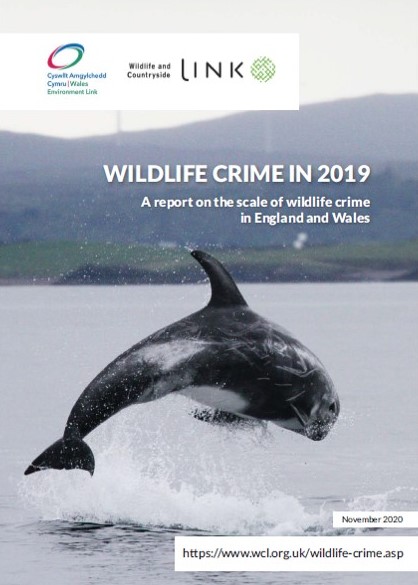
Wildlife crime in England & Wales – 2019 report published by Wildlife & Countryside LINK coalition

Press release by Wildlife & Countryside LINK (6 November 2020)

Wildlife cybercrime is in police’s sights, but wildlife crime underworld remains mostly beneath the radar

Our 2019 Annual Wildlife Crime Report gives a snapshot picture of the state of wildlife crimes across England and Wales

Wildlife and Countryside Link and Wales Environment Link’s latest report on wildlife crime across England and Wales reveals positive progress in identifying and tackling hi-tech online criminals who are harming our wildlife. Yet centuries old hunting, trapping, and poisoning practices, and smuggling of illegal wildlife goods, are still widespread, and exacting a heavy penalty for nature, warn conservation experts.

Activity on wildlife cybercrime (which can include illegal hunting and trapping coordination, gambling on live-stream cruelty such as badger and dog fights, and the online sale of rare protected species) has ramped up over the last year. Online initiatives from police and wildlife organisations have led to more tips from the public, arrests, and rescues of animals – such as dogs injured in badger-baiting. The creation of a new Cyber Enabled Wildlife Crime Priority Delivery Group, led by the police National Wildlife Crime Unit, has been hailed by conservationists as a major step forward in improving prevention, intelligence and enforcement.

Yet many wildlife crimes continue to be unwitnessed or unreported and go unpunished. A shocking array of wildlife including bats, birds, badgers, plants, hares, deer, fish, seals, dolphins, amphibians and reptiles, and more, are harmed at the hands of hunters, poachers, criminals, and even normally law-abiding members of the public every year. Overall levels of reported wildlife crimes have changed very little in the four years since our annual report was first published, with 3800 incidents reported in 2019 compared to 4288 in 2016.

Convictions remain shockingly low, with just 10 people convicted of wildlife crimes in 2019 (other than convictions relating to fisheries crimes).

Dr Richard Benwell CEO of Wildlife and Countryside Link said: “The wildlife crime underworld in Britain remains rampant. Our figures are just a snapshot of the number of animals being illegally hurt and killed every single day, sometimes for sport, sometimes for profit, sometimes in sheer callousness. Steps forward in tackling the growing online world of wildlife crime are very welcome. But overall a lack of adequate police recording and resourcing, low levels of prosecutions and inadequate sentencing are leaving our wildlife without the protection it needs“.

Martin Sims of the League Against Cruel Sports and Chair of Link’s Wildlife Crime Working Group, said: “It seems incredible in our digital age that our police forces can’t just call up the data they need to effectively tackle wildlife crime at the touch of a button. While the police are cracking down on wildlife cyber criminals more effectively now, their own electronic data on wildlife crimes is decades behind where it should be. We need to bring the fight against wildlife crime into the 21st century and ensure police have the resources they need to punish those who are harming our natural world“.

Paul De Ornellas, Chief Wildlife Adviser at WWF-UK said: “In recent years the UK has played a significant role in focusing global attention on the illegal wildlife trade. This report clearly shows that wildlife crime, including links to illicit wildlife trade internationally, is happening here at home, with a concerning increase in cybercrime and the use of major UK airports by traffickers. To continue to show global leadership, the government must do more to address IWT in its own backyard, as well as overseas”.

The biggest barrier to tackling wildlife crime remains the lack of recording, reporting, and resourcing allocated to these crimes by the police and Home Office. Wildlife cybercrime is believed to be extensive, but, as with many types of wildlife crime, it is not recorded in any meaningful way, due in large part to the absence of dedicated police wildlife crime reporting codes. So it is impossible to assess patterns and levels of wildlife crimes accurately and effectively target resources. There is a National Wildlife Crime Unit within the police, but this has been significantly underfunded for years and is currently going through an opaque restructuring process.

While fisheries crimes continue to receive low sentencing (and are a target for organised crime for this reason), the data, prosecution and conviction rates for fisheries crimes are notably better than for other types of wildlife crime. The main reason for this is that these crimes are tackled by a well-resourced section of the Environment Agency (in England) and Natural Resources Wales, funded by fishing licence fees. The fact that in 2019 2642 fisheries crimes were reported (more than double the number of all types of wildlife crime we report on combined) and 1992 people were convicted (compared to just 10 for other crimes) puts into stark relief the difference that adequate resourcing can make.

To help ensure that wildlife across England and Wales are adequately protected, conservation groups are calling on the Home Office and the Police to:

  • Ensure wildlife crimes are recorded and reported on effectively – with long-promised dedicated wildlife crime recording codes put into place urgently
  • Create a new Wildlife Crime Strategy with recording, reporting and resourcing at its heart, backed up by an action plan for the delivery of key targets
  • Provide transparency over changes to the police’s National Wildlife Crime Unit – including a consultation on funding, form and function to ensure this coordination body is better-resourced and fit for purpose
  • Keep up the momentum on wildlife cybercrime – by ensuring funding is in place to increase effectiveness through more dedicated officers to tackle the growth in online coordination and facilitation of wildlife crimes.
  • Deliver effective guidance and training on wildlife crimes for police officers through online knowledge and training hubs and tying local police in to regional wildlife enforcement hubs,
  • Strengthen the network of wildlife crime experts within the Crown Prosecution Service and ensure they are actively available to inform and support police officers

    ENDS

The report can be downloaded here:

Notes to Editors

Wildlife and Countryside Link is the largest environment and wildlife coalition in England, bringing together 57 organisations to use their strong joint voice for the protection of nature. Wales Environment Link is a network of environmental, countryside and heritage non-governmental organisations with an all-Wales remit. Both operate as part of a UK-wide coalition – Environment Links UK. The calls in the Wildlife Crime Annual Report 2019 are supported by: Amphibian and Reptile Conservation, Badger Trust, Bat Conservation Trust, Born Free Foundation, Buglife, Humane Society International UK, Institute of Fisheries Management, League Against Cruel Sports, the National Trust, Naturewatch Foundation, Plantlife, RSPB, the RSPCA, Whale and Dolphin Conservation, Wild Justice, WWF-UK, Zoological Society of London (ZSL).

The Independent ran an exclusive on the report’s launch today – see here