Sainsbury’s refuses to address concerns about selling potentially toxic gamebirds

It’s UK game week so it seems timely to re-visit the Sainsbury’s saga.

UK supermarket Sainsbury’s is selling gamebird meat which is potentially contaminated with toxic, poisonous lead shot.

The product of interest is this diced game casserole, produced by Home Farmed Venison in North Yorkshire and kitemarked by the British Game Alliance, which claims to be the official marketing board for the game shooting industry.

[Photos by Ruth Tingay]

It’s not illegal to sell toxic, lead-contaminated game meat; lots of supermarkets sell lead-contaminated gamebirds, although the more ethically responsible ones (Waitrose) have committed to selling lead-free meat by 2021 and the contaminated stuff they currently sell at least comes with a proper health warning (e.g. see here for the warning about toxic lead shot in the Waitrose Xmas pheasant).

It’s a bit like fags really. You can still buy them but they have to contain a public health warning. But unlike fags, poisonous game meat is still on full display on supermarket shelves and is often being marketed as the ‘healthy’ option!!

The game meat on sale at Sainsbury’s is of particular interest for two reasons.

(1) It’s the first time that a British Game Alliance-endorsed product has been promoted in a UK supermarket, and given the lack of transparency and confidence in this ‘official marketing board’ it is obviously going to lead to questions.

(2) There is no warning on the packaging about the product containing poisonous lead shot.

Two earlier blogs on Sainsbury’s game meat (here and here) have revealed an alarming unwillingness from Sainsbury’s to address the concerns.

Sainsbury’s did respond to questions, but to be perfectly frank the answers given were pretty unconvincing and Sainsbury’s has now told one of our blog readers,

At present Sainsbury’s will not be providing any further update regarding your concerns, and we would encourage any further questions to be directed to Holme Farmed Vension, through their customer helpline‘.

Wow. And this is the supermarket that claims it wants to be ‘the UK’s most trusted retailer’.

Several blog readers have pointed out that this mixed game casserole is no longer available on Sainsbury’s website and have suggested this may be connected to the questions being asked of Sainsbury’s. This seems unlikely given that the casserole is still available in the supermarkets and its removal from the online store may instead simply be a result of a diminishing supply due to Covid restrictions.

Needless to say, there is now great interest in finding out whether Sainsbury’s claim that ‘there is no lead shot in this product’ is based on fact or wishful thinking.

There’ll be more on this in due course.

Westminster debate on moorland burning doesn’t go the grouse shooters’ way

Last Wednesday Olivia Blake MP (Labour, Sheffield Hallam) opened a debate in Westminster Hall calling for the Government to put a stop to moorland burning, including the burning of heather on upland grouse moors.

It didn’t go the grouse shooters’ way, as even The Telegraph had to admit with these headlines:

It’s been a year since the Westminster Government committed to banning burning on peatlands, including the deliberate rotational burning on blanket bog (see here). However, nothing has happened and Ministers have been accused of stalling to protect grouse moor owners (see here).

Wednesday’s debate was interesting for a number of reasons, but perhaps most significantly because it contrasted so clearly from the last big debate in this Hall where grouse shooting interests were on full dishonourable display. There was no braying or table-thumping this time, and those with clear vested interests are of course no longer even in the building (e.g. Benyon, Soames).

The debate transcript can be read here, although for those who follow this subject there won’t be any surprises, until you get to the Minister’s bit towards the end.

Amazingly, Minister Rebecca Pow didn’t spend the session looking wholly disinterested in the topic, examining the contents of her handbag and then dismissing the debate out of hand (a la former Environment Minister Therese Coffey). Instead, she appeared to listen and then engaged respectfully with all the debaters before hinting, strongly, that the science shows that keeping peat bogs wet is a much better idea for tackling climate change than setting fire to them every year.

It’s a view shared by the Climate Change Committee (here) and DEFRA Minister Zac Goldsmith, who only a few days ago repeated his commitment to a ban on grouse moor burning (here).

Are we poised to finally seeing some action on this from the Westminster Government, and will it happen before the Scottish Government even comments on the same topic via its response to the Werritty Review?

Scottish National Party blocks declaration of ‘nature emergency’

A few days ago the Scottish Greens announced that Mark Ruskell MSP was putting forward a Parliamentary motion for there to be a declaration of a ‘nature emergency’ (see here).

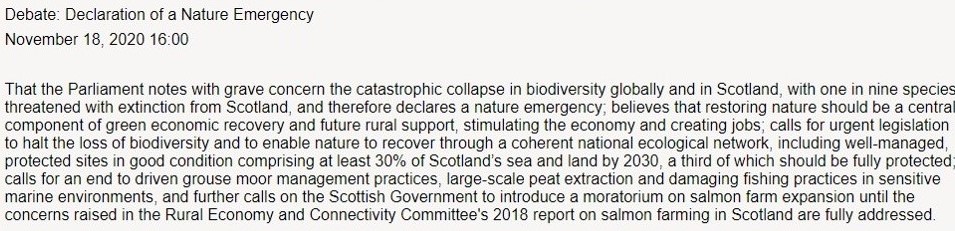
Here’s the proposed motion:

The cross-party debate took place in the Holyrood chamber yesterday afternoon. You can watch a video of the archived session here and the transcript is available here:

If you don’t have the time to watch the video I’d thoroughly recommend reading the transcript – it’s quite enlightening. There’s a fair bit of chat about the Werritty Review and at one point Environment Minister Mairi Gougeon explains that the Government’s delay in responding to it (one year and still waiting) is not just because of Covid19 interruptions but apparently because the review contained more than one recommendation for the Government to consider(!).

Good grief. It’s not as though any of those recommendations in the Werritty Review were new ideas or that the Scottish Government has had, literally, years to think about these issues.

The Scottish Greens have issued a press release in response to yesterday’s debate, as follows:

SNP blocks declaration of a nature emergency

The Scottish Parliament has missed the opportunity to declare a nature emergency, after the SNP blocked the vote with an amendment congratulating the Scottish Government instead.

If passed, the Scottish Green motion would have made Scotland the first country to formally recognise the rapid decline in species populations as an emergency.

However, the proposal was defeated after the Conservatives backed a Scottish Government amendment which removed the words ‘nature emergency’, and other parties refused to commit to radical action required to halt and reverse the decline. 

MSPs therefore voted against calling a halt to practices which are environmentally damaging such as driven grouse shooting, large-scale peat extraction and damaging fishing practices such as dredging. 

Speaking afterwards, Scottish Greens environment spokesperson Mark Ruskell said: “While I’m proud that the Greens brought this issue to parliament, I’m extremely disappointed that Scotland has not declared a nature emergency when the evidence on species decline is so clear.

It was truly shocking to see SNP ministers congratulating themselves on their inadequate efforts, when their own data shows an alarming decline in species and a shocking loss of biodiversity. 

It is clear that only the Scottish Greens are committed to actions such as ending the scourge of Scotland’s grouse moors, and we will put our commitment to acting on the nature emergency in our manifesto.”

ENDS

Shot buzzard found dead in Peak District National Park

Press release from RSPB (19 Nov 2020)

Young buzzard found dead had been illegally shot

The RSPB is appealing for information regarding the death of a protected buzzard in Little Hayfield, within the Peak District National Park between Manchester and Sheffield.

A local resident found the buzzard, a juvenile which had hatched this summer, freshly dead on 5 September 2020, in a paddock adjacent to woodland and a driven grouse moor. They contacted Derbyshire Police on 101 and reported it to the RSPB. The body was x-rayed by a local vet who identified a broken leg and a piece of lead shot lodged within the bird’s chest. It is possible that the injuries were sustained at different times during the bird’s short life.

All birds of prey are protected by the Wildlife and Countryside Act 1981. To intentionally kill or injure one is a criminal offence and could result in an unlimited fine or up to six months in jail.

Tom Grose, RSPB Investigations Officer, said: “This was a tragic end to the life of a young bird which had barely begun to spread its wings. The sight of a buzzard soaring overhead is part of the pleasure of being out in the Peak District. This is one of our most visited National Parks and should be a place people can go to enjoy nature, and a place in which nature is protected.

Buzzards are sadly highly vulnerable to illegal killing, and RSPB data shows that more buzzards were the object of persecution in 2019 than any other raptor species. While it’s not clear whether shooting was the cause of death, it’s clear that this bird had been illegally shot at some point in its very short life. We are therefore appealing to the public for information.”

If you have any information relating to this or any other raptor persecution incident, call Derbyshire Police on 101.

If you find a wild bird of prey which you suspect has been illegally killed, contact RSPB Investigations at crime@rspb.org.uk or fill in the online form: https://www.rspb.org.uk/our-work/our-positions-and-campaigns/positions/wildbirdslaw/reportform.aspx

Alternatively, if you have sensitive information about this or any other raptor crime which you wish to share anonymously, you can call the confidential Raptor Crime Hotline: 0300 999 0101.

ENDS

Werritty review – one year on & still waiting for Scottish Government response

Today marks one year since the Werritty Review on grouse moor management was submitted to the Scottish Government. And still no formal response.

The review itself took two and a half years to complete after Environment Cabinet Secretary Roseanna Cunningham announced its commission in 2017, on the back of the publication of another Government-commissioned review which showed clear evidence of deliberate and sustained illegal raptor persecution on many driven grouse moors. We’ve since seen more evidence pointing towards the inevitable fate of those birds.

And that 2017 review had been commissioned on the back of an RSPB report in 2016 that over a period of five years since 2011, eight satellite-tagged golden eagles had ‘disappeared’ in suspicious circumstances on grouse moors in the Monadhliaths in Highland Scotland.

The longer the Scottish Government delays taking evidence-based action against those criminals in the grouse shooting industry, the more eagles (and other raptors) are going to be illegally killed. There is absolutely no question that these crimes are continuing, despite enormous scrutiny and public condemnation, as demonstrated during lockdown when the poisoned corpse of a white-tailed sea eagle was found, face down, on a grouse moor in the middle of the Cairngorms National Park. Nobody has been charged for this horrendous crime. In fact there has never been a successful prosecution for killing an eagle in Scotland.

[A police officer examines the corpse of the poisoned white-tailed eagle, found dead on a grouse moor in the Cairngorms National Park]

For years the Scottish Government has promised further action if current measures proved to be ineffective. Time and time again, after each crime has been publicised, a succession of Environment Ministers has proclaimed, ‘We will not tolerate illegal raptor persecution’ and ‘We will not hesitate to act‘ (see here for a long list of examples).

And guess what? They’re still tolerating it and they’re still hesitating to act. Why is that?

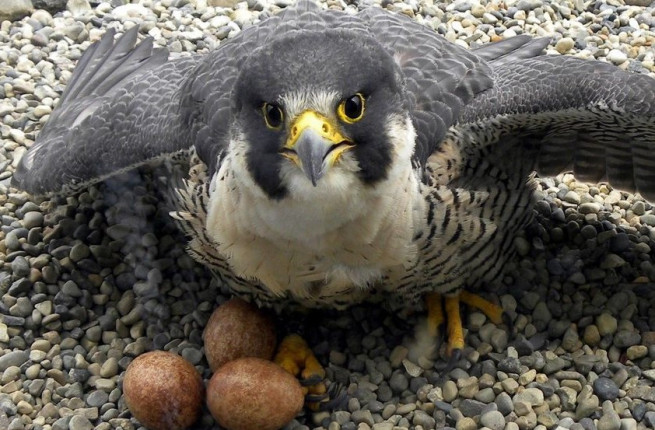
Derbyshire man due in court in February for alleged theft of peregrine eggs in Peak District

Earlier this year Derbyshire Constabulary reported the theft of peregrine eggs from three different nests in the Peak District National Park (see here).

[Photograph by Barb Baldinger]

Ten days ago the police wrote on Facebook that an unnamed man had been charged in connection with the egg theft and also for a firearms offence. The suspect was identified after the RSPB had filmed an individual robbing one of the nests (see here).

This afternoon Derbyshire Constabulary issued a more formal statement on its website, as follows:

Man charged for theft of Peregrine Falcon eggs

A man has been charged with theft in connection with an incident in the spring where Peregrine Falcon eggs were allegedly stolen in the Peak District.

John Fenton, of Bridgemont, Whaley Bridge, was charged with the offence following an investigation by the Derbyshire Rural Crime Team and work by the RSPB.

It follows an incident in the Stoney Middleton area in May earlier this year.

Detective Constable Paul Flint of the Derbyshire Rural Crime Team said: “We take all reports of wildlife crime seriously and will seek to take action against offenders. This is a senseless crime and will not be tolerated. We would like to thank the RSPB for their support throughout.”

The 60-year-old is due to appear before magistrates at Chesterfield Justice Centre in February next year.

ENDS

As this is a live prosecution no comments will be published until criminal proceedings have ended.

UPDATE 20th February 2021: Trial date set as man pleads not guilty to theft of peregrine eggs in Peak District National Park (here)

Police raid property in poisoned peregrine investigation

At the end of October 2020, South Yorkshire Police published an appeal for information in relation to an investigation into the illegal poisoning of a young peregrine that had been found in Barnsley on 4th July 2020. Toxicology tests confirmed it had been killed with the highly toxic poison, Bendiocarb (see here).

[The poisoned peregrine. Photo via South Yorkshire Police]

Today, South Yorkshire Police has raided a property, under warrant, and seized what have been described as ‘a number of suspicious items’.

Here’s the police press release:

Warrant executed in connection to poisoned bird

A warrant has today (17 November) been executed at a property in Barnsley in connection to the poisoning of a protected wild bird.

Last month officers appealed for your help in finding those responsible for poisoning a juvenile peregrine falcon in the Fish Dam area of Barnsley.

Intelligence from the public assisted officers from the Barnsley Central Neighbourhood Team, the force’s Wildlife and Rural Coordinators, Crime Scene Investigation and members of the RSPB to carry out a search of a property on Abbots Road, under the Wildlife and Countryside Act 1981.

[‘Officers briefing before the warrant at Ring Farm, Cudworth’. Photo via South Yorkshire Police]

PC Fran Robbs de la Hoyde explains: “Peregrine Falcons are an important part of our local ecosystems, and are protected under The Wildlife and Countryside Act 1981.

It is a shame that someone would wish to harm these animals in such a deliberate act. The bird is believed to have ingested bait laced with toxic substances.

This morning we executed a warrant and found a number of suspicious items. Enquiries into persons involved in the offence are ongoing.

We are committed to protecting our wildlife and will ensure that those responsible are brought before the courts.”

We are stronger with our communities help and we are always grateful for those who take the time to read, respond and share information in which they have to help officers with their enquiries.

ENDS

NB: As this is a live investigation comments won’t be published until criminal proceedings have ended.

Guns up for hen harriers – new report confirms what’s been known for decades

Scottish Natural Heritage (now re-branded as NatureScot) has published a new report today from it’s controversial ‘Heads up for Hen Harriers’ project.

It’s findings confirm what’s been known for decades – breeding hen harriers aren’t very successful on driven grouse moors but are more successful on moors where there’s little or no gamebird shooting. Gosh, who knew?

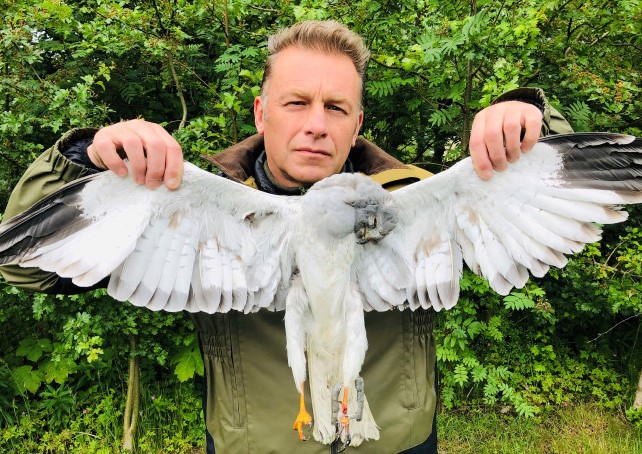
[This hen harrier was critically injured in an illegally-set trap next to a nest on Leadhills Estate in 2019. He was rescued by members of the Scottish Raptor Study Group, with an almost severed leg. A specialist vet at the SSPCA did all he could to save him but eventually the extent of his injuries were too much and he had to be euthanised. Photo by Ruth Tingay]

But before we get in to this latest report of the bleedin’ obvious, here’s some background for new readers.

The Heads up for Hen Harriers Project is a Scottish Government-funded initiative, led by Scottish Natural Heritage (SNH, now NatureScot) in partnership with the grouse moor owners’ lobby group Scottish Land & Estates (SLE), RSPB Scotland and the National Wildlife Crime Unit.

The idea behind this project, which began in 2015, is that sporting estates agree to have cameras installed at hen harrier nests to identify the causes of nest failure. This is a flawed idea right from the off. We all know the main reason behind the declining hen harrier population – illegal persecution on intensively managed driven grouse moors – it has been documented time and time and time again, in scientific papers and government-funded reports. So, if you put an ‘official Project camera’ on a hen harrier nest situated on a driven grouse moor, the gamekeepers will know about it and won’t touch that nest (although they’re quite likely to try and bump off the young once they’ve left the nest but are hanging around the grouse drives, away from the nest camera). So if the nest then fails for natural reasons (e.g. poor weather, predation), the Project will only identify those issues as the cause of failure, and not the illegal persecution issue. The grouse-shooting industry will then use those (biased) results to shout about illegal persecution not being an issue. We’ve seen this many times already.

I’ve blogged about this project many times over the last five years and have been highly critical of its claims, particularly about the so-called ‘partnership working’. Basically it looks like a massive greenwashing exercise (e.g. see hereherehereherehereherehereherehere, here and here). Andy Wightman MSP also condemned the project in a Parliamentary debate in 2017. You can read the transcript here and watch the video here (and note the stony silence after Andy’s speech!).

The estates involved in this project have insisted on remaining anonymous, and this has allowed both SNH and SLE to publish some pretty outrageous claims without anybody else being able to scrutinise the taxpayer-funded data (e.g. see here and here). This is astonishing, and a preliminary look at the results presented in today’s report do not support some of the earlier claims made about ‘successful’ hen harrier nests on driven grouse moors. I’ll be looking at this more closely in due course.

So, back to today’s report. It’s a short-ish summary, presenting an analysis of a proportion of the camera images captured during the project. You can download it here:

The most important result is written on page 6, and there’s an accompanying table on page 7. It goes like this:

Fourteen (56%) of the 25 estates involved in the scheme had driven grouse moors employing full time keepers. Despite their involvement for 46 estate years only four nests were found. Just one was successful (25%) and produced four young‘.

If that isn’t damning evidence then I don’t know what is.

NatureScot has published a press release to accompany the publication of today’s report, as follows:

The success of one of Scotland’s rarest birds of prey, hen harriers, is closely linked to the age of the parent birds, prey availability and land use, concludes a report published by NatureScot today.

The report, based on five years of camera evidence on 28 estates participating in the Heads Up for Harriers partnership project, found the age of the adult male bird is a key factor in breeding. There was a 91% success rate when males were older than one year, irrespective of the age of the adult female bird. 

Not surprisingly, the report also found that nesting attempts and fledging success were higher during warm, dry spring weather, with wetter weather having a negative impact on both the harriers and availability of prey.

The research also found that hen harriers prey were birds 89% of the time with mammals making up the final 10%. However, the report concludes that hen harriers rarely prey on grouse. Meadow pipits were by far the most abundant prey at 77% of birds, with red grouse accounting for only 5.6% of prey.

Over 2 million hen harrier nest camera images were meticulously studied to reveal harrier behaviour and factors impacting their survival. While the majority of estates have some game shooting interest, analysis indicated that harriers fare best on those estates with no shooting interests, with more breeding attempts, nesting success and higher productivity recorded on the majority of non-sporting estates.

Hen harriers have a low survival rate for young birds, and the project showed that where the reasons for failure could be determined, all the nest failures were due to natural factors or predation by foxes and other birds.

Chair of the Heads Up for Harriers Group, Professor Des Thompson of NatureScot, said:

“Hen harriers continue to struggle in Scotland and they remain a rare species, although Scotland holds by far the majority of the UK population with 505 territorial pairs. This report shows that almost half of breeding adult female birds are four years or older and 87% of male birds are older than one year, despite the females being capable of breeding much earlier. This indicates a high turnover of young birds, and while the report does not speculate as to the reasons, this is a worrying statistic.”

Report author, Brian Etheridge, said:

“Some fascinating patterns in hen harrier breeding habits have been identified, such as a tendency for nesting on westerly facing slopes, with an increasing preference for nests in higher areas, and the low occurrence of grouse within the sampled 500 prey items.  This information should help land managers better cater for nesting harriers, while providing reassurance of the limited impact on game birds.”

Professor Thompson added: “The report is testimony to the work of the Heads Up for Harriers project group, particularly RSPB and Scottish Land & Estates, the project staff and those estates that have actively participated in the project.”

Information in the report was gleaned by analysing images from 52 hen harrier nests (37 of which had cameras installed), between them fledging 120 young birds.

Heads Up for Harriers is a Partnership for Action Against Wildlife Crime Scotland (PAW) Scotland project, led by NatureScot. From the project start in 2015, 52 hen harrier nests were located. 35 of these were successful in fledging a total of 120 young. Trail cameras were installed at 37 nests and over two million images recorded.

The Heads Up for Harriers Group are considering a shift in focus to concentrate on areas which can benefit most from intervention. The group will be discussing how best to achieve this with the PAW Scotland Raptor Group in the future.

ENDS

That penultimate sentence in the press release is telling. Reading between the lines, it looks like the plug is finally being pulled on this ridiculous scheme. ‘….Considering a shift in focus to concentrate on areas which can benefit most from intervention‘ – FFS, why not just say it? Why not just acknowledge, in full, that ongoing illegal persecution of hen harriers on many driven grouse moors is what’s causing the catastrophic population decline of the hen harrier?

Look – 45 hen harriers ‘missing’ or confirmed illegally killed since 2018 (see here).

By the way, tomorrow marks the one year anniversary of the Werritty Review on grouse moor management being submitted to the Scottish Government. We are still waiting for the Government’s response.


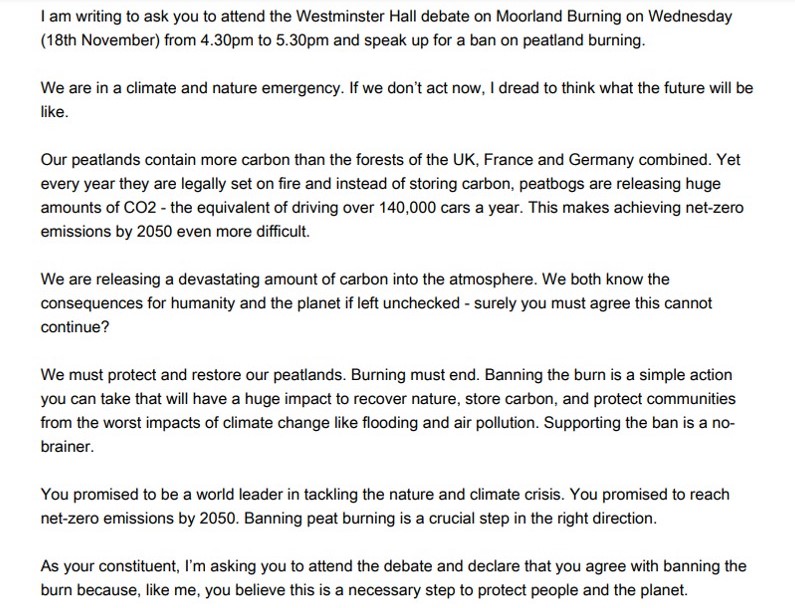
Take action – ask your MP to attend this debate on Weds to ban moorland burning

There’ll be a Westminster Hall debate on Wednesday 18th November 2020 (4.30-5.30pm) on moorland burning, moved by Olivia Blake MP (Sheffield Hallam).

It’s been a year since the Westminster Government committed to banning burning on peatlands, including the deliberate rotational burning on blanket bog (see here). However, nothing has happened and Ministers have been accused of stalling to protect grouse moor owners (see here).

In advance of this parliamentary debate on Wednesday, the RSPB has launched an e-action which allows you to sign up and have a letter sent automatically to your MP to urge them to attend the debate and speak up against peatland burning and urge the Government to act on its commitments.

The letter looks like this:

If you’d like to support this e-action and get your MP to attend the debate, please visit the RSPB’s e-action webpage here. It takes seconds to complete.

Buzzard-shooting caught on camera

Press release from RSPB (16 November 2020)

Horror as buzzard gunned down on nature reserve boundary

A member of the public witnessed and filmed the moment the bird of prey was shot out of the sky

The buzzard was found fatally injured over a week later

Due to its injuries the bird could not be saved and sadly had to be euthanised

The RSPB is appealing to the public for information regarding the illegal shooting of a protected bird of prey.

On 10 October 2020, members of the public out walking stopped to watch a buzzard in flight, on land adjoining the south-west boundary of the RSPB’s Northward Hill reserve near High Halstow. One of them started filming it on a mobile phone when they suddenly heard a loud shot, and the bird crumpled and fell from the sky before their eyes.

The witnesses called the police on 101. Kent Police and the RSPB conducted a search of the area, but the body could not be found. However, a few days later, on 19 October, a birdwatcher reported seeing a buzzard with a broken wing close to where the buzzard had fallen. RSPB reserve staff set out and discovered a badly injured buzzard on the ground. It was rushed to a local vet but the bird couldn’t be saved and had to be humanely euthanised.

An x-ray of the body revealed that the bird had four pieces of shot lodged in its wing, shoulder and leg. The injury to the wing, which had caused the break, was consistent with the timing of the recent witnessed shooting. However, three of the pellets were older, indicating that the bird had been shot before on an earlier occasion.

Police have spoken with a man in connection with the incident.

All birds of prey are protected by the Wildlife and Countryside Act 1981. To intentionally kill or injure one is a criminal offence and could result in an unlimited fine or up to six months in jail. Yet according to the RSPB’s recent Birdcrime report, there were 85 confirmed incidents of bird of prey persecution in the UK in 2019 – with many more likely to have gone undetected. More buzzards were the object of persecution in 2019 than any other raptor species. 

The witness, who does not wish to be named, said:

Northwood is a really special place for my family. We had just lost a loved one, so my dad suggested we take a walk to clear our heads. We were watching a buzzard flying together with another bird of prey, and I quickly got my phone out and started filming it. It was a beautiful sight. Then suddenly we heard a crack and the buzzard crumpled and fell to the ground. It was a feeling of utter shock; we couldn’t believe what we’d just seen. My sister was in floods of tears, we were just so shaken. It was not what we’d envisaged for our walk together. One moment we were watching something so alive, then the next a human had needlessly and senselessly taken it away – it felt like such a horrific waste.”

Mark Thomas, RSPB Head of Investigations, said: “Nature has the power to lift our spirits, never more so than in these difficult times. No-one should have to witness wildlife being killed illegally before their eyes and our utmost sympathy goes out to the family.

We regularly gather evidence of raptor persecution, either finding bodies full of shot or illegal traps, but it’s rare that a bird is killed and filmed right in front of someone. This incident really brings home the horrible reality of what is happening to our birds of prey.

We are so grateful to them for picking up the phone and reporting this incident. We know that passing on information about any crime can be difficult, but if you do see anything, or have any information about this or any other crime involving birds of prey, please call our confidential hotline number (0300 999 0101). Your call could make all the difference and prevent more birds being killed.

We are in a climate and ecological emergency and losing our wildlife at a frightening rate. We all have a role to play, which is why we need an immediate halt to incidents such as this.”

If you have any information relating to this incident, call Kent on 101 and quote the crime reference: 11-0064. You can also call the RSPB’s confidential Raptor Crime Hotline on 0300 999 0101.

ENDS

There is a short clip of the buzzard-shooting on the RSPB blog here