Wildlife killed in illegally-set trap and snares in south Scotland

Press release from Scottish SPCA (17 July 2020)

Scottish SPCA raise concerns after animals die suffering in illegal snares and traps

The Scottish SPCA is appealing for information after being alerted to deceased animals caught in illegal snares and traps over the last month.

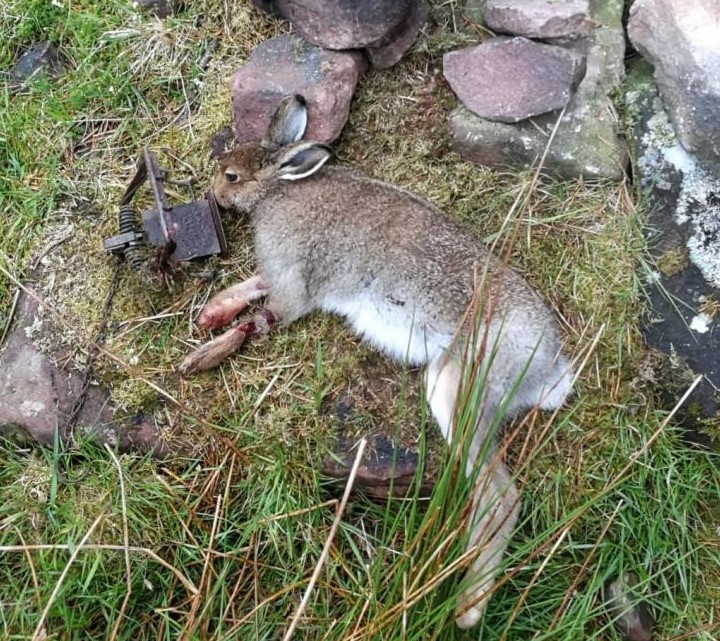
The Society’s special investigations unit was alerted to two incidents of badgers in illegal snares in North Lanarkshire since 5 July and a hare was discovered trapped in a spring trap in the Pentland Hills on 18 June.

From 2018 to 2019, the charity dealt with almost 60 incidents involving animals caught in snares and traps. The majority of these animals were dead on arrival.

Scotland’s animal welfare charity supports an outright ban on all snares due to the level of suffering an animal is caused.

The snares that killed the badgers were illegal as both had been set on a fence line. This is unlawful due to the risk of an animal trapped being wholly or partially suspended which can lead to severe unnecessary suffering. The snares also did not have a ‘stop’ which does not allow the device to tighten after a certain point. All snares are legally required to have an identification tag but this was absent on both devices. The snare in Motherwell was made out of nylon which is an illegal material for use in snares.

The hare was caught in an outdated spring trap which became illegal for use on non-target animals in April 2020. Trap operators should be aware of the recent change in legislation that dictates which traps are legal and which traps are no longer approved. This particular trap was unapproved and was not legal in the circumstances in which it was used.
Scottish SPCA special investigations inspector, who cannot be named due to undercover operations, said:

Snare and trap operators must check on the device every 24-hours and this was not the case in these incidents.

These animals were caused unimaginable physical and mental anguish being caught in these traps. The creatures will have experienced slow and agonising deaths. The level of suffering they would have felt is unimaginable.

The badger in Airdrie had been dead for two or three months and in Motherwell, the animal had been deceased for over 24 hours.

The badgers must have passed under the fence and become caught in the snare. One under its front legs and the other around its neck. Both animals must have panicked and this caused the snare to constrict them further and further.

The hare was found in the Pentland Hills near Balerno trapped by its front leg. By the time we found it, the leg had almost been severed due to the amount of struggle and fight put up by the animal.

These areas are popular with dog walkers so we would ask that anyone with pets in the areas are vigilant. Snares and traps are indiscriminate and domestic animals such as dogs and cats can also be caught in them. It is illegal for anyone to tamper with a legally set snare or trap so we would ask the public not to attempt this. If someone suspects a device is set illegally then they should contact us immediately.

We’ve been working closely with our partners at Police Scotland on these wildlife crimes and both agencies are keen to find those responsible.

We’d also like to thank the owners of the land in Airdrie, Premier Woodlands, who have been fully cooperative and are keen to find those responsible.

If anyone has any information on whoever may have set these snares or traps or if anyone finds what they believe to be an illegal item, we would urge them to phone our animal helpline immediately on 03000 999 999. All calls can be treated confidentially.”

ENDS
Queen’s North Yorkshire grouse moor named at centre of police investigation

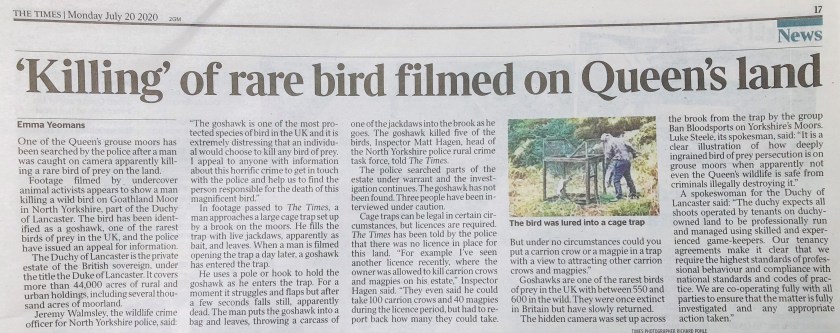
Further to last week’s news that North Yorkshire Police were appealing for information after the alleged killing of a goshawk that was caught inside a trap on a grouse moor in the North York Moors National Park (see here), the location has now been revealed to be one of the Queen’s grouse moors, part of the Duchy of Lancaster, according to an article in The Times today.

It’s reported that ‘the Duchy of Lancaster is the private estate of the British sovereign, under the title the Duke of Lancaster. It covers more than 44,000 acres of rural and urban holdings, including several thousand acres of moorland‘.

The video footage of the goshawk caught in the trap is described:

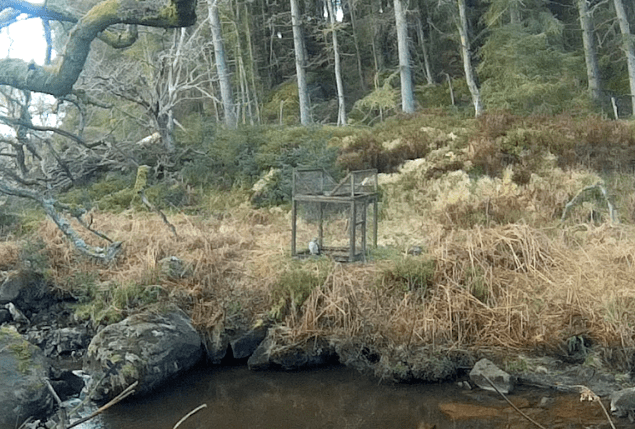
A man approaches a large cage trap set up by a brook on the moors. He fills the trap with live jackdaws, apparently as bait, and leaves. When a man is filmed opening the trap a day later, a goshawk has entered the trap.

He uses a pole or hook to hold the goshawk as he enters the trap. For a moment it struggles and flaps but after a few seconds falls still, apparently dead. The man puts the goshawk into a bag and leaves, throwing a carcass of one of the jackdaws into the brook as he goes. The goshawk killed five of the birds, Inspector Matt Hagen, head of North Yorkshire Police Rural Task Force told The Times.’

North Yorkshire Police have searched part of the estate under warrant and interviewed three individuals under caution. The investigation is ongoing.

We understand there is a sporting agent on this estate and it’s a name we’ve heard many times before.

This isn’t the first time that a royal estate has been at the centre of a police investigation about goshawks – see here for a very mysterious story from the Queen’s Sandringham Estate in Norfolk a couple of years ago.

North Yorkshire Police search for illegal poisons in Nidderdale

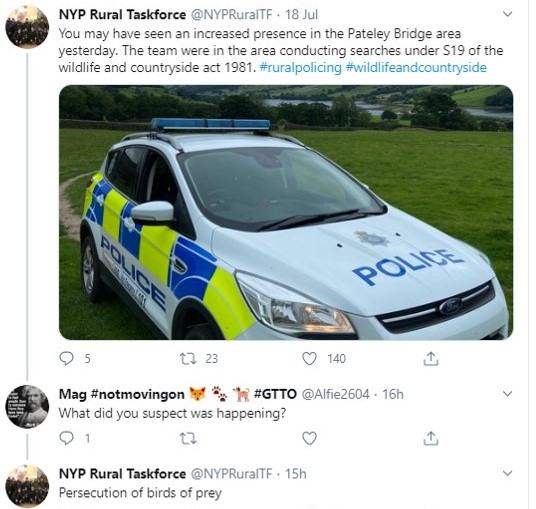
North Yorkshire Police made quite a statement on Friday morning when at least 10 marked police vehicles descended upon Pateley Bridge in Nidderdale, along with forensic-suited poisons experts from Natural England. When asked by local residents what they were doing, the police replied they were conducting searches in relation to the illegal killing of birds of prey in the area.

North Yorkshire Police’s Rural Task Force tweeted about it yesterday:

This is a very good example of proactive policing. The Nidderdale AONB is one of the UK’s most notorious hotspots for illegal raptor persecution, particularly on many of its driven grouse moors e.g. see here for a recent damning report published by the local AONB authority and for just a small sample of reported persecution crimes in recent years see hereherehereherehereherehere here, here, here, here, here and here.

During lockdown, the police were appealing for information about two separate illegal poisoning incidents in the area, involving two dogs (here) and a buzzard (here) and it’s believed Friday’s search may have been in relation to these most recent incidents.

Illegal poisoning happens with such frequency in this area that the specific concoction used has even been named the ‘Nidderdale Cocktail’ (Bendiocarb, Carbofuran, Isofenphos, and Chloralose). Bendiocarb is licenced for use in England as an ingredient in a number of insect control products but should not be released into an environment where wildlife could come into contact with them. Carbofuran, Isofenphos and Chloralose are all banned substances which should not be used under any circumstances.

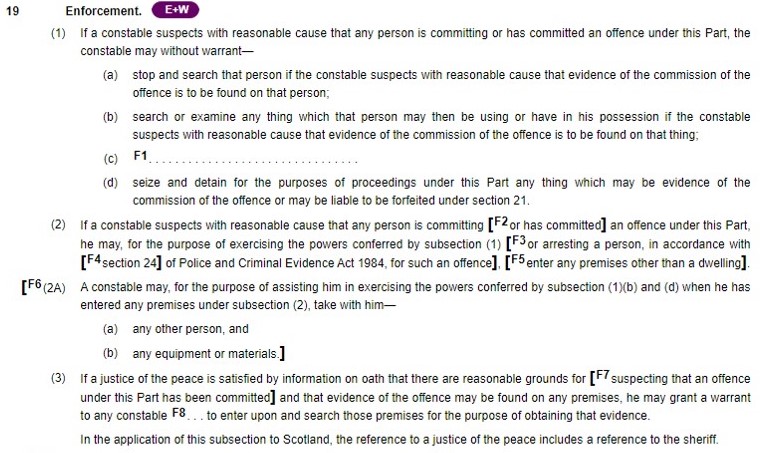
In the police’s tweet, they mention searches ‘under S19 of the Wildlife & Countryside Act 1981’. This refers to Section 19 of the Act, entitled ‘Enforcement’ and allows officers to enter private land, without a warrant, to conduct searches where there is reasonable suspicion that an individual is committing or has committed an offence:

North Yorkshire Police haven’t revealed whether anything was found, and nor would we expect them to at this early stage, but the fact they turned up in force, accompanied by Natural England staff who have expertise in poison storage, labelling and identification, and that they weren’t shy about telling local shoppers why they were there, sends a very clear message to the Nidderdale raptor killers.

Well done, North Yorkshire Police & Natural England. More of this, please.

Hen Harrier Day Wales – archived video available to watch now

Well done Ian Cooper (Mountain Escapes) for hosting today’s inaugural Hen Harrier Day Wales, ably assisted by Alan Davies (Birdwatching Trips).

This event was supposed to have taken place at a venue in Snowdonia but obviously covid19 put paid to that, but Ian and co have worked hard to bring the event online and it was live-streamed on Facebook this afternoon from 12-4pm.

The speakers included Iolo Williams, Dr Cathleen Thomas, Alan Davies, Ruth Tingay, Rob Taylor, Dan Rouse and Chris Packham.

For those who missed it, the archive video is now available to watch (and you don’t need a Facebook account to access it). Just click on the video below.

UK Hen Harrier Day will be an online event on Saturday 8 August 2020 – to find more details please visit the website here

Hen Harrier Day Wales – livestreaming online Saturday 18 July 2020

The first ever Hen Harrier Day Wales takes place tomorrow (Saturday, 18 July 2020) and will be live-streamed on Facebook from 12 – 4pm.

Hosted by two outdoor companies, Mountain Escapes & Julian Cartright Mountain Adventures, this is the first of two online Hen Harrier Day events this year, with a UK-wide event taking place in three weeks time on Saturday 8 August. More info to follow on that one.

Hen Harrier Day Wales has the following line-up:

  • 12.00-12.05 Introduction
  • 12.05-12.30. Iolo Williams. The history of Hen Harriers in Wales, recolonisation and persecution.
  • 12.50-13.05. Dr Cathleen Thomas. Join us to find out more about the RSPB’s Hen Harrier LIFE project, which ran from 2014 to 2020. We’ll tell you a bit more about our work in Wales, and our hopes for the future of Welsh hen harriers.
  • 13.15-13.30. Alan Davies. The magical experience of watching Hen Harriers on Welsh moorlands, a sight which everybody should have the chance to see. He will then move on to highlight the terrible persecution of these spectacular birds and will wrap up with how we can all help Hen Harriers by spreading the word about these fantastic endangered birds.
  • 13.40-13.55. Dr Ruth Tingay. Topic to be confirmed.
  • 14.05-14.20. Rob Taylor. Topic to be confirmed.
  • 14.30-14.45. Dan Rouse. Young people and Hen harriers: what has been achieved and what people can work towards doing if they want to get involved in helping hen harriers.
  • 15.00-15.45. Chris Packham. Topic to be confirmed.
  • 16.00. Thanks/ Close.

For further information about Hen Harrier Day Wales, please visit the web page here

For a bit more background, there is also this blog (here) by Alan Davies and this blog (here) from RSPB Wales.

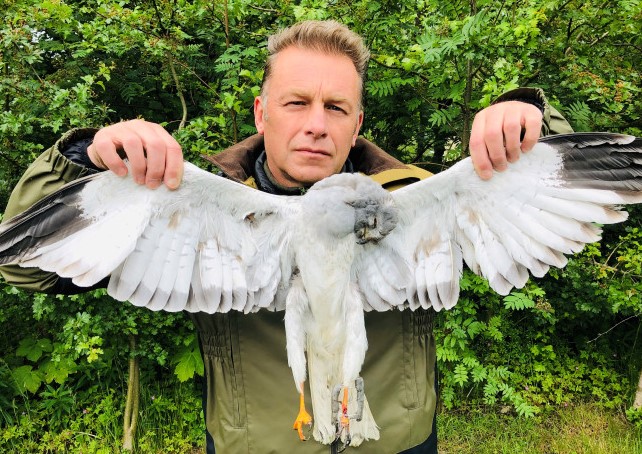
[Chris Packham with an illegally-killed hen harrier – full story here – photo by Ruth Tingay]


Police appeal after goshawk killed on grouse-shooting estate in North York Moors National Park

Press release from North Yorkshire Police (15 July 2020)

Police appeal for information after goshawk killed near Goathland

North Yorkshire Police is appealing for information about an incident in which a goshawk appeared to be killed after becoming caught in a cage trap.

Video footage, which was passed on to North Yorkshire Police, shows the bird becoming caught in the trap in the early hours of 2 May 2020. Shortly afterwards, an individual with their face obscured is seen entering the trap and appears to deliberately kill the bird before removing the body in a bag.

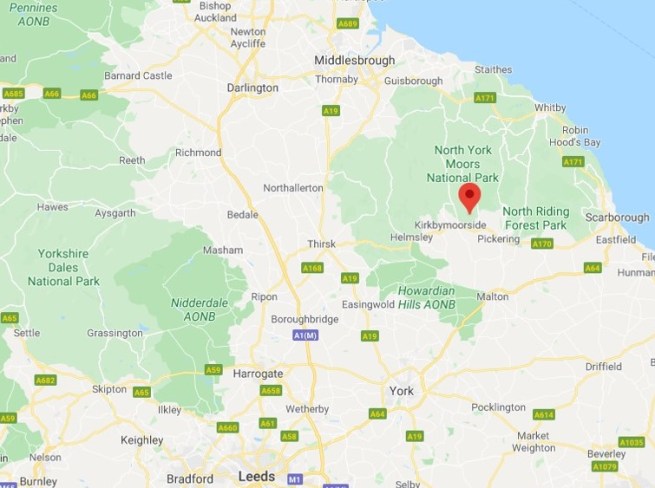
The trap was located on Howl Dale Moor near Goathland in the North York Moors National Park.

[The goshawk trapped inside the cage trap prior to being killed, photo via North Yorkshire Police]

North Yorkshire Police Wildlife Crime Officer, Jeremy Walmsley, is urging anyone with information to come forward:

The goshawk is one of the most protected species of bird in the UK and it is extremely distressing that an individual would choose to kill any bird of prey. I appeal to anyone with information about this horrific crime to get in touch with the police and help us to find the person responsible for the death of this magnificent bird.

We see far too many incidents of birds of prey killed or injured in North Yorkshire and as a police force we are doing all we can to put a stop to this inhumane and callous crime.”

Andy Wilson, Chief Executive of the North York Moors National Park Authority said:

We are deeply saddened to hear about this incident. Goshawks were persecuted to extinction in the UK in the late 19th century and, despite an improvement in numbers, persecution and habitat loss remain a constant threat to their survival.

Killing or injuring a bird of prey is illegal, cruel and must be prosecuted wherever possible. We are working alongside the police to support them in their investigations and we would strongly urge any witnesses or anyone who has any information to come forward. With your help the offender(s) can be brought to justice.”

A cage trap can be used to catch certain species of birds and is designed to trap birds alive and unharmed, in case of any non-target species becoming caught. Any non-target birds, such as birds of prey, should be released as soon as possible after being caught. Killing a bird of prey is an offence under the Wildlife and Countryside Act 1981.

If you have any information which could help this investigation, please call 101 quoting reference: 12200073462 or if you wish to remain anonymous contact Crimestoppers on 0800 555 111.

ENDS

UPDATE 20 July 2020: Queen’s grouse moor named at centre of wildlife crime investigation in North Yorkshire (here)

Conservationists fear for safety of Bearded Vulture on notorious Peak District grouse moors

The young Bearded Vulture that has been roosting in the Peak District National Park is causing concern for conservationists who fear for its safety on the notorious grouse moors.

[The young Bearded Vulture, photo by William Bowell]

It just happens to have chosen to hang out in ‘one of the worst 10km squares for raptor persecution in the UK’ according to Mark Thomas of RSPB Investigations (e.g. see here) and there are fears that it could be targeted by ruthless gamekeepers in the run up to the start of the grouse shooting season on 12 August.

Only last month police appealed for information after the discovery of a dying buzzard found inside the National Park (see here). It had suffered horrific gunshot injuries and a post-mortem revealed it had previously been shot but had survived those earlier injuries.

[The vulture has been roosting at an old raven nest site, photo by Tim Birch]

Tim Birch from the Derbyshire Wildlife Trust has been quoted in a number of media articles (e.g. here and here):

It “couldn’t have come to a worse spot in terms of bird of prey persecution” amid fears the vulture could be poisoned or shot. “I don’t think people realise it’s happening in the national park. The bearded vulture is of international importance, so if anything happened to that bird it would bring into sharp focus what is happening here.”

It’s a pretty shocking indictment when a rare bird of prey shows up inside one the country’s most famous national parks and the big story is whether it’ll be left alone or killed.

Fortunately, so far it’s been left alone, presumably because so many birdwatchers have been flocking to see it.

[Birdwatchers viewing the Bearded Vulture, photo by Indy Kiemel Greene]

UPDATE 16th October 2020: Bearded vulture flies out of UK (here)

Peregrines illegally poisoned on Guernsey

Police on the island of Guernsey are appealing for information after at least three peregrines have been found poisoned with ‘an unusual cocktail of banned pesticides’ in the last 14 months. A fourth peregrine was found in June and toxicology results are pending.

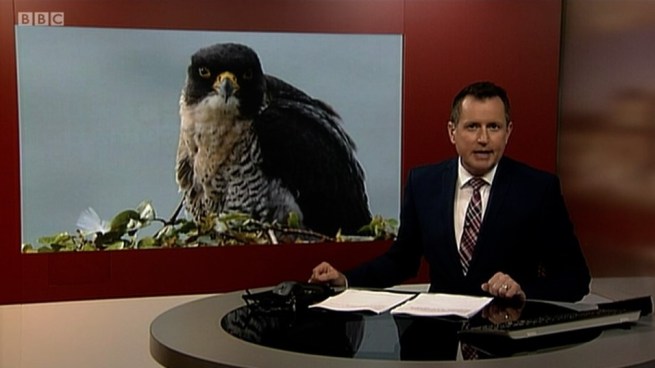
This story featured on the BBC Channel Islands News last night and is available to watch on iPlayer until 18.55hrs today. Click here to watch (it’s the first item).

The short film includes interviews with Mark Thomas (RSPB Investigations) and David Chamberlain, Guernsey State Vet, who said he believed the pesticides had been imported from the UK rather than ‘hanging around for a long time on the island’ as a similar deadly cocktail had been used elsewhere in the UK for the same purpose of killing raptors.

The names of the pesticides were not revealed.

UPDATE 1st August 2020: 4th peregrine confirmed poisoned on Guernsey & another raptor submitted for toxicology analysis (here)

Yet another buzzard shot in North York Moors National Park

Press release from North Yorkshire Police (13 July 2020)

Appeal for information after buzzard found shot in Ryedale

Bird found seriously injured near Appleton-le-Moors

North Yorkshire Police is appealing for information after a female buzzard was discovered shot near Appleton le Moors on Sunday 5 July. The bird was found suffering multiple injuries in woods just off Hamley Lane, Appleton le Moors by a member of the public.

Although the buzzard received immediate veterinary treatment, she sadly did not survive given the seriousness of her injuries. A post mortem examination revealed she had suffered shot damage to her tail and wing feathers but also had leg and head wounds which may have been caused by becoming stuck in a cage trap.

Prior to her death, the female buzzard had been seen feeding two juveniles in the area and it is believed she was shot at some point between 6 – 9pm on Saturday 4 July 2020.

If you have any information which may help with this investigation, please call 101 quoting reference: 12200115223 or if you wish to remain anonymous you can call Crimestoppers on 0800 555 111.

North Yorkshire Police Wildlife Crime Officer, Jeremy Walmsley, said:

This is the latest in a very long line of raptor persecution incidents that have occurred in Ryedale over the last few months and it is completely unacceptable. Killing or injuring a bird of prey is not only illegal but cruel and callous.

We are doing everything we can to track down these offenders and I would urge anyone who can help with information about this incident or any other wildlife crime, to get in touch as soon as possible.”

Find out more about bird of prey persecution and how you can Recognise, Record and Report it.

ENDS

The lawless untouchables of North Yorkshire strike again. New blog readers may well wonder, with such a high incident rate, how this is allowed to continue. Everybody knows North Yorkshire is consistently rated as having the worst record for illegal raptor persecution in England, year after year after year and yet there are no consequences and no deterrents – the criminals are assured they won’t be caught and even if they are, their employer will likely stump up large sums of money to pay for the best legal representation available. Meanwhile, representative bodies all enjoy a seat at the table of the so-called ‘partnerships’ that are meant to be tackling these crimes. Nobody bats an eyelid when these crimes are reported – they happen with such frequency that we’re all accustomed to the headlines and numbed to the reality.

This latest victim comes soon after a Channel 4 News special report that highlighted the extent of raptor persecution in North Yorkshire, and particularly on grouse moors in the two national parks (Yorkshire Dales and North York Moors) as well as in the Nidderdale Area of Outstanding Natural Beauty (see here) where a senior police officer (Insp Matt Hagen) told news reporter Alex Thomson:

All the shooting investigations that we’ve got going on at the moment are involving gamekeepers on grouse moors“.

Alex Thomson: All of them?

Matt Hagen: All of them.

Alex Thomson: Every single one?

Matt Hagen: That’s right.

One of those recently highlighted incidents involved the discovery of five dead buzzards that had been hidden under a rock on a Bransdale grouse moor in the North York Moors National Park – post mortems revealed that four had been shot (see here). North Yorkshire Police interviewed eight people (presumably gamekeepers) under caution and enquiries continue.

This latest victim wasn’t found on a grouse moor and although the nearest one isn’t a million miles away it’s not known where she was shot, although the head injury is consistent with what you’d expect to see of a buzzard trying to escape from a trap. This injury looks remarkably similar to that suffered by another buzzard not too far away in 2017 (see here).

If you have any information about any of these incidents that could help North Yorkshire Police bring the armed and out of control criminals to court, please call 101 or Crimestoppers on 0800 555 111.

Disingenuous parliamentary answers from Scot Gov on toxic hazards of grouse moor management

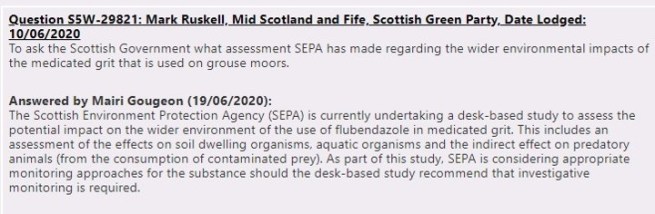
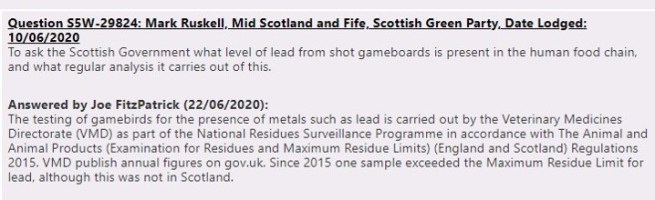
Last month Scottish Greens MSP Mark Ruskell lodged a series of Parliamentary questions about the toxic hazard of lead ammunition and the use of medicated grit on grouse moors (see here).

Those questions have now been answered by two SNP Ministers (Mairi Gougeon, Environment Minister and Joe Fitzpatrick, Minister for Public Health, Sport & Well-being).

To the casual, uninformed reader these answers might seem reasonable, informed and adequate. To those of us who know a bit more about these issues, and importantly who bother to read the source documents, some of these answers could be described as disingenuous or just plain old taking the piss. Either that or there are some seriously badly-informed Ministers in the Scottish Government.

Let’s go through each answer and as we do, bear in mind that we’re talking about toxic hazards, one of which (lead ammunition) is already known to cause damage to the environment, to wildlife and to public health and the other (Flubendazole, the active ingredient in medicated grit) has been shown to be extremely toxic to aquatic organisms, and yet the use of both substances still remains virtually unregulated, despite the Scottish Government knowing full well what the toxic legacy could be.

This answer isn’t disingenuous, but it begs the question, if this level of excretion is known from other species, and it is also known that some grouse moors are using a super-strength dose of Flubendazole, up to twenty times the original dose (see here), then why hasn’t the use of medicated grit been under scrutiny before now, especially as Flubendazole has been identified as ‘an emerging environmental contaminant of acute and chronic toxicity’?

Good. This answer isn’t disingenuous either but see above for questions about why this review has taken so long to get started. Let’s hope this review also considers the issue of the disease Cryptosporidiosis, also known as Bulgy Eye, known to be spreading rapidly amongst grouse and other species via communally-used grit trays on grouse moors (see here), even though SNH has proven itself astonishingly indifferent to this threat despite knowing about it for at least three years (see here).

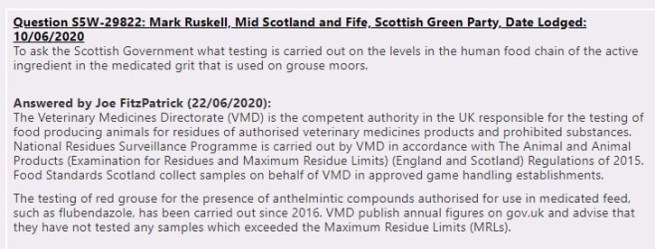
I consider this to be a disingenuous response, or evidence of a Minister who needs to employ more clued-up staff. Mr Fitzpatrick may argue that it’s not disingenuous because he’s unaware of the woefully inadequate level of background testing by the Veterinary Medicines Directorate (VMD) but as he’s the Minister for Health I’d argue it’s his job to make sure he does know. If he doesn’t know then he’s very badly informed.

Mr Fitzpatrick claims that the VMD has been testing red grouse for the presence of anthelmintics such as Flubendazole since 2016 and that the VMD has claimed not to have tested any red grouse samples which exceed the Maximum Residue Levels (thus implying that drug residues are not a problem to be concerned about).

Rather than take the VMD’s word for it (because the VMD has previously proven itself to be undeniably crap at its job – see here), I thought I’d have a look at the number of red grouse that have actually been tested for anthelmintics since 2016 to see how representative the sampling effort has been. The VMD publishes annual databases on the number and type of sampling it has undertaken. Here’s what I found:

2016: 6 x red grouse tested

2017: 8 x red grouse tested

2018: 3 x red grouse tested

2019: 6 x red grouse tested

So in four years of testing, the VMD has managed to test a grand total of 23 red grouse for residues of the drug Flubendazole. When you consider that an estimated 750,000 red grouse are shot in the UK each year, it’s no wonder the VMD can say with confidence that it hasn’t detected any drug residues above the maximum permitted limit, because it’s hardly tested any samples at all! Joe Fitzpatrick should have checked these source data to put his answer into context because as it currently stands it looks like he’s professing there’s no issue with the drug reaching the human food chain, instead of admitting that there’s inadequate testing going on to reach any such conclusion.

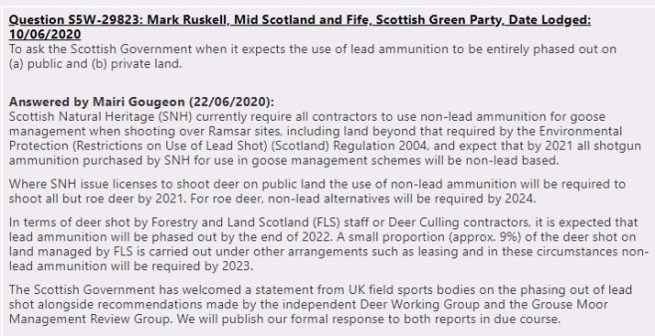
I consider the last paragraph to be a disingenuous response, or evidence of a Minister who needs to employ more clued-up staff. As it reads, it looks as though the shooting industry is moving forward unanimously towards a ‘phasing out’ of lead shot.

However, what this paragraph doesn’t mention is (a) the long-term evidence that the game-shooting industry is incapable of voluntary restraint, particularly on the use of lead ammunition (e.g. see here) and (b) the position of the Scottish Gamekeepers Association, which has quite clearly announced its rejection of the voluntary phasing out of toxic lead ammunition (see here). There’s a (c), too. And that’s the confusing position of another shooting organisation, BASC, who were one of the shooting orgs to promote the voluntary phasing out of lead ammunition as described above, but who then several weeks later decided to fight proposed EU restrictions on the use lead ammunition (see here). See, Mairi? You can’t take them at face value and trust what they tell you.

This is also a disingenuous response, in my opinion, or evidence of a Minister who needs to employ more clued-up staff.

Again, rather than trust what the VMD says, I wanted to look at the actual data myself. How many gamebirds have actually been tested for toxic lead contamination since 2015? Here’s what I found:

2015: 6 x partridge; 6 x pheasant; 0 x red grouse

2016: 7 x partridge; 7 x pheasant; 0 x red grouse

2017: 6 x partridge; 7 x pheasant; 0 x red grouse

2018: 5 x partridge; 5 x pheasant; 0 x red grouse

2019: 6 x partridge; 6 x pheasant; 0 x red grouse

So in five years of testing for toxic lead residues in gamebird meat, the VMD has examined 30 x partridge and 31 x pheasant and 0 x red grouse. That’s a total of 61 samples out of a possible 90 million shot partridge and pheasant (conservatively estimated 57 million released each year, multiply by five (years) and divide by 1/3 believed to be shot each year = 90 million shot of 285 million released).

Not very representative sampling, is it Mr Fitzpatrick? Don’t you think you should have put the results in to context so that instead of inferring that toxic lead poisoning isn’t an issue in gamebirds sold for human consumption, it would be clear that testing for toxic lead residues was totally and utterly inadequate given the massive number of gamebirds shot every year?

And actually isn’t it true that when some grouse, partridge and pheasant were tested by independent researchers for traces of toxic lead, many contained lead levels that were ten times the legal level in other meats and some contained lead levels that were one hundred times over the legal limit for other non-game meat (see here and here)?

Isn’t it about time the Scottish Government got its act together on these toxic hazards and on all the other grouse-shooting related issues that it’s been long-grassing since 1998?