More birds of prey illegally killed in & around Peak District National Park

As conservationists continue to express concern for the safety of the visiting Bearded Vulture in the Peak District National Park (e.g. see here), the RSPB has published a blog detailing more cases of confirmed and suspected illegal raptor persecution that have been recorded in the area since the beginning of lockdown.

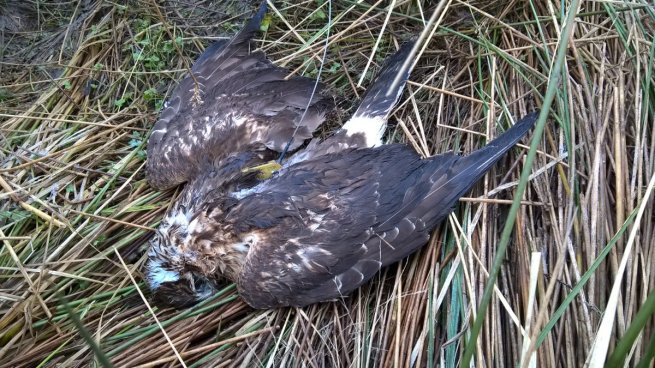
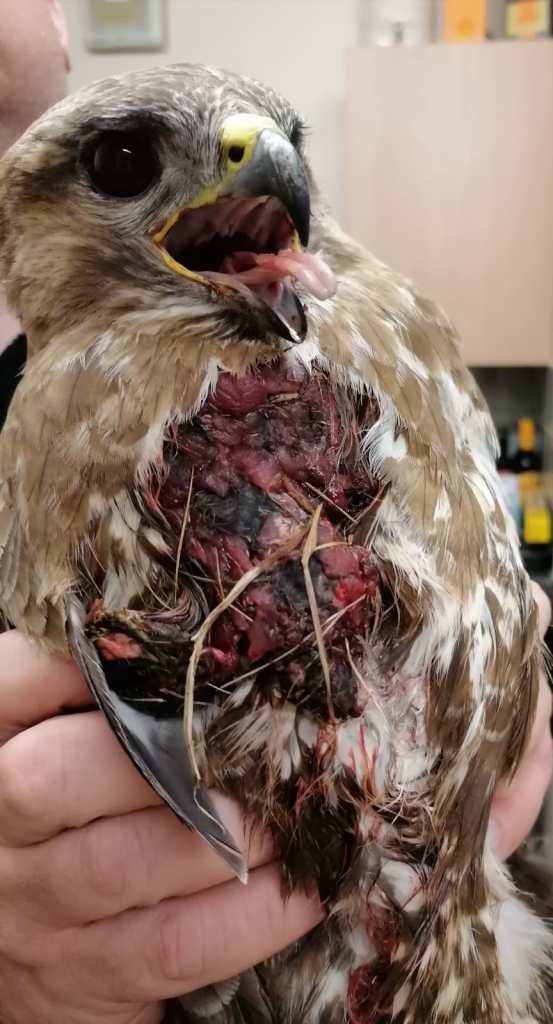
[This shot buzzard had to be euthanized due to the extent of its injuries. Photo by Peak District Raptor Monitoring Group]
The RSPB’s updated list includes the following, some of which have already featured on this blog and some which haven’t previously been publicised:

NEW: In the north of the National Park, the remains of a short-eared owl, an amber-listed species, were found on a grouse moor near Glossop on 7 May. A post-mortem recently concluded that shooting had been the cause of death. No leads were forthcoming from police enquiries.

NEW: Near Agden Reservoir, an area dominated by driven grouse moors, four raven chicks were found dead in a nest also on 11 May. The parent birds had been seen bringing food to the young, then vanished without explanation. The chicks were almost at the point of fledging, and the RSPB say the adults were exceptionally unlikely abandon the nest at that stage. The incident is being investigated by South Yorkshire Police.

NEW: Test results are awaited in connection with an adult peregrine found dead in the Upper Derwent Valley.

NEW: In the south, just outside the National Park an eyewitness reported seeing two buzzards being shot near Ashbourne on 1 April 2020. A member of the public was watching the two birds circling a wood, on land managed for pheasant shooting, when he heard a shot and saw the birds fall. There’s no comment about a police investigation.

PREVIOUSLY REPORTED: On 11 May, a buzzard was found mortally wounded on land managed for gamebird shooting near Diggle. It was found alive but with terrible injuries and sadly had to be euthanized. An x-ray revealed six pieces of shot lodged in the bird’s body. [This crime has previously been blogged about here]

PREVIOUSLY REPORTED: In the south of the Park, a buzzard and two peregrines are being tested for poison after being found dead in Staffordshire. [These incidents have previously been blogged about here] [Confirmed illegally poisoned. See UPDATE at foot of this blog]

PREVIOUSLY REPORTED: In mid-June, Derbyshire Police issued an appeal for information after three peregrine nests were robbed of their eggs, all within the National Park. The RSPB alerted the police about one of the incidents. [These incidents have previously been blogged about here]

PREVIOUSLY REPORTED: A dead kestrel and a buzzard have also gone for poison testing: they were found near Glapwell, where several buzzards were found poisoned in 2016. [These incidents have previously been blogged about here] [Confirmed illegally poisoned. see UPDATE at foot of blog].

To read the RSPB blog in full please click here

The RSPB’s Head of Investigations, Mark Thomas, was also on BBC Radio Derby a few days ago talking about the ongoing killing of birds of prey in the Peak District National Park. Available here (starts 3hrs 16) for 24 days.

UPDATE 3rd August 2020: Buzzard and kestrel confirmed illegally poisoned in Derbyshire (here)

UPDATE 2nd October 2020: Birds of prey illegally poisoned in Staffordshire / Peak District National Park (see here)
“It’s time Scotland took on landed interests over animal protections” says Alison Johnstone MSP

Last month the Scottish Parliament voted overwhelmingly (see here) to provide full protected status for mountain hares, thus effectively ending the unregulated slaughter of ~26,000 hares on grouse moors every year.

However, hare-culling under licence will still be permitted under certain circumstances and the conflict over the protection of this species is far from over.

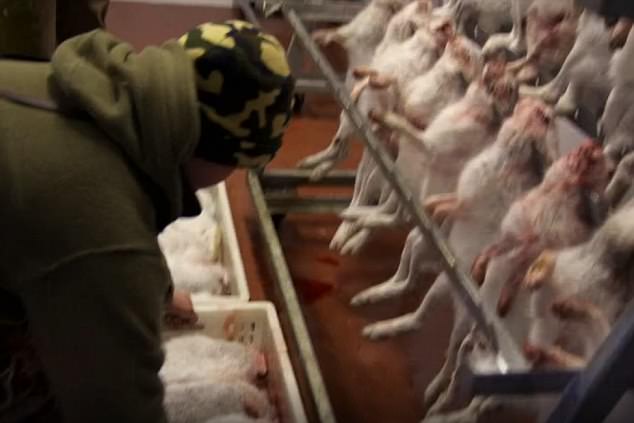
[Shot mountain hares strung up in a chilling larder, screen-grabbed from a controversial feature on Countryfile (2018) showing mountain hares being shot on a Scottish grouse moor]

In preparation for a more detailed blog in the run up to the opening of the hare-killing season this Saturday (1st August), have a read of this opinion piece written last month by Alison Johnstone MSP, whose amendment to the Animals and Wildlife (Penalties, Protections & Powers) (Scotland) Bill led to the [as yet to be implemented] increased protection for mountain hares.

This article is reproduced from The National (26 June 2020).

It’s time Scotland took on landed interests over animal protections

by Alison Johnstone MSP

THE response to mountain hares finally becoming a protected species in Scotland has been nothing less than astonishing.

After MSPs backed my amendment, thanks and congratulations came flooding in from across Scotland and around the world for winning vital protection for this iconic native species.

In parts of the Highlands, mountain hare populations have crashed since the 1950s, with an average of 26,000 killed every year, largely for fun and as part of mass killing on grouse moors. Last year their conservation status was downgraded to “unfavourable”.

Protecting these animals is the least we should do as a progressive country that values our wildlife and countryside, yet there has also been an astonishing response to this move from landed vested interests and the grouse shooting lobby, who have reacted with fury.

Gamekeepers claimed the vote in Parliament was “undemocratic” and threatened to set up their own political party, while the countryside alliance called into question my integrity, presumably because their only alternative is to defend the indefensible.

Preventing the slaughter of native wildlife in decline is perhaps the most basic act of conservation. Even under the highest level of wildlife protection available in Scotland, land managers could still apply for a licence to kill hares as a last resort, so the scale of response from the grouse shooting lobby is very revealing. It shows this is a community which is not used to being beaten. It demonstrates the power and influence they are used to having.

In December, the two-year review of Scotland’s grouse moors led by Professor Alan Werritty was published, but it brought absolutely nothing new to the table. It couldn’t even define what a grouse moor is, even though they cover around a fifth of Scotland’s land mass.

Incredibly, the Scottish Government has yet to respond to this watered-down review, which perhaps shows how unwilling the SNP is to take on this powerful lobby.

Last week, however, Scottish Government ministers came under incredible pressure after a Scottish Greens petition in support of hare protection garnered more than 25,000 signatures in just a few days. It was clear that public opinion does not align with the interests of those who enjoy shooting grouse on an industrial scale.

Although Parliament voted for an end to indiscriminate killing of mountain hares, the fight is not yet over. Shooting clubs have ominously warned our celebrations will be “short-lived”, and August will see the start of hare-killing season.

The RSPB and others have expressed concerns that these enthusiasts will use any delay in implementing the new restrictions to kill as many mountain hares as possible. There are already signs on social media that they are mobilising to do this.

They know this would be met with outrage, but this is a sector which has shown little interest for public concerns. The number of birds of prey which vanish around grouse moors is testament to that, which no doubt contributes to the lobby’s claim that mountain hares “thrive” on grouse moors. It is a circle of killing dressed up as conservation.

The fact muirburn continued into the pandemic lockdown and in dangerously dry conditions, despite the warnings of the fire service and Parliament backing my colleague Andy Wightman’s temporary ban, is another example of this industry’s disregard for wider community concerns and democratic process.

In accepting my amendment during the debate, natural environment minister Mairi Gougeon suggested the Scottish Government might delay implementation of this vital protection for mountain hares.

LIKE many, I’m really worried that this delay will only encourage an unprecedented killing spree by those who want one last hurrah. The ban must come in by August 1 and the Scottish Government need to issue a warning to these powerful vested interests that they must control themselves. They can’t always have their own way.

Grouse moors are left deliberately barren as a plaything for the very few. It’s ridiculous that so much of Scotland is taken up with this this mindlessly cruel Victorian hobby, when that land is needed to restore forests and peatland to tackle the climate emergency. Changing its use would also provide thousands of rural jobs at a time when unemployment is rising at an alarming rate.

Although mountain hare protection is a vital first step in tackling the problem of grouse moors, when we look back at last week’s animal and wildlife bill, it’s clear there is a long way to go for our Parliament to truly take on the powerful lobbyists who defend them.

For example, once again the SNP joined forces with the Conservatives to protect the rights of the shooting lobby to dock the tails of puppies. This practice involves cutting or crushing muscle, nerves and bones, without anaesthetic, in puppies under five days old. If done badly, it can cause the dog chronic pain throughout its life. Animal welfare experts are clear that there is no scientific basis for tail docking and the British Veterinary Association agree the practice should be banned in all circumstances except for treating an injury.

Our proposals to further protect badgers and beavers were also rejected. It’s time for Scotland to take on the powerful landed interests that hold back progress, for which animal protection is the front line.

ENDS

More hysterical scaremongering over proposed grouse moor licensing

Earlier this week Duncan Orr-Ewing, Head of Species and Land Management at RSPB Scotland, wrote an opinion piece for The Scotsman in which he argued that the licensing of Scottish grouse moors is needed now, not in five years’ time (see here).

[Intensively managed grouse moors in the Cairngorms National Park, photo by Ruth Tingay]

In response, Tim (Kim) Baynes, Director of Scottish Land & Estates’ Moorland Group has written an hysterical scaremongering piece in which he suggests that grouse moor licensing will threaten the rural economy in terms of investment and jobs. Here’s his letter:

Letters page, The Scotsman, 25 July 2020

Licensing grouse shooting would backfire

Don’t risk the rural economy, says a reader

Duncan Orr-Ewing’s article (Friends of the Scotsman, 22 July) is correct in stating that grouse shooting provides employment in rural areas.

Despite this and many other public benefits, the RSPB tries to make the case that driven grouse shooting in Scotland should be subject to licensing.

This would make it the most heavily regulated land use in the UK and would discourage ongoing investment, potentially losing jobs associated directly and indirectly with the sector and threatening many rural communities.

It was only seven months ago that Professor Alan Werritty and his panel, commissioned by the Scottish Government, delivered a very carefully considered report into driven grouse shooting, which concluded that licensing of grouse shooting was not justified at this stage.

A second research report on the value of driven grouse shooting to Scotland is due to be published by SRUC this year. It makes no sense to disregard the evidence and impose a licensing system now. Licensing is also unnecessary given that recorded raptor persecution is at an all-time low, with an increasing number of golden eagles, hen harriers, buzzards and other raptors nesting and breeding successfully on grouse moors.

There is an abundance of wildlife thriving on moorlands due to the careful conservation work carried out year-round by skilled land managers. Much of this work is already subject to agreed codes of practice.

No other sporting or land use sector is subject to state licensing and in one move the Scottish Government would undermine all the progress made in recent years through effective collaboration between landowners, Scottish Natural Heritage and conservation charities. If we want a diversity of species and habitats we must allow moorland managers to look after our upland areas for the benefit of all.

Tim Baynes, Director, Scottish Land & Estates, Moorland Group, Eskmills Business Park, Musselburgh

It’s not the first time we’ve heard histrionics about a proposed grouse moor licensing scheme (e.g. see here here and here for more of the same unfounded rhetoric) and it’s not the first time that Tim (Kim) has falsely claimed that raptor persecution “is at an all time low” – in fact the latest wildlife crime report published by the Scottish Government shows that raptor persecution crimes have more than doubled (see here).

Nor is it the first time we’ve heard the claim that any sort of enforced regulation will ‘threaten’ or ‘damage’ the rural economy.

When the Land Reform Bill was being debated the Scottish Landowners Federation (which later re-branded to call itself the Scottish Rural Property & Business Association (SRPBA) and then re-branded again to its current name of Scottish Land & Estates) warned that the legislation would do irreversible damage to rural economies and they threatened to block the legislation at the European Court of Human Rights (see here).

Scottish Land & Estates also bleated about further land reform measures when the Scottish Government proposed removing the two-decades-old exemption from business rates enjoyed by shooting estates. SLE claimed that, “We believe that there would be a negative impact on rural jobs, tourism and land management” (see here).

And then there was more bleating when the Scottish Government brought in vicarious liability to tackle the continued illegal persecution of birds of prey. David Johnstone, the now former Chair of Scottish Land & Estates claimed this would introduce another layer of bureaucracy “When the Government should be doing what it can to help landowners and the rural economy” (see here).

The bottom line is, no other sporting or land use sector has been responsible for the appalling toll on wildlife, and especially on so-called protected birds of prey, and despite years of repeated warnings and hundreds of second chances (e.g. see here), the grouse shooting industry continues to deny responsibility and continues to do as it pleases.

Sure, there are some members of the industry who aren’t ‘at it’ and would have nothing to fear from a licensing scheme if their businesses are lawful and environmentally sustainable, as many claim to be. However, if the Scottish Government does decide to implement a licensing scheme, the grouse shooting industry should be thanking its lucky stars that that’s all it’s getting. The case for banning driven grouse shooting has been made clear and if/when licensing is proved to be ineffective, then the industry need only look to its own embedded criminals to understand who will be responsible for its ultimate demise.

UPDATE 27 July 2020: Scottish Raptor Study Group responds to hysteria over proposed grouse moor licensing (here)

Funding award available for early-career raptor conservationists

A funding award of up to £1,000 is up for grabs to help support early-career researchers working on projects that focus on the conservation of birds of prey.

The Marion Paviour Award is administered by the Hawk Conservancy and this is the third year it has been available.

This award is open to applicants anywhere in the world and preference will be given to those seeking support for costs associated with fieldwork and conference attendance to present findings.

In 2018, MSc researcher Katie Harrington received the award to support her research involved with designing and constructing tail-mounted data loggers to investigate the daily movements and activities of the Striated Caracara in the Falkland Islands. Biologist Diego Méndez was the recipient in 2019, using the funding to support surveys of roosts, foraging grounds and nests of the King Vulture in central Bolivia.

The closing date for applications for this year’s award is 31 August 2020. Funds will be available from Oct 2020.

For more information and details of how to apply online, please see here.

Yet another poisoned buzzard found dead on a grouse moor in North York Moors National Park

Joint press release from North Yorkshire Police and RSPB (24 July 2020)

APPEAL FOR INFORMATION AFTER ANALYSIS REVEALS BUZZARD POISONED

Buzzard found dead on moorland near Swainby, North Yorkshire

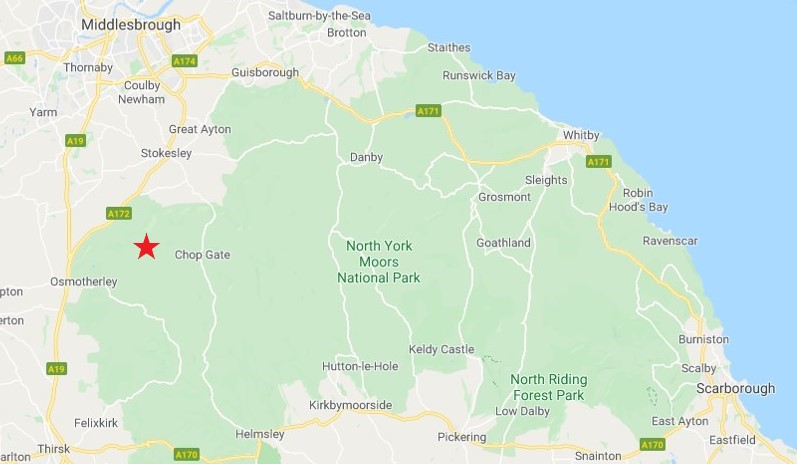
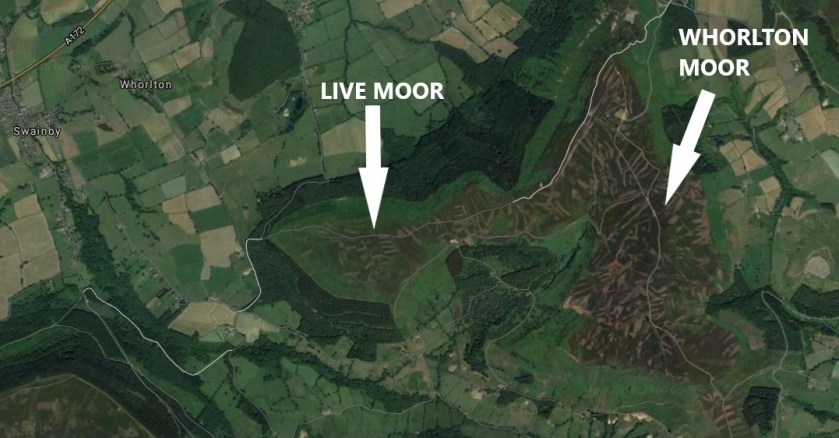
North Yorkshire Police and the RSPB are appealing for information after a dead buzzard was found on Live Moor close to the village of Swainby.

The bird was discovered by a member of the public on 20 March 2020 and reported to the RSPB before being removed. North Yorkshire Police submitted the buzzard for a post mortem examination which revealed an extremely high concentration of  toxic chemical, Chloralose in the bird’s system. Given the buzzard was in good bodily condition and had no injuries, the analysis shows poisoning to be the cause of death.

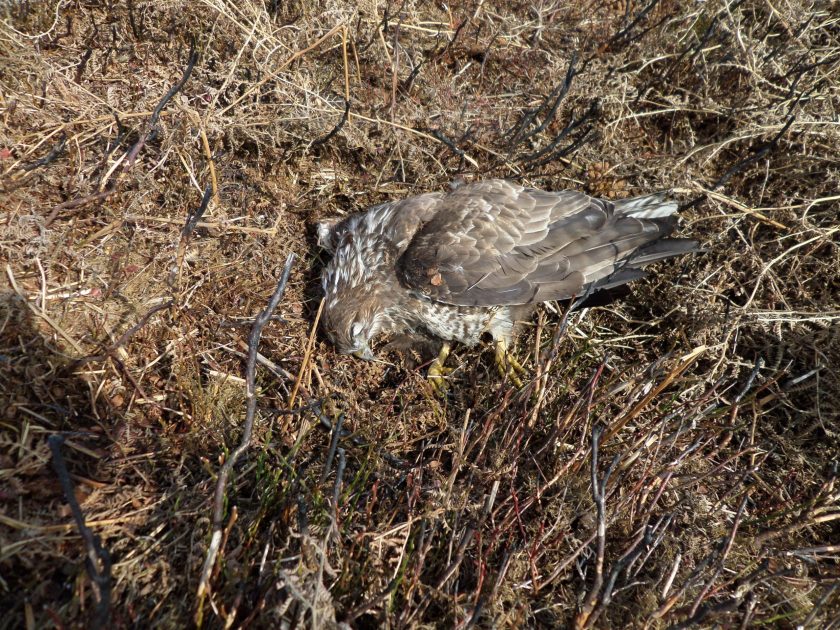
[The poisoned buzzard. Photo by RSPB]

North Yorkshire Police Inspector, Matt Hagen, explains:

A low percentage of chloralose was commonly used in rodenticides to kill mice but is only currently permitted for use indoors and at a small dose. As such, there is no way this buzzard could have come into contact with such a high concentration of this poison by accident and we believe someone deliberately set out to kill this bird by poisoning.

Unfortunately, this is the latest in a number of similar cases where birds of prey have been subjected to cruel and illegal persecution here in North Yorkshire. We are doing everything we can to try and find those responsible but we really need the public’s help as they are acting as our eyes and ears around the county. Anyone with information about this or any other incident of bird of prey persecution should contact the police on 101, we all have a part to play in putting an end to these unacceptable crimes.

Howard Jones, RSPB Investigations Officer, said:

Buzzards are a protected species yet continue to be relentlessly shot, trapped and poisoned in North Yorkshire. RSPB data shows that North Yorkshire is consistently the county with the highest number of crimes against birds of prey.

Alphachloralose is a commonly abused product in the illegal killing of birds of prey. The amount of it found in this bird was enough to kill a human child. People, pets and other wildlife are at risk from this kind of illegal behaviour, which is why we urge anyone who may have information about this incident to do the right thing and come forward.”

Anyone who has information which could assist with this investigation should contact North Yorkshire Police on 101 or if you wish to remain anonymous, you can call Crimestoppers on 0800 555 111. Quote reference: 12200116641.

ENDS

What this press release doesn’t say is that this illegally poisoned buzzard was found dead on a grouse moor inside the North York Moors National Park.

Nor does the press release explain the delay in publishing an appeal for information (corpse found 20 March, press release issued 24 July).

There are some individuals from the grouse shooting industry who are claiming on social media that this delayed reporting is a deliberate ploy to coincide with the run-up to the start of the grouse-shooting season on 12 August, and thus create bad publicity for the industry to ruin the ‘celebrations’. It’s a commonly-heard complaint and simply allows the persecution apologists to focus on anything other than the news that yet another bird of prey has been found illegally killed on yet another grouse moor.

Had they bothered to ask the police why there was such a long delay they might have understood that the toxicology labs were closed during lockdown and are now having to work through a significant backlog of cases, so confirmation of poisoning will take longer than usual.

It’s no surprise the grouse shooting industry wants to divert attention from this latest crime to be uncovered on a grouse moor inside this national park. It’s the third raptor persecution crime to be reported in the North York Moors National Park in recent months, following the discovery in April of five dead buzzards shoved in a hole on a grouse moor in Bransdale, four of which were later confirmed to have been shot (see here), and then last week’s news that three gamekeepers on the Queen’s grouse moor at Goathland had been suspended following a police investigation in to the trapping and alleged killing of a goshawk in May (see here).

The grouse shooting industry’s professed ‘zero tolerance for raptor persecution’ (see here) is as unconvincing now as it was when it was claimed last year, and the year before that, and the year before that, and the year before that, and the year before that, and the year before that, and the year before that, and the year before that, and the year before that, and the year before that, and the year before that, and the year before that……etc.

Insane hen harrier brood meddling trial continues in 2020

Natural England has today published a short, poorly-detailed update on this year’s hen harrier brood meddling trial.

For new blog readers, hen harrier brood meddling is a conservation sham sanctioned by DEFRA and carried out by Natural England (NE), in cahoots with the very industry responsible for the species’ catastrophic decline in England. For more background see here.

[Cartoon by Dr Gerard Hobley]

In today’s update, here’s what NE has to say:

So it looks like at least two hen harrier nests have been meddled with in this year’s trial – but of course NE hasn’t provided any further detail of the number nor locations of those nests, nor of the release site(s). We wouldn’t expect them to say exactly where these locations are – that would be counterproductive for a species that is so heavily persecuted, but a county-level disclosure would have been useful.

The death of one of the brood meddled hen harrier chicks prior to release is concerning and it’ll be interesting to hear more about the cause of death.

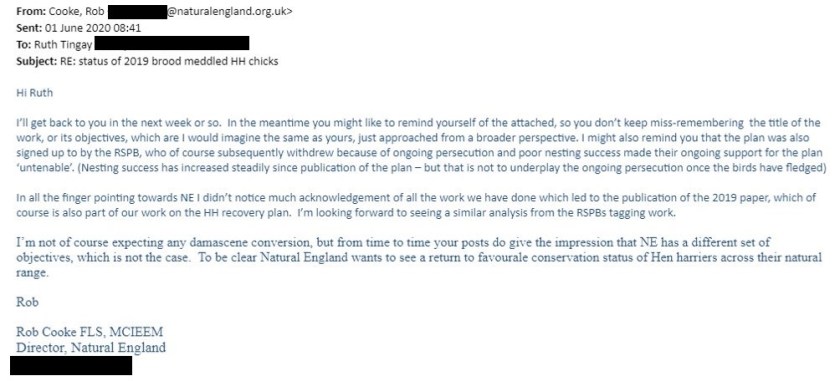
Although getting info out of Natural England is a painful exercise. Here’s an example of some recent correspondence on the fates of last year’s five brood meddled hen harrier chicks:

Of course we now know that all five of last year’s brood meddled hen harriers are ‘missing’ presumed dead, four of them in suspicious circumstances (see here). They form part of the list of 42 hen harriers that we know are either missing in suspicious circumstances or have been found illegally killed, since 2018, the majority on or near driven grouse moors (see here).

How many of this year’s brood meddled chicks do you think will survive to Christmas?

What’s that famous quote?

The definition of insanity is doing the same thing over and over again and expecting different results‘.

More dead pheasants wrapped in black bags & dumped in countryside

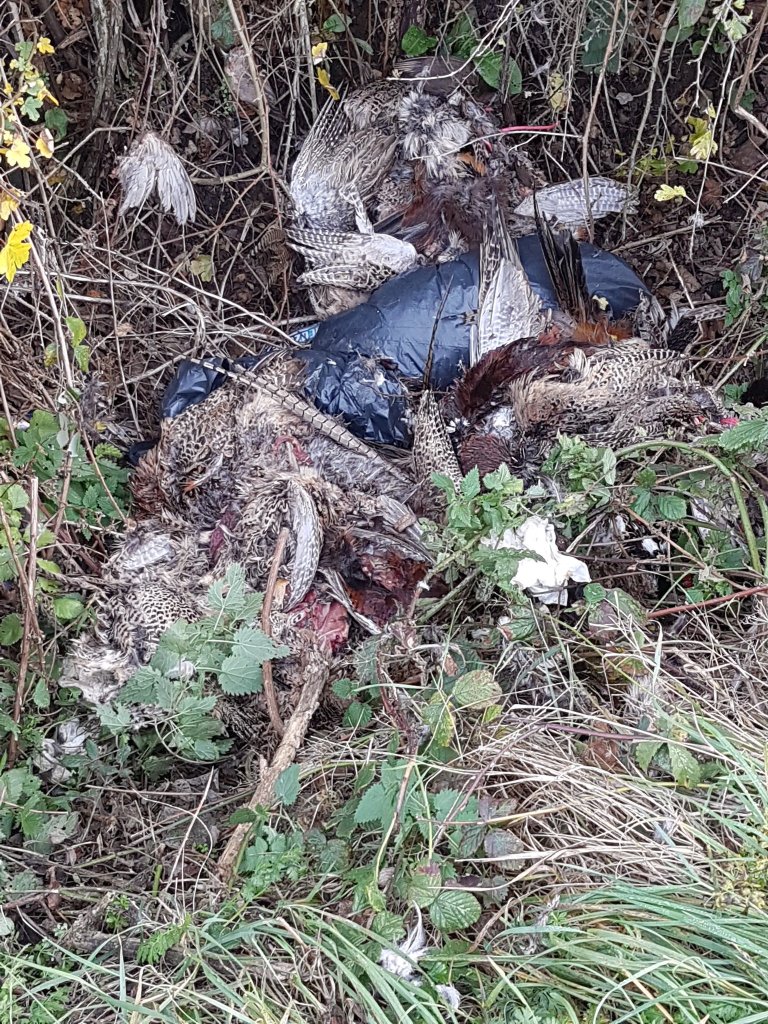
32 dead pheasants have been found wrapped in black bin liners and dumped in the countryside in the north east of England, according to a report on social media.

According to the local council guys who were called to come and remove them, this is the second time pheasants have been dumped at this site in recent months.

The reporter has asked that the location not be revealed as the council is installing cctv to try and catch the offender.

Dumping dead pheasants isn’t anything new. We’ve previously blogged about pheasants and red-legged partridge that have been shot and subsequently dumped in in Cheshire, Scottish borders (here), Norfolk (here), Perthshire (here), Berkshire (here), North York Moors National Park (here) and some more in North Yorkshire (here), Co. Derry (here), West Yorkshire (here), N Wales (here), mid-Wales (here), Leicestershire (here), Lincolnshire (here and more in West and North Yorkshire (here).

But this latest case is all a bit weird given the time of year. The pheasant-shooting season runs from 1st October to 1st February so where have these birds come from?

Gamebird dumping continues to be a widespread problem. That’s hardly a surprise when the game shooting industry is permitted to release as many non-native pheasants and red-legged partidge as it likes (conservatively estimated to be almost 60 million EVERY YEAR), with minimal regulation, and no requirement to report on what happens to those birds once they’ve been shot for a bit of a laugh.

And let’s not forget this is the same game shooting industry that is responsible for the vast majority of illegal raptor persecution, done, it says, to protect gamebirds. That’ll be the gamebirds that are shot and then dumped, with no respect for the quarry and no respect for the local residents who’ll have to foot the bill to have the carcasses removed.

In a letter to the Daily Telegraph in November 2005 headed ‘Game birds for eating not dumping’, Tim Bonner of the Countryside Alliance said this:

Every bird shot in Britain goes into the food chain, whether into participants’ freezers, or through game dealers into an increasing number of supermarkets, butchers, pubs and restaurants“.

That statement wasn’t true in 2005 and nor is it true 15 years later in 2020, despite the game shooting industry’s extensive (but flawed, e.g. see here) PR efforts to persuade the public that everything that’s killed is done ethically and sustainably.

Last year DEFRA admitted, after a legal challenge by Wild Justice, that gamebird releases need to be assessed properly for their potential ecological damage to protected nature conservation sites. However, as DEFRA failed to make significant and timely progress on addressing this issue, Wild Justice was recently granted permission for a Judicial Review and this will take place before the end of October (see here).

If you want to keep up to date with Wild Justice’s legal challenge (on this and other issues) you can sign up for the group’s free newsletter to ensure you’re amongst the first to know what’s going on. Please click here to subscribe.

“Licensing of Scottish grouse moors is needed now: it cannot wait five years”

Duncan Orr Ewing, Head of Species and Land Management at RSPB Scotland has written an opinion piece published today in The Scotsman:

Duncan’s article relates to the still-awaited Government response to the Werritty Review (apparently now due ‘in the autumn’ but don’t hold your breath). For new blog readers, the Werritty Review was commissioned by the Scottish Government in 2017 to assess the sustainability of grouse moor management and it reported in November 2019. The group unanimously recommended that grouse moors should be licensed but only if, within five years, there is no measured improvement in the conservation prospects of key bird of prey populations (see here).

Here are a couple of extracts from Duncan’s article:

In December 2019 the independent Grouse Moor Management Review Group, chaired by Professor Alan Werritty, made recommendations as to how Scottish grouse moors might be managed “sustainably and within the law”. The Werritty Review was prompted by relentless illegal persecution of birds of prey. It followed the publication of a damning report by Scottish Natural Heritage that analysed the fate of satellite-tagged golden eagles between 2004 and 2016. The report revealed that a third of the 131 tracked birds disappeared in illegal or suspicious circumstances, predominantly on land managed for grouse shooting. Since only a small proportion of the golden eagle population was monitored, the true number of birds killed was likely higher‘.

and

RSPB Scotland supports the Group’s recommendations; but we do not accept the need for a five-year delay before licensing is considered. Licensing must be progressed as soon as possible. Grouse shooting businesses have had many decades to get their house in order and have patently failed to adapt to the laws of the land and to modern expectations. A five-year delay would likely mean up to ten years before a licensing system could be practically implemented. We need an immediate and significant change to deliver environmentally sustainable grouse moor management practices; any delay puts the future of Scotland’s spectacular birds of prey at prolonged risk from illegal behaviours; and hinders Scotland’s attempts to use nature-based solutions to tackle the climate crisis‘.

To read the full article please click here

UPDATE 26 July 2020: More hysterical scaremongering over proposed grouse moor licensing (here)

Three gamekeepers suspended from Queen’s grouse moor after wildlife crime investigation

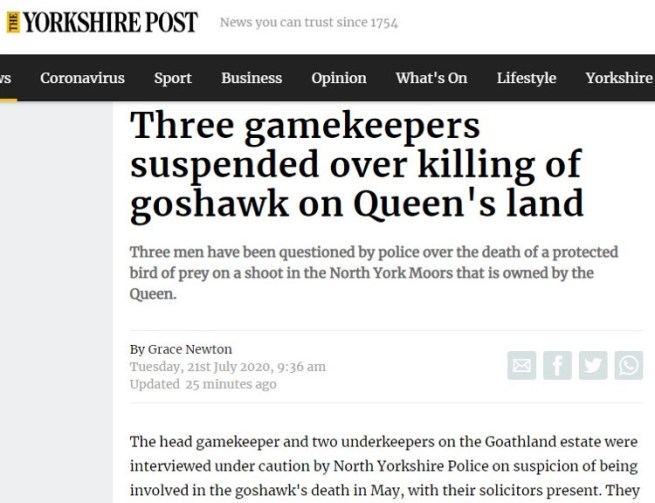
Following the news that a goshawk was recently trapped and apparently killed by a masked individual on the Queen’s grouse moor in North Yorkshire (see here and here), the Yorkshire Post is claiming that three gamekeepers were suspended.

According to the article, the Head gamekeeper and two underkeepers were suspended after being interviewed by North Yorkshire Police in relation to the alleged killing of the goshawk. Two have since been reinstated while the third one has been allowed to resign, and apparently allowed to work his notice period before he went!

The police investigation continues as officers await forensic results from items seized during a search of the estate.

Full article in the Yorkshire Post available here

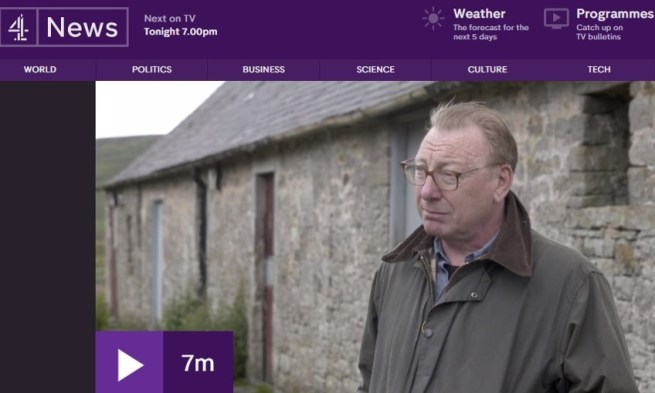
Channel 4 News does Langholm buyout

Alex Thomson, Chief Correspondent at Channel 4 News is on a bit of a roll.

In May he did a cracking report on the illegal persecution of birds of prey on grouse moors across North Yorkshire (see here).

Yesterday he did a cracking report about why the Langholm community is having to raise £6 million to turn a knackered grouse moor in to a nature reserve.

You can watch the seven minute film here and it really is worth your time.

Here’s how Alex describes the film on the Channel 4 News website:

You could call it a highly ambitious grassroots project – a group of Scottish villagers in Dumfries and Galloway is hoping to raise more than six million pounds to turn the UK’s most famous grouse moor into a new ten thousand acre nature reserve.

The land currently belongs to the Duke of Buccleuch, the second largest private landowner in Britain.

This scheme has revealed how far the vestiges of feudal land ownership are still very much alive today‘.

Once you’ve watched the film, which features a cameo role for land reform campaigner and Scottish Greens MSP Andy Wightman, you might want to have a read of this blog (here) written by Andy back in 2014. It puts the current situation into context, somewhat.

Regular blog readers will already know about the Langholm Initiative’s crowdfunding campaign to try and raise the money to buy this tiny piece of Buccleuch’s massive estate (e.g. see here, here, here, here, here and here). There was also an interesting article published in The National last month by Dr Lesley Riddoch (see here).

If you want to contribute to the crowdfunder please click here.