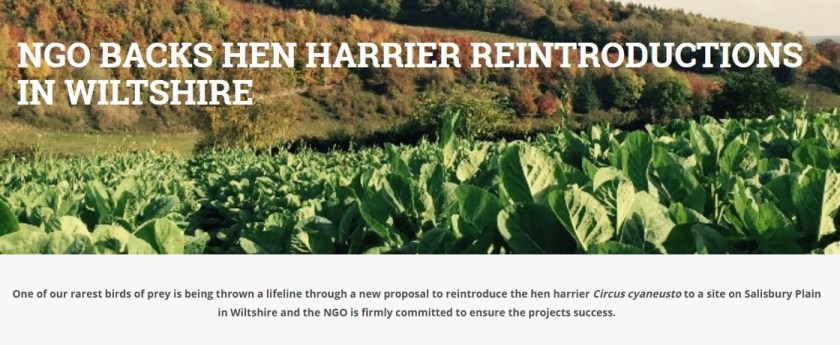
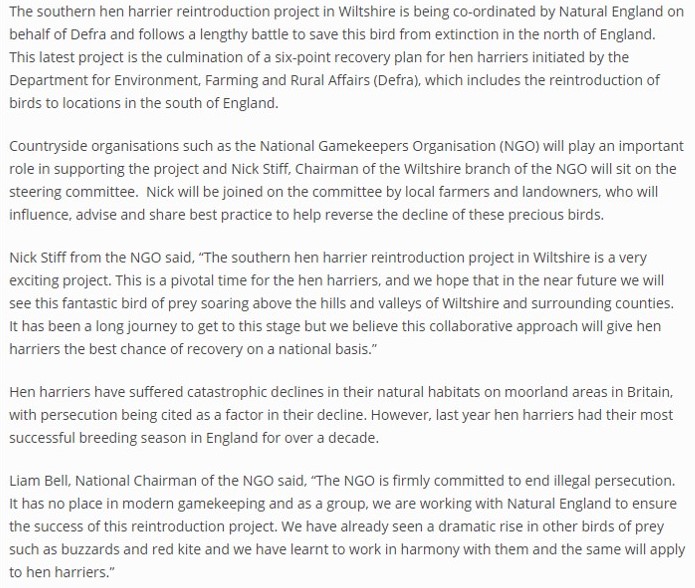
Don’t laugh, but gamekeepers claim to “care deeply” about protecting hen harriers!

It’s not quite April Fools’ Day but the National Gamekeepers’ Organisation thought it’d get in there early this year.

Just a week on from the publication of a scientific paper that demonstrated the catastrophic loss of satellite-tagged hen harriers was undeniably linked to land managed by gamekeepers for grouse shooting (see here), the National Gamekeepers’ Organisation (NGO) published this on its website:

Amazing, eh?

Remind us again, NGO – where was the last known location of the latest hen harrier to ‘disappear’ in suspicious circumstances? Ah yes, in Wiltshire, close to the proposed hen harrier reintroduction site and in an area heavily managed for pheasant and partridge shooting. And what did the NGO say about this bird’s disappearance? Ah yes, that it was “a set up” by the RSPB.

And remind us again, NGO – what examples do you have of the NGO “living in harmony with buzzards“? Ah yes, you supported a gamekeeper (who had a prior poison-related conviction) to get licences to kill buzzards to ‘protect’ his pheasants.

And remind us again, NGO – what was your most recent action on the RPPDG, the group that’s supposed to tackle illegal raptor persecution? Ah yes, it was to resign.

And please could you tell us, NGO, what is “Circus cyaneusto“?! Is this an imaginary harrier species, to match the gamekeepers’ imaginary devotion to hen harriers that we’re supposed to believe?

Not so much April Fools, more like deluded fools.

National Gamekeepers’ rep still in denial about extent of illegal raptor persecution

A couple of weeks ago we blogged about how Tim Weston, a Development Officer for the National Gamekeepers’ Organisation (NGO) had suggested that the suspicious disappearance of satellite-tagged hen harrier ‘Vulcan’ had been a “set-up” by the RSPB (see here).

At the same time, he argued that there was “zero wildlife crime” in the area where Vulcan vanished, even though the RSPB had already recorded 27 confirmed raptor persecution incidents since 2000, including 10 shot, 9 poisoned, 7 trapped and one nest destruction.

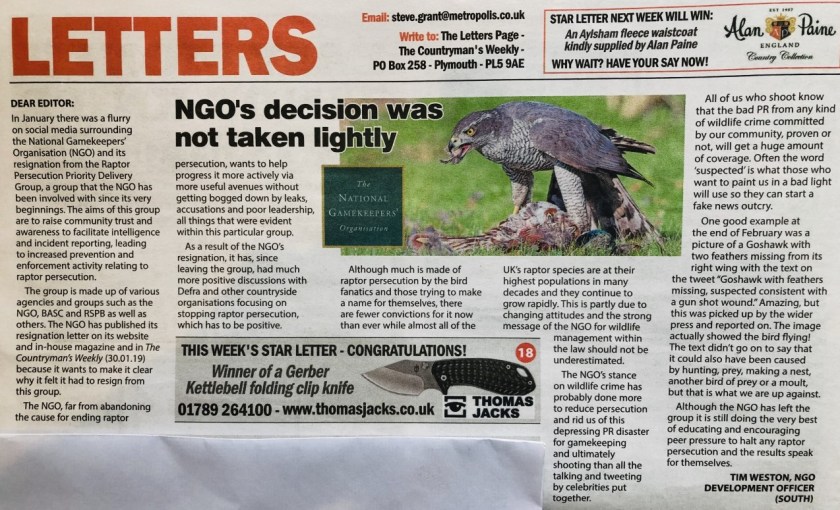
Tim’s not great with figures. Nor logic. In a letter he wrote for last week’s Countryman’s Weekly rag he suggests that as there are now fewer convictions for raptor persecution, it follows that there are fewer crimes. Good grief. Perhaps he missed the latest edition (2017) of the RSPB’s annual Birdcrime report, which says:

In 2017, there were 68 confirmed incidents of raptor persecution, but only four prosecutions relating to raptor crime. Of those, only one resulted in a conviction‘.

The main focus of Tim’s letter was on the NGO’s recent resignation (here, here and here) from the Raptor Persecution Priority Delivery Group (RPPDG), a group established to tackle illegal raptor persecution:

Check out that last paragraph:

Although the NGO has left the [RPPDG] group it is still doing the very best of educating and encouraging peer pressure to halt any any raptor persecution and the results speak for themselves”.

Indeed, Tim, “the results do speak for themselves” because two days after your letter was published we were able to read those results in a top quality scientific paper that revealed that 72% of satellite tagged hen harriers were either confirmed as illegally killed or disappeared in circumstances in which illegal killing was the only plausible explanation, most of them on or close to grouse moors. The research results also revealed that the likelihood of an individual hen harrier dying, or disappearing, was ten times higher within areas predominantly covered by grouse moor, compared to areas with no grouse moors.

Sorry Tim, no cigar for you, although you do appear to have won a knife, what with your letter being deemed the ‘star letter’ of last week’s rag (which gives everyone a pretty good idea about the quality of the other letters published in Countryman’s Weekly).

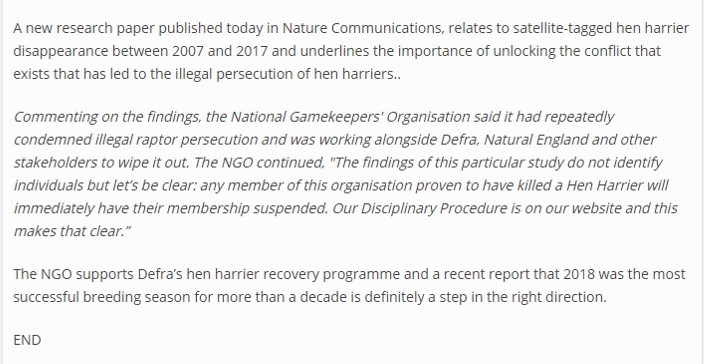
And what of the National Gamekeepers’ Organisation’s formal response to the hen harrier satellite tag paper? Was it any more convincing than Tim’s grasp of the extent of raptor persecution?

Not really. This is from the NGO’s website:

Who ever wrote this response for the National Gamekeepers’ Org didn’t quite manage to include the information that was central to the research findings: that, er, the illegal killing of hen harriers is intrinsically linked to the distribution of grouse moors across northern England, which is, er, where gamekeepers work.

RSPB to appeal hen harrier brood meddling ruling

Excellent news! This morning the RSPB has stated its intention to appeal the hen harrier brood meddling ruling.

This follows on from the news that Mark Avery has already lodged an appeal (see here).

Writing on his blog this morning, the RSPB’s Global Conservation Director Martin Harper said that after an RSPB Council meeting yesterday, the decision was taken to proceed with an appeal.

Read the details of the appeal on Martin’s blog here

Well done, RSPB!

[A breeding hen harrier as she should be – alive and unmeddled. Photo by Laurie Campbell]

Game & Wildlife Conservation Trust (GWCT): deliberately publishing misleading information?

The Game and Wildlife Conservation Trust (GWCT) is a charity registered in England, Wales and Scotland and as such it has to abide by certain rules and regulations.

A charity might find itself in deep water with the charities regulator if it was found to have been publishing material it knew was deliberately misleading.

Andrew Gilruth is the GWCT’s Director of Membership, Marketing and Communications. He’s a senior member of staff and has been around for as long as we can remember. He’s certainly not new to the grouse shooting debate and we’ve often blogged about his contributions, which we’ve viewed as mostly being grotesque distortions of reality (e.g. see here and here).

We think that Andrew Gilruth has taken his cherry-picking activities to a new level over the last month, but we believe his actions appear so deliberately deceptive that his motive must be to mislead the public – a serious accusation for an organisation with charitable status, and especially for one that prides itself on its so-called scientific integrity.

See what you think.

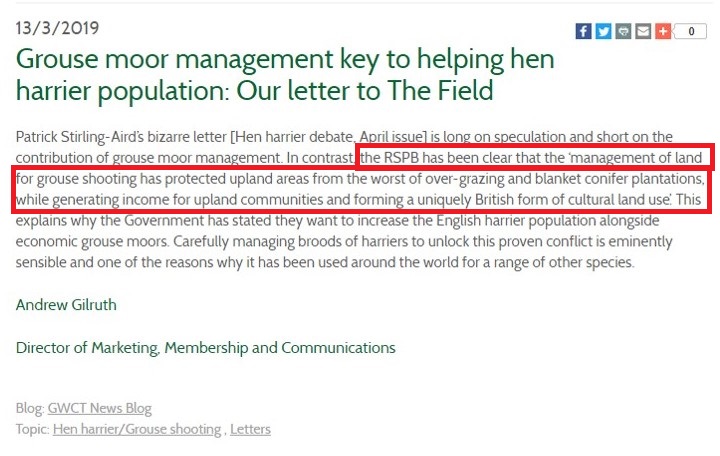
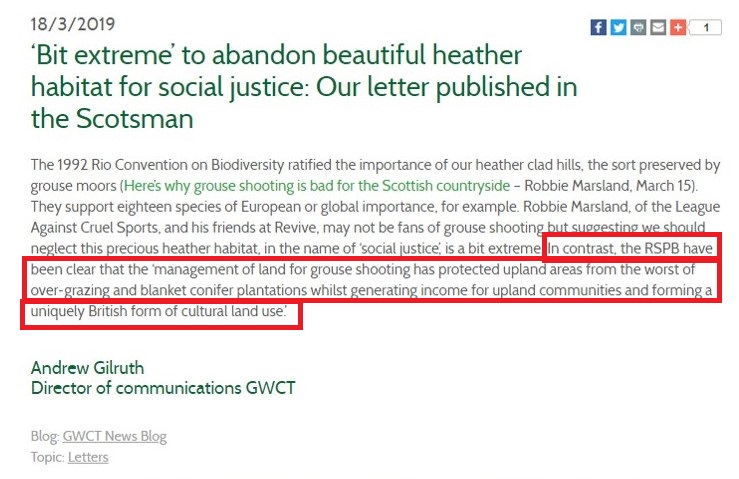
During March 2019, Andrew has submitted at least four letters to various national media outlets and in each one he’s included the same quote, attributed to the RSPB, that would suggest to the reader that the RSPB is supportive of grouse moor management:

We were quite curious about the provenance of this RSPB quote because it didn’t sound like anything the RSPB might have said in recent years and if they had, it was probably said within a wider context than that presented by Andrew.

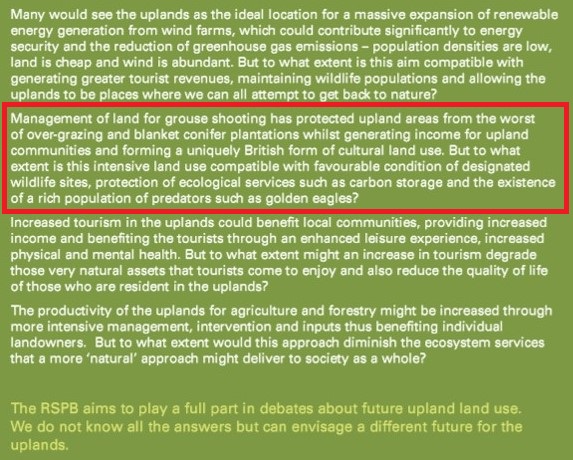
So we did some digging and we found the document from which Andrew has lifted the quote. It’s an RSPB leaflet entitled ‘The Uplands: Time to Change?’ and it was published er, thirteen years ago, in 2006:

You can read the leaflet here: The Uplands_Time For Change_RSPB2006

If you do read it, you’ll find the quote that Andrew has been so keen to share with the general public. So yes, the RSPB did say that the “management of land for grouse shooting has protected upland areas from the worst of over-grazing and blanket conifer plantations whilst generating income for upland communities and forming a uniquely British form of cultural land use” but look closely at the context in which the RSPB made this statement, paying particular attention to the sentence that immediately follows it:

So not only has the GWCT’s Director of Communications cherry-picked a quote and reproduced it completely out of context from how the RSPB intended, but he’s also cherry-picked it from a publication that is thirteen years old, knowing full well that the RSPB has published plenty of more up to date material in the intervening years.

For example, RSPB staff wrote an excellent, balanced review of grouse moor management and included a discussion on the RSPB’s position, which was published in the scientific journal Ibis in 2016. You can read it here: Thompson_et_al-2016-Ibis

We know that Andrew Gilruth is aware of this publication because he blogged about it at the time (see below), so why is he now quoting from an ancient 2006 RSPB publication when he knows that this paper was published ten years later? Incidentally, we’ve highlighted the first sentence of Andrew’s 2016 blog because it somehow seems pertinent!

We’ll be contacting the GWCT today to make a complaint and depending on the reponse, the next port of call will be the Charity Commission.

We’ll keep you posted.

Lake District farmer’s osprey ‘disturbance’ conviction is quashed

Last August a farmer was convicted of recklessly disturbing a pair of breeding ospreys at Bassenthwaite, in the Lake District (see here).

Paul Barnes, 59 from Keswick, had been found guilty after a three-day trial at Workington Magistrates. The court heard how he had taken a group of children in his tractor and trailer close to the site, without a Schedule 1 disturbance licence, causing the birds to leave their nest.

Mr Barnes appealed his conviction at Carlisle Crown Court and last week his appeal was upheld and his conviction quashed.

The following write up appeared in Cumbria Crack last Friday:

A Lake District farmer convicted last year of “recklessly disturbing” an osprey nest has had his conviction quashed.

Paul Barnes vehemently denied two charges. These alleged that he had intentionally or recklessly disturbed a male and female osprey which were in a nest at Bassenthwaite on June 13 in 2017.

The charges arose after 59-year-old Mr Barnes, of Braithwaite, near Keswick, was seen to drive a tractor and a trailer containing children close to the nesting site as he conducted one of many educational visits which have become a regular part of his farming business. The two adult ospreys were said to have left their nest for around 20 minutes.

Mr Barnes was convicted on both charges after a magistrates’ court trial in August but lodged an appeal.

This began at Carlisle Crown Court earlier this year and, after two adjournments, concluded earlier today (FRI).

A judge and two magistrates ruled the case should be stopped – and Mr Barnes’ appeal upheld – after legal submissions were made during an application by his barrister, Peter Glenser QC.

Judge James Adkin – sitting with two magistrates – summed up the three main strands of Mr Glenser’s submissions.

An individual in authority told Mr Barnes to carry on farming as usual,” noted Judge Adkin.

Observations had been undertaken of (nest) disturbances not wholly dissimilar to the current circumstances – in some cases arguably worse. They are characterised as agricultural disturbances and not criminal offences.

Combined with these features there has been a lamentable failure by the prosecution to adhere to the (legal document) disclosure regime.”

As a result, the appeal panel concluded the court proceedings should halted, and Mr Barnes’ appeal against conviction was upheld.

In response, Mr Barnes – a farmer for 35 years and also a trained primary school teacher who has won national awards for conservation and children’s education – spoke “emerging from 18 months of turmoil” which had a “massive impact on family life”.

I’m pleased with the outcome; relieved. But I wasn’t totally disappointed after the trial because I knew that all the evidence hadn’t been heard,” he said.

Moving forward, Mr Barnes said he looked forward to developing a “fruitful partnership” with all groups and individuals who had a genuine osprey interest.

ENDS

The Lake District Osprey Project, a partnership between the Forestry Commission, the RSPB and the Lake District National Park Authority, aims to ensure the continued success of breeding ospreys at Bassenthwaite. Since the birds returned in 2001, ospreys have raised over 30 chicks and have received over a million visitors, with an estimated value of £2 million to the Cumbrian economy.

Lake District Osprey Project website here


Wild Justice supporters raise £36K in ten days to fund first legal challenge

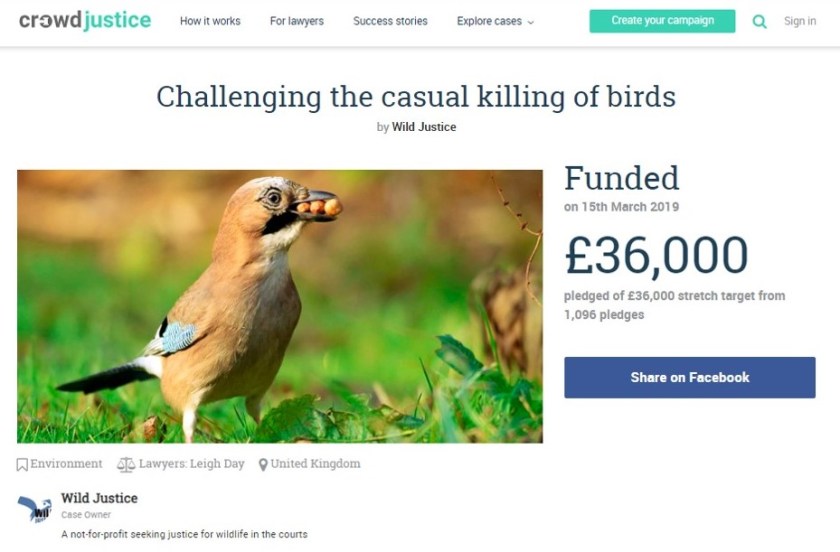
What an absolutely fantastic response by supporters of Wild Justice, who have raised an amazing £36,000 in ten days, which means that Wild Justice’s legal challenge against Natural England has now been fully funded and the crowdfunder has closed.

Thanks to everyone who contributed, both financially and by spreading and sharing the word. I think I can speak on behalf of all three Directors when I say we’ve been blown away and we are incredibly humbled by such speedy and generous support.

Thank you so much.

Our legal papers have been lodged at the High Court and now we’re waiting to hear whether Natural England intends to defend this legal challenge.

Farmers Weekly struggles with facts on Wild Justice legal challenge

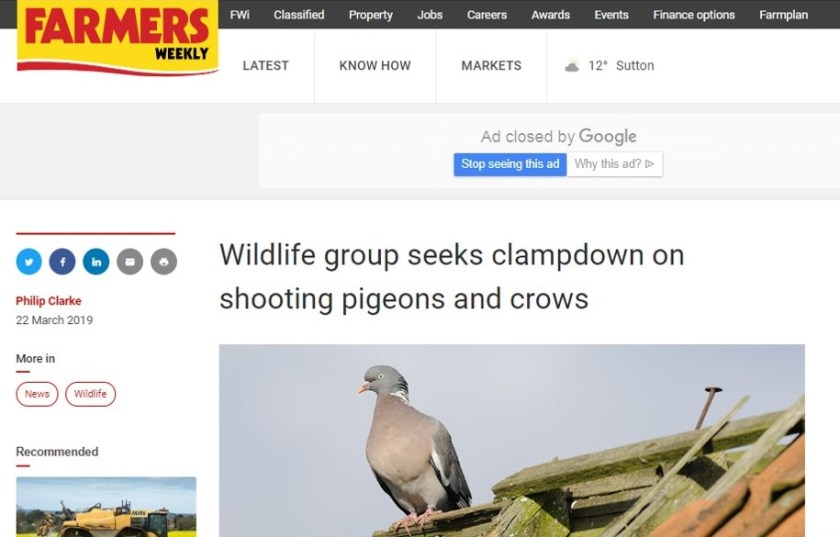
Earlier this week, Farmers Weekly wrote an article purporting to be about Wild Justice’s first legal challenge. The article headlined with this:

The headline was, of course, completely inaccurate, as was a lot of the text, and led to a fair amount of online abuse.

This morning Wild Justice Director Mark Avery wrote a letter of complaint to Philip Clarke at Farmers Weekly as follows:

Letter of correction for publication:
Your article on Wild Justice’s legal challenge of the General Licences (Chris Packham group seeks ban on shooting pigeons and crows, 22 March) contained mistakes – perhaps because you did not talk to us before writing it.
Wild Justice was founded by three people but you inexplicably omitted Dr Ruth Tingay, scientist, campaigner and blogger whilst mentioning both myself and Chris Packham. Was this casual sexism or simply inattention to detail?
Your headline states that Wild Justice ‘seeks a ban on killing of crows and pigeons’ – not true! Our legal challenge is that the current system of ‘authorising’ such killing is itself unlawful and that if Natural England wishes for crows and pigeons to be killed then it will have to introduce a lawful system to ensure that such killing is only carried out when non-lethal methods have failed and under the conditions set out in the legislation which includes serious damage to crops.
Our legal advice is that farmers and gamekeepers have been rather casually killing millions of birds under a false impression that this is legal for nearly 40 years.
Dr Mark Avery (one of three equal directors of Wild Justice)
Raunds, Northants
END
To be fair, Philip Clarke has been very responsive and has quickly amended both the headline and some of the text in the article (read the amended version here). Although mistakes still exist – our lawyers are not based in Manchester! Here’s the amended headline:
The article still doesn’t include a statement from Natural England, who seem to be being pretty evasive about how they intend to respond to Wild Justice’s legal challenge, but it does still include some ever helpful commentary from Tim Bonner, Chief Exec of the Countryside Alliance, an organisation best known for promoting the killing of wildlife, so not a bad stand-in for Natural England.

Former Edradynate Estate Head Gamekeeper fails to persuade court to abandon his trial

The trial of Edradynate Estate’s former head gamekeeper continued at Perth Sheriff Court last week.

David Campbell, 69, denies that between 14 and 16 April 2017 at Edradynate Estate he maliciously damaged game crops by spraying them with an unknown substance which caused them to rot and perish.

[Edradynate Estate driveway, photo by Ruth Tingay]

At the time of the alleged offences, Campbell was no longer an employee of the estate, having worked there since 1983 but after falling out with the landowner, millionaire city financier Michael Campbell (no relation), his employment was terminated in February 2017. Michael Campbell told the court in November 2018 that he believed his former employee had caused the damage ‘in revenge’ (see here).

During a hearing in late January, the court heard from various witnesses who claimed David Campbell was ‘upset’ about having to leave his long-term position at Edradynate (see here).

At day three of the trial last week David Campbell’s solicitor, David Holmes, failed to have the case thrown out of court. Mr Holmes argued that there was a lack of evidence to show that his client was the person seen on the covert CCTV images. However, Sheriff Gillian Wade rejected this argument and said the court had been presented with sufficient evidence to let the Crown continue with its prosecution.

The case continues.

It might seem odd that we’re reporting on this case, and although we can’t explain that decision while this trial is on-going, all will become clear in due course.

PLEASE NOTE: We’re not accepting comments on this case until the trial concludes. Thanks.

Responses to hen harrier satellite tag paper: GWCT

The publication of the hen harrier satellite tag paper on Tuesday (here) that provided compelling evidence to highlight, yet again, the link between grouse moors and the illegal killing of hen harriers, has resulted in a flurry of responses from various individuals and organisations.

We’ve be looking at these responses in turn.

So far we’ve discussed the responses of Supt Nick Lyall (Chair, RPPDG) (here), BASC (here), Dr Therese Coffey (DEFRA Wildlife Minister) (here), Northern England Raptor Forum (here) and the Moorland Association (here).

This time we’re examining the response of the Game and Wildlife Conservation Trust (GWCT), a supposedly ‘independent’ charity that seems to attract a good deal of funding from, er, the grouse shooting industry.

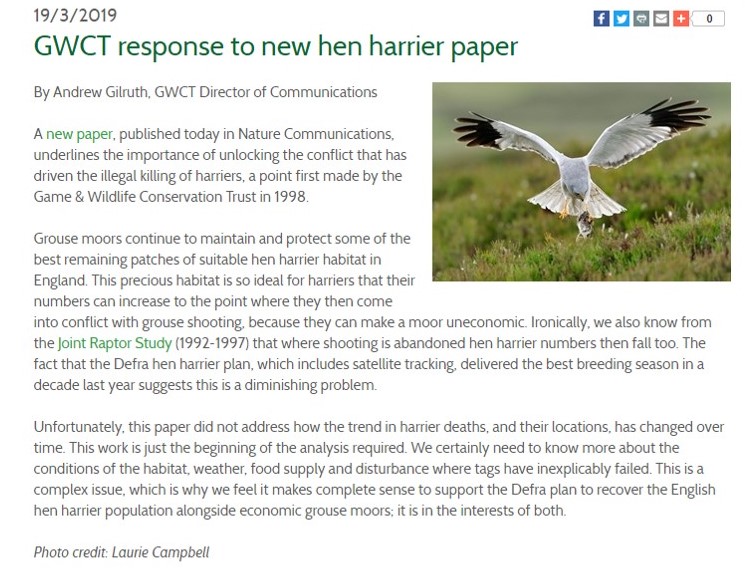
GWCT posted a statement on its website in response to the devastating findings of the hen harrier satellite tag paper. Here it is:

You’ll notice that this GWCT response carefully avoids mentioning the headline figures from the paper – hen harriers are ten times more likely to be killed on grouse moors than any other habitat, and at least 72% of the hen harriers tagged by Natural England between 2006 – 2017 have either been confirmed to have been illegally killed on grouse moors or are highly likely to have been killed on grouse moors, with the researchers saying they can find no alternative, plausible, explanation.

We’re then told by GWCT that the illegal killing of hen harriers on grouse moors is “a diminishing problem” based on last year’s breeding results. Let’s just remind ourselves of those 2018 breeding results – only nine successful nests in England (where there is suitable habitat to support over 300 nests) and not one of those nine nests was situated on a privately-owned grouse moor (see here).

And what happened to the hen harrier chicks that did manage to fledge in 2018? A lot of them ‘disappeared’ in suspicious circumstances on, er, grouse moors:

The final paragraph of GWCT’s statement implies that habitat condition, weather, food supply and disturbance may explain the pattern of hen harriers deaths and disappearances on grouse moors. You’ll note that criminal gamekeepers armed with shotguns and illegal traps are not mentioned.

There was a time, long ago, when the GWCT was a respected, credible, science-based organisation. What happened?

Responses to hen harrier satellite tag paper: Moorland Association

The publication of the hen harrier satellite tag paper on Tuesday (here) that provided compelling evidence to highlight, yet again, the link between grouse moors and the illegal killing of hen harriers, has resulted in a flurry of responses from various individuals and organisations.

We’ll be looking at these responses in turn.

So far we’ve discussed the responses of Supt Nick Lyall (Chair, RPPDG) (here), BASC (here), Dr Therese Coffey (DEFRA Wildlife Minister) (here) and the Northern England Raptor Forum (here).

This time we’re examining the response of the Moorland Association, the lobby group for grouse moor owners in northern England.

The Moorland Association couldn’t be arsed to publish a statement on its website, nor to tweet about this important scientific publication nor to mention it on its Facebook page. Blimey, anyone would think that grouse moor owners aren’t at all bothered that hen harriers are ten times more likely to be killed on a grouse moor than anywhere else, or that 72% of satellite tagged hen harriers had either been confirmed or suspected of being illegally killed on grouse moors.

And let’s not forget, the Moorland Association is supposedly a willing ‘partner’ on the Raptor Persecution Priority Delivery Group (RPPDG), where it’s supposed to be using every opportunity to raise awareness about the illegal killing of birds of prey and stopping these crimes from being committed. Really impressive partnership work, eh?

We did find a quote from the Moorland Association’s Director, Amanda Anderson, in this brilliantly headlined article in The Independent (“Massive wildlife crime scene” is a Mark Avery quote from a couple of years ago).
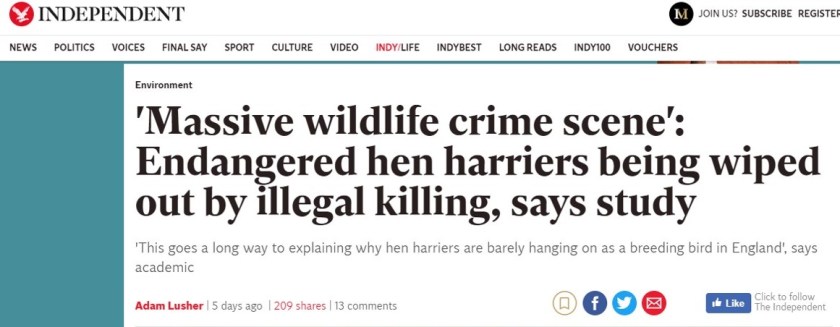
Here’s Amanda quoted in The Independent article:

Amanda Anderson, director of the Moorland Association, which represents grouse moor owners and managers in England and Wales, said the study data, gathered between 2006 and 2017, was before a management scheme put in place as part of Defra’s hen harrier recovery plan.

She said keepers had engaged with tactics such as reporting and monitoring nests and roost sites, as well as reducing conflicts between the birds via feeding strategies.

Ms Anderson said that 2018, the first year of the brood management scheme, was “the most successful hen harrier breeding season in England for over a decade”, continuing: “We know from evidence gathered on the ground there are many areas on grouse moors where hen harriers – with or without satellite tags – are currently thriving.”

But she added: “We want to see more hen harriers on grouse moors. Persecution should not occur and must cease in order to give hen harriers the best chance of survival. Seventy per cent of hen harriers perish in their first year from natural causes. However, when a satellite tag fails unexpectedly, persecution may be a factor.

END

Wow. What’s that saying? More front than Blackpool?

It’s all ok, folks, no need to worry about the extraordinarily high percentage of ‘missing’ (presumed killed) hen harriers on grouse moors, because all that took place before DEFRA’s Hen Harrier Action Plan was put in place. Er, except that in the year after the paper’s data were gathered and the so-called Action Plan was in place (2018), at least 11 satellite-tagged hen harriers all ‘disappeared’ in suspicious circumstances, most of them either on or near a grouse moor, between the months of August and November. How do you explain that, Amanda?

[RPUK map showing the last known locations of 11 satellite-tagged hen harriers that ‘disappeared’ in suspicious circumstances between August – November 2018]

Also according to Amanda, ‘keepers had engaged with tactics such as reporting and monitoring nests and roost sites’. Ah, would that ‘monitoring’ of nest sites include the tactic of repeatedly driving up towards a nesting attempt on a quad bike, disturbing the birds so much that the nesting attempt was abandoned? There are certainly reports of that happening on one particular grouse moor (which was reported to the police).

And would that ‘monitoring’ of roost sites include the tactic of turning up with a gun and a couple of dogs at dusk, to walk around a roost site where three hen harriers had just gone to ground (see here)?

And where is this “evidence gathered on the ground” that shows “there are many areas on grouse moors where hen harriers – with or without satellite tags – are currently thriving”? Have those sites been reported to raptor fieldworkers from NERF, or the RSPB, or Natural England (all partners in the RPPDG), or is this yet another imaginary scene that Amanda’s viewed through her magical kitchen window?

Unfortunately for the Moorland Association, Amanda’s latest episode of propagandist nonsense is looking a lot like a rapidly disintegrating sand castle crumbling in the face of an overwhelming rising tide of evidence.