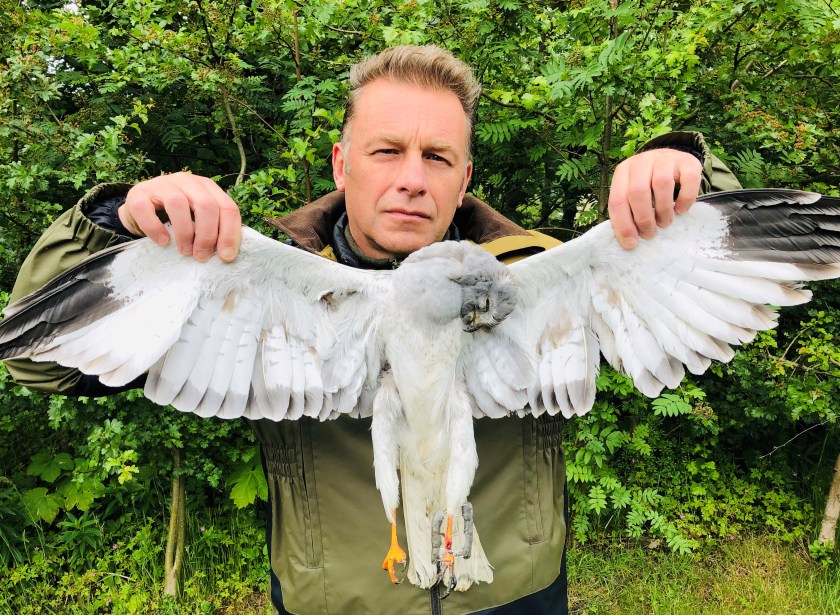
Police called as grouse shooting supporters threaten disruption at Packham gig in Harrogate

A small gaggle of anti-Chris Packham pro-grouse shooting protesters turned up in Harrogate last night to demonstrate outside the theatre where Chris Packham was presenting a show to help raise awareness of wildlife in the Nidderdale Area of Outstanding Natural Beauty (AONB).

Much to the bemusement (and amusement) of theatre-goers, the protesters held banners aloft claiming ‘Packham’s lies are destroying moorland communities‘ and ‘Pack it in Packham you are destroying our jobs‘.

Er, no, that’ll be the unidentified criminals in Nidderdale, who not only are poisoning and shooting red kites, hen harriers, buzzards, marsh harriers on Nidderdale grouse moors (as reported by the AONB partnership just last month), but who have also managed to turn the local community against them, all by themselves. Unsurprising really, when according to the Chair of the Nidderdale AONB these crimes are “starting to have a damaging effect on tourism businesses”. 

Here’s a map we produced a while ago showing the boundary of the Nidderdale AONB (yellow line), illegally killed red kites (red dots), missing satellite-tagged hen harriers (orange stars), shot hen harrier Bowland Betty (red star), shot hen harrier River (red triangle, which we now know should be closer to the red star on the Swinton Estate).

According to one of the organisers of Chris’s event at the theatre yesterday, she told us that her social media accounts promoting the event had been “inundated with a relentless list of abusive responses” from those within the game-shooting industry and how shocked she’d been at the “depth of hatred and nastiness” from the pro-shooting trolls. They’ve got a lot to learn about winning friends and influencing people!

It’s not known if any of those abusive trolls were present at the protest last night but she told us that when she went outside to speak to the protesters about their “aggressive chanting” and to ask them to be respectful of theatre-goers she was told that they intended to come inside and disrupt the event to make sure they were heard. The police were called to ensure the protesters didn’t turn violent.

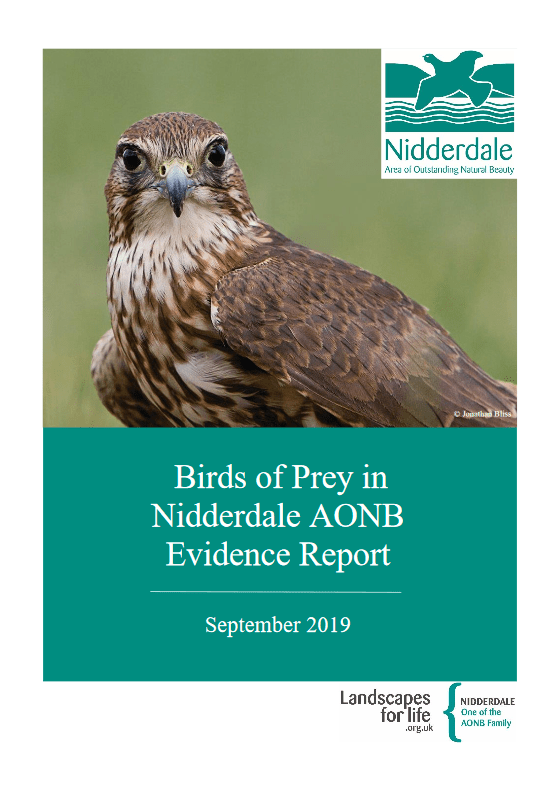
It’s believed a few of them did have tickets to enter the theatre but no trouble was reported. Not even when Chris started talking about Nidderdale’s reputation as being one of the worst raptor-killing hotspots in the entire country; not a claim he’d made up at all but a factual statement that has been robustly evidenced, including by the AONB Partnership’s very own report.
So who were last night’s protesters?

Well, it turns out they’re quite an interesting bunch. According to this website it’s a newly formed group called ‘Campaign 4 Protection of Moorland Communities’. Here’s a copy of the group’s web report about last night’s protest:

Moorland communities protest in Harrogate against unjust attacks on their livelihoods

Demonstrators from the Yorkshire Moorland Communities braved the weather to take a message to BBC Presenter Chris Packham as he arrived at the Royal Hall in Harrogate to give a talk this evening (Saturday, 19th October).

That message could not have been clearer: livelihoods and whole communities are under threat by misleading statements and actions by the likes of Chris Packham.

A famously outspoken critic of driven grouse shooting, the presenter, campaigner and author was met outside the theatre by over 100 fed-up members of the moorland communities, who depend on moorland activities for their livelihoods. They held placards reading “Chris Packham – ignoring science since 04.05.1961!” (Packham’s date of birth), and a large banner declared: “Moorlands are our lives, our livelihood and our community. We stand in unity to protect them.”

Chris Packham and his followers are wilfully misrepresenting facts and distorting clear scientific evidence” said Roy Burrow’s, estate manager at a nearby moorland. “These are large communities who live and work in these uplands, and rely on the moorland for their livelihoods. The simple fact is that stopping grouse shooting, or rewilding the moor, could destroy many local businesses, local livelihoods and the very social fabric that makes the moorlands such a wonderful place to live in and to visit.”

Packham makes no secret of his dislike for grouse shooting, frequently posting about it on social media. He even spoke at last month’s Green Party conference about his campaign to ban driven grouse shooting. However, many argue that the BBC should not allow him to use his platform to promote his personal agenda when there is extensive scientific evidence available to show the environmental and conservational benefits brought from well managed moorlands.

The protestors sang chants including: “From bus drivers to gamekeepers, together we thrive, we need to protect, moorland community lives”.

A spokesperson for The Campaign for the Protection of Moorland Communities, said: “The moorland management system which grouse shooting sustains creates a unique landscape that encourages rare and endangered wildlife, as well as being the foundation of the moorland area’s rural economy. This is reinforced by clear scientific evidence, which is too often wilfully ignored by our opponents. The facts are very clear: without grouse shooting these areas would lose millions of pounds in investment each year causing lives and livelihoods would be destroyed, alongside one of Britain’s most unique habitats. It is disgraceful that a rich celebrity from Hampshire thinks it is okay to dictate to the hard-working people of Yorkshire how we should live our lives. Moorland and other rural communities seem to be the only cultural minority Chris Packham and others think it is okay to abuse. Enough is enough.”

ENDS

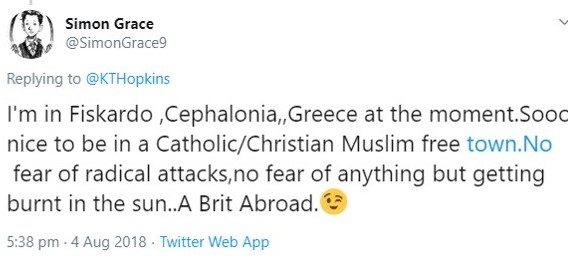
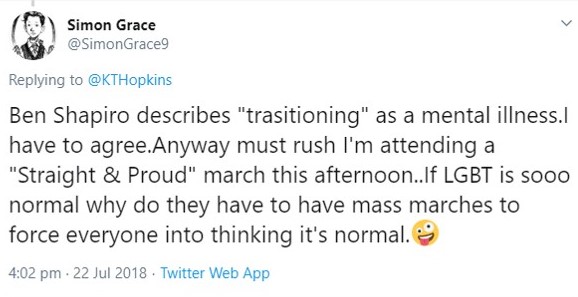
It’s ironic that the group accuses Chris of abusing a cultural minority. According to our own research, one of the main instigators behind this new group appears to be someone called Simon Grace, ‘a shooting enthusiast’ from Yorkshire whose activities have previously been promoted by articles in Shooting Times and on the Fieldsports TV website.

Simon Grace’s twitter feed makes for a fascinating read and perhaps explains why he’s managed to attract only four followers since June 2016.

He’s not a racist, homophobic xenophobe abusing cultural minorities. No siree Bob. Not at all.

What is it about game shooting and hunt supporters that attracts the right wing mob? There’s probably a PhD topic there for someone.
Decision on next Hen Harrier brood meddling licence to ‘take into account the results to date’

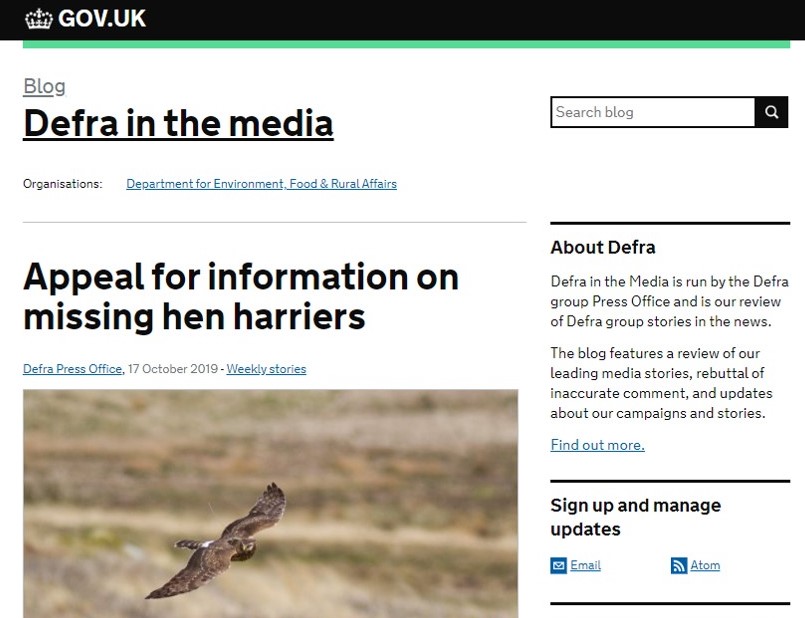
Yesterday, before the news that a fourth satellite-tagged hen harrier had vanished in suspicious circumstances this autumn (see here), DEFRA published the following blog:

We’re still waiting to learn from Natural England what, exactly, is the exit strategy for the hen harrier brood meddling trial and specifically, what are the criteria for making that decision?

Well what a relief to learn that the decision on whether to renew the hen harrier brood meddling licence ‘will take into account the results to date‘.

Those ‘results’ will be the suspicious disappearance of three of this year’s five brood meddled hen harriers (we understand the two surviving brood meddled birds have flown off to France) plus the suspicious disappearance of at least one other satellite-tagged hen harrier (Rosie) in recent weeks and there’s absolutely no doubt there’ll be more before this year is out.

The decision whether to renew or not should be easy and it should already have been made. Nobody in their right mind can think that brood meddling has (a) been successful and (b) is in any way helping hen harrier conservation.

But then look at that last paragraph in the DEFRA blog, above. It claims that the ‘ultimate aim’ of the DEFRA Hen Harrier (In)Action Plan, of which brood meddling is a part, is to ‘reduce hen harrier predation of grouse chicks on driven grouse moors……’

Eh?

Why is a Government department (DEFRA) and the statutory conservation agency (Natural England) focusing on protecting excessive numbers of red grouse (that are going to be shot for fun) at the expense of a protected red-listed bird of prey in population free-fall due to illegal killing on aforementioned grouse moors?

Another satellite-tagged hen harrier goes missing – Northumbria Police appeal for info

A fourth young hen harrier has vanished in suspicious circumstances this year.

The first three disappeared in September from moors in County Durham (here) and the Yorkshire Dales National Park (here and here).

The latest one to go, ‘Rosie’ is not believed to be part of Natural England’s outrageous brood meddling trial, but is believed to have hatched at a protected nest site in Northumberland earlier this summer and tagged by Natural England staff.

[Photo from Northumbria Police]

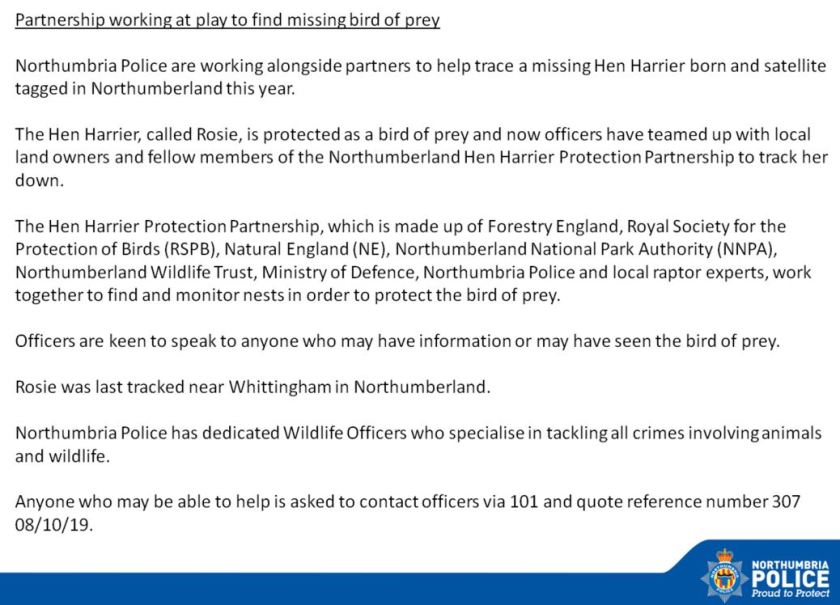
Here is the appeal for information issued by Northumbria Police this afternoon:

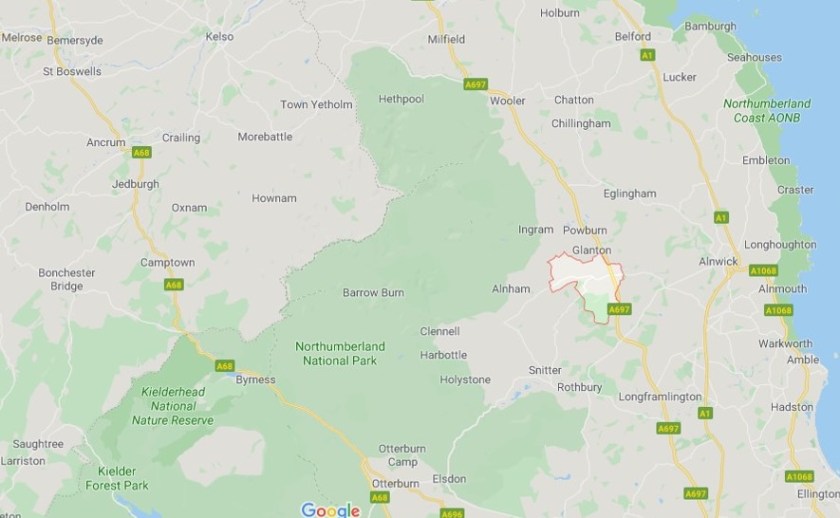
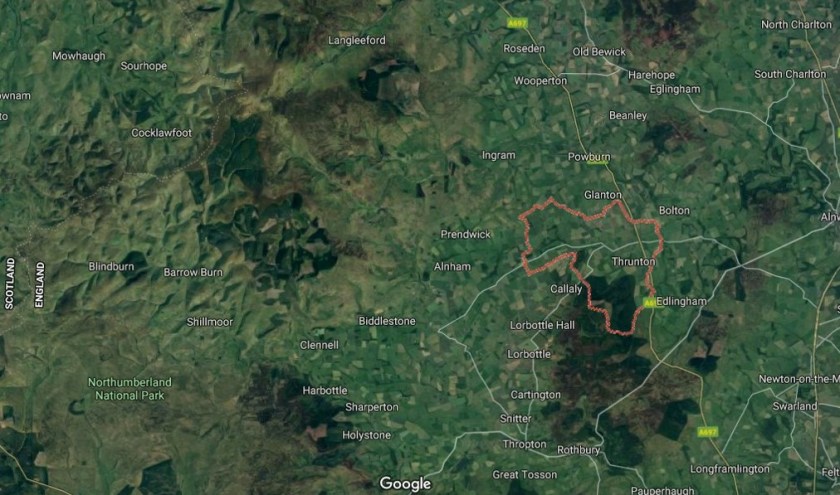
Unfortunately it does not say when this hen harrier disappeared nor does it give any more specific location than ‘near Whittingham’. (Come on Northumbria Police, this is basic information).

Whittingham is a village and parish just outside the Northumberland National Park, as outlined on these two Google maps:

UPDATE 20 October 2019: 

Sup Nick Lyall has tweeted this evening to say Rosie is alive and well. No further information has been provided.

UPDATE 21 October 2019: Missing hen harrier Rosie reported to be alive and well (here)

UPDATE 27 October 2019: Re-discovery of hen harrier Rosie not quite as it’s being portrayed (here)

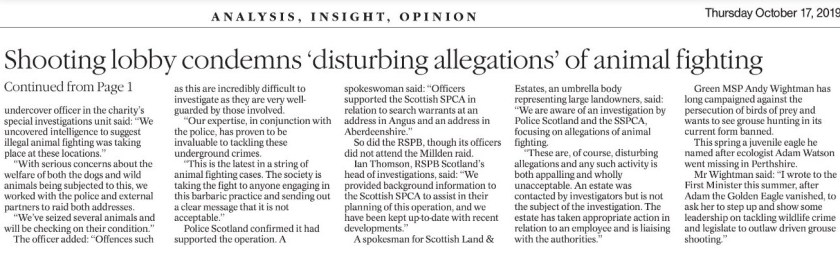
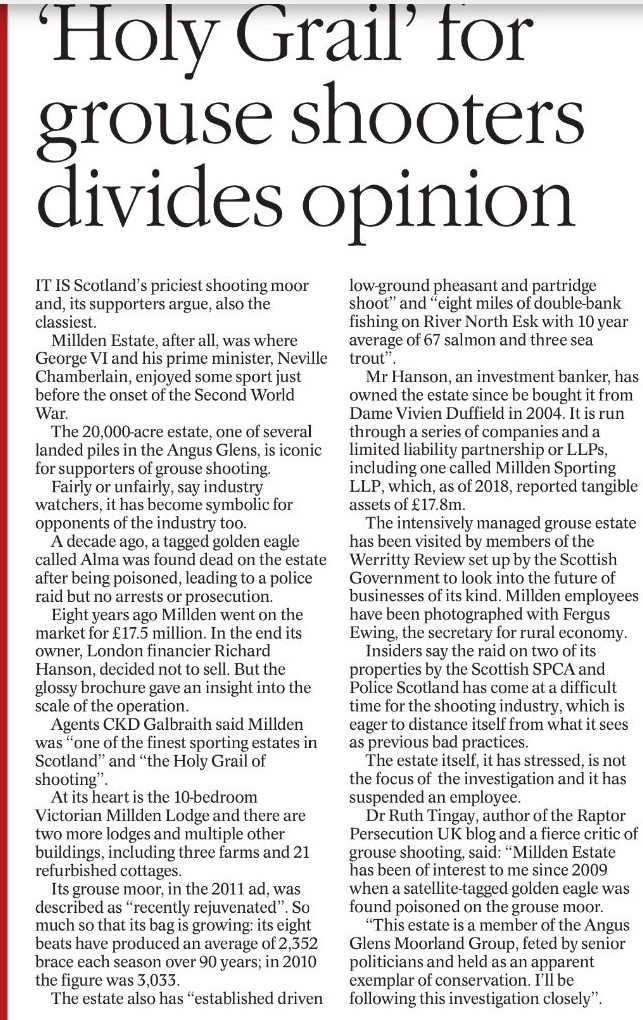
Millden Estate named in joint SSPCA/Police raid as part of investigation in to suspected animal cruelty

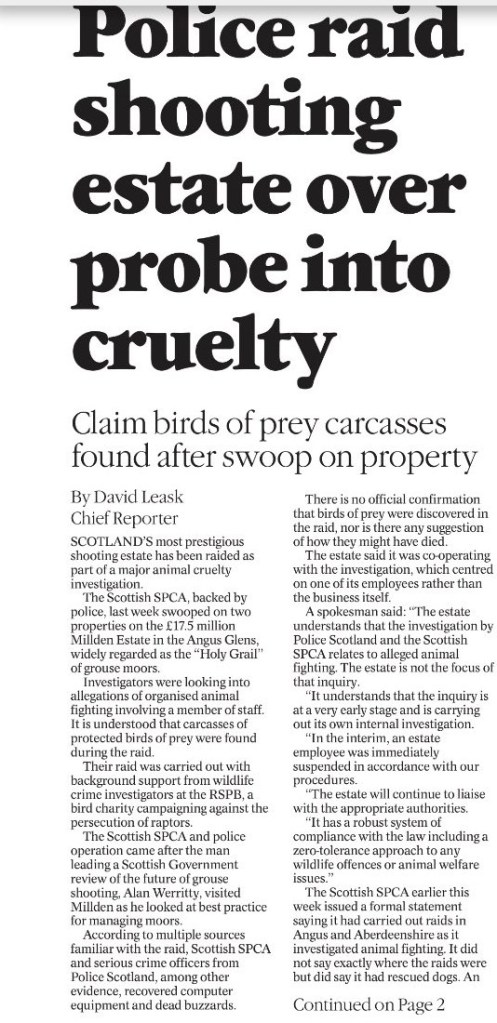
Further to Monday’s blog about a joint Scottish SPCA/Police Scotland raid on various properties as part of an investigation in to suspected animal fighting (here), it has emerged that one of the addresses was the Millden Estate in the Angus Glens.

An exclusive article by journalist David Leask is on the front page of this morning’s Herald and reads as follows:

This looks to be a significant investigation, led by the Scottish SPCA and supported by Police Scotland, with input from other partner agencies including the RSPB.

Further updates will be posted as they become available.

Please note, as this is a live investigation we will not be accepting any comments on this blog.

UPDATE 2 November 2021: New trial date for Millden Estate gamekeeper accused of animal fighting offences (here)

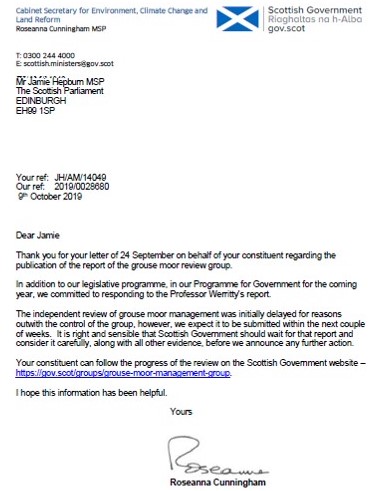
Still waiting for Werritty

Autumn is here; Werritty’s report is not.

For new readers, the long anticipated and long overdue Werritty Review is a Government-commissioned report on grouse moor management in Scotland. Environment Cabinet Secretary Roseanna Cunningham commissioned it following the publication of the authoritative, ‘exemplary and thorough‘ Golden Eagle Satellite Tag Review in May 2017, which revealed the magnitude of ongoing raptor persecution on some Scottish grouse moors (read that report here).

The Werritty Review Group was announced in November 2017 and we were told to expect the report by spring 2019.

Spring 2019 came and went, the report didn’t appear, but we were told that Professor Werritty was ill and the report would be delayed by two months (new expected date: June 2019). Fair enough.

June 2019 came and went, the report didn’t appear.

Then we heard it would arrive in July 2019.

July 2019 came and went, the report didn’t appear then we heard from Professor Werritty himself that it’d be submitted ‘during the summer‘.

At the end of July, in response to public fury about on-going illegal raptor persecution on Scottish grouse moors, a Government spokesperson told us the report ‘was due in the next few weeks’ (see here).

It’s now mid-October and the report still hasn’t appeared. According to Environment Cabinet Secretary Roseanna Cunningham, writing to an MSP in response to a query about the publication date by a constituent (and blog reader!), the report is “expected within the next couple of weeks“!!

To be perfectly frank, events this year have overtaken whatever recommendations Professor Werritty might suggest – the discovery of this spring-trapped hen harrier on a grouse moor in Perthshire, this spring-trapped hen harrier caught next to his nest on a grouse moor in South Lanarkshire, this spring-trapped golden eagle photographed flying above a grouse moor in Royal Deeside, and the suspicious disappearance of two more satellite-tagged golden eagles from a grouse moor in Perthshire have demonstrated that we now need a radical approach to bring this to an end.

Nevertheless, we’re still keen to see the Werritty report appear because until it does, the Scottish Government has the perfect excuse, that it has used repeatedly since May 2017 when the review was first commissioned, to do absolutely naff all to tackle these ongoing serious organised crimes.

It is right and sensible that Scottish Government should wait for that report“, says Roseanna Cunningham. How can it possibly be “right” or “sensible” that the Government should continue to sit on its hands and watch these atrocities taking place, suggesting it’s powerless to act?


3rd brood meddled hen harrier ‘disappears’ in suspicious circumstances

Following the news that two of this year’s five brood meddled hen harriers had ‘vanished’ on grouse moors in the north of England in September 2019 (one in County Durham here and one in the Yorkshire Dales National Park here), we now learn that a third harrier has disappeared, also in the Yorkshire Dales National Park.

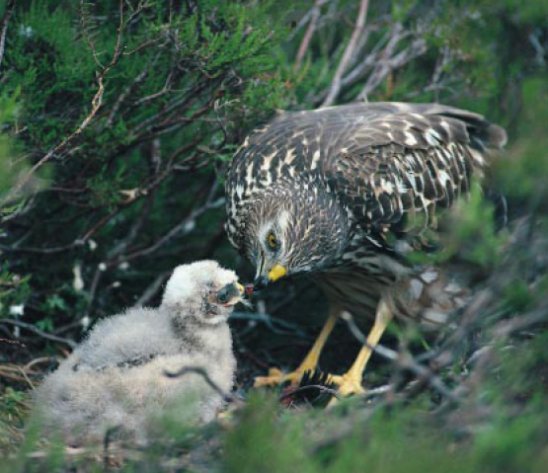
[Hen harrier photo by Laurie Campbell]

Here’s the press release from North Yorkshire Police, published today:

Second satellite-tagged hen harrier goes missing in North Yorkshire

Police appealing for information about whereabouts of hen harrier

North Yorkshire Police is appealing for information after another satellite-tagged hen harrier has gone missing in the region just weeks after another one also stopped transmitting a signal.

The hen harrier is a young female bird tagged at the release site in the Yorkshire Dales on 30 July 2019 as part of the hen harrier brood management scheme. The bird has not been named and is known to the Natural England monitoring team as 183703.

It is known from satellite tag data that the bird had the bird stayed in the Hawes area since her release, with one excursion to the Sedbergh area on 16 September, then south to the West Pennine Moors near Horwich 17-19 September before returning to land near Semerwater where she had remained for at least a fortnight.

The last transmission from the bird’s satellite tag was received on the 29 September on Thornton Rust moor, 3.37km east of Semerwater, but the bird could have flown on for some distance since the last transmission.

Since then no further transmissions have been received from the tag. Natural England field staff have carried out checks with a hand-held scanner and monitored the area with no findings and North Yorkshire Police have also searched the area with colleagues from the Yorkshire Dales National Park Ranger team, as well as making extensive local enquiries.

The bird is a juvenile female, brown in colour and ringed with the BTO ring number FJ48404.

This appeal for information sadly follows the disappearance of another satellite-tagged hen harrier in the area, this one a juvenile male known as 183704 who was last known to be in the area of Askrigg Common on 19 September.

At this time North Yorkshire Police are keen to locate both birds safe and well, but if found deceased the birds can be subject to post mortem to establish if the cause of death was from natural causes or if criminal activity was involved.

If you find the bird or have any information please contact North Yorkshire Police on 101 and quote reference number 12190186540.

ENDS

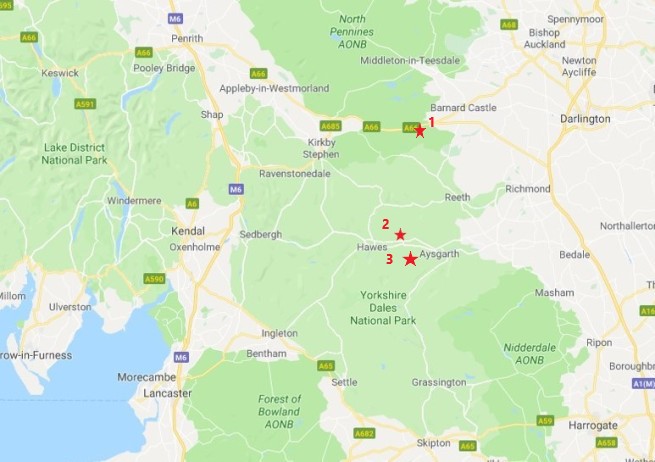
Here is an RPUK map showing the approximate last known locations of the three brood meddled satellite-tagged hen harriers that have ‘disappeared’ this year: 1 = the HH that vanished on 9th September; 2 = the HH that vanished on 19th September; 3 = the HH that vanished on 29th September:

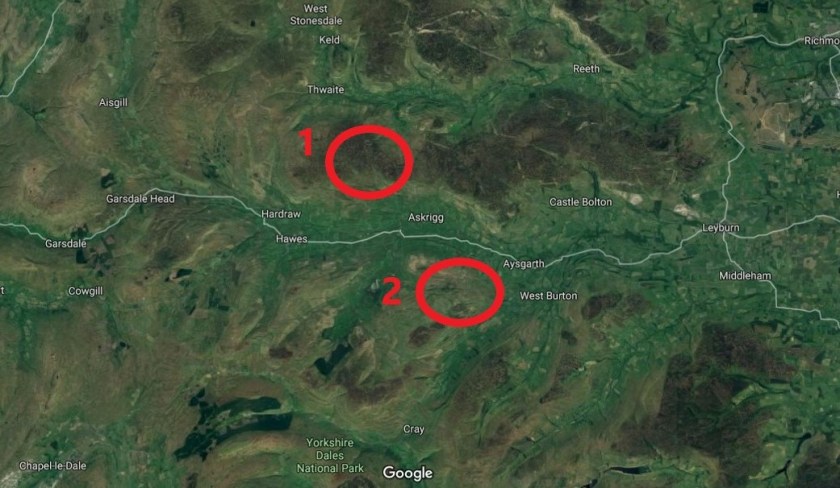
Here is an RPUK map showing the approximate last known locations of the two brood meddled hen harriers that have disappeared on moors in the Yorkshire Dales National Park:

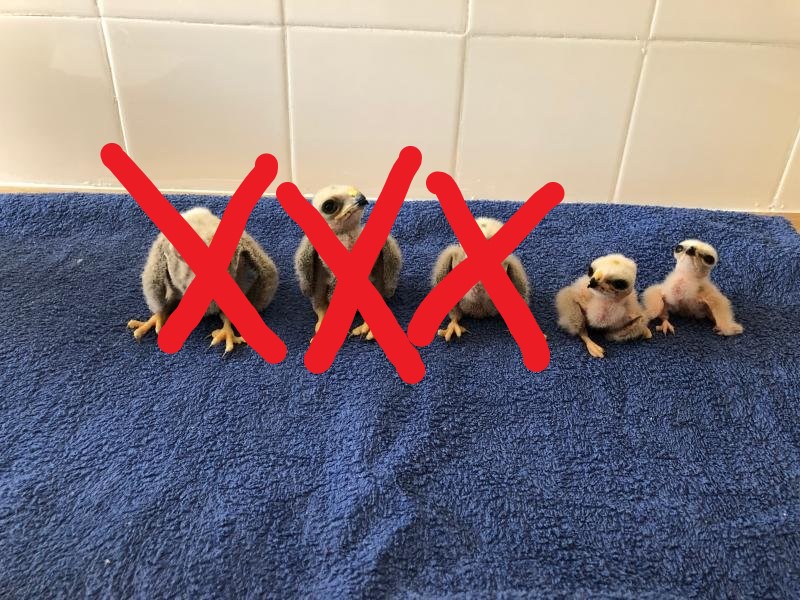
So within weeks of those five brood meddled hen harriers being released back in to the uplands of northern England, three of them (60%) have disappeared without a trace.

This isn’t unusual nor is it unexpected – we know from authoritative research published earlier this year that 72% of young satellite-tagged hen harriers will disappear in suspicious circumstances on grouse moors in northern England, probably having been killed illegally.

What this is, though, is a bloody joke. This brood meddling ‘trial’, sanctioned by DEFRA and carried out by Natural England, in cahoots with the very industry responsible for the species’ catastrophic decline in England, is supposed to test whether those people responsible for killing hen harriers illegally would stop if the chicks were brood meddled (removed from the grouse moor in June at the critical grouse-rearing stage and then returned to the wild in August). We all knew this wouldn’t work because we know that young hen harriers are killed routinely during the grouse shooting season, and especially in September and October and yet still DEFRA, Natural England and their grouse shooting mates pressed ahead.

No doubt we’ll now have to endure more bollocks from Natural England, DEFRA, the Moorland Association and all the rest of the persecution deniers, pretending that nothing’s going on, everything’s fine and isn’t the grouse shooting industry doing great things for conservation.

What we will be doing is asking Natural England, again, what its exit strategy is for the hen harrier brood meddling trial and when will it implement it? We’ve asked several times, including at direct face to face meetings with senior staff, most recently last week. We were promised an answer – we haven’t had it yet.

Well done and thank you, North Yorkshire Police, for publishing a relatively swift appeal for information and for including enough detail to make it useful. And also for not including any grouse shooting propaganda in the appeal this time, in contrast to a previous appeal for info.

Scottish SPCA & Police raid suspected animal fighters in Angus

Press release from Scottish SPCA and Police Scotland, 14th October 2019
Double swoop on suspected animal fighters

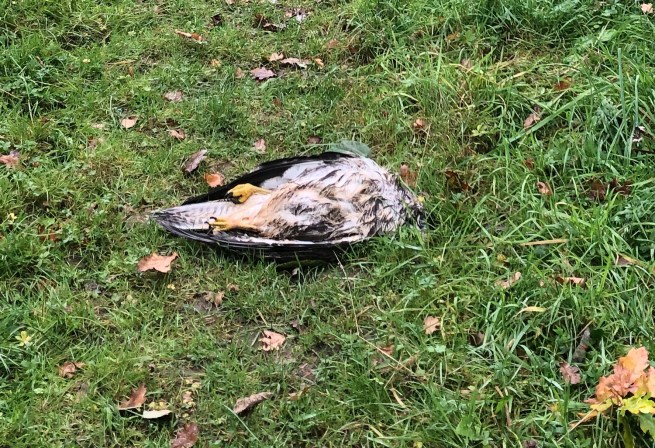
Numerous dogs have been seized by the Scottish SPCA following two simultaneous raids at different addresses in Scotland

Working in partnership with Police Scotland, the Scottish SPCA led raids at an address in Angus and an address in Aberdeenshire last week. Scotland’s animal welfare charity acted on intel gathered on animal fighting activities in both areas.

An undercover officer in the Scottish SPCA’s special investigations unit (SIU) said: “We uncovered intelligence to suggest illegal animal fighting was taking place at these locations. With serious concerns about the welfare of both the dogs and wild animals being subjected to this, we worked with the police and external partners to raid both addresses. We’ve seized several animals and will be checking on their condition.”

Offences such as this are incredibly difficult to investigate as they are very well-guarded by those involved. Our expertise, in conjunction with the police, has proven to be invaluable to tackling these underground crimes.”

This is the latest in a string of animal fighting cases the Scottish SPCA has taken on recently. The Society is taking the fight to anyone engaging in this barbaric practice and sending out a clear message that it is not acceptable.”

As it is an ongoing investigation, we are unable to give any more specific information at this time.”

A Police Scotland spokesperson said: “Officers supported the Scottish SPCA in relation to search warrants at an address in Angus and an address in Aberdeenshire. Officers from Police Scotland will continue to work with the Scottish SPCA and partner agencies.”

So far this year, the Scottish SPCA has taken an average of a call on animal fighting every other day. Approximately 50% of the jobs the charity’s SIU take on relate to it.

The investigation continues.

ENDS

You may be wondering why we’ve posted a press statement about suspected animal fighters on this blog. Unfortunately we’re not able to comment further at this stage but it will become apparent in due course if this case progresses.

As this is a live investigation and a potential case of huge significance, we won’t be accepting any comments.

We’ll be blogging updates when they become available.

UPDATE 17 October 2019: Millden Estate named in joint SSPCA/Police Scotland raid as part of investigation in to suspected animal cruelty (here)

UPDATE 21 October 2019: More detail emerges about SSPCA/Police raid at Millden Estate (here)

UPDATE 3 December 2020: Animal cruelty charges follow SSPCA/Police raid at property on Millden Estate (here)

UPDATE 2 November 2021: New trial date for Millden Estate gamekeeper accused of animal fighting offences (here)

UPDATE 3 December 2021: Angus Glens gamekeeper in court today on animal fighting charges (here)


Buzzard shot dead in North Yorkshire

Appeal for information from North Yorkshire Police (11 October 2019):

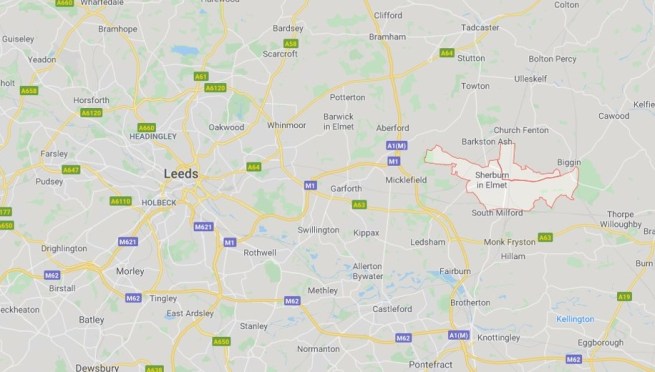
APPEAL FOR INFORMATION AFTER BUZZARD FOUND SHOT NEAR SHERBURN IN ELMET

North Yorkshire Police is appealing for information after a dead buzzard was found by a member of the public at 11.45am on 3 October on a footpath close to Hagg lane near Sherburn in Elmet.

The bird was recovered and taken to a local vets to be x-rayed which revealed it contained what appeared to be eight pieces of shot.

A spokesperson for North Yorkshire Police said: “This is sadly yet another example of the unacceptable bird of prey persecution which blights our region. Killing wild birds is an offence under the Wildlife and Countryside Act and we are committed to putting a stop to this deplorable crime.”

North Yorkshire Police have carried out extensive enquiries in the local area. Officers are appealing for anyone with any information, or who may have witnessed anything taking place in relation to this bird to call 101 quoting ref: 12190183166

ENDS


RSPB challenges misinformation about satellite tags

This is an excellent blog written by Ian Thomson, Head of Investigations at RSPB Scotland, countering the misinformation (that’s being kind) about satellite tags that is being touted by some in the game shooting industry.

We’ll be writing more on this shortly.

We’ve reproduced Ian’s blog here:

Challenging misinformation about satellite tags

RSPB Scotland’s Head of Investigations Ian Thomson outlines our thoughts on claims made accompanying the launch of a petition regarding satellite tags fitted to raptor species.

One of the greatest conservation tools to emerge in recent years has been satellite-tagging technology. Whether following the journeys of migrating cuckoos or shedding light on the dangers facing UK birds of prey, these tiny pieces of technology are becoming increasingly valuable in the conservationist’s mission to save nature.

As you read this, satellite tags are helping scientists monitor a handful of recently released captive-reared white-rumped vultures in Nepal after the species almost went extinct. It allowed the finding of a turtle dove nest in Suffolk this August, crucial for a species which has declined in the UK by 97% since 1970. Another tag’s data led us to the body of a hen harrier, Rannoch, lying in the heather, her leg caught in an illegal spring trap on a Perthshire grouse moor.

[Hen harrier Rannoch was fitted with a satellite tag at a nest in Perthshire in summer 2017]

A couple of weeks ago the Scottish Gamekeepers Association (SGA), lodged a petition “calling on the Scottish Parliament to urge the Scottish Government to introduce independent monitoring of satellite tags fitted to raptor species, to assist the police and courts in potential wildlife crime cases and to provide data transparency.”

The Scottish Parliament Information Centre (SPICe) briefing about the petition gives a rounded picture of the context.

However, the supporting information provided by the SGA to support their petition contains misleading information which appears to be part of an ongoing and concerted attempt to undermine the credibility of these scientifically-approved tags and the integrity of those monitoring them.

In recent years, various statements the SGA have made in the media (eg. as discussed here) are symptomatic of an organisation in complete denial about the extent of raptor persecution and it’s association with grouse moor management. Indeed, every story about a dead or disappeared satellite-tagged bird of prey on a grouse moor is met with denials, obfuscation or conspiracy theories.

[Rannoch was killed by an illegal trap on a grouse moor in November 2018. Had she not been tagged, this crime would have remained undiscovered]

The RSPB has been involved in the fitting of satellite transmitters, using experienced, trained and licenced taggers, to a wide variety of birds of prey and other species, both in the UK and abroad, for the last 15 years. As a key adviser and contributor to a number of high-profile conservation research projects involving the tagging of bird species across the world, we thought it important to share our experience to put the SGA’s claims into context.

In the UK, all tagging projects require approval from the independent British Trust for Ornithology (BTO)’s Special Methods Panel, who rigorously scrutinise all such proposals on behalf of the UK statutory conservation agencies, including SNH in Scotland, to check their scientific validity and that the welfare of the birds tagged is ensured. The BTO’s process also ensures all projects meet Home Office requirements.

All practitioners must demonstrate experience and capability to undertake this work and this is heavily scrutinised by the Special Methods Panel. Most of those involved with this technique are experienced bird ringers and handlers. An annual licence return is supplied to the BTO by all satellite practitioners for their records, and this is a condition of receiving further licences in the future.

The RSPB also has considerable experience in monitoring the data coming from our own transmitters and in working closely with other individuals and organisations involved in similar projects, notably with regard to development of tag technology, sharing good practice and the analysis of satellite tag data.

We lead on police training on the interpretation of tag data, recently attending key events in Perthshire and Yorkshire in 2019 to ensure that the police and officers from the National Wildlife Crime Unit are equipped to carry out independent scrutiny of tag data. We have also helped ensure that, where satellite-tagged birds of prey are suspected of being illegally killed, relevant tag data is provided to investigating officers as required.

We have assisted the police in numerous follow-up investigations where tagged birds have been illegally killed or have been suspected to have been victims of criminality – as with Rannoch, mentioned above.

In 2017, the government-commissioned review of the fates of satellite-tagged golden eagles concluded that almost a third of young tagged eagles “disappeared (presumably died) under suspicious circumstances” and that “areas managed as grouse moors were strongly associated with the disappearance of many of the tagged eagles”. This independently peer-reviewed study was underpinned by data from tags that researchers from RSPB and several other organisations and agencies had fitted to Scottish golden eagles, and is key evidence that scientifically highlights the ongoing problem of raptor persecution on Scotland’s grouse moors.

Satellite transmitters, all fitted as part of projects licensed by the BTO, have revolutionised the study of bird ecology. They have proved invaluable research tools in understanding the movements of birds, from Asian vultures to English turtle doves, Welsh hen harriers and Scottish golden eagles. They have allowed us to identify important migration staging areas, key nest and roost site locations, allowing us to further protect these birds. They have also allowed recovery of dead birds, enabling post-mortem examinations to take place and identify causes of death which would otherwise remain a mystery. Indeed, they are shining a very bright light on those areas of upland Scotland where raptor persecution continues unabated.

It is unfortunate that the SGA, which has consistently attempted to undermine the veracity of tag data, has also refused to take part in meetings of the partnership for action against wildlife crime (PAW Scotland) since the government’s satellite-tag review was published. Had it done so, perhaps many of the inaccurate statements contained in the briefing document, or in their recent members’ magazine, prepared to accompany the petition would not have appeared.  One can only question their motives.

ENDS

UPDATE 1st July 2022: Scottish Parliament sees sense and closes SGA’s petition seeking ‘Independent monitoring of satellite tags fitted to raptors’ (here).

North Yorkshire Police appeal for info after Marsh Harrier found shot nr Scarborough

North Yorkshire Police have issued the following appeal for information:

Police appeal after an injured marsh harrier was found near Scarborough

8 October 2019

Police are appealing for information after an injured marsh harrier was found near Scarborough.

The bird was found at 4pm on Sunday 18 August 2019 by a member of the public in a stubble field close to the village of Hutton Buscel near Scarborough.

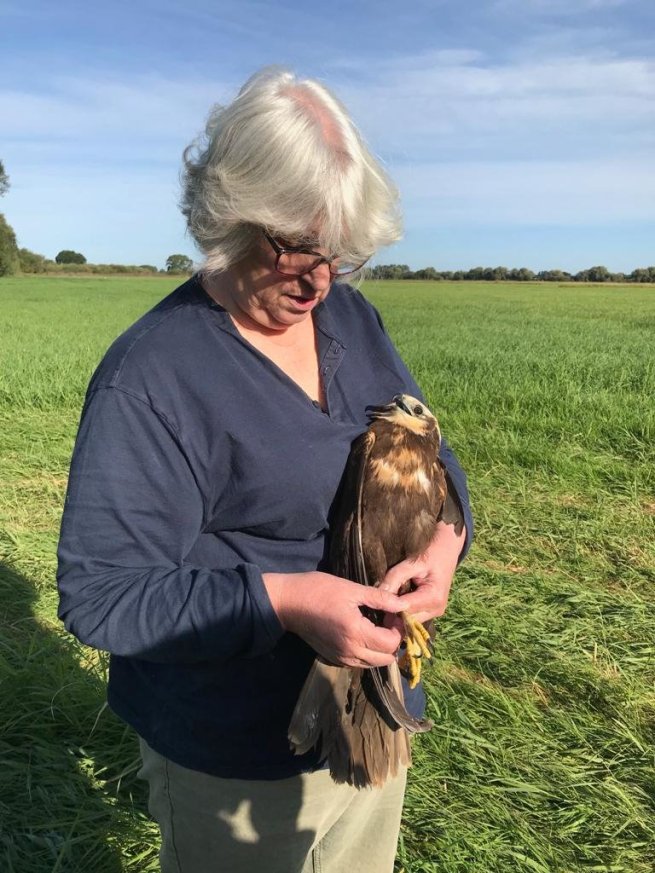
It was taken to local wildlife rehabilitator Jean Thorpe for care, and was subsequently taken to a veterinary practice for examination. The marsh harrier was found to have a broken left wing with a shotgun pellet lodged next to the fracture, which shows the bird had been subjected to persecution.

[Photo from Lower Derwent Valley National Nature Reserve, where it was subsequently released after being helped by Jean Thorpe and veterinary specialists at Battle Flatts Veterinary Clinic]

A spokesperson for North Yorkshire Police said: “Sadly, North Yorkshire is the UK’s worst hotspot for confirmed cases of bird of prey persecution. This magnificent bird has been very fortunate to survive, largely thanks to the dedication and care given by Jean Thorpe, but is yet another example of a wildlife crime having taken place against our birds of prey.”

North Yorkshire Police have carried out extensive enquiries in the Hutton Buscel area. Officers are appealing for anyone with any information, or who may have witnessed anything taking place in relation to this bird, to contact PC Mark Atkinson at Malton Police Station by dialling 101, quoting reference number 12190155625.

ENDS

We believe this Marsh harrier is the one we blogged about on 18 September 2019 (here), having been found injured on a game-shooting estate near Scarborough in August, rescued, rehabbed and then released.

It’s not the first time a Marsh harrier has been found targeted on a game-shooting estate in Yorkshire. This one was found with shotgun injuries next to a partridge release pen on an East Yorkshire sporting estate in 2016 and this breeding pair was shot at and had their eggs removed by men dressed as gamekeepers on a grouse moor in North Yorkshire in 2017.

In 2017/2018 Amanda Anderson (Moorland Association) denied that her members were interested in obtaining licences permitting them to kill Marsh harriers but several witnesses said otherwise.