Nearly 60 million non-native gamebirds released in UK every year

The exact number of game birds that are released in the UK for shooting every year is not known (because, incredibly, the game bird shooting industry is virtually unregulated). Nobody even knows how many game bird shoots there are, because the people involved do not have to register anywhere, nor report on the number of birds released / shot each year. It’s been a great old wheeze for decades.

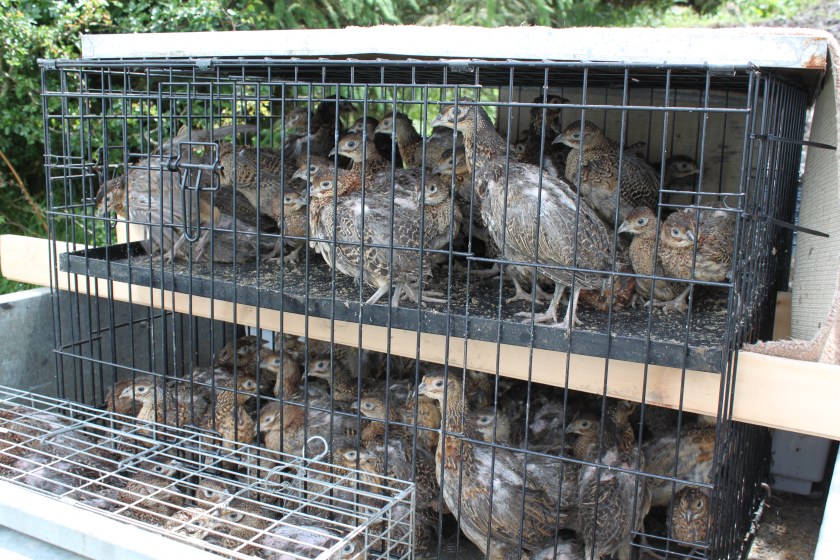
[Gamebird poults in poor feather condition just prior to release in to a woodland pen. Photo by Ruth Tingay]

All we’ve had to go on in recent years has been a conservative estimate of approx 50 million released birds every year, of which approx 43 million are pheasants and 9 million are red-legged partridge.

This ~50 million estimate came from the GWCT’s National Gamebag Census which until now hadn’t been updated since 2012, so a lot of us had guessed that the figure had probably increased substantially since then but we had no hard evidence to support this theory.

Until now.

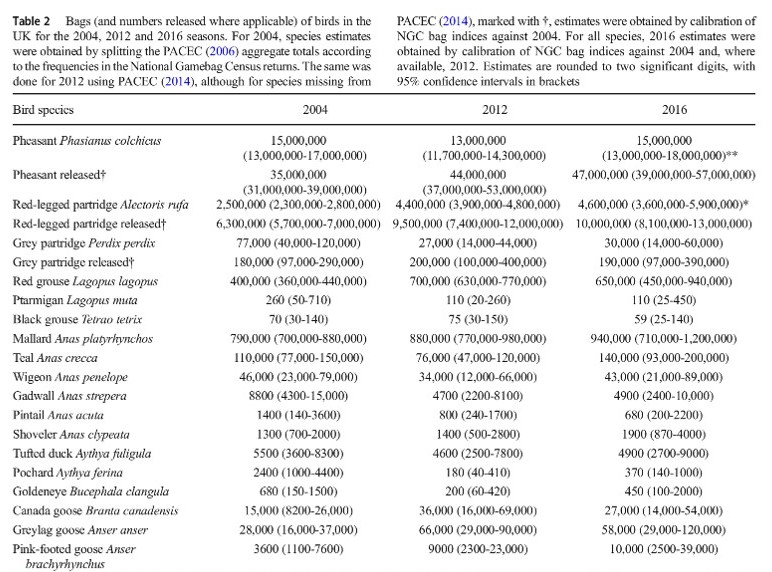
Take a look at this recent paper from the GWCT, which analyses gamebag data up until 2016 (so it’s still not up to date but it’s more up to date than their 2012 estimate).

This table from the paper is fascinating:

So as of 2016 there are at least 47 million (yes, million) pheasants released in to the countryside for shooting every year, as well as at least 10 million (yes, million) red-legged partridge.

That’s nearly 60 million non-native birds, every year!

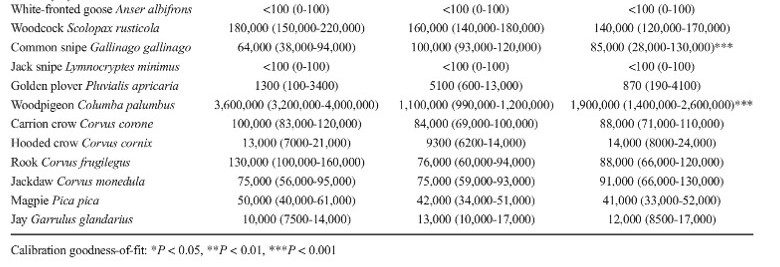
And look at that – at least 12,000 jays killed every year. Why?

140,000 woodcock, 85,000 common snipe and 870 golden plover killed every year. Why? Isn’t the shooting industry supposed to be ‘looking after’ waders? Why are they killing them in such huge numbers?

As many of you will know, Wild Justice is currently challenging DEFRA about its failure to assess the environmental impact of releasing so many millions of non-native game birds in to the countryside. The crowdfunder to support this legal action is just £2,059 short of its target, with 7 days to go. If you can help push it over the line, please visit here.

Thank you


More osprey chicks released at Poole Harbour, Dorset

Some welcome conservation news…..

The Poole Harbour Osprey Translocation Project has just released eleven healthy young birds as part of a five year plan to establish a breeding population on the south coast.

This year’s birds were collected from nests in Scotland (only from broods with multiple chicks) in mid-July and have spent the last few weeks being cared for around the clock by a team of dedicated staff and volunteers. The birds were released from the aviaries at the weekend and are reported to be doing exceptionally well (see here).

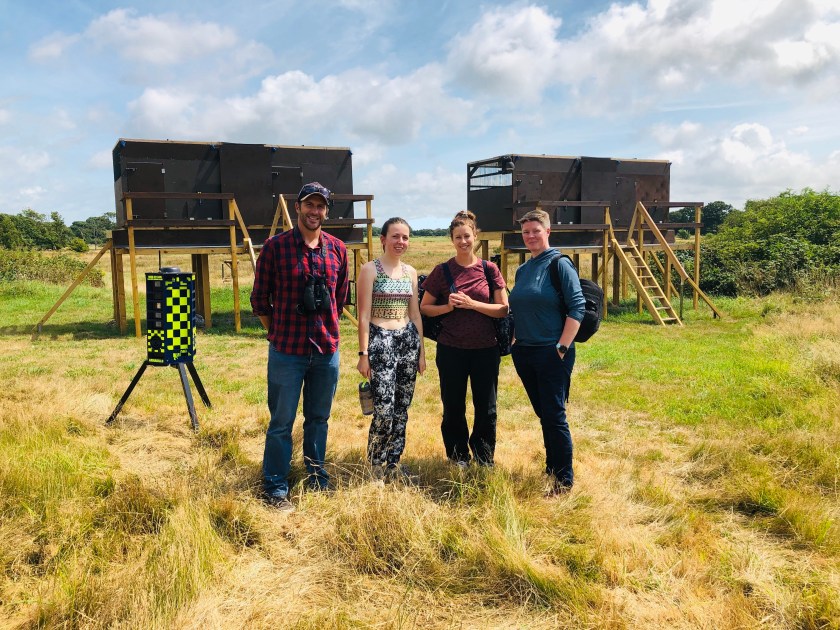
[Osprey project team members Paul, Brittany & Lucy showing Lou Hubble (Head, National Wildlife Crime Unit) around the site last month. Photo by Ruth Tingay]

[Osprey #21 in fantastic condition inside the release aviary, being photo bombed by another. Photo by Lou Hubble, NWCU]

The project is jointly led by local charity Birds of Poole Harbour, The Roy Dennis Wildlife Foundation and local Poole-based business Wildlife Windows. This is the third year of releases and already one of the 2017-released birds has returned to the harbour after a successful inaugural migration to West Africa and has been seen pair-bonding with an older female who originated from Rutland Water but has been hanging out in Poole since the project began.

The project team has built a number of artificial nest platforms around the harbour and hopes are high that next year will see the first breeding attempt.

As you might expect, these birds are attracting a huge amount of local public interest and support and Birds of Poole Harbour has hosted a number of special ‘Osprey Boat Cruises’ which have proved to be extremely popular. The boats go for a leisurely cruise around the harbour for a couple of hours with members of the project team on board to provide a commentary and help spot the ospreys (highly recommended – these trips are great fun). If you’d like to book you’d better be quick – book here.

Congratulations to everyone involved with this excellent project and fingers crossed that all the hard work will pay off next year with at least one breeding attempt.

Disaster hits South Scotland Golden Eagle Release Project

The South Scotland Golden Eagle Project has been hit by disaster in an unprecedented set of circumstances.

This is a project to translocate golden eagles from the Scottish Highlands and release them in south Scotland in an attempt to boost the remnant sub-population in the Borders and Dumfries & Galloway. The first three birds were released in 2018 and all have survived so far.

However, this year’s cohort of translocated eagles (three of them) were released in the last week and now one of them is dead, one of them is injured (but recaptured) and one of them is ‘missing’.

The project team believe that one of last year’s birds, a large female called ‘Beaky’, has been the source of the problem. She is known to have been 10 miles away from the release site when this year’s birds were released, and despite not having visited the project’s food dumps for months, she suddenly made a bee-line there and began to display dominant behaviour towards this year’s three (smaller) males. The males responded by cowering in nearby undergrowth and not visiting the food dumps.

One of the eagles has since been found dead and is currently undergoing a post mortem to find out the cause of death. It’s believed he had injuries but it’s not clear whether those injuries were the cause of death or whether he starved to death.

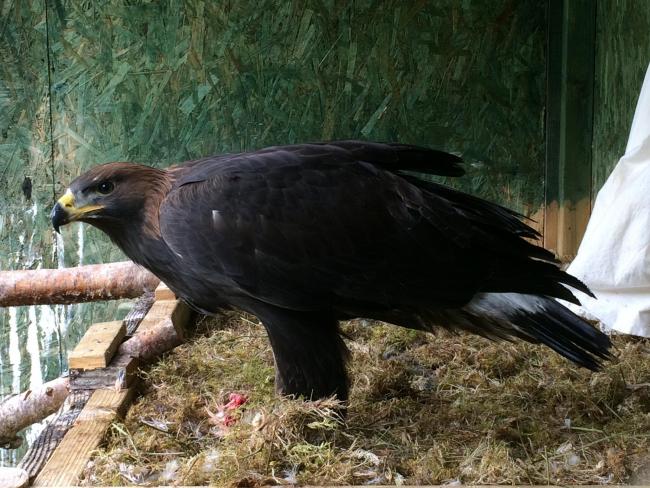
[This is the eagle that is believed to have died. Photo by South Scotland Golden Eagle Project]

A second eagle has been recaptured and is undergoing treatment. The project team has yet to decide the next course of action but if this eagle is to be released it’s probably safe to say it’ll be released at a different site.

The third eagle is apparently ‘missing’, although it is fitted with a satellite tag.

This situation is devastating for the project team (and for all those who helped source the eagles from the Highlands) and to be fair to them, it’s not something that could ever have been predicted. Adult eagles are well known for territorial disputes and these can sometimes result in death, but it’s exceptional for such a young bird (Beaky – one year old) to display such aggressive territorial behaviour that results in death. It’s virtually unheard of.

The future of the project will be under serious scrutiny as a result of this week’s events – it may be that a new release site has to be found – but that’s for another day. At the moment the priority is to rehabilitate the injured eagle and to locate the ‘missing’ eagle. Hopefully the project team is seeking expert help from those with experience of searching for ‘missing’ sat tagged raptors.

Police warning as red kite confirmed poisoned in Nidderdale AONB

Last October (2018) a dead red kite had been found near Wath, in the Nidderdale Area of Outstanding Natural Beauty (AONB), a notorious raptor persecution black spot.

An x-ray confirmed the kite had been shot and North Yorkshire Police launched an investigation. We blogged about the case here.
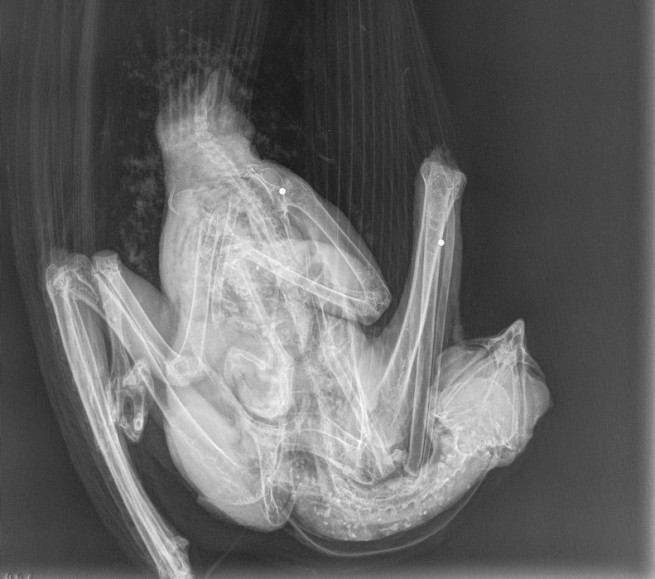
It seems that wasn’t the end of the story. Although the x-ray revealed two pieces of shot, these were not considered to have caused the kite’s death so it was sent off for post-mortem and toxicology examination.

The results are now back (10 months on!!) and nobody will be surprised to learn that, like so many other red kites in Nidderdale, this one had not only been shot on two separate occasions, but it had also been poisoned with a concoction of banned pesticides.

North Yorkshire Police has now issued a warning and an appeal for information as follows:

POLICE PESTICIDE WARNING AFTER DEATH OF RED KITE (8 August 2019)

Police have issued a warning about illegal pesticides, after a post-mortem concluded a red kite died as a result of pesticide abuse.

At the end of October 2018 a red kite was found dead in Nidderdale. The finder in this case was the landowner, who was concerned that criminal activity may have taken place on his land.

North Yorkshire Police arranged for the bird to be x-rayed, and this showed there were two pieces of shot in the bird. However, it was not possible to say whether these had caused fatal injuries. Police released details of the incident, and appealed for information from the public.

Officers have now completed their enquiries. The dead bird was subjected to a post mortem, which concluded that the injury caused by one piece of shot was old and had healed. The damage caused by the second piece was recent but was not a fatal injury.

The bird was then submitted to the Wildlife Incident Investigation Scheme, which is administered by Natural England. It was subjected to toxicological tests which found several poisons in the bird. The largest quantity of poison was a substance called bendiocarb, a pesticide which is licenced [sic] for use in the UK. Smaller amounts of two other pesticides, isofenphos and carbofuran, which are both illegal in the UK, were also present. The report concluded that the kite had died as a result of the abuse of several pesticides.

At this time, officers have not received any information to help them identify any suspects. Although the investigation has now concluded, anyone with any information about this incident is asked to contact North Yorkshire Police, quoting reference 12180199938.

A spokesperson for North Yorkshire Police said: “The test results suggest that someone not only has access to two illegal poisons, but is also placing them, along with a legal pesticide, into the environment so that a wild bird has been able to consume them. In addition to being poisoned, the bird had also been shot at least twice during its life.”

Red kites have been successfully re-introduced to Yorkshire, having been extinct as a breeding bird in England, and they are now a familiar sight to people in Nidderdale. All birds are protected by law and it is a crime to intentionally kill, injure, or take any wild bird. If anybody has information about persecution of birds of prey, whether by poisoning or shooting, please call North Yorkshire Police on 101.

Anyone misusing pesticides may also be committing a variety of offences. If you come across an object which you believe may be contaminated with a pesticide or other poisons, please do not handle it. Report the situation immediately to the police giving accurate details of location and why you suspect involvement of a poison.

ENDS

There’s an RSPB blog about this case here.

Interesting to note the suggestion that Bendiocarb is a pesticide that is licensed for use in the UK. Not in Scotland it isn’t – it’s one of eight pesticides that are considered so highly toxic that it’s an offence to even have them in your possession, let alone use them (the others are Aldicarb, Alphachloralose, Aluminium phosphide, Carbofuran, Mevinphos, Sodium cyanide and Strychnine).

When an opportunity arose to have these substances banned in England, the then Wildlife Minister Richard Benyon (owner of grouse moor & pheasant shoot) refused to support such a move (see here).

So, here’s yet another red kite victim to add to all the other red kite victims that have been found either poisoned or shot on or close to grouse moors in the Nidderdale AONB, along with all those missing satellite-tagged hen harriers and two shot hen harriers.

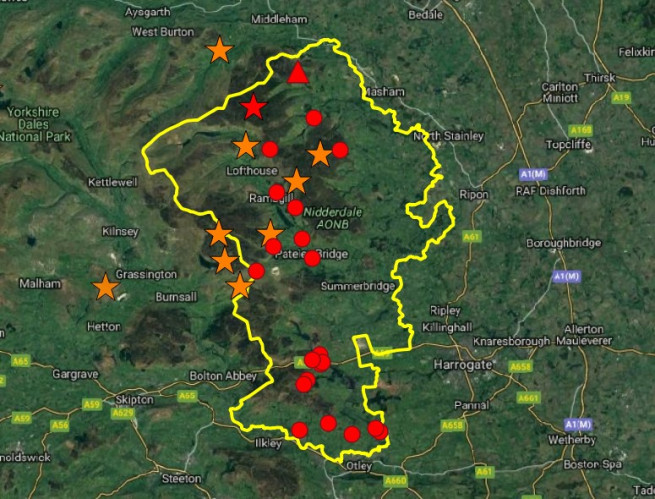
RPUK map showing the boundary of the Nidderdale AONB (yellow line), illegally killed red kites (red dots), missing satellite-tagged hen harriers (orange stars), shot hen harrier Bowland Betty (red star), shot hen harrier River (red triangle).

 

Fundraising drive for RSPB’s Investigations Team

The RSPB’s Investigations Team has launched a fundraising drive to help support more staff and buy more specialist equipment for use in the front line against the raptor-killing criminals.

There doesn’t seem to be a set target as such, and donations can be either made as a one-off or as a monthly contribution.

The Team has produced some material to explain why funds are needed, including this website and this video:

For those of you wondering about the value of contributing, please be aware that these funds are specifically for the Investigations team and not for use by the wider organisation.

If you’re still wondering about the value of contributing, consider the following names and ask yourself if you’d have any clue about what’s been going on there without the tireless efforts of the Investigations team:

Bleasdale, Whernside, Mossdale, Stody, Glanusk, Leadhills, Millden, Glenogil, Moy, Invercauld, Denton, East Arkengarthdale, Swinton, Brewlands, Cabrach, Tillypronie, Invermark, Kildrummy, Buccleuch, Farr & Kyllachy, Glenbuchat, Raeshaw, Skibo, Clee Hill etc etc etc

Please support them if you can, HERE

Two ravens shot – police issue CCTV image of man of interest

Statement from Staffordshire Police:

CCTV APPEAL: DO YOU KNOW THIS MAN?

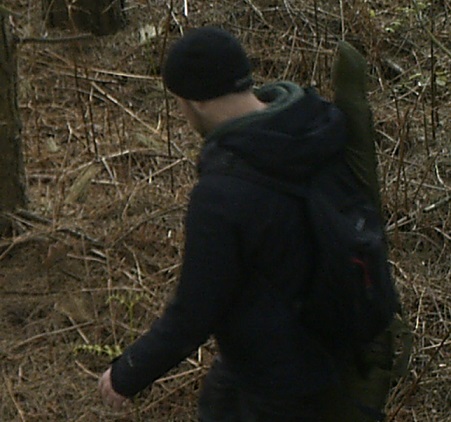
Staffordshire Police’s Rural and Wildlife Crime officers have released a CCTV image of a man they would like to talk to following the discovery of the bodies of two protected birds on Cannock Chase.

The two adult ravens were found at around 11.30am on Sunday 6 May by a passer by. The birds were still warm at the time they were discovered and further examination showed they had been shot.

Anyone who recognises the man in the images or who has any other information is asked to ring 101 quoting incident 298 of 6 May.

Alternatively, for guaranteed anonymity, please call Crimestoppers on 0800 555 111.

ENDS

RSPB calls for independent review of grouse moor management in England

The RSPB is calling on the new Secretary of State for the Environment, Theresa Villiers, to instigate an independent review of grouse moor management in England, similar to the much-anticipated Werritty review which is about to report in Scotland.

The RSPB’s Conservation Director Martin Harper appears in an impassioned video, explaining that self-regulation has failed and why urgent reform is required. The RSPB continues to push for a licensing system to regulate grouse moor management and red grouse shooting:

Martin has also written a blog (here) where he discusses two aspects of grouse moor management (illegal raptor persecution and heather burning on peatlands) that have led to the RSPB’s renewed calls for reform.

Some believe that shoot and/or estate licensing won’t work, largely due to the same enforcement weaknesses that have led to the current failures in regulating this industry. Some believe that only a ban will suffice. What was fascinating to see at the Revive conference this weekend was a growing realisation amongst the public that no matter what their particular motivation for grouse moor reform (e.g. environmental, animal welfare or social injustice concerns), they are all inter-linked and they all lead to the same conclusion.

Whatever your view, something has to change and these calls are just going to keep getting louder and louder…….

Campaigners call for radical grouse moor reform at Perth conference

The Revive Coalition’s conference was a huge success at the weekend – many thanks to Max Wiszniewski, Revive’s Campaign Manager, who pulled it all together, and an incredibly engaged audience, who enthusiastically interacted with a number of expert discussion panels throughout the day.

Revive will be reporting separately on the conference so for now, here’s a report in yesterday’s Courier:

Hundreds of campaigners flooded into Perth Theatre on Saturday demanding radical reform of Scotland’s grouse moors.

The Revive Coalition, consisting of Common Weal, Raptor Persecution UK, Friends of the Earth Scotland, OneKind and League Against Cruel Sports (LACS) organised the inaugural event at the theatre’s Joan Knight Studio.

Sparked by the ongoing blight of illegal persecution of birds of prey across Scotland, the group are calling on stringent legal changes to grouse moors across the country.

The group believe that almost a fifth of Scotland is grouse moor, and have called on the wider “circle of destruction” to be reigned in.

Amongst the coalition’s demands are an end to government subsidies for grouse moors, fairer taxation, stricter policing and a requirement for full planning permission to build tracks on moorland.

Limitations on the amount of heather which can be burned and a ban on burning on peat reserves is also being sought by the group, along with bans on snares, medicating grouse.

TV conservationist Chris Packham addressed the audience with an video message before the speakers took to the stage.

With MSPs Alison Johnstone, Claudia Beamish and Andy Wightman all speaking at the event, the group already has plenty of political support.

Robbie Marsland, director of LACS, said: “It’s so much bigger than just the shooting of the birds. To make sure there are enough to shoot, you’re looking at a circle of destruction which includes unplanned tracks and roads which go across the moors, spoiling the countryside.

There’s also medicated grit trays which are supposed to control disease, but grouse pass on disease amongst themselves more frequently. This draws them together and they pass on the disease.

If you want to make sure there as as many grouse as possible, you get rid of everything which predates on them and their eggs or chicks. In effect, these foxes and crows and weasels are just animals.”

A reform is hoped would help clamp down on the number of birds of prey being killed or going missing over moorland, but Mr Marlsand’s organisation hopes that a reform could tackle wider issues relating to social justice and the environment.

Mr Marsland claimed that the grouse shooting industry is worth around £36m to Scotland, what he says is about the same annual income as two supermarkets, and employs less than 3,000 people with an average income of under £12,000.

Following this weekend’s event, Revive are looking to hold a parliamentary reception later in the year to further case.

ENDS

First Minister finally writes to 9 year old boy about golden eagle persecution

At the beginning of July the news emerged that two satellite-tagged golden eagles, named Adam and Charlie, had vanished from the same grouse moor, on the same morning, in highly suspicious circumstances (see here).

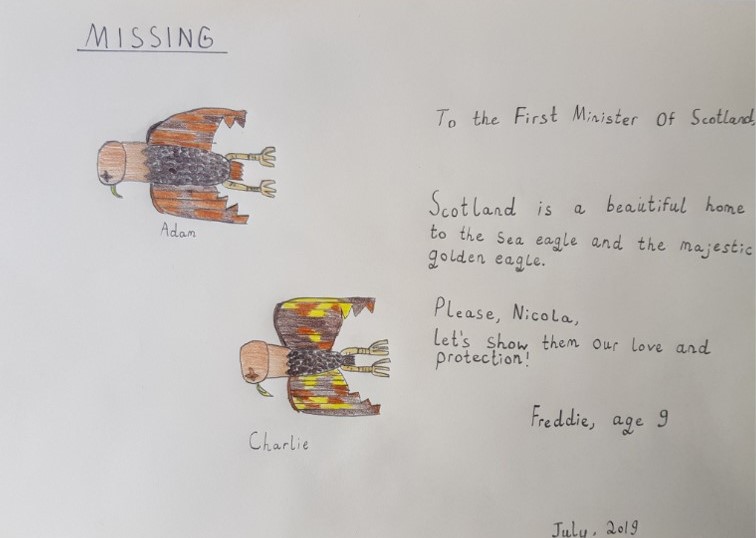
In response to this news, and prompted by children’s author Gill Lewis, quite a number of people drew pictures of golden eagles and sent them to First Minister Nicola Sturgeon, urging her to finally take action against the grouse shooting industry. One of those people was a nine-year-old boy called Freddie Blackman, who drew this fantastic picture:

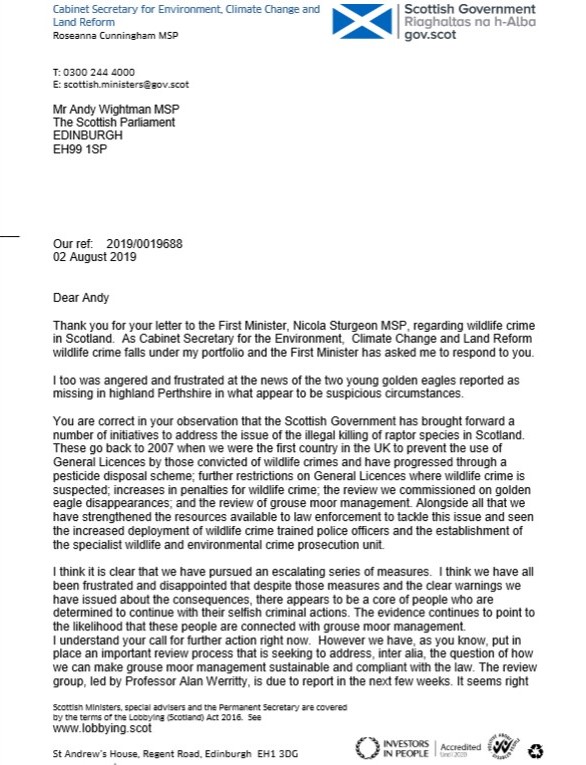
After almost a month of silence from the First Minister, not just about these suspiciously ‘missing’ eagles but also about a ‘missing’ hen harrier and two other hen harriers (here & here) that were found on grouse moors with illegal spring traps gripping their legs, Nicola Sturgeon has now finally responded to Freddie with this letter:

Nine-year-old Freddie seems a pretty savvy young man and is unlikely to be impressed with The First Minister’s suggestion that she doesn’t yet know why golden eagles and other raptors are ‘going missing or being hurt’ but that she’s waiting for a report from a ‘special group of people’ (Prof Werritty et al) to find out!

He’ll also be pretty unimpressed if he checks out the SNH website, as Ms Sturgeon suggests, to find out ‘what we are doing to protect wildlife in Scotland’. Er, here’s what you’re doing, Nicola – thinking about putting ravens on the General Licence so that gamekeepers and farmers can slaughter as many as they like, when they like, without any level of accountability whatsoever.

Freddie wasn’t the only one who wrote to the First Minister urging action against the grouse shooting industry. Andy Wightman MSP, the Scottish Parliament’s Golden Eagle Species Champion also wrote to Ms Sturgeon following the disappearance of Adam & Charlie. He told her it was ‘long past time for reviews and inquiries’ and he asked for some very specific action:

  1. Provide clear leadership in condemning these organised crimes;
  2. Commit to legislate to ban or to regulate driven grouse-shooting;
  3. Meet with me and others concerned with raptor conservation to discuss how your Government can take further action to eradicate wildlife crimes;
  4. Invite the Justice Secretary to convene a high-level task force of law enforcement officials to step up prevention and detection of wildlife crime and improve the admissibility of evidence in court.

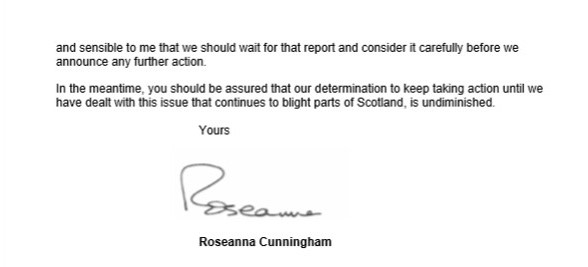
The First Minister’s response to Andy’s letter? To ignore his specific requests for action and to delegate back to Environment Cabinet Secretary Roseanna Cunningham who simply regurgitated the standard response that’s been sent to all those who wrote to the Scottish Government about the ongoing persecution of raptors on Scottish grouse moors:

Without a shadow of doubt, the Scottish Government’s continued procrastination about dealing with the criminals within the grouse shooting industry will be high up on the agenda of many of us attending the Revive conference today.

Watch this space……

Revive Coalition hosts first conference on grouse moor reform

The Revive Coalition for grouse moor reform in Scotland will host its first national conference in Perth this weekend.

Entitled Wildlife, Land Reform and Environment, tickets sold out months ago, which is a good indicator of the level of public interest.

10.00 – 11.00: Registration

11.00 – 11.20:  Introduction from Revive Campaign Manager Max Wiszniewski

Presentation from Holly Gillibrand on the need to act for environment, wildlife and young people

11.20 – 12.45: Presentations and discussion panel on Raptor Persecution, Mountain Hares & Animal Welfare

Chair: Alison Johnstone MSP

Dr Ruth Tingay, Revive Director & Raptor Persecution UK

Bob Elliot, Revive Director & OneKind

Andrea Hudspeth, Scottish Raptor Study Group

Ian Thomson, RSPB Scotland

12.45 – 13.45: Lunch

13.45 – 14.45: Presentations and discussion panel on Environment and Landscape

Chair: Claudia Beamish MSP

Dr Richard Dixon, Revive Director & Friends of the Earth Scotland

Helen Todd, Ramblers Scotland

Beryl Leatherland, Scottish Wild Land Group

Peter Cairns, Scotland the Big Picture

14.45 – 15.15: Discussion panel, ‘Living with it Locally’

Chair: Max Wiszniewski

Julie Bell, SNP Councillor, Kirriemuir and Dean

Susan Mathews, Cairngorms resident

Steve Gardner, Common Weal Angus

15.15 – 16.05: Presentations and discussion panel on ‘Back to Life’

Chair: Libby Anderson, Policy Advisor to OneKind

Andy Wightman MSP

Máiri McFadyen, Fearann/Land project creative activist

Robin McAlpine, Revive Director & Common Weal

16.05 – 16.30: Closing statements

Robbie Marsland, Revive Director & League Against Cruel Sports Scotland

17.00: Conference ends