
As we all sit and wait for the publication of the Werritty Review (due out shortly) and find out what recommendations have been proposed for the regulation of grouse moor management in Scotland, it’s well worth having a read of another report that’s just been published by RSPB Scotland.
Called ‘Grouse Moor Licensing in Scotland: Where Next?‘, it’s written by Lloyd Austin, an authoritative and respected commentator and the former Head of Policy at RSPB Scotland who is now working as a freelance consultant.
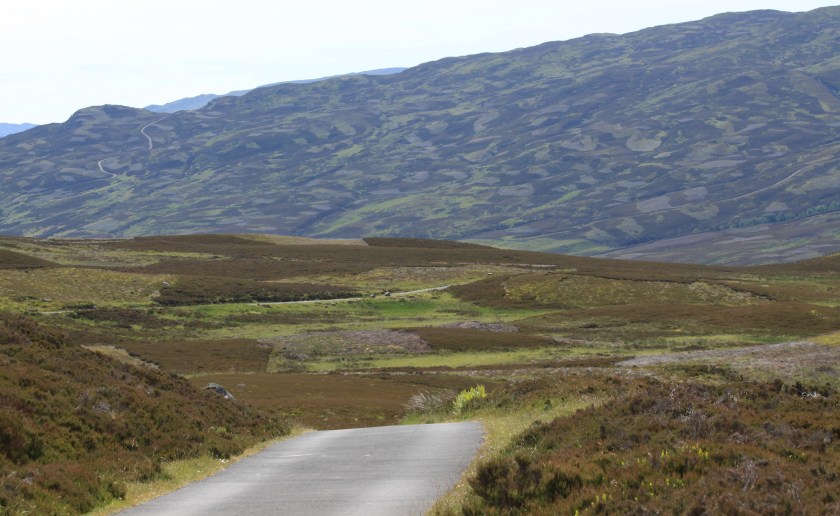
[The end of the road for driven grouse moor management as we know it in Scotland? Photo by Ruth Tingay]
This report sets the scene succinctly and then discusses the five broad options that the Scottish Government will face, regardless of whatever the Werritty Review recommends:
- Do nothing at all
- Carry out a few, piecemeal bits of regulation tightening
- Develop a coherent regulatory system for the existing industry – a ‘licensing scheme’
- Seek comprehensive reform of the entire hunting culture/system and its entire legal framework
- Instigate some form of complete ban of grouse shooting – at least in its highly intensive ‘driven’ form.
Lloyd explores each of these options in turn and discusses why they would or wouldn’t work, and then goes in to some detail about how his favoured option (#3) could actually be delivered.
This is a really important and impressive piece of work. We understand that it has already been shared with several key players in the Scottish Government, Parliament and beyond.
You can read the report here: Grouse moor licensing – Where Next – Report by Lloyd Austin for RSPB Mar 2019
For those who don’t want to read the detail in the report (although we’d encourage you to do so!), RSPB Scotland has written an accompanying blog that picks out the key points – see here.
What you get from Lloyd’s report is that, aside from being subject to potential complications from Brexit, it seems that it’s the end of the road for driven grouse moor management in Scotland as we know it. The Government does have the option to ‘do nothing’, of course, but as Lloyd points out so well, this is politically untenable given the breadth of concerns, the scale of campaigns and the support for change.
Bring it on.
 Raptor Persecution UK
Given the complete inability of the current system to prosecute people who break the law what are the chances a licencing system is going to bring about the changes needed. Given the current lack of convictions are licences going to be revoked based on rumour and hearsay. Mark Avery has discussed the licencing in some detail. He sees the only viable option being a complete ban.
I fear the RSPB is under-estimating the guile of the grouse shooting industry.
The weaknesses a comprehensive licensing system to my mind are :- That most if not all successful licensing systems rely heavily on the compliance of the licensed. Given the vehement opposition to an idea of licensing within the whole of the grouse shooting cabal that will not be true, creating a foreseeable wealth of difficulty. Given that opposition the first hurdle will be one of getting the politicians to stand against it with little, preferably no compromises such that we get a system that is really fit for purpose.
Difficulty two, I cannot foresee any government of whatever complexion funding remotely adequately any system of policing a licensing system such that the licensees actually comply with what is required of them or that transgressions of the licence are adequately demonstrated such that restrictions can be put in place as a result. A failed or failing licensing system might, nay would probably be the worst of all worlds. Politicians claiming they had done what was asked and being very, very unwilling to change the system. This has always to my mind being the weakness of the argument that says a failed licence system is a predictable part of the road to a complete ban.
Nothing I read in this report convinces me otherwise.
It is a pity that the RSPB is sticking for a licensing system rather than campaigning for a ban on driven grouse shooting. A licensing system will actually legitimise this ‘sport’ for years or even decades to come and thus spike the guns (pun intended) of the campaign for a ban i.e. ‘everything’s alright now as we are licensed’ etc.. The fun killers currently run rough shod over any form of regulation including widespread criminality. Any licensing system will be merely another minor obstacle – no doubt a modest one if the SNP’s track record is anything to go by – for the fun killers to dodge, negate or simply ignore. At best a Pyrrhic victory and a minor inconvenience for the fun killers whilst the slaughter continues. Sad days.
Pushing for a licencing system is probably the best the RSPB could do at the moment, but once one is in place it will be up for review and development and potentially bit by bit tightening up. If parts of grouse moors are identified as suitable for flood alleviation work such as riparian tree planting and eventual translocation of beavers is it too far fetched or unreasonable to think that carrying out such work where it’s appropriate becomes a necessary element for retaining the licence? Regarding it as unreasonable means that compromising the homes, busineses and better quality farmland affected by flooding is more acceptable than compromising grouse shooting! Personally I can’t see a problem with this especially as such work would also create some very effective fire breaks on vast stretches of currently uninterrupted flammable moor which increasingly seem to go up in smoke every dry spell. I think licencing would represent a practical and political step towards the end of driven grouse shooting, and if it’s not working then the licence can be altered or if driven grouse shooting shows it cannot be licenced effectively then good argument for it being banned. Step by step DGS is losing its lustre.
The SNP’s normal home for issues like this is a place called “the long grass” ….normally supported by the need for more research. The werrity study was obviously far from comprehensive and leaves open doors for further exploration.