

Wild Justice’s legal success against Natural England had the following chronology:
Wild Justice’s legal success against Natural England had the following chronology:
13 February – “Pre Action Protocol” legal letter sent from Wild Justice’s lawyers to Natural England setting out why we considered the General Licences issued on 1 January, which ‘authorise’ killing of 16 bird species, to be unlawful. In essence, these birds can only be killed under certain legal conditions and NE has to be satisfied that those conditions are met before issuing the licences. NE had not satisfied itself of those things and so the licences are not lawful.
26 February – NE respond, a day ahead of the normal deadline for response, asking for two more weeks
27 February – Wild Justice says – no, NE can have one more week.
1 March – NE ask for a meeting with Wild Justice.
11 March – Chris Packham, Ruth Tingay, Mark Avery and some of their lawyers meet Natural England.
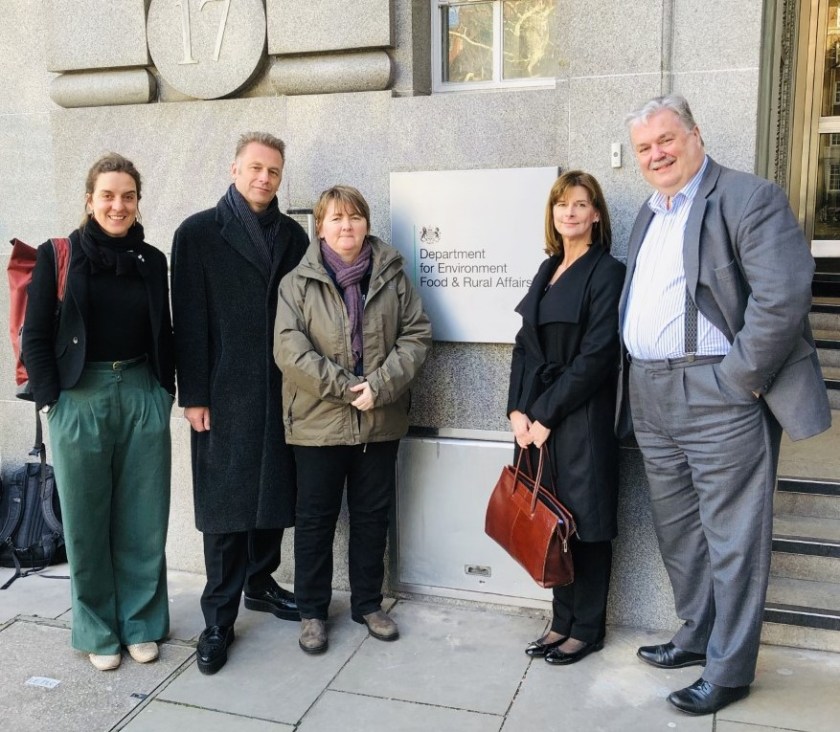
[Wild Justice and lawyers outside Defra Nobel House on 11 March ahead of meeting Natural England. L to R: Anita Davies (Matrix Chambers), Chris Packham and Ruth Tingay (Wild Justice), Carol Day (Leigh Day) and Mark Avery (Wild Justice)]
13 March – Wild Justice receives confused and ambiguous written legal response from NE which does not concede the legal argument, nor provide evidence for the legality of current system.
15 March – Wild Justice launches crowdfunder on Crowdjustice platform to raise funds for legal challenge – this was the first public mention of what the case was about – Wild Justice had given NE over a month of quiet contemplation to work out the implications of our challenge and its response.
21 March – legal claim forms were issued in the court on behalf of Wild Justice asking for judicial review.
25 March – crowdfunder reaches target of £36,000 in 10 days.
23 April – Out of the blue NE announces revocation of three General Licences on 25 April and that, at least for now, anyone wanting to kill any of the species formerly listed on those General Licences will need to apply for and receive an actual licence from NE. A review of the General Licences is planned.
Wild Justice is perfectly happy for the full legal correspondence between NE and Wild Justice to be put in the public domain and we may well do this over the next few days.
There are several points to be made about this process:
- Wild Justice has not changed the law – we have shown that NE has issued authorisations for killing of wildlife that are unlawful and NE has had to accept that. They ought to have known or suspected this before we brought it to their attention – surely?
- Wild Justice did not ask for the revocation of the 2019 General Licences – only that they would not be issued in the same unlawful form in 2020. It was NE’s decision to revoke the 2019 General Licences and at such short notice. Wild Justice took such a measured line because we knew that such an action would be an unpopular shock to some interest groups and would cause administrative challenges for NE and we wanted to give NE space fully to consider the legal options.
- NE could have made their decision to concede the legal case at any time after 13 February – the fact that it took them nearly two and a half months is a matter for them to explain, not Wild Justice.
- NE did not tell Wild Justice what it was going to do in advance and issued its press notice more or less at the time it communicated its decision to us.
Wild Justice says
‘We are delighted to have won this legal case. What sort of world is it where the statutory body with responsibility for wildlife protection is operating a bird-killing licensing scheme that is unlawful? Millions of birds are killed each year under the terms of the General Licences and many of these deaths will not be justified.
We are grateful to over 1100 individuals who funded this legal challenge and allowed us to take it with the means to progress it through the courts.
NE could have, and in our view should have, conceded the correctness of our case many weeks ago. This would have reduced the financial costs to the public and allowed farmers and land managers more time to adjust to the news that their bird-killing actions may have been illegal for several decades.
This is a mess of Natural England’s making – they have operated an unlawful licensing system and they have dillied and dallied over admitting it’.
Wild Justice – Mark Avery, Chris Packham and Ruth Tingay
 Raptor Persecution UK
Well done Wild Justice; the correct result. There seems to be a lot of angry conservation signallers wielding their keyboards this morning; they really should calm down and read the details of how this case unfolded.
NE have failed in their statutory obligation under the EU birds directive to protect the Hen Harrier in England. This should be challenged in the courts also, in my opinion.
All due credit to Wild Justice. It’s clear though that NE’s real purpose seems to be lost on government.
The photograph’s the giveaway here – The sign says it all – it’s fairly obvious the organisational set-up has to be flawed in DEFRA – While that’s totally understandable and almost desirable from a government manageability perspective (it makes life easier), there must obviously be competing interests, some more likely to benefit from powerful lobbying than others – Wildlife and conservation policy just has to be independent of food production and rural affairs to ensure long term planning and that environmental issues aren’t kicked into the long grass – as scarce a habitat as that is these days.
I perhaps should have said “independent of food production and rural affairs where these have clear commercial interests, to ensure long term planning” …
The description “rural affairs” in the title, probably originally meant as a “cover all” now appears intentionally ambiguous.
Yes indeed, credit where credit is due, well done.
Looks to me that NE is doing this to make Wild Justice the bad guy and cover up there own incompetence
.
And idea if SNH is going to follow suit?
Or are there sufficient differences in the legislative framework and/or administrative procedures north and south of the border for them to be satisfied that they have acted within the law when issuing the General Licences?
Its the same legislation as far as I know so I think SNH will be preparing to change the GLs in Scotland too.