Tony Juniper appointed Chair Natural England from 23 April

Excellent news! Highly-regarded environmentalist Tony Juniper has finally been appointed as the new Chair of Natural England and he’ll begin on 23 April 2019.

Environment Secretary Michael Gove confirmed Tony’s appointment yesterday with this press statement. It comes after a long recruitment process, including some vacuous questioning from two parliamentary committees last month (see here). It’s probably safe to say the Countryside Alliance won’t be celebrating this appointment.

Michael Gove said: “Tony will bring great experience and passion to Natural England from a career dedicated to conservation from his role at WWF to advising the Prince of Wales.

Natural England has a key part to play in the government’s 25 year plan for the environment and ensuring we can protect nature for future generations.

That is why I am looking forward to working with Tony as he leads the organisation and ensures Natural England can continue delivering the government’s environmental priorities“.

Tony Juniper said: “Natural England’s vital role in defending and enhancing our nation’s natural environment has never been more important. It is a real honour to have been appointed as the new Chair and I am very much looking forward to working with the Natural England teams and many partners across the country in delivering the biggest possible positive impact that we can.

Natural England’s work is very wide ranging, from protecting our National Nature Reserves to advising farmers and from opening England’s new coastal path to ensuring greater public access to our wonderful natural areas.

As Chair, my aim will be to celebrate, protect and deepen the impact of Natural England’s excellent work, not only for the sake of our wildlife and beautiful landscapes, but also for the huge benefits that our success brings for society“.

He’s going to be a busy guy. We look forward to seeing whether he can drag Natural England from its current disreputable position to something more like the nature conservation agency it once was and we hope can be again.

Gamekeepers’ rep suggests disappearance of hen harrier Vulcan was “set up” by RSPB

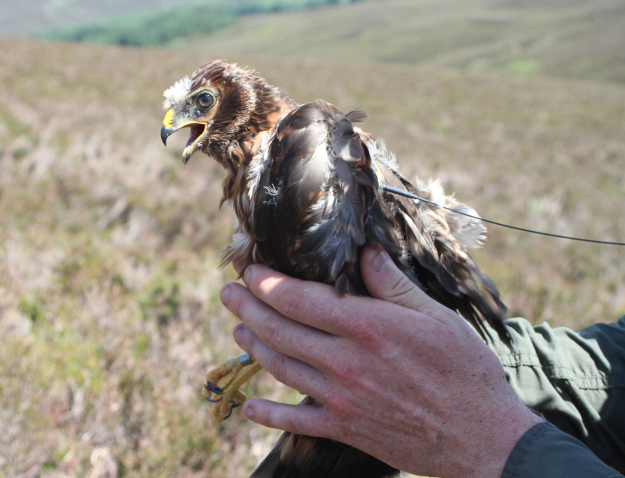
At the end of February 2019, the RSPB announced the suspicious disappearance of a satellite-tagged hen harrier called Vulcan who had vanished in January 2019 in an area heavily managed for gamebird shooting in Wiltshire (see here).

[Hen harrier Vulcan, photo by RSPB]

The suspicious disappearance of any satellite-tagged hen harrier in the UK is significant because the loss of any of these young birds is a reminder of just how precarious the hen harrier population is, and as many of them seem to disappear on grouse moors it’s also usually a repeated reminder of how the authorities have failed to address the rampant criminality associated with this type of land management.

Whilst Vulcan’s disappearance was not on a grouse moor, it was in an area managed for pheasant and partridge shooting and his disappearance was still significant because this area from which he ‘disappeared’ was close to the proposed release site of Natural England’s highly controversial hen harrier reintroduction project, a supposedly raptor persecution free zone.

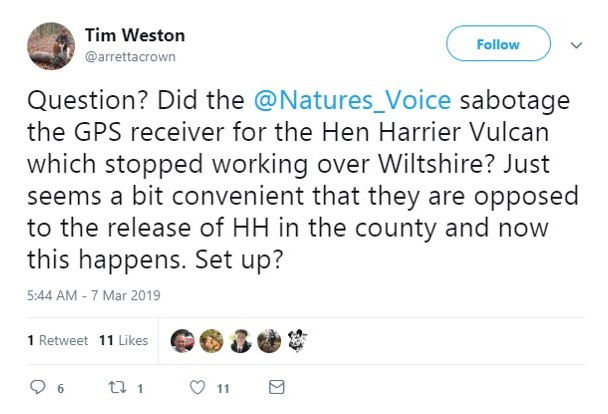
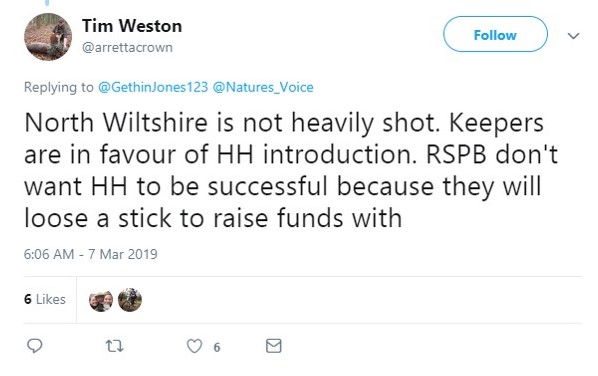
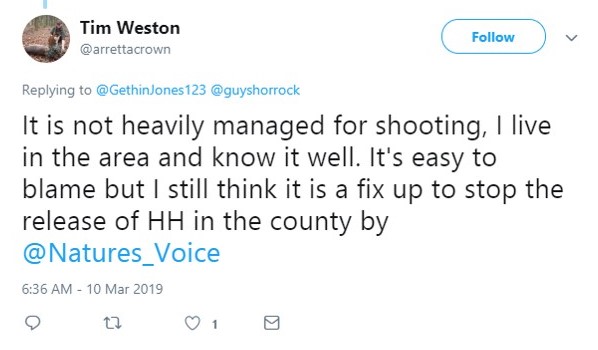
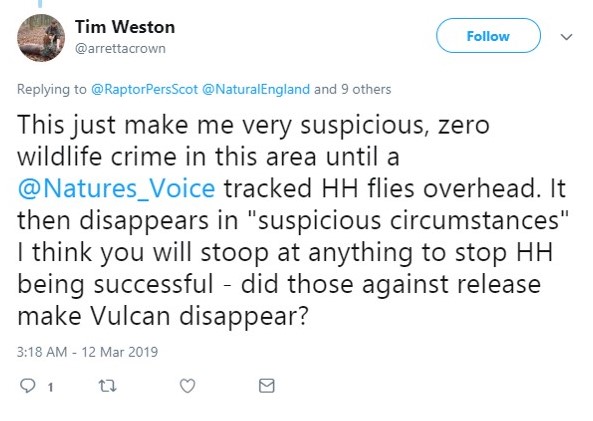
The inevitability of yet another lost hen harrier (the 12th to vanish in suspicious circumstances since last summer) and the significance of Vulcan’s last known location has led Tim Weston, Devlopment Officer for the National Gamekeepers’ Organisation, to accuse the RSPB of a “set up” (or, in more formal legal terms, of perverting the course of justice [by fabricating evidence]).

We’ve come to expect this sort of nonsense from a small number of pro-shooting, anti-RSPB trolls on social media but to see it from a representative of the National Gamekeepers’ Organisation (NGO) was more than a little surprising.

Here are a series of tweets from National Gamekeepers’ Org employee, Tim:

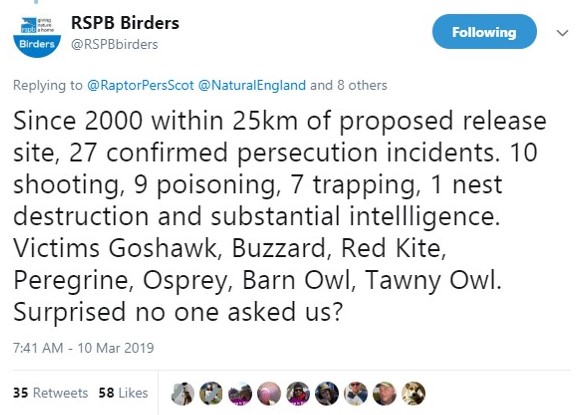
Zero wildlife crime in this area until [RSPB] tracked HH flies overhead“? Tim must have missed the tweet from the RSPB Investigations Team on Sunday night where they outlined some of the confirmed raptor persecution crimes in this area:

Does the National Gamekeepers’ Organisation endorse Tim Weston’s accusations? Not that it matters anymore, since the NGO walked out of the partnership group trying to tackle the illegal killing of birds of prey in England and Wales (the Raptor Persecution Priority Delivery Group, RPPDG). With the gamekeepers gone, hopefully the RPPDG can now focus on the issue at hand instead of being side-tracked and disrupted by distractions like this.

Meanwhile, an organisation which retains its membership of the RPPDG and has played a central role in tackling the illegal persecution of birds of prey in northern England is the Northern England Raptor Forum (NERF). NERF has today issued a statement about the suspicious disappearance of hen harrier Vulcan, because even though Vulcan vanished in southern England, he hatched from a nest in northern England where NERF members helped to protect the site. Read NERF’s statement here

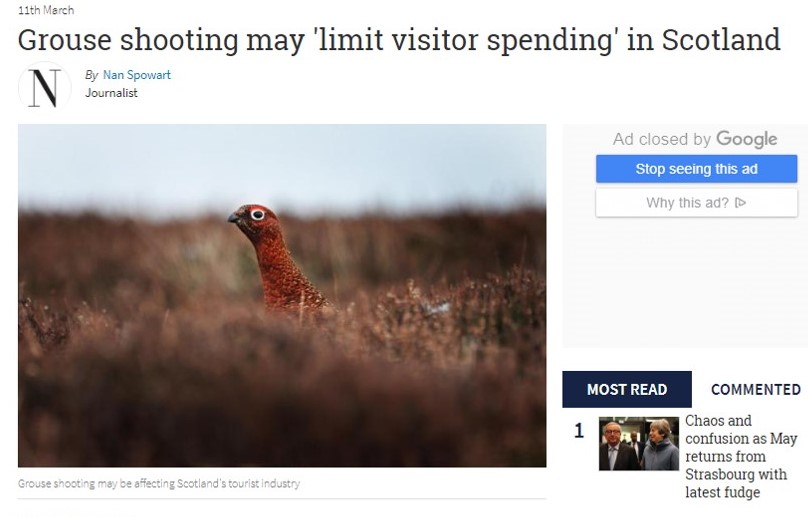
Grouse shooting could be negatively affecting Scotland’s tourist industry

Following the publication last week of a number of reports on the socio-economic and biodiversity impacts of driven grouse shooting in Scotland (see here), a number of news articles are now appearing.

The National published the following article yesterday:

GROUSE shooting in Scotland could be negatively affecting Scotland’s tourist industry, according to a new report.

Populations of mountain hare may also be at risk as a result of the controversial culls by gaming estates, with “potential cascading effects” on predators.

The report – which was drawn up by the James Hutton Institute and Scotland’s Rural College, and commissioned by the Scottish Government– estimates that 2500 equivalent full-time jobs are supported by grouse moors, but emphasises that existing data on their benefits is inadequate.

The authors say the figures on grouse moors’ socio-economic impact “come from a very narrow base of industry-sponsored studies that have self-reporting biases and do not consider counterfactual scenarios”.

The authors go on to point out that the research base has a lack of “robust” evidence on which to base policy decisions.

However, they say the existing evidence highlights that driven grouse moor management and grouse shooting are part of a myriad of wider sporting activities.

The report explains the negative aspects of driven grouse moors – such as raptor persecution, the impact of heather burning on soils and certain birds, and perceived negative landscape – which may be affecting the areas they are based in.

The authors continue: “Negative impacts (perceived or actual) may limit visitor spending within an area from the estimated half million domestic visits, 2.7m accommodation nights and £187m spend on visits that included watching wildlife/bird watching in 2015.”

In examining the impact of muirburn and legal culls, the report identifies “major knowledge gaps” and calls for further research and data collection on both the environmental impacts and the socio-economic impacts of grouse shooting.

With regard to mountain hares the reports states: “Evidence suggests that hare populations in Scotland show limited dispersal capacity and may therefore be prone to local extinction, though hare spatial ecology is not well understood. Changes in mountain hare numbers could have potential cascading effects on predators, although the effects are not well researched.”

Responding to the report, Alex Hogg, chair of the Scottish Gamekeepers’ Association, agreed there were “clearly some knowledge gaps” but welcomed the work done so far.

“The jobs created by grouse shooting, like gamekeepers’ roles, are important because they keep people in some of the most fragile and remote parts of Scotland where opportunities can be very hard to come by,” he said.

ENDS

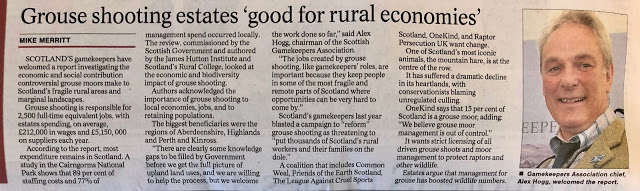
Of course, the grouse shooting industry has a different interpretation of the reports’ findings, leading to other headlines yesterday such as these:

Naturally, the grouse shooting industry fails to mention that these findings are based on previously published reports, commissioned by the grouse shooting industry itself, and therefore suffering from inherent bias, as noted in the more recent reports from the James Hutton Institute and the SRUC.

This media circus will continue, no doubt, until the publication of Professor Werritty’s grouse moor management review later this year, and perhaps more importantly, when we find out how the Scottish Government plans to respond to Prof Werritty’s recommendations for grouse moor reform.

Hen harrier reintroduction to southern England: Natural England suggests persecution not an issue

Natural England has been planning a so-called ‘reintroduction’ of hen harriers to southern England since 2016, as part of DEFRA’s ludicrous Hen Harrier Action Plan.

We’ve blogged about this ‘reintroduction’ for three years (see links at the foot of this blog) and its recently been in the news again as a young satellite-tagged hen harrier called ‘Vulcan’ disappeared in suspicious circumstances close to the proposed reintroduction release site in Wiltshire (see here), indicating that this is not a safe location to rear and release young hen harriers.

This morning on BBC Breakfast News the RSPB again voiced its concerns about the planned reintroduction, citing the loss of hen harrier Vulcan in Wiltshire and arguing that until the issue of illegal persecution has been addressed, any young hen harriers are likely to be killed. You can watch it here (starts at 1:21:08 and ends at 1:23:29; only available until 08.30hrs Monday morning). The RSPB interviewees included Nick Bruce-White (Regional Director RSPB South West) and Tony Whitehead (RSPB Press Officer) who couldn’t have been clearer: “The only limiting factor [for hen harriers], let’s make no mistake about this, is illegal persecution“.

Meanwhile, behind the scenes, Natural England has continued to court favour with potential donor countries and we’ve been sent an unbelievable powerpoint presentation, which we believe was delivered to European harrier experts at an international conference in October 2018 by Natural England’s Hen Harrier Reintroduction Project Manager, Simon Lee. It’s basically a plea for donor birds and an apparent reassurance that donor birds will be safe in England! Honestly, this has to be seen to be believed:

Download the PDF presentation here: Simon Lee presentation HH reintro to southern England

According to Simon, there’s been “a gradual recovery [of hen harriers] across Scotland and Wales in recent decades“. Er, except for the results of the 2016 national HH survey which showed population declines in each country, and a whopping 27% decline in Scotland since 2004. Losing over a quarter of the population in just 12 years isn’t what we’d call “a gradual recovery“.

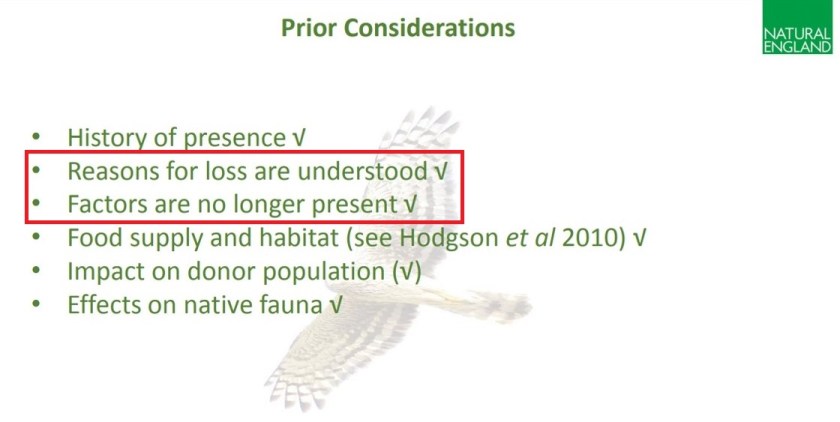
Also according to Simon, prior considerations [for the proposed reintroduction] included ‘understanding the reasons for loss’ and that those “factors are no longer present“:

So, having earlier noted in his presentation that ‘human persecution’ was a cause of the species’ historical decline, Simon is now suggesting to potential donor countries that illegal persecution is no longer an issue.

You couldn’t make this up. Although it looks like Simon did.

And if this presentation was given in Oct 2018, as we believe, Simon must also have been fully aware of the findings of Natural England’s hen harrier satellite tag analysis, which was completed last summer and is due to be published imminently under the title: ‘Patterns of satellite tagged hen harrier disappearances suggest widespread illegal killing on British grouse moors’.

And now with the suspicious disappearance of hen harrier Vulcan near to the proposed reintroduction location, will Simon / Natural England be updating the potential donor countries about the continuing threat to hen harriers in the UK and advising them that the planned reintroduction won’t be going ahead because its simply not safe to do so?

UPDATE 8pm: The RSPB has tweeted the following information about confirmed raptor persecution crimes within 25km of the proposed reintroduction site:

UPDATE 23rd September 2020: Large police operation investigating raptor persecution near proposed release site for hen harriers (here)

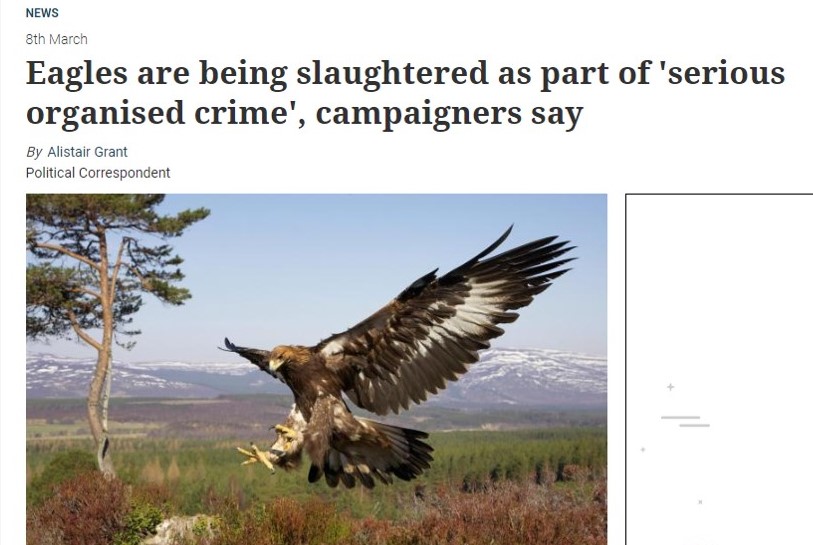
‘Eagles are being slaughtered as part of serious organised crime’

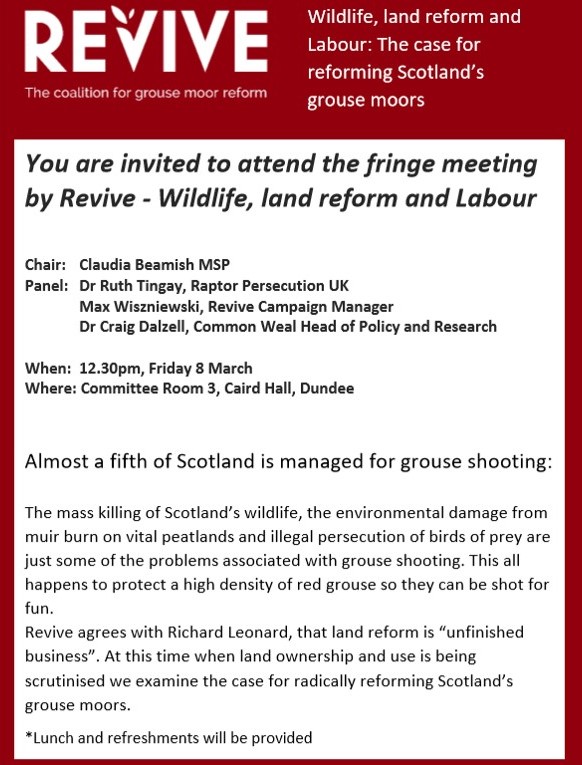
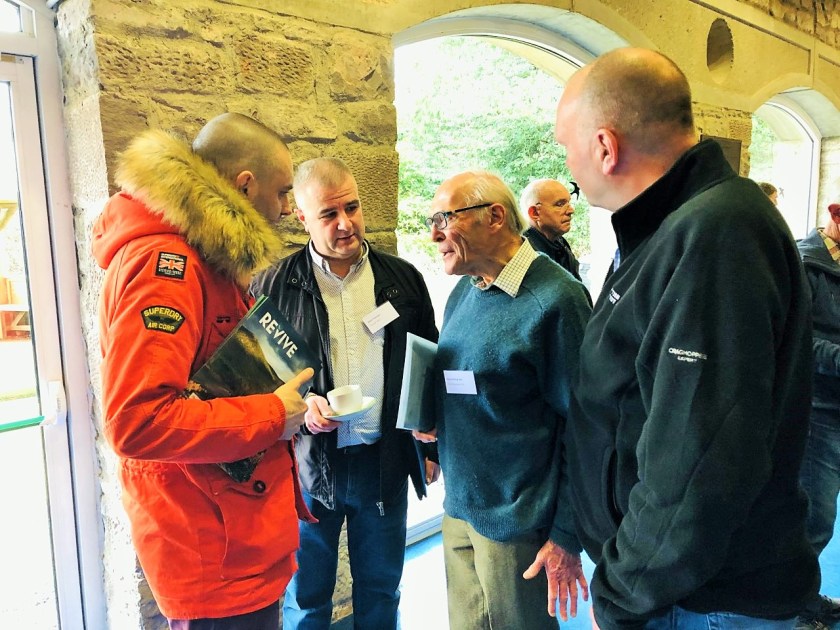
Revive, the coalition for grouse moor reform held its first ever fringe event at a party political conference yesterday, at the Scottish Labour conference in Dundee.

The event was chaired by Claudia Beamish MSP and three speakers from Revive joined the panel (Dr Ruth Tingay of RPUK, Max Wiszniewski, Revive Campaign Manager, and Dr Craig Dalzell, Head of Policy & Research at Common Weal) with another coalition member (Dr Richard Dixon, Director of Friends of the Earth Scotland) in the audience.

[Photo by Louise Robertson]

Each speaker gave a ten minute presentation followed by approx 20 minutes of questions from the floor.

It was brilliant to see a number of journalists in the audience, resulting in some good coverage in the papers today.

The Herald focused on the illegal persecution of golden eagles and hen harriers on or close to driven grouse moors and journalist Alistair Grant got the message loud and clear that, in our opinion, the extent of this persecution on many driven grouse moors is such that it amounts to serious organised crime. [Definition by the National Crime Agency: ‘Serious crime planned, coordinated and conducted by people working together on a contuining basis. Their motivation is often, but not always, financial gain‘]

Here’s the text from The Herald article:

GOLDEN eagles and other protected birds of prey are being illegally slaughtered in what amounts to “serious organised crime”, a leading expert has said.

Dr Ruth Tingay of Raptor Persecution UK said birds are being killed on or near grouse moors across Scotland before the evidence is then removed to avoid prosecution.

She spoke out during a fringe meeting at the Scottish Labour conference in Dundee.

Claudia Beamish MSP, the party’s environment spokeswoman, said it backed strict new rules for estate owners – including a total ban on the use of lead shot and the large-scale cull of mountain hares.

She said: “In order for grouse moors to continue, if indeed they do, there needs to be very robust licensing.”

Labour delegates heard grouse moors cover almost a fifth of Scotland, with estates handed more than £300,000 a year in public subsidies.

Revive, a coalition of organisations calling for change, insisted estates should be stripped of this cash as part of a crackdown aimed at encouraging radical land reform.

It said the intensive land management associated with driven grouse shooting causes environmental damage.

Meanwhile, there is evidence scores of birds have been illegally killed on or near estates, it said.

Dr Tingay, a leading raptor ecologist, said: “My argument is that what we are seeing here – not just with golden eagles but with other birds of prey, particularly hen harriers, which are also persecuted on driven grouse moors – is serious organised crime.

If the Government accepted this, we would see a lot more resources coming in to deal with this issue.”

She said some estimates suggest 50 eagles a year are disappearing.

Revive is made up of Raptor Persecution UK, Friends of the Earth Scotland, animal charity Onekind, the League Against Cruel Sports Scotland and think tank Common Weal.

Craig Dalzell, head of policy and research at Common Weal, said estates should be opened up to other uses.

He said grouse moors in Scotland had an annual economic impact of £32 million and were responsible for around 2,640 jobs.

In comparison, forestry boasts an annual economic impact of £973m and creates 26,000 jobs, he said.

ENDS

The Press & Journal also covered this fringe event and journalist Tom Peterkin headlined with this:
Here’s the text of the P&J article:

Labour has said there should be robust licencing of grouse shooting amid claims that illegal wildlife killing on sporting estates amounted to “serious organised crime”.

The call was made by Shadow Environment Secretary Claudia Beamish at a Labour conference fringe meeting where she cast doubt on the survival of the pastime in the long-term.

The meeting was hosted by Revive, an organisation campaigning for the reform of the country sport and whose agenda includes stripping grouse moor landowners of public subsidies.

Speaking at the meeting, Ms Beamish said it would be “valid” for a licencing system to take into account issues raised by Revive.

Ms Beamish said: “I think that in order for grouse moors to continue – if indeed they do – there needs to be very robust licencing and robust monitoring.”

Ms Beamish made her remarks after campaigners claimed grouse moors only supported 3,000 jobs on an average salary of £11,500 despite accounting for almost one fifth of Scottish land.

Ruth Tiingay of Raptor Persecution UK, drew attention to golden eagles killed on Scottish moors, arguing it was “serious organised crime”.

Max Wiszniewski of Revive said his organisation was “not going for a ban” on grouse shooting “however understandable that would be”.

Rather Revive’s focus was to reform it as much as possible, including an end to government subsidies, heather burning limits, a lead ammunition ban, a ban on snares and more action against wildlife crime.

He said: “The question may come about if the industry can’t survive after the necessary reforms, it possibly has to reflect on itself.”

ENDS

This was a very worthwhile event. Revive signed up more supporters to its pledge for grouse moor reform (you can sign online here if you haven’t already done so), it was an opportunity to interact with a number of politicians who were keen to learn more about the Revive campaign and the media was interested in what we had to say.

Well done to Max (Revive Campaign Manager) for organising this event and many thanks to Claudia Beamish MSP for her interest and support.

Revive will be at other party political conferences later this year.

Scottish Labour conference: raptor persecution and grouse moor reform

Revive, the coalition for grouse moor reform, is hosting a fringe event at the Scottish Labour conference tomorrow:

A fantastic opportunity for bringing illegal raptor persecution and the urgent need for grouse moor reform to the attention of politicians and party members and supporters.

Many thanks to Claudia Beamish MSP for hosting this fringe event.

For further information about the Revive Coalition please visit its website here, watch a couple of short introductory videos here, and have a listen to this short podcast interview between Charlie Moores (Lush producer) and Max Wiszniewski (Revive Campain Manager) recorded in February 2019.

Buzzard found with shotgun injuries at Ryton, North Yorkshire

An injured buzzard was found on Ryton flood bank in North Yorkshire last week.

The bird was still alive but unable to fly – its broken humerus was sticking through the skin (see the x-ray below) and the wound site was infected.

Unfortunately the bird had to be euthanised.

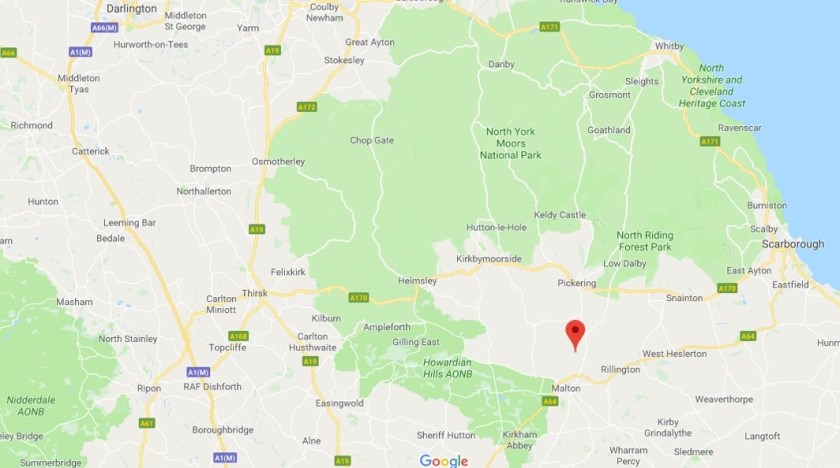
If anyone has any information about this crime please contact Police Wildlife Crime Officer Jez Walmsley at Malton Police Station (Tel: 101) or the RSPB’s Raptor Crime Hotline (Tel: 0300 999 0101).

[Photos via Jean Thorpe]

New report published: Socio-economic & biodiversity impacts of driven grouse moors in Scotland

Remember back in May 2017 when Environment Secretary Roseanna Cunningham commissioned the Werritty Review to examine the environmental impact of grouse moor management and to make recommendations for how the industry might be regulated (see here)?

Part of that announcement also included a commitment to commission additional research in to the costs and benefits of large shooting estates to Scotland’s economy and biodiversity. This research would then be fed in to the Werritty Review.

Well, while we’re still waiting for the Werritty Review to report (not expected until later this year), the other research has now been completed, written-up and has just been published.

The research was undertaken by the James Hutton Institute and Scotland’s Rural College (SRUC), overseen by a steering committee which included representatives from the Scottish Government, SNH, University of St Andrews, BASC, RSPB Scotland and Scottish Land & Estates.

The research has been separated in to four reports and published as follows:

A summary report which can be downloaded here: Summary Report_Final

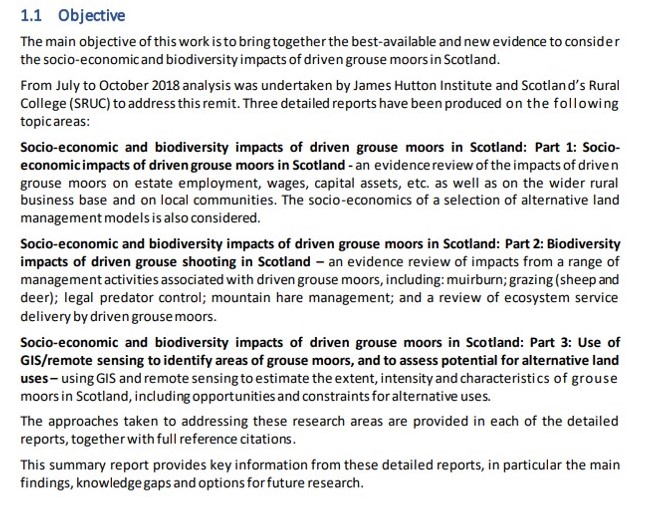
This summary report is a useful and concise guide to the other more detailed three reports and provides an outline of what to expect from those three reports:

The three more detailed reports can be downloaded here:

Part 1: Socio-Economic Report_Final

Part 2: Biodiversity Report_Final

Part 3: GIS Report_Final

PLEASE NOTE: We have not read any of the reports in detail and due to other commitments we probably won’t get to them for at least a couple of weeks. We hope to comment in due course.

Why did this gunman (+ 2 dogs) visit this hen harrier roost site on this Yorkshire grouse moor?

If you’re new to this blog and you’ve ever wondered what happens to satellite tagged hen harriers that suddenly ‘disappear’ in suspicious circumstances on driven grouse moors in Yorkshire (and elsewhere!), the latest video from the RSPB’s investigations team might just provide a clue. Just a little teeny tiny one.

The video was filmed by two members of the RSPB Investigations team shortly after they’d watched three young hen harriers settle down at the roost site for the night. Just as dusk fell, an armed man turned up with a labrador and a terrier and walked through the roost. He spent a few minutes crouching down amongst the vegetation whilst his dogs ‘worked’ the area. Fortunately none of the harriers flushed and the gunman later left in a vehicle.

The RSPB has published a blog describing the evening’s events (see here) and the blog includes the video footage, which is obviously of low quality given the fading light but clear enough to see what’s going on.

Here is a still from the video and we’ve added a red circle to highlight the gunman:

Who might this have been and what do you think he was doing there? How many implausible explanations will be churned out from the grouse shooting industry?

Didn’t sat tagged hen harrier ‘River‘, ‘disappear’ in this area in November 2018, the day before this video was recorded?

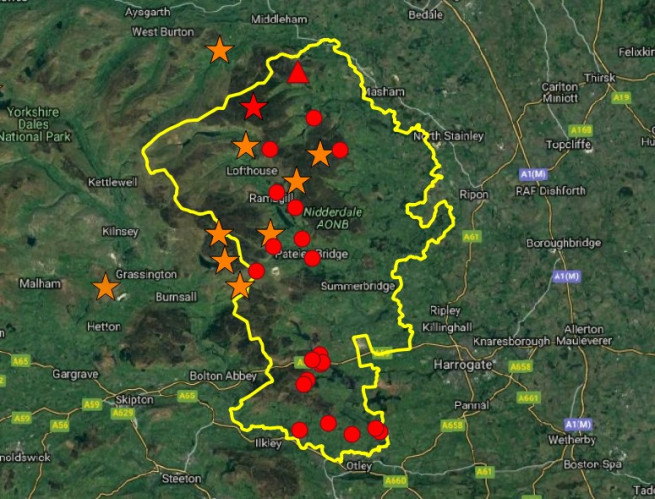
Look how many sat-tagged hen harriers have ‘disappeared’ in the Nidderdale AONB in Yorkshire in recent years, along with illegally killed red kites:

[RPUK map: Nidderdale AONB = yellow boundary. Illegally killed red kites = red circles; sat-tagged hen harriers that have vanished in suspicious circumstances = orange stars & red triangle; illegally shot hen harrier Bowland Betty = red star]

There hasn’t been a single prosecution for any of these incidents.

Do you think the [unnamed] estate has offered its full cooperation to North Yorkshire Police’s enquiries?

Do you think the Moorland Association will publicise this video?

Is anybody still unclear about what happens to hen harriers on driven grouse moors?

VIP guests attend Scottish Raptor Study Group conference

The Scottish Raptor Study Group (SRSG) held its annual conference last weekend – a day of fascinating presentations from a series of expert speakers on the latest developments in the field of raptor research and conservation, and a chance for SRSG members from across Scotland to catch up with one another.

This year the SRSG welcomed five MSPs who had given up their Saturday to attend the conference and meet informally with raptor workers. As Species Champions for several raptor species, some of these MSPs were already familiar with the SRSG’s huge voluntary contribution to raptor conservation in Scotland (estimated to be worth approx £1.8 million if Scot Gov had to pay consultants to do the same work!) and it was an excellent opportunity for them to learn in more detail about the successes and on-going threats to Scottish raptors.

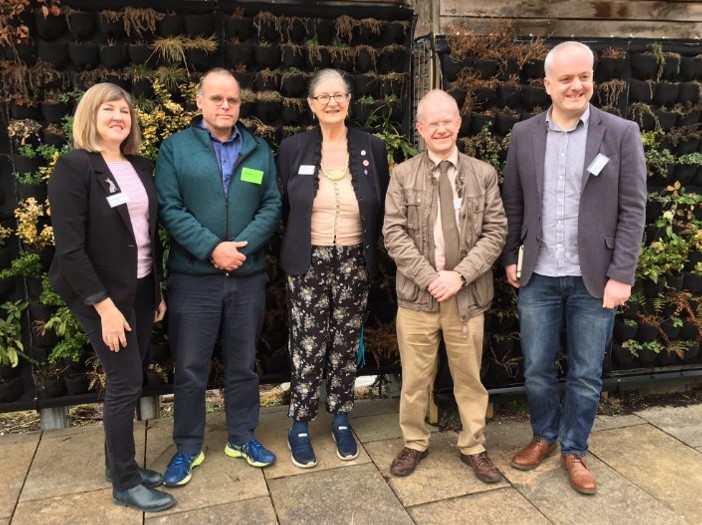
Thank you for coming along Alison Johnson MSP (Scottish Greens, Species Champion for brown (and mountain!) Hare); Andy Wightman MSP (Scottish Greens, Species Champion for Golden eagle (and Mountain everlasting); Claudia Beamish MSP (Labour, Species Champion for Forester moth); John Mason MSP (SNP, Species Champion for Kestrel); Mark Ruskell MSP (Scottish Greens, Species Champion for White-tailed eagle).

[Photo by Logan Steele]

Also accepting an invitation to the conference was Charlie Everitt, Police Investigative Support Officer from the National Wildlife Crime Unit (NWCU), standing in for Chief Inspector Lou Hubble, Head of the NWCU who was unable to attend due to a prior booking.

Another senior police officer attending was Supt Nick Lyall, the Chair of the Raptor Persecution Priority Delivery Group (RPPDG). Not only was Nick supposed to be on annual leave, but he also made a 14hr round trip to attend this conference. His committment to the subject of tackling illegal raptor persecution is outstanding. (As was his rapper coat, for which he tolerated some good humoured stick!).

[Nick Lyall chatting with Kelvin Thomson, Patrick Stirling-Aird and Logan Steele of the SRSG, photo by Ruth Tingay]

The benefits of having senior police wildlife crime officers attending a conference like this are many, not least to help develop ongoing partnership opportunities which haven’t always been maximised in the past. With new faces and a renewed sense of determination, things have been changing and we look forward to seeing continued progress on this front.