‘Effective regulation required for excesses of driven grouse shooting in Scotland’

Duncan Orr-Ewing, Head of Species and Land Management at RSPB Scotland, has written a blog discussing the state of raptor conservation in Scotland, how certain species are still suffering due to the ongoing illegal killing associated with land managed for driven grouse shooting, and how the Scottish Government needs to bring about significant change.

Duncan’s blog is reproduced here:

EFFECTIVE REGULATION MUST BE PUT IN PLACE IN SCOTLAND TO TACKLE THE EXCESSES OF “DRIVEN” GROUSE SHOOTING

Most people accept that the conservation prospects for many raptor species in Scotland have improved in recent decades, and since full protection of these birds in the UK from the 1950s. This is most apparent in the rise in the common buzzard population. This bird of prey species has made a welcome return and can now be seen in almost all of the countryside of lowland Scotland, and even in some of our main towns and cities. Like the common buzzard, various other raptor species have re-established their populations naturally,  particularly when the main constraint of human persecution has ceased or been significantly reduced. Red kite and white-tailed eagle have been given a helping hand by conservationists, working with landowners, through well planned reintroduction programmes, and are also on the way back.

Raptor species are now amongst the most studied birds in Scotland, much of this work prompted by the effects of organochlorine pesticides on their populations from the 1960s. We have good information on the population distribution of most raptor species, as well as a clear scientific understanding of the main threats to their conservation status. There are a number of native raptor species whose populations have not recovered, and these include the hen harrier. National surveys of this species have shown that the population of hen harriers in Scotland has declined between 2004 and 2016 from 633 to 460 breeding pairs, or by 27%. When you scrutinise the data more carefully there are significant geographical differences; the breeding hen harrier population is doing relatively well on Orkney and the Western Isles but is struggling in the eastern and central Highlands and southern uplands. The authoritative Conservation Framework for Hen Harriers in the UK (Fielding et al. 2011. JNCC) estimated that the Scottish breeding population of this species should be between 1467 and 1790 breeding pairs based on the availability of suitable nesting habitat. So what is happening?

What is now becoming clearer is that many raptor populations in Scotland are held below their potential population levels and range because of continuing illegal human persecution on land managed for “driven” grouse shooting. For the raptor species that have got commoner, it is clear to those who monitor them that even these species are largely absent from “driven” grouse moor areas as breeding birds. Equally, the raptor populations that hang on in these areas do not behave as you would expect – traditional nesting sites become occupied periodically, and then breeding birds disappear or nesting attempts routinely fail in mysterious circumstances. Young birds attempt to breed that would normally be excluded from good sites by adult birds. For those species, like the hen harrier, where grouse moors are their most suitable breeding habitat, and where populations remain heavily persecuted , it is held that their populations simply cannot increase without changes in land management culture and behaviours. Population “sinks” occur where the best habitats are repeatedly attracting nesting birds and these birds are repeatedly killed illegally. Most recently, new technological advances in the study of the survival and dispersal of birds, in the form of GPS satellite tagging, have reinforced the point that many of these marked raptors simply vanish without trace in grouse moor areas. The report “Analyses of the fate of satellite tagged golden eagles in Scotland” (Whitfield et al. 2017. SNH) highlighted that a third of a large sample of marked golden eagles disappeared in precisely this way.

[RPUK map, derived from data in the golden eagle sat tag review, showing the last known location of satellite-tagged golden eagles that had disappeared in suspicious circumstances on or close to driven grouse moors]

Sadly, it is now clear to many people involved with raptor conservation efforts that progress has stalled. Until now, the Scottish Government has made important, but piecemeal changes, to raptor protection laws. These measures have had the desired impact in large parts of Scotland. However, on land managed for “driven” grouse shooting, it is equally evident that raptor persecution is such an entrenched part of their business model, that tougher measures are now urgently required. Our RSPB Investigations team report that ever more extreme measures are being deployed by grouse moor gamekeepers to kill birds of prey and avoid detection, including the use of thermal imaging gear and night vision equipment to kill raptors at night. Many in the grouse moor community will tell you quite openly that they do not believe that they can manage their estates to deliver high grouse bags for sporting clients without breaking wildlife protection laws. This appalling situation has been further compounded in recent decades by the arrival on the scene of a new breed of sporting manager, and the proliferation of more intensive grouse moor management methods, involving ever increasing grouse bags for clients to shoot. This type of operator has commercialised grouse shooting. They have the resources to disregard public opinion; they have little concern for Scotland’s international reputation; and feel safe in the knowledge that it is very hard for the public authorities to bring the perpetrators of these wildlife crimes to justice.

From a RSPB Scotland perspective, we have put significant investment over many years into working with responsible landowners. We recognise that many landowners understand the harm that is being done to their sector by the more extreme grouse moor interests, but are apparently powerless to stop this momentum. We have engaged with conflict resolution processes, including the Langholm Moor Demonstration Project, designed to investigate ways that grouse moors can be managed both legally and sustainably. However, we have reluctantly concluded that amongst the “driven” grouse moor sector at least, there is little appetite to adapt businesses in line with modern day expectations. We simply do not think that further piecemeal changes to wildlife protection laws will be adequate.

The current independent Grouse Moor Management Review Group, commissioned by Scottish Government, is due to report in May 2019. This could be an important milestone if we are prepared to accept that a significant change must occur if we are to tackle the deeply embedded cultural issues concerning the current model of “driven” grouse moor management. This is also why the RSPB supports the licensing of “driven” grouse moors, including proportionate sanctions to remove such licences to operate, where the public authorities have good evidence of illegal activities taking place.

ENDS

Mark Avery appeals Hen Harrier brood meddling ruling

Last week we learned that Natural England’s decision to licence hen harrier brood meddling had been ruled lawful by Mrs Justice Lang at London’s High Court (see here) following a judicial review instigated by Mark Avery and the RSPB.

Today – some excellent news – Mark Avery has decided to appeal that ruling (see here for his announcement).

We’ve yet to hear whether the RSPB will also appeal.

[UPDATE 27 March 2019: RSPB to appeal hen harrier brood meddling ruling, here]

[A breeding hen harrier as she should be – alive and unmeddled. Photo by Laurie Campbell]

Liar, liar, your grouse moor’s on fire

At the weekend, the Revive coalition for grouse moor reform issued the following press release:

CAMPAIGN GROUP CALLS FOR URGENT ACTION TO END MUIRBURN ON GROUSE MOORS

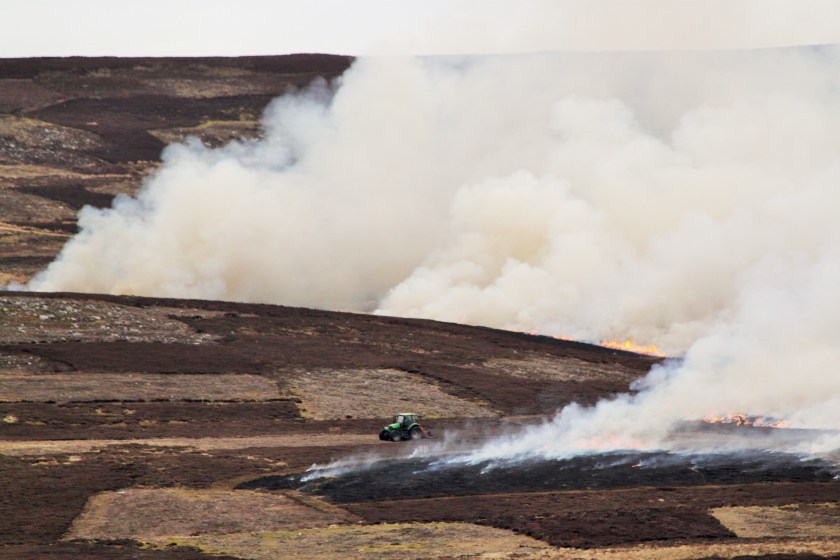
A campaign group has released new footage showing parts of the Cairngorms, an area which has a high density of peat, quite literally on fire, as gamekeepers burn heather moorland as part of intensive management of grouse moors.

The footage obtained by Revive, the coalition for grouse moor reform, shows the extent land managers will go to in their quest to create a habitat suitable for just one species – the red grouse. These grouse will subsequently be shot for entertainment.

Revive campaigner Max Wiszniewski said: “The footage that we captured is extremely disturbing showing vast swathes of heather upland on fire with flames and smoke billowing for miles, all for the single purpose of protecting grouse which will subsequently be shot for entertainment.

I’m sure the public will be shocked to see the damage which is deliberately inflicted on our uplands to create a habitat suitable for one species to the detriment of our environment and wildlife.”

Grouse moor managers routinely burn patches of heather to create a structurally diverse patchwork habitat to favour red grouse. Tall heather provides concealment from predators while younger heather provides adult grouse with more nutritious shoots for food, and short heather provides greater insect availability for chicks.

The practice known as muirburn is hugely detrimental to the environment. Moorlands are of high conservation value for their vegetation, invertebrate and bird communities with large areas given legal protection under the European Habitats Directive. Muirburn is in direct conflict with concerns about meeting global carbon emissions.

[Gamekeepers setting fire to a grouse moor, photo by Ruth Tingay]

Dr. Richard Dixon, Director of Friends of the Earth Scotland added: “We’re growing increasingly concerned about the extent and intensity of burning on grouse moors, and particularly the effects of burning over deep peat. Where blanket bog is damaged by burning, impacts include a lowered water table and breakdown of the active peat-forming structure, resulting in the carbon store in the peat being released as climate change emissions.

There is more carbon locked up in Scotland’s peaty soils than in all the trees and vegetation in the whole of the UK. Urgent action is needed to reduce Scottish climate emissions and lock stored carbon into our environment. The Scottish Government must put in place plans to reverse the damaging environmental effects of moorland burning and protect our peatlands as the huge natural treasure they are.”

The footage also shows mountain hares fleeing for their lives as their habitat burns, illustrating the devastating impact this practice has on other wildlife.

Robbie Marsland, Director of the League Against Cruel Sports Scotland said: “To witness wild animals running for their lives to escape such willful and deliberate environmental vandalism is extremely upsetting, made worse by the complete lack of justification for this action.

As well as the iconic mountain hares, seen on the footage, there’s also the extensive risk to many other species including ground nesting birds and all for nothing more than to line the pockets of land owners looking to enrich their stocks of game birds for paying guns.”

The Revive coalition which includes Common Weal, OneKind, Friends of the Earth Scotland, League Against Cruel Sports and Raptor Persecution UK, will set the agenda for a multi-year strategy aimed at encouraging a national dialogue about how Scotland’s moors should be utilised. It believes that a fresh look at how this land is used could lead to a better Scotland, better for its economy, its people, its environment and its fauna.

ENDS

This article, and the very angry responses from the grouse shooting industry, received extensive coverage in the news, e.g. The Ferret (here), The National (here), The Scotsman (here), The Telegraph (here) and The Times (here).

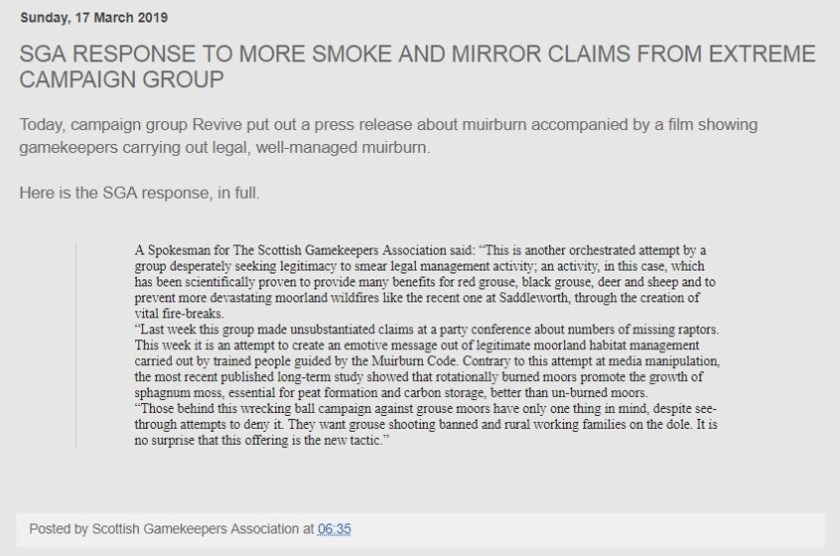
The Scottish Gamekeepers Association (SGA) also posted a statement on its website:

The SGA makes some interesting claims but the one we’re most interested in because it’s used repeatedly by those within the grouse shooting industry, is that muirburn ‘prevents’ wildfires. The Gift of Grouse (a propaganda campaign funded by Scottish Land & Estates) made a similar claim last year: they claimed that the continued burning of peatland moors is ‘one of the most effective means of reducing the risk of damage from wildfires by providing breaks in continuous moorland cover and reducing the fuel load’ (see here).

It’s a fascinating claim, because it contradicts the Muirburn Code (often cited by the industry as evidence of good practice, even though the Code is rarely, if ever, enforced) which states that:

Fires escaping from muirburn are a major cause of wildfire in Scotland“.

Let’s just repeat that, in case anyone missed it:

Fires escaping from muirburn are a major cause of wildfire in Scotland“.

It’s not just the Muirburn Code that states this fact. The SNH-commissioned review of sustainable moorland management (published in 2015) states:

Whilst large, intense wildfires can be destructive, many may have no greater impact than prescribed burns (Clay et al. 2010) and evidence suggests that over 50% of wildfires with known causes may themselves be caused by loss of control of prescribed burns“.

And who authored that report? None other than Professor Werritty, the Chair of the current Government-commissioned review of grouse moor management!

For anyone interested in more detail or for the full citations, have a look at the Revive report that was published at the launch in November 2018 – it’s all in there.

Shooting Times provides supportive evidence for Wild Justice legal challenge

It’s really generous of the Shooting Times to provide supporting evidence for Wild Justice’s first legal challenge, announced two days ago.

Wild Justice’s first case challenges the casual killing of birds such as Jackdaws and Rooks under a series of General Licences (if you’re unfamiliar with General Licences, Mark Avery has written a useful blog today).

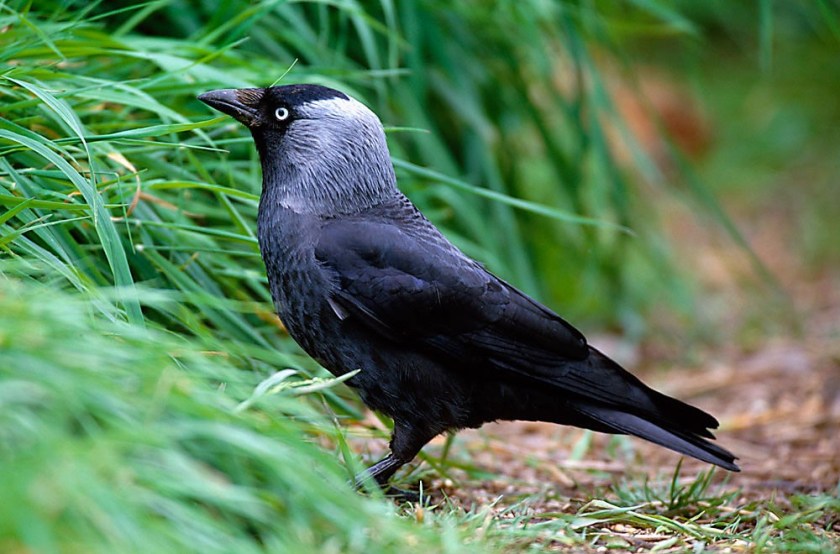
[Jackdaw, by Laurie Campbell]

Some members of the shooting community have been unable to get their heads around the legal challenge, and in amongst their predictable and lamentable personal insults and abuse towards the Wild Justice directors on social media, not many of them have been able to display the tiniest hint of comprehension.

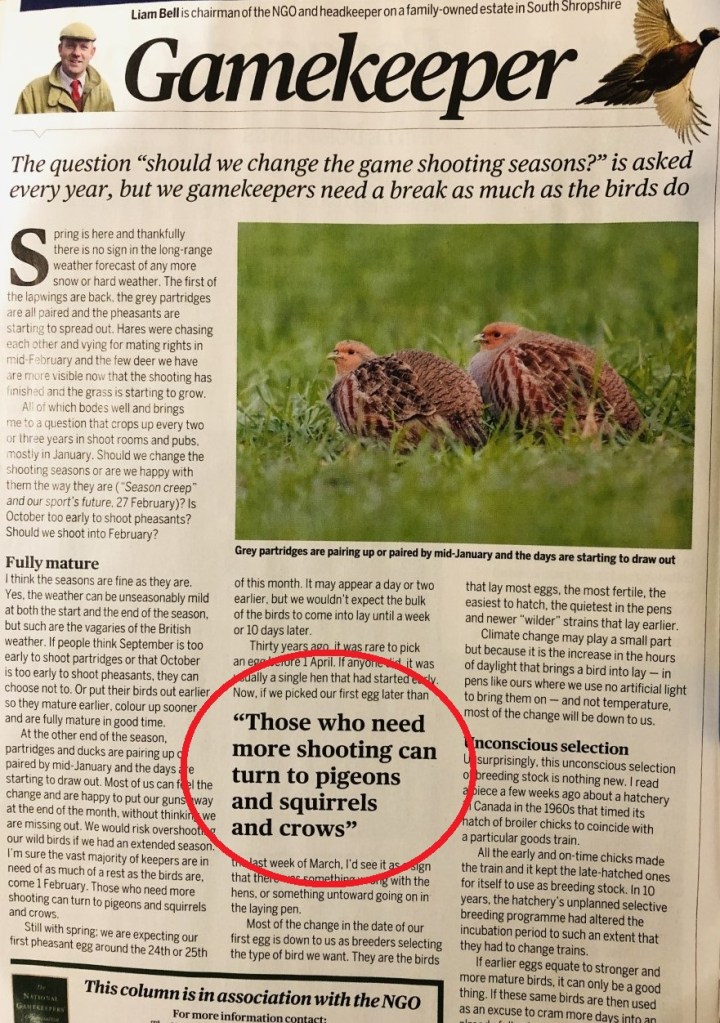
If they’d read the latest edition of Shooting Times though, there’s a perfect example of why the Wild Justice legal challenge is long overdue.

This is p38 and is a regular column written by Liam Bell, chairman of the National Gamekeepers’ Organisation:

Who “needs” more shooting?!

And is this so-called “need” sufficient justification to kill birds under the terms of a General Licence? No, it most definitely isn’t, but that is clearly what has been going on, for decades.

Thanks, Shooting Times, for helping to frame the Wild Justice legal challenge so effortlessly.

Some on social media have been accusing the Wild Justice directors of ‘making money’ from this challenge – they seem to struggle with the concept of Wild Justice being a non-profit company. It’s not that hard to grasp, is it?

Others (although often the same!) have accused Wild Justice of wasting public funds by seeking a judicial review – that’ll be the same people who recently supported a judicial review application by the Countryside Alliance, BASC and the National Gamekeepers’ Organisation to contest a decision by Natural Resources Wales to ban pheasant shooting on the Welsh Government Estate! Gosh, the irony! Their application for judicial review was refused (see here).

Meanwhile, 737 fantastic people have contributed to the Wild Justice crowdfunder, raising £18k of the £36k target within 48 hours. That’s a brilliant start. If you’d like to support the legal challenge, please click HERE

Thank you

Wild Justice launches its first legal challenge

The non-profit company Wild Justice launched last month with the intention of taking legal action, on behalf of wildlife, against public bodies where they are failing to protect species and/or habitats.

Wild Justice’s first case has just been announced and it is a legal challenge against the casual killing of birds permitted under Natural England’s General Licences.

The statutory agency Natural England allows the unlimited killing of a wide variety of bird species under a series of ‘General Licences’ which are published at the start of each year. Birds such as Carrion Crows, Rooks, Magpies, Woodpigeons, Jackdaws, Jays and Ring-necked Parakeets can be killed without applying for a licence, without having to justify why the action is necessary, without having to explain why alternative non-lethal measures such as scaring or proofing are ineffective or impracticable, and without having to report on how many birds are killed. All a person needs to do to ‘qualify’ to kill unlimited numbers of these birds is to claim to have read and understood the relevant General Licence.

[Photo of a Jay, by Laurie Campbell. This is one of several species which may be killed in unlimited numbers under the General Licence]

Wild Justice believes this system is unlawful despite the fact that it has been in existence for decades and has ‘authorised’ the casual killing of millions of birds. Wild Justice contends that it is the licensing authority’s (Natural England’s) legal responsibility to satisfy itself that killing these birds is an appropriate last resort. However, in the General Licences issued on 1 January 2019 Natural England ducks its responsibility and instead places the decision-making completely in the hands of the General Licence user.

Wild Justice is seeking a judicial review of Natural England’s decision to issue General Licences GL04, GL05 and GL06 on 1 January 2019. Similar licences apply to Wales, Scotland and Northern Ireland and this case may have implications in those countries too.

Wild Justice is not asking for the 2019 General Licences to be withdrawn, but rather that Natural England does not issue further General Licences and instead develops a legal system for regulating and monitoring the killing of birds if lethal control is absolutely necessary as a last resort.

Wild Justice sees the General Licence system as a clear example of how wildlife killing is largely unregulated in the UK. The system is lax and allows gamekeepers, farmers and others to kill birds without any proper oversight or regulation.

To bring this legal challenge to court, Wild Justice is crowdfunding, with a target of £36,000 to cover all costs associated with such legal action.

If you’d like to support and contribute towards this legal challenge, please visit Wild Justice’s crowdfunder page HERE.


High Court rules decision to licence hen harrier brood meddling was lawful

Mrs Justice Lang has today handed down her ruling on the lawfulness of Natural England’s decision to issue a hen harrier brood meddling licence, after a judicial review was brought by Mark Avery and the RSPB (see here).

Download her judgement here: HH brood meddling judgement_March2019

She has judged Natural England’s decision to issue a brood meddling licence to be lawful as it has been issued for ‘research’ purposes and not for conservation purposes.

Mark Avery (here) and the RSPB (here) have published their initial responses to this judgement.

We won’t say anything further until we hear whether either or both parties intend to appeal the judgement.

[An unmeddled hen harrier, photo by Laurie Campbell]

Why grouse shooting is bad for the Scottish countryside, by Robbie Marsland

The Scotsman has published a feature article today by Robbie Marsland, Director of the League Against Cruel Sports Scotland and a partner in the Revive Coalition for grouse moor reform, outlining why grouse shooting is bad for the Scottish countryside.

You can read the article at The Scotsman here and we’ve reproduced the text below in case the link is lost somewhere in the future.

[Robbie Marsland speaking at the launch of the Revive Coalition, Nov 2018]

Here’s why grouse shooting is bad for the Scottish countryside

Problems of social justice and animal welfare trump any number of positives about grouse shooting, writes Robbie Marsland. Best estimates suggest that almost 20 per cent of Scotland is a grouse moor. In recent years, these moors have come under increasing scrutiny. The scale of wildlife crime, most notably the killing of eagles and hen harriers, has led a concerned Scottish Government to set up the Werrity Commission to review the activities on grouse moors and how this interacts with the environment and local communities.

The Commission’s brief is wider than raptor persecution and covers many of the issues of concern to Revive – a unique coalition of environmental, animal welfare and social justice organisations questioning the role grouse moors play in 21st century Scotland.

The Werrity report is expected “in the spring” and we await their conclusions with some interest. Another Government-commissioned report into the “Socio-Economic and Biodiversity Impacts of Grouse Moors” was released at the beginning of this month, produced by the James Hutton Institute and others. As with most issues to do with grouse moors, the report laments the lack of independent publicly available data to back up any findings. It also notes much of the data that is available is “self-selected” by the grouse shooting industry and has a “self-reporting bias”.

Some of that data doesn’t exactly help the grouse shooter’s cause. It was thought – again using industry figures – that the average wage of the 2,500 or so people working on grouse moors was around £11,500a year – less than the minimum wage. However, the new Government-commissioned report says that only £14.5 million is spent on wages. That’s equivalent of a lamentable £5,800 a year.

So the more grouse that can be raised and shot has a direct bearing on estate values. This confirms the Revive coalition’s opinion that the intensification of grouse moor management is aimed at maximising the numbers of grouse to be shot. This can lead to grouse population densities at around 100 times their natural state. This is achieved by the removal of anything that threatens the grouse – except of course, the people who pay to shoot them for entertainment. Foxes, stoats, weasels, and crows are ruthlessly targeted with snares and traps. Medication is left out in the open in the hope it will protect the grouse from worms. Lead shot litters the countryside and protected birds of prey continue to mysteriously disappear. And an average of 26,000 mountain hares are killed each year. Those who shoot the mountain hares say they need to because they either spread disease to the grouse or they “over graze” the heather that is the staple food of the grouse.

There is no scientific data to support either reason and the Socio-Economic and Biodiversity report explicitly backs this up. The Scottish Government, at the highest level, has made it clear that it finds this annual killing repugnant and that it intends to stop it. That was a year ago after Revive coalition members drew public attention to film of one such cull in the Cairngorms. Now that their own commissioned report confirms that it has no utility we look forward to swift Government protection of mountain hares.

Then we have the vexed issue of muir burn, where huge swathes of heather are set on fire to make life better for the grouse and so increase their numbers. The Socio-Economic and Biodiversity report sits on the fence on this issue, mentioning “positive and negative impacts” and the lack of data on the impact the burning has beneath the ground.

The report also recommends more research into the levels of the heat intensity of the burning. It does, however, note that there are examples of grouse moors where muir burn is not practised and raises the question if it is needed at all. Despite the report agreeing with the recent Common Weal report that grouse shooting provides a terrible return on investment – especially taking into account the scale of land used – it also casts doubt on possible alternatives. The Revive coalition contests those doubts.

In general, the report, as it should, looks at the “positives” and “negatives” and often declines to make a firm recommendation as there is not enough independent data. From the Revive coalition perspective, there are two elements missing from the “negative” column. These are social justice and animal welfare. That almost 20 per cent of Scotland has such a tiny comparative benefit to local communities so that a small number can shoot wild birds for entertainment are two “negatives” that we believe should trump any number of positives. And we are not alone. Benchmark polling commissioned by Revive in Scotland shows that there is already a close majority against grouse shooting and that only 0.25 per cent of Scots eat grouse more than two or three times a year.

Grouse moors are used to intensive management. Let’s see how they stand up to intensive scrutiny.

ENDS

Poisoned raven found on Peak District grouse moor: Natural England & Police fail to investigate

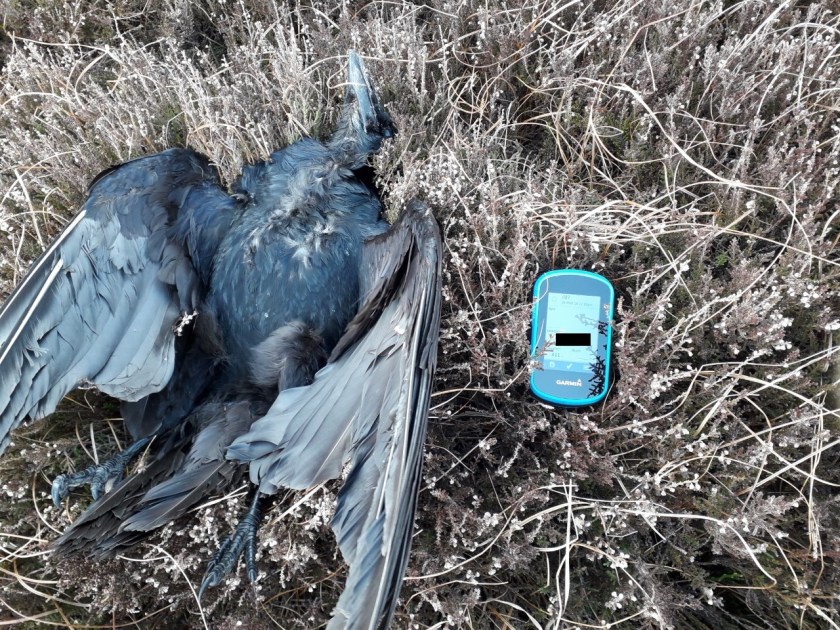
A year ago in March 2018, a dead raven was found on a grouse moor in the Peak District National Park.

The member of the public who found it, Bob Berzins, was savvy enough to call the RSPB Investigations Team, who collected the corpse.

[Dead raven, photo by Bob Berzins]

Given the location, and the area’s long history of the illegal persecution of birds of prey (e.g. see here), the RSPB asked Natural England to run toxicology tests on the corpse, as is routine when animals have been found dead in suspicious circumstances or risky locations. According to the RSPB, Natural England refused to test the bird.

Instead, the RSPB paid to have the corpse privately tested, first in a post-mortem at the SRUC lab in Scotland and then for toxicology tests at the Science & Advice for Scottish Agriculture (SASA) labs, who have an excellent track record for conducting these forensic examinations.

SASA confirmed that this raven had been poisoned by Aldicarb, a toxin so dangerous that in Scotland if you’re caught even being in possession of it, let alone using it, you’ve committed an offence.

The RSPB reported these lab results to South Yorkshire Police and, according to the RSPB, nothing else has happened since, not even a police search of the grouse moor to look for further poisoned baits or victims.

You can read the details of this pathetic response to a criminal act on the RSPB’s blog here.

The RSPB Investigations Team has also produced a video about this case, here:

What the hell is going on? Why did Natural England refuse to test this raven for banned pesticides when it had been found in an area notorious as a raptor persecution hotspot?

And why did South Yorkshire police fail to investigate further? They should have been all over this, not least with a publicity campaign alerting members of the public, who visit this National Park in their millions, to the dangers of touching any dead animal or suspected poisoned bait. A year has passed and South Yorkshire police appear to have done absolutely nothing.

Disgraceful.

Well done Bob Berzins and well done to the RSPB, not just for paying to have this bird privately tested but also for submitting a formal complaint to South Yorkshire police and for alerting the public to the very serious threat of toxic poisonous baits being laid out on the ground inside this so-called National Park.

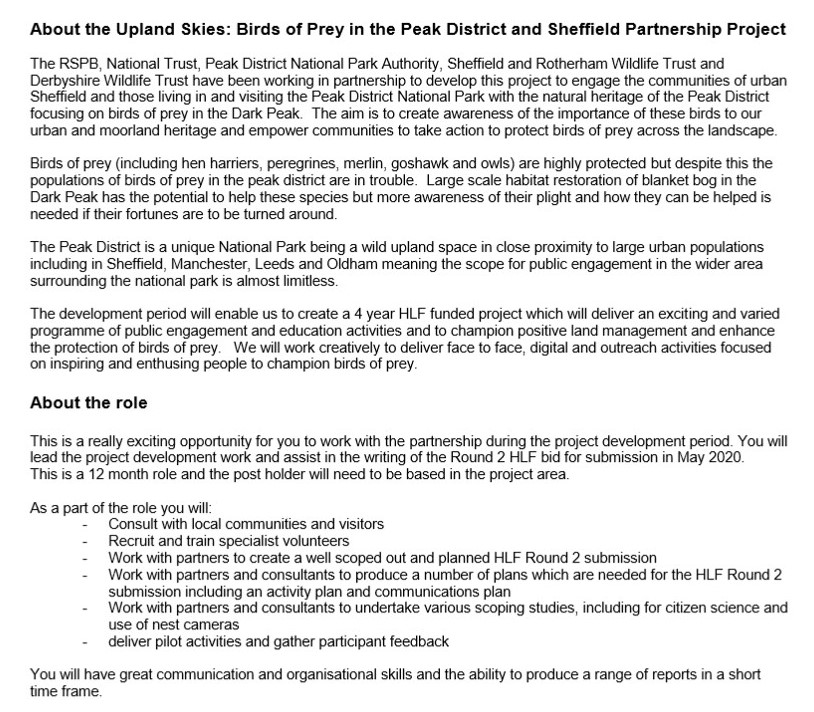
Job opportunity: empowering communities to protect raptors in Peak District National Park

This is a fantastic opportunity to have a real impact on the frontline of raptor conservation in one of the country’s persecution hotspots, the driven grouse moors in the Dark Peak area of the Peak District National Park.

The Upland Skies project appears to be the conservation world’s alternative to the useless pseudo-partnership known as the Peak District Birds of Prey Inititiative, which has consistently failed to meet its targets (to restore populations of raptors to the Dark Peak) and has been distracted and disrupted by the antics of the Moorland Association and others over many years.

Have a look at the organisations involved with this Upland Skies partnership project and there’s every probability that it will stay on track and achieve its objectives.

Job details below:

Salary starting at £25,463 – £27,585 per annum

Full time, 12 month contract

Closing date: 27 March 2019

Interview date: 10 April 2019

For more details and an application form, please see here

More on proposed reintroduction of golden eagles to Wales

Last month we blogged about conflicting approaches to the proposed reintroduction of golden eagles to Wales (see here).

One group (Eagle Reintroduction Wales Project, ERW) being led by researchers at Cardiff University is part-way through conducting a careful scoping exercise to properly consider all the factors that need to be addressed before permission for a reintroduction would be granted, e.g. biological and environmental considerations, social and political considerations, and comprehensive risk assessments and an exit strategy.

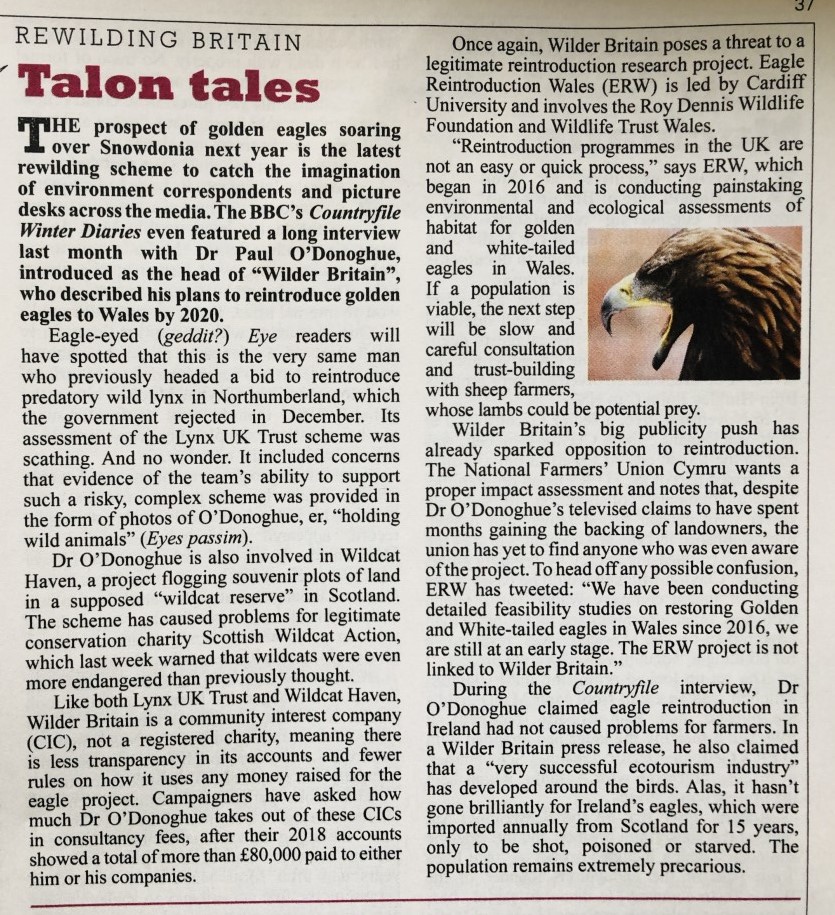
The other group (Wilder Britain) is a newly registered Community Interest Company being led by Dr Paul O’Donoghue of Wildcat Haven and Lynx Trust UK ‘fame’. A press release from Wilder Britain stated that an application to release golden eagles would be submitted this summer, which appears to us to be premature.

Private Eye picked up on this news and have published a piece in their latest edition:

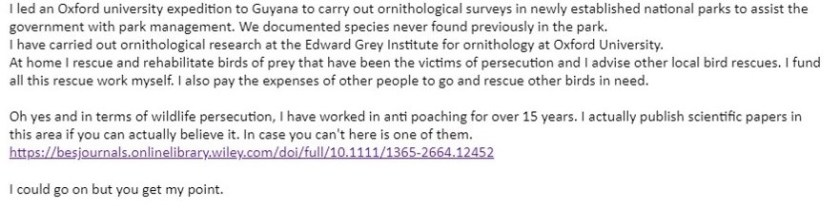
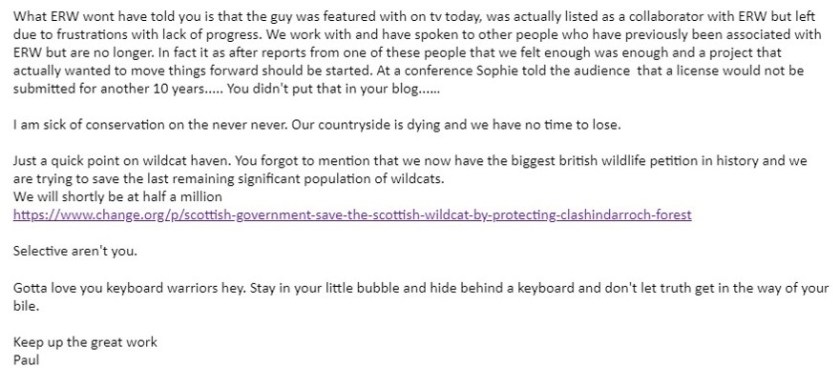
Meanwhile, Dr O’Donoghue wrote to RPUK to complain about last month’s blog. Unfortunately Dr O’Donoghue’s email went straight to the spam folder so it’s only just been discovered but in the interests of transparency it’s published here so that everyone has the opportunity to view his extensive ornithological expertise:

Just a couple of points from us.

When we wrote, “We’re not aware of Dr O’Donoghue’s experience or expertise in ornithology or in the field of raptor research and conservation” in our earlier blog, we did not ‘seek to lead the reader to believe that I [Paul O’Donoghue] have no relevant ornithological experience‘. If that’s what we had wanted to say, that is what we would have said! We said we were not aware of Dr O’Donoghue’s experience or expertise in ornithology or in the field of raptor research and conservation, simply because we weren’t aware of it. His name is not a familiar one in the scientific journals we read.

Having now become aware of Dr O’Donoghue’s ornithological experience and expertise, based on the information he provided, we maintain our support for the Cardiff University ERW Project’s robust approach to assessing the feasibility of a reintroduction of golden eagles to Wales.

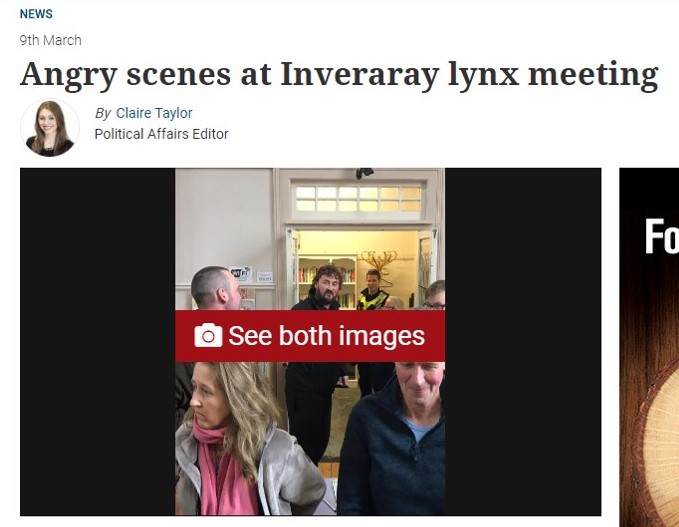
Meanwhile, Dr O’Donoghue has been the subject of more media attention, this time at a public meeting to discuss his proposal to reintroduce the Lynx to various sites in Scotland. It didn’t end well, according to the Scottish Farmer (see here).